


Is Aura Worth It? That’s the question many people are asking in 2026 as identity theft, data breaches, and online fraud continue to rise. To see how Aura stacks up against the broader market, check out our comparison of the Best Identity Theft Protection Services for 2026.
With so many identity protection services available — and free credit monitoring options offered by banks and credit bureaus — it can be difficult to know whether paying for Aura is actually justified.
In this guide, we break down Aura’s features, pricing, pros and cons, real-world protection value, and how it compares to competitors. By the end, you’ll have a clear, straightforward answer to whether Aura is worth it for your specific situation — so you can make a confident decision.
Table of Contents
🔥 Quick Verdict: Is Aura Worth It in 2026?
The Short Answer
If you are seriously asking “Is Aura Worth It?” in 2026, you are likely comparing it to other identity theft protection services and deciding whether the cost is justified.
Here’s the direct answer:
Yes — Aura is worth it for most individuals and families who want real-time identity protection, financial fraud monitoring, and full-service recovery support.
Check Aura pricing and see if it’s right for you!
Aura is not just credit monitoring. It combines:
- Identity theft monitoring
- Dark web monitoring
- Credit monitoring from major bureaus
- Fraud alerts
- Identity theft insurance
- 24/7 U.S.-based support
For buyers looking for all-in-one digital security, Aura is positioned as a premium but comprehensive solution.
Why Aura Stands Out in 2026
Identity theft is no longer rare. According to the Federal Trade Commission, millions of identity theft reports are filed each year in the United States.
Additionally, the Identity Theft Resource Center regularly reports thousands of publicly disclosed data breaches annually.
This matters because:
- Data breaches are increasing.
- Personal information is frequently exposed.
- Fraud can happen before you realize it.
Aura’s value lies in real-time monitoring and rapid response, not just monthly credit score updates.
What You’re Actually Paying For
When buyers search “Is Aura Worth It?”, they usually want to know:
- Will it prevent fraud?
- Will it detect fraud early?
- Will someone help fix it if it happens?
Prevention + Detection + Recovery
Aura focuses on three core protection layers:
- Monitoring – Tracks your SSN, bank accounts, credit activity, and dark web exposure.
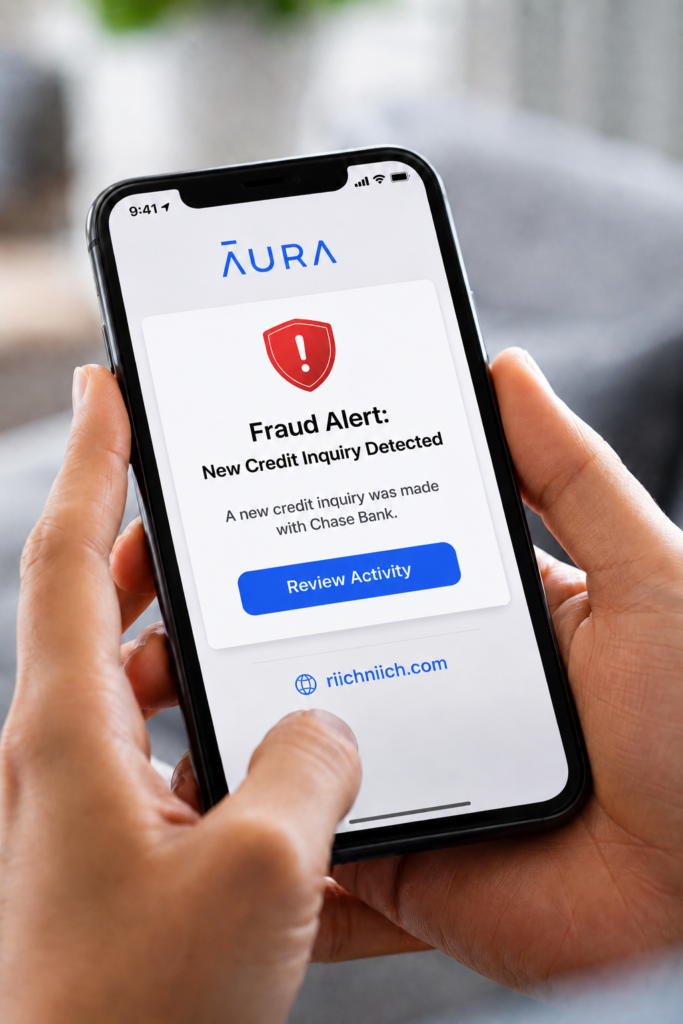
- Alerts – Sends near real-time alerts for suspicious activity.
- Recovery Support – Provides identity theft specialists and insurance coverage if fraud occurs.
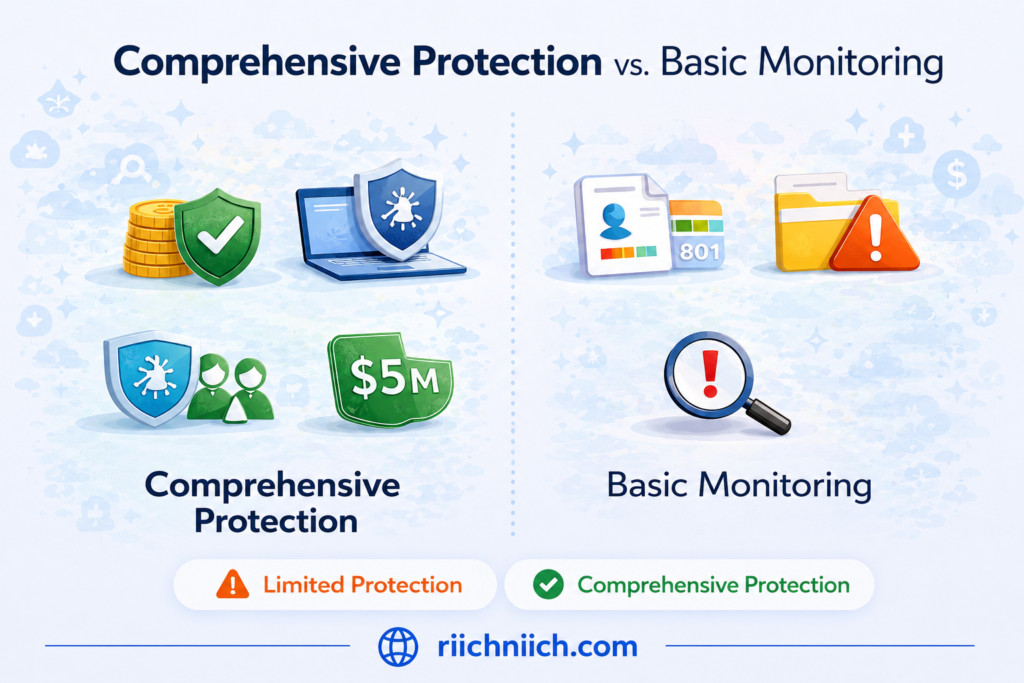
This full-cycle approach is what makes it stronger than free credit monitoring alone.
When Aura Is Definitely Worth It
Aura tends to be worth the investment if you:
- Store sensitive data online frequently
- Shop online often
- Use multiple financial accounts
- Have children (child identity theft is rising)
- Have already experienced a data breach
- Want hands-on recovery help if something goes wrong
If you are proactive about cybersecurity and prefer prevention over damage control, Aura aligns well with that mindset.
When Aura Might Not Be Necessary
Aura may not feel worth it if:
- You rarely use online services
- You already freeze your credit and actively monitor accounts daily
- You are comfortable handling fraud recovery yourself
However, many buyers underestimate how time-consuming and stressful identity restoration can be without professional assistance.
Bottom Line on “Is Aura Worth It?”
If your goal is peace of mind, real-time alerts, and expert recovery help, Aura delivers strong value in 2026.
It is not the cheapest option.
But it is one of the more comprehensive identity protection platforms available today.
For buyers comparing protection services, Aura is typically worth it if you want:
✔ Proactive monitoring
✔ Fast alerts
✔ Recovery support
✔ Insurance coverage
✔ Family plan options
In the sections below, we’ll break down exactly who Aura is best for, its features, pricing, and how it compares to competitors — so you can make a confident decision.
Aura Pros and Cons
When evaluating “Is Aura Worth It?”, the most useful way to decide is to balance what works against what could be better. Below we break this down clearly so you can make an informed choice before buying.
Pros — What Aura Does Well
📌 1. Comprehensive Identity Protection
Aura combines multiple layers of protection in one service, including:
- Credit monitoring
- Dark web monitoring
- SSN tracking
- Bank account activity alerts
- Identity theft insurance
This all-in-one approach makes Aura more valuable than basic credit monitoring services. According to the Federal Trade Commission, identity fraud cases continue to rise, making layered protection increasingly important.
📌 2. Real-Time Alerts
One of Aura’s biggest advantages is near real-time notifications. Instead of waiting for monthly updates, you get alerts when suspicious activity appears — often before fraud can cause major damage.
Real-time alerts help you act fast, which is crucial in preventing long-term financial loss.
📌 3. Identity Theft Insurance
Aura includes identity theft insurance up to a set limit (typically $1M or more — check current coverage). This can help reimburse expenses like:
- Legal fees
- Lost wages
- Notary costs
- Fraudulent account closures
This protects you not just reactively, but financially, if something goes wrong.
📌 4. Family Plans
Most rival services charge extra for family member coverage. Aura allows you to add adults and children at competitive prices, protecting your entire household under one plan.
Child identity theft is often overlooked, but according to the Identity Theft Resource Center, child identity exposure has increased dramatically in recent years.
📌 5. U.S.-Based Support
Aura offers customer support from U.S.-based specialists trained to help you through identity theft restoration. This is a major benefit compared to companies that outsource support overseas or offer limited live help.
Cons — What Aura Could Improve
⚠️ 1. Pricier Than Basic Monitoring
Aura is not inexpensive compared to free credit monitoring or single-feature services. If you only want a credit score tracker, Aura may feel like overkill.
However, for buyers prioritizing full protection and real-world restoration help, the additional cost is often justified.
⚠️ 2. Feature Overlap Can Be Confusing
New users sometimes find the wide range of features overwhelming at first — especially if they’re not familiar with identity protection terminology (e.g., dark web scans vs. financial monitoring).
But once set up, most customers appreciate the robust protection.
⚠️ 3. No Free Tier
Unlike some competitors that offer limited free credit monitoring, Aura does not have a free tier. This means casually curious buyers might need more convincing before purchasing.
However, free monitoring is limited and does not include recovery support or insurance, which are two key benefits of Aura.
Overall Pros and Cons Summary: Is Aura Worth It?
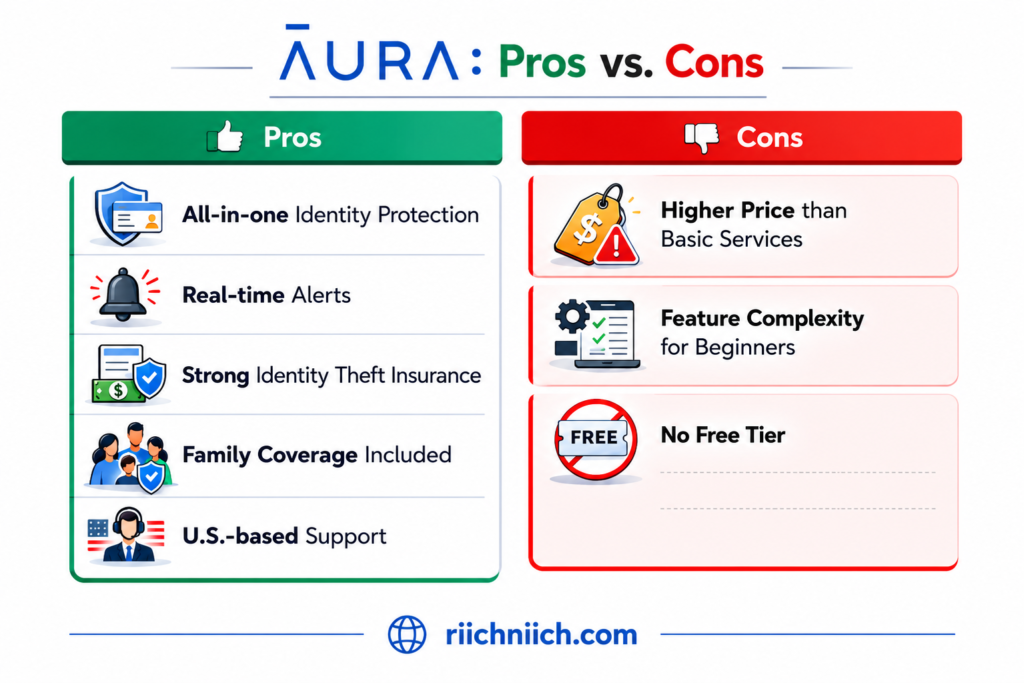
Bottom Line: Aura’s pros — especially its comprehensive protection and recovery support — generally outweigh the cons for buyers who are serious about identity security. For people with minimal online activity or low perceived risk, cheaper options may suffice. But if you value peace of mind and real-world coverage, Aura often proves worth the investment.
Next, we’ll break down exactly who Aura is best for so you can determine if it fits your specific needs.
Who Is Aura Best For?
Understanding who Aura is best for is essential when answering the buyer-focused question: “Is Aura Worth It?” Not every protection service fits every person — but Aura is designed for specific types of users who benefit most from its features.
Below is a clear breakdown of the ideal Aura user profiles so you can decide if this service matches your needs.
1. People Who Use Multiple Financial Accounts
If you actively use:
- Checking and savings accounts
- Credit cards
- Online lenders
- Investment platforms
Then you have more exposure to potential fraud. Aura monitors financial data and suspicious activity across multiple accounts, which helps catch unauthorized behavior early.
According to the Federal Trade Commission, financial fraud is among the most common forms of identity theft.
2. Individuals With High Online Activity
People who:
- Shop online regularly
- Store personal information on websites
- Use public Wi-Fi often
- Save passwords across sites
…are more vulnerable to data exposure.
Aura’s dark web monitoring scans for leaks of:
- Email addresses
- Passwords
- Social Security numbers
- Personal IDs
This makes Aura especially valuable for online shoppers and heavy internet users.
3. Parents and Families
One of Aura’s strongest selling points is family coverage. With children increasingly targeted by identity thieves due to clean credit histories, many parents don’t realize:
✦ A child’s identity can be stolen without the child ever knowing.
The Identity Theft Resource Center has reported rising cases of child identity theft in recent years.
Aura offers plans that allow you to monitor:
- Multiple adults
- Children under 18
- Shared family profiles
This makes it a strong choice for household protection.
4. People Who Want Real Help — Not Just Alerts
Some monitoring services just send alerts and leave you on your own.
Aura goes further by offering identity restoration support and insurance coverage.
This matters because if your identity is compromised, resolving it can take:
- Hours on the phone
- Letters to creditors
- Disputes with agencies
Aura’s specialists help you navigate the recovery process — which can save time, stress, and money.
5. Professionals With Valuable Personal Data
Certain careers or lifestyles put more personal information at risk:
- Freelancers/consultants
- Healthcare workers
- Executives and business owners
- Anyone with public-facing profiles
If your identity theft risk is higher due to the nature of your work, Aura’s advanced monitoring is worth the investment.
Quick Persona Summary: Is Aura Worth It for You?
Best Fits
✔ Frequent online shoppers
✔ Multiple financial account holders
✔ Families with children
✔ People who prefer guided recovery
✔ Anyone with moderate to high exposure to personal data leaks
*If you’re a retiree or helping protect an older family member, you may also want to review our full guide to the Best Identity Theft Protection for Seniors.
Might Be Less Necessary For
⚠ Infrequent internet users
⚠ Users comfortable self-monitoring manually
⚠ People only needing basic credit score tracking
Bottom Line
If you fall into one or more of the “Best Fits” categories, Aura is likely worth the investment for comprehensive identity protection and peace of mind.
Up next, we’ll break down Aura’s key features so you know exactly what you’re paying for — and how it helps you stay safe in 2026.
Aura Key Features Breakdown
When evaluating “Is Aura Worth It?”, the most important section for buyers is a clear explanation of what exactly you get. Below is a straightforward, feature-by-feature breakdown of Aura’s capabilities — how they work and why they matter in 2026.
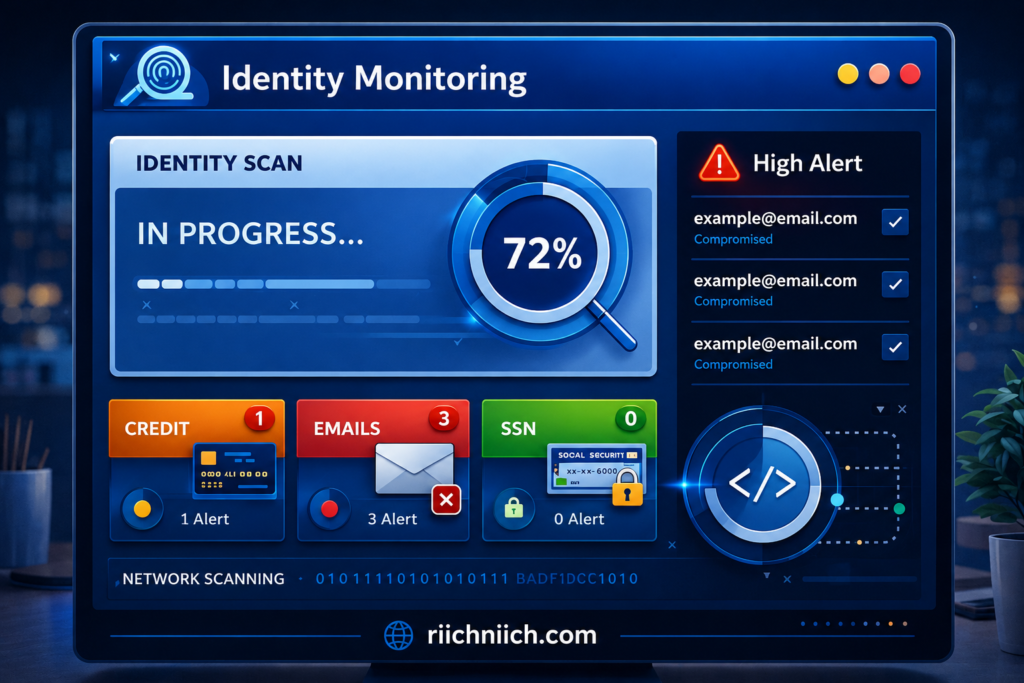
Identity Monitoring
Aura continuously scans your personal information across:
- Credit reports
- Public records
- Dark web databases
- Financial accounts
It looks for unusual activity tied to your name, Social Security number, email addresses, and more.
This is essential because most identity theft begins with a data breach or leaked credentials — often long before the victim notices. According to the Federal Trade Commission, millions of identity theft reports are filed each year in the U.S., and early detection significantly reduces financial loss.
Dark Web Monitoring
Aura scans dark web sources for signs your information has been exposed or traded.
What this means in practice:
- Scans underground forums for email/password combinations
- Looks for your Social Security number
- Detects exposed financial data
Dark web monitoring is valuable because stolen credentials are often sold or shared long before active fraud occurs.
Credit Monitoring With Alerts
Aura monitors your credit activity and sends alerts if:
- New credit accounts are opened
- Credit inquiries occur
- Major score changes appear
Credit monitoring helps you catch early signs of fraud — like someone opening a credit card in your name — before it damages your score or finances.
Free services may offer basic score updates, but Aura includes third-party alerts and greater depth of monitoring.
Bank Account & Transaction Monitoring
Aura watches your linked bank accounts and notifies you of suspicious transactions or unusual banking behavior.
This is especially useful for:
- Detecting unauthorized withdrawals
- Spotting fraud early
- Protecting debit/credit card accounts
With financial fraud often preceding other forms of identity theft, this feature helps buyers answer the question: “Is Aura Worth It?” by preventing losses rather than merely reporting them.
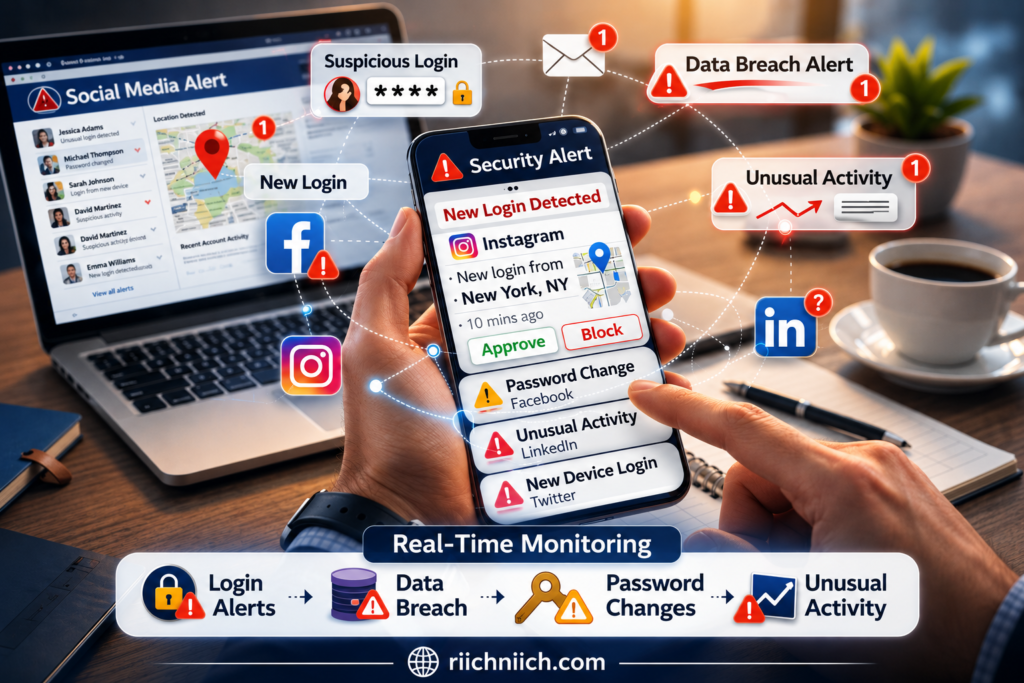
Social Media Monitoring
Aura tracks your social profiles for:
- Impersonation attempts
- Leaked information
- New accounts created using your identity
Social media is a common entry point for scams and impersonation, making this a useful add-on for comprehensive coverage.
Lost Wallet Protection
Aura provides tools to quickly lock and replace:
- Credit cards
- Debit cards
- Driver’s license
- Identification documents
This speeds up recovery if your wallet is lost or stolen.
Identity Theft Insurance
Aura includes identity theft insurance that typically covers:
- Legal fees
- Notary and documentation costs
- Lost wages due to identity fraud recovery
This is not just a feature — it’s peace of mind. Identity restoration can be expensive without coverage.
Insurance limits and terms vary, so always review the latest plan details.
24/7 U.S.-Based Customer Support
Professional support is a major differentiator. Aura offers:
- Live phone support
- Chat support
- Trained restoration specialists
If fraud occurs, having hands-on help makes the recovery process less confusing and stressful — something that free services do not offer.
Family & Multi-Person Plans
Aura allows you to protect:
- Spouses/partners
- Children under 18
- Other dependents
This creates a centralized family protection system that saves money compared to buying individual plans for multiple people.
Child identity theft is increasingly common, and Aura’s family coverage addresses this risk comprehensively.
Key Features Summary: Why This Matters
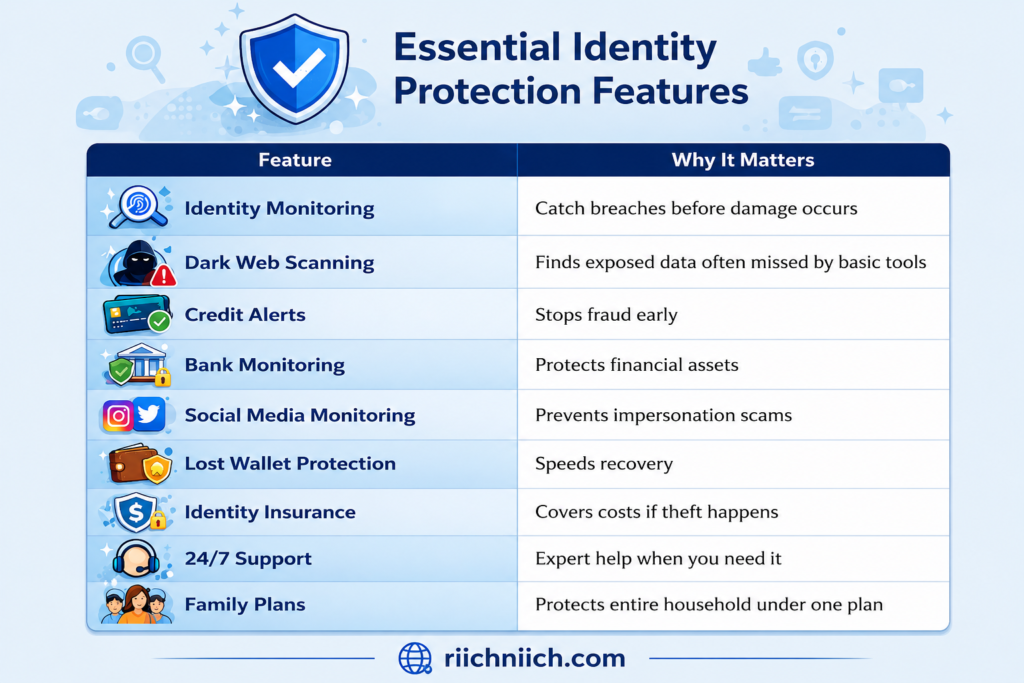
By understanding these robust features, it becomes much easier to answer “Is Aura Worth It?” in practical terms: you’re not just buying monitoring — you’re buying proactive protection and real-world recovery support.
While Aura includes many built-in tools, some users also use NordVPN for additional privacy protection when browsing online.
Aura Pricing Overview (Plans and Value)
When buyers ask “Is Aura Worth It?”, the next logical question is: How much does it cost and what value do you actually get for the price? Below is a clear breakdown of Aura’s pricing structure in 2026 — from individuals to families — so you can decide whether the investment aligns with your identity protection needs.
Aura’s Pricing Tiers
Aura offers multiple plans depending on how much coverage you want and how many people you’re protecting. All plans include identity monitoring, fraud alerts, and access to support, but the level of coverage and features increases with each tier.
🚨 Please note that ALL prices in this blog article are subject to change and/or may or may not be accurate.
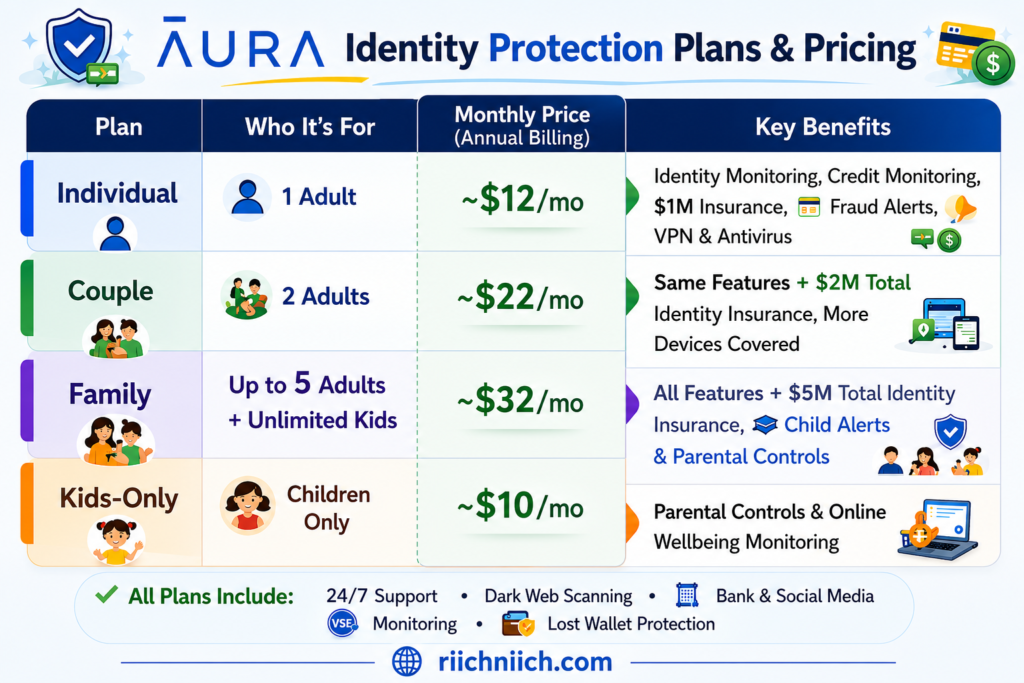
💡 Aura also typically offers a 14-day free trial and a 60-day money-back guarantee on annual plans, so you can test the service risk-free.
What You Get at Each Price Point
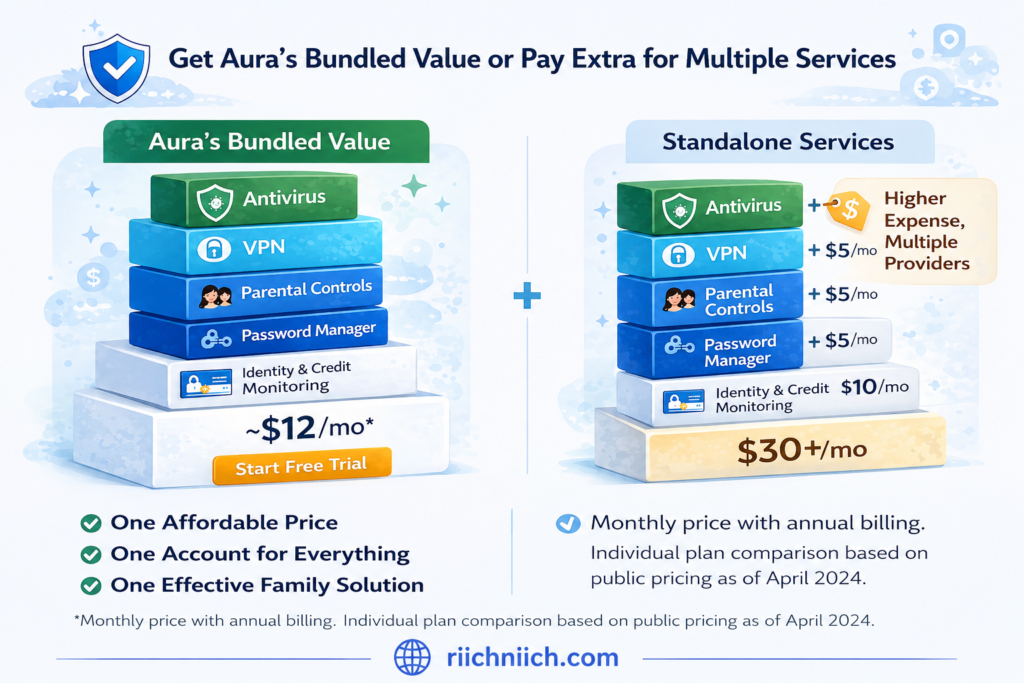
Individual Plan (~$12/mo)
This is Aura’s entry-level identity and fraud protection plan and the most common starting point for people asking “Is Aura Worth It?” It includes:
- 3-bureau credit monitoring
- Identity & SSN monitoring
- Financial transaction alerts
- Experian credit lock
- $1M identity theft insurance
- Antivirus, VPN, and password manager protection
- 24/7 U.S.-based support
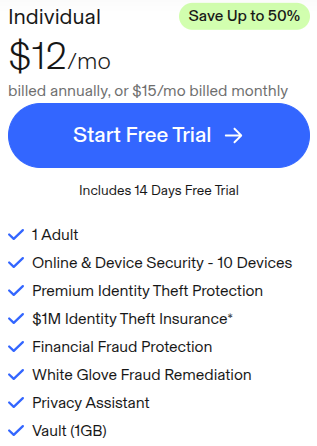
This plan is great if you want full identity monitoring plus device and cybersecurity tools without paying for family coverage.
Couple Plan (~$22/mo)
Designed for two adults in the same household. It includes everything in the Individual plan, but:
- Coverage for 2 adults
- Up to $2M total identity insurance ($1M per adult)
- More devices covered with VPN and antivirus protection
If you and a partner both want identity and digital security protection under one subscription, this plan adds notable value.
Family Plan (~$32/mo)
This is Aura’s most comprehensive tier and often delivers the best overall value for households. In addition to everything in the Couple plan, this includes:
- Coverage for up to 5 adults and unlimited kids
- Up to $5M total identity insurance ($1M per covered adult)
- Child SSN monitoring and alerts
- Parental controls and safe gaming features
- Social interaction and online wellbeing monitoring for kids
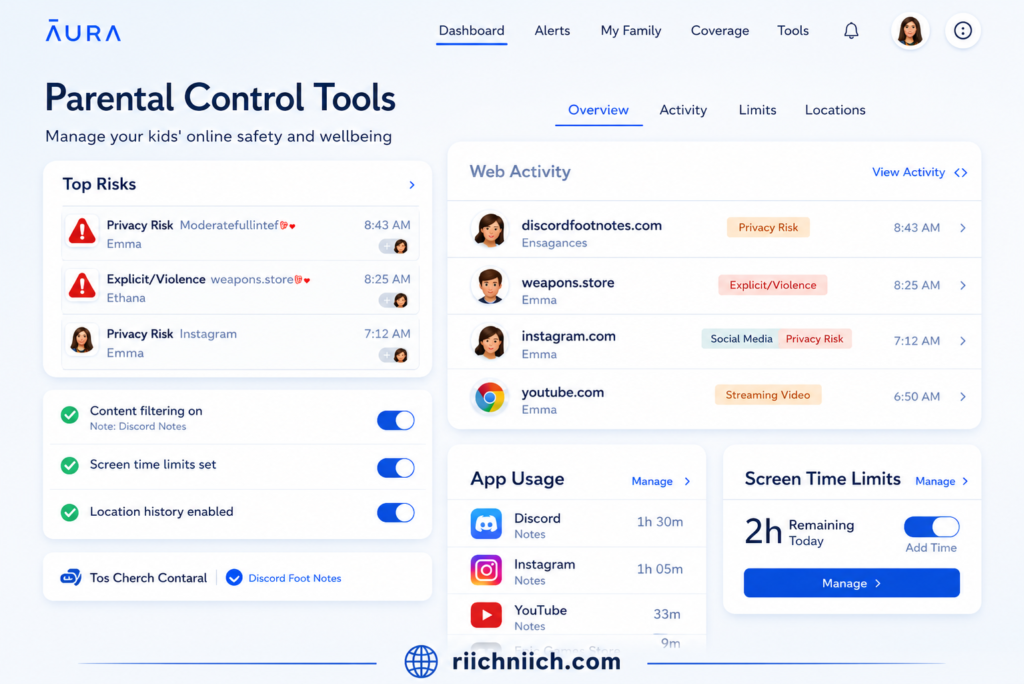
For families — especially those with teenagers or kids using apps and the internet daily — this plan is a comprehensive security solution.
Kids-Only Plan (~$10/mo)
Aura also offers a standalone plan focused on children’s online safety and digital wellbeing, including:
- Parental controls
- Content filtering
- Screen time scheduling
- Cyberbullying & predator alerts
This plan doesn’t include identity theft insurance or full credit monitoring but provides targeted protection for younger users.
How Aura’s Pricing Compares
According to pricing surveys, most identity theft protection services range from $10 to $40 per month depending on coverage levels and provider.
Compared to competitors:
- Some services charge similar rates for only credit monitoring
- Others require higher tiers or add-ons for fraud recovery support
- Aura’s plans often include antivirus, VPN, parental controls, and password management bundled in — adding extra value relative to standalone identity protection services
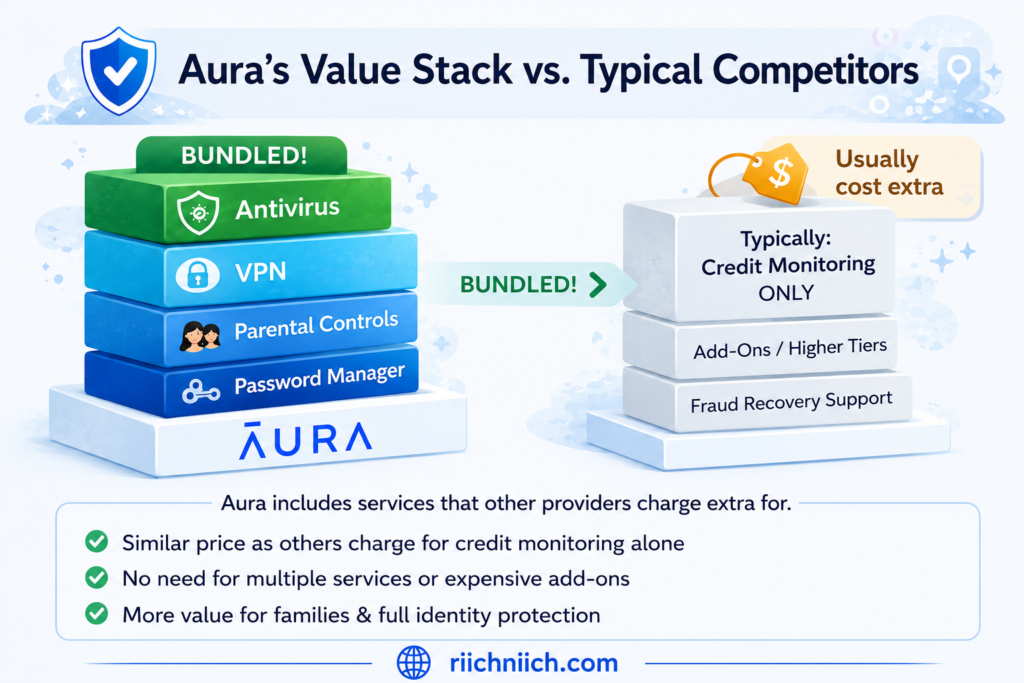
Value Summary: Is Aura Worth It?
Perfoming a quick value assessment helps answer “Is Aura Worth It?” in practical terms:
You’re paying for:
✔ Comprehensive real-time monitoring
✔ Identity & credit protection
✔ Fraud alerts and financial monitoring
✔ Identity theft insurance (up to $5M with Family plan)
✔ Device security tools (VPN, antivirus, password manager)
✔ Expert support and fraud remediation
✔ Family & Kids features (parental controls, child SSN monitoring)
Versus typical base-level free services:
❌ No insurance coverage
❌ No live support
❌ No bundled cybersecurity tools
In other words, Aura’s pricing reflects a full-suite digital protection system, not just basic credit monitoring.
Aura’s pricing is structured so that buyers get what they pay for — broader coverage, stronger recovery support, and integrated security tools — which is why many users find it worth the investment when compared to bare-bones alternatives.
If Aura feels too expensive, IdentityIQ is a simpler and more affordable alternative focused on core identity monitoring.
Real-World Example: What Happens If Your Identity Is Stolen?
When people search “Is Aura Worth It?”, they’re usually imagining one thing:
“What would actually happen if my identity were stolen — and would this service really help me?”
Let’s walk through a realistic scenario so you can clearly see the value.
Step 1: Your Information Gets Exposed
It often starts with a data breach.
Maybe your email and password were leaked from an online retailer. Or your Social Security number was exposed in a corporate breach.
According to the Identity Theft Resource Center, thousands of data breaches occur every year, exposing millions of consumer records.
You may not even know it happened.
Step 2: Fraudulent Activity Begins
A criminal uses your exposed information to:
- Open a new credit card
- Apply for a personal loan
- Attempt to access your bank account
- File a fraudulent tax return
The Federal Trade Commission reports that identity theft remains one of the most common types of fraud complaints in the United States.
Without monitoring, you might not notice until:
- Your credit score drops
- Debt collectors call
- Your bank account shows unauthorized charges
By then, damage may already be done.
Step 3: How Aura Responds (If You Have It)
Now let’s answer the key question: Is Aura Worth It in this situation?
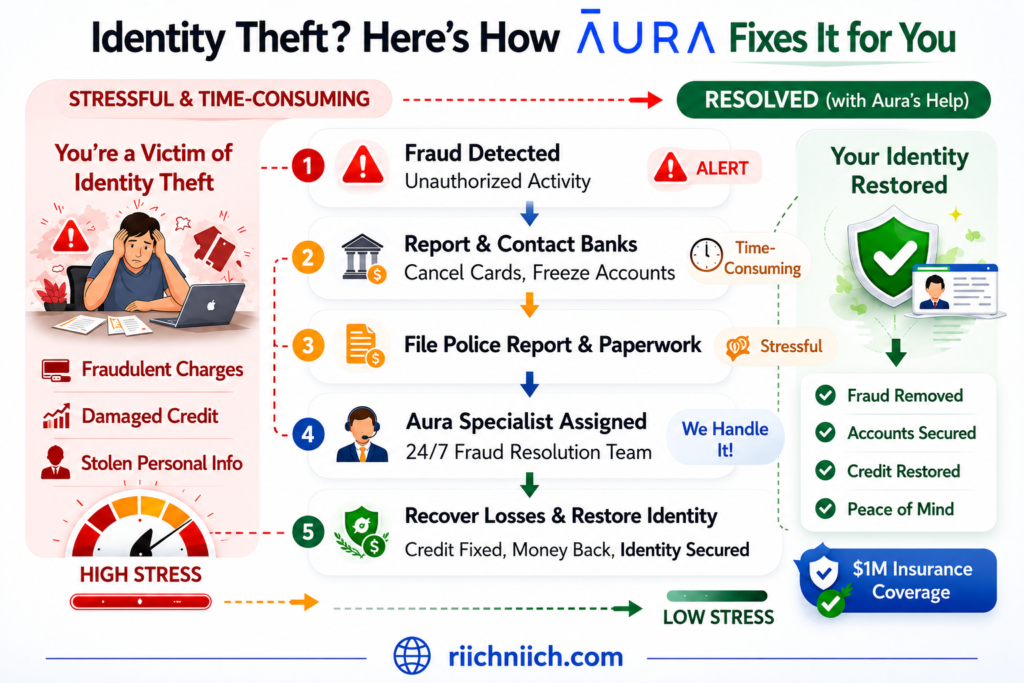
If you’re enrolled in Aura, here’s what typically happens:
1. You Receive a Real-Time Alert
Aura detects unusual credit activity or suspicious account changes and sends you an immediate notification.
Early detection can prevent additional accounts from being opened.
2. You Confirm the Fraud
Inside your dashboard, you can quickly confirm whether the activity was authorized.
If it wasn’t, you move directly into recovery support.
3. A Recovery Specialist Steps In
Aura provides access to trained identity restoration specialists who:
- Help file fraud reports
- Guide you through credit bureau disputes
- Assist with account closures
- Help place fraud alerts or credit freezes
This is where many free monitoring services stop — but Aura continues.
4. Insurance Helps Cover Costs
If you miss work dealing with creditors or need legal help, Aura’s identity theft insurance can help reimburse certain expenses.
That financial protection reduces the long-term impact of identity fraud.
What Happens If You Don’t Have Protection?
If you’re unprotected, you may need to:
- Contact each credit bureau individually
- File police reports
- Call banks and lenders yourself
- Write formal dispute letters
- Track deadlines and follow-ups
The FTC outlines the recovery process here.
This process can take weeks — sometimes months — depending on the severity.
Why This Scenario Matters
When evaluating “Is Aura Worth It?”, it’s not just about features — it’s about outcomes.
Identity theft isn’t just a notification problem.
It’s a:
- Time problem
- Stress problem
- Financial risk problem
Aura’s value comes from combining:
✔ Early detection
✔ Immediate alerts
✔ Guided recovery
✔ Insurance coverage
That full support system is what separates comprehensive identity protection from basic credit monitoring.
The Bottom Line
If identity theft happened tomorrow, would you prefer:
- To handle it alone with free tools?
- Or have a team and insurance backing you up?
For many buyers, that’s where the answer to “Is Aura Worth It?” becomes much clearer.
How Aura Compares to Other Identity Theft Protection Services
If you’re still wondering “Is Aura Worth It?”, comparing Aura to other leading identity theft protection services gives you real clarity on where it stands in the competitive landscape.
Below is an honest, buyer-focused comparison of Aura versus other popular identity protection options in 2026 — highlighting differences in features, pricing, and overall value.
*For a broader look at how top services compare overall, see Best Identity Theft Protection Services for 2026.
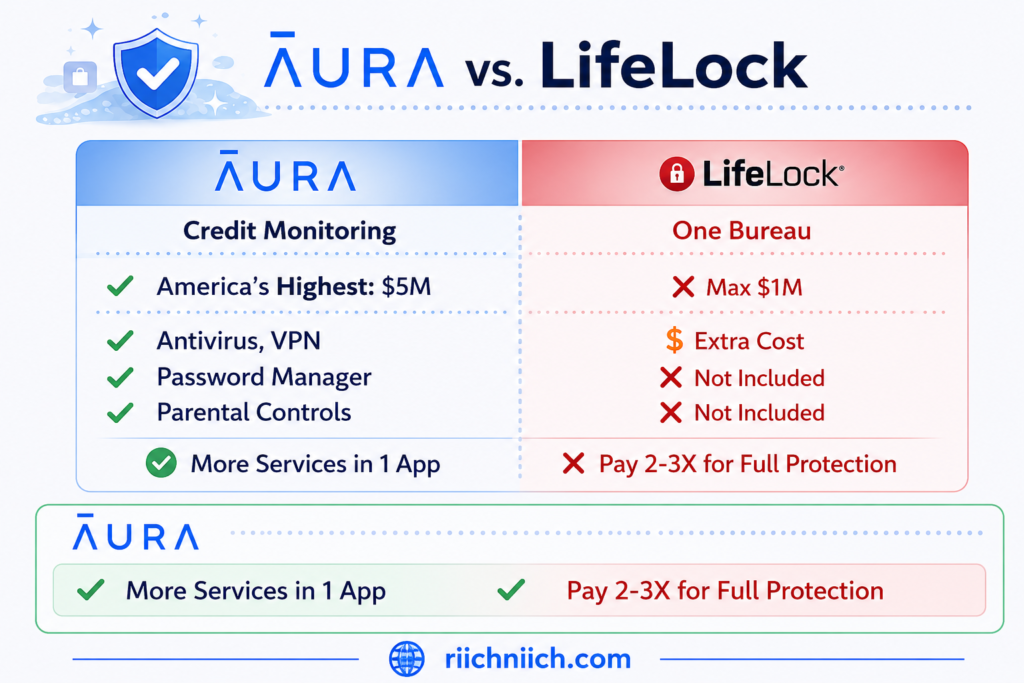
Aura vs LifeLock
LifeLock is one of the most widely known identity theft protection brands, often bundled with cybersecurity tools from Norton.
Key differences:
- Aura includes three-bureau credit monitoring on every plan, whereas LifeLock’s basic tier may only monitor one bureau unless you choose a higher (more expensive) plan.
- Aura bundles additional digital security tools — such as antivirus, VPN, and password manager — at no extra cost, while LifeLock typically requires a Norton 360 bundle for these extras.
- LifeLock generally offers higher identity theft insurance limits (e.g., up to $3 million on top tiers) compared to Aura’s typical $1 million per adult coverage.
🎯 Value takeaway: Aura offers strong protection with all core features included at lower price points, while LifeLock may cost more especially if you want full coverage and advanced extras. Many comparison guides show Aura delivering comparable or better coverage for most users at a better overall value.
Aura vs Experian IdentityWorks
Experian’s IdentityWorks is backed by one of the major credit bureaus and has a reputation in credit monitoring.
Comparative insights:
- Aura typically offers more comprehensive identity theft detection and monitoring tools beyond credit reporting alone — including bank account monitoring and dark web alerts — which many basics from Experian lack.
- Aura’s family and household plans often provide broader coverage, including multiple adults and children, whereas IdentityWorks’ family options tend to be more limited in features and scope.
- Experian’s primary advantage is a free credit monitoring tier or lower-cost basic monitoring, but this does not include the full suite of identity protection that Aura provides.
💡 Value takeaway: Experian can be good for users wanting basic credit alerts or an introductory free plan, but Aura delivers more robust all-around identity protection — making it a stronger choice if security is your priority.
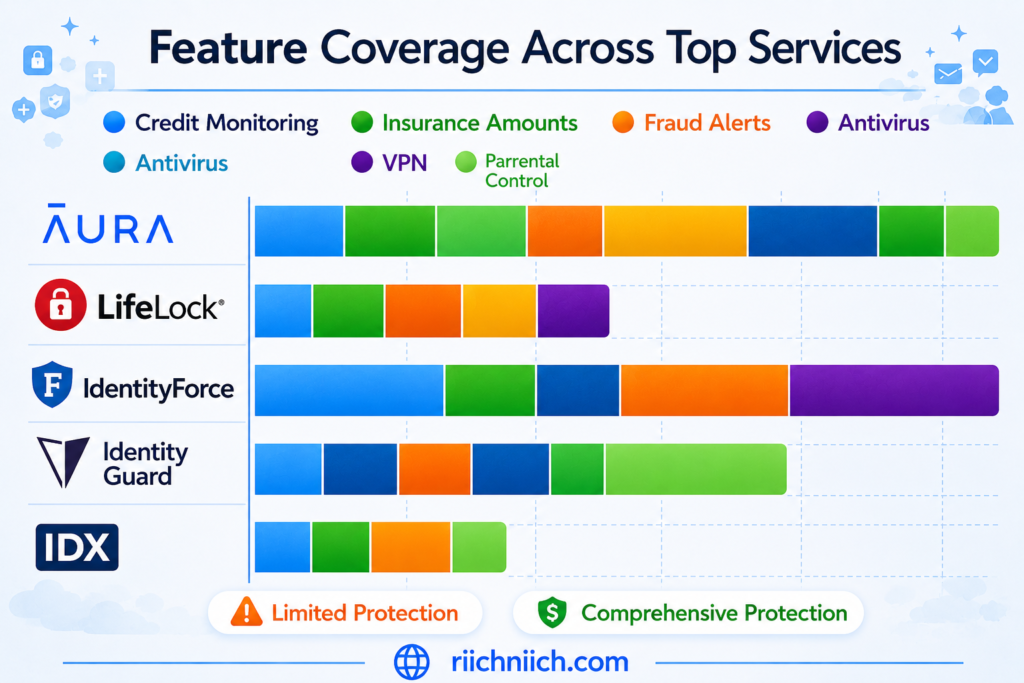
Aura vs Identity Guard and Other Providers
Many identity theft protection services exist beyond LifeLock and Experian — such as Identity Guard, IDShield, and others — each with its strengths.
Broadly speaking:
- Identity Guard can be a more budget-friendly option with strong credit monitoring & alerts, but advanced features and support may require higher-tier plans.
- IDShield focuses heavily on identity restoration with licensed investigators and offers high insurance limits, yet its pricing can be higher for equivalent features.
- Aura continues to stand out for its comprehensive all-in-one suite — combining identity protection, credit monitoring, restoration support, insurance, and bundled digital security tools.
🏆 In fact, multiple industry rankings currently list Aura as one of the best overall identity theft protection services for 2026, thanks to its broad protection features and balanced pricing.
Summary: Where Aura Shines
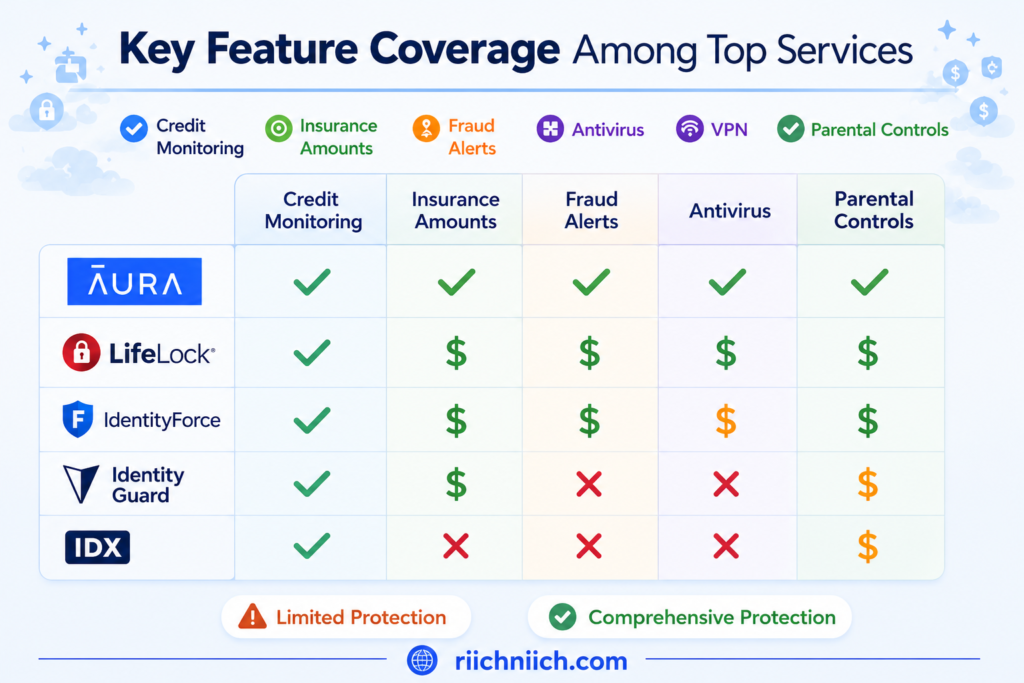
✔ All-inclusive protection: Every plan includes three-bureau monitoring, fraud alerts, and digital security tools like VPN and antivirus — no add-ons required.
✔ Better value for most users: Compared to similar services, Aura often delivers equivalent or better protection at lower or similar cost.
✔ Family-friendly plans: Strong support for family coverage with robust monitoring and insurance limits.
Areas Where Others May Excel
⚠ Higher insurance limits: Some competitors, like LifeLock on top tiers, offer higher identity theft insurance levels.
⚠ Specialized credit bureau access: Services tied to a major bureau (like Experian’s tools) may provide deeper direct access to that single bureau’s data.
Buyer Takeaway: Is Aura Worth It Compared to Others?
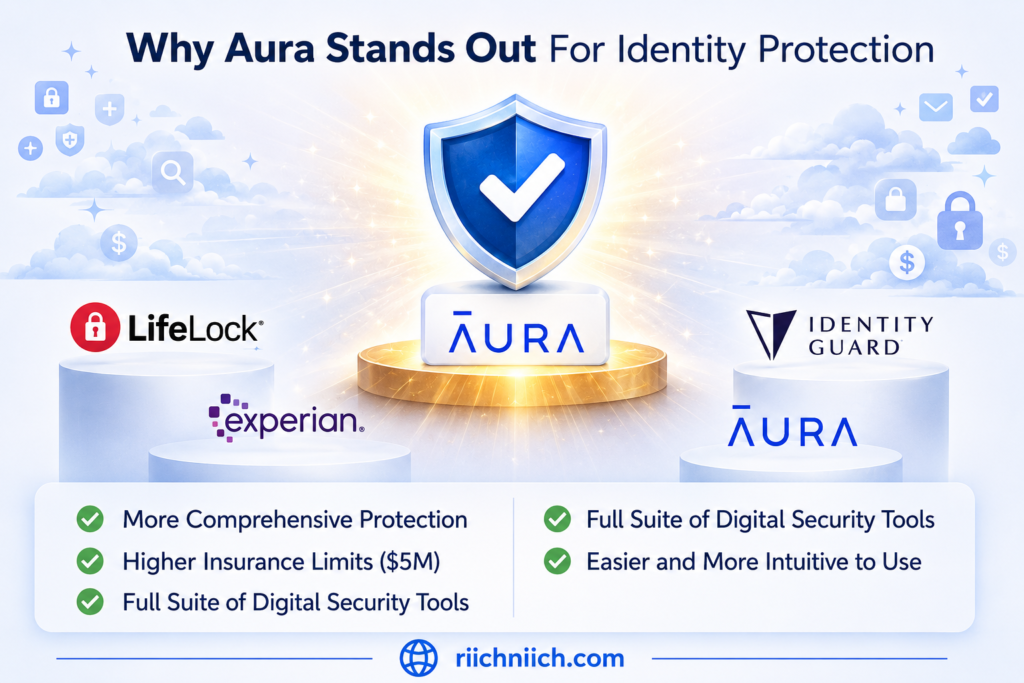
Yes — for most users prioritizing comprehensive identity protection, easy setup, and an all-in-one solution, Aura remains one of the best values in 2026.
If your focus is minimal monitoring with no extras, a basic free plan from a credit bureau might suffice. But if you want real protection, fast alerts, and peace of mind, Aura’s offering frequently outperforms or matches competitors on features, simplicity, and cost.
Final Verdict: Is Aura Worth It in 2026?
Yes — Aura is worth it for most people who want complete identity theft protection in one place.
It offers strong monitoring, fast alerts, and full recovery support — which makes it one of the most reliable options available today.
If you want protection without complexity, Aura is the best choice.
👉 Start protecting yourself with Aura here!
Who Aura Is Definitely Worth It For
Aura stands out as a top identity theft protection service in 2026 because of its broad coverage and value-driven approach:
✔ Comprehensive identity, credit, and financial monitoring across multiple data sources — including dark web scans.
✔ Monitoring and alerts from all three major credit bureaus for most plans.
✔ Identity theft insurance up to $1 million per adult (and up to $5 million for families).
✔ Bonus cybersecurity tools like VPN, antivirus, and password manager included without add-ons.
✔ Strong family coverage with child monitoring and parental controls.
If you value peace of mind, proactive alerts, and 24/7 expert support, Aura delivers strong value that justifies the cost. Independent reviews rank it among the best identity theft protection services available in 2026.
When Aura Is A Very Strong Choice
✅ You have multiple financial accounts or susceptible personal information stored online
✅ You want more than just credit monitoring — including fraud support and recovery guidance
✅ You’re protecting a family or dependents
✅ You’d rather pay for convenience with expert assistance than DIY monitoring
✅ You want all-in-one protection — identity, financial, and digital security
👉 See if Aura fits your situation!
When Aura Might Not Be Necessary
There are a few situations where Aura might not be worth it:
⚠ You’re an extremely light internet user with no financial accounts or online presence
⚠ You’re comfortable actively managing freezes, credit reports, and manual monitoring
⚠ You want only the lowest cost basic alerts without extras like VPN or antivirus
⚠ You prefer a credit-bureau-linked provider (e.g., Experian or TransUnion) for deeper bureau access
In these cases, doing manual credit freezes and free bureau alerts may be enough — but that requires diligence most people don’t maintain over time.
How Experts Summarize Aura’s Value
Industry reviews generally agree:
Aura offers robust identity monitoring and fraud alerts that go beyond basic services.
Its combination of identity protection, insurance, and digital security tools often outperforms others in value.
Some competitors push specialized features (like deeper bureau tools or higher insurance limits), but Aura’s all-around package is one of the most complete available.
So Ultimately…
Is Aura worth it?
✔ For most individuals and families — absolutely yes.
✔ For bargain-only or extremely DIY users — maybe not.
The real question isn’t whether identity theft protection is valuable — it is — but whether you want that protection to be:
*If retirement security or protecting an older family member is your priority, you may also want to review our comparison of the Best Identity Theft Protection for Seniors.
- Basic and manual
or - Comprehensive, continuous, and supported by experts
Aura sits firmly in the latter camp.

Pingback: Best Identity Theft Protection Services for 2026 - Riich Niich
Pingback: Best Identity Theft Protection for Seniors - Riich Niich
Pingback: Best Identity Theft Protection for Families (2026 Guide) - Riich Niich
Pingback: Aura vs LifeLock: Which Identity Theft Protection Is Better in 2026? - Riich Niich
Pingback: Aura vs Experian IdentityWorks: Which Identity Protection Service Is Better in 2026? - Riich Niich
Pingback: Aura vs Identity Guard: Which Identity Theft Protection Is Better in 2026? - Riich Niich
Pingback: Do You Really Need Identity Theft Protection in 2026? - Riich Niich
Pingback: 13 Warning Signs Someone Stole Your Identity (And What To Do Immediately) - Riich Niich
Pingback: What To Do Immediately If Your Identity Is Stolen (Step-by-Step Guide) - Riich Niich
Pingback: How Hackers Get Your Personal Data (And How to Stop Them) - Riich Niich
Pingback: Is Aura Better Than Free Credit Monitoring? - Riich Niich
Pingback: Credit Freeze vs Credit Lock — What’s Safer? - Riich Niich
Pingback: Best Antivirus for Families (2026 Guide) - Riich Niich
Pingback: How Identity Theft Happens (Most People Don’t Know This) - Riich Niich
Pingback: NordProtect Review (Is It Worth It in 2026?) - Riich Niich
Pingback: Is Incogni Worth It in 2026? (Full Review + Results) - Riich Niich
Pingback: Incogni vs Aura: Which Privacy Protection Service Is Right for You? - Riich Niich
Pingback: Best Data Removal Services - Riich Niich
Pingback: How to Freeze Your Credit at All Three Credit Bureaus - Riich Niich
Pingback: Best Identity Monitoring Service: What to Look for Before You Choose - Riich Niich