

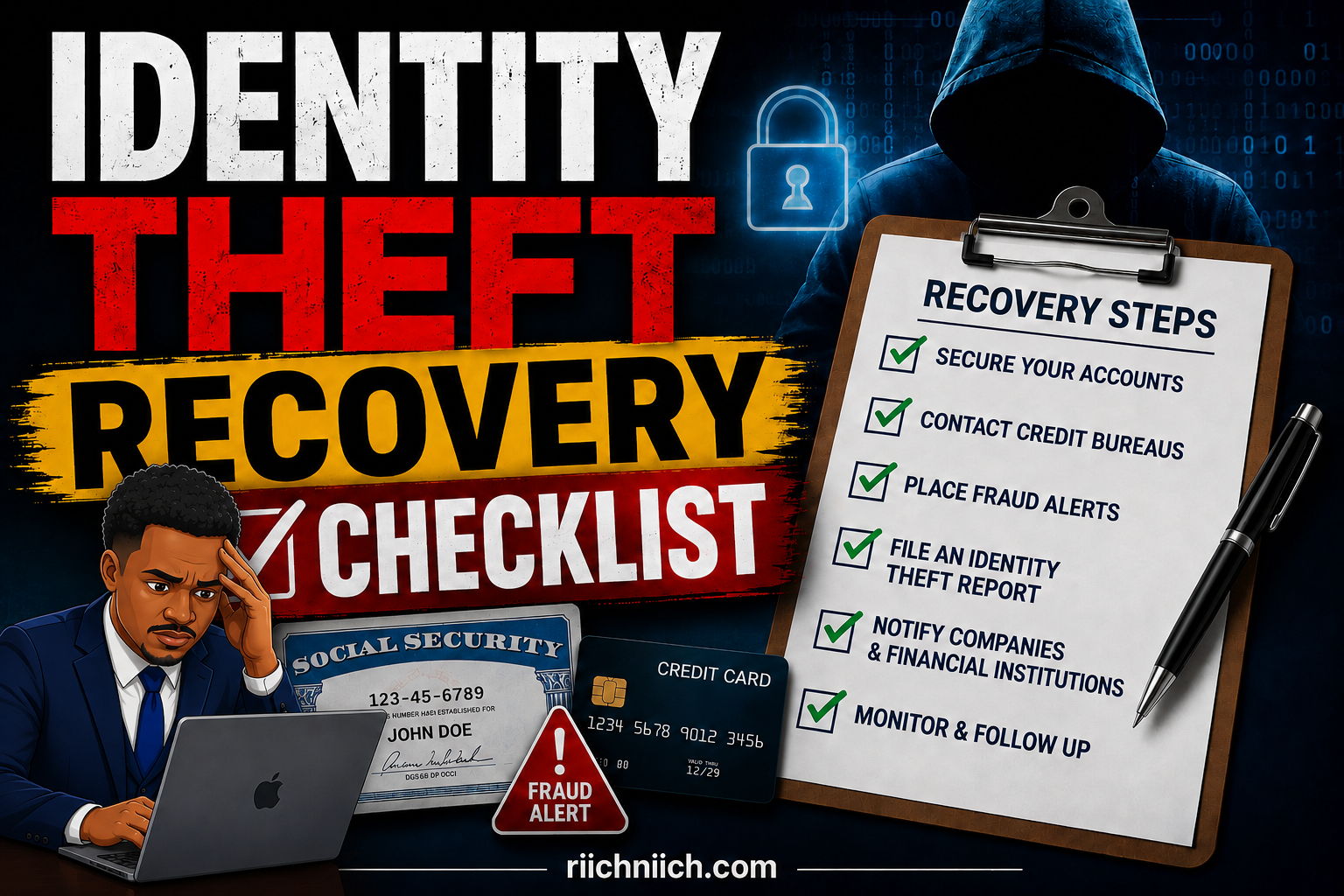
Identity theft recovery checklist is one of the most important resources you can have if your personal information has been stolen or misused. Knowing exactly what to do—and in what order—can help you limit financial damage, protect your credit, and recover your identity more quickly.
In this guide, you’ll learn a step-by-step identity theft recovery checklist that walks you through securing your accounts, freezing your credit, reporting the fraud, disputing unauthorized activity, replacing compromised documents, and monitoring your identity for future threats. You’ll also discover common mistakes to avoid, the best tools to simplify the recovery process, and practical tips to help protect yourself from becoming a victim again.
Table of Contents
Identity Theft Recovery Checklist: 🔥 Quick Answer
An identity theft recovery checklist is a step-by-step action plan that helps you regain control of your finances, personal information, and online accounts after your identity has been compromised. Acting quickly can reduce financial losses, prevent additional fraudulent activity, and improve your chances of recovering from identity theft with minimal long-term damage.
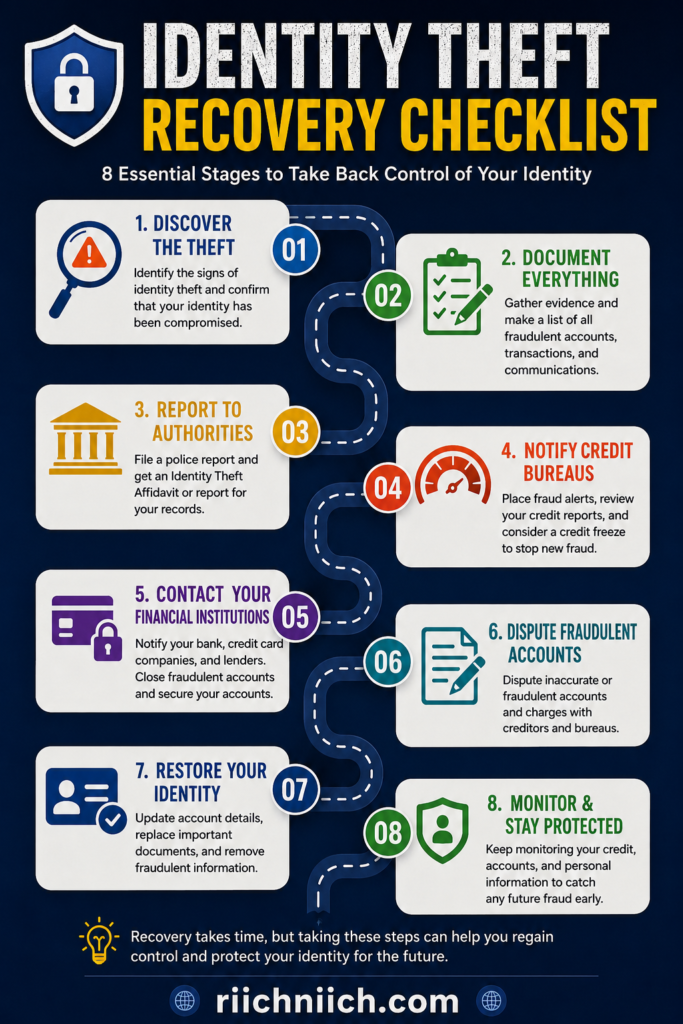
The most effective identity theft recovery checklist includes these essential steps:
- Secure your online accounts by changing passwords and enabling multi-factor authentication.
- Freeze your credit with all three major credit bureaus to stop criminals from opening new accounts in your name.
- Report the identity theft to the Federal Trade Commission (FTC) and keep a copy of your Identity Theft Report.
- Notify your banks, credit card companies, and other financial institutions about any unauthorized activity.
- Review your credit reports for fraudulent accounts, inquiries, and incorrect information.
- Replace stolen or compromised identification documents, including your driver’s license or Social Security card if necessary.
- Dispute fraudulent accounts and transactions with creditors and credit bureaus.
- Continue monitoring your identity, credit, and personal information for signs of future fraud.
If you’re still trying to determine whether someone has actually stolen your identity, learn the warning signs in How to Know If Someone Stole Your Identity before starting the recovery process.
While you can complete many of these steps on your own, identity theft protection services can simplify the recovery process by providing continuous identity monitoring, dark web monitoring, fraud alerts, credit monitoring, and recovery assistance. If you’re comparing services, look for one that offers identity restoration support in addition to real-time alerts, as these features can significantly reduce the time and stress involved in recovering from identity theft.
For additional guidance, the Federal Trade Commission (FTC) offers official identity theft recovery resources, while the three major credit bureaus—Experian, Equifax, and TransUnion—provide instructions for placing security freezes and monitoring your credit. These trusted resources can help you complete each step of your recovery with confidence.
What Is an Identity Theft Recovery Checklist?
An identity theft recovery checklist is a step-by-step action plan designed to help you regain control after your personal information has been stolen or misused. Instead of reacting emotionally or wondering what to do next, the checklist gives you a clear recovery process that prioritizes the most important actions first, helping you minimize financial losses and reduce the risk of additional fraud.
Identity theft can affect much more than your credit score. Criminals may use your information to open new credit accounts, take out loans, file fraudulent tax returns, drain bank accounts, or even use your identity for medical services. Because these situations can escalate quickly, following a structured identity theft recovery checklist helps ensure that every critical recovery step is completed.
A comprehensive identity theft recovery checklist typically includes:
- Securing all online accounts by changing passwords and enabling multi-factor authentication.
- Freezing your credit with all three major credit bureaus.
- Reporting the identity theft through the Federal Trade Commission’s IdentityTheft.gov recovery system.
- Reviewing your credit reports for unauthorized accounts, hard inquiries, and inaccurate information.
- Contacting banks, credit card companies, lenders, and other affected organizations.
- Disputing fraudulent accounts and transactions.
- Replacing compromised identification documents when necessary.
- Monitoring your identity and financial accounts for continued suspicious activity.
Following these identity theft recovery steps in the proper order can make the recovery process significantly easier. Many victims who delay taking action discover additional fraudulent accounts weeks or even months later, making recovery more difficult.
While you can complete every step yourself, many people choose to use an identity theft protection service because it helps automate parts of the recovery process. Features such as identity monitoring, dark web monitoring, fraud alerts, credit monitoring, and identity restoration specialists can provide ongoing protection while you work through your recovery checklist.
As you complete your identity theft recovery checklist, you’ll likely need to use several trusted government and financial resources. The FTC’s IdentityTheft.gov website allows victims to report identity theft and generate a personalized recovery plan, while Experian, Equifax, and TransUnion provide online tools for placing and managing credit freezes. These official resources work together to help stop additional fraudulent activity and support your recovery.
Who Should Use an Identity Theft Recovery Checklist?
An identity theft recovery checklist is valuable for anyone who believes their personal information has been exposed, stolen, or misused. Whether you’ve noticed fraudulent charges, received unexpected collection notices, or discovered accounts you never opened, following a structured recovery plan can help you respond quickly and reduce further damage.
You should use an identity theft recovery checklist if you have experienced any of the following situations:
- Unauthorized charges on your credit card or bank account.
- New credit accounts or loans opened in your name.
- Debt collection calls for accounts you don’t recognize.
- A notification that your personal information was involved in a data breach.
- Alerts from your bank or identity monitoring service about suspicious activity.
- A lost or stolen wallet containing identification or financial cards.
- Tax return fraud or an IRS notice about duplicate tax filings.
- Medical bills for services you never received.
- A compromised Social Security number or driver’s license.
Even if you’re unsure whether identity theft has occurred, it’s better to begin an identity theft recovery checklist as soon as possible. Taking preventive steps early can stop criminals from causing additional financial or personal harm.
Individuals Recovering From a Recent Data Breach
If you’ve recently received a data breach notification from a company you do business with, your information may already be circulating among cybercriminals. While not every breach leads to identity theft, acting quickly by following an identity theft recovery checklist can help secure your accounts before criminals have an opportunity to misuse your information.
Families Protecting Multiple Household Members
Identity theft doesn’t only affect adults. Children can become victims because their Social Security numbers often remain unused for years, making fraudulent activity difficult to detect. Families should use an identity theft recovery checklist whenever a parent, spouse, or child may have had sensitive information exposed. Recovering together helps ensure every affected family member receives the necessary protection.
Seniors Who May Be Targeted by Scammers
Older adults are frequently targeted by phishing scams, fake technical support calls, Medicare fraud, and financial scams designed to steal personal information. If a senior believes their identity has been compromised, an identity theft recovery checklist provides a straightforward recovery process that reduces confusion during an already stressful situation.
Small Business Owners and Self-Employed Professionals
Business owners often store both personal and business financial information on the same devices. If a laptop, email account, or online business account is compromised, criminals may gain access to personal identities as well as business assets. Using an identity theft recovery checklist helps prioritize which accounts should be secured first and reduces the risk of additional financial losses.
Many government agencies encourage victims to begin the recovery process immediately after discovering suspicious activity. For example, the Federal Trade Commission’s IdentityTheft.gov service provides a personalized recovery plan after you report identity theft, while the Consumer Financial Protection Bureau offers educational resources about recognizing fraud and protecting your financial accounts. Using these trusted resources alongside a comprehensive identity theft recovery checklist can make the recovery process more organized and less overwhelming.
No matter how your information was exposed, acting quickly is one of the most important factors in recovering from identity theft. The sooner you begin following an identity theft recovery checklist, the greater your chances of preventing additional fraudulent accounts, protecting your credit, and restoring your financial security.
Step 1: Secure Your Online Accounts Immediately
The first and most important step in any identity theft recovery checklist is securing your online accounts. If criminals have gained access to your personal information, there’s a good chance they’ll try to log in to your email, banking apps, shopping websites, social media accounts, or other online services. Acting quickly can stop unauthorized access before additional damage occurs.
Start with your email account. Since your email is connected to password resets for many of your other accounts, it should be your highest priority. If a criminal controls your email, they may be able to reset passwords and take over multiple accounts within minutes.
Once your email account is secure, change the passwords for your:
- Online banking accounts
- Credit card accounts
- Investment and retirement accounts
- Shopping websites
- Mobile payment apps
- Social media accounts
- Cloud storage services
- Healthcare portals
- Utility accounts
- Any account that stores sensitive personal information
Create a unique password for every account. Reusing the same password across multiple websites makes it much easier for criminals to access additional accounts if just one password becomes compromised.
👉 Since stolen email accounts are often the starting point for identity theft, Coveron can help by monitoring your email address for data breaches and alerting you if your personal information appears in newly discovered leaks.
If creating dozens of strong passwords sounds overwhelming, a password manager can generate and securely store unique passwords for every account. This significantly reduces the chances of another account takeover while making future logins much more convenient.
Enable Multi-Factor Authentication (MFA)
Changing passwords alone is not enough. As part of your identity theft recovery checklist, enable multi-factor authentication (MFA) on every important account that supports it.
MFA requires a second verification step before someone can log in, such as:
- An authentication app
- A security key
- A one-time verification code
- A biometric scan like a fingerprint or facial recognition
Even if someone knows your password, they usually won’t be able to access your account without this second form of verification.
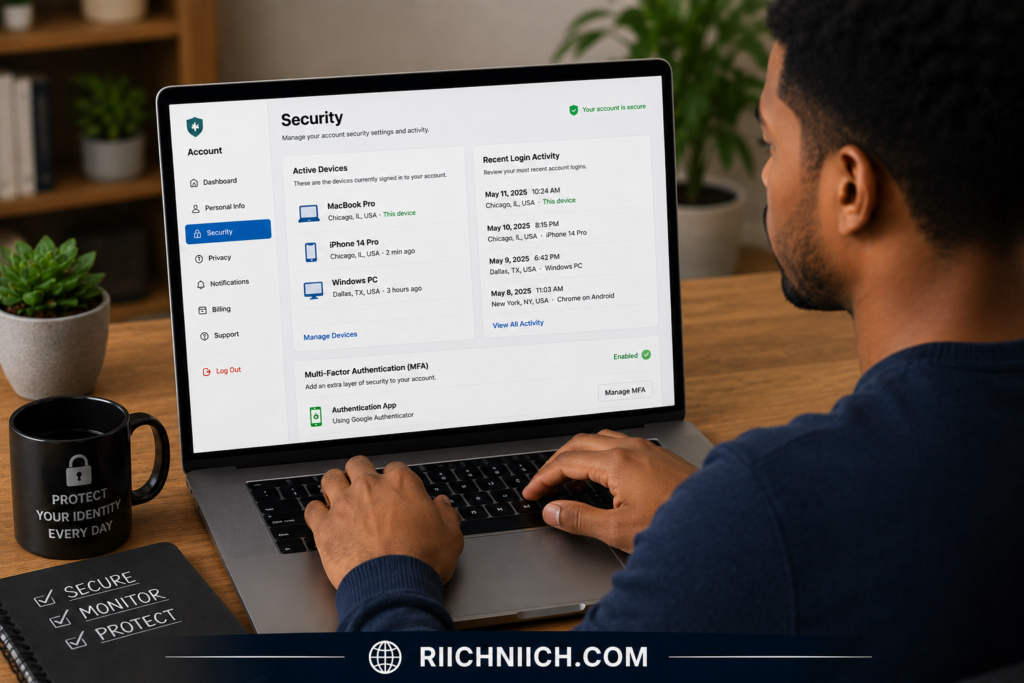
Review Your Account Security Settings
Many people overlook their account security settings after changing passwords. Take a few extra minutes to review each account for signs of unauthorized access.
Check for:
- Unknown devices currently signed in
- Login activity from unfamiliar locations
- New recovery email addresses
- Unknown phone numbers
- Unauthorized trusted devices
- Third-party apps you don’t recognize
Remove anything that you didn’t authorize. Many online services allow you to sign out of every device with one click, forcing anyone else to log in again using your new credentials.
Watch for Password Reset Emails
After identity theft, criminals often attempt to regain access to your accounts by requesting password resets. Pay close attention to emails or text messages about password changes that you didn’t request.
If you receive an unexpected password reset notification, immediately log in to that account using the official website or mobile app—not the link inside the email—to verify that your account is still secure.
Don’t Forget Connected Accounts
As you work through your identity theft recovery checklist, remember that many online accounts are connected to one another. For example, your email may be linked to your bank, your shopping accounts may store payment information, and your cloud storage may contain copies of important documents.
Take time to review any connected apps and services that have permission to access your accounts. Removing unused or unfamiliar connections reduces your overall security risk and limits the damage if another account becomes compromised.
Organizations like the Cybersecurity and Infrastructure Security Agency (CISA) recommend using strong, unique passwords and enabling multi-factor authentication as two of the most effective ways to protect online accounts after a security incident. Likewise, the National Institute of Standards and Technology (NIST) encourages using password managers to create complex passwords that are difficult for attackers to guess or reuse across multiple accounts.
Securing your online accounts is the foundation of a successful identity theft recovery checklist. Once you’ve regained control of your accounts, you’ll be in a much stronger position to complete the remaining recovery steps and prevent criminals from causing additional harm.
Step 2: Freeze Your Credit With All Three Credit Bureaus
The next step in your identity theft recovery checklist is to place a credit freeze with all three major credit bureaus: Experian, Equifax, and TransUnion. A credit freeze is one of the most effective ways to prevent criminals from opening new credit accounts, loans, or credit cards in your name after your personal information has been compromised.
A credit freeze restricts access to your credit report. Since most lenders review your credit before approving new credit applications, freezing your credit makes it much more difficult for identity thieves to obtain financing using your information.
It’s important to understand that a credit freeze does not:
- Affect your credit score.
- Close your existing credit cards or loans.
- Prevent you from using your current accounts.
- Stop you from lifting the freeze temporarily when you legitimately apply for new credit.
Instead, it simply adds an extra layer of protection while you work through the rest of your identity theft recovery checklist.
Freeze Your Credit With All Three Bureaus
Many people mistakenly believe freezing their credit with one bureau is enough. Unfortunately, lenders don’t all use the same credit bureau. If you freeze only one credit file, a lender may still access another unfrozen report and approve a fraudulent application.
To maximize your protection, place a security freeze with:
- Experian
- Equifax
- TransUnion
Each bureau allows you to create an online account where you can freeze, temporarily lift, or permanently remove your credit freeze whenever needed.
Credit Freeze vs. Credit Lock
As you complete your identity theft recovery checklist, you may also come across credit lock services. Although they sound similar, they are not exactly the same.
A credit freeze is protected under federal law and is available free of charge through each credit bureau. A credit lock is typically a paid service that offers similar protection through a contractual agreement and may include additional identity monitoring features.
If your primary goal is preventing new fraudulent accounts, a credit freeze is generally the first step most security experts recommend after discovering identity theft.
Not sure whether you should place a credit freeze or use a credit lock? Read our complete Credit Freeze vs. Credit Lock comparison to understand which option offers the best protection for your situation.
Keep Your Freeze Information Safe
After placing your credit freeze, save your account credentials and any recovery information provided by each bureau. You’ll need this information if you decide to temporarily lift your freeze to apply for:
- A mortgage
- An auto loan
- A personal loan
- A new credit card
- Certain apartment rentals
- Some employment background checks
Keeping this information organized will make managing your credit freeze much easier in the future.
Continue Monitoring Existing Accounts
A credit freeze helps stop new fraudulent accounts, but it does not prevent criminals from using accounts they have already accessed. As you continue your identity theft recovery checklist, regularly review your bank statements, credit card activity, and financial accounts for unauthorized transactions.
If you notice suspicious activity, report it immediately to the affected financial institution so they can investigate and help protect your accounts.
The Consumer Financial Protection Bureau (CFPB) explains that freezing your credit is one of the strongest defenses against new account fraud following identity theft. Likewise, the Federal Trade Commission provides guidance on when to place a credit freeze and how it fits into a broader identity theft recovery plan.
Taking a few minutes to freeze your credit can save you countless hours of frustration later. It’s one of the most valuable steps in an identity theft recovery checklist because it helps stop identity thieves from expanding the damage while you focus on restoring your financial security.
Step 3: Report the Identity Theft to the FTC and Local Authorities
After securing your accounts and freezing your credit, the next step in your identity theft recovery checklist is to officially report the identity theft. Creating a formal record of the crime can help you dispute fraudulent accounts, work with creditors, and demonstrate that you are a victim—not the person responsible for the fraudulent activity.
File a Report With the Federal Trade Commission (FTC)
Your first stop should be the Federal Trade Commission’s IdentityTheft.gov website. By answering a series of questions about your situation, you’ll receive a personalized recovery plan tailored to your specific type of identity theft.
When you file a report, you’ll also receive an official Identity Theft Report, which can be useful when:
- Disputing fraudulent accounts with creditors.
- Removing unauthorized information from your credit reports.
- Working with debt collectors.
- Communicating with banks and financial institutions.
- Documenting your identity theft recovery efforts.
Keep both digital and printed copies of your report in a secure location, as you may need to reference them multiple times throughout your identity theft recovery checklist.
Consider Filing a Police Report
Not every identity theft case requires a police report, but it can be extremely helpful in certain situations.
You should consider filing a police report if:
- Someone used your identity during a criminal investigation.
- Your driver’s license or government-issued identification was stolen.
- A creditor specifically requests a police report.
- You know who committed the identity theft.
- The theft involved stolen mail, physical documents, or a stolen wallet.
- Your state or local agency recommends filing one.
When visiting your local law enforcement agency, bring as much documentation as possible, including:
- Your FTC Identity Theft Report.
- A government-issued photo ID.
- Proof of your current address.
- Copies of fraudulent bills or account statements.
- Credit report entries showing unauthorized accounts.
- Any emails, letters, or fraud alerts related to the identity theft.
Having organized documentation can make it easier for investigators to understand your case and may speed up the reporting process.
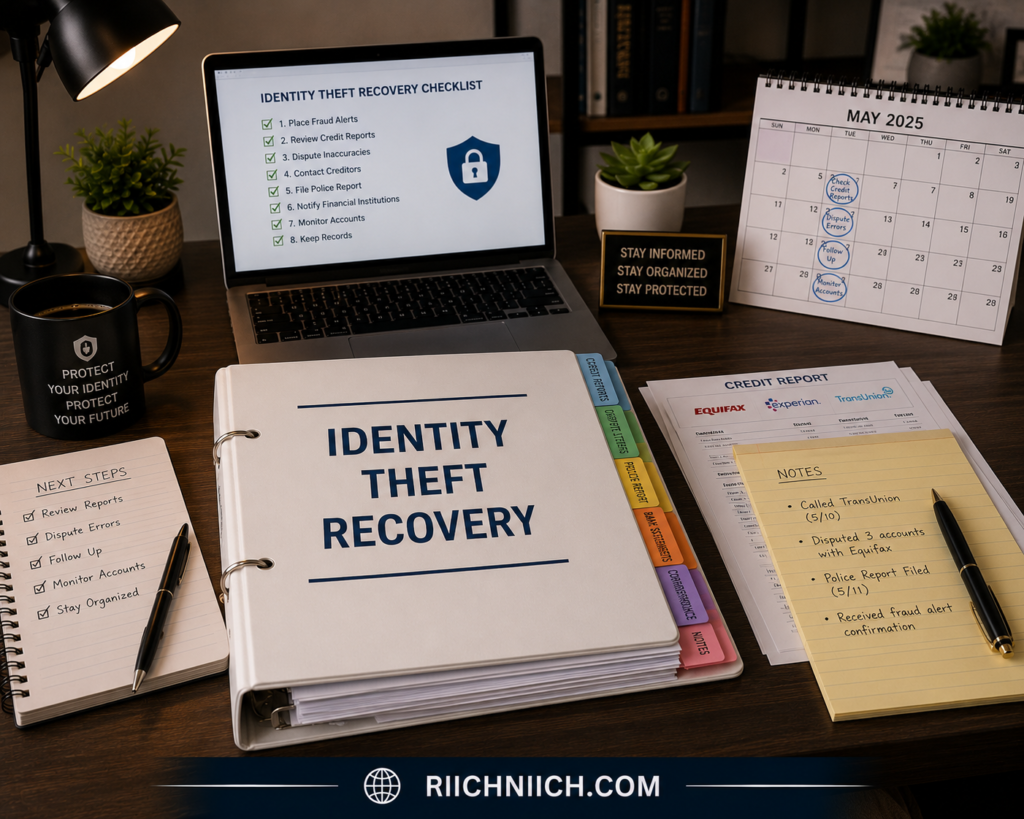
Keep a Recovery Folder
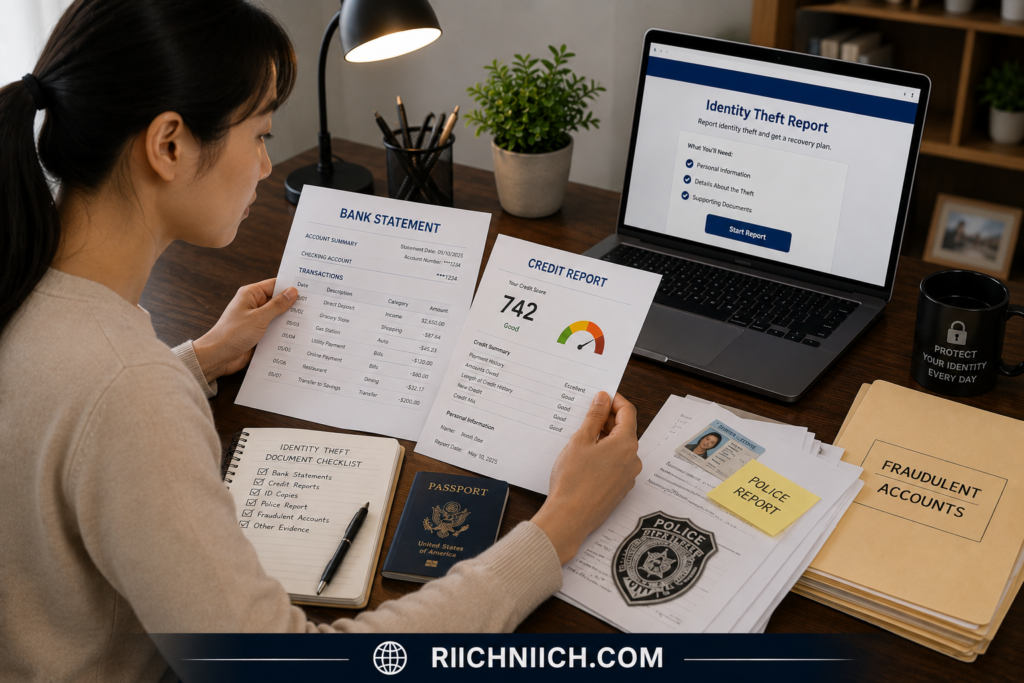
One of the smartest things you can do while completing your identity theft recovery checklist is create a dedicated folder—either physical, digital, or both—for everything related to your case.
Include items such as:
- FTC Identity Theft Report.
- Police report (if filed).
- Copies of letters and emails.
- Fraud alert confirmations.
- Credit freeze confirmations.
- Bank correspondence.
- Account dispute letters.
- Notes from phone calls, including dates, names, and reference numbers.
Keeping detailed records can save time if you need to follow up with financial institutions or dispute fraudulent activity months later.
Notify Other Organizations if Necessary
Depending on how your identity was misused, you may also need to report the incident to other agencies or organizations. For example:
- If your Social Security number was used fraudulently, you may need to contact the Social Security Administration.
- If fraudulent tax returns were filed in your name, the Internal Revenue Service (IRS) has procedures for identity theft victims.
- If your passport or driver’s license was stolen, your state’s licensing agency or the U.S. Department of State can explain the replacement process.
Reporting identity theft to the appropriate organizations early can help prevent additional misuse of your personal information.
The FTC recommends reporting identity theft as soon as you discover suspicious activity because early reporting creates an official recovery record and generates a personalized action plan. Similarly, the Internal Revenue Service and the Social Security Administration provide dedicated identity theft assistance for victims whose tax or Social Security information has been compromised.
Completing this step in your identity theft recovery checklist establishes an official paper trail that will support you throughout the recovery process. It also makes it easier to dispute fraudulent accounts, work with financial institutions, and restore your identity with confidence.
Step 4: Contact Your Banks, Credit Card Issuers, and Financial Institutions
Once you’ve reported the identity theft, the next step in your identity theft recovery checklist is to notify every financial institution where you have an account. Even if you haven’t noticed unauthorized transactions yet, contacting your financial providers immediately can help prevent additional fraud and protect your money.
Many banks and credit card companies have dedicated fraud departments that can quickly investigate suspicious activity, lock compromised accounts, issue replacement cards, and monitor for future unauthorized transactions.
Start With Your Most Important Financial Accounts
Prioritize the accounts that give criminals direct access to your money or credit.
Contact your:
- Primary checking account
- Savings account
- Credit card companies
- Mortgage lender
- Auto loan provider
- Personal loan companies
- Investment and brokerage accounts
- Retirement accounts, such as 401(k)s and IRAs
- Digital payment services like PayPal, Venmo, Cash App, or Apple Pay
Explain that you’re following an identity theft recovery checklist after discovering potential identity theft and ask what additional security measures they recommend for your specific accounts.
Ask the Fraud Department to Protect Your Accounts
When speaking with your financial institution, ask the representative whether they can:
- Freeze or temporarily lock compromised accounts.
- Issue new account numbers or replacement debit and credit cards.
- Reverse unauthorized charges when appropriate.
- Place additional fraud monitoring on your accounts.
- Require extra identity verification before approving future transactions.
- Flag your account for suspicious activity alerts.
Taking these precautions can reduce the likelihood of criminals continuing to use your financial information.
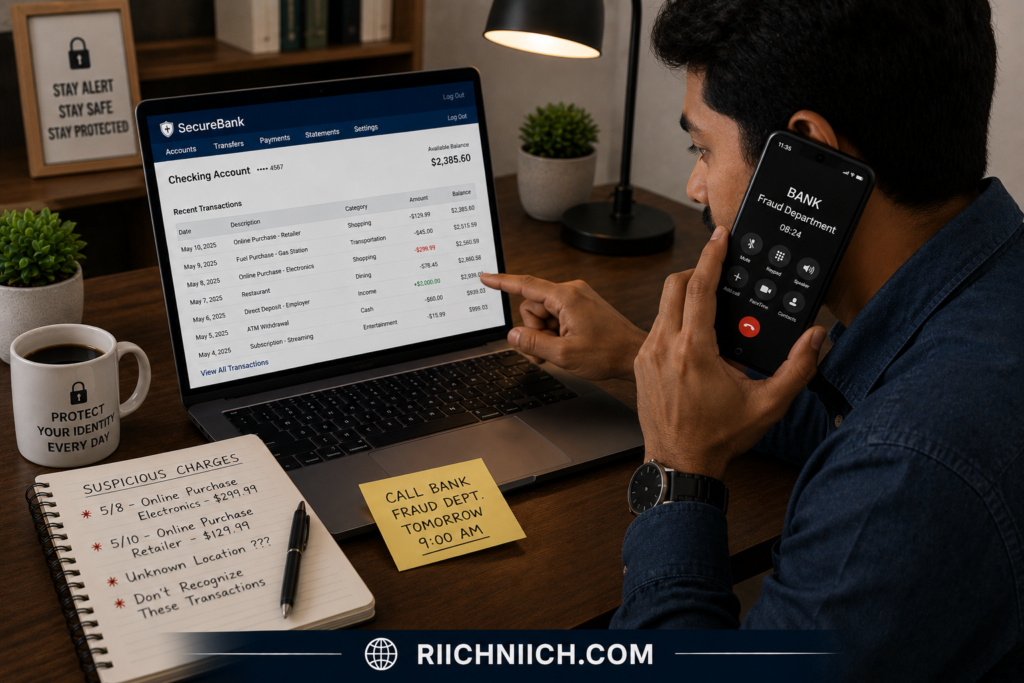
Review Recent Transactions Carefully
Don’t assume you’ll immediately recognize every fraudulent transaction. Criminals often begin with small “test purchases” to determine whether a stolen card or account is still active before making much larger purchases.
Carefully review:
- Debit card transactions
- Credit card statements
- ATM withdrawals
- Wire transfers
- Mobile payment history
- Online bill payments
- Automatic withdrawals
- Account transfers
If you find any transaction you don’t recognize, report it immediately instead of waiting for your next statement.
Keep Records of Every Conversation
As you work through your identity theft recovery checklist, document every interaction with your financial institutions.
Write down:
- The date and time of each call.
- The representative’s name.
- A reference or case number.
- The actions that were taken.
- Any follow-up steps you need to complete.
Keeping organized records can make future disputes much easier if questions arise about fraudulent activity or reimbursement.
Don’t Overlook Automatic Payments
If your bank or credit card company issues a replacement card or new account number, remember to update your automatic payments.
This may include:
- Streaming subscriptions
- Utility bills
- Insurance premiums
- Mortgage or rent payments
- Gym memberships
- Phone and internet services
- Online shopping subscriptions
Updating these payments promptly helps prevent missed bills, late fees, and unnecessary service interruptions while you’re recovering from identity theft.
Continue Monitoring Your Accounts
Even after your accounts have been secured, continue checking them frequently during the following weeks and months. Some fraudulent transactions don’t appear immediately, and criminals may wait before attempting additional unauthorized activity.
Many financial institutions now offer instant transaction alerts through their mobile apps. Enabling these notifications allows you to quickly detect suspicious purchases and respond before additional damage occurs.
The Consumer Financial Protection Bureau (CFPB) recommends reviewing your financial statements regularly after identity theft and reporting unauthorized electronic transfers or credit card charges as soon as possible. Likewise, the Federal Deposit Insurance Corporation (FDIC) encourages consumers to monitor bank accounts closely and notify their financial institution immediately if they suspect fraud.
Promptly contacting your financial institutions is one of the most important steps in an identity theft recovery checklist. The sooner your accounts are secured and monitored, the better your chances of limiting financial losses and preventing identity thieves from causing further harm.
Step 5: Review Your Credit Reports for Fraudulent Activity
A critical step in your identity theft recovery checklist is carefully reviewing your credit reports for signs of fraud. Even if you’ve already frozen your credit and contacted your financial institutions, it’s important to verify exactly what information has been reported in your name. Identity thieves often open new accounts or apply for loans long before victims realize their personal information has been misused.
Your credit reports provide a detailed history of your credit activity, making them one of the best tools for identifying fraudulent accounts and unauthorized inquiries.
Obtain Your Credit Reports
Request a copy of your credit report from each of the three major credit bureaus:
- Experian
- Equifax
- TransUnion
Although the reports contain similar information, they are not always identical. Some lenders report to only one or two bureaus, which means fraudulent activity could appear on one report but not the others. Reviewing all three reports gives you the most complete picture of your credit history.
What to Look For
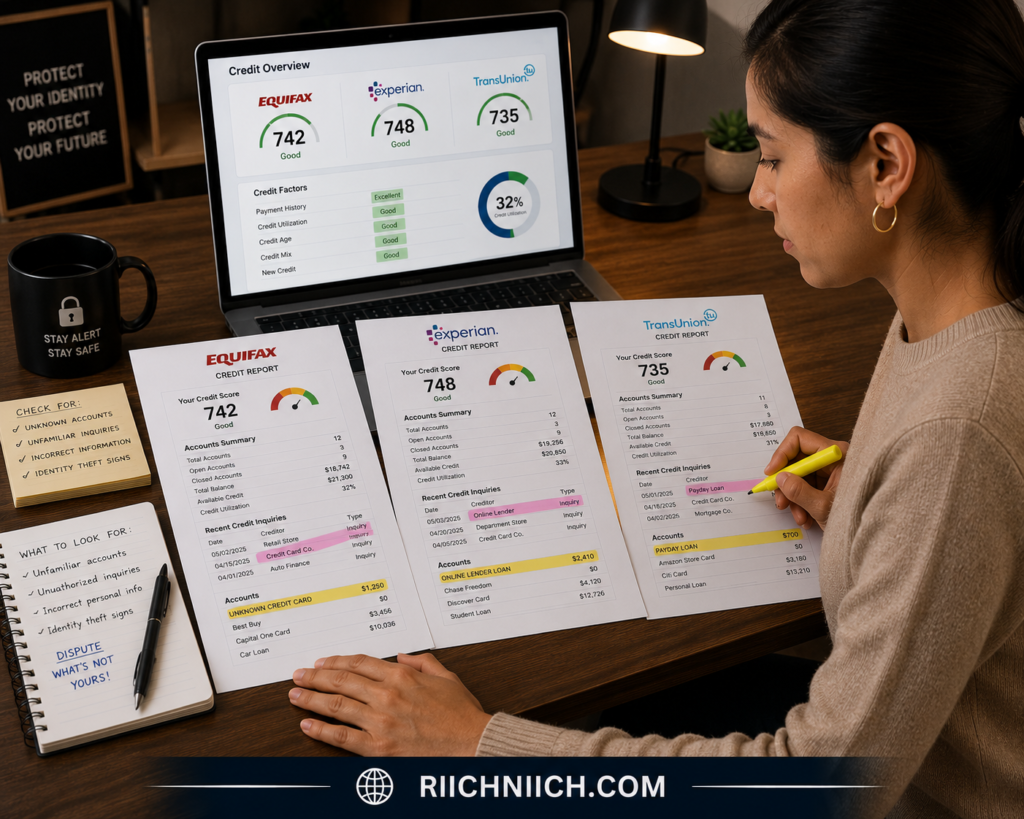
As you work through your identity theft recovery checklist, examine each credit report line by line. Even small inaccuracies can be warning signs that someone has used your identity.
Look for:
- Credit cards you never opened.
- Personal loans you didn’t apply for.
- Auto loans or mortgages you don’t recognize.
- Hard credit inquiries from unfamiliar lenders.
- Incorrect personal information, such as addresses or employers.
- Collection accounts you don’t recognize.
- Unexpected increases in outstanding balances.
- Accounts reported as late that you know were paid on time.
If you discover any unfamiliar information, document it immediately. Taking screenshots or printing copies of the affected sections can make it easier when filing disputes.
Dispute Fraudulent Information Promptly
If you find unauthorized accounts or inaccurate information, contact the appropriate credit bureau as soon as possible to begin the dispute process.
You may be asked to provide:
- Your FTC Identity Theft Report.
- A police report, if available.
- Proof of your identity.
- Copies of supporting financial documents.
- A written explanation describing the fraudulent activity.
The sooner fraudulent information is disputed, the sooner the credit bureau can investigate and determine whether it should be removed from your credit file.
Continue Monitoring Your Credit
Completing this step once isn’t enough. Identity theft recovery often takes weeks or months, and new fraudulent activity can appear after your initial review.
For that reason, continue checking your credit reports periodically while completing your identity theft recovery checklist. Ongoing monitoring allows you to identify new accounts, inquiries, or reporting errors before they become larger financial problems.
Many identity theft protection services also monitor your credit continuously and notify you when significant changes occur. Receiving real-time alerts can help you respond much faster than waiting until your next manual credit report review.
👉 If you want continuous monitoring without checking everything manually, Identity Guard includes identity monitoring, dark web monitoring, fraud alerts, and identity restoration support to help you stay protected long after completing your identity theft recovery checklist.
Don’t Ignore Small Changes
One of the biggest mistakes people make is dismissing unfamiliar information because it seems minor. A single hard inquiry, an incorrect mailing address, or a small account balance could indicate that someone is testing your identity before attempting larger forms of fraud.
Treat every unfamiliar item seriously until you’ve confirmed its legitimacy. Investigating a small issue today could prevent thousands of dollars in fraudulent debt later.
The Consumer Financial Protection Bureau (CFPB) recommends reviewing your credit reports carefully after identity theft to identify unauthorized accounts and inaccuracies that require correction. Likewise, AnnualCreditReport.com, the federally authorized website for obtaining free credit reports from all three nationwide credit bureaus, provides consumers with direct access to their reports, making it easier to monitor credit activity throughout the recovery process.
Reviewing your credit reports is one of the most important parts of an identity theft recovery checklist because it helps you understand the full extent of the damage. Identifying fraudulent accounts early allows you to dispute them more quickly, protect your credit history, and move one step closer to fully recovering from identity theft.
For a more detailed walkthrough, follow our guide on How to Check Your Credit Report for Signs of Identity Theft to make sure you don’t overlook suspicious accounts or credit inquiries.
Step 6: Replace Compromised Identification and Important Documents
Another essential step in your identity theft recovery checklist is replacing any identification or important documents that were lost, stolen, or used fraudulently. While securing your financial accounts helps prevent additional monetary losses, replacing compromised documents reduces the risk of criminals continuing to impersonate you or gain access to sensitive services.
Not every identity theft case requires replacing every document. Focus on replacing the items that were actually exposed or stolen.
Determine Which Documents Were Compromised
Start by making a list of every document that may have been accessed during the identity theft.
This could include your:
- Driver’s license
- State-issued identification card
- Social Security card
- Passport
- Birth certificate
- Permanent resident card (if applicable)
- Military identification
- Health insurance card
- Medicare or Medicaid card
- Employee identification badge
If your wallet or purse was stolen, assume that every document inside could potentially be used by criminals.
Replace Government-Issued Identification
If your driver’s license or state identification card was stolen, contact your state’s Department of Motor Vehicles (DMV) or equivalent licensing agency as soon as possible. They can explain the replacement process and, in some cases, add fraud alerts to your record if identity theft is involved.
Likewise, if your passport was lost or stolen, report it promptly and apply for a replacement through the U.S. Department of State. Reporting a stolen passport helps prevent it from being used fraudulently for travel or identification purposes.
Protect Your Social Security Number
If your Social Security card was stolen or you believe your Social Security number has been compromised, don’t automatically assume you need a new number. In many cases, replacing the physical card is sufficient, while changing your Social Security number is reserved for severe or ongoing identity theft situations.
Instead, continue following your identity theft recovery checklist by monitoring your credit, watching for suspicious financial activity, and reporting any misuse to the appropriate agencies.
Update Financial and Insurance Records
After receiving replacement documents, notify organizations that rely on your identification information if necessary.
This may include your:
- Bank
- Employer
- Insurance providers
- Healthcare providers
- Investment companies
- Government benefit programs
Keeping your records current helps prevent delays when verifying your identity in the future.
Secure Your Replacement Documents
Receiving new documents is only part of the recovery process. It’s equally important to protect them from future theft.
Consider these best practices:
- Store important documents in a locked home safe or secure filing cabinet.
- Carry only the identification you actually need each day.
- Avoid keeping your Social Security card in your wallet.
- Shred outdated documents before disposing of them.
- Store digital copies of important documents in an encrypted, password-protected location.
These simple habits can significantly reduce the risk of future identity theft.
Continue Monitoring for Identity Misuse
Even after replacing compromised documents, criminals may still attempt to use information they previously obtained. That’s why replacing identification should always be combined with the other steps in your identity theft recovery checklist, including credit monitoring, fraud alerts, and regular account reviews.
If you continue receiving suspicious mail, debt collection notices, or account alerts after replacing your documents, investigate them immediately rather than assuming the issue has been resolved.
The Social Security Administration (SSA) provides guidance for replacing lost or stolen Social Security cards and reporting concerns related to Social Security fraud. Similarly, the U.S. Department of State explains how to report and replace a lost or stolen passport, while state Departments of Motor Vehicles provide procedures for replacing driver’s licenses and state identification cards.
Replacing compromised identification documents is an important milestone in your identity theft recovery checklist. It helps restore your ability to verify your identity, reduces opportunities for criminals to misuse stolen documents, and strengthens your overall recovery from identity theft.
Step 7: Remove Fraudulent Accounts and Dispute Unauthorized Charges
Once you’ve identified fraudulent activity, the next step in your identity theft recovery checklist is to have unauthorized accounts removed and fraudulent charges reversed whenever possible. Simply finding the fraud isn’t enough—you’ll need to work with creditors, financial institutions, and credit bureaus to correct your records and prevent long-term damage to your credit history.
The sooner you begin disputing fraudulent activity, the easier it typically is to resolve. Delays can make investigations more complicated and may allow additional fraudulent transactions to occur.
Contact Every Company Involved
For each fraudulent account or unauthorized charge you discover, contact the company directly using the customer service or fraud department listed on its official website or your account statement.
You may need to contact:
- Credit card issuers
- Banks and credit unions
- Personal loan providers
- Auto finance companies
- Mortgage lenders
- Utility companies
- Wireless phone providers
- Retail financing companies
- Collection agencies
Explain that the account or transaction resulted from identity theft and ask to begin their fraud resolution process.
Gather Supporting Documentation
Most companies will ask for documentation before removing fraudulent accounts or reversing unauthorized charges.
Keep copies of documents such as:
- Your FTC Identity Theft Report.
- Police report (if available).
- Government-issued identification.
- Credit reports showing the fraudulent account.
- Bank or credit card statements.
- Emails or letters confirming suspicious activity.
- Copies of any previous dispute correspondence.
Having these documents organized can make the investigation move more smoothly and reduce delays.
Submit Disputes in Writing When Possible
Although many companies allow you to report fraud by phone, submitting your dispute in writing provides an additional layer of protection.
Include:
- Your contact information.
- The account number involved.
- A description of the fraudulent activity.
- Copies of supporting documentation.
- A request to remove fraudulent accounts or reverse unauthorized charges.
Keep copies of everything you send and note when it was submitted. If the dispute takes several weeks to resolve, having a complete paper trail will make future follow-up much easier.

Monitor the Progress of Every Dispute
As you continue your identity theft recovery checklist, don’t assume every dispute will be resolved automatically. Some investigations take several weeks, and you may need to provide additional documentation before a decision is made.
Create a simple tracking list that includes:
- Company name
- Date the dispute was filed
- Case or reference number
- Current status
- Follow-up date
- Final resolution
This helps ensure that no dispute is forgotten while you’re working with multiple organizations at the same time.
Review Updated Credit Reports
After a creditor or lender confirms that a fraudulent account has been removed, request updated copies of your credit reports to verify that the inaccurate information has actually been deleted.
Check that:
- Fraudulent accounts no longer appear.
- Incorrect balances have been corrected.
- Unauthorized hard inquiries have been removed when appropriate.
- Collection accounts related to the fraud have been deleted.
- Your personal information remains accurate.
If incorrect information still appears, contact both the creditor and the credit bureau to continue the dispute process.
Stay Alert for Additional Fraud
Unfortunately, identity thieves don’t always stop after opening one fraudulent account. They may continue attempting to use your personal information months after the initial theft.
For that reason, continue monitoring:
- Credit reports
- Bank accounts
- Credit card activity
- Loan statements
- Debt collection notices
- Identity monitoring alerts
Ongoing vigilance is an essential part of every identity theft recovery checklist and can help you detect new fraudulent activity before it causes significant financial harm.
The Consumer Financial Protection Bureau (CFPB) provides guidance for disputing inaccurate information that appears on your credit reports, while the Federal Trade Commission (FTC) recommends keeping detailed records of every dispute and communication throughout the recovery process. These official resources can help you understand your rights and navigate disputes more effectively.
Successfully removing fraudulent accounts and disputing unauthorized charges is one of the most rewarding steps in an identity theft recovery checklist. Every corrected account and reversed transaction brings you closer to restoring your credit, protecting your finances, and putting the effects of identity theft behind you.
Step 8: Continue Monitoring Your Identity for New Threats
Completing the first seven steps of your identity theft recovery checklist is a major accomplishment, but your recovery doesn’t end there. Identity thieves often keep stolen personal information for months or even years before attempting to use it again. That’s why ongoing monitoring is one of the most important long-term strategies for protecting yourself after identity theft.
The goal isn’t just to recover from identity theft—it’s to detect future threats before they become major financial problems.
Monitor Your Financial Accounts Regularly
One of the easiest ways to identify suspicious activity is by reviewing your financial accounts on a regular basis.
Check your:
- Bank accounts
- Credit card statements
- Savings accounts
- Investment accounts
- Retirement accounts
- Digital payment apps
- Loan balances
Instead of waiting for your monthly statement, consider reviewing your accounts every few days. Catching unauthorized transactions early gives your financial institution a better opportunity to investigate and limit additional losses.
Watch Your Credit Reports
Even after completing your identity theft recovery checklist, continue reviewing your credit reports throughout the year.
Look for:
- New accounts you didn’t open.
- Hard inquiries you didn’t authorize.
- Incorrect personal information.
- Unexpected balance increases.
- Collection accounts that don’t belong to you.
Many victims discover additional fraudulent activity months after their original identity theft because criminals attempt to reuse stolen information later.
Enable Security Alerts
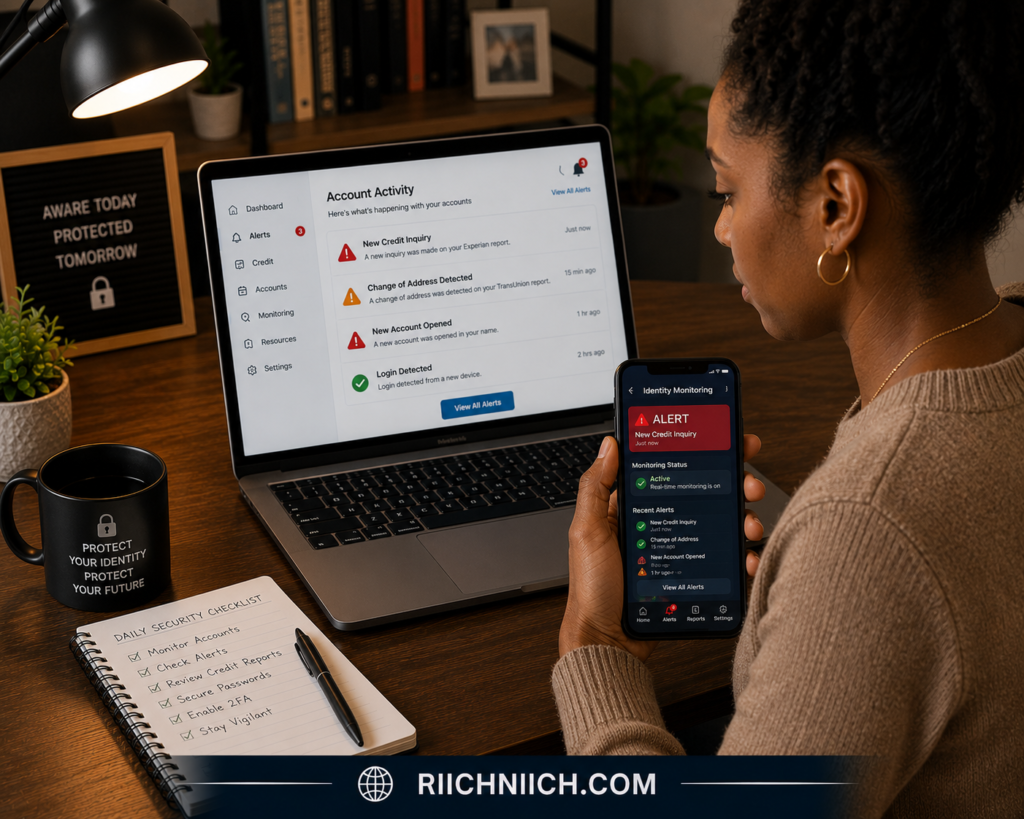
Most banks, credit card companies, and online services allow you to receive real-time notifications about account activity.
Consider enabling alerts for:
- New logins
- Password changes
- Large purchases
- Wire transfers
- International transactions
- Changes to your personal information
- New credit inquiries, when available
Receiving instant notifications allows you to respond quickly if suspicious activity occurs.
Keep Your Accounts Secure
Identity monitoring works best when combined with strong security habits.
Continue to:
- Use unique passwords for every account.
- Update passwords periodically.
- Keep multi-factor authentication enabled.
- Install software and security updates promptly.
- Be cautious of phishing emails and text messages.
- Avoid logging into sensitive accounts on unsecured public Wi-Fi.
These habits reduce the likelihood of becoming a victim of identity theft again.
Consider an Identity Theft Protection Service
While you can monitor your accounts manually, many people prefer using an identity theft protection service to automate much of the process.
Depending on the provider, these services may include:
- Identity monitoring
- Credit monitoring
- Dark web monitoring
- Financial account monitoring
- Social Security number monitoring
- Data breach notifications
- Identity restoration assistance
- Fraud resolution support
Instead of checking multiple accounts every day, you’ll receive alerts whenever suspicious activity is detected, allowing you to respond much more quickly.
If you’re evaluating different providers, choose one that offers both proactive monitoring and dedicated identity restoration support. Having experienced specialists available can save significant time and reduce stress if identity theft occurs again.
👉 If you want one service that combines identity monitoring, three-bureau credit monitoring, dark web monitoring, fraud alerts, and dedicated identity restoration support, Aura is one of the most comprehensive options available for protecting yourself after completing your identity theft recovery checklist.
Make Identity Monitoring Part of Your Routine
The most successful identity theft recovery checklist doesn’t end after a few weeks—it becomes part of your long-term financial security routine.
Set a recurring reminder each month to:
- Review your bank and credit card statements.
- Check your credit reports periodically.
- Update important account passwords when needed.
- Remove unused online accounts.
- Verify that your contact information is current.
- Review recent account login activity.
These simple habits take only a few minutes but can help you detect fraud before it causes serious financial or credit damage.
The Cybersecurity and Infrastructure Security Agency (CISA) encourages consumers to maintain strong cybersecurity habits, including multi-factor authentication and regular account monitoring, to reduce the risk of future identity theft. Likewise, the Federal Trade Commission (FTC) recommends continuing to watch financial accounts and credit reports after recovering from identity theft because stolen personal information may be used long after the initial incident.
Continuing to monitor your identity is the final—and ongoing—step in your identity theft recovery checklist. By staying proactive and responding quickly to suspicious activity, you can better protect your credit, finances, and personal information while reducing the risk of becoming a victim again.
Common Mistakes That Can Slow Your Identity Theft Recovery
Following an identity theft recovery checklist can significantly reduce the financial and emotional impact of identity theft, but even small mistakes can delay your recovery or allow criminals to continue misusing your personal information. Knowing what to avoid is just as important as knowing what steps to take.
Here are some of the most common mistakes people make during the identity theft recovery process.
Waiting Too Long to Take Action
One of the biggest mistakes is assuming the suspicious activity will resolve itself. Identity thieves often move quickly, opening new accounts, making purchases, or attempting additional fraud before victims realize what’s happening.
The sooner you begin your identity theft recovery checklist, the greater your chances of limiting financial losses and preventing additional fraudulent activity.
Only Freezing Credit at One Credit Bureau
Some people freeze their credit with only one credit bureau and assume they’re fully protected. Unfortunately, lenders don’t all use the same credit bureau when reviewing credit applications.
To maximize your protection, place a security freeze with Experian, Equifax, and TransUnion. Leaving one credit report unfrozen could still allow criminals to open new accounts in your name.
Reusing Old Passwords
Changing your passwords is essential after identity theft, but replacing an old password with a slight variation isn’t enough.
Avoid passwords like:
- Password123 → Password124
- SmithFamily2025 → SmithFamily2026
Instead, create completely unique, randomly generated passwords for every account. A password manager can make this much easier while improving your overall online security.
Ignoring Small Signs of Fraud
Many victims overlook small warning signs because they don’t seem serious.
Examples include:
- A $1 unauthorized charge.
- A hard inquiry from an unfamiliar lender.
- A password reset email you didn’t request.
- A new mailing address appearing on your credit report.
- A bill for an unfamiliar service.
Identity thieves often begin with small actions to test whether an account is actively monitored before attempting larger forms of fraud.
Failing to Keep Good Records
Identity theft recovery usually involves communicating with multiple organizations over several weeks or months. Without organized records, it becomes much harder to track disputes and follow up when necessary.
Keep copies of:
- FTC Identity Theft Report.
- Credit reports.
- Police reports.
- Dispute letters.
- Bank correspondence.
- Confirmation emails.
- Case numbers.
- Notes from phone conversations.
A well-organized recovery folder can save hours of frustration later.
Stopping Account Monitoring Too Soon
Some victims assume the problem is over once fraudulent accounts have been removed. Unfortunately, stolen personal information can continue circulating among criminals long after the initial identity theft.
Continue monitoring:
- Credit reports
- Bank accounts
- Credit cards
- Loan accounts
- Identity monitoring alerts
- Email security notifications
Ongoing monitoring is one of the most effective ways to detect new fraudulent activity before it becomes a larger problem.
Trying to Handle Everything From Memory
Identity theft recovery involves many important deadlines, phone calls, and follow-up actions. Trying to remember everything without a written plan often leads to missed steps.
Using a comprehensive identity theft recovery checklist allows you to track completed tasks, prioritize your next actions, and ensure that nothing important is overlooked. Many people also find it helpful to create a simple timeline showing when each recovery step was completed and when follow-up actions are required.
Not Considering Ongoing Identity Protection
Recovering from identity theft is only part of the process. Protecting yourself against future incidents is equally important.
Many identity theft protection services provide continuous monitoring, fraud alerts, dark web monitoring, and identity restoration support that can help detect suspicious activity much earlier than manual monitoring alone. If your personal information has already been exposed once, investing in ongoing protection may help reduce the risk of dealing with another lengthy recovery process.
The Federal Trade Commission (FTC) encourages identity theft victims to maintain organized records throughout the recovery process and continue monitoring their financial accounts after resolving fraudulent activity. Similarly, the Cybersecurity and Infrastructure Security Agency (CISA) recommends practicing strong cybersecurity habits, such as using unique passwords and enabling multi-factor authentication, to reduce the likelihood of future identity theft.
Avoiding these common mistakes can make your identity theft recovery checklist far more effective. By acting quickly, staying organized, and continuing to monitor your identity after the initial recovery, you’ll be better prepared to protect your finances, preserve your credit, and reduce the chances of becoming a victim again.
How Long Does the Identity Theft Recovery Checklist Process Take?
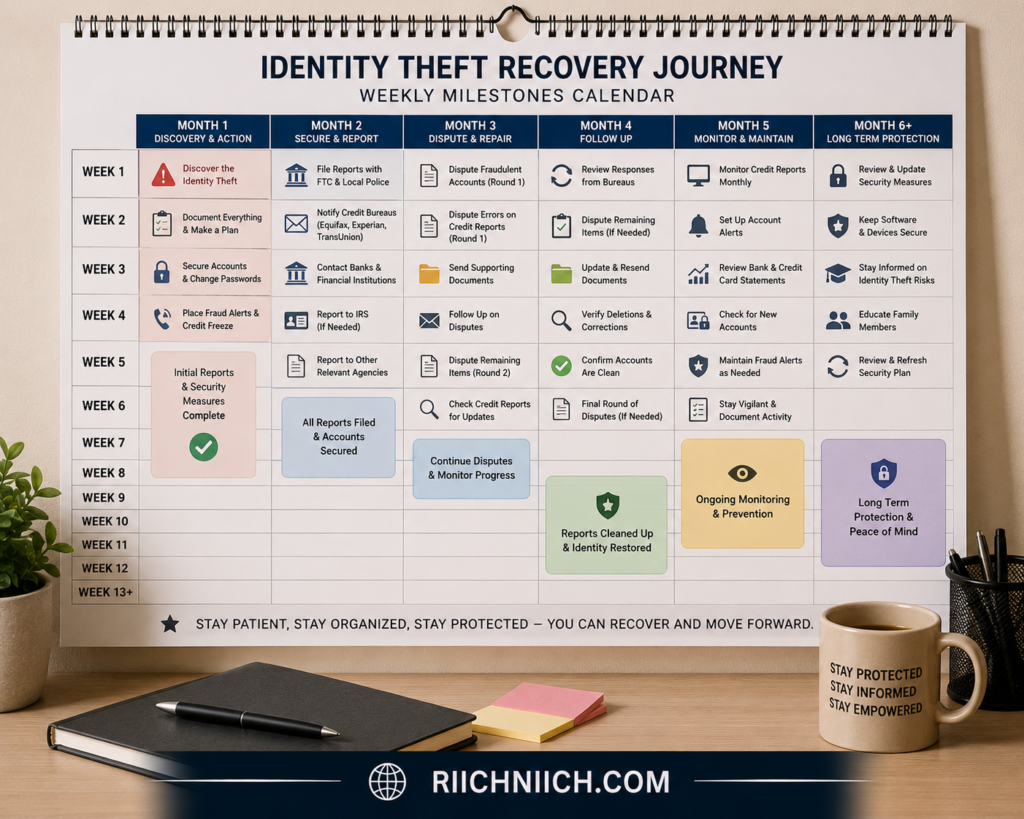
One of the most common questions victims ask is, “How long will it take to recover from identity theft?” The honest answer is that it depends on the type of fraud involved and how quickly you begin following an identity theft recovery checklist.
Some people complete the initial recovery steps in just a few hours, while others spend several months resolving fraudulent accounts, disputing inaccurate credit information, and restoring their financial records. The more organized and proactive you are, the smoother the recovery process is likely to be.
The First 24 to 48 Hours
The first two days are the most critical. During this time, your goal is to stop criminals from causing additional damage.
Most people can complete these tasks within the first 24 to 48 hours:
- Change passwords on important online accounts.
- Enable multi-factor authentication.
- Freeze credit with all three major credit bureaus.
- Report the identity theft to the FTC.
- Contact banks and credit card companies.
- Replace compromised payment cards.
- Begin documenting the recovery process.
Completing these actions quickly can significantly reduce the chances of additional fraudulent activity.
The First Few Weeks
During the next several weeks, you’ll begin working through the administrative side of your identity theft recovery checklist.
This often includes:
- Reviewing credit reports.
- Disputing fraudulent accounts.
- Responding to requests for additional documentation.
- Replacing identification documents.
- Following up with creditors and lenders.
- Monitoring financial accounts for new suspicious activity.
Some disputes may be resolved quickly, while others require multiple rounds of communication before they are finalized.
One to Six Months
Many identity theft cases continue for several months, especially if multiple financial institutions or credit bureaus are involved.
During this stage, you may need to:
- Verify that fraudulent accounts have been removed.
- Confirm corrections appear on your credit reports.
- Continue monitoring your credit and financial accounts.
- Respond to additional creditor requests.
- Update financial records after receiving replacement documents.
Staying organized during this period makes it much easier to manage multiple investigations simultaneously.
Some Cases Can Take Longer
While many victims recover within a few months, more complex situations can take significantly longer.
Examples include:
- Criminal identity theft.
- Tax identity theft.
- Medical identity theft.
- Social Security fraud.
- Multiple fraudulent loans or credit accounts.
- Identity theft involving several family members.
These situations often require additional documentation, extended investigations, and coordination with multiple government agencies and financial institutions.
Factors That Affect Recovery Time
Every identity theft case is different. Several factors can influence how long your identity theft recovery checklist takes to complete.
These include:
- How quickly the fraud was discovered.
- The number of compromised accounts.
- Whether your Social Security number was involved.
- The responsiveness of financial institutions.
- The complexity of credit disputes.
- How organized your documentation is.
- Whether you have ongoing identity monitoring.
In general, victims who begin the recovery process immediately and keep detailed records often resolve issues faster than those who delay taking action.
Can Identity Theft Protection Speed Up Recovery?
Although no service can erase the effects of identity theft overnight, many identity theft protection providers offer identity restoration specialists who can guide you through the recovery process. Instead of handling every phone call, dispute, and document request on your own, you’ll have experienced professionals helping you navigate each step.
Many services also provide continuous monitoring and real-time fraud alerts, allowing you to identify new suspicious activity before it becomes a larger problem. This can reduce the likelihood of future recovery efforts and give you greater peace of mind after completing your identity theft recovery checklist.
The Federal Trade Commission (FTC) notes that recovery time varies depending on the severity of the identity theft and the number of organizations involved. Likewise, the Consumer Financial Protection Bureau (CFPB) emphasizes the importance of responding promptly to fraudulent activity and maintaining organized records throughout the recovery process.
While every situation is unique, following a comprehensive identity theft recovery checklist can help you recover more efficiently and reduce unnecessary delays. Acting quickly, staying organized, and continuing to monitor your identity are the best ways to restore your financial security and move forward with confidence.
Best Tools to Help You Complete an Identity Theft Recovery Checklist
Completing an identity theft recovery checklist doesn’t have to be overwhelming. While you can handle every recovery step yourself, the right tools can save time, reduce stress, and help you detect new threats before they cause additional damage.
Below are some of the most useful types of tools to consider while recovering from identity theft.
Identity Theft Protection Services
Identity theft protection services are designed to monitor your personal information continuously and notify you if suspicious activity is detected. Many providers also include identity restoration specialists who can guide you through the recovery process if your identity is compromised again.
Common features include:
- Identity monitoring
- Credit monitoring
- Dark web monitoring
- Fraud alerts
- Social Security number monitoring
- Financial account monitoring
- Identity restoration assistance
- Identity theft insurance (depending on the provider)
If you’re looking for a solution that combines monitoring with expert recovery assistance, an identity theft protection service can be one of the most valuable investments after completing your identity theft recovery checklist.
If you’re comparing providers, our guide to the Best Identity Theft Protection Services reviews the top options based on monitoring features, recovery assistance, pricing, and overall value.
Password Managers
One of the first steps in recovering from identity theft is changing passwords across dozens of online accounts. Trying to create and remember unique passwords for every website can be frustrating.
A password manager helps by:
- Generating strong, unique passwords.
- Securely storing login credentials.
- Automatically filling passwords when you sign in.
- Alerting you if saved passwords appear in known data breaches.
👉 If you’re ready to stop reusing passwords after recovering from identity theft, NordPass securely stores your login credentials and generates strong, unique passwords for every account, making it much easier to protect yourself going forward.
Credit Monitoring Services
Even after you’ve frozen your credit, it’s important to continue watching for changes to your credit file.
Credit monitoring services can notify you about:
- New credit inquiries.
- Newly opened accounts.
- Significant changes to your credit reports.
- Changes to your personal information.
- Potential signs of identity theft.
Receiving alerts quickly allows you to respond before fraudulent activity becomes more serious.
Secure Cloud Storage
Identity theft recovery often requires collecting important documents, including:
- FTC Identity Theft Report.
- Credit reports.
- Bank statements.
- Police reports.
- Dispute letters.
- Replacement identification documents.
Storing encrypted digital copies in a secure cloud storage service provides an additional backup if physical documents are lost or damaged. Just be sure your cloud account is protected with a strong password and multi-factor authentication.
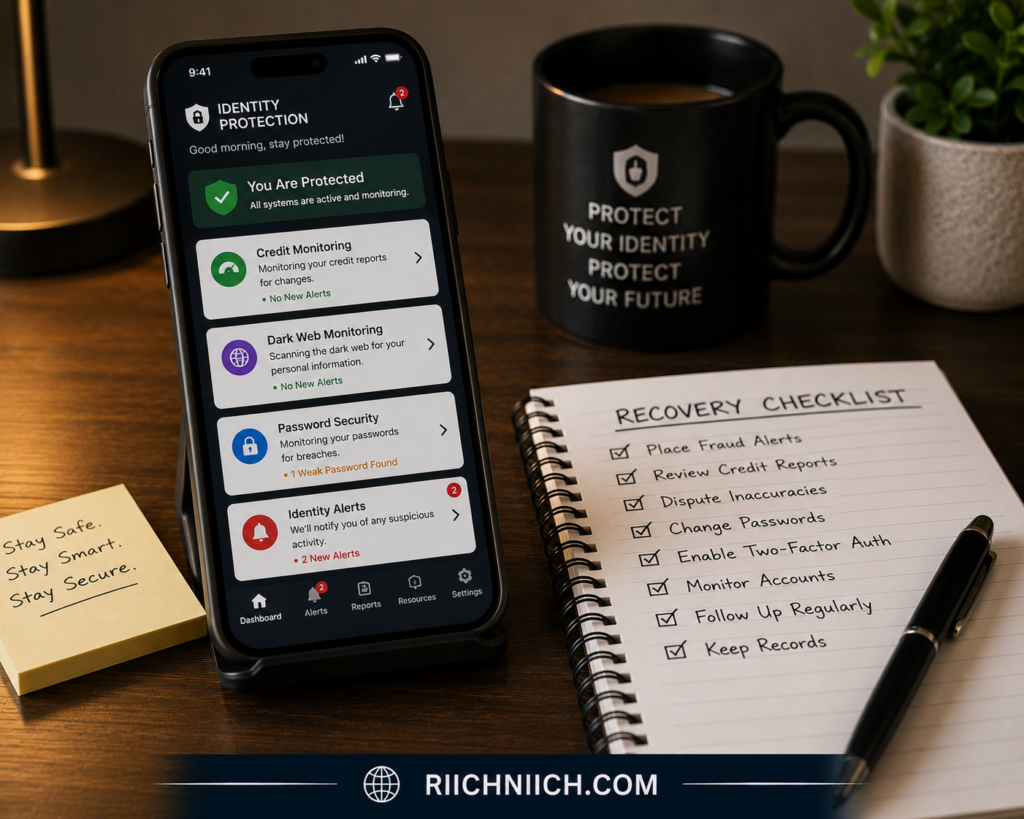
Identity Monitoring Apps
Many identity theft protection providers offer mobile apps that allow you to monitor your identity from anywhere.
These apps often provide:
- Real-time fraud alerts.
- Credit monitoring updates.
- Dark web monitoring notifications.
- Security recommendations.
- Account monitoring dashboards.
Having this information readily available on your smartphone makes it easier to stay informed throughout your recovery.
Which Tool Is Right for You?
The best solution depends on your situation.
If you experienced a minor data breach, improving your passwords and enabling account alerts may provide enough protection.
However, if your Social Security number, financial accounts, or multiple forms of personal information were compromised, a comprehensive identity theft protection service may provide additional peace of mind by combining monitoring, fraud alerts, and recovery assistance into a single platform.
If you’re comparing providers, prioritize services that include:
- Identity restoration specialists
- Continuous identity monitoring
- Three-bureau credit monitoring (when available)
- Dark web monitoring
- Financial account monitoring
- Fast fraud alerts
- Clear recovery guidance
Choosing a service with these features can make completing your identity theft recovery checklist much easier while reducing the likelihood of future identity theft.
Organizations such as the Cybersecurity and Infrastructure Security Agency (CISA) recommend using strong passwords, multi-factor authentication, and ongoing account monitoring as part of a long-term cybersecurity strategy.
The right tools won’t prevent every type of identity theft, but they can make your identity theft recovery checklist much easier to manage. By combining proactive monitoring, stronger account security, and expert recovery assistance, you’ll be better prepared to protect your personal information long after the initial recovery process is complete.
Is an Identity Theft Recovery Checklist Worth Following?
Yes—an identity theft recovery checklist is absolutely worth following if your personal information has been stolen, exposed, or used without your permission. Identity theft can quickly become overwhelming, especially when you’re dealing with multiple financial institutions, credit bureaus, and government agencies at the same time. A structured checklist keeps you organized and helps ensure you don’t miss important recovery steps.
Instead of wondering what to do next, an identity theft recovery checklist provides a logical order of actions that helps you:
- Secure compromised online accounts.
- Prevent criminals from opening new credit accounts.
- Report identity theft to the appropriate agencies.
- Recover fraudulent funds and accounts.
- Protect your credit history.
- Reduce the risk of future identity theft.
Following a checklist also helps you stay focused during a stressful situation. Rather than trying to solve everything at once, you can work through one task at a time and track your progress as each step is completed.
A Checklist Helps You Recover Faster
One of the biggest benefits of using an identity theft recovery checklist is that it encourages immediate action. Many victims lose valuable time because they aren’t sure where to begin.
By following a proven recovery process, you can prioritize the most urgent tasks first, such as securing your accounts, freezing your credit, and reporting the fraud. Completing these high-priority actions early can prevent identity thieves from causing additional financial damage.
It Reduces the Risk of Missing Important Steps
Identity theft recovery often involves dozens of individual tasks. It’s easy to overlook something important, especially if you’re dealing with multiple fraudulent accounts.
A comprehensive identity theft recovery checklist serves as a roadmap, helping you remember critical actions such as:
- Replacing compromised identification documents.
- Reviewing all three credit reports.
- Disputing fraudulent accounts.
- Updating automatic payments after receiving replacement cards.
- Continuing to monitor your identity after the initial recovery.
Completing every step gives you the best chance of fully restoring your financial security.
It Makes Communication Easier
Recovering from identity theft usually requires conversations with banks, creditors, insurance companies, credit bureaus, and government agencies.
An organized identity theft recovery checklist helps you keep track of:
- Who you’ve contacted.
- When you contacted them.
- Case or reference numbers.
- Documents you’ve submitted.
- Outstanding follow-up actions.
This organization can save significant time if questions arise later or if additional fraudulent activity is discovered.

Ongoing Protection Is Just as Important
Completing an identity theft recovery checklist doesn’t mean your personal information is no longer at risk. In many cases, stolen information continues circulating online long after the initial identity theft has been resolved.
For that reason, many victims choose to add ongoing identity protection after completing their recovery.
A quality identity theft protection service can help by providing:
- Continuous identity monitoring.
- Dark web monitoring.
- Credit monitoring.
- Fraud alerts.
- Identity restoration specialists.
- Assistance if suspicious activity returns.
These services don’t replace your recovery efforts, but they can help detect future threats much earlier and provide additional support if another incident occurs.
The Bottom Line
If you’ve experienced identity theft, following an identity theft recovery checklist is one of the smartest decisions you can make. It provides structure during a stressful situation, reduces the chances of overlooking important recovery steps, and helps you regain control of your financial and personal information more efficiently.
The Federal Trade Commission (FTC) encourages victims to follow a structured recovery plan because the appropriate steps can vary depending on the type of identity theft involved. Likewise, the Consumer Financial Protection Bureau (CFPB) recommends acting quickly and keeping detailed records throughout the recovery process to improve your chances of resolving fraud successfully.
While no checklist can completely eliminate the effects of identity theft, following a comprehensive identity theft recovery checklist gives you a clear path toward recovery. Combined with strong security habits and ongoing identity monitoring, it can help you protect your credit, safeguard your finances, and reduce the likelihood of becoming a victim again.
Pros & Cons of Using an Identity Theft Recovery Checklist
An identity theft recovery checklist is one of the most effective tools for organizing your recovery after identity theft, but like any resource, it has both strengths and limitations. Understanding the pros and cons can help you set realistic expectations and decide whether additional identity protection tools or professional assistance are worth considering.
Pros
Keeps You Organized During a Stressful Time
Recovering from identity theft often involves contacting banks, credit bureaus, government agencies, creditors, and other organizations. An identity theft recovery checklist gives you a clear sequence of actions, helping you stay organized instead of wondering what to do next.
Helps Reduce Costly Mistakes
When emotions are high, it’s easy to overlook an important recovery step. A structured identity theft recovery checklist lowers the risk of forgetting critical tasks like freezing your credit, replacing compromised documents, or disputing fraudulent accounts.
Saves Time
Rather than researching every step individually, a comprehensive identity theft recovery checklist provides a proven recovery process that helps you move through the situation more efficiently.
Improves Your Chances of Recovering Faster
Acting quickly can significantly reduce the damage caused by identity theft. Following a checklist encourages you to secure accounts, report fraud, and notify financial institutions before criminals have more opportunities to misuse your personal information.
Works for Many Types of Identity Theft
Whether you’ve experienced financial identity theft, account takeover, tax fraud, medical identity theft, or a data breach, the core principles of an identity theft recovery checklist apply to most situations. You can adapt the checklist to your specific circumstances while still following a logical recovery process.
Cons
Recovery Can Still Take Time
Even with a detailed identity theft recovery checklist, resolving identity theft isn’t always quick. Credit disputes, fraud investigations, and account corrections can take weeks or even months, depending on the complexity of your case.
Every Situation Is Different
No checklist can account for every possible scenario. Some victims may need additional steps involving the Internal Revenue Service, Social Security Administration, insurance companies, or state agencies based on the type of fraud they experienced.
You’ll Still Need to Do the Work
An identity theft recovery checklist tells you what needs to be done, but you’ll still need to contact organizations, complete paperwork, submit documentation, and follow up on disputes. The checklist simplifies the process—it doesn’t eliminate it.
Ongoing Monitoring Is Still Necessary
Completing the checklist doesn’t guarantee your information won’t be misused again. Criminals may hold stolen personal information for months or years before attempting another attack. That’s why continuing to monitor your identity remains an important part of long-term protection.

Should You Use Additional Identity Protection?
For many people, the answer is yes. An identity theft recovery checklist is an excellent roadmap, but pairing it with an identity theft protection service can make the recovery process much easier.
Many services offer features such as:
- Continuous identity monitoring
- Credit monitoring
- Dark web monitoring
- Financial account alerts
- Identity restoration specialists
- Fraud resolution support
These tools can help you identify suspicious activity sooner and provide expert assistance if your identity is compromised again.
The Federal Trade Commission (FTC) recommends staying organized and maintaining records throughout the identity theft recovery process, while the Cybersecurity and Infrastructure Security Agency (CISA) encourages consumers to combine recovery efforts with strong cybersecurity practices such as multi-factor authentication and ongoing account monitoring.
Overall, the advantages of using an identity theft recovery checklist far outweigh the drawbacks. While it won’t eliminate every challenge associated with identity theft, it provides a clear, organized framework for recovering your identity, protecting your finances, and reducing the risk of future fraud.
Frequently Asked Questions About an Identity Theft Recovery Checklist
What is an identity theft recovery checklist?
An identity theft recovery checklist is a step-by-step guide that helps victims recover after their personal information has been stolen or misused. It typically includes securing online accounts, freezing credit, reporting the identity theft, reviewing credit reports, disputing fraudulent accounts, replacing compromised documents, and monitoring your identity for future threats.
How soon should I start an identity theft recovery checklist?
Immediately. The sooner you begin an identity theft recovery checklist, the better your chances of preventing additional financial losses and stopping criminals from opening new accounts or accessing your existing ones. Delaying action gives identity thieves more time to misuse your personal information.
Can I complete an identity theft recovery checklist by myself?
Yes. Many people successfully complete an identity theft recovery checklist on their own by working directly with banks, credit bureaus, government agencies, and creditors. However, if your case is complex or involves multiple fraudulent accounts, an identity theft protection service with identity restoration specialists can provide valuable assistance throughout the recovery process.
Should I freeze my credit during an identity theft recovery checklist?
Yes. Freezing your credit with Experian, Equifax, and TransUnion is one of the most important steps in an identity theft recovery checklist. A credit freeze helps prevent criminals from opening new credit accounts or loans in your name while you recover.
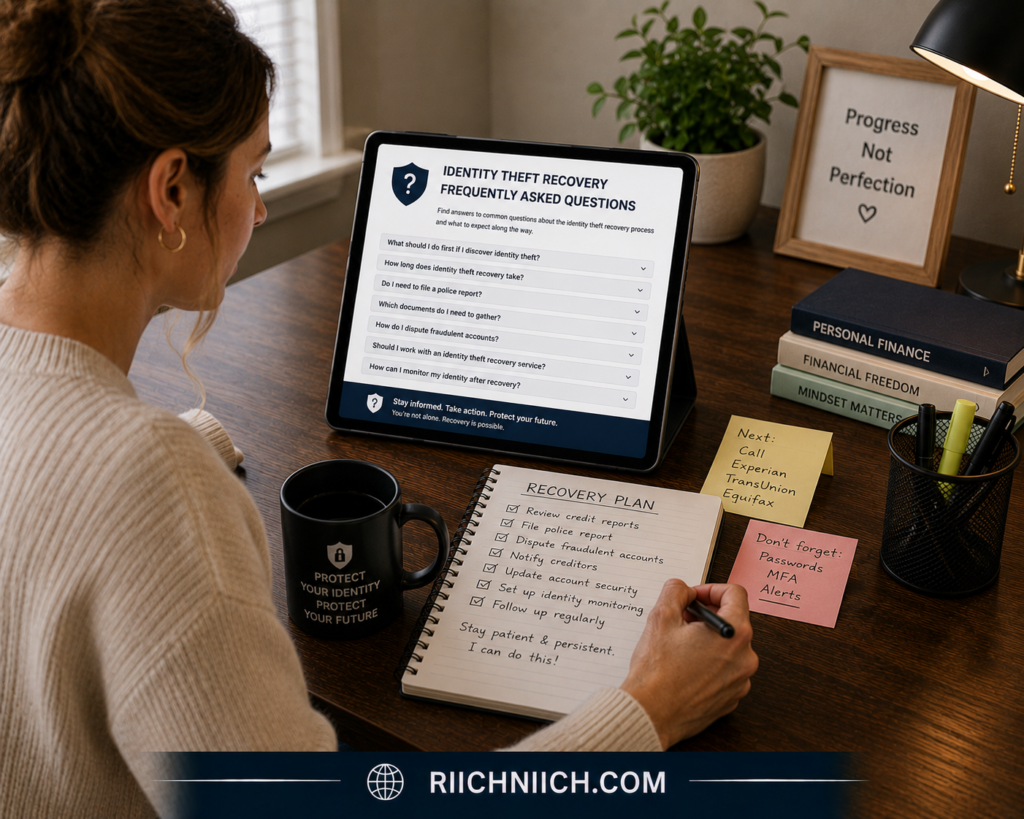
Do I need to file a police report?
Not always. Many identity theft cases can be handled by filing a report through the Federal Trade Commission’s IdentityTheft.gov website. However, a police report may be recommended if your driver’s license was stolen, someone used your identity during a criminal investigation, a creditor requests one, or local law enforcement advises filing a report.
How long does an identity theft recovery checklist take to complete?
The initial recovery steps can often be completed within a day or two, but resolving fraudulent accounts and correcting your credit reports may take several weeks or even months. More complicated cases involving tax fraud, Social Security fraud, or multiple fraudulent accounts usually require additional time.
What documents should I keep during the recovery process?
As you complete your identity theft recovery checklist, keep copies of:
- Your FTC Identity Theft Report
- Police report (if applicable)
- Credit reports
- Bank and credit card statements
- Dispute letters
- Fraud confirmation emails
- Case numbers
- Notes from conversations with financial institutions and government agencies
Maintaining organized records makes it much easier to track your progress and resolve disputes.
Can someone steal my identity again after I’ve recovered?
Unfortunately, yes. Recovering from identity theft doesn’t automatically prevent future attacks. That’s why your identity theft recovery checklist should include long-term account monitoring, strong passwords, multi-factor authentication, and regular reviews of your credit reports and financial accounts.
Is an identity theft protection service worth it after completing an identity theft recovery checklist?
For many people, yes. If your personal information has already been compromised, ongoing identity monitoring can help detect suspicious activity much sooner than manual monitoring alone. Many identity theft protection services also include dark web monitoring, fraud alerts, and identity restoration assistance if new problems arise.
Where can I find official identity theft recovery information?
Trusted organizations such as the Federal Trade Commission (FTC) provide personalized recovery plans through IdentityTheft.gov, while the Consumer Financial Protection Bureau (CFPB) offers educational resources about protecting your finances and responding to fraud. These official resources can complement your identity theft recovery checklist and help you navigate the recovery process with confidence.
Conclusion: Is an Identity Theft Recovery Checklist Enough to Protect Your Identity?
An identity theft recovery checklist is one of the most valuable resources you can follow after discovering that your personal information has been compromised. It provides a clear, organized plan for securing your accounts, protecting your credit, reporting the fraud, disputing unauthorized activity, and restoring your financial security.
However, while an identity theft recovery checklist is essential for recovering from identity theft, it isn’t designed to prevent future attacks on its own.
To reduce your chances of going through this recovery process again, read our guide on How to Protect Yourself From Identity Theft for practical strategies that help prevent identity theft before it happens.
Identity thieves are constantly developing new ways to obtain personal information through data breaches, phishing scams, malware, stolen devices, and social engineering. Even after you’ve completed every recovery step, your personal information could still be exposed in future incidents. That’s why long-term protection is just as important as recovery.
To reduce your risk going forward, consider combining your identity theft recovery checklist with proactive security habits, including:
- Using strong, unique passwords for every account.
- Enabling multi-factor authentication wherever available.
- Reviewing your financial accounts regularly.
- Monitoring your credit reports throughout the year.
- Being cautious of phishing emails, phone calls, and text messages.
- Keeping your devices and software updated.
- Limiting how much personal information you share online.
For many people, adding an identity theft protection service provides another layer of security after completing their recovery. Services that include identity monitoring, credit monitoring, dark web monitoring, fraud alerts, and identity restoration assistance can help detect suspicious activity much earlier than manual monitoring alone. If your information has already been compromised once, having continuous monitoring may provide additional peace of mind and help you respond more quickly if another incident occurs.
If you’re comparing identity theft protection providers, look for features such as:
- Continuous identity monitoring
- Three-bureau credit monitoring (when available)
- Dark web monitoring
- Financial account monitoring
- Identity restoration specialists
- Fast fraud alerts
- Identity theft insurance, if included
Choosing a provider with these features can complement your identity theft recovery checklist by helping you identify and respond to new threats before they cause significant financial damage.

Recovering from identity theft isn’t just about fixing today’s problems—it’s about reducing tomorrow’s risks. The Federal Trade Commission (FTC) continues to encourage consumers to report identity theft promptly and follow a structured recovery plan, while the Cybersecurity and Infrastructure Security Agency (CISA) recommends maintaining strong cybersecurity habits long after the recovery process is complete.
If you’ve experienced identity theft, don’t wait for another warning sign before taking action. Start following a comprehensive identity theft recovery checklist immediately, complete every recovery step carefully, and consider adding ongoing identity protection to help safeguard your personal information in the future. Recovering from identity theft takes time, but with the right plan and the right tools, you can regain control of your identity, protect your finances, and move forward with greater confidence.


Pingback: What Happens If Someone Has Your Social Security Number? - Riich Niich