Best Identity Theft Protection for Families (2026 Guide) — if you’re here, you’re likely looking for real protection for the people who matter most. With identity theft affecting millions of Americans each year, families face unique risks: multiple Social Security numbers, shared financial accounts, connected devices, and children whose credit profiles can be exploited for years without detection.
This guide breaks down the top identity theft protection plans for families in 2026 — comparing features, pricing, monitoring strength, restoration support, and overall value. If you want to compare every leading provider side-by-side — not just family plans — see our full breakdown of the Best Identity Theft Protection Services for 2026. Whether you’re protecting young children, teenagers, or a large household with multiple devices, you’ll find clear recommendations to help you choose the right plan with confidence. If you’re specifically looking to protect older parents or retirees, see our guide to the Best Identity Theft Protection for Seniors.
Table of Contents
Why Families Are More Vulnerable to Identity Theft
Families face a higher risk of identity theft because there are multiple people, accounts, and data points to protect.
Children are especially vulnerable because identity theft can go undetected for years.
The more accounts, devices, and financial activity your household has, the larger your exposure becomes.
This is why family-level protection matters — not just individual monitoring.
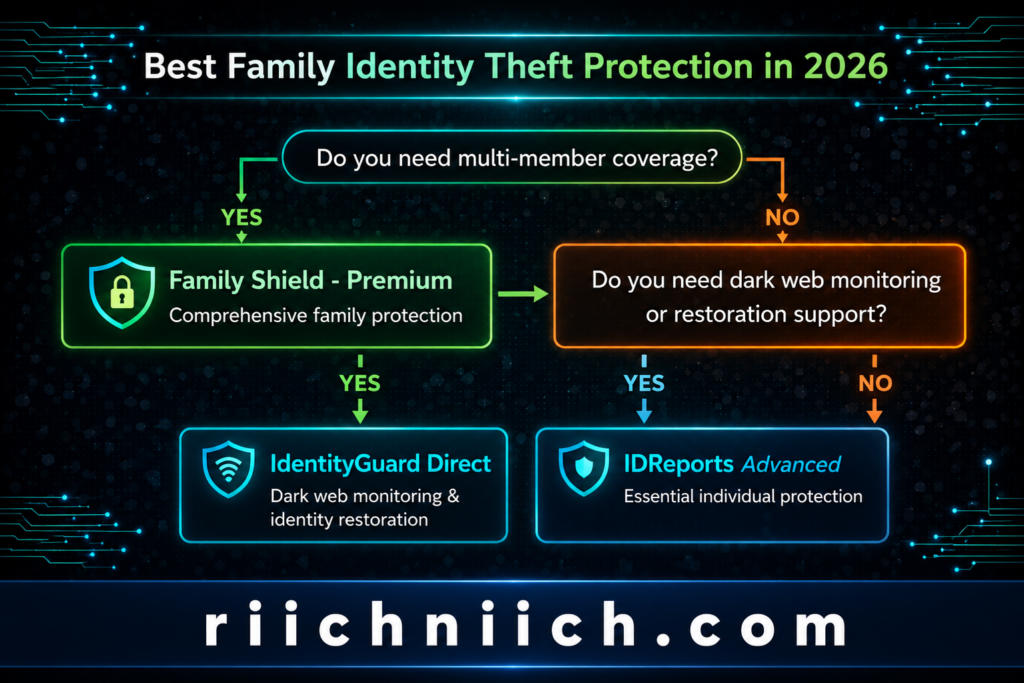
🔥 Quick Answer: Best Identity Theft Protection for Families
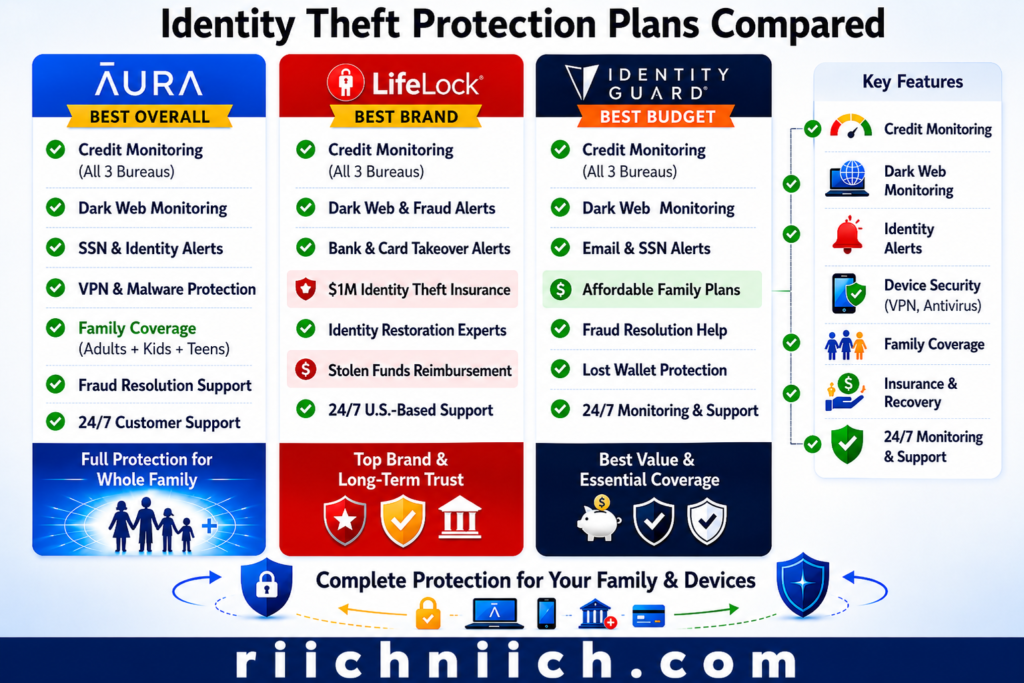
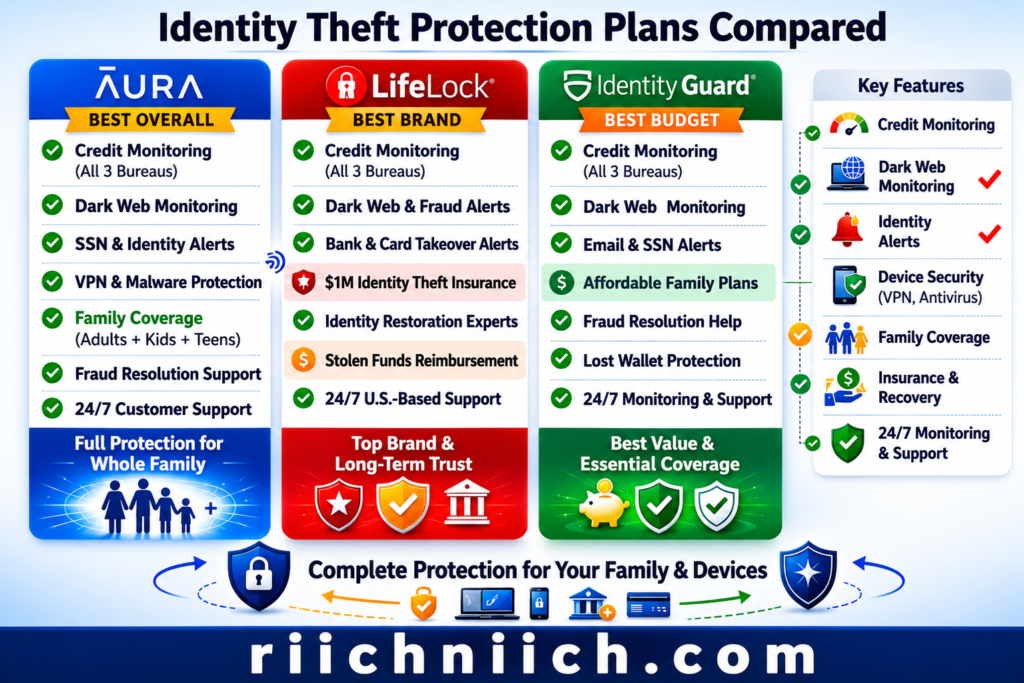
If you want the best identity theft protection for your entire family, Aura is the top choice for most households in 2026.
It allows you to monitor adults and children, detect fraud early, and respond quickly — all from one simple dashboard.
When searching for the Best Identity Theft Protection for Families (2026 Guide), most parents aren’t casually browsing — they’re actively looking to protect:
Their children’s Social Security numbers
Shared bank accounts
Family devices
Personal data exposed in breaches
According to the Federal Trade Commission, identity theft reports continue to number in the millions annually. You can review current fraud trends directly on the FTC’s data portal.
Families are attractive targets because hackers often use children’s untouched credit profiles to open fraudulent accounts — something many parents don’t discover for years.
What Makes a Family Plan “Worth It” in 2026?
Not all family identity protection plans are built the same. The strongest options include:
Coverage for multiple adults AND children
Child identity monitoring
Credit monitoring across major bureaus
Identity restoration specialists
High insurance limits
Device and WiFi protection
If you have young children, child identity monitoring is non-negotiable. The Federal Trade Commission specifically recommends checking whether your child has a credit file — because if one exists, it could indicate fraud.
The Bottom Line
If you want the fastest answer:
Choose Aura for the most complete all-in-one protection.
Choose LifeLock if brand longevity matters most.
Choose Identity Guard for affordable essential monitoring.
Each option can protect your household — but the best choice depends on how much coverage your family needs.
In the full breakdown below, we’ll compare features, pricing, and family plan limits so you can confidently decide which provider fits your home in 2026.
Why Families Are Prime Targets for Identity Theft
When researching the Best Identity Theft Protection for Families (2026 Guide), many parents assume identity theft mainly affects adults with credit cards and mortgages.
That assumption is exactly why families are prime targets.
Identity thieves don’t just target individuals — they target households.
Protecting Your Children and Family Members
If you have children, identity theft protection becomes even more important.
Child identity theft can go unnoticed for years, potentially causing serious financial damage later in life.
Family plans allow you to monitor your children’s identity, detect suspicious activity early, and take action before problems grow.
Children are especially attractive to identity thieves because:
They usually have no active credit history
Fraud can go undetected for years
Parents rarely check their child’s credit
According to the Federal Trade Commission, child identity theft is a growing issue, and parents are encouraged to check whether their child has a credit report — because children typically shouldn’t have one at all.
A stolen child’s Social Security number can be used to:
Open credit cards
Secure loans
Apply for government benefits
Rent property
Often, the fraud isn’t discovered until the child applies for student loans or their first job.
2️⃣ Families Have More Financial Accounts
The average household has:
Multiple bank accounts
Joint credit cards
Auto loans
Mortgage accounts
Streaming and subscription services
Online shopping profiles
Each account increases the digital footprint — and the risk exposure.
The FBI Internet Crime Complaint Center (IC3) consistently reports billions of dollars in cybercrime losses each year, much of it involving credential theft and account fraud.
More accounts = more opportunities for attackers.
3️⃣ Shared Devices Increase Vulnerability
Families commonly share:
Home WiFi networks
Tablets
Laptops
Gaming systems
Smart home devices
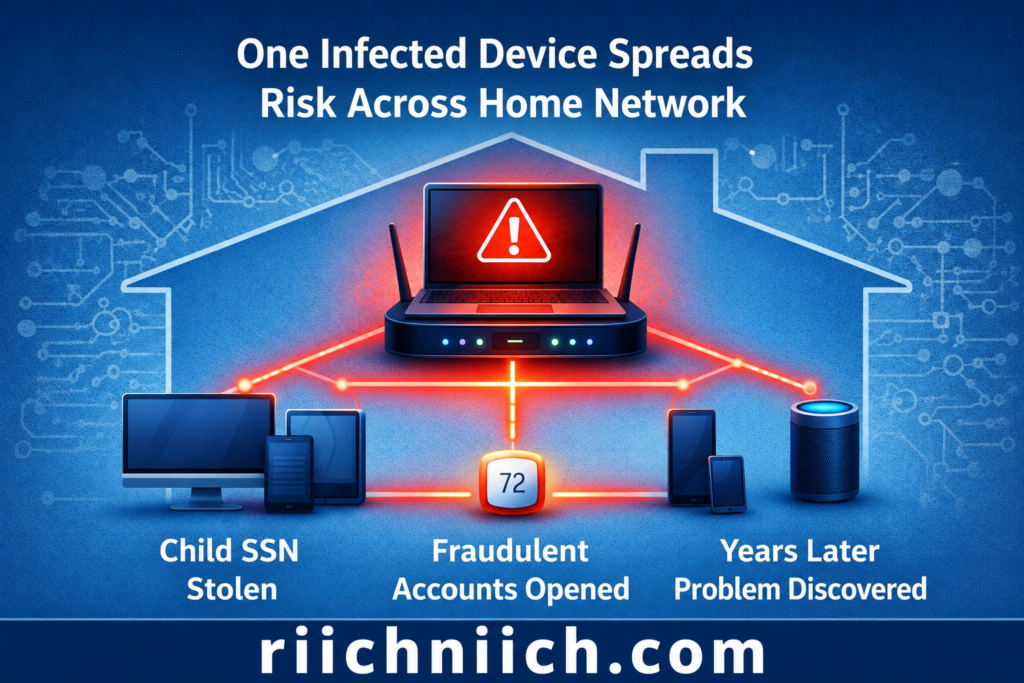
If one device becomes compromised through phishing, malware, or unsafe public WiFi use, the entire household can be exposed.
When one family member clicks a malicious link, it can affect everyone.
4️⃣ Data Breaches Expose Entire Households
Large-scale data breaches don’t just expose one person — they often expose:
Parents’ SSNs
Children’s personal data
Home addresses
Insurance records
School information
Once personal data hits the dark web, it can circulate for years.
The Identity Theft Resource Center tracks data breach trends and reports thousands of breach incidents annually affecting millions of consumers.
Families are often unaware their information is exposed until fraud alerts appear — sometimes long after the breach occurred.
5️⃣ Emotional Manipulation Tactics Target Parents
Cybercriminals increasingly use social engineering tactics such as:
“School payment” phishing emails
Fake child emergency scams
Tax refund fraud
Fake healthcare billing messages
Parents are more likely to act quickly when they believe their child is involved — and attackers exploit that urgency.
This is why searching for the Best Identity Theft Protection for Families (2026 Guide) isn’t just about credit monitoring — it’s about layered protection and fast alerts.
The Risk Is Compounded — Not Isolated
Unlike single adults, families face compounded risk:
Multiple identities
Multiple devices
Shared financial systems
Long-term exposure
That’s why family-specific plans matter. Basic individual monitoring often isn’t enough when children and multiple adults are involved.
Buyer Insight: Why This Matters Before You Choose a Plan
Understanding why families are prime targets helps you evaluate protection plans more critically.
Instead of asking:
“Does this monitor my credit?”
You should ask:
Does this monitor my child’s identity?
Does it alert me quickly?
Does it include identity restoration specialists?
Does it protect shared devices?
The right protection plan isn’t just about alerts — it’s about preventing long-term damage across your entire household.
In the next section, we’ll break down exactly what features to look for when choosing the best protection plan for your family in 2026.
What to Look for in Family Identity Theft Protection
When searching for the Best Identity Theft Protection for Families (2026 Guide), the goal isn’t just to find any protection — it’s to find the right combination of features that actually safeguard every member of your household.
Here are the key components you should prioritize, with buyer-focused clarity so you can confidently choose the best plan for your family.
🔐 1. Multi-Member Coverage
Not all family plans are created equal.
A good plan should cover:
Adults
Children
Spouses or partners
Some services charge extra for additional members, while others bundle multiple family members under one price. Make sure you understand how many people are included and whether there are age limits for children.
🧠 2. Child Identity Monitoring
Children are especially vulnerable, and their identity issues often go undetected for years.
Look for plans that specifically include:
Monitoring of minor SSNs
Alerts if a credit file is created for a child
Notifications of suspicious use of a child’s personal info
The Federal Trade Commission recommends actively checking children’s credit records precisely because criminals exploit “clean” profiles.
📊 3. Three-Bureau Credit Monitoring
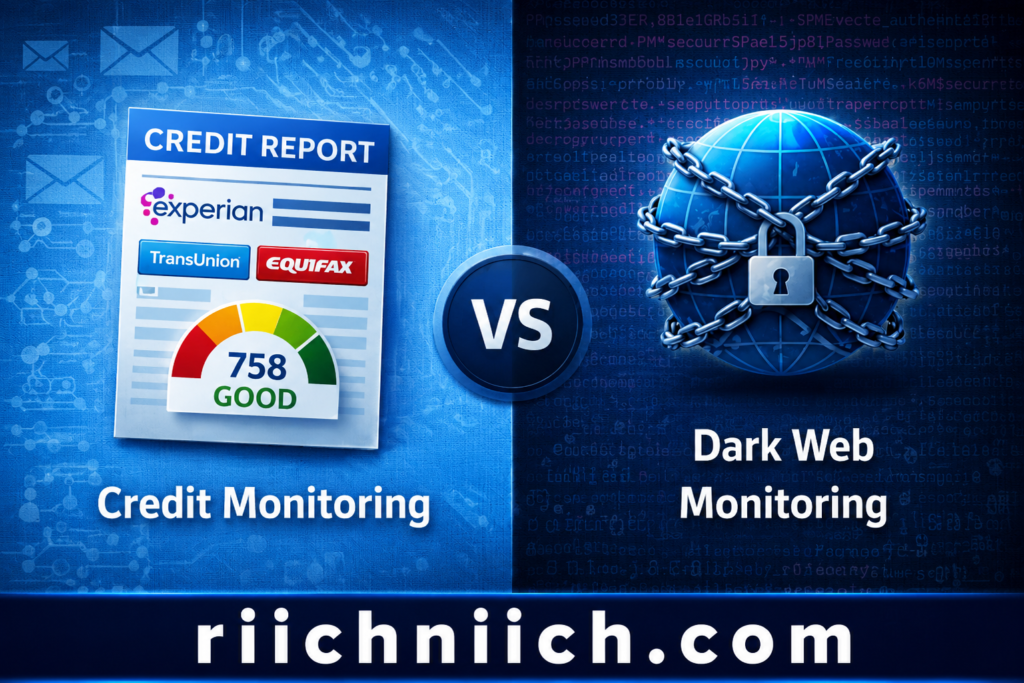
Identity theft protection should monitor your credit reports from all three major bureaus:
Experian
TransUnion
Equifax
Single-bureau monitoring can leave gaps in coverage. Three-bureau monitoring increases the chance of catching fraud early and can alert you to:
New accounts opened in your family’s name
Hard inquiries
Unexpected changes in credit scores
🕵️♂️ 4. Dark Web and Personal Data Monitoring
Attackers often trade stolen information on the dark web long before victims know it’s compromised.
The best family identity theft protection services scan:
Email addresses
SSNs
Phone numbers
Password databases
Other personal data
For more information on how dark web monitoring works, the Cybersecurity and Infrastructure Security Agency provides guidance on online risk and breach prevention.
🚨 5. Fast Alerts and Easy Notifications
Early detection is critical.
High-quality protection plans alert you instantly through:
Email
SMS
App notifications
Faster alerts mean you can take action before damage compounds. Make sure the service you choose emphasizes timeliness.
👩💼 6. Identity Restoration Support
Monitoring alone isn’t enough if a breach occurs.
Top family plans include access to identity restoration specialists — trained professionals who:
Walk you through the recovery process
Help contact creditors and bureaus
Assist in filing reports and disputes
According to FTC fraud recovery guidance, professional restoration support significantly reduces stress and speeds up the process.
💰 7. High Insurance / Reimbursement Limits
Identity theft protection plans often include insurance or reimbursement for:
Stolen funds
Legal fees
Lost wages from recovery efforts
Higher limits (e.g., $1M+) offer stronger protection against worst-case scenarios.
If a plan doesn’t include coverage or caps it too low, consider that a red flag.
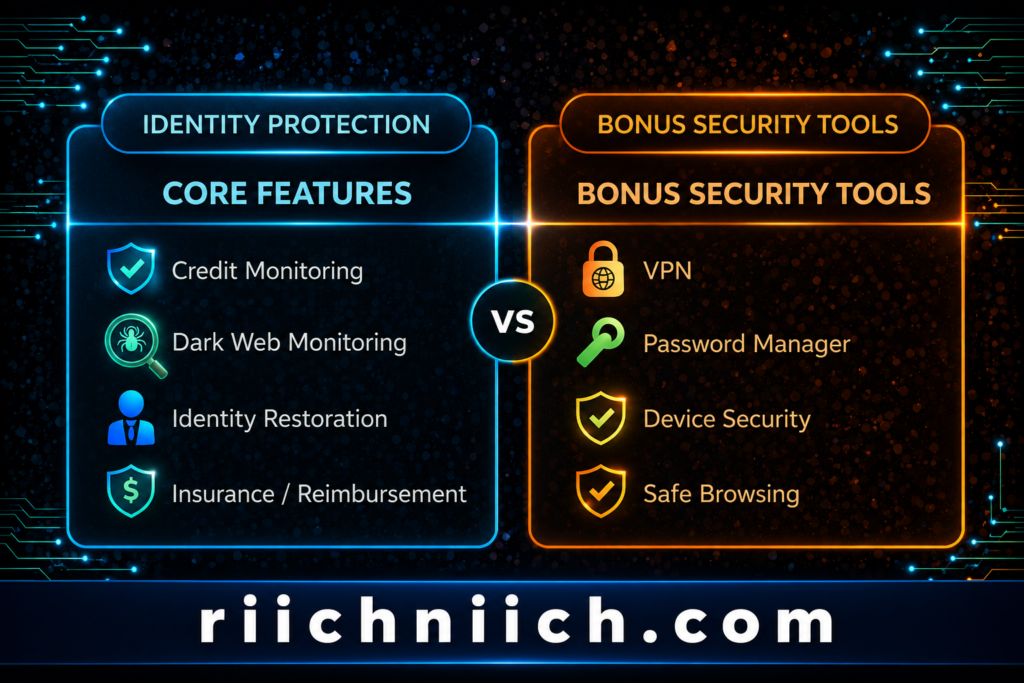
🛡️ 8. Extra Security Tools
Family online safety isn’t just identity monitoring — it’s also digital hygiene.
These additional tools can add value and reinforce your family’s overall security posture.
Buyer Tip: Don’t Sacrifice Coverage for Price
It’s tempting to choose the cheapest family plan, but value is not always measured in price alone.
Ask yourself:
✔ Does this plan cover all family members? ✔ Are there tools for both prevention and response? ✔ How quickly will I be alerted? ✔ Is restoration support included? ✔ Are there hidden fees for adding members?
If the answer isn’t clearly “yes,” it’s worth exploring better-equipped options.
By understanding what to look for in family identity theft protection, you’re better positioned to choose a service that genuinely defends your household — not just watches from the sidelines.
Next up, we’ll explore the top providers offering the most comprehensive family plans in 2026.
Best Overall Identity Theft Protection for Families
When it comes to choosing the Best Identity Theft Protection for Families (2026 Guide), you want a plan that doesn’t just alert you to problems — but prevents them, monitors comprehensively, and helps you recover quickly if something goes wrong.
After comparing features, coverage, and value, one provider stands out above the rest for family-focused identity theft protection:
🏆 Aura — Most Complete Family Identity Theft Protection
Aura takes the top spot as the Best Overall Identity Theft Protection for Families in 2026. Multiple expert review sites rank Aura as the leading choice for families due to its rich feature set, ease of use, and comprehensive protections that go beyond basic monitoring.
✔ Comprehensive Monitoring: Aura tracks your family’s credit from all three major bureaus (Experian, TransUnion, Equifax), watches for suspicious financial activity, and monitors dark web sources for exposed personal data.
✔ Family-Friendly Coverage: Aura’s family plans include multiple adults and unlimited minors, giving broad protection under one subscription — ideal for larger households.
✔ Strong Identity Theft Insurance: Plans include identity theft insurance that can help cover costs associated with fraud recovery and lost wages if your family becomes a victim.
✔ Extra Security Tools: Beyond identity protection, Aura bundles useful digital security features such as a VPN, antivirus, and password manager — which help protect your family’s devices and online activity too.
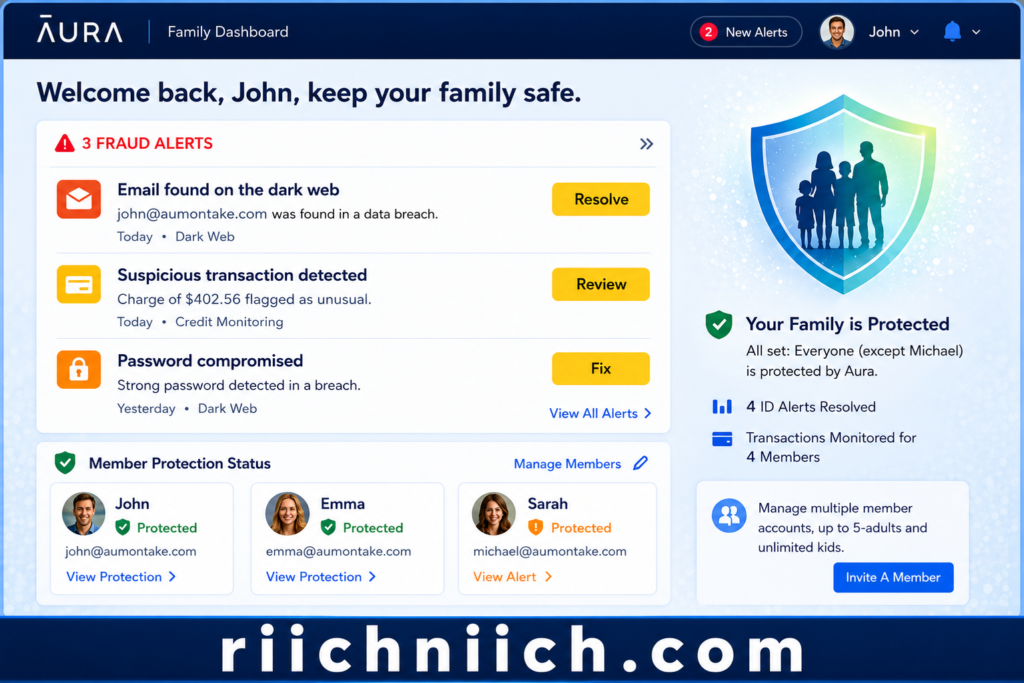
✔ Easy Setup & Alerts: Aura’s modern dashboard and real-time alerts make it simple for parents to stay informed about potential risks without becoming overwhelmed.
Why Aura is the best choice for families:
It allows you to monitor multiple family members, including children, while providing real-time alerts and full identity recovery support.
Instead of managing separate tools for each person, everything is handled in one place.
Families need more than one layer of protection. Identity theft can happen from many directions:
Breached accounts
Dark web leaks
New credit accounts opened without permission
Child identity compromise These threats aren’t abstract — the Federal Trade Commission recommends proactive monitoring and protection because identity theft can go undetected for months or longer.
Aura’s family plans help you stay ahead of these risks with alerts when anything looks suspicious — for kids as well as adults.
What You Get With Aura’s Family Plan
Most family identity protection services focus mainly on credit monitoring, but Aura delivers a wider set of safeguards, including:
Triple-bureau credit monitoring
SSN monitoring for all members
Dark web scanning for personal data leaks
Financial account alerts
Identity theft insurance
Device and online threat protection
Parental controls for kids’ devices
Password manager and safe browsing tools These extras can make a real difference for busy households, linking identity protection with everyday digital safety.
How Aura Compares to Other Top Services
While other providers like LifeLock and IdentityForce also offer strong protections, Aura’s mix of comprehensive features, family coverage, and security extras — all under one dashboard — makes it the most well-rounded option for families in 2026. Independent reviewers consistently rank Aura at or near the top of identity protection lists.
Quick Take
If you want the Best Identity Theft Protection for Families (2026 Guide) without juggling multiple services or confusing feature tiers, Aura is the standout choice. It protects every member of your household, provides essential alerts and restoration tools, and adds extra digital security features that help keep your family safe online.
Whether you’re safeguarding kids who are online more than ever or protecting your joint financial accounts, Aura gives you a strong foundation to defend against identity theft threats this year and beyond.
Best Budget-Friendly Option for Families
When looking for the Best Identity Theft Protection for Families (2026 Guide), price matters — especially if you’re protecting multiple people in one household. Not every family needs all the premium bells and whistles, but you still want solid monitoring that actually alerts you to suspicious activity without a high monthly cost.
For families who want strong, budget-friendly identity theft protection that still delivers real value, one provider stands out in 2026:
💡 Identity Guard — Best Budget-Friendly Family Identity Theft Protection
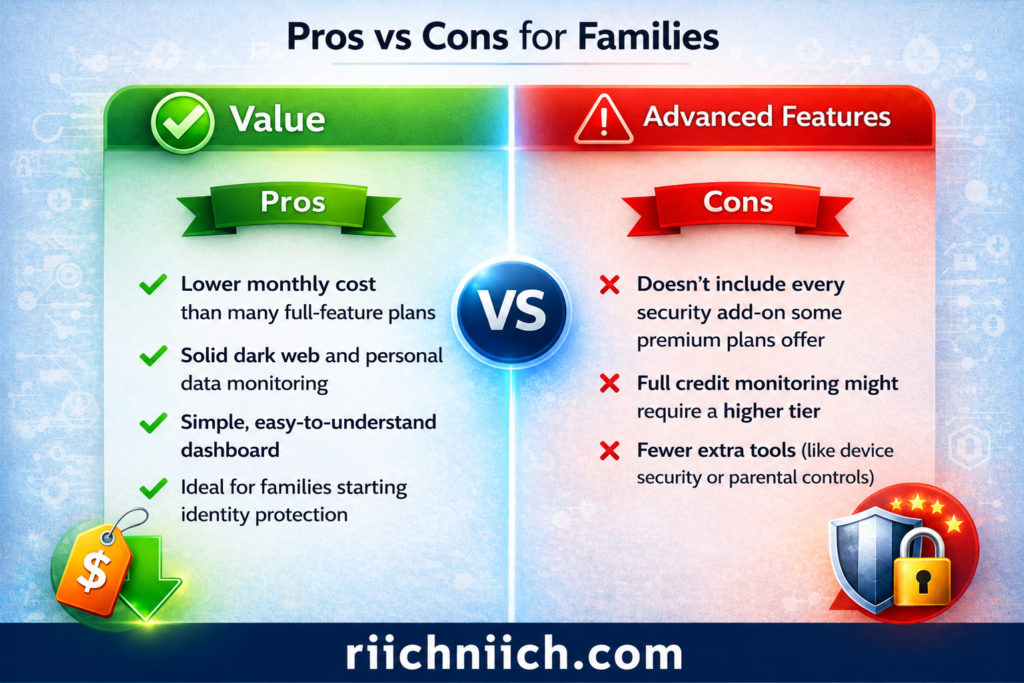
Identity Guard is widely recognized as a dependable, more affordable alternative to premium plans, making it our top pick for budget-conscious families.
Identity Guard offers core identity monitoring services at a lower price than many competitors, while still helping you catch potential fraud early.
📦 What You Get with Identity Guard
While more budget-oriented than some all-in-one platforms, Identity Guard still includes the essentials families need:
✔ Dark web monitoring — Alerts you if emails, SSNs, or personal data appear where they shouldn’t ✔ Personal data monitoring — Tracks critical information tied to all covered family members ✔ Risk level scores — Helps you understand your exposure ✔ Fraud alerts — Quick notifications of suspicious activity
Most plans also allow you to cover multiple family members, though exact limits and features depend on the tier you choose.
📉 Value That Makes Sense for Families
One of the biggest reasons Identity Guard is a top budget pick is its emphasis on core identity protections without unnecessary extras that drive up cost.
According to cybersecurity experts at the Cybersecurity and Infrastructure Security Agency, monitoring systems that scan for exposed personal data and dark web leaks are key early warnings for identity fraud — which Identity Guard includes even at cheaper tiers.These kinds of alerts can help you stop fraud sooner rather than later when losses escalate.
💵 Typical Pricing Structure
While exact prices change over time, Identity Guard’s plans generally start at a lower entry price than many premium services — making it easier for families to start monitoring multiple members without a major budget commitment.
Pricing is usually tiered, meaning:
Basic plans focus on foundational monitoring features
Mid-level plans expand coverage to include additional alerts
Higher tiers can include three-bureau credit monitoring (optional)
Always check the provider’s official pricing page for the latest details — but expect better affordability compared with many premium competitors.
📊 Pro
👨👩👧 Best Fit: Which Families Benefit Most?
Identity Guard is especially worth considering if:
Your primary goal is identity monitoring and alerting
You want an affordable way to protect multiple household members
You’re comfortable pairing this with other security tools (like antivirus) if needed
You’re new to identity theft protection and want solid coverage without paying premium prices
It’s not the flashiest plan — but for many families, it’s good coverage at a price that makes sense.
Buyer’s Tip
👉 Even if you start with a budget-friendly plan like Identity Guard, you can still add features later. Many families begin with essential monitoring and upgrade over time as needs grow — especially if you add older teens or want more advanced restoration support.
Considering identity theft reports from the Federal Trade Commission remain high year over year, having some protection in place for your family is infinitely better than having none at all.
Best for Large Families and Multiple Devices
When you’re hunting for the Best Identity Theft Protection for Families (2026 Guide), one critical question is:
Does this plan scale with your household?
Large families — especially those with multiple adults and a growing number of connected devices — need a protection plan that covers more people and more endpoints without compromising on alerts, monitoring, or support.
For families juggling several members and devices, one identity theft protection service stands out in 2026:
👪 IdentityForce — Best for Large Families & Multiple Devices
IdentityForce earns the recommendation for households that need wide coverage — including multiple adults, teens, and lots of devices — without sacrificing quality.
IdentityForce’s family plans are designed with flexibility in mind, offering:
✔ Multi-member identity monitoring ✔ Multiple device protection ✔ Comprehensive alerting systems ✔ Identity restoration support
This makes it a compelling choice for large family units and tech-heavy households.
Why Device Coverage Matters for Families
Today’s families use a surprising number of internet-connected devices. According to the Pew Research Center, most households have multiple smartphones, tablets, laptops, and often smart home tech like printers and gaming consoles.
More devices = more potential attack vectors.
Identity theft protection that includes device scanning and protection alerts helps ensure that deeper vulnerabilities — like unsafe public Wi-Fi or infected devices — don’t serve as entry points for identity fraud.
📊 What IdentityForce Offers for Large Families
Here’s a snapshot of why IdentityForce is ideal for larger households:
1. Flexible Member Coverage IdentityForce allows families to include:
Multiple adults
Teens and older children
Option to add additional members at reasonable rates
This means you don’t have to limit protection based on family size.
2. Device-Focused Alerts The platform can monitor devices for suspicious activity tied to identity theft risks — an important feature for families with several phones, tablets, or shared computers.
3. Advanced Monitoring Tools IdentityForce uses data sources that scan:
Credit activity
Public records
Dark web databases These scans help catch threats before they escalate.
According to independent reviews, IdentityForce’s monitoring tools consistently perform well in detecting emerging risks across large coverage pools.
📈 Family-Friendly Protection — Without Extra Complexity
One of the biggest benefits of IdentityForce for large families is its user-friendly interface. Despite covering multiple people and devices, the dashboard remains:
Easy to navigate
Centralized
Inclusive of alerts and recommendations
This matters a lot — because complicated systems often get ignored, reducing the effectiveness of your protection.
Is IdentityForce Right for Your Family?
Choose IdentityForce if your household:
✅ Includes more than 3–4 members ✅ Has multiple devices shared daily ✅ Wants centralized alerts for all identities ✅ Prefers clear dashboards for group monitoring
It’s especially ideal if you’ve struggled with basic plans that only cover 1–2 adults or don’t include device alerts — a common limitation of many budget offerings.
Buyer Tip: Scale Matters
Many identity theft services charge per member or restrict devices. With IdentityForce, larger families often get better scalability without proportionally higher costs.
The goal of this guide — the Best Identity Theft Protection for Families (2026 Guide) — is to help you find protection that grows with your household, not one that forces you to compromise because of size or technology use.
Best for Identity Restoration and White-Glove Support
When searching for the Best Identity Theft Protection for Families (2026 Guide), one of the most important differentiators isn’t just how early a service detects fraud — it’s how well it helps you recover if identity theft actually happens.
For families dealing with the stress and complexity of restoring stolen identities, identity restoration and white-glove support can make the difference between a minor inconvenience and months of financial and emotional upheaval.
The best plans in this category combine expert recovery teams, personalized case management, and proactive guidance — so you don’t have to figure it all out on your own.
🛟 Identity Theft 911™ by Experian — Best for Restoration & White-Glove Support
Experian Identity Theft 911™ earns the top spot for families who want hands-on help from professionals when the worst happens.
This plan focuses on delivering dedicated restoration assistance, including:
✔ Personalized case management ✔ Direct contact with creditors and bureaus on your behalf ✔ Detailed action planning ✔ Help filling out and submitting fraud reports ✔ Step-by-step support throughout recovery
🧠 Why Restoration Support Matters for Families
When fraud strikes, dealing with credit bureaus, banks, and collections can be overwhelming — especially for households with multiple people affected.
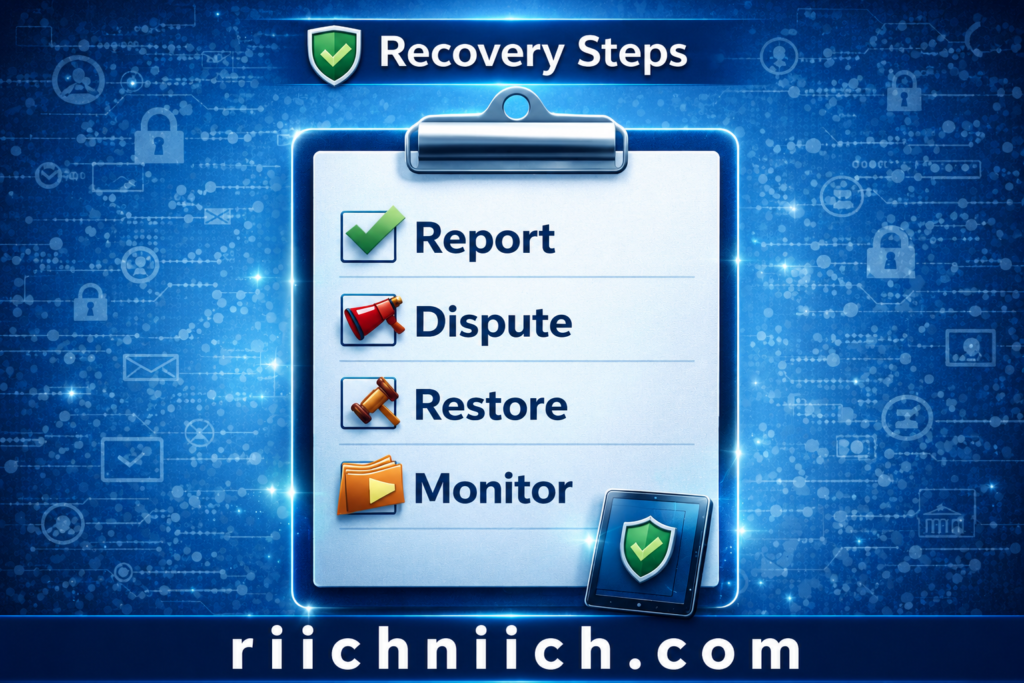
According to the Federal Trade Commission, identity theft victims often face long recovery timelines that involve:
Filing police and FTC reports
Contacting each creditor and financial institution
Disputing fraudulent accounts
Monitoring credit report corrections
These steps can be confusing and time-consuming — particularly for parents already managing family responsibilities. Dedicated restoration specialists lift that burden by guiding you through every required step.
📋 What You Get with Identity Theft 911™
Identity Theft 911™ focuses less on bells and whistles and more on hands-on customer help, which is what sets it apart for families who want peace of mind:
1. Full Restoration Assistance Experts work on your behalf to undo fraudulent activity — from paperwork to dispute communications.
2. Dedicated Case Managers Instead of generic alerts, you work with a specialist who knows your case and helps coordinate the recovery process.
3. Document Templates and Guidance Access to ready-to-use forms and step-by-step instructions saves time and reduces confusion.
4. High Insurance Coverage Plans often include reimbursement for legal fees, lost wages, and certain out-of-pocket costs tied to identity theft remediation.
🧩 How It Compares to Basic Monitoring Plans
Many identity theft services focus mainly on:
Alerts
Credit monitoring
Dark web scanning
But those features only tell you something is wrong. They don’t help you fix the problem.
Identity restoration support fills this gap, which is why it’s crucial for families who want:
Real human help, not just AI alerts
Guided support for dealing with creditors
Assistance with long-term recovery steps
As identity theft statistics from the Federal Bureau of Investigation IC3 report show, cybercrime losses continue to climb — meaning expert help isn’t just convenient, it’s necessary in serious fraud cases.
📊 Ideal Families for Restoration-Focused Plans
Choose a restoration-oriented service like Identity Theft 911™ if your household:
Includes adults with credit files and financial accounts
Has teens or young adults who may soon apply for credit
Has experienced past fraud or breaches
Wants peace of mind knowing support is on standby
For these families, the cost difference compared with basic monitoring plans is often worth it — because the time and stress savings during a real identity theft event can be significant.
Buyer Tip: Alerts Are Only Part of the Equation
Plenty of services will notify you when something suspicious happens — but not all will help you resolve it. That’s where white-glove identity restoration matters.
If your goal is not just awareness, but actual recovery support, prioritize plans with:
✔ Dedicated specialists ✔ Full restoration services ✔ Document and dispute support ✔ Direct engagement with lenders and institutions
In the context of the Best Identity Theft Protection for Families (2026 Guide), this level of support ensures you aren’t left to navigate complex financial systems alone — and gives you a reliable partner when you need help most.
With that foundation, let’s dive into how pricing compares for these top family plans next. Would you like a table summarizing costs and coverage?
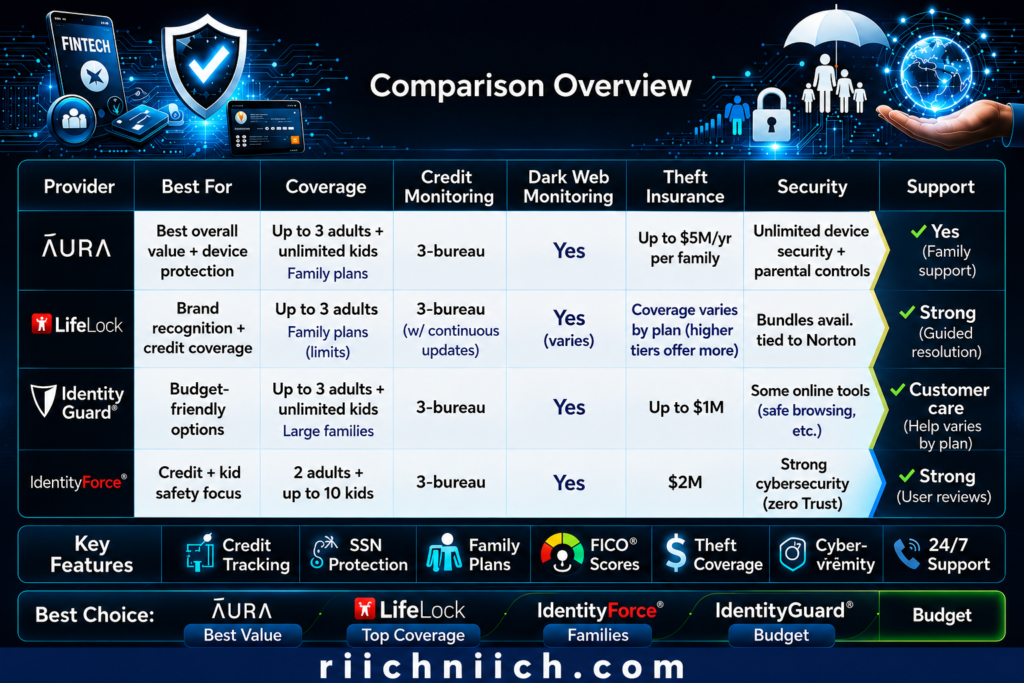
Family Identity Theft Protection Comparison Table (2026)
If you’re searching for the Best Identity Theft Protection for Families (2026 Guide), this table is meant to make the decision fast. It compares the family-friendly providers mentioned in this guide using the features that matter most for households: member limits, kid coverage, credit monitoring depth, insurance, device protection, and restoration support.
Note: Pricing and included features can change. We’re using the most current public plan pages and reputable third-party summaries available at the time of writing (February 2026 where specified).
Want the most complete “family + devices” bundle? Pick Aura (especially if you want one dashboard for identity + online safety).
Want a lower-cost entry plan without going barebones?Identity Guard is usually the best “start here” option for families.
Have a bigger household and want structured child coverage limits (up to 10) + robust credit tiers?IdentityForce is built for that.
Prefer a long-established brand with tiered options and add-ons?LifeLock can fit, but make sure your chosen tier includes the exact monitoring you want (especially 3-bureau).
External resources to bookmark (recovery + prevention)
Even with the best service, it helps to know the official playbook:
How Much Does Identity Theft Protection for Families Cost?
Understanding the cost of the Best Identity Theft Protection for Families (2026 Guide) is crucial before you commit to a subscription. Family plans vary widely in features and price — but the good news is you can find options that fit most budgets while still offering meaningful protection.
🧾 Typical Price Range for Family Plans
Most family identity theft protection services charge between around $20 to $50 per month, depending on the provider and the level of features included. This usually covers multiple adults (often two to five) plus an unlimited number of children under 18.
Here’s a high-level look at typical costs:
🔹 Budget-Friendly Plans
Starting around $20–$30 per month
Often include core monitoring, dark web scans, and basic alerts
Good for families who want essential protection without premium extras
Example: IDShield family plans may start near $29.95 per month.
🔹 Mid-Tier Plans
$30–$45 per month is common for more robust family plans
Usually include 3-bureau credit monitoring and stronger alert systems
May also provide some restoration support and insurance
Example pricing for comprehensive plans (like IdentityForce) starts near $24.90 for family coverage.
🔹 Premium Plans
Around $45–$55+ per month
Includes full 3-bureau monitoring, insurance, device protection, and advanced restoration services
Best for large families or households needing full digital protection
Examples like Aura often price family plans in this range, especially when paid monthly.
💡 Tip: Many providers offer annual plans at a discounted price compared with paying monthly — sometimes saving you 10–20% over the year.
📊 What You’re Paying For
The cost of identity theft protection reflects the number and depth of services you receive. For families, this often includes:
🛡️ Monitoring Across Multiple Data Sources
More comprehensive plans track:
credit bureaus
dark web data
SSNs and personal details This makes it easier to catch suspicious activity early — before the damage spreads.
🔔 Alerts and Notifications
Real-time alerts notify you if:
new credit accounts are opened
personal information appears in risky places
suspicious financial activity occurs
This speed matters — early notice often prevents bigger loss or damage.
👥 Identity Restoration and Insurance
Better family plans include:
identity restoration specialists
reimbursement for legal fees or lost wages
coverage for children’s identities
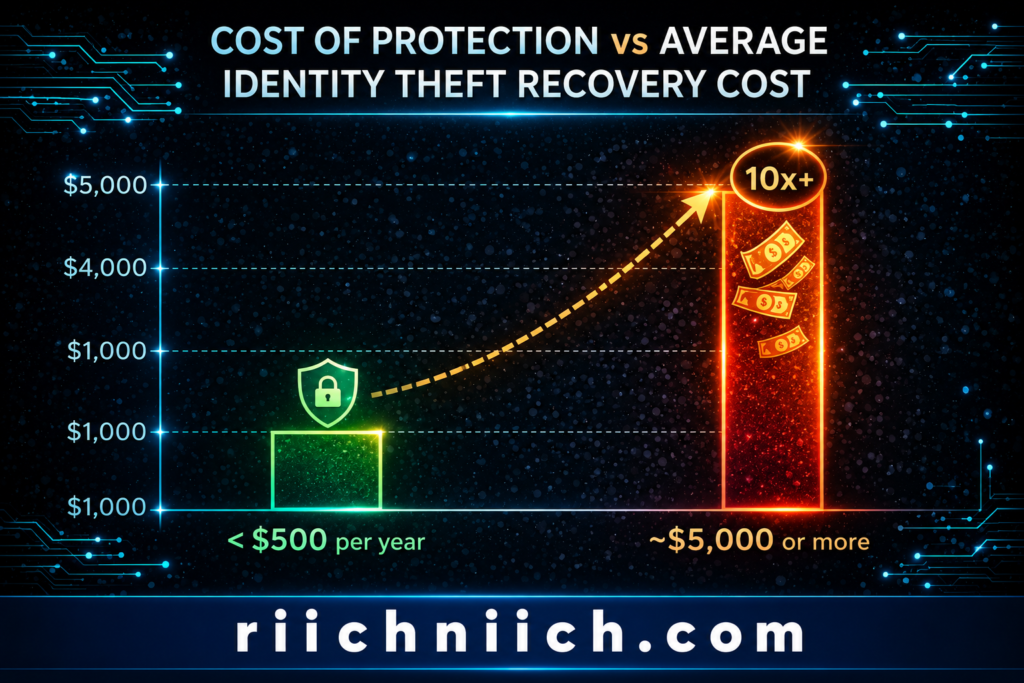
The cost of not having this can be far higher — identity theft victims often spend hours and potentially thousands of dollars restoring their credit and records.
💰 Examples of Specific Costs
Here are rough estimates from popular providers (note: actual pricing can vary over time and based on promotions):
🎯 IdentityForce Family Plan
Around $24.90 per month (or ~$249.90 annually for family coverage).
🎯 IDShield Family Plan
Starts close to $29.95 per month for family coverage.
🎯 Aura Family Plan
Often in the $40–$50 per month range for the full unlimited family protection tier (depending on billing cycle). We break down Aura’s family pricing structure in detail in our Is Aura Worth It? review.
🎯 Identity Guard Family Plans
Mid-tier plans that include more monitoring may fall in the ~$30+ range, with some budget plans a bit lower.
🚨 Please be advised: ALL prices in this blog may or may not be accurate and subject to change in the future.
💡 Buyer Tips to Lower Your Costs
Here are savvy ways to make your family identity theft protection more affordable:
✔ Choose Annual Billing
Paying yearly instead of monthly almost always saves money (often 10–20% total).
✔ Start with Core Features
If you’re budget-conscious, start with essential monitoring — then upgrade later if you want more coverage.
👉 If you’re looking for one of the most affordable ways to start protecting your family, check out IdentityIQ. It offers identity monitoring and credit-related features at a competitive price, making it a practical choice for families who want solid protection without paying for premium extras.
✔ Compare Provider Trials
Many services offer free trials or money-back guarantees so you can test the platform before fully committing.
🧠 Is It Worth the Cost?
The cost for a family plan is often less than what most households would spend to resolve a single identity theft incident — which, according to industry studies, can cost individuals hundreds or even thousands of dollars in time and financial loss.
When you consider the peace of mind, real-time alerts, and professional support included in many family plans, it’s not just cost — it’s risk management for your household’s financial future.
Is Family Identity Theft Protection Worth It?
When evaluating the Best Identity Theft Protection for Families (2026 Guide), the most important question many parents ask is:
“Is it really worth paying for protection if nothing bad has happened yet?”
The short answer: Yes — for most families, proactive identity theft protection is worth the investment. Here’s exactly why.
📌 Identity Theft Isn’t Rare — It’s Common
The Federal Trade Commission reports that identity theft remains one of the most commonly reported consumer crimes each year, with hundreds of thousands of reported cases across adults and children.
Families are target-rich environments:
Children’s SSNs often have clean credit histories, which thieves exploit.
Multiple adults increase exposure to phishing, breaches, and fraud.
Shared devices and accounts multiply risk vectors.
Protection plans help you detect suspicious changes early, rather than learning about them months later when recovery is harder and more expensive.
🧠 Early Alerts Save Time and Money
Identity theft plans don’t just tell you after something bad happens — they often alert you to signals that something may be wrong, such as:
✔ An unexpected credit inquiry ✔ A new account opened in your child’s name ✔ Personal data found on the dark web
According to experts at the Cybersecurity and Infrastructure Security Agency, early detection is key to reducing fraud losses because it gives you a chance to act before accounts are misused or damaged.
Without alerts, you might only find out your family has been compromised when a bill arrives or a loan application is rejected — months after fraud began.
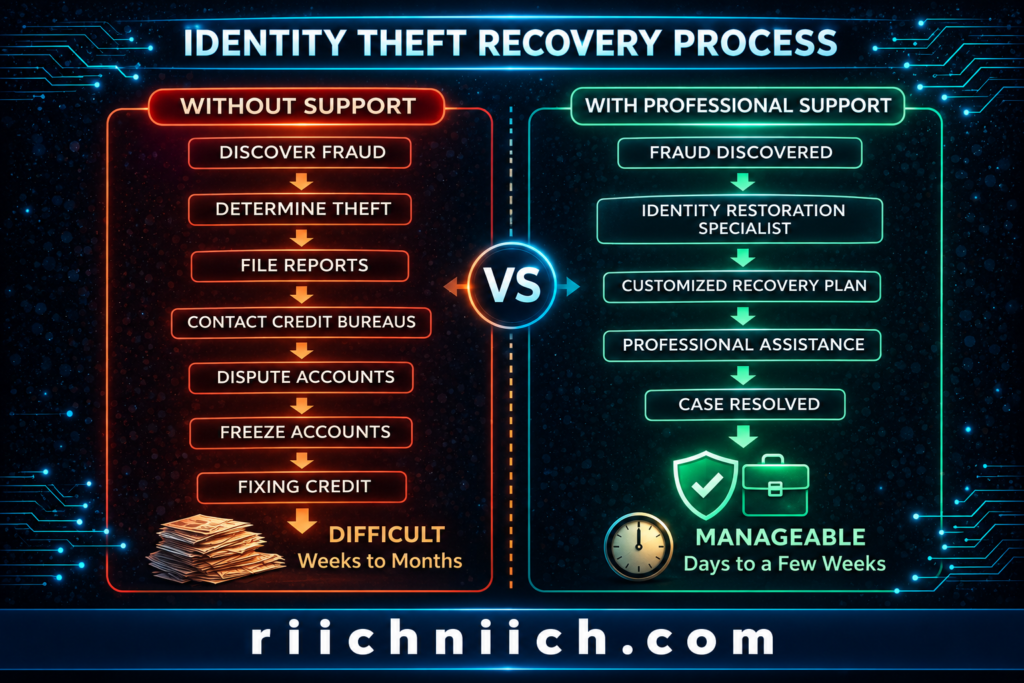
🛡️ Identity Restoration Is Hard Without Help
If identity theft does happen, recovery can be complicated and time-consuming:
Changing and freezing credit reports
Contacting banks and creditors
Filing police reports
Disputing fraudulent charges
The FTC’s official identity theft site outlines a long list of steps victims need to take to resolve fraud — a process that can take weeks or even months if handled on your own.
That’s where professional restoration support — included in many family plans — adds value by helping guide you through the process, often saving you time and emotional stress.
💸 Cost vs Risk: What You’re Really Paying For
Families often think of identity theft protection cost as an expense, but the smarter lens is risk management.
Consider these points:
A single unauthorized loan or credit account can damage a credit score for months.
Restoring credit and disputing accounts can cost hundreds in legal fees or out-of-pocket costs.
Children’s identity fraud can go undetected for years, affecting their credit before they even know about it.
Many plans offer insurance that helps cover these costs, making protection more than just alerts — it’s financial backup when fraud happens.
👪 Protection Doesn’t Replace Good Habits — But It Helps
Identity theft protection isn’t a magic shield. You should still practice good cybersecurity:
✔ Use unique, strong passwords ✔ Enable multi-factor authentication ✔ Review credit reports annually ✔ Freeze credit for minors
However, protection services help you see things you might otherwise miss — like dark web exposure, subtle credit changes, and alerts tied to children’s identities.
🧠 So, Is It Worth It?
Yes — especially if:
You have multiple family members (adults and children).
You want early warning of suspicious activity.
You value professional restoration support.
You want peace of mind knowing help is available if fraud hits.
If your household includes aging parents or retirees, you may also want to explore our Best Identity Theft Protection for Seniors guide for coverage tailored specifically to older adults.
For many families, the Best Identity Theft Protection for Families (2026 Guide) isn’t just a luxury — it’s a form of security planning that prevents costly headaches later.
If your budget allows, having the right identity theft protection can turn a reactive problem into a controlled scenario — giving you back time, money, and peace of mind.
Free vs Paid Family Identity Protection: What’s the Difference?
When evaluating the Best Identity Theft Protection for Families (2026 Guide), you may wonder: Do I really need a paid service if there are “free” tools available?
The short answer is yes — there’s a clear difference between free resources and full paid identity theft protection plans. Understanding that difference helps you decide what makes sense for your household.
🆓 Free Identity Protection: What You Can Get
Free identity protection tools and services are generally limited, but they can still be helpful for basic monitoring:
🔹 Free Credit Reports
Under U.S. law, you’re entitled to one free credit report every 12 months from each of the three major bureaus:
You can place a free credit freeze on your accounts, which prevents new accounts from being opened without your permission. This is a powerful step often recommended by the Federal Trade Commission to reduce fraud risk.
🔹 Basic Alerts
Some banks and credit cards offer basic alerts if there’s suspicious activity on a specific account — but these won’t catch broader identity theft like new accounts opened in your name.
🔹 Manual Monitoring
You can manually check statements and credit reports regularly — but this requires time, diligence, and you might still miss subtle early signs of identity theft.
💰 Paid Family Identity Theft Protection: What You Get
Paid family identity protection goes well beyond free resources by offering continuous monitoring, alerts, and support designed specifically for households.
Here’s what paid plans typically include that free tools don’t:
📍 1. Continuous Monitoring Across Multiple Data Sources
Paid services scan:
Dark web databases
SSNs
Credit reports from one or all three bureaus
Financial accounts
Email & personal info exposure
This gives you real-time alerts, instead of what you uncover manually.
🧠 2. Real-Time Alerts and Notifications
Free tools give you limited alerts tied to one account. Paid services send notifications for things like:
New credit inquiries
Data found in risky online places
Accounts opened in your name
SSN usage alerts
These real-time warnings help you act faster.
👥 3. Family Coverage in One Plan
Family plans include multiple adults and often unlimited children, providing protection tailored to households — something free tools can’t do.
Having centralized alerts for the entire family makes it easier to manage risk for your household as a whole.
📞 4. Dedicated Identity Restoration Support
If fraud happens, paid plans often include specialists who help:
File reports
Contact creditors and bureaus
Dispute fraudulent activity
Walk you through recovery steps
Free tools give you no professional help, leaving you to figure it out on your own.
🛡️ 5. Insurance or Financial Reimbursement
Many paid identity protection plans include some level of identity theft insurance that can reimburse:
Legal fees
Lost wages
Costs associated with restoring your identity
Free tools have no such coverage.
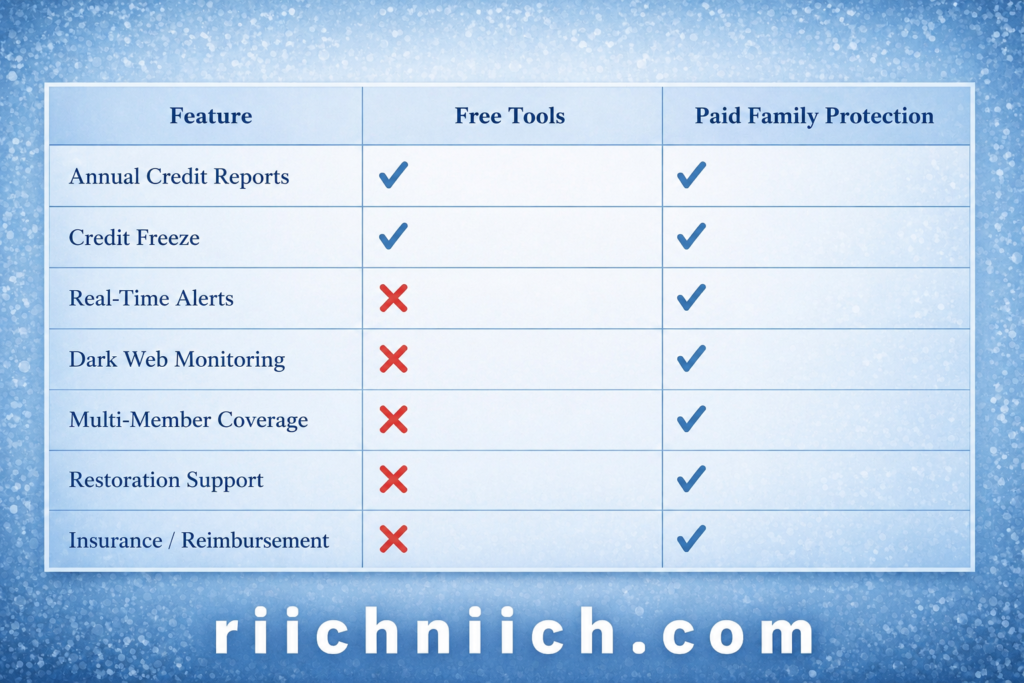
📊 So What’s the Real Difference?
Here’s a quick side-by-side:
🧠 Important Buyer Insight
Free tools are useful — and everyone should use them. But they are reactive, not proactive. Meaning, they help you see what’s happened, not alert you early, nor support you in fixing it.
When you’re comparing options for the Best Identity Theft Protection for Families (2026 Guide), remember:
Free tools are good first steps They do not replace full protection Paid plans offer continuous coverage and recovery support
In other words, free identity safeguards are a great foundation — but paid family protection provides peace of mind and broader defense for the people you care about most.
How to Choose the Right Identity Theft Protection Plan for Your Family
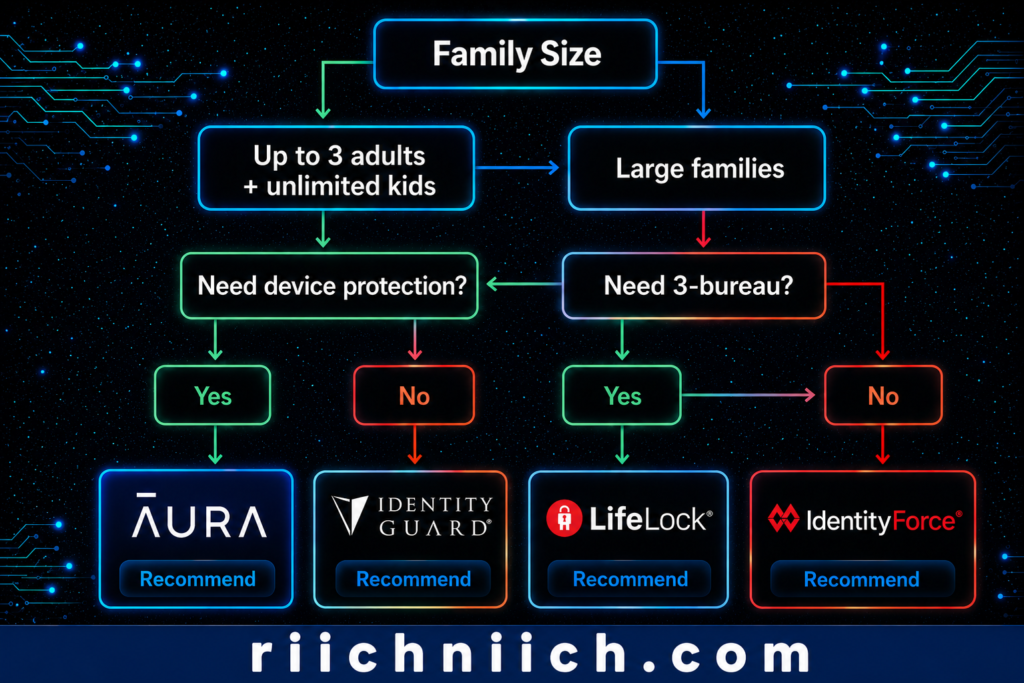
Choosing the Best Identity Theft Protection for Families (2026 Guide) doesn’t have to be confusing — but it does require clarity about what matters most to your household. With many options and features on the market, making the right choice means aligning your family’s risk profile with the protection plan that gives you the most value.
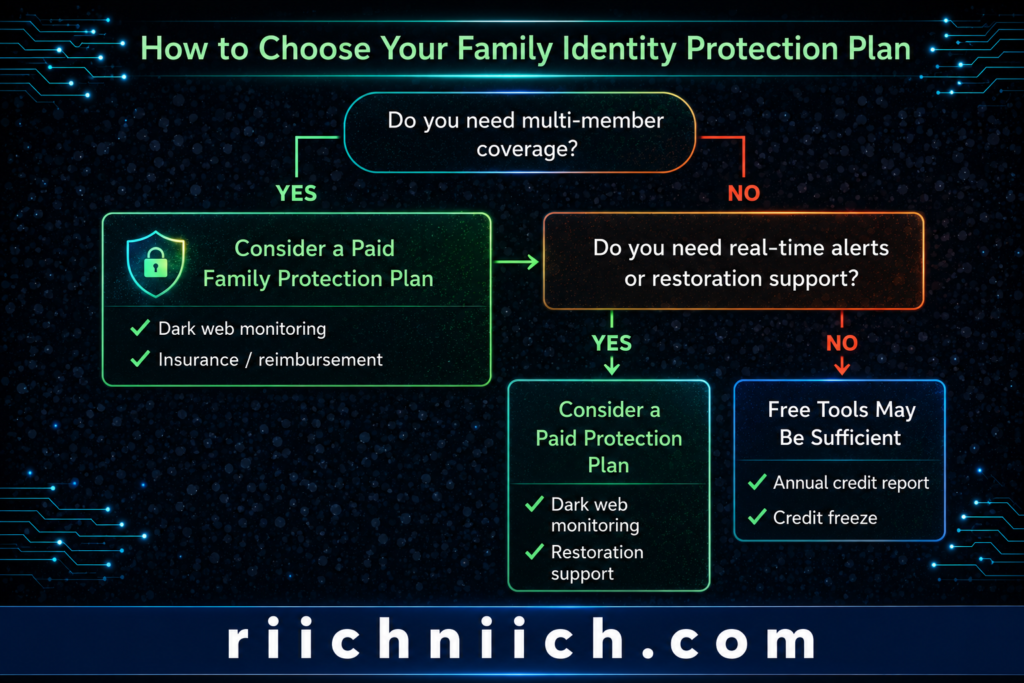
Here’s a step-by-step approach to help you pick the plan that fits your family’s needs — quickly and confidently.
1️⃣ Understand Your Family’s Risk Profile
Before comparing services, assess your family’s identity theft risk:
✔ How many adults and children need coverage? ✔ Do you have teens who may soon build credit? ✔ Are financial accounts shared among family members? ✔ Do family members use shared or personal devices frequently?
Families with multiple adults and mobile device usage tend to have greater exposure. Knowing this helps you decide which features matter most — alerts, device security, full credit monitoring, or identity restoration.
To understand broader risk factors and trends, the Federal Trade Commission offers insights on current identity theft threats and prevention strategies.
2️⃣ Prioritize Core Features First
Once you know your risk level, focus on the core protections that matter most:
🔹 Family Member Coverage
Make sure the plan includes all members of your household, including children. Some plans cap adult or child accounts — choose one that matches your family size.
🔹 Credit Monitoring
Look for three-bureau credit monitoring whenever possible. This provides a comprehensive view of credit activity across:
Experian
TransUnion
Equifax
Single-bureau monitoring can miss changes reported elsewhere.
🔹 Dark Web and Data Monitoring
Strong plans scan for exposed personal information — like emails, SSNs, or usernames — on the dark web, which is a common source for stolen consumer data.
3️⃣ Look for Professional Support
Some families choose identity theft protection just for alerts. But the real value comes when something goes wrong — and you need help fixing it.
Good plans should offer:
✔ Dedicated identity restoration support ✔ Access to specialists you can call or email ✔ Assistance filing reports and disputing fraudulent charges
If you want personalized guidance when fraud occurs, this feature is worth paying extra for.
The FTC’s recovery checklist highlights how complex restoring identity can be — making professional support a huge advantage.
4️⃣ Consider Insurance and Reimbursement Limits
Many family identity protection plans include insurance coverage — which helps reimburse:
Legal costs
Lost wages
Certain out-of-pocket expenses
Resolution services
Look at the maximum coverage limits offered by each plan. Larger limits (e.g., $1M or higher per family) provide broader financial protection if identity theft strikes.
5️⃣ Evaluate Extra Security Tools
Some plans bundle identity protection with online security tools, such as:
VPN (secure browsing)
Password managers
Antivirus
Parental controls
While not strictly identity monitoring, these extras help protect your family’s online presence — especially if connected devices are frequently used.
6️⃣ Compare Cost vs Value
Price matters — but don’t choose only based on the lowest monthly cost.
Here’s how to think about cost:
Entry-level plans can be ideal for essential monitoring
Mid-tier plans usually balance coverage with alerts and insurance
Premium plans give deeper protection and better restoration support
Remember: identity theft can cost far more to resolve than an annual subscription to a good family plan. According to cybersecurity reports, recovery costs can run into hundreds or even thousands of dollars when done on your own.
7️⃣ Read User Reviews and Expert Evaluations
Real-world feedback adds perspective to marketing claims. Look for:
✔ Customer satisfaction levels ✔ Ease of customer support ✔ Speed and accuracy of alerts ✔ Restoration success stories
8️⃣ Take Advantage of Free Trials or Guarantees
Many providers offer:
Free trials
Money-back guarantees
Monthly billing options
These let you test a plan risk-free before committing long-term — especially useful if you’re unsure which features matter most to your family.
🧠 Final Checklist Before You Buy
Before purchasing, ask yourself:
🔹 Does this protect all family members? 🔹 Does it monitor credit and personal data consistently? 🔹 Are alerts timely and clear? 🔹 Is identity restoration included? 🔹 Does the cost match the value offered?
When you confidently answer these questions, you’re ready to choose a plan that truly earns the title of the Best Identity Theft Protection for Families (2026 Guide).
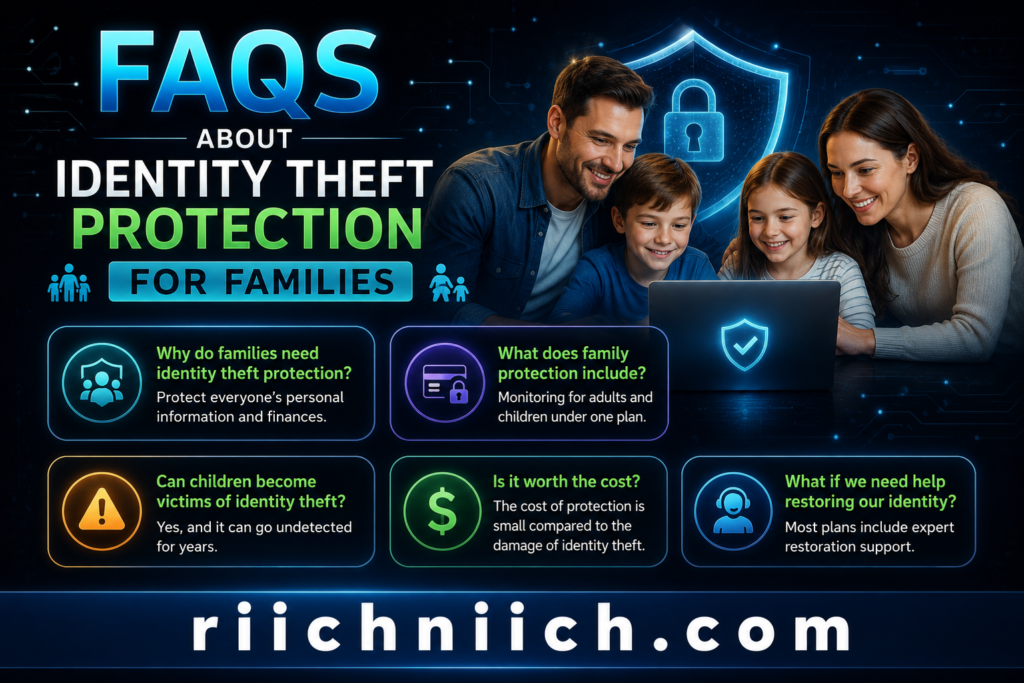
FAQs About Identity Theft Protection for Families
Here are the most common questions people ask when exploring the Best Identity Theft Protection for Families (2026 Guide) — along with clear, buyer-focused answers.
❓ 1. What Is Family Identity Theft Protection?
Family identity theft protection is a service that monitors personal and financial information for multiple people in your household — typically adults and children — and alerts you to suspicious activity. This includes monitoring credit reports, Social Security numbers, dark web exposure, account changes, and more.
Services often combine monitoring with restoration support and insurance — things free tools don’t provide. See FTC recommendations for identity theft prevention.
❓ 2. Do I Really Need Identity Theft Protection for My Family?
If your family uses shared financial accounts, multiple devices, or if you have children with Social Security numbers, the answer is yes — especially if you want early alerts and professional support.
Identity theft can affect anyone, and families often have increased exposure due to multiple adults, shared logins, and kids whose credit histories are untouched (children’s identities are sometimes misused for years before detection). The FTC encourages proactive steps — including monitoring — to reduce risk.
❓ 3. What’s the Difference Between Monitoring and Restoration?
Monitoring watches for signs of suspicious activity (like credit changes or data exposure). Restoration helps you fix the problem if identity theft occurs — with specialists guiding you through disputes, reporting, and recovery.
Monitoring tells you something may be wrong. Restoration helps you undo the damage. Both are valuable, but restoration support is what differentiates basic plans from truly robust ones.
❓ 4. How Many People Can a Family Plan Cover?
It varies by provider, but most family identity protection plans include:
Multiple adults (2–5 typical)
Children or minors under 18 (often unlimited)
For example, some plans allow unlimited kids at no extra cost, which is especially valuable for larger households.
Providers often list coverage limits on their plan pages — always double-check before purchasing.
❓ 5. Will Identity Theft Protection Prevent Fraud?
No plan can guarantee fraud prevention 100% — but high-quality services provide early detection and alerts that help you act quickly to stop fraud before it escalates.
Monitoring combined with best practices (strong passwords, credit freezes, two-factor authentication) significantly reduces potential loss.
The Cybersecurity and Infrastructure Security Agency (CISA) offers guidance on layered defenses here.
❓ 6. What Happens After an Alert?
When you receive an alert (e.g., unusual credit activity), the usual steps are:
Review the alert to confirm if it’s legitimate
Follow the service’s guidance to dispute changes
Contact banks or creditors if needed
Use identity restoration support (if included)
With plans that include white-glove support, specialists help you with steps 2–4 so you’re not handling everything on your own.
❓ 7. Is Child Identity Theft Common?
Yes — and it’s often overlooked because children don’t have active credit histories. If a child’s Social Security number is stolen, fraud can go undetected for years until they try to open credit as an adult.
That’s why family plans that include child monitoring are so valuable — they alert you if a child’s data shows up in risky places.
The FTC highlights special steps to protect minors on their identity theft page.
❓ 8. Can I Use Free Tools Instead?
Free tools like annual credit reports and credit freezes are excellent starting points — every household should use them. However:
Free tools don’t offer continuous monitoring
They don’t scan dark web exposure
They don’t notify you in real time
They don’t provide professional restoration assistance
Paid plans combine these features to offer broader and more proactive protection for families.
❓ 9. How Much Does Family Identity Theft Protection Cost?
Costs vary by provider and plan tier, but most family plans range from about $25 to $50+ per month depending on features included — such as 3-bureau monitoring, dark web scans, insurance, and restoration support.
Paid plans often deliver value far beyond free tools — especially when compared to the potential cost of resolving identity theft without professional help.
❓ 10. How Do I Choose the Best Plan?
Choosing the Best Identity Theft Protection for Families (2026 Guide) comes down to:
✔ the number of family members covered ✔ breadth of monitoring (credit + dark web) ✔ device and online security tools ✔ degree of restoration support ✔ insurance limits
Our comparison table and buying guide above walks you through these decisions. A strong plan aligns with your family’s risk level and comfort with digital security.
Final Verdict: What’s the Best Identity Theft Protection for Families?
If you want the most complete and easiest way to protect your entire household, Aura is the best choice for most families in 2026.
It provides multi-user monitoring, fast alerts, and full recovery support — all in one system.
🥇 Best Overall Identity Theft Protection for Families
Aura sits at the top of the list as the best all-around choice for most families. For a deeper look at pricing, features, and real-world performance, read our full Is Aura Worth It? review.
Comprehensive coverage — full identity and dark web monitoring
3-bureau credit monitoring included
Unlimited child protection
Device and online security tools
High insurance limits and restoration support
Aura combines strong identity protection with digital security tools like VPN and antivirus — making it ideal for households that want one unified solution.
💡 Best Budget-Friendly Option
If you’re looking for quality protection without paying premium prices, Identity Guard stands out.
Solid dark web and personal data monitoring
Flexible family coverage
Lower monthly cost than most premium plans
Good alerts and risk insights
This option is great for families who want core identity monitoring and alerts, with the ability to upgrade later if your needs grow.
Centers for Disease Control and Prevention (CDC) data on cybercrime and identity theft reinforce that early alerting can reduce the impact of fraud — even if you start with a basic plan.
👨👩👧 Best for Large Families and Multiple Devices
IdentityForce is the best pick if you need reliable coverage for a larger household or have many shared devices.
Up to 10 kids included on some plans
Strong credit and risk alerts
Great usability for monitoring multiple identities
Alerts tied to device and online account activity
This is ideal for tech-savvy families or those where every member has their own devices and accounts.
An independent reviewer highlighted IdentityForce’s strong multi-member support in its overview of family identity theft plans:
🛟 Best for Identity Restoration and White-Glove Support
If your priority is hands-on help when fraud happens, Experian Identity Theft 911™ (from Experian) tops the list.
Dedicated case managers
Personalized assistance with recovery
Help with filing reports, disputes, and restoration steps
Insurance coverage for legal and out-of-pocket costs
Families that want real people on their side — not just alerts — will appreciate the depth of support offered here.
The FTC’s identity theft resources emphasize the benefit of having guided help when navigating complex recovery processes.
The “best” plan depends on your family size, digital habits, and risk tolerance:
Small families on a budget? Start with an affordable plan and add upgrades later.
Families with teens or many shared devices? Choose a plan with broad coverage and device support.
Concerned about worst-case scenarios? Prioritize plans with high insurance limits and restoration assistance.
Identity theft isn’t going away — the Federal Trade Commission reports ongoing high volumes of fraud each year — which means proactive protection is worth serious consideration.





Pingback: Do You Really Need Identity Theft Protection in 2026? - Riich Niich
Pingback: Aura vs LifeLock: Which Identity Theft Protection Is Better in 2026? - Riich Niich
Pingback: LifeLock vs Identity Guard: Which Identity Protection Service Is Better in 2026? - Riich Niich
Pingback: Aura vs Identity Guard: Which Identity Theft Protection Is Better in 2026? - Riich Niich
Pingback: Best Identity Theft Protection Services for 2026 - Riich Niich
Pingback: Aura vs Experian IdentityWorks: Which Identity Protection Service Is Better in 2026? - Riich Niich
Pingback: Is Aura Better Than Free Credit Monitoring? - Riich Niich
Pingback: Best Antivirus for Families (2026 Guide) - Riich Niich
Pingback: NordProtect Review (Is It Worth It in 2026?) - Riich Niich
Pingback: Credit Monitoring vs Identity Theft Protection: What’s the Difference, and Which Do You Need? - Riich Niich
Pingback: What Is Synthetic Identity Theft? How It Works and How to Protect Yourself - Riich Niich