
Wondering why did NordProtect change to Coveron and whether the new name means anything for your identity protection? NordProtect officially became Coveron in 2026 as the service moved toward a stronger standalone identity—but the story goes beyond a simple name and logo change. In this guide, we’ll break down what changed, what stayed the same, what existing customers need to know, and whether Coveron’s current identity theft protection features are worth considering before you spend your money.
Table of Contents
🔥 Quick Answer: Why Did NordProtect Change to Coveron?
If you’re wondering why did NordProtect change to Coveron, the official explanation is straightforward: NordProtect was rebranded as Coveron to give the identity theft and scam protection service a stronger standalone identity. Coveron announced the change on May 14, 2026, following what the company described as significant product developments.
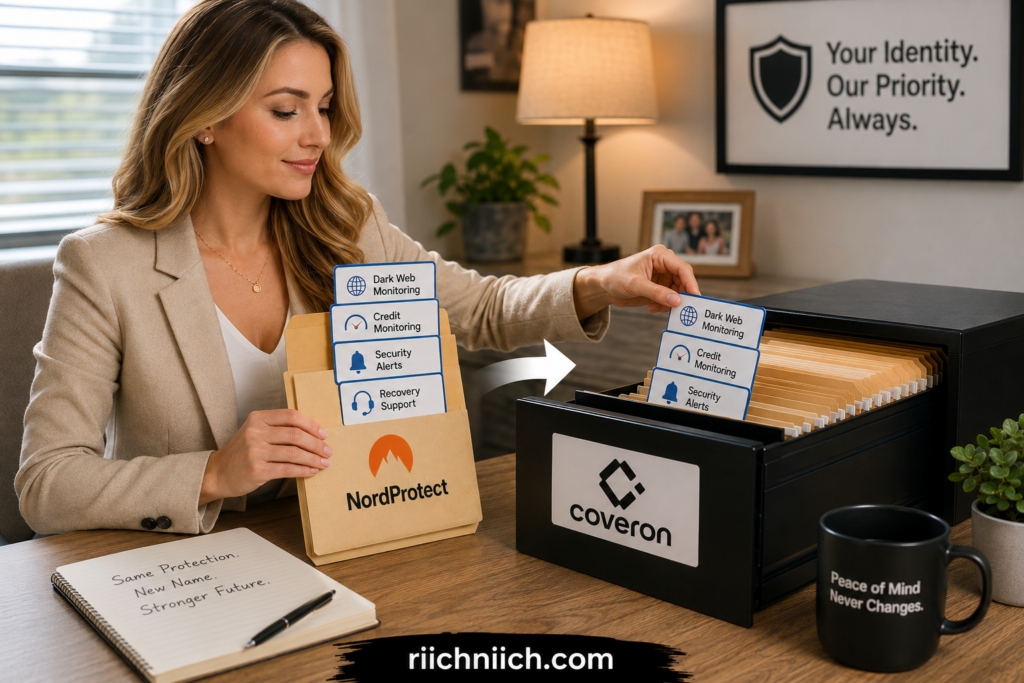
This is important because NordProtect did not simply disappear or get replaced by an unrelated identity protection company. According to Coveron, the transition was primarily a branding change. At the time of the announcement, the company said the name and logo were changing while the service scope, existing features, coverage, and customer benefits would carry over. Existing NordProtect customers could also keep their plans without subscribing again.
In other words, if you previously knew the service as NordProtect, Coveron is the identity theft and scam protection service that emerged from that rebrand. Coveron currently identifies itself as an identity theft and cyber protection service from Nord Security, the cybersecurity company behind NordVPN.
What Does That Mean If You’re Considering Coveron?
The name may be different, but the more important question for potential buyers is whether the protection is worth paying for.
Coveron currently offers features including dark web monitoring, credit monitoring, financial account monitoring, security alerts, identity theft recovery assistance, and several insurance-related benefits. Its current plans advertise up to $2 million toward eligible identity theft recovery expenses, depending on the applicable coverage and terms.
That makes the NordProtect rebrand more than a question about a new logo. If you’re researching Coveron before purchasing identity theft protection, you should evaluate the current Coveron features, price, insurance terms, monitoring capabilities, and alternatives rather than basing your decision solely on what NordProtect offered before the change.
So, why did NordProtect change to Coveron? Based on Coveron’s official explanation, the purpose was to establish a stronger independent identity for the service—not because NordProtect’s core protection was being abandoned.
Read Coveron’s official NordProtect-to-Coveron announcement
What Was NordProtect Before It Became Coveron?
Before the rebrand, NordProtect was an identity theft and scam protection service developed by the cybersecurity team behind NordVPN. Its purpose was different from a traditional VPN: rather than primarily protecting internet traffic, the service focused on monitoring personal and financial information, alerting users to potential identity threats, and providing assistance when identity theft occurred.
Understanding that history helps answer why did NordProtect change to Coveron. Coveron wasn’t introduced as an unrelated company taking NordProtect’s place. According to the company’s official rebrand announcement, the existing service moved forward under the Coveron identity while retaining its established protection features and coverage.
NordProtect Was Built Around Identity and Financial Protection
Before becoming Coveron, NordProtect’s protection centered on several areas that remain important when shopping for an identity theft protection service.
The service included 24/7 dark web monitoring designed to detect exposed personal information, credit monitoring for suspicious credit activity, security alerts, and identity theft recovery support. It also included insurance-related protection for certain covered incidents.
This distinction matters for buyers because NordProtect wasn’t simply another privacy tool added to the Nord ecosystem. It was designed to address what happens when sensitive information is exposed or criminals attempt to misuse someone’s identity.
That foundation carried into Coveron. Today, Coveron continues to position itself as an all-in-one identity theft and cyber protection service, although its current offerings have continued to evolve since the earlier NordProtect service.
Why NordProtect’s History Matters Before You Buy Coveron
For someone considering Coveron today, the NordProtect history provides useful context.
You’re not evaluating a service whose identity-protection concept suddenly appeared with the Coveron name. You’re evaluating the current version of a protection service built by Nord Security’s cybersecurity team and developed around monitoring, alerts, recovery assistance, and financial protection. Coveron officially says it was created by Nord Security, the cybersecurity company behind NordVPN.
However, buyers should still evaluate Coveron as it exists today, rather than assuming everything about the former NordProtect service remains identical forever. Features, coverage limits, plan structures, introductory pricing, renewal pricing, and insurance terms can change over time.
That’s particularly important with a paid identity protection service. The best choice isn’t necessarily the company with the most recognizable history—it’s the service whose current monitoring, recovery support, insurance benefits, price, and overall protection best match what you actually need.
So when researching why did NordProtect change to Coveron, think of NordProtect as the foundation of the service and Coveron as the brand carrying that identity-protection offering forward.
What Is Coveron?
Coveron is an identity theft and cyber protection service from Nord Security, the cybersecurity company behind NordVPN. It is designed to monitor personal, financial, and credit information for potential signs of identity theft, fraud, data exposure, and other online threats.
For anyone researching why did NordProtect change to Coveron, it’s important to understand that Coveron isn’t an unrelated identity protection company that replaced NordProtect. NordProtect officially rebranded as Coveron in May 2026, with the company stating that the change was intended to give the service a stronger standalone identity.
👉 Want to see what Coveron offers today? Check Coveron’s current identity protection plans, features, and pricing to see whether the service fits your needs.
What Does Coveron Actually Do?
Coveron combines several types of monitoring and recovery protection within one service. Depending on the available plan and eligibility, its current features include 24/7 dark web monitoring, credit monitoring, financial account monitoring, security alerts, identity theft recovery assistance, and insurance-related benefits.
For example, dark web monitoring can alert you when monitored information such as an email address, Social Security number, or other personal details appears in known compromised data. Credit and financial monitoring can help identify suspicious activity that could indicate someone is attempting to misuse your identity.
Some Coveron plans also provide access to additional identity-protection tools. One example is TransUnion Credit Lock, which can restrict access to your TransUnion credit file and make certain attempts to open new credit in your name more difficult.
Coveron Also Focuses on What Happens After Identity Theft
Monitoring is only one side of identity theft protection. Coveron also provides recovery assistance if your identity is stolen.
According to Coveron’s current coverage information, eligible customers can receive expert assistance from an identity restoration case manager and reimbursement of qualifying identity theft recovery expenses. Coveron currently advertises up to $2 million in eligible identity theft recovery coverage, subject to the applicable terms, limits, exclusions, and deductible.
Coveron also offers insurance benefits addressing certain online fraud, cyberattack, and cyber extortion incidents. Because insurance benefits have specific eligibility requirements and limitations, buyers should always review the current terms rather than choosing a plan based solely on the maximum advertised coverage amount.
Is Coveron Worth Considering?
From a buyer’s perspective, Coveron’s appeal is its attempt to bring identity monitoring, financial monitoring, cyber protection, alerts, insurance benefits, and recovery assistance together under one service.
That doesn’t automatically make it the right identity theft protection service for everyone.
Before purchasing, compare the features included with your specific Coveron plan, the regular renewal price, monitoring coverage, insurance terms, recovery assistance, and any features you would realistically use. Someone primarily interested in dark web monitoring may have very different needs from someone looking for extensive credit monitoring and identity restoration support.
This is where understanding why did NordProtect change to Coveron becomes useful. You’re not simply deciding whether you trust a new name. You’re deciding whether the current Coveron service that grew out of NordProtect provides enough protection and value to justify its price.
If you’re deciding whether Coveron is the right identity protection service for you, our Coveron vs Aura comparison breaks down how the two services compare on protection, monitoring, features, and overall value.
Is NordProtect Now Coveron?
Yes. NordProtect is now Coveron. NordProtect officially rebranded as Coveron in May 2026. According to Coveron’s announcement, the service received a new name and visual identity while continuing its identity theft and scam protection offerings. This wasn’t an unrelated company purchasing NordProtect or a completely different service replacing it.
That distinction is important for anyone researching why did NordProtect change to Coveron before buying identity theft protection. If you previously encountered NordProtect in an older review, advertisement, account, or search result, you may now see the same service referred to under the Coveron brand.
Did NordProtect Shut Down?
Not in the traditional sense.
NordProtect didn’t announce that it was shutting down and leaving customers without service. Instead, the NordProtect name was retired as the identity protection service transitioned to the Coveron brand.
Coveron’s official announcement states that existing customers kept their plans and did not need to resubscribe because of the change. The company also said that the service’s existing scope, features, coverage, and benefits remained in place during the transition.
For an existing customer, that means seeing “Coveron” instead of “NordProtect” should not automatically be interpreted as your identity protection service being canceled.
Is Coveron Still Connected to Nord Security?
Yes. This is another important detail for potential buyers.
Coveron identifies itself as having been created by Nord Security, the cybersecurity company known for products such as NordVPN. That relationship helps explain why someone familiar with the old NordProtect name may still encounter references to Nord Security while researching Coveron.
For buyers, however, the Nord Security connection shouldn’t be the only reason to purchase the service. The more important consideration is whether Coveron’s current identity monitoring, credit protection, dark web monitoring, recovery assistance, insurance benefits, and other features provide enough value for your needs.
What Should Potential Customers Do With Older NordProtect Reviews?
Be careful when relying on older NordProtect information.
A review written before the Coveron rebrand can still provide historical context, but pricing, plan structures, features, coverage, and terms may have changed. Identity protection services can evolve quickly, so purchasing decisions should be based on Coveron’s current offering rather than assuming every detail from NordProtect still applies.
For example, if you find an older NordProtect review mentioning a particular feature or price, verify that information against Coveron’s current plan details before subscribing.
This is especially important for shoppers investigating why did NordProtect change to Coveron because the name change can make older search results appear as though they are discussing two separate identity protection services.
They’re not.
NordProtect became Coveron, and Coveron is the brand potential customers should evaluate today.
What Does This Mean If You’re Thinking About Buying Coveron?
The rebrand itself shouldn’t determine whether you buy the service.
Instead, consider whether Coveron’s current protection matches the risks you’re trying to address. Someone concerned about exposed personal information may prioritize dark web monitoring, while someone worried about financial identity theft may care more about credit monitoring, financial account alerts, credit locking capabilities, and identity restoration support.
The NordProtect history can give you confidence about where the service came from, but the purchasing decision should come down to what Coveron provides now.
So, why did NordProtect change to Coveron? The company says the new identity was created to establish a stronger standalone brand. For consumers, the simplest way to understand the transition is this: NordProtect was the former name; Coveron is the identity protection brand you should research and compare today.

What Changed When NordProtect Became Coveron?
When NordProtect became Coveron, the most obvious changes were the brand name and logo—not the core purpose of the service. Coveron’s official May 14, 2026 announcement states that NordProtect was rebranded to establish a stronger standalone identity while its existing service scope, features, coverage, and benefits carried over.
That’s an important distinction for anyone researching why did NordProtect change to Coveron. The transition wasn’t presented as NordProtect shutting down and an entirely different identity theft protection service taking its place. Instead, Coveron became the new identity under which the service would continue developing.
The Name and Brand Identity Changed
The clearest change was straightforward: NordProtect became Coveron.
Moving away from the “NordProtect” name gives Coveron a more independent identity rather than having the service’s connection to the broader Nord brand immediately built into its name.
Coveron specifically says the rebrand was intended to strengthen its presence as a standalone service.
For potential customers, this explains why older NordProtect reviews, articles, or references may look different from the Coveron website and branding they encounter today.
Existing Customers Were Moved Into the Coveron Brand
Existing NordProtect subscribers didn’t have to start over.
Coveron states that customers retained their existing plans and benefits without needing to resubscribe. Customers could also continue accessing the service through their Nord Account.
Coveron’s legal documentation provides additional confirmation of the relationship by identifying applicable plans as Coveron (formerly NordProtect).
That continuity matters from a buyer’s perspective because it shows that Coveron wasn’t introduced as an unrelated service with no connection to NordProtect’s customers or previous protection.
Coveron Is Continuing to Develop Beyond the Original Rebrand
There’s another distinction buyers should understand.
Coveron said the existing NordProtect features and coverage carried over unchanged at the time of the rebrand. That doesn’t mean Coveron’s product will remain permanently frozen at its May 2026 feature set.
The service is continuing to evolve.
Coveron’s current feature lineup includes tools such as 24/7 dark web monitoring, three-bureau credit monitoring, financial account monitoring, criminal records monitoring, short-term loan monitoring, credit locking, identity theft recovery assistance, and several insurance benefits, although availability can depend on the plan and applicable terms.
This means shoppers should distinguish between what changed specifically because of the rebrand and features Coveron has introduced, expanded, or modified as the product has continued developing.
What Does the Change Mean for Someone Considering Coveron?
For buyers, the biggest mistake would be treating the new name itself as evidence that Coveron is either better or worse than NordProtect.
The rebrand doesn’t answer the most important purchasing question:
Is the current Coveron service worth the price for the protection you need?
That’s where you should look beyond the NordProtect name and evaluate Coveron’s current monitoring capabilities, credit protection, identity restoration support, insurance benefits, plan limitations, and subscription terms.
It’s also worth checking the price you’ll pay after any introductory offer. Coveron’s current subscription terms state that introductory pricing applies only to the initial subscription period and that subscriptions can automatically renew at the then-current renewal price, which may be higher.
That’s particularly important for anyone comparing the value of identity theft protection services over several years rather than choosing solely because of an attractive introductory price.
Ultimately, understanding why did NordProtect change to Coveron clears up the branding confusion, but it shouldn’t make the buying decision for you. The name and logo changed during the rebrand, while the existing service continued—and today’s Coveron should be evaluated based on what it currently offers for the money.
What Stayed the Same After NordProtect Changed to Coveron?
Although the NordProtect name disappeared, several important parts of the service stayed the same when NordProtect became Coveron. According to Coveron’s official rebrand announcement, the existing service scope, features, coverage, and benefits continued through the transition. Existing customers also kept their plans without needing to purchase another subscription.
That continuity is an important part of understanding why did NordProtect change to Coveron. The company presented the transition as a rebrand designed to establish a stronger standalone identity—not as a decision to abandon the identity protection service NordProtect customers were already using.
The Core Identity Protection Mission Stayed the Same
NordProtect was built to help consumers identify and respond to threats involving their personal and financial information. Coveron continues that core mission by focusing on identity theft detection, monitoring, fraud protection, and recovery assistance.
In other words, the service didn’t suddenly change direction and become a completely different type of cybersecurity product.
For buyers, that’s significant. If you originally became interested in NordProtect because you wanted protection against identity theft, exposed personal information, suspicious credit activity, or online fraud, those same categories remain central to Coveron’s current offering.
Existing NordProtect Customers Kept Their Plans
One of the most important areas of continuity involved existing subscribers.
Coveron stated that NordProtect customers did not need to resubscribe when the rebrand occurred. Their plans continued under the Coveron identity, and customers could continue accessing the service through their Nord Account.
That helps demonstrate that the NordProtect-to-Coveron transition wasn’t treated as a completely new subscription service requiring existing customers to start over.
Monitoring and Recovery Remained Central to the Service
The combination of monitoring threats before they become larger problems and providing assistance after identity theft occurs also remained fundamental to the product.
Coveron’s current protection includes features such as dark web monitoring, credit monitoring, financial account monitoring, security alerts, identity theft recovery assistance, and eligible insurance benefits.
For a potential buyer, these features matter considerably more than the logo attached to them.
Monitoring can help alert you to suspicious activity, but no identity protection service can guarantee that identity theft will never happen. Recovery assistance becomes particularly valuable when someone actually misuses your information and you need help dealing with the consequences.
The Nord Security Connection Remained
Another major point of continuity is the team behind the product.
Coveron identifies itself as being created by Nord Security, the cybersecurity company behind NordVPN. The transition therefore didn’t remove the service from the cybersecurity organization responsible for developing NordProtect.
This may be reassuring to shoppers who encounter the Coveron name for the first time and wonder whether it is an entirely new identity protection company with no history behind it.
However, brand pedigree alone shouldn’t determine whether you subscribe. The service still needs to provide the monitoring, recovery assistance, insurance protection, and overall value that justify its cost.
What This Continuity Means for Buyers
For someone deciding whether to purchase Coveron, the fact that important parts of NordProtect carried over provides useful context—but Coveron should still be evaluated based on what it offers today.
Don’t purchase simply because NordProtect became Coveron, and don’t dismiss the service simply because its name changed.
Instead, look closely at factors such as:
- Which credit bureaus are monitored with your plan
- What personal and financial information can be monitored
- Which identity restoration services are included
- Insurance limits, exclusions, and eligibility requirements
- Individual versus family protection
- Introductory and renewal pricing
- Cancellation and refund terms
- Whether you’ll actually use the additional cybersecurity features included
Those details tell you far more about Coveron’s value than the rebrand itself.
Ultimately, why did NordProtect change to Coveron is primarily a question about branding and the service’s standalone identity. The important takeaway for potential customers is that NordProtect’s established identity protection direction continued under Coveron rather than being discarded and rebuilt from scratch.
That gives buyers a clearer way to evaluate the service: understand where Coveron came from, but make your purchasing decision based on what Coveron protects, what it costs, and whether those protections fit your needs today.

Is Coveron Still Part of Nord Security?
Yes. Coveron remains connected to Nord Security. Coveron’s official About Us page states that Coveron was created by Nord Security, the cybersecurity company behind NordVPN. That connection is important for anyone who remembers NordProtect and is wondering whether the Coveron rebrand also meant the service changed hands.
It did not.
When researching why did NordProtect change to Coveron, it’s helpful to separate the brand change from the company behind the product. NordProtect received a new standalone identity as Coveron, but the cybersecurity expertise behind the service remained tied to Nord Security.
Who Is Behind Coveron?
Nord Security is a cybersecurity company whose products and services focus on areas such as online privacy, network security, password management, and consumer cybersecurity.
Coveron describes itself as being created by Nord Security’s cybersecurity experts, with the service focused specifically on protecting consumers against threats such as identity theft, financial fraud, scams, exposed personal information, and other cyber risks.
That background provides useful context for potential buyers.
Coveron may be a relatively new name compared with some long-established identity protection brands, but the team behind it isn’t entering consumer cybersecurity for the first time.
Why Give Coveron Its Own Brand?
This is where the company’s official explanation matters.
Coveron has stated that NordProtect was rebranded to create a stronger standalone identity. Rather than continuing to position the identity protection service primarily around the Nord name, Coveron can operate with branding specifically associated with identity theft, scam, financial, and cyber protection.
However, it’s important not to take that explanation further than the company itself has.
There is no need to speculate that NordProtect failed, that Nord Security was distancing itself from the product, or that something went wrong behind the scenes. The confirmed explanation is that the rebrand was intended to establish a stronger independent identity for the service.
That distinction helps provide a factual answer to why did NordProtect change to Coveron without turning assumptions about the company’s business strategy into facts.
Does the Nord Security Connection Make Coveron More Trustworthy?
Nord Security’s cybersecurity background can certainly be a positive consideration, especially for shoppers who are hesitant because they haven’t heard of Coveron before.
But company recognition shouldn’t replace proper comparison shopping.
Identity theft protection is ultimately about what happens when your personal information is exposed or misused. Before paying for Coveron, look at the protection you’re actually receiving, including its current:
- Credit monitoring
- Dark web monitoring
- Financial account monitoring
- Identity theft alerts
- Credit locking capabilities
- Identity restoration assistance
- Insurance benefits
- Individual and family protection options
- Subscription and renewal pricing
A recognizable cybersecurity company behind the product can add confidence, but features and value should determine whether you buy it.
Coveron Is Building an Identity Separate From NordVPN
The Coveron name also makes it easier to distinguish the identity protection service from NordVPN.
A VPN and an identity theft protection service solve different problems.
A VPN primarily helps protect your internet connection and online privacy. Identity protection services are designed to monitor for signs that personal or financial information may have been exposed or misused and to provide tools or assistance for responding to identity theft.
Coveron’s standalone branding therefore gives consumers a clearer distinction between those different types of cybersecurity protection.
For shoppers investigating why did NordProtect change to Coveron, this is one of the most useful ways to understand the new positioning: Coveron has its own identity, but it still comes from the Nord Security cybersecurity ecosystem that created NordProtect.
The buying decision should ultimately come down to whether Coveron’s current combination of monitoring, fraud protection, identity recovery assistance, insurance benefits, and pricing provides enough value for the level of protection you want.

What Does the NordProtect to Coveron Change Mean for Existing Customers?
For existing NordProtect customers, the transition to Coveron was designed to be relatively straightforward. According to Coveron’s official rebrand announcement, existing customers kept their plans and benefits and did not need to purchase a new subscription simply because NordProtect became Coveron.
That’s one of the most important facts for anyone researching why did NordProtect change to Coveron. The rebrand wasn’t presented as a shutdown that forced NordProtect subscribers to start over. Instead, existing protection continued under the new Coveron identity.
Your Existing NordProtect Plan Continued
When the rebrand was announced, Coveron stated that existing NordProtect customers would keep their current plans.
That means customers weren’t expected to cancel NordProtect and then sign up separately for Coveron. Their existing subscription transitioned with the service.
This continuity is especially important if you purchased NordProtect shortly before the name change and were concerned that your subscription had suddenly become obsolete.
Your Existing Benefits Carried Over
Coveron also stated that the service scope, features, coverage, and benefits remained unchanged as part of the rebrand itself.
So if you were already receiving identity protection through NordProtect, the new Coveron name didn’t automatically mean those protections disappeared.
However, there’s an important distinction here: saying the benefits carried over during the rebrand doesn’t mean Coveron’s plans can never change afterward.
Like other subscription-based cybersecurity products, Coveron can continue developing its features, pricing, terms, and plan structures. Existing customers should therefore check their current account and applicable plan documents when they need to confirm exactly what protection they have today.
Your Nord Account Still Matters
Existing customers were also told they could continue accessing the service through their Nord Account after the transition.
This is another sign that the NordProtect-to-Coveron change was designed around continuity rather than requiring customers to establish an entirely separate relationship with a new provider.
For someone who originally purchased NordProtect because of its connection to Nord Security, that may make the transition less confusing.
You May Start Seeing the Coveron Name Instead of NordProtect
One of the biggest adjustments for existing customers is simply recognizing the new branding.
You may encounter Coveron on service pages, account information, customer communications, legal documents, or other materials where you previously expected to see NordProtect.
Coveron’s legal documentation even uses language identifying certain coverage as Coveron (formerly known as NordProtect), reinforcing the connection between the old and new names.
So if you’re an existing subscriber and suddenly encounter Coveron branding, don’t automatically assume you’ve been enrolled in an unrelated identity protection service.
Should Existing Customers Review Their Coverage Anyway?
Yes—and this is where the rebrand creates a good opportunity to evaluate whether you’re still getting enough value from the service.
Even though Coveron stated that customers didn’t lose their existing benefits because of the name change, it’s smart to periodically review any identity protection subscription.
Check:
- What identity and financial information you’re currently monitoring
- Which credit bureaus your plan monitors
- Whether your dark web monitoring information is current
- Which family members are protected, if applicable
- Your identity restoration benefits
- Insurance coverage limits and exclusions
- Your current subscription price
- Your upcoming renewal price
- Any newer Coveron features that may be available to you
This isn’t because the rebrand itself indicates a problem. It’s simply good practice when paying for an ongoing security service.
What If You’re an Old NordProtect Customer Thinking About Returning?
This is where the change becomes particularly relevant from a buyer’s perspective.
If you previously canceled NordProtect and are considering signing up again, don’t base your decision entirely on your old NordProtect experience.
Evaluate Coveron as it exists today.
Look at the current plans, monitoring features, recovery assistance, insurance benefits, pricing, and subscription terms. The service has continued developing under the Coveron name, so an older NordProtect plan may not perfectly represent what a new customer receives now.
This also applies if you’re researching why did NordProtect change to Coveron because you found an old NordProtect review while shopping for identity theft protection. Historical reviews can explain where the service came from, but current Coveron information should drive your purchasing decision.
For existing customers, the bottom line is simple: the transition from NordProtect to Coveron was designed to continue your protection rather than reset it. Your plan didn’t suddenly become worthless because the name changed.
And if you’re deciding whether to stay with the service long term, look beyond the rebrand. Compare what you’re paying with the protection you’re actually receiving and decide whether Coveron’s current value still makes sense for you.

Do Existing NordProtect Customers Need to Do Anything?
For most existing NordProtect customers, no major action was required simply because NordProtect became Coveron. Coveron’s official rebrand announcement stated that existing customers would keep their plans and benefits and would not need to resubscribe after the name change.
This is an important part of understanding why did NordProtect change to Coveron. The transition was designed as a rebrand of the existing identity theft and scam protection service—not a migration that required customers to cancel NordProtect and purchase an entirely new Coveron subscription.
You Don’t Need to Buy Coveron Again
If you already had an active NordProtect subscription when the rebrand occurred, you shouldn’t need to purchase another plan solely because you now see the Coveron name.
Coveron stated that existing plans continued through the transition.
That’s especially important for customers who encounter Coveron branding and wonder whether NordProtect has disappeared or whether their previous subscription is still valid.
Before purchasing anything again, check your existing account first.
Continue Using Your Existing Nord Account
Coveron also stated that existing customers could continue accessing the service through their Nord Account.
That means the rebrand wasn’t intended to require subscribers to create an entirely new account just to maintain their protection.
If you’re an existing customer, logging into your account is also a good opportunity to verify that your contact information and monitored personal details are accurate. Identity monitoring is only as useful as the information you’ve actually configured the service to watch.
Review Your Monitoring Information
While Coveron didn’t require customers to rebuild their accounts because of the rebrand, there are a few practical things worth checking.
Make sure the information you’re monitoring is still current. Depending on your plan and available features, that could include personal information, financial accounts, credit activity, or information monitored for dark web exposure.
You should also make sure your email address and notification settings are current so important security alerts don’t end up going to an old inbox or getting overlooked.
These aren’t requirements created by the NordProtect rebrand. They’re simply smart maintenance steps for anyone paying for identity protection.
Check Your Current Plan and Renewal Price
This is particularly important.
If you’ve been subscribed since the NordProtect era, don’t assume that the amount you originally paid is necessarily what you’ll pay indefinitely.
Coveron’s subscription terms explain that subscriptions may automatically renew and that introductory pricing can differ from the applicable renewal price.
Before your next renewal, check:
- Your current Coveron plan
- The features included
- Your next billing date
- Your expected renewal price
- Whether your payment information is current
- Current cancellation and refund terms
A service can provide useful protection and still stop being a good value if the price you’re paying no longer matches the benefits you actually use.
Don’t Ignore Official Coveron Communications
Existing NordProtect customers should also become familiar with the Coveron name and branding.
That doesn’t mean trusting every email that contains the word Coveron. Cybercriminals frequently impersonate legitimate companies, particularly companies associated with security, financial accounts, and personal information.
Instead of clicking unexpected links in an email claiming to be from Coveron, consider accessing your account through the service you normally use and verifying important notices there.
This is especially useful after a company rebrand because customers may be more vulnerable to confusion when they suddenly start seeing unfamiliar branding.
Do You Need to Switch Identity Protection Services?
Not simply because NordProtect became Coveron.
A name change by itself isn’t a strong reason to cancel an identity protection service you’ve been satisfied with.
But it is a good opportunity to reevaluate what you’re paying for.
If your Coveron plan still provides the identity monitoring, credit protection, fraud detection, recovery assistance, and insurance benefits you want at a price you’re comfortable paying, continuing may make sense.
If you’re paying for features you rarely use—or another type of identity protection better fits your needs—then comparing your options before the next renewal can be worthwhile.
That’s ultimately why understanding why did NordProtect change to Coveron matters for existing customers. You shouldn’t feel pressured to purchase another subscription because the branding changed, but you also shouldn’t automatically renew year after year without reviewing the service.
Your protection may have continued automatically. Your decision to keep paying for it should still be intentional.

Is Coveron Legitimate and Safe to Use?
Yes, Coveron is a legitimate identity theft and cyber protection service created by Nord Security, the cybersecurity company behind NordVPN. Coveron’s connection to the former NordProtect service is also documented by the company itself, which announced in May 2026 that NordProtect was becoming Coveron as part of a rebrand intended to give the service a stronger standalone identity.
That background is particularly important if you’re researching why did NordProtect change to Coveron because the unfamiliar Coveron name could make the service appear newer than it actually is. Coveron wasn’t presented as an unknown company suddenly taking over NordProtect. It is the brand that emerged from the NordProtect rebrand.
What Makes Coveron a Legitimate Service?
Several factors help establish Coveron’s legitimacy.
First, Coveron openly identifies its connection to Nord Security. Second, its official documentation explains the transition from NordProtect to Coveron rather than attempting to distance the new brand from its previous identity.
Coveron also maintains publicly available subscription terms, privacy information, insurance documentation, and other legal policies describing how the service operates.
That transparency is something buyers should look for with any identity protection service because you’re potentially trusting the provider with highly sensitive information.
How Does Coveron Protect Your Information?
This is where “legitimate” and “safe” need to be separated.
A company can be legitimate without any cybersecurity service being completely risk-free. Coveron necessarily handles sensitive information to provide features such as identity monitoring, credit monitoring, financial monitoring, and security alerts.
According to Coveron’s privacy information, the company describes technical and organizational safeguards intended to protect the personal information it processes.
Before subscribing, it’s still worth reviewing the company’s current privacy policy so you understand what information may be collected, why it’s needed, how it’s processed, and what choices you have regarding your data.
Coveron Provides More Than Simple Monitoring
Another factor buyers should consider is what they’re actually purchasing.
Coveron’s current service can include protection such as dark web monitoring, three-bureau credit monitoring, financial account monitoring, criminal records monitoring, short-term loan monitoring, credit locking, identity theft recovery assistance, and eligible insurance benefits, depending on the plan and applicable terms.
That makes Coveron more than a basic service that simply sends an alert when an email address appears in a known breach.
For someone paying for identity theft protection, the broader question is whether those additional layers provide enough value to justify the subscription price.
Can Coveron Prevent Identity Theft Completely?
No—and you should be cautious of any identity protection service that suggests otherwise.
Identity monitoring can help detect warning signs and potentially alert you faster, but it cannot guarantee that criminals will never obtain or misuse your information.
For example, monitoring might alert you after suspicious credit activity is detected. Dark web monitoring may identify personal information discovered in compromised datasets. Recovery assistance may help you respond if identity theft occurs.
Those tools can be valuable, but they’re different from guaranteeing that identity theft will never happen.
A strong identity protection strategy should still include habits such as using unique passwords, enabling multifactor authentication, monitoring financial accounts, reviewing credit reports, and being cautious about phishing attempts.
Is It Safe to Give Coveron Your Personal Information?
This is a reasonable question because identity monitoring services may require sensitive information to monitor effectively.
Before providing personal information to any identity protection company, make sure you’re using the official service or application rather than a link from an unexpected email, advertisement, text message, or social media post.
The rebrand makes this particularly important for former NordProtect users. Someone accustomed to the NordProtect name could potentially be confused by communications using Coveron branding.
Understanding why did NordProtect change to Coveron helps remove some of that uncertainty: the Coveron name is part of an officially announced transition, not evidence by itself that you’ve encountered an unrelated service.
Should You Trust Coveron Enough to Buy It?
Coveron’s legitimacy doesn’t automatically mean everyone should subscribe.
The better question is whether Coveron provides enough value for your particular risk level and budget.
Someone who has experienced repeated data breaches, exposed personal information, suspicious credit activity, or previous identity theft may place greater value on continuous monitoring and professional recovery assistance.
Someone who already actively freezes their credit, monitors accounts, reviews credit reports, and uses other cybersecurity tools may evaluate the subscription differently.
Before buying, compare the Coveron plan you’re considering based on:
- Monitoring coverage
- Credit protection
- Dark web monitoring
- Financial monitoring
- Identity restoration assistance
- Insurance limits and exclusions
- Family protection options
- Introductory pricing
- Renewal pricing
- Cancellation terms
Don’t buy simply because Coveron comes from Nord Security, and don’t dismiss it simply because you don’t recognize the new name.
For consumers researching why did NordProtect change to Coveron, the key takeaway is that Coveron is the legitimate successor brand to NordProtect and remains connected to Nord Security. Whether it’s worth buying is a separate decision—and that decision should be based on the current protection, price, and benefits you’re actually getting.

What Identity Protection Features Does Coveron Offer?
Coveron offers a broad collection of identity monitoring, credit protection, financial monitoring, fraud detection, and identity recovery features designed to help consumers spot suspicious activity earlier and get assistance if their identity is stolen.
For someone researching why did NordProtect change to Coveron, this is where the rebrand becomes especially relevant from a buyer’s perspective. The name may have changed, but today’s purchasing decision should be based on what Coveron actually provides now, not simply what you remember about NordProtect.
Coveron’s current feature lineup varies by plan, so buyers should verify exactly what’s included before subscribing.
24/7 Dark Web Monitoring
Coveron provides 24/7 dark web monitoring for personal information that may have been exposed through data breaches or other compromises.
Users can add information for monitoring such as their email address, phone number, Social Security number, and credit card information. If monitored information is detected in compromised data, Coveron sends an alert so the user can investigate and take action.
This can be particularly useful if you’ve been involved in multiple data breaches and don’t want to manually check whether your personal information has surfaced elsewhere online.
If you’re unsure how this type of protection actually works, our guide, What is Dark Web Monitoring and Is It Worth It? explains what these services can detect, what they cannot detect, and when paying for monitoring may make sense.
Three-Bureau Credit Monitoring
Credit monitoring is one of Coveron’s stronger buyer-intent features.
Coveron currently offers three-bureau credit monitoring across Experian, Equifax, and TransUnion. The service can alert users to potentially important changes such as new accounts, hard inquiries, late payments, and other activity appearing on their credit files.
Monitoring all three bureaus matters because lenders don’t necessarily report information to every credit bureau. Suspicious activity could therefore appear on one credit file before another.
Credit monitoring is only one part of protecting your identity, so understanding Identity Monitoring vs. Credit Monitoring can help you decide whether you need broader protection than credit alerts alone.
Coveron also provides access to a VantageScore 3.0 credit score.
TransUnion Credit Lock
Coveron also offers a TransUnion Credit Lock feature.
When enabled through the Coveron dashboard, the feature instructs TransUnion to block new creditors from accessing the user’s TransUnion credit file, making it harder for someone to use stolen personal information to open certain new credit accounts.
Users can turn the lock off when they legitimately need creditors to access their TransUnion file, such as when applying for a mortgage or credit card.
This is different from simply monitoring your credit. Monitoring can warn you about suspicious activity; locking access can help create an additional barrier against certain types of new-account fraud.
If you’re considering using this feature, it’s also important to understand the differences between a Credit Freeze vs. Credit Lock before deciding which option makes more sense for protecting your credit.
Financial Account Monitoring
Identity theft doesn’t always begin with a new credit card.
Coveron’s financial account monitoring is designed to detect activity involving checking, savings, business, CD, and IRA accounts. According to Coveron, alerts can include new account applications, newly opened financial accounts, changes to account holders, and new signers being added.
Interestingly, Coveron says users don’t need to link their bank accounts to activate this monitoring. Identity verification is required, including personal information such as the user’s name, date of birth, address, and Social Security number.
For buyers particularly concerned about financial identity theft, this expands protection beyond simply watching credit reports.
Short-Term Loan Monitoring
Coveron also monitors for certain short-term and payday loan activity involving a user’s personal information.
This can help identify situations where a criminal attempts to use stolen identity information to obtain a loan that might otherwise go unnoticed until collection notices or other financial problems appear.
The service can alert users about new loan inquiries, accounts, or changes in loan status.
Criminal Records Monitoring
One of Coveron’s more unusual features is criminal records monitoring.
Coveron says it checks arrest and booking information from more than 2,800 incarceration facilities across 48 states to identify cases where a customer’s identity may have been associated with criminal activity. The underlying data is refreshed daily.
This addresses a different form of identity theft: someone providing another person’s identifying information during interactions with law enforcement.
If Coveron detects a potential match, the customer receives an alert and guidance for addressing the situation.
Malware Breach Alerts
Coveron also includes malware-related breach monitoring.
Its malware breach alerts are intended to identify situations where login credentials or payment information exposed through a malware infection subsequently appear in compromised data. Alerts can provide information about what was exposed and steps the user can take to secure affected accounts.
This adds another layer to Coveron’s monitoring because the threat isn’t limited to traditional corporate data breaches.
Identity Theft Recovery Assistance
Detection is useful, but buyers should also consider what happens after identity theft actually occurs.
Coveron provides identity theft recovery support along with reimbursement for certain eligible recovery expenses.
Its current identity theft recovery benefit advertises up to $2 million for eligible expenses, which may include certain legal costs, replacement documents, credit reports, lost wages, application fees, notary expenses, and other qualifying recovery costs. Coverage is subject to the applicable terms, limits, exclusions, and deductible.
For some buyers, professional recovery assistance may ultimately be more valuable than receiving another monitoring alert.
Online Fraud, Cyberattack, and Cyber Extortion Coverage
Coveron’s protection extends beyond traditional identity theft.
Its current feature information advertises up to $10,000 for eligible online fraud losses, up to $10,000 for certain eligible cyberattack-related losses, and up to $50,000 for eligible cyber extortion expenses. These benefits are subject to the applicable coverage requirements, exclusions, limits, and deductible.
Insurance benefits should never be judged solely by the largest number printed on a sales page. Read the applicable benefit documents before purchasing so you understand which events and expenses actually qualify.
Additional Privacy and Cybersecurity Tools
Depending on the Coveron plan selected, buyers may also have access to additional online privacy and cybersecurity features.
Coveron’s current pricing page lists features such as a VPN, next-generation antivirus protection, and Incogni personal-data removal within its broader plan lineup.
These extras can change the value calculation considerably.
If you’re already paying separately for several cybersecurity and privacy tools, a bundled Coveron plan may be more attractive. If you already have those protections elsewhere, however, you should determine whether you’re paying extra for overlapping features you don’t need.
Which Coveron Features Matter Most?
Don’t choose Coveron simply because it has a long feature list.
Think about which risks you’re actually trying to reduce.
If your biggest concern is someone opening accounts in your name, three-bureau credit monitoring, financial account monitoring, short-term loan monitoring, and credit locking may matter most.
If you’ve had personal information exposed through breaches, dark web monitoring and malware breach alerts could be more important.
And if your biggest concern is the financial and administrative nightmare of recovering from identity theft, restoration assistance and eligible recovery coverage may carry more weight.
That’s why understanding why did NordProtect change to Coveron is only the beginning of the buying decision. The rebrand explains where Coveron came from. Its current combination of monitoring, prevention tools, recovery support, insurance benefits, and cybersecurity features determines whether Coveron is actually worth paying for.
How Much Does Coveron Cost After the NordProtect Rebrand?
After the NordProtect rebrand, Coveron offers three main protection plans with monthly, one-year, and two-year subscription options. Current promotional pricing varies significantly depending on how long you’re willing to subscribe, so it’s important to look beyond the advertised monthly equivalent before deciding which plan offers the best value.
As of August 2026, Coveron’s official pricing page lists Scam Protection, Identity Theft Protection, and Full Protection as its three primary options. The lowest advertised rates are attached to two-year subscriptions.
For anyone researching why did NordProtect change to Coveron, pricing is particularly important because you’re no longer evaluating the old NordProtect offering. You’re deciding whether the current Coveron plans provide enough protection to justify their current price.
Coveron Two-Year Plan Pricing
Coveron’s two-year subscriptions currently offer the lowest advertised monthly-equivalent prices:

🚨 Sales tax may apply. These are introductory prices for the first subscription period, not guaranteed lifetime rates and subject to change.
From a buyer-intent perspective, the Identity Theft Protection plan may be the most relevant starting point for someone specifically shopping for protection against identity theft rather than primarily scams.
It currently includes benefits such as identity theft insurance, credit monitoring, financial account monitoring, short-term loan monitoring, dark web monitoring, malware breach alerts, and criminal records monitoring.
Coveron One-Year Plan Pricing
If you don’t want to commit to two years, Coveron currently offers one-year plans at higher monthly-equivalent introductory rates:
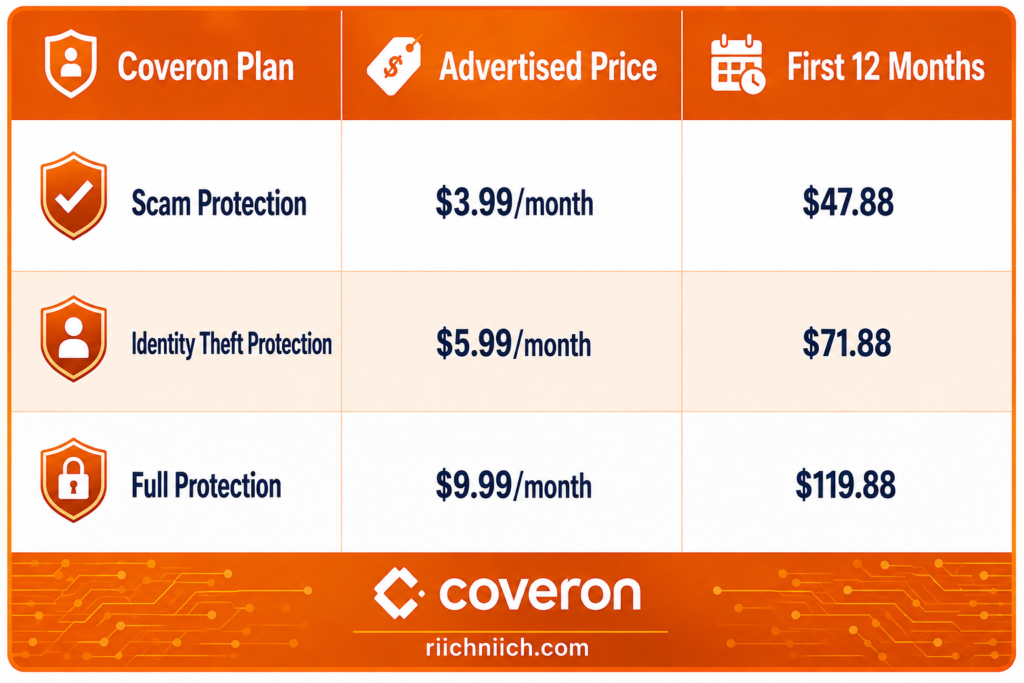
🚨 Again, these are introductory prices for the first subscription period and subject to change. Sales tax may apply.
The one-year option costs more per month than the two-year promotion, but some buyers may prefer paying for a shorter commitment before deciding whether Coveron deserves a permanent place in their identity protection strategy.
What If You Want to Pay Month-to-Month?
Coveron also provides monthly subscriptions, but they’re considerably more expensive:

🚨 Once again, these are introductory prices for the first subscription period and subject to change. Sales tax may apply.
These options give buyers greater flexibility without committing to a longer subscription, but the difference in cost is substantial compared with Coveron’s introductory annual and two-year pricing.
For example, the Full Protection plan is currently advertised at a $8.99 monthly equivalent with the two-year introductory offer versus $29.99 when billed month-to-month.
That’s why subscription length should be part of your Coveron buying decision, not just the advertised headline price.
Which Coveron Plan Offers the Best Value?
That depends on what you actually want protected.
Scam Protection is the least expensive option, but it’s considerably more limited. It focuses on protections such as dark web monitoring, malware breach alerts, and eligible online fraud and cyberattack insurance.
Identity Theft Protection moves much deeper into identity protection. It currently adds benefits including up to $2 million in eligible identity theft insurance, credit monitoring, short-term loan monitoring, financial account monitoring, criminal records monitoring, and additional insurance protections.
Full Protection is the most comprehensive option. It currently upgrades credit monitoring to all three major credit bureaus and adds online privacy and cybersecurity tools, including a VPN, next-generation antivirus protection, and a personal data removal service.
For buyers specifically worried about identity theft, the middle plan could offer a useful balance between price and protection. However, someone wanting three-bureau credit monitoring plus broader privacy and cybersecurity tools may find the Full Protection plan more attractive.
Watch the Renewal Price
This is probably the most important pricing detail to understand before purchasing Coveron.
The promotional price you see when signing up isn’t necessarily what you’ll continue paying.
Coveron’s subscription terms state that introductory pricing applies only to the first subscription period. After that period ends, the subscription automatically renews unless canceled, and customers are charged the then-current renewal price, which may be higher than the introductory price and can change.
For subscriptions longer than one month, Coveron says it sends customers a notification before the upcoming charge that includes the renewal price, billing date, and cancellation information.
That means you shouldn’t evaluate Coveron’s long-term affordability using the introductory rate alone.
Coveron Includes a 30-Day Money-Back Guarantee
Coveron’s current plans advertise a 30-day money-back guarantee for the initial purchase. Its terms state that customers who aren’t satisfied can request a refund within 30 days following the purchase, subject to the applicable conditions. Renewed subscriptions don’t receive the same money-back guarantee simply because they’ve renewed.
For someone unsure about committing to an identity protection service, that provides a limited period to evaluate whether Coveron’s interface, monitoring tools, alerts, and overall service meet expectations.
Is Coveron Worth the Price?
This is where understanding why did NordProtect change to Coveron eventually turns into a purchasing decision.
The rebrand itself doesn’t make Coveron a good or bad value.
At the current introductory rates, buyers should compare how much protection they’re receiving for the total subscription cost, rather than automatically choosing the cheapest plan.
If you only want basic breach and scam monitoring, paying for Full Protection may be unnecessary.
If you want credit monitoring, financial account monitoring, identity theft recovery assistance, and broader protection against identity fraud, the Identity Theft Protection plan becomes considerably more relevant.
And if you’re already paying separately for a VPN, antivirus protection, data removal, and identity protection, Coveron’s Full Protection bundle could potentially consolidate several services—but only if you’ll actually use them.
So when researching why did NordProtect change to Coveron, don’t stop at understanding the rebrand. Compare Coveron’s current introductory price, renewal terms, included features, and total long-term cost before deciding whether the new Coveron service deserves your money.
Coveron vs Other Identity Theft Protection Services
Coveron competes in a crowded identity theft protection market, but its approach is broader than simply watching your credit report. The service combines identity monitoring, credit monitoring, financial account monitoring, dark web monitoring, identity recovery assistance, insurance benefits, and—in its higher-tier offering—additional cybersecurity and privacy tools.
For anyone researching why did NordProtect change to Coveron, this comparison matters because the rebrand itself shouldn’t determine whether you subscribe. The real question is whether Coveron’s current combination of protection and price is competitive enough to earn your money.
Where Coveron Stands Out
One of Coveron’s biggest advantages is the number of different threats it attempts to address within one subscription.
Depending on the plan, Coveron currently offers features including:
- Dark web monitoring
- Credit monitoring
- Financial account monitoring
- Short-term loan monitoring
- Criminal records monitoring
- Malware breach alerts
- TransUnion Credit Lock
- Identity theft recovery assistance
- Eligible identity theft insurance
- Online fraud insurance
- Cyberattack insurance
- Cyber extortion insurance
Its Full Protection offering expands the package further with three-bureau credit monitoring, VPN protection, antivirus protection, and personal data removal.
That bundled approach could be particularly appealing if you’re trying to avoid paying separately for multiple privacy, identity protection, and cybersecurity services.
Three-Bureau Credit Monitoring Can Make a Difference
One feature worth paying close attention to when comparing identity protection services is how many credit bureaus are actually monitored.
Coveron’s Full Protection plan currently includes monitoring across Experian, Equifax, and TransUnion.
That’s more comprehensive than watching only one bureau because suspicious activity isn’t guaranteed to appear simultaneously across all three credit reports.
However, Coveron’s lower-priced Identity Theft Protection plan currently provides single-bureau credit monitoring, according to its plan comparison.
That distinction is important.
A buyer who considers three-bureau monitoring essential shouldn’t choose a Coveron plan based solely on its attractive introductory price and assume every tier provides the same credit coverage.
Coveron Goes Beyond Credit Monitoring
Credit monitoring alone doesn’t cover every way someone can misuse your identity.
Coveron’s financial account monitoring can alert users to certain suspicious activity involving deposit accounts, while short-term loan monitoring looks for certain activity involving payday and other short-term loans.
Criminal records monitoring addresses another unusual risk: someone potentially using your identity when interacting with law enforcement.
Then there’s dark web monitoring, which looks for monitored personal information discovered in compromised data.
This broader approach may appeal to buyers who want identity monitoring beyond traditional credit-file changes.
Identity Recovery Support Is an Important Part of the Comparison
Identity protection shouldn’t be judged only by how many alerts appear on a feature list.
Ask what happens after your identity is actually stolen.
Coveron provides identity restoration assistance designed to help eligible customers navigate the recovery process. Its current coverage also advertises up to $2 million toward eligible identity theft recovery expenses, subject to the applicable policy terms, limits, exclusions, and a deductible.
This could become one of the most valuable parts of an identity protection subscription if you ever experience serious identity theft.
A dozen monitoring features may sound impressive, but having knowledgeable assistance when you’re dealing with fraudulent accounts, compromised documents, credit problems, and recovery expenses can matter considerably more.
Coveron’s Cybersecurity Bundle Changes the Value Equation
Coveron’s Full Protection plan becomes particularly interesting for buyers who want more than traditional identity monitoring.
The current package combines identity protection with tools covering online privacy, malware protection, safer internet connections, and personal data removal.
That’s significant because reducing identity theft risk isn’t only about detecting fraud after something goes wrong.
Reducing the amount of personal information circulating online, protecting devices against malicious software, and securing internet activity can complement identity monitoring by addressing other parts of your overall digital security.
However, there’s a catch.
If you already pay for—or are satisfied with—separate cybersecurity and privacy tools, some of Coveron’s bundled features could overlap with protection you already have.
In that situation, paying for the highest Coveron tier may not provide as much additional value.
Don’t Compare Identity Protection Services by Price Alone
Coveron’s introductory pricing can look attractive, particularly with a longer subscription.
But headline price isn’t enough to determine which identity protection service offers better value.
When comparing Coveron with another service, look at:

A cheaper identity protection plan isn’t necessarily a better deal if it leaves out protection you consider essential.
Likewise, the most expensive service isn’t automatically the best if you’re paying for features you’ll never use.
Coveron May Be Better for Buyers Who Want an All-in-One Approach
Coveron becomes particularly compelling for someone who wants to consolidate several layers of digital protection.
Instead of thinking:
“I need identity monitoring.”
A Coveron buyer may be thinking:
“I want help monitoring my identity, credit, financial activity, exposed information, devices, internet privacy, and personal data—and I want recovery assistance if something still goes wrong.”
That’s a very different value proposition.
On the other hand, someone who already has strong cybersecurity tools and only needs specialized identity monitoring may prefer a more focused approach.
The NordProtect History Shouldn’t Decide the Winner
This brings the comparison back to why did NordProtect change to Coveron.
Knowing that NordProtect became Coveron helps establish where the service came from and why older NordProtect information still appears online. But brand history shouldn’t determine which identity theft protection service you purchase.
The better approach is to compare the protections that matter most to you.
If Coveron’s combination of monitoring, recovery support, insurance benefits, credit protection, privacy tools, and cybersecurity features matches your needs at a price you’re comfortable paying, it deserves consideration.
If another service gives you stronger coverage in the areas you care about most, you shouldn’t choose Coveron simply because you recognize Nord Security.
👉 Not convinced Coveron is the right fit? Check Aura’s current identity theft protection plans here to compare another option before making your decision.
The best identity theft protection service isn’t the one with the longest feature list. It’s the one whose features address the risks you’re actually willing to pay to protect against.
Who Should Consider Coveron?
Coveron may be worth considering if you want more than basic credit monitoring and prefer having multiple layers of identity, financial, privacy, and cybersecurity protection managed through one service.
For anyone researching why did NordProtect change to Coveron, this is where the question shifts from understanding the rebrand to deciding whether the service actually fits your needs. Coveron may have grown out of NordProtect, but that history alone isn’t a reason to buy it. The value comes from whether you’ll benefit from the protection included in your chosen plan.
People Whose Information Has Been Exposed in Data Breaches
If your personal information has appeared in one or more data breaches, Coveron’s monitoring features may be particularly useful.
Coveron’s dark web monitoring is designed to watch for monitored information found in compromised data and notify you when potential exposure is detected.
That doesn’t remove stolen information from criminals’ possession, but receiving an early warning can give you an opportunity to change compromised passwords, secure affected accounts, watch for fraud, or take other protective action.
For people whose information has already circulated through breaches, continuous monitoring may provide more value than occasionally checking for exposure manually.
People Worried About New Accounts Being Opened in Their Name
Coveron may also appeal to people particularly concerned about new-account identity fraud.
Depending on the plan, its protection can include credit monitoring, financial account monitoring, short-term loan monitoring, and TransUnion Credit Lock.
Coveron’s Full Protection plan currently includes three-bureau credit monitoring across Experian, Equifax, and TransUnion, providing broader visibility into potentially important credit-file changes.
If a criminal attempts to use your stolen information to apply for certain credit or financial products, monitoring can increase the chances that you notice suspicious activity sooner rather than discovering it months later.
People Who Want Help Recovering From Identity Theft
Some consumers are comfortable handling security alerts themselves.
Others want someone available when the situation becomes complicated.
Coveron provides identity theft recovery assistance, which can be particularly valuable for people who don’t want to navigate the recovery process alone after serious identity fraud.
Its current identity theft recovery benefit advertises up to $2 million toward eligible recovery expenses, subject to applicable policy terms, exclusions, limits, and deductible.
That doesn’t mean every identity theft incident results in a $2 million reimbursement. Buyers should read the applicable coverage documents carefully.
The more meaningful benefit for many customers may be having access to professional assistance when dealing with the paperwork, financial consequences, and administrative burden that identity theft can create.
People Who Want Identity Protection and Cybersecurity Together
Coveron becomes particularly interesting for consumers who don’t want to assemble their digital protection one service at a time.
Its Full Protection offering currently combines identity monitoring with additional cybersecurity and privacy tools, including VPN protection, antivirus protection, and personal data removal, alongside its broader identity and credit monitoring features.
That could make sense if you’re currently thinking about purchasing several of those services separately.
Instead of managing multiple subscriptions, you may prefer a more consolidated protection package.
However, calculate what you’re already paying before switching. If you already have strong VPN, antivirus, and privacy tools that you like, Coveron’s bundled features may provide less additional value.
People Who Don’t Regularly Monitor Their Own Credit and Accounts
Some people consistently review their credit reports, check bank activity, maintain credit freezes, investigate breaches, and monitor their personal information.
Many people don’t.
If you know you’re unlikely to manually check these areas consistently, automated monitoring and alerts may make a paid identity protection service more useful.
The service isn’t replacing your responsibility to pay attention to your finances. It’s providing another set of eyes watching for specific warning signs.
That convenience can be one of the strongest reasons to pay for identity protection.
People Who Have Already Experienced Identity Theft
If you’ve noticed suspicious financial activity but aren’t sure whether identity theft is actually happening, start with our guide, How to Know If Someone is Using Your Identity to identify the warning signs you shouldn’t ignore.
Previous victims may have a different tolerance for risk.
After experiencing fraudulent accounts, stolen credentials, financial fraud, or other forms of identity misuse, some people decide that continuous monitoring and access to recovery assistance are worth paying for.
Coveron’s combination of monitoring, alerts, recovery support, and eligible insurance benefits may therefore appeal to someone who wants additional protection after going through identity theft once already.
It still can’t guarantee that identity theft won’t happen again, but it can provide additional tools for detecting and responding to suspicious activity.
People Who Want Broader Protection Than Free Monitoring
Free credit monitoring can be useful, but it may not provide the broader protection someone wants.
Depending on the Coveron plan, you’re potentially paying for a combination of credit monitoring, dark web monitoring, financial account monitoring, short-term loan monitoring, criminal records monitoring, recovery assistance, insurance benefits, and cybersecurity tools.
The question isn’t whether paid monitoring is automatically better than free monitoring.
The question is whether the additional services are valuable enough to you to justify paying for them.
Coveron Makes the Most Sense When You’ll Actually Use the Protection
This is the key buyer-intent takeaway.
Coveron may be a strong fit if you want:
- Multiple forms of identity monitoring
- Broader credit protection
- Financial account monitoring
- Dark web exposure alerts
- Professional identity restoration assistance
- Eligible insurance benefits
- Additional cybersecurity and privacy tools
- One service managing several layers of protection
But don’t purchase the largest Coveron plan simply because it offers the most features.
Choose the protection level that matches your actual risks, budget, and existing security setup.
That’s also why understanding why did NordProtect change to Coveron is useful but shouldn’t dominate your decision. The rebrand explains Coveron’s history. Your personal risk profile determines whether Coveron deserves a place in your budget.
If several of the situations above describe you—particularly if you’ve experienced previous identity theft, repeated data breaches, or simply don’t have time to monitor everything yourself—Coveron may be worth putting on your shortlist.

Who Should Consider an Alternative to Coveron?
Coveron offers a broad combination of identity monitoring, credit protection, recovery assistance, insurance benefits, and cybersecurity tools, but it won’t be the best fit for every buyer.
For anyone researching why did NordProtect change to Coveron, it’s important not to let the Nord Security connection or the rebrand itself make the purchasing decision. Coveron should earn your subscription based on its current features, coverage, price, and how well those benefits match your needs.
Some consumers may be better off with another identity protection approach—or may not need a paid identity protection subscription at all.
People Who Only Want Free Credit Protection
If your main concern is preventing criminals from opening new credit accounts in your name, you may not need a monthly identity protection subscription solely for that purpose.
Consumers can place a credit freeze for free with Equifax, Experian, and TransUnion. A security freeze restricts prospective creditors from accessing your credit file, which can make it harder for an identity thief to open certain new accounts using your information.
The Federal Trade Commission explains how consumers can place and lift credit freezes through each credit bureau.
A credit freeze doesn’t replace identity monitoring, dark web monitoring, recovery assistance, or other Coveron features. But if freezing your credit addresses your primary concern, consider whether the additional paid protection is worth the recurring cost.
People Who Already Have Significant Protection Elsewhere
Before subscribing to Coveron, take inventory of what you already have.
You may already receive some security or identity-related benefits through your:
- Bank
- Credit card company
- Employer
- Insurance provider
- Financial institution
- Existing cybersecurity software
You may also already pay separately for a VPN, antivirus software, password manager, personal data removal service, or another security product.
This matters because Coveron’s Full Protection plan bundles several privacy and cybersecurity tools with its identity protection features.
Bundling can be convenient—but paying twice for overlapping protection isn’t.
If you already have security tools you’re happy with, a more specialized identity protection plan may make more financial sense than purchasing another broad bundle.
People Who Want Three-Bureau Monitoring at a Lower Coveron Tier
Credit monitoring deserves careful attention when choosing between Coveron’s plans.
Coveron’s current plan comparison shows that its Identity Theft Protection plan provides single-bureau credit monitoring, while the higher-tier Full Protection plan provides monitoring across all three major credit bureaus—Experian, Equifax, and TransUnion.
If three-bureau credit monitoring is one of your non-negotiable requirements but you don’t want the broader Full Protection package, you should compare your options carefully before subscribing.
Don’t assume every Coveron plan provides identical credit monitoring simply because each falls under the same brand.
People Who Don’t Want a Long Subscription Commitment
Coveron’s promotional pricing is significantly more attractive when purchasing a longer subscription.
But the lowest monthly-equivalent price isn’t the same thing as a low-commitment subscription.
If you’re uncomfortable paying for one or two years upfront—or simply want the flexibility to change services more frequently—the savings from Coveron’s longer introductory plans may be less compelling.
Coveron does offer monthly subscriptions, but those currently cost considerably more per month than its longer promotional subscriptions.
For buyers who value flexibility above getting the lowest introductory price, that tradeoff deserves consideration.
People Who Don’t Want to Deal With Higher Renewal Pricing
Coveron’s introductory offers can make the service appear especially affordable at signup.
However, introductory pricing applies to the initial subscription period.
Coveron’s subscription terms state that subscriptions automatically renew unless canceled and that customers are charged the then-current renewal price, which may be higher than the introductory rate.
If you dislike promotional subscription models where the initial price and renewal price can differ substantially, factor that into your decision before purchasing, not when the renewal notice arrives.
A good introductory deal doesn’t necessarily equal good long-term value.
Highly Hands-On Consumers May Not Need Everything Coveron Offers
Some consumers already manage much of their identity protection themselves.
You may regularly:
- Keep your credit frozen
- Review all three credit reports
- Monitor banking and credit card transactions
- Use strong unique passwords
- Enable multifactor authentication
- Check breach notifications
- Remove personal information from data broker sites
- Keep devices protected
- Closely investigate suspicious account activity
Even then, Coveron could still provide convenience and recovery assistance.
But the value proposition changes.
If you’re already performing many of these tasks consistently, ask yourself whether you’re paying Coveron for meaningful additional protection or primarily for convenience.
If you’re still deciding whether you need a paid service at all, our guide, Is Identity Theft Protection Worth It? explains when the extra monitoring and recovery support may justify the cost.
There’s nothing wrong with paying for convenience. You should simply know that’s what you’re buying.
People Looking for a Guarantee That Identity Theft Won’t Happen
Coveron—or any legitimate identity monitoring service—cannot guarantee that your identity will never be stolen.
Monitoring services generally help detect suspicious activity, alert you to certain threats, and assist with recovery. They don’t create an invisible wall around your Social Security number, credit information, or online accounts.
If you’re considering Coveron because you expect a subscription to eliminate identity theft risk entirely, reconsider that expectation.
Paid identity protection works best as one layer of a broader security strategy, not a replacement for good security habits.
People Who Won’t Use Most of the Features
This is perhaps the simplest reason to consider an alternative.
More features don’t automatically mean more value.
If you only care about one or two areas—perhaps credit monitoring and dark web alerts—you may not need a package containing numerous additional protections.
On the other hand, if you genuinely want identity monitoring, financial monitoring, recovery support, insurance protection, privacy tools, and cybersecurity features together, Coveron’s broader approach becomes much easier to justify.
This is why why did NordProtect change to Coveron shouldn’t be the final question you ask before purchasing.
The better question is:
Does Coveron provide enough protection that I will actually use to justify what I’ll pay today—and what I may pay when the subscription renews?
If the answer is yes, Coveron deserves consideration.
If you’re primarily attracted to the brand name, introductory discount, or a long list of features you probably won’t use, an alternative—or a combination of free security measures—may provide better value for your situation.

Is Coveron Worth It After the NordProtect Rebrand?
For many consumers, Coveron can be worth considering after the NordProtect rebrand, particularly if you want identity monitoring, credit protection, financial monitoring, recovery assistance, and broader cybersecurity tools available through one service. But the strongest reason to choose Coveron isn’t that it used to be NordProtect—it’s whether the current features provide enough value for the price you’re paying.
For shoppers researching why did NordProtect change to Coveron, the rebrand itself shouldn’t be viewed as either a reason to buy or a warning sign. Coveron says NordProtect was renamed to establish a stronger standalone identity, while the service’s existing scope, features, coverage, and benefits carried over at the time of the transition.
The better question is what Coveron offers today.
Coveron Offers Stronger Value If You Want Broad Protection
Coveron’s biggest advantage is the breadth of protection available within its current lineup.
Depending on the plan, buyers can receive features including dark web monitoring, credit monitoring, financial account monitoring, short-term loan monitoring, criminal records monitoring, malware breach alerts, identity theft recovery assistance, and eligible insurance benefits.
Its Full Protection plan goes further by adding three-bureau credit monitoring and additional privacy and cybersecurity tools.
That makes Coveron especially interesting for someone who doesn’t want to build their protection by subscribing to several unrelated services.
Instead of buying one tool for identity monitoring, another for online privacy, another for malware protection, and another for reducing personal data exposure, Coveron’s higher-tier offering attempts to bring several of those protections together.
The Identity Theft Recovery Benefits Add Real Value
Monitoring features are useful, but recovery support may become more important if identity theft actually happens.
Coveron currently provides identity restoration assistance and advertises up to $2 million toward eligible identity theft recovery expenses, subject to the applicable terms, exclusions, limits, and deductible.
This is an area where paid identity protection can potentially provide value beyond simply checking your own credit.
You can monitor many aspects of your financial life yourself. But when someone has actually stolen your identity, dealing with fraudulent accounts, damaged credit, compromised documents, creditors, and other consequences can become time-consuming.
Having professional recovery assistance available may therefore be one of Coveron’s more meaningful benefits for some buyers.
The Introductory Pricing Can Be Attractive
Coveron’s longer subscription options can make the initial cost relatively attractive compared with paying month-to-month.
The Identity Theft Protection plan, for example, is currently advertised at a significantly lower monthly-equivalent introductory rate when purchased as a longer subscription than when purchased month-to-month.
For someone who already intends to maintain identity monitoring for several years, the longer introductory offer can make the upfront value more appealing.
But there’s an important catch.
Renewal Pricing Could Change the Long-Term Value
Don’t decide Coveron is worth it based only on the promotional price.
Coveron’s subscription terms state that introductory pricing applies to the initial subscription period. Unless canceled, subscriptions can automatically renew at the then-current renewal price, which may be higher.
That means there are really two Coveron value questions:
Is Coveron worth the introductory price?
And:
Will Coveron still be worth whatever you’re charged when it’s time to renew?
Those answers may not always be the same.
Before committing to a longer subscription, consider setting yourself a reminder before renewal so you can review the current price and decide whether the service still deserves a place in your budget.
The Full Protection Plan Makes More Sense If You’ll Use the Extras
Coveron’s Full Protection offering can provide significantly broader protection, but that doesn’t mean everyone should pay for it.
The plan becomes more attractive if you genuinely want features such as three-bureau credit monitoring, VPN protection, antivirus protection, and personal data removal in addition to identity monitoring.
If you already pay separately for similar cybersecurity tools, calculate the combined cost.
Coveron could potentially simplify several subscriptions into one package.
But if you’re already satisfied with your existing tools—or simply don’t need them—the extra features may not justify paying for the higher tier.
Coveron Is Probably Worth Considering If…
Coveron makes the strongest case for buyers who:
- Want automated identity monitoring
- Want credit and financial activity monitored
- Have experienced previous data breaches
- Are concerned about identity theft or new-account fraud
- Want professional assistance if identity theft occurs
- Value eligible insurance protection
- Prefer combining identity and cybersecurity tools
- Don’t want to manually monitor everything themselves
If several of those points describe you, Coveron deserves serious consideration.
Coveron May Not Be Worth It If…
The value becomes less convincing if you:
- Already receive substantial monitoring elsewhere
- Keep your credit frozen and closely monitor your accounts yourself
- Already pay for cybersecurity tools you don’t want to replace
- Only want one basic monitoring feature
- Don’t expect to use most of the included protection
- Prefer completely free identity protection measures
- Don’t want a recurring subscription
- Are uncomfortable with introductory pricing that can change at renewal
If you like the idea of identity monitoring but aren’t convinced Coveron is the best fit, compare your options in our guide to the Best Identity Theft Protection Services before choosing a provider.
In those situations, paying for a comprehensive Coveron subscription could mean purchasing more protection than you actually need.
Our Take: Look Past the Rebrand
The NordProtect-to-Coveron transition doesn’t fundamentally determine whether the service is worth buying.
What matters is what you’re getting for your money now.
Coveron has developed into a broad identity and cyber protection offering with features covering several stages of the identity theft problem: monitoring for warning signs, helping restrict certain forms of fraud, alerting users to suspicious activity, and providing assistance if identity theft occurs.
That’s a compelling combination for the right buyer.
But don’t purchase it just because you recognize the Nord Security connection, and don’t automatically choose the most expensive plan because it contains the longest feature list.
Understanding why did NordProtect change to Coveron gives you confidence about where the service came from. Deciding whether Coveron is worth it requires looking forward—at the protection you’ll actually use, the price you’ll actually pay, and the financial and identity risks you actually want help managing.
For buyers who want broad, hands-off identity monitoring combined with recovery and cybersecurity protection, Coveron is worth putting on the shortlist. For highly hands-on consumers who already manage much of their security themselves, the value may be harder to justify.

Frequently Asked Questions About Why Did NordProtect Change to Coveron
If you’ve recently encountered the Coveron name after previously seeing NordProtect, it’s understandable to have questions. The most important thing to know about why did NordProtect change to Coveron is that the company describes the transition as a rebrand intended to give the service a stronger standalone identity, rather than NordProtect being replaced by an unrelated identity protection company.
Below are answers to some of the most important questions for existing customers and people considering Coveron.
Did NordProtect Shut Down?
NordProtect did not shut down in the traditional sense. Instead, NordProtect became Coveron in May 2026.
Coveron’s official announcement stated that the service received a new name and brand identity while its existing service scope, features, coverage, and benefits continued through the transition. Existing customers also kept their plans without needing to subscribe again.
That distinction matters when researching why did NordProtect change to Coveron because older NordProtect reviews and newer Coveron information may initially make it look like you’re researching two separate services.
You’re looking at the service before and after its rebrand.
Why Was NordProtect Renamed Coveron?
According to Coveron’s official explanation, the change was made to establish a stronger standalone identity for the service.
That’s the confirmed reason we can point to.
There may be plenty of possible business or marketing reasons someone could speculate about, but unless the company confirms them, they shouldn’t be presented as fact.
For buyers, the more important takeaway is that Coveron now has branding specifically associated with its identity theft, scam, financial, and cyber protection offerings rather than relying primarily on the NordProtect name.
When Did NordProtect Become Coveron?
Coveron officially announced the NordProtect-to-Coveron rebrand on May 14, 2026.
The announcement explained that the name and logo were changing while existing customers would continue receiving their plans and benefits.
If you find NordProtect reviews published before the rebrand, check Coveron’s current information before relying on specific prices, plan structures, or features when making a purchasing decision.
Is Coveron the Same as NordProtect?
Coveron is the rebranded identity protection service formerly known as NordProtect.
That doesn’t mean every Coveron feature and price will remain permanently identical to what NordProtect offered. Products continue developing after a rebrand.
The key distinction is that Coveron wasn’t introduced as an unrelated service replacing NordProtect. It represents the continuation and development of the service under a new identity.
Is Coveron Still Connected to Nord Security?
Yes. Coveron states that it was created by Nord Security, the cybersecurity company behind NordVPN.
The new Coveron name therefore doesn’t mean the service lost its connection to the cybersecurity organization responsible for NordProtect.
That history can provide useful context if you’re evaluating whether Coveron is legitimate, but buyers should still judge the service by its current features, privacy practices, terms, pricing, and protection rather than relying on the Nord Security name alone.
Did Existing NordProtect Customers Lose Their Protection?
According to Coveron’s rebrand announcement, no.
Existing NordProtect customers kept their plans and benefits and did not need to resubscribe simply because the service became Coveron.
Customers could also continue accessing the service through their Nord Account.
If you’re an existing subscriber and aren’t sure what’s currently included with your account, check your plan details rather than relying on an older NordProtect feature list.
Do NordProtect Customers Need to Create a New Coveron Account?
Coveron’s rebrand announcement stated that existing customers could continue accessing the service through their Nord Account.
Customers weren’t instructed to cancel their NordProtect subscription and establish an entirely separate Coveron subscription because of the name change.
If you receive an unexpected message claiming you must urgently purchase a new Coveron subscription to prevent your existing protection from expiring, don’t automatically trust it. Access your account through the service you normally use and verify the information.
Did Coveron’s Features Change During the Rebrand?
Coveron stated that the existing service scope, features, coverage, and benefits remained unchanged as part of the rebrand itself.
However, that doesn’t mean Coveron’s features can never change.
The service can continue adding, removing, or modifying features as its product develops. Buyers should therefore use Coveron’s current plan information when comparing protection rather than assuming an old NordProtect review perfectly represents today’s service.
Does Coveron Monitor All Three Credit Bureaus?
Coveron currently offers three-bureau credit monitoring, but not every plan provides the same credit monitoring coverage.
Its Full Protection plan currently includes monitoring across Experian, Equifax, and TransUnion, while its Identity Theft Protection plan lists single-bureau credit monitoring.
This is an important distinction for shoppers.
If three-bureau monitoring is one of your priorities, confirm that the specific Coveron plan you’re purchasing includes it rather than assuming every tier does.
Does Coveron Include Identity Theft Insurance?
Coveron currently advertises up to $2 million toward eligible identity theft recovery expenses, subject to applicable coverage terms, limits, exclusions, and deductible.
The service also offers other eligible insurance benefits covering certain online fraud, cyberattack, and cyber extortion incidents.
Insurance limits shouldn’t be interpreted as guaranteed payouts. Before purchasing based on an advertised coverage amount, read the applicable benefit terms to understand what situations and expenses qualify.
Can Coveron Prevent Someone From Stealing My Identity?
No identity protection service can guarantee that identity theft will never happen.
Coveron can monitor for certain warning signs, alert you to suspicious activity, provide tools that may help reduce particular risks, and offer assistance if identity theft occurs.
But you should still use strong passwords, multifactor authentication, credit freezes when appropriate, account monitoring, phishing awareness, and other good security practices.
Think of Coveron as another layer of protection, not an invisible barrier criminals can never get through.
Whether you pay for monitoring or not, learning How to Protect Yourself from Identity Theft can help you build stronger everyday defenses around your accounts, credit, and personal information.
Is Coveron Legitimate?
Yes. Coveron is the identity and cyber protection brand that emerged from the NordProtect rebrand, and Coveron identifies itself as having been created by Nord Security.
The company also publishes information about its privacy practices, subscription terms, insurance benefits, and other legal documentation.
However, legitimate doesn’t automatically mean right for every buyer.
You should still determine whether Coveron’s protection is worth its cost for your particular situation.
Is Coveron Worth Buying?
Coveron may be worth considering if you want a combination of identity monitoring, credit monitoring, financial account monitoring, dark web monitoring, recovery assistance, eligible insurance benefits, and additional cybersecurity tools, depending on the plan.
Its value is likely strongest for people who want broader automated protection and don’t want to manually monitor everything themselves.
If you already have extensive monitoring and cybersecurity protection elsewhere—or you only need one or two basic features—the value may be less compelling.
Should I Buy Coveron Just Because It Comes From Nord Security?
No.
Nord Security’s cybersecurity background can be a positive factor, but brand recognition shouldn’t replace comparison shopping.
Look at the Coveron plan you’re considering and ask:
What does it monitor?
How many credit bureaus does it cover?
What recovery assistance is included?
What are the insurance limitations?
Which cybersecurity tools will I actually use?
What will I pay initially?
And what could I pay at renewal?
Those answers should influence your purchasing decision more than the company name alone.
What’s the Most Important Thing to Know Before Buying Coveron?
Understand both the protection and the price.
Don’t choose Coveron solely because of an introductory discount or because it has a long list of features.
Identify the threats you’re most concerned about and determine whether the plan you’re considering actually addresses them.
Then check the subscription length and renewal terms.
Ultimately, the answer to why did NordProtect change to Coveron helps explain the service’s history: NordProtect was rebranded to establish a stronger standalone identity, while its existing protection continued under the new Coveron name.
For potential customers, however, the more important question is what comes next:
Does today’s Coveron give you enough useful protection to justify what you’ll pay for it?
That’s the question that should determine whether you subscribe.

Conclusion: Why Did NordProtect Change to Coveron?
The clearest answer to why did NordProtect change to Coveron comes directly from the company: NordProtect was rebranded as Coveron to establish a stronger standalone identity for its identity theft and scam protection service.
The transition was officially announced in May 2026. Coveron stated that the change involved a new name and visual identity while the existing service scope, features, coverage, and benefits continued through the rebrand. Existing NordProtect customers also kept their plans without needing to purchase a new subscription.
That’s an important distinction.
NordProtect didn’t simply disappear and get replaced by an unrelated identity protection company. NordProtect became Coveron.
The Rebrand Isn’t a Reason to Avoid Coveron
A sudden name change can understandably make consumers cautious, particularly when the company involved handles sensitive personal and financial information.
In this case, however, Coveron has publicly documented its connection to NordProtect and Nord Security. Coveron identifies itself as having been created by Nord Security, the cybersecurity company behind NordVPN.
The company also maintains information covering its privacy practices, subscription terms, insurance benefits, and other legal documentation.
That transparency gives consumers a way to verify the relationship rather than simply trusting a new brand name.
But the Nord Security Connection Isn’t a Reason to Buy It Either
The opposite mistake is assuming Coveron must automatically be worth purchasing because of its Nord Security background.
It still needs to earn your money.
Coveron’s current appeal comes from the breadth of protection available across its plans, including features such as dark web monitoring, credit monitoring, financial account monitoring, short-term loan monitoring, criminal records monitoring, malware breach alerts, identity recovery assistance, and eligible insurance benefits.
Higher-tier protection can also include three-bureau credit monitoring and additional privacy and cybersecurity tools.
That’s a substantial protection package—but a large feature list only provides value when you’re actually going to use those features.
Coveron Makes the Most Sense for Certain Buyers
Coveron is likely to be most appealing if you want a more hands-off approach to monitoring your identity and financial information.
It may be particularly worth considering if:
- Your personal information has appeared in previous data breaches
- You’ve experienced identity theft before
- You’re concerned about fraudulent credit or financial accounts
- You want dark web and financial monitoring
- You want professional recovery assistance available after identity theft
- You value eligible identity theft insurance benefits
- You want multiple cybersecurity and privacy tools under one subscription
- You don’t want to manually monitor every potential threat yourself
For those buyers, Coveron’s broader protection could justify the cost.
Don’t Ignore the Long-Term Price
Coveron’s introductory pricing can make its longer subscriptions look particularly attractive.
But don’t make your decision based on the promotional rate alone.
Coveron’s subscription terms explain that introductory pricing applies to the initial subscription period and that subscriptions can automatically renew at the then-current renewal price, which may be higher.
Before purchasing, calculate what you’re receiving for the money and review the subscription terms carefully.
And before renewal, evaluate the service again.
A product that’s worth its introductory price isn’t automatically worth every future renewal price.
Choose the Plan Based on the Protection You Need
Another important takeaway from this Coveron review is that not every plan provides the same protection.
For example, shoppers who specifically want three-bureau credit monitoring should verify that they’re choosing a plan that includes monitoring across Experian, Equifax, and TransUnion.
Likewise, don’t automatically pay for the highest tier because it includes more features.
If you already have a VPN, antivirus software, or other privacy tools, determine whether Coveron’s bundled cybersecurity features would replace those subscriptions or simply duplicate them.
The goal isn’t to purchase the most protection on paper.
It’s to purchase the protection you’re most likely to benefit from.
Our Final Take on the NordProtect to Coveron Change
After looking at the confirmed information surrounding why did NordProtect change to Coveron, there isn’t evidence from the company’s explanation that consumers should interpret the rebrand itself as a warning sign.
Coveron’s stated reason was to give the service a stronger standalone identity. Existing NordProtect customers continued with their plans and benefits, and the service remained connected to Nord Security.
What matters now is what Coveron does with that independent identity.
For potential customers, Coveron deserves consideration as an identity theft protection option, particularly if you’re looking for a combination of identity monitoring, credit protection, financial monitoring, recovery assistance, insurance benefits, and broader cybersecurity tools.
But don’t buy it because it used to be called NordProtect.
Don’t buy it simply because Nord Security created it.
And don’t buy it simply because the introductory price looks inexpensive.
👉 Buy Coveron if the current protection solves problems you genuinely want help managing and the total cost makes sense for your budget.
That is ultimately the most useful answer to why did NordProtect change to Coveron: the name changed to give the service a stronger identity of its own, but whether Coveron deserves your subscription depends on the protection and value behind that new name.