

Coveron vs Identity Guard is an important comparison if you’re looking for identity theft protection but aren’t sure which service offers the better value. Both provide identity monitoring, credit protection, dark web monitoring, insurance, and recovery assistance, but their biggest strengths are different. Coveron stands out for combining identity protection with cybersecurity and privacy tools, while Identity Guard offers strong family coverage and specialized financial monitoring. In this guide, we’ll compare their features, pricing, credit monitoring, fraud protection, recovery support, pros and cons, and overall value to help you decide which service is the better fit for you.
Table of Contents
🔥 Coveron vs Identity Guard: Quick Answer
If you are trying to decide between Coveron and Identity Guard, the better choice largely depends on whether you want broader online security and privacy tools or a more established identity and credit monitoring service with stronger family-plan options.
In the Coveron vs Identity Guard comparison, Coveron stands out for buyers who want identity theft protection combined with cybersecurity and online privacy features. Its current Full Protection plan combines identity monitoring with 3-bureau credit monitoring, dark web monitoring, financial account monitoring, criminal records monitoring, a VPN, antivirus protection, and personal data removal. Coveron also advertises up to $2 million in reimbursement for eligible identity theft recovery expenses.
Identity Guard takes a somewhat different approach. It offers several levels of identity theft protection and credit monitoring, including individual and family options. Depending on the plan, features can include dark web monitoring, data breach notifications, bank account monitoring, credit and debit card monitoring, investment account monitoring, home title monitoring, criminal monitoring, and premium credit protection. Identity Guard’s family options can also cover multiple adults and children, making it particularly attractive to households that want to protect several identities under one membership.
For buyers primarily concerned about protecting themselves while also improving their overall digital privacy and device security, Coveron may provide the more compelling all-in-one package. Features such as its VPN, next-generation antivirus, and personal data removal service expand the protection beyond traditional identity monitoring. However, some of these benefits are reserved for Coveron’s higher-tier Full Protection plan.
For households or buyers who place greater emphasis on family identity protection, established identity monitoring, fraud resolution, and credit protection, Identity Guard deserves serious consideration. Its current plans range from basic identity protection to more extensive identity and credit protection, so the best value depends heavily on which tier you choose.
Quick verdict: In Coveron vs Identity Guard, I would lean toward Coveron for an individual who wants identity protection bundled with additional cybersecurity and privacy tools, especially if features such as a VPN, antivirus, and data removal would otherwise require separate services. I would lean toward Identity Guard for families or buyers who place greater priority on established identity and credit monitoring options for multiple household members.
Neither service can guarantee that identity theft will never happen. Identity protection services are primarily designed to monitor for suspicious activity, alert you to potential problems, and provide assistance if identity theft occurs. Coveron itself explicitly states that no single product can completely prevent identity theft or monitor every transaction.
For additional guidance on what to do if your information is actually misused, the Federal Trade Commission (FTC) provides official identity theft reporting and recovery guidance.
As we go deeper into Coveron vs Identity Guard, we’ll compare their identity monitoring coverage, credit protection, dark web monitoring, financial monitoring, identity theft insurance, recovery assistance, family protection, online security features, pricing, and overall value to determine which service makes the most sense for your money.
👉 If you want broader protection that combines identity monitoring with credit monitoring, financial account monitoring, dark web monitoring, and additional online security tools, check out Coveron and see which plan fits your needs.
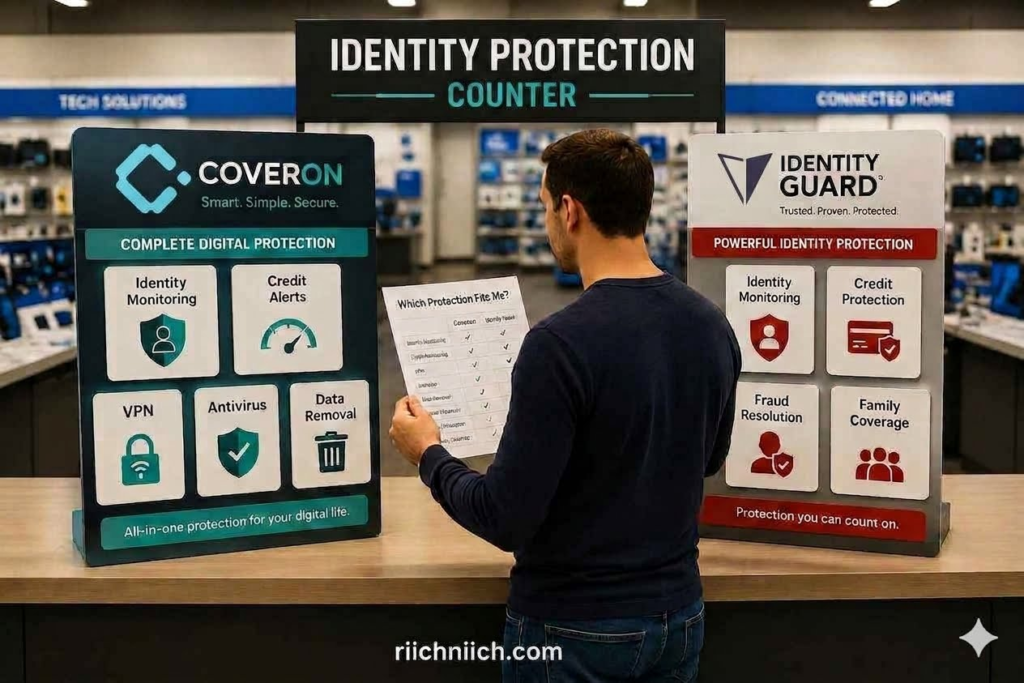
Why Compare Coveron vs Identity Guard?
Choosing an identity theft protection service is about more than finding the company with the longest feature list. You are paying for a service that may monitor your credit, personal information, financial activity, and online exposure—and potentially help you recover if your identity is stolen. That makes comparing your options before subscribing especially important.
If you want to see how these services fit into the larger identity protection market, our guide to the Best Identity Theft Protection Services compares the key features buyers should consider before choosing a provider.
The Coveron vs Identity Guard comparison is particularly useful because both services address identity theft risk, but the decision can come down to which types of protection matter most to you. Coveron currently combines identity monitoring with features such as dark web monitoring, financial account monitoring, criminal records monitoring, 3-bureau credit monitoring, credit lock capabilities, and identity theft recovery support. Some Coveron plans also extend into broader online privacy and cybersecurity protection.
That distinction matters for buyers. Someone primarily looking for identity monitoring, credit protection, and fraud alerts may evaluate these services differently from someone who also wants tools designed to reduce online exposure and strengthen everyday digital security.
Another reason to compare Coveron vs Identity Guard is that not all identity theft protection features accomplish the same thing. The Federal Trade Commission distinguishes between credit monitoring, identity monitoring, recovery services, and identity theft insurance. Credit monitoring primarily watches for changes to your credit reports, while identity monitoring may look for suspicious uses of your information outside your credit file. Recovery services can then help you address the damage after identity theft occurs.
That means simply seeing “identity theft protection” on a product page doesn’t tell you whether a service provides the specific protection you care about.
For example, buyers should consider questions such as whether they want 3-bureau credit monitoring, dark web monitoring, financial account monitoring, Social Security number monitoring, fraud recovery assistance, family identity protection, or additional online security tools. Coveron currently advertises 3-bureau monitoring across Experian, Equifax, and TransUnion, along with alerts for suspicious credit activity.
Recovery protection deserves just as much attention. Detecting suspicious activity is useful, but knowing what happens after identity theft occurs can be equally important. Coveron currently advertises access to expert recovery assistance and up to $2 million toward eligible identity theft recovery expenses, subject to its coverage terms and limitations.
Price should therefore never be considered by itself. A cheaper plan may look attractive until you discover that a feature you actually want requires a higher subscription tier. Conversely, paying for a premium package may not make sense if you will never use many of its additional features.
This is why our Coveron vs Identity Guard comparison will focus on value rather than simply asking which company costs less. We’ll look at what you actually receive for your money and how the services compare across identity monitoring coverage, credit protection, dark web monitoring, financial monitoring, recovery assistance, family protection, online security features, and overall usability.
There is another important reason to make this comparison now: Coveron is a relatively new name in the identity protection market. NordProtect officially became Coveron in May 2026 as part of a rebrand intended to give the product a stronger standalone identity. Coveron stated that the existing service benefits continued through the transition.
For consumers who encounter Coveron while researching the best identity theft protection service, that newer name can naturally raise questions about how it stacks up against a more established option such as Identity Guard.
Ultimately, Coveron vs Identity Guard isn’t about declaring one service universally better for everyone. It is about determining which service gives you the better combination of monitoring, recovery support, credit protection, online security, and value for the money.
Before paying for either service, it is also worth reviewing the FTC’s guidance on identity theft and monitoring services. The FTC explains what different monitoring services can—and cannot—detect, which can help you avoid paying for protection based on unrealistic expectations.
As we break down Coveron vs Identity Guard feature by feature, the goal is simple: help you determine which service better matches the risks you actually want to protect against before you spend your money.
Coveron vs Identity Guard: Key Features Compared
When comparing identity theft protection services, the number of features matters less than what those features actually protect. A service may be excellent at monitoring your credit but provide fewer tools for online privacy, while another may combine identity monitoring with broader cybersecurity protection.
That distinction becomes important in Coveron vs Identity Guard because both services cover several core identity theft risks, but their feature sets are not identical.
Coveron currently takes a broad approach to personal security. Its protection can include 24/7 dark web monitoring, 3-bureau credit monitoring, financial account monitoring, short-term loan monitoring, criminal records monitoring, malware breach alerts, identity theft recovery, and a TransUnion credit lock. Its Full Protection offering also adds a VPN, next-generation antivirus, and Incogni-powered personal data removal.
Identity Guard emphasizes identity and financial monitoring with features that vary by membership level. Its current offerings include data breach notifications, dark web monitoring, high-risk transaction monitoring, bank account monitoring, and—on applicable plans—social media monitoring, credit and debit card monitoring, 401(k) and investment account monitoring, home title monitoring, criminal and sex-offense monitoring, and USPS address-change monitoring. It also offers individual and family memberships.
For buyers researching Coveron vs Identity Guard, here is the practical feature picture:

🚨 Because plans and promotional offerings can change, buyers should verify the current inclusions before purchasing. Coveron’s own April 2026 industry comparison, for example, listed Identity Guard as offering family plans while Coveron did not.
Coveron Focuses Heavily on All-in-One Protection
One of Coveron’s biggest advantages in Coveron vs Identity Guard is how far its higher-level protection extends beyond traditional identity monitoring services.
For example, Coveron’s Full Protection package currently includes a VPN for encrypting internet traffic, next-generation antivirus for detecting malicious websites, phishing attempts and malware, and Incogni for removing personal information from data brokers and people-search sites.
That combination could be particularly valuable for someone who would otherwise purchase several privacy and cybersecurity tools separately.
Think about the difference this way: identity monitoring helps you discover when something may already be wrong, while privacy and cybersecurity tools can address some of the ways your information becomes exposed in the first place.
Coveron also monitors the dark web for information such as email addresses, phone numbers, Social Security numbers and credit card information. If monitored information is detected, the service sends an alert so the user can respond.
Identity Guard Has Some Strong Specialized Monitoring Features
Identity Guard shouldn’t be overlooked simply because Coveron bundles additional cybersecurity tools.
Depending on the Identity Guard membership selected, buyers can receive monitoring for areas such as bank accounts, credit and debit cards, investments, social media, home titles, criminal records, and address changes.
Those specialized monitoring categories could make Identity Guard particularly appealing to buyers whose primary goal is watching for different forms of personal information misuse and financial fraud rather than purchasing an all-in-one cybersecurity bundle.
Its family memberships are another important consideration. Identity Guard’s current plan information includes family coverage, with the number of covered adults depending on the plan and coverage for children included.
That means a household comparing the best identity theft protection service should look beyond the individual monthly price. Protecting several people under one membership can substantially change the value calculation.
Credit Protection Is a Major Part of the Comparison
Credit monitoring deserves special attention because fraudulent credit activity can be one of the clearest signs that someone is misusing your identity.
Coveron currently provides 3-bureau credit monitoring across Experian, Equifax and TransUnion. It can alert users to activity such as new accounts and credit inquiries, and it provides a VantageScore 3.0 credit score.
Coveron also offers a TransUnion credit lock that can restrict new creditors from accessing the user’s TransUnion credit report.
Identity Guard also provides credit protection, but the exact capabilities depend on the membership tier. That makes plan selection particularly important when evaluating Identity Guard against Coveron.
The Federal Trade Commission’s identity theft guidance explains why this matters: credit-monitoring services can watch one, two or all three major credit bureaus, and the breadth of monitoring affects what activity may be detected.
Recovery Features Matter Just as Much as Monitoring
Monitoring tells you that something suspicious may have happened. Identity restoration and recovery support help you deal with what comes next.
Coveron currently advertises expert identity theft recovery assistance and up to $2 million toward eligible recovery expenses, subject to its terms, limitations and deductible. It also advertises separate protections for certain online fraud, cyberattacks and cyber extortion.
Identity Guard currently lists White Glove Fraud Resolution and $1 million in identity theft insurance among the benefits displayed with its plans.
These protections shouldn’t be interpreted as a guaranteed payout whenever fraud occurs. Buyers should read the applicable insurance documents and exclusions before purchasing rather than choosing a service based solely on the headline coverage amount.
Which Feature Set Looks Better?
At the feature level, Coveron vs Identity Guard comes down to what type of protection you value most.
Coveron has a compelling argument for buyers who want identity theft protection combined with broader digital security and privacy tools. Its combination of credit monitoring, dark web monitoring, financial monitoring, recovery assistance, VPN, antivirus, and personal data removal can reduce the need to assemble several separate services.
Identity Guard becomes particularly interesting for buyers who want specialized identity and financial monitoring or protection for a family. Its applicable plans extend monitoring into areas such as investments, social media, home titles, payment cards, criminal records, and address changes.
Neither feature list automatically makes one service the winner. The real question is how many of those features you will actually use relative to what you are paying.
That’s why the remaining Coveron vs Identity Guard comparison will go beyond checkmarks. We’ll examine their credit protection, dark web monitoring, financial monitoring, identity theft insurance, recovery assistance, family protection, pricing, and overall value individually before deciding which service is the better purchase.

Coveron vs Identity Guard: Identity Monitoring and Fraud Protection
Identity monitoring is one of the most important areas to examine before paying for an identity theft protection service. Credit monitoring can help uncover suspicious activity involving your credit files, but identity theft can happen in ways that never immediately appear on a traditional credit report.
That is why the Coveron vs Identity Guard comparison becomes more interesting when we look beyond credit scores and focus on how each service monitors your personal information for possible misuse.
If you’re unsure where credit monitoring ends and broader identity protection begins, our guide to Identity Monitoring vs Credit Monitoring explains the difference and why having both can provide more complete protection.
How Coveron Monitors Your Identity
Coveron takes a multi-layered approach to identity monitoring and financial fraud protection. Depending on the plan, its current protection includes dark web monitoring, financial account monitoring, short-term loan monitoring, criminal records monitoring, malware breach alerts, credit monitoring, and security notifications.
One particularly useful feature is financial account monitoring. Coveron says it can monitor activity associated with checking, savings, business, certificate of deposit, and IRA accounts. The service can alert you to events such as:
- A new bank account inquiry
- A pending application for a new financial account
- A new account opened using your identity
- A new signer or account holder being added
- Changes to an account holder’s personal information
Coveron says this monitoring operates continuously, with account activity checked daily for changes.
For someone shopping for identity theft monitoring, this is important because a criminal doesn’t necessarily need to steal money directly from an existing account to cause damage. They could attempt to use stolen personal information to establish a new financial relationship in your name.
Coveron also provides dark web monitoring designed to detect exposed information such as Social Security numbers, payment card information, email addresses and other personal data. When suspicious activity or compromised information is detected, Coveron’s alerts can provide recommended steps for responding to the potential threat.
This gives Coveron an appealing combination of personal information monitoring, financial account monitoring, dark web monitoring, and fraud alerts rather than relying exclusively on credit-file activity.
How Identity Guard Monitors Your Identity
Identity Guard also provides extensive identity monitoring, particularly once you move beyond its entry-level protection.
Identity Guard states that it monitors personal information including your name, Social Security number, and driver’s license number and can alert you when monitored information is exposed. Its service also combines identity monitoring with financial and credit protection depending on the plan selected.
Higher-level Identity Guard protection can become considerably more extensive. Its currently listed monitoring features include:
- Data breach notifications
- Dark web monitoring
- High-risk transaction monitoring
- Bank account monitoring
- Credit and debit card monitoring
- 401(k) and investment account monitoring
- Social media monitoring
- Home and auto title monitoring
- Criminal and sex-offense monitoring
- USPS address-change monitoring
These features vary by plan, so buyers should pay close attention to the specific membership tier rather than assuming every Identity Guard subscriber receives every monitoring feature.
That breadth gives Identity Guard a notable advantage for certain buyers in Coveron vs Identity Guard.
For example, someone particularly concerned about fraudulent changes involving investments, property titles, payment cards or mailing addresses may find Identity Guard’s specialized monitoring categories valuable.
Detecting Fraud Is Only Half the Battle
There is an important limitation to understand with identity monitoring services: monitoring generally doesn’t mean that a company can prevent every criminal from attempting to use your identity.
Instead, much of the value comes from detecting warning signs quickly enough for you to respond.
Imagine someone secretly opens a financial account using your information. The account itself is the problem—but the monitoring alert is the alarm that tells you something may be wrong.
The faster you recognize suspicious activity, the sooner you may be able to contact the financial institution, secure affected accounts, freeze your credit, change compromised passwords, or begin the identity theft recovery process.
That is why buyers shouldn’t evaluate Coveron vs Identity Guard simply by asking, “Which one monitors more things?”
A better question is:
Which service monitors the types of identity fraud I am most concerned about—and gives me useful tools when something suspicious is detected?
Which Has Better Identity Monitoring?
For general identity monitoring and fraud protection, both services provide meaningful coverage, but they have different strengths.
Coveron is particularly compelling if you want identity monitoring connected to broader financial and cybersecurity protection. Its current identity theft protection combines financial account monitoring, dark web monitoring, credit monitoring, short-term loan monitoring, criminal records monitoring, security alerts, and recovery benefits. Higher-tier protection also adds cybersecurity and privacy tools.
Identity Guard becomes especially attractive if you want more specialized monitoring categories. Depending on your plan, it can extend beyond basic identity and bank account monitoring into investments, credit and debit cards, property titles, social media, criminal records, and USPS address changes.
From a buyer-intent perspective, that creates a fairly straightforward distinction in Coveron vs Identity Guard:
Choose Coveron if you prefer a broader personal-security ecosystem that combines identity monitoring with financial monitoring and additional digital security tools.
Consider Identity Guard if your priority is extensive monitoring across multiple categories of personal, financial, property, and account activity—particularly if the higher-tier monitoring features match risks you specifically want covered.
👉 If comprehensive identity monitoring and fraud resolution are your top priorities, see what Identity Guard has to offer.
Neither approach is automatically better. The better purchase is the one that monitors the areas where your identity and finances are most exposed without making you pay for a long list of features you are unlikely to use.
The next pieces of the Coveron vs Identity Guard comparison—especially credit monitoring, dark web protection, financial monitoring, and identity restoration—will help make that distinction even clearer.

Coveron vs Identity Guard: Credit Monitoring and Credit Protection
Credit monitoring is one of the most important features to compare when choosing an identity theft protection service. If someone uses your personal information to apply for a credit card, loan, or other form of credit, suspicious activity may appear on one or more of your credit reports.
In Coveron vs Identity Guard, both services offer credit-monitoring capabilities, but the plan you purchase matters. Buyers should pay particular attention to how many credit bureaus are monitored, how frequently credit information is provided, what types of alerts are available, and whether tools such as a credit lock are included.
How Coveron Credit Monitoring Works
Coveron offers 3-bureau credit monitoring that can track activity across Experian, Equifax, and TransUnion. This matters because lenders don’t necessarily report information to all three bureaus. Monitoring only one credit file can potentially leave activity occurring at another bureau unnoticed.
Depending on the Coveron plan, its credit protection can include:
- 1-bureau or 3-bureau credit monitoring
- Alerts about suspicious changes to your credit file
- VantageScore 3.0 credit score access
- Credit freeze assistance
- TransUnion Credit Lock
- Annual 3-bureau credit report access
- Short-term loan monitoring
Coveron’s pricing page currently shows that the exact credit-monitoring benefits vary between its Identity Theft Protection and Full Protection offerings, so buyers should verify the features included in the plan they are considering.
Coveron says its credit alerts can notify users about activity such as new accounts, credit inquiries, unfamiliar addresses, delinquent accounts, fraud alerts, and other changes appearing in their credit files.
For someone concerned that a criminal could attempt to establish new credit in their name, this type of monitoring can provide an important early-warning system.
Identity Guard Also Offers 3-Bureau Credit Monitoring
Identity Guard also offers 3-bureau credit monitoring, but it is important to distinguish between its identity-only and identity-plus-credit memberships.
Identity Guard’s current plan information shows 3-bureau credit monitoring on applicable Identity & Credit Protection plans. Depending on the membership level, its credit features can also include a monthly credit score, an annual 3-bureau credit report, and an Experian Credit Lock.
That makes Identity Guard competitive with Coveron for buyers specifically searching for credit monitoring services rather than basic identity monitoring alone.
Identity Guard says its 3-bureau monitoring can watch Experian, Equifax, and TransUnion for warning signs such as new accounts, hard inquiries, and changes to personal or credit information.
The biggest takeaway is simple: don’t choose Identity Guard’s least expensive plan assuming that every credit feature is automatically included. Compare the exact membership tier against the Coveron plan you are considering.
Credit Monitoring vs Credit Protection
There is an important difference between watching your credit and restricting access to your credit file.
Credit monitoring is primarily an early-detection tool. It can alert you when certain changes occur, but an alert doesn’t necessarily stop someone from attempting to open fraudulent credit in the first place.
That is where credit locks and credit freezes become important.
Coveron currently provides a TransUnion Credit Lock with applicable protection. When activated through the Coveron dashboard, the feature instructs TransUnion to block new credit application inquiries into that TransUnion file.
Identity Guard’s applicable premium credit protection includes an Experian Credit Lock, allowing eligible members to lock or unlock their Experian credit file.
This creates an interesting distinction in Coveron vs Identity Guard:
Coveron → TransUnion Credit Lock
Identity Guard → Experian Credit Lock on applicable plans
Neither should be confused with freezing all three of your credit reports.
Don’t Confuse a Credit Lock With a Credit Freeze
This is particularly important for buyers because a paid identity protection subscription is not required to freeze your credit.
The Federal Trade Commission says anyone can place a credit freeze for free. A freeze lasts until you lift it, does not affect your credit score, and can make it much harder for an identity thief to open new credit accounts in your name. To comprehensively freeze your credit, you need to contact Experian, Equifax, and TransUnion individually.
The Federal Trade Commission’s credit freeze guidance explains how freezes work and when consumers may want to use them.
This distinction matters when deciding whether Coveron vs Identity Guard provides enough value for your money.
You aren’t necessarily paying these companies simply for the ability to restrict a credit file. You are paying for the convenience of combining monitoring, alerts, identity protection, recovery assistance, and other security features within one service.
Why 3-Bureau Monitoring Matters
Suppose an identity thief applies for financing using your Social Security number.
The lender checks Experian, but your identity protection service monitors only TransUnion.
You could potentially have a blind spot.
That is why 3-bureau credit monitoring is one of the features I would prioritize when comparing premium identity theft protection services. Coveron itself notes that lenders may report to different bureaus, which is why monitoring all three can provide broader visibility into suspicious credit activity.
Even with a paid monitoring service, it’s smart to understand what suspicious activity looks like yourself, so use our guide on How To Check Your Credit Report for Signs of Identity Theft to learn what to watch for.
However, even 3-bureau monitoring shouldn’t be treated as complete identity theft prevention. Fraud involving bank accounts, tax returns, medical identities, account takeovers, scams, or exposed credentials may not necessarily originate as a change to your credit report.
This is why the strongest identity theft protection comparison should examine credit monitoring as one layer of protection, not the entire solution.
Which Has Better Credit Protection?
For buyers comparing Coveron vs Identity Guard specifically for credit protection, this category is competitive.
Coveron makes a strong case with 3-bureau credit monitoring on its applicable plan, detailed credit-file alerts, credit score access, annual credit reporting, credit freeze assistance, short-term loan monitoring, and a TransUnion Credit Lock.
Identity Guard also makes a strong case on its applicable credit-protection tiers, offering 3-bureau credit monitoring and monthly credit score access, while its premium credit protection can add an annual 3-bureau credit report and Experian Credit Lock.
For someone primarily interested in better identity protection through credit monitoring, I wouldn’t choose between these two services based solely on the words “3-bureau monitoring.” Both can provide it on applicable plans.
Instead, compare the total price required to obtain 3-bureau monitoring and the additional protection included at that price.
That is where Coveron vs Identity Guard becomes a much more meaningful buyer decision. If Coveron’s combination of credit monitoring, short-term loan monitoring, identity monitoring, dark web monitoring, recovery assistance, and broader cybersecurity tools matches your needs, its package may deliver greater overall value. If Identity Guard’s credit protection combined with its broader specialized identity and financial monitoring—or family coverage—better matches your risks, paying for the appropriate Identity Guard tier may make more sense.
Ultimately, the better credit protection service isn’t simply the one that watches your score. It is the one that helps you spot suspicious activity quickly, understand what happened, and take action before fraudulent credit activity causes even more damage.
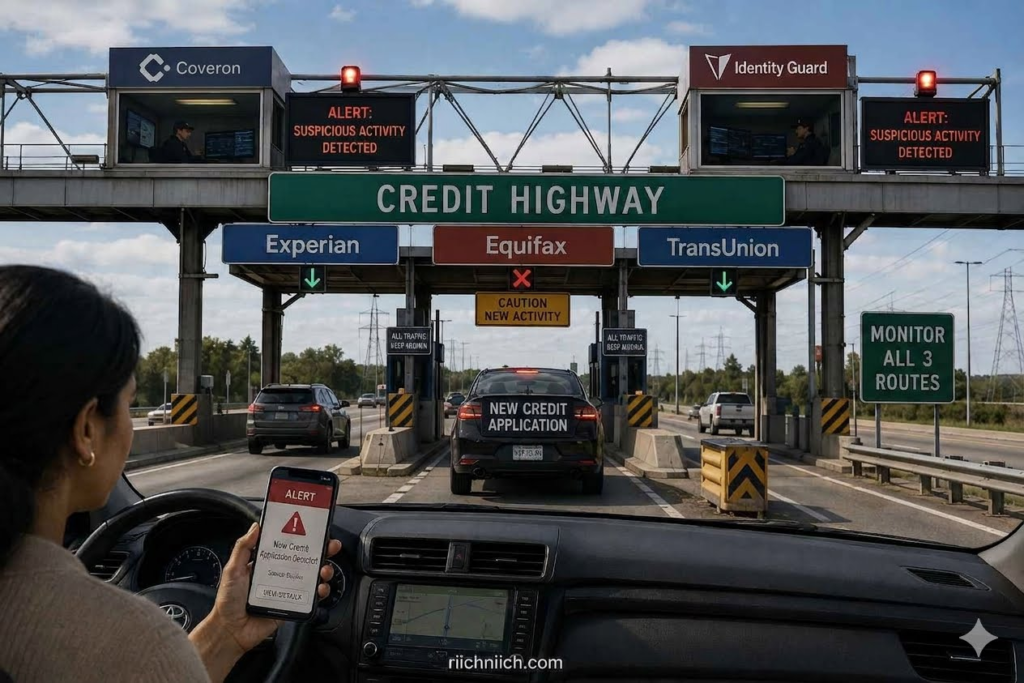
Coveron vs Identity Guard: Dark Web and Personal Information Monitoring
Your credit report is only one place where signs of identity theft can appear. Long before a fraudulent loan or credit card shows up on your credit file, information such as your email address, password, phone number, Social Security number, or payment card details may already have been exposed through a data breach.
That makes dark web monitoring and personal information monitoring an important part of the Coveron vs Identity Guard comparison. Both services can watch for compromised information, but buyers should look closely at what information can be monitored, how alerts work, and what they can actually do after an exposure is discovered.
How Coveron Dark Web Monitoring Works
Coveron provides 24/7 dark web monitoring designed to search for personal information that may have appeared in leaked databases and other monitored dark web sources.
You choose which eligible personal information you want Coveron to monitor. Coveron specifically identifies information such as:
- Email addresses
- Phone numbers
- Social Security numbers
- Credit and debit card information
- Login credentials and other compromised account information
Once monitoring is activated, Coveron scans for the information in the background. If monitored information is detected, Coveron sends an alert explaining the exposure and recommending actions you can take to secure the affected information or accounts.
This is useful because discovering a leaked password or email address isn’t enough by itself. The real value comes from knowing what you should do next.
For example, if a monitored login credential appears in a breach, an appropriate response could include changing the compromised password, checking whether that password was reused elsewhere, enabling multi-factor authentication, and reviewing the associated account for unauthorized activity.
Coveron also offers malware breach alerts on its current plans. These are designed to alert users when personal information appears on the dark web as a result of a malware infection on a device.
For buyers looking for identity theft monitoring that extends beyond credit reports, those additional exposure alerts strengthen Coveron’s overall offering.
Identity Guard Has an Extensive Personal Information Watchlist
Identity Guard also provides dark web monitoring, but one particularly useful feature is the range of information users can register through its Watchlist.
According to Identity Guard’s current FAQ, users can add several types of personally identifiable information for monitoring, including email addresses, phone numbers, credit and debit cards, financial account numbers, a Social Security number, driver’s license information, passport numbers, health insurance IDs, a home address, and loyalty cards.
Identity Guard says the Watchlist can alert users when registered information is discovered on dark web sites, forums, breached lists, and other monitored sources.
That breadth is significant in Coveron vs Identity Guard because personal information exposure isn’t limited to passwords and Social Security numbers.
Consider a passport number or health insurance ID. Neither is something you would normally expect to see simply by checking your credit report, yet both could be valuable pieces of information if they were exposed.
For buyers especially interested in personal information monitoring, Identity Guard’s ability to register numerous categories of information gives it a compelling argument in this part of the comparison.
Dark Web Monitoring Doesn’t Remove Your Information
This is one of the biggest misconceptions buyers should understand before purchasing either service.
Dark web monitoring generally detects exposure—it doesn’t make leaked information disappear.
Identity Guard’s current terms explicitly state that its Dark Web Monitoring feature doesn’t remove designated information from the dark web and doesn’t guarantee that every instance of the information will be discovered.
Coveron makes a similar distinction. Its terms state that its monitoring searches various sources where compromised information may appear, but it doesn’t guarantee that every possible site or directory containing leaked information will be located or monitored.
Coveron also explains that dark web monitoring is designed to detect exposed information and alert you, rather than prevent the original data breach or remove information that has already leaked.
This distinction is critical when deciding whether Coveron vs Identity Guard is worth paying for.
You aren’t buying an invisible shield that guarantees your information will never reach criminals.
You are buying an early-warning system.
Before paying extra for this feature, read our complete guide on What Is Dark Web Monitoring and Is It Worth It? to understand what these services can actually detect and where their limitations begin.
Personal Data Removal Gives Coveron an Interesting Advantage
There is another important privacy feature to consider.
Coveron’s Full Protection plan currently includes an Incogni-powered personal data removal service designed to remove personal information from data brokers and people-search sites.
This is different from dark web monitoring.
Think of the two functions this way:
Dark web monitoring: “Has my information already been discovered in monitored leaked-data sources?”
Personal data removal: “Can I reduce some of the personal information that legitimate data brokers and people-search sites make available about me?”
Those are two different privacy problems.
For someone who wants online identity protection that includes both exposure detection and reducing their publicly obtainable personal-data footprint, Coveron’s Full Protection package becomes particularly interesting.
However, personal data removal shouldn’t be confused with deleting leaked information from criminal marketplaces or breach databases. Removing information from a legitimate data broker does not mean copies of previously leaked information disappear from the dark web.
What Happens When Your Information Is Found?
Imagine receiving an alert at 7:30 Tuesday morning:
Your email address and password were detected in a data breach.
The monitoring service has done its first job.
What happens next is largely up to you.
You may need to change the password immediately, replace reused passwords on other accounts, activate MFA, review recent login activity, watch financial accounts, or take additional precautions depending on what information was exposed.
This is why actionable alerts are more valuable than simply receiving a notification saying, “Your information was found.”
Coveron says its alerts include information about detected threats along with recommended actions users can take.
Identity Guard similarly uses alerts to notify users when registered information is discovered through its monitoring systems.
Speed matters because exposure doesn’t necessarily mean identity theft has already occurred. It means information that could potentially be abused has been discovered.
That creates an opportunity to respond before the situation becomes worse.
Which Is Better for Dark Web and Personal Information Monitoring?
This portion of Coveron vs Identity Guard is close, but each service has a different strength.
Identity Guard has a strong argument for buyers who want to register a wide variety of personal information for monitoring. Its current Watchlist supports numerous categories, including multiple email addresses, payment cards, financial accounts, phone numbers, passports, health insurance IDs, a driver’s license number, and a Social Security number.
Coveron has a strong argument for buyers who want dark web monitoring integrated into a broader privacy and cybersecurity package. In addition to monitoring information such as emails, phone numbers, Social Security numbers, and payment information, its plans include malware breach alerts, while Full Protection adds personal data removal, a VPN, and antivirus protection.
For buyers comparing Coveron vs Identity Guard, I wouldn’t choose solely because both companies advertise “dark web monitoring.” Look at what information you personally want monitored and what additional protection you receive alongside that monitoring.
If your priority is monitoring a broad collection of personal identifiers, Identity Guard’s Watchlist deserves serious consideration.
If you want dark web monitoring combined with tools designed to reduce your data exposure and strengthen your broader online security, Coveron’s Full Protection package may provide better overall value.
Either way, dark web monitoring works best as one layer of a larger identity protection strategy—not as a guarantee that your personal information will never be exposed.

Coveron vs Identity Guard: Financial Account and Social Security Number Monitoring
Your Social Security number and financial account information are among the most sensitive pieces of personal data an identity thief can obtain. A stolen SSN can potentially be combined with other information to impersonate you, while compromised financial information can be used in attempts to open accounts or commit other forms of fraud.
That makes financial account monitoring and Social Security number monitoring especially important in the Coveron vs Identity Guard comparison. Both services provide tools designed to detect potential misuse, but they approach the problem through several different monitoring layers.
How Coveron Monitors Financial Accounts
Coveron provides dedicated financial account monitoring with its Identity Theft Protection and Full Protection plans. The service monitors financial activity associated with your identity and looks for certain changes that could indicate unauthorized use of your information.
Coveron says its financial account monitoring covers several types of accounts, including:
- Checking accounts
- Savings accounts
- Business accounts
- Certificates of deposit (CDs)
- IRA accounts
More importantly, Coveron isn’t simply watching the balance of an account you already know about. Its monitoring can alert you to events such as a new bank account inquiry, a pending account application, a new financial account opened in your name, a new signer or holder being added, or changes to an account holder’s personal information.
That distinction is important for someone shopping for identity theft protection.
Suppose someone obtains enough of your personal information to attempt to open a checking account in your name. You might not discover that activity simply by looking at the balance in your existing bank account. Financial account monitoring is designed to identify certain activity connected to your identity beyond the accounts you normally check yourself.
Coveron says the feature operates continuously, checking for banking activity updates daily and sending notifications when relevant changes are detected. You also don’t have to link an existing bank account to activate the monitoring; Coveron says identity verification is instead required.
Coveron Also Watches for Short-Term Loan Activity
Coveron adds another useful financial-fraud layer with short-term loan monitoring.
Once activated, Coveron says this feature monitors short-term loan information associated with your identity and can alert you to a new inquiry, newly opened loan, or changes in the status of a short-term loan.
This can matter because fraudulent financial activity doesn’t always begin with a traditional credit card or mortgage.
Someone with enough stolen personal information could potentially attempt to obtain a payday loan, cash advance, or other short-term financing using another person’s identity.
For buyers comparing Coveron vs Identity Guard, Coveron’s combination of financial account monitoring, short-term loan monitoring, credit monitoring, and dark web monitoring creates several different detection layers rather than relying exclusively on changes to a traditional credit report.
How Coveron Monitors Your Social Security Number
Coveron’s SSN protection works across several of its monitoring systems.
For dark web monitoring, you can add your Social Security number as information you want Coveron to watch. Coveron then checks monitored dark web sources for exposure and can send a security alert if the information is detected.
Your SSN is also used—after identity verification—to activate certain financial monitoring features. Coveron’s terms state that features including credit monitoring, short-term loan monitoring, financial account monitoring, and credit lock require successful identity authentication and a valid U.S. Social Security number.
This creates an important distinction:
SSN monitoring can help detect signs that your Social Security number has been exposed or potentially misused, but it cannot make the number unusable to criminals.
That is why SSN monitoring should be viewed as an early-detection tool, not a guarantee against identity theft.
How Identity Guard Monitors Financial Information
Identity Guard also puts substantial emphasis on financial fraud monitoring.
The company currently states that its protection can monitor credit cards, financial accounts, credit files, and other information for indications of fraudulent activity. Identity Guard also specifically monitors a member’s name, Social Security number, and driver’s license number for potential identity fraud and exposure.
Depending on the plan, Identity Guard’s broader financial monitoring can extend to areas such as bank accounts, payment cards, and investments.
This can make Identity Guard especially interesting for buyers who want personal information monitoring and financial monitoring across multiple types of assets, rather than focusing solely on bank-account applications.
Identity Guard Provides Dedicated Social Security Number Monitoring
SSN monitoring is also a specific component of Identity Guard’s protection.
Identity Guard’s current service documentation says its Social Security number monitoring searches thousands of databases and alerts users when a monitored SSN is detected. Its broader online monitoring also watches for registered Social Security numbers, bank account numbers, and credit card numbers across monitored underground online sources.
This is a valuable feature because a compromised SSN can remain useful to criminals for years.
Unlike a credit card number, you generally don’t receive a new Social Security number every time your information appears in a breach. That makes ongoing monitoring for possible SSN exposure and misuse particularly valuable for consumers whose information has previously been compromised.
If your Social Security number has already been exposed, our guide on What Happens If Someone Has Your Social Security Number? explains what criminals may try to do with it and the steps you can take to protect yourself.
What Can Someone Potentially Do With a Stolen SSN?
A Social Security number becomes particularly dangerous when it is combined with other identifying information such as your name, date of birth, address, or financial details.
Depending on what information the criminal possesses and whether other verification barriers can be defeated, stolen identity information can potentially be used in attempts to open financial or credit accounts, obtain loans, impersonate someone, or commit other types of identity fraud.
This is why an alert that your SSN has been exposed shouldn’t automatically be interpreted as proof that someone has already stolen your identity.
Instead, think of it as a warning that deserves investigation.
Monitoring Your SSN Doesn’t Replace Free Protective Measures
This is another important consideration before purchasing either service.
Paying for Social Security number monitoring doesn’t mean you should stop taking other precautions.
You can still review your credit reports, investigate unfamiliar accounts, use strong unique passwords, enable multi-factor authentication where available, review financial statements, and freeze your credit if appropriate.
If you believe your SSN has been compromised, you can also use the official Social Security Administration resources alongside the FTC’s identity theft recovery process.
The value of a paid service such as Coveron or Identity Guard is primarily convenience, broader monitoring, alerts, and recovery assistance rather than access to protections that consumers couldn’t possibly perform themselves.
Which Is Better for Financial Account and SSN Monitoring?
This category of Coveron vs Identity Guard is highly competitive.
Coveron makes a particularly strong case for buyers concerned about new financial activity appearing under their identity. Its financial account monitoring can watch for new applications, pending openings, newly established financial accounts, added signers or holders, and changes to account-holder information. Short-term loan monitoring provides another layer for detecting certain lending activity.
Identity Guard makes a strong case for buyers who place particular importance on dedicated Social Security number monitoring combined with broader identity and financial monitoring. Its service documentation specifically describes continuous SSN monitoring across thousands of databases, while its broader monitoring can watch registered financial information for exposure.
For someone deciding between the two, I wouldn’t choose based solely on whether the words “Social Security number monitoring” appear on a feature list.
Instead, ask what you want the service to detect.
If you’re particularly concerned about new financial accounts, account applications, short-term loans, and changes involving your financial identity, Coveron’s monitoring package deserves serious consideration.
If you want dedicated SSN monitoring combined with extensive personal and financial identity monitoring, Identity Guard remains a strong alternative.
Ultimately, Coveron vs Identity Guard comes down to the complete protection package. SSN and financial account monitoring are valuable, but they become considerably more useful when combined with credit monitoring, dark web monitoring, fraud alerts, identity restoration, and a clear plan for responding when suspicious activity is detected.
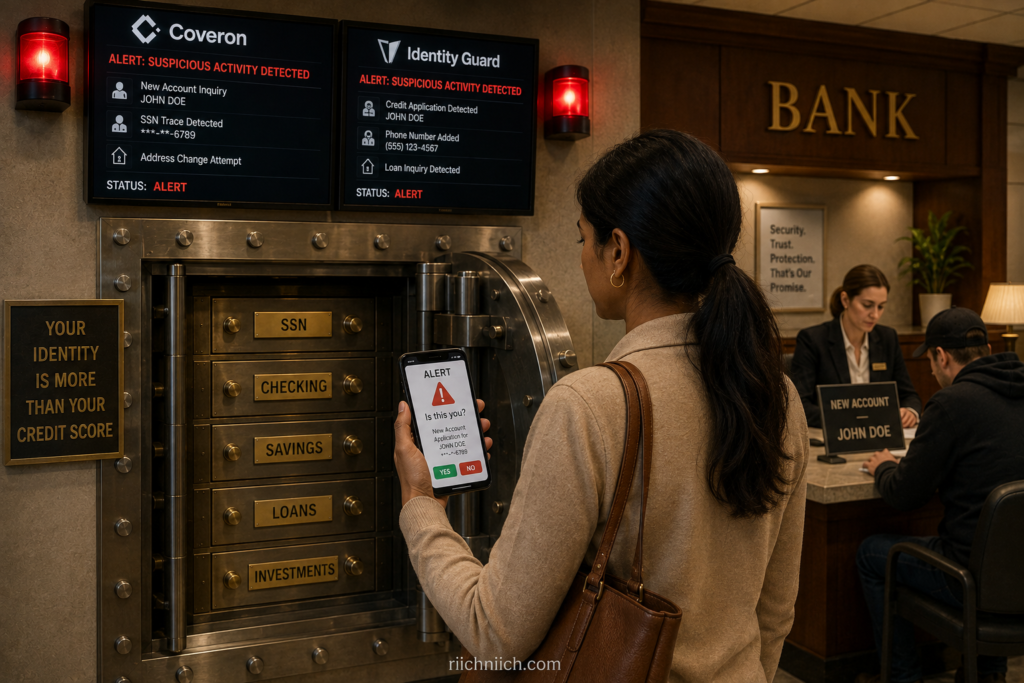
Coveron vs Identity Guard: Identity Theft Insurance and Recovery Support
Monitoring can warn you that something suspicious is happening, but the real test of an identity theft protection service may come after your identity has already been stolen.
Recovering from identity theft can involve disputing fraudulent accounts, contacting creditors, replacing documents, correcting credit records, filing reports, and spending hours trying to prove that transactions or accounts were not yours. This makes identity restoration services, recovery assistance, and identity theft insurance especially important when evaluating Coveron vs Identity Guard.
Both services provide financial protection and professional recovery assistance, but there are meaningful differences in their current coverage.
How Coveron’s Identity Theft Recovery Works
Coveron currently includes identity theft recovery benefits with its Identity Theft Protection and Full Protection plans. If a covered identity theft incident occurs, eligible customers can receive professional assistance along with reimbursement of qualifying recovery expenses up to $2 million.
Coveron’s recovery service provides access to an identity restoration case manager who can help guide the recovery process. Coveron says the case manager can assist with tasks such as contacting creditors, closing unauthorized accounts, correcting identity records, and helping restore the victim’s credit and identity information.
This matters because identity theft recovery can quickly become overwhelming if you are trying to handle every organization yourself.
Instead of simply receiving an alert and being left to figure out what to do next, Coveron’s recovery support is designed to provide a specialist who can help manage the process.
What Can Coveron’s $2 Million Recovery Coverage Pay For?
The $2 million figure should not be interpreted as $2 million automatically paid to someone whose identity is stolen.
It represents the maximum reimbursement available for eligible identity theft recovery expenses under the applicable coverage.
Coveron currently identifies qualifying expenses that can include:
- Credit bureau reports
- Replacement documents
- Application fees
- Notary expenses
- Postage
- Certain legal fees
- Lost wages and child or elder care while dealing with the identity theft, subject to a $5,000 sublimit
- Mental health counseling, subject to a $1,000 sublimit
- Certain miscellaneous expenses, subject to a $1,000 sublimit
Coveron’s identity theft recovery coverage currently has a $2 million limit and a $100 deductible. Its coverage is provided through HSB Specialty Insurance Company and is subject to eligibility requirements, exclusions, and the applicable policy terms.
That fine print matters enormously when comparing Coveron vs Identity Guard. A large headline insurance number shouldn’t automatically determine which service you purchase.
Coveron Goes Beyond Traditional Identity Theft Coverage
Another interesting part of Coveron’s offering is that its protection extends beyond traditional identity theft recovery.
Coveron’s current Identity Theft Protection and Full Protection plans advertise several separate insurance benefits:
$2 million identity theft insurance
$50,000 cyber extortion insurance
$25,000 home title insurance
$10,000 online fraud insurance
$10,000 cyberattack insurance
These are separate categories of protection with their own eligibility requirements, limits, and exclusions.
That makes Coveron particularly interesting for buyers looking for broader financial fraud protection rather than identity restoration alone.
For example, traditional identity theft insurance and online fraud insurance aren’t necessarily designed to cover the same loss. A scam in which you voluntarily transfer money to an impersonator may be treated differently from expenses incurred while restoring your identity after someone opens fraudulent accounts in your name.
That distinction can make Coveron’s broader insurance package valuable—but only if the coverage applies to the types of risks you are actually concerned about.
How Identity Guard Handles Identity Theft Recovery
Identity Guard also combines insurance with professional recovery assistance.
Its current plans include White Glove Fraud Resolution, access to a U.S.-based customer care team, and identity theft insurance. Identity Guard’s currently displayed Value-level coverage includes $1 million in identity theft insurance, while its plan comparison indicates that some higher-level offerings can provide up to $5 million in identity theft insurance, depending on the applicable membership.
This is an important detail for Coveron vs Identity Guard because it means we shouldn’t simply describe the comparison as:
Coveron = $2 million
Identity Guard = $1 million
Identity Guard’s insurance amount can vary with the membership being evaluated. Buyers need to compare the specific plan against the specific Coveron plan, rather than comparing only each company’s most prominently advertised number.
Identity Guard also states that its recovery experts can assist identity theft victims with tasks such as canceling compromised credit cards, understanding how to file a police report, and working through the process of restoring their identity.
For someone who doesn’t know where to begin after discovering identity theft, having access to an experienced recovery specialist could be one of the most valuable parts of the subscription.
Insurance and Recovery Assistance Are Not the Same Thing
This distinction is easy to overlook when comparing identity theft protection services.
Recovery assistance gives you professional help navigating the restoration process.
Identity theft insurance can reimburse certain qualifying expenses or losses according to the policy.
You ideally want to examine both.
A $2 million or $5 million insurance limit sounds impressive, but a high limit isn’t necessarily useful if the expense you incur isn’t covered by the policy. Likewise, excellent recovery assistance can save considerable time even when you never submit a large insurance claim.
The Federal Trade Commission explains that identity recovery services may provide counselors or case managers who help victims deal with creditors, review documents, freeze credit reports, and complete other recovery tasks.
The FTC also explains that identity theft insurance may cover certain out-of-pocket recovery expenses, lost wages, and legal fees, but generally doesn’t simply reimburse every dollar stolen by a scammer or identity thief.
Don’t Choose Based Only on the Headline Insurance Number
For buyers researching Coveron vs Identity Guard, this is one area where marketing numbers can easily become misleading if they are viewed without context.
Imagine two policies:
One advertises $2 million in coverage but provides better protection for the expenses you are likely to incur.
Another advertises a larger maximum but has different covered losses, sublimits, exclusions, or eligibility requirements.
The larger number doesn’t automatically mean the second policy provides better protection for you.
Before purchasing either service, look for:
- The maximum insurance limit
- What qualifies as a covered identity theft event
- Which expenses are reimbursable
- Deductibles
- Individual category sublimits
- Geographic restrictions
- Reporting deadlines
- Documentation requirements
- Exclusions
- Whether stolen funds themselves qualify for reimbursement
- Whether coverage differs between individual and family members
Identity Guard, for example, states that losses must be reported within 90 days, members must allow the company to assist with recovery, and reimbursement must first be sought from the relevant financial institution where applicable.
These details are exactly why the terms and Summary of Benefits matter more than the number printed in large type on the sales page.
Which Has Better Identity Theft Insurance and Recovery Support?
This part of Coveron vs Identity Guard doesn’t produce an automatic winner.
Coveron makes a compelling case for buyers who want a broad recovery package. Its applicable plans currently provide up to $2 million toward eligible identity theft recovery expenses, a dedicated identity restoration case manager, and separate insurance benefits for risks such as online fraud, cyberattacks, cyber extortion, and home title incidents.
Identity Guard makes a compelling case for buyers who value established fraud-resolution assistance and want multiple membership choices. Its plans include White Glove Fraud Resolution and identity theft insurance, with the amount of advertised coverage varying by membership and reaching up to $5 million on certain current offerings.
For someone considering purchasing either service, I would put professional recovery support almost on the same level as the insurance amount itself.
When identity theft happens, you don’t just need money.
You need to know who to call, which accounts to secure, which documents to file, which institutions to contact, and how to repair the damage.
That is where identity restoration can become one of the most valuable features in the entire Coveron vs Identity Guard comparison.
If identity theft has already happened, our step-by-step guide on What To Do Immediately If Your Identity Is Stolen walks you through the actions you should take to secure your accounts, report the fraud, and begin the recovery process.

Coveron vs Identity Guard: Privacy and Online Security Features
Identity theft protection is no longer just about watching credit reports and sending fraud alerts. A large portion of your personal information now lives online, where phishing attacks, malicious websites, compromised passwords, data brokers, trackers, and malware can create additional opportunities for your information to be exposed.
That makes privacy and online security features an important part of the Coveron vs Identity Guard comparison. Both services extend beyond traditional identity monitoring, but they take noticeably different approaches.
Coveron Offers a Broader Cybersecurity Bundle
One of Coveron’s biggest advantages in this category is its Full Protection plan. In addition to identity theft monitoring and credit protection, Coveron currently bundles three major privacy and cybersecurity tools:
- A secure, high-speed VPN
- Next-generation antivirus protection
- Incogni-powered personal data removal
Coveron’s VPN encrypts your internet connection, while its next-generation antivirus is designed to block dangerous websites, detect phishing attempts, scan downloads for malware, and stop ads and trackers.
This makes Coveron more than a traditional identity monitoring service at its highest tier.
For someone who currently pays—or is considering paying—for a VPN, antivirus software, identity protection, and a data removal service separately, having those tools under one subscription could make Coveron significantly more attractive.
The VPN Adds Another Layer of Online Privacy
A VPN serves a different purpose from identity monitoring.
Dark web monitoring watches for personal information that may already have been exposed. Credit monitoring looks for suspicious activity involving your credit files.
A VPN, by comparison, helps protect your internet connection by encrypting traffic between your device and the VPN service.
This can be particularly useful when you’re using networks you don’t fully control, such as Wi-Fi at an airport, hotel, coffee shop, or other public location.
Coveron’s Full Protection plan currently includes a secure VPN as part of its online privacy and security package.
However, buyers shouldn’t interpret a VPN as an identity theft prevention guarantee. A VPN won’t stop you from entering your password into a convincing phishing website, and it can’t prevent every data breach involving a company that already stores your information.
Think of it as another security layer, rather than a replacement for identity monitoring, strong passwords, multi-factor authentication, or fraud alerts.
Coveron’s Antivirus Targets Threats Before They Become Identity Problems
Coveron’s next-generation antivirus adds another interesting dimension to Coveron vs Identity Guard.
According to Coveron, the Full Protection antivirus can block dangerous websites, identify phishing scams, scan downloaded files for malware, and block advertisements and trackers.
That is relevant to identity theft because some attacks begin long before fraudulent activity reaches your credit report.
Imagine receiving what appears to be a legitimate delivery notification.
You click the link.
The website looks convincing, so you enter your email address and password.
If that website is malicious, the identity problem may have started at the moment you surrendered your credentials.
Security tools that help identify dangerous websites, phishing attempts, and malware therefore address a different part of the risk than traditional credit monitoring services.
Personal Data Removal Is Coveron’s Biggest Privacy Differentiator
Coveron’s Full Protection plan also includes Incogni, a personal data removal service.
Incogni sends removal requests to data brokers and people-search websites that collect personal information. Coveron says the service handles the removal process and tracks the requests rather than requiring customers to contact individual data brokers themselves.
This creates an important difference between monitoring your personal information and reducing its availability.
Dark web monitoring asks:
“Has my information been discovered in monitored leaked-data sources?”
Personal data removal asks:
“Can some of my information be removed from legitimate companies that collect and distribute it?”
Those are fundamentally different privacy functions.
Data removal cannot erase information from every corner of the internet or make previously stolen information disappear from criminal databases. But reducing the amount of easily accessible information held by data brokers can still be valuable for people trying to shrink their digital footprint.
The Federal Trade Commission also provides guidance about people-search sites and how consumers can request that those sites stop selling certain personal information.
For buyers who don’t want to manually submit removal requests themselves, an automated data removal service may add meaningful value to a paid subscription.
Identity Guard Takes a Different Approach to Online Security
Identity Guard’s current plans include Safe Browsing and a Password Manager among their online and device security features. Its plan information also lists mobile app access for iOS and Android.
These tools address two major areas of everyday online security.
Safe browsing protection can help reduce exposure to malicious online destinations, while a password manager can help users create and maintain stronger, unique passwords rather than reusing the same credentials across multiple accounts.
Password reuse is especially dangerous because one compromised account can potentially create problems elsewhere.
Suppose you use the same password for:
Your email account.
Your shopping account.
Your streaming account.
Your financial app.
If that password becomes exposed through one compromised service, criminals may attempt those same credentials on other websites.
A password manager makes it considerably easier to maintain unique credentials for different accounts without having to memorize every password.
Coveron and Identity Guard Solve Different Online Security Problems
This is where the Coveron vs Identity Guard comparison becomes especially useful.
Coveron currently emphasizes a broader privacy and cybersecurity bundle through its Full Protection plan:
VPN → protects the internet connection
Next-gen antivirus → helps detect malicious websites, phishing and malware
Personal data removal → reduces information held by participating data brokers and people-search sites
Dark web monitoring → watches for exposed personal information
Identity Guard’s online security offering emphasizes:
Safe Browsing → helps protect against risky online destinations
Password Manager → helps improve account credential security
Dark Web Monitoring → watches for exposed personal information
Identity Monitoring → watches for signs that personal information may be compromised
Identity Guard’s current plan page confirms Safe Browsing and Password Manager availability among its online and device security features.
Neither strategy is inherently wrong. They simply prioritize different pieces of the online security puzzle.
Which Has Better Privacy and Online Security Features?
For this category of Coveron vs Identity Guard, Coveron has the stronger overall feature package if your priority is combining identity protection with broader privacy and cybersecurity tools.
The combination of a VPN, next-generation antivirus, dark web monitoring, and Incogni-powered personal data removal gives Coveron’s Full Protection plan a particularly strong argument for buyers who would otherwise consider purchasing several separate services.
Identity Guard remains attractive for buyers who want identity protection combined with practical account-security tools, particularly Safe Browsing and a Password Manager.
That distinction could ultimately affect which service provides better value.
If you already have a VPN, antivirus software, and a data removal service you’re happy with, Coveron’s bundled extras may be less important to you.
But if you want to purchase identity monitoring, online privacy protection, cybersecurity tools, and personal data removal together, Coveron Full Protection becomes much more compelling.
On the other hand, if your biggest online-security concern is protecting accounts with stronger passwords while receiving identity, financial, dark web, and credit monitoring, Identity Guard may provide the combination you prefer.
The key is not paying for the longest feature list. It is choosing the service whose features can replace tools you would otherwise need to purchase or manage separately.
That is one of the strongest buyer-intent differences emerging in Coveron vs Identity Guard: Coveron increasingly looks like an all-in-one identity, privacy, and cybersecurity package, while Identity Guard remains more centered on identity, financial, credit, and account protection with additional online-security tools.

Coveron vs Identity Guard: Individual and Family Protection
Identity theft doesn’t affect only the person paying for the subscription. A spouse, partner, child, parent, or other family member can also become a target, which makes family identity protection an important consideration when choosing an identity theft protection service.
This is one category where the Coveron vs Identity Guard comparison produces a much clearer difference: Coveron currently focuses on individual protection, while Identity Guard offers dedicated individual and family memberships. Coveron’s own 2026 comparison lists Coveron as not offering a family plan, while Identity Guard currently advertises family coverage.
For an individual buyer, that may not matter at all. But for a household trying to protect several people under one subscription, it could become one of the biggest reasons to choose Identity Guard.
Coveron Is Currently Better Suited to Individual Protection
Coveron’s current plans—Scam Protection, Identity Theft Protection, and Full Protection—are built around protecting the subscriber from different levels of identity theft, financial fraud, scams, and online threats.
Depending on the Coveron plan selected, protection can include:
- Dark web monitoring
- Malware breach alerts
- Credit monitoring
- Financial account monitoring
- Short-term loan monitoring
- Criminal records monitoring
- Identity theft recovery assistance
- Identity theft insurance
- Home title insurance
- Online fraud insurance
- Cyberattack insurance
- Cyber extortion insurance
- VPN, antivirus, and personal data removal with Full Protection
For an individual who wants identity monitoring, credit protection, financial fraud protection, and online security bundled together, Coveron’s Full Protection plan can be especially attractive.
The limitation appears when you want to extend that protection across an entire household.
Coveron’s own identity-theft-service comparison, last verified by Coveron in April 2026, explicitly lists “Family plan: No” for Coveron.
Because identity protection products change frequently, anyone purchasing specifically for family coverage should verify Coveron’s current checkout terms before subscribing. But based on Coveron’s currently published information, family protection is not one of its strengths.
Identity Guard Has a Major Advantage for Families
Identity Guard takes a very different approach.
Its current plans allow shoppers to choose between Individual and Family protection, and its family memberships can cover up to five adults and unlimited children.
That can dramatically change the value equation in Coveron vs Identity Guard.
Imagine a household consisting of:
Two parents.
Three children.
An adult child still living at home.
And a grandparent living with the family.
Instead of evaluating identity protection as seven separate purchasing decisions, an eligible Identity Guard family membership may allow multiple household members to receive protection under the same subscription.
For larger households, that can make Identity Guard considerably more appealing than simply comparing the price of one Coveron subscription against one Identity Guard individual subscription.
Children Need Identity Protection Too
One reason family protection matters is that children can become identity theft victims even though they may not have credit cards, mortgages, or traditional financial accounts.
The Federal Trade Commission warns that criminals can misuse a child’s Social Security number, name, address, or date of birth to commit fraud. Stolen child identity information can potentially be used to open bank or credit card accounts, apply for loans, obtain government benefits, establish utilities, or even rent property.
The problem can remain hidden because parents may have little reason to check whether financial activity exists under a young child’s identity.
Identity Guard specifically offers child dark web monitoring as part of its family protection. The company says it can monitor for signs that a child’s name, Social Security number, or date of birth has appeared in known data breaches or monitored dark web sources.
That is a meaningful advantage for parents researching the best identity theft protection for families.
The Federal Trade Commission’s child identity theft guide also explains how parents can protect a child’s personal information and what to do if they discover fraudulent activity.
Identity Guard Gives Adults Their Own Dashboards
Family protection can become difficult to manage if everyone in the household shares the same account information.
Identity Guard addresses this by giving each covered adult a private online identity dashboard where they can view alerts, manage monitoring, and adjust their own settings. Monitoring for children is managed through the primary account holder.
That separation is useful.
A family identity theft protection plan shouldn’t necessarily mean that one person gets unrestricted visibility into every adult family member’s financial and identity information.
Instead, each adult can manage their own protection while still benefiting from the family membership.
Family Protection Is About More Than Adding Children
Another important point in Coveron vs Identity Guard is that family identity protection isn’t exclusively about parents protecting young children.
Identity Guard specifically markets its family protection toward households concerned about identity fraud involving spouses, parents, grandparents, and children.
That can make family coverage useful for multigenerational households.
An older parent, for example, may be more concerned about scams and financial fraud, while a teenager may need monitoring for exposed personal information. A working adult may be primarily concerned about credit accounts, banking activity, and compromised credentials.
Different family members can have very different identity risks.
A dedicated family plan gives buyers the ability to think about household protection instead of individual protection alone.
Don’t Forget Free Child Credit Freezes
Even if you purchase Identity Guard family protection, paid monitoring shouldn’t replace free preventive measures.
The FTC states that parents and guardians can request a free credit freeze for a child under 16. A freeze can make it harder for someone to open new credit accounts using the child’s identity. Minors who are 16 or 17 can request and remove a security freeze themselves.
That means a strong family identity protection strategy can combine:
Monitoring to detect potential exposure.
Credit freezes to make certain forms of new-account fraud harder.
Account security to protect online credentials.
Recovery assistance if identity theft actually occurs.
No paid identity monitoring service should be treated as a substitute for those basic precautions.
Parents who want to compare additional household-focused options should also read our guide to the Best Identity Theft Protection for Families before choosing a plan.
What If You Only Need Protection for Yourself?
This is where Coveron becomes much more competitive.
If you aren’t trying to protect children or multiple adults, Identity Guard’s family-plan advantage may have little value to you.
Instead, you should compare what you personally receive for the subscription price.
For an individual buyer, Coveron’s Full Protection plan currently combines 3-bureau credit monitoring, financial account monitoring, short-term loan monitoring, dark web monitoring, criminal records monitoring, identity theft recovery benefits, a VPN, next-generation antivirus, and personal data removal.
That is a broad package for one person.
Identity Guard also offers individual memberships, with the available identity, financial, credit, and online-security features increasing according to the selected tier.
So for individual protection, the decision becomes considerably closer.
Which Is Better for Individuals?
For an individual, Coveron vs Identity Guard should come down primarily to features and price rather than family coverage.
Coveron may be the better fit if you want an all-in-one personal security package combining identity monitoring with broader privacy and cybersecurity features. Its Full Protection plan is particularly attractive for someone who also wants a VPN, antivirus protection, and personal data removal.
Identity Guard may be the better fit if you want a more established identity protection service with multiple individual tiers and specialized identity, financial, and credit monitoring features.
For one person, neither service automatically wins.
For a household, however, the comparison changes significantly.
Which Is Better for Families?
For families, Identity Guard is the stronger choice based on the services currently advertised.
Its ability to protect up to five adults and unlimited children under a family membership gives it a substantial advantage over Coveron’s current individual-focused offering. Identity Guard also provides child dark web monitoring and individual dashboards for covered adults.
That doesn’t make Identity Guard universally better than Coveron.
It means the number of people you need to protect should influence which service you buy.
If you’re purchasing identity protection only for yourself, Coveron’s extensive identity, financial, privacy, and cybersecurity features may provide better value depending on the plan and current price.
If you’re purchasing protection for your spouse, children, or a larger household, Identity Guard’s family coverage becomes one of the strongest buyer-intent advantages in the entire Coveron vs Identity Guard comparison.

Coveron vs Identity Guard: Pricing and Plans
Price can easily become the deciding factor when choosing an identity theft protection service, but the cheapest plan is not necessarily the best value. What matters is how much protection you actually receive for the amount you pay—and whether you are paying extra for features you will realistically use.
In Coveron vs Identity Guard, the pricing structures are noticeably different. Coveron currently offers three individual-focused plans with aggressive introductory pricing, while Identity Guard offers three primary protection levels with separate pricing for individuals and families. Both companies also use introductory discounts, which means the price you initially pay can be significantly lower than the renewal price.
Because prices and promotions can change, the figures below reflect the companies’ published pricing checked in August 2026.
Coveron Pricing
Coveron currently offers three plans:
Scam Protection
Coveron’s entry-level Scam Protection plan currently starts at $2.99 per month when purchasing the first 24 months, totaling $71.76 for that introductory term. A 12-month introductory option is currently advertised at $3.99 per month.
This plan focuses more heavily on scams and online threats than comprehensive identity protection. It currently includes:
- $10,000 in online fraud insurance
- $10,000 in cyberattack insurance
- Dark web monitoring
- Malware breach alerts
For someone mainly concerned about scams, breached credentials, and basic online fraud protection, this is Coveron’s lowest-cost option. However, it doesn’t provide the extensive credit and financial monitoring available in Coveron’s more expensive plans.
Identity Theft Protection
Coveron’s middle-tier Identity Theft Protection plan currently starts at $4.99 per month for the first 24 months, totaling $119.76 for the introductory term. The current 12-month offer is $5.99 per month.
This is where Coveron becomes much more relevant for buyers specifically shopping for identity theft monitoring.
The plan currently includes:
- Up to $2 million in identity theft insurance
- $50,000 in cyber extortion insurance
- $25,000 in home title insurance
- $10,000 in online fraud insurance
- $10,000 in cyberattack insurance
- 1-bureau credit monitoring
- Short-term loan monitoring
- Financial account monitoring
- Dark web monitoring
- Malware breach alerts
- Criminal records monitoring
For buyers who primarily want identity monitoring, financial fraud protection, and basic credit monitoring, this plan offers a substantial step up from Scam Protection.
Full Protection
Coveron’s highest-tier Full Protection plan currently starts at $8.99 per month for the first 24 months, totaling $215.76 for the introductory period. Its current 12-month introductory price is $9.99 per month.
This is Coveron’s most comprehensive package and the plan that makes the Coveron vs Identity Guard comparison particularly interesting.
Full Protection currently upgrades credit monitoring from one bureau to 3-bureau credit monitoring and adds:
- Secure VPN
- Next-generation antivirus
- Personal data removal powered by Incogni
It retains the financial monitoring, short-term loan monitoring, dark web monitoring, criminal records monitoring, malware breach alerts, and insurance benefits included with Identity Theft Protection.
👉 If Coveron’s combination of identity protection, monitoring, insurance, and cybersecurity features sounds like a good fit for your needs, compare Coveron’s current plans and choose the level of protection that’s right for you.
Identity Guard Pricing
Identity Guard currently divides its protection into three main tiers:
Value — Basic Identity Protection
Identity Guard’s Value plan is its entry-level option.
At the time of this comparison, the standard annual individual pricing displayed is $7.50 per month for the first year, totaling $90, before renewing at $8.99 per month or $107.88 annually. Identity Guard is also displaying promotional offers that can reduce the first-year price further, so the exact checkout price may vary.
Value provides basic identity theft protection, including features such as data breach notifications, dark web monitoring, high-risk transaction monitoring, online-security tools, customer care, and identity theft insurance.
However, this is important for buyers:
Value is not Identity Guard’s full credit-monitoring package.
If 3-bureau credit monitoring is one of your priorities, you will need to look higher in Identity Guard’s lineup.
Total — Standard Identity & Credit Protection
Identity Guard Total currently has standard annual individual introductory pricing of approximately $16.67 per month, totaling $200.04 for the first year, before renewing at $19.99 per month or $239.88 annually. Promotional pricing can currently bring that first-year cost lower.
Total is where Identity Guard adds more meaningful credit protection and financial monitoring.
Its current features include bank account monitoring, 3-bureau credit monitoring, monthly credit score access, Safe Browsing, a Password Manager, and other identity protection features.
For someone who considers 3-bureau credit monitoring essential, Total is a much more appropriate Identity Guard comparison against Coveron’s higher-tier protection than the cheaper Value plan.
Ultra — Premium Identity & Credit Protection
Ultra is Identity Guard’s premium option.
Its currently displayed standard annual individual introductory price is approximately $25 per month, totaling $300 for the first year, before renewing at $29.99 per month or $359.88 annually. Identity Guard is also currently displaying promotional pricing that can reduce the first-year cost significantly.
Ultra adds Identity Guard’s more specialized monitoring features, including areas such as:
- Credit and debit card monitoring
- 401(k) and investment account monitoring
- Social media monitoring
- Home and auto title monitoring
- Criminal and sex-offense monitoring
- USPS address-change monitoring
- 3-bureau credit monitoring
- Annual 3-bureau credit report
- Experian Credit Lock
- Monthly credit score
- White Glove Fraud Resolution
For buyers who want extensive identity monitoring across multiple financial and personal categories, Ultra is Identity Guard’s strongest offering.
👉 If Identity Guard’s approach to identity and credit protection better matches your priorities, compare Identity Guard’s current plans and coverage options before making your decision.
Coveron vs Identity Guard Pricing at a Glance
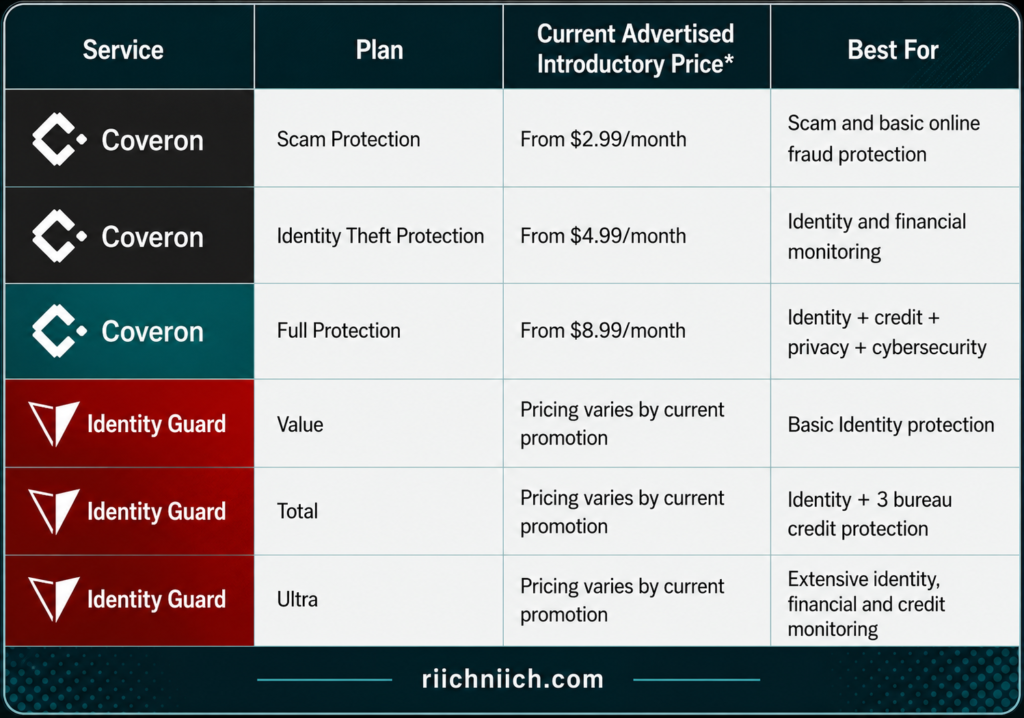
🚨 Advertised introductory prices depend on subscription length, billing choice, and active promotions. Renewal prices can be higher. Always verify the checkout price before purchasing.
Don’t Compare the Cheapest Plans Directly
This is one of the biggest mistakes someone could make when researching Coveron vs Identity Guard pricing.
Coveron’s $2.99 Scam Protection plan and Identity Guard’s Value plan don’t necessarily represent the protection someone searching for a comprehensive identity theft protection comparison actually wants.
Likewise, comparing Coveron’s Identity Theft Protection plan against Identity Guard Ultra isn’t necessarily fair because the products provide different levels of protection.
A more useful comparison is to first decide which features you consider essential.
If you want:
Dark web monitoring + basic scam protection
Look at the lower tiers.
If you want:
Identity monitoring + financial monitoring + credit monitoring
Move into the middle and higher tiers.
If you want:
3-bureau credit monitoring + extensive identity protection
Compare the plans that actually include those features.
And if you want:
Identity protection + 3-bureau credit monitoring + VPN + antivirus + personal data removal
Coveron’s Full Protection plan becomes especially interesting because those additional cybersecurity tools are bundled into the subscription.
Coveron Has a Strong Price Advantage for Individual Buyers
Looking strictly at the currently advertised introductory pricing and included features, Coveron makes an aggressive value proposition for individuals.
Its Full Protection plan currently starts at $8.99 per month on the 24-month introductory offer while providing 3-bureau credit monitoring, financial account monitoring, short-term loan monitoring, dark web monitoring, criminal records monitoring, identity theft recovery benefits, a VPN, antivirus, and personal data removal.
That feature combination is particularly important.
If you were already planning to pay separately for a VPN, antivirus software, personal data removal, and identity theft protection, Coveron’s bundle could potentially reduce the number of separate subscriptions you need.
That doesn’t automatically make Coveron the better service. But from a price-to-feature perspective for one person, it is one of Coveron’s strongest advantages in Coveron vs Identity Guard.
Identity Guard Changes the Equation for Families
Price becomes more complicated once you need to protect several people.
Identity Guard currently offers family memberships capable of covering up to five adults and unlimited children, according to its current plan information.
That means you shouldn’t compare:
One Coveron subscription vs. one Identity Guard family subscription
and conclude that Coveron is automatically cheaper.
The Identity Guard family subscription may be protecting several identities at once.
For a household with multiple adults and children, the cost per protected person could make Identity Guard significantly more competitive despite its higher headline subscription price.
This is why Identity Guard remains particularly compelling for shoppers searching for identity theft protection for families.
Watch the Renewal Price
This is one of the most important buyer-intent considerations in the entire Coveron vs Identity Guard pricing comparison.
Both companies advertise introductory discounts.
Coveron explicitly states that its introductory price applies only to the first subscription period. After that period, the subscription automatically renews at the then-applicable renewal price unless canceled. Coveron also warns that renewal prices may be higher than the introductory price.
Identity Guard similarly displays first-year prices alongside higher renewal amounts for its plans.
So don’t evaluate either service using only the giant discounted number on the sales page.
Ask:
What will this cost me today?
And then:
What will this cost me when it renews?
That second question can completely change which service provides better long-term value.
Money-Back Guarantees Are Different Too
Coveron currently offers a 30-day money-back guarantee on its plans.
Identity Guard currently advertises a 60-day money-back guarantee on annual plans, giving buyers a longer period to evaluate the service under the applicable guarantee terms.
That isn’t necessarily a reason by itself to choose Identity Guard, but it is another purchasing detail worth considering if you’re hesitant about committing to a paid identity protection service.
Which Has Better Pricing?
For individual buyers, Coveron currently has a very compelling price-to-feature argument—particularly with Full Protection. Someone who wants 3-bureau credit monitoring, identity monitoring, financial fraud protection, dark web monitoring, VPN protection, antivirus, and personal data removal may get considerable value from having those tools bundled together.
For families, Identity Guard becomes much more competitive because its family plans can protect multiple adults and children under one membership.
So the pricing winner in Coveron vs Identity Guard depends on who you’re protecting:
Individual seeking an all-in-one security package → Coveron has the stronger value proposition.
Family seeking protection for multiple people → Identity Guard has the stronger structural advantage.
But price alone still doesn’t tell us which service is the better purchase.
The more important question is what you actually receive for every dollar you spend—which is exactly what we’ll examine next when comparing the overall value for the money.

💵 Coveron vs Identity Guard: Which Offers Better Value for the Money?
Getting the best value from identity theft protection isn’t the same as choosing the lowest monthly price. A cheaper subscription can become poor value if it leaves out features you actually need, while a more expensive plan can make financial sense if it replaces several services you would otherwise purchase separately.
That is why the value question in Coveron vs Identity Guard should come down to three things: what you pay, what protection you receive, and how many people you need to protect.
Based on the current offerings, Coveron has the stronger overall value proposition for many individual buyers, particularly those who want identity protection bundled with privacy and cybersecurity tools. Identity Guard becomes much more competitive for families and buyers who want its more specialized identity and financial monitoring features.
Why Coveron Offers Strong Value for Individuals
Coveron’s biggest value advantage appears in its Full Protection plan.
At the time of this comparison, Coveron advertises Full Protection for $8.99 per month when purchasing the first 24 months, or $215.76 for the introductory two-year period. Its 12-month introductory option is currently $9.99 per month.
That subscription combines:
- 3-bureau credit monitoring
- Financial account monitoring
- Short-term loan monitoring
- Dark web monitoring
- Malware breach alerts
- Criminal records monitoring
- Up to $2 million in eligible identity theft recovery coverage
- Cyber extortion insurance
- Online fraud insurance
- Cyberattack insurance
- Home title insurance
- Secure VPN
- Next-generation antivirus
- Personal data removal
That is an unusually broad combination for one subscription.
The key buyer-intent advantage isn’t simply that Coveron has more checkmarks on a feature list.
It is that some Coveron features could replace services you might otherwise purchase separately.
For example, someone interested in identity theft protection might also be paying separately for a VPN, antivirus software, and a data removal service. Coveron’s Full Protection bundles those categories together alongside its identity monitoring and credit protection.
That makes Coveron particularly compelling for someone starting from scratch and trying to build a broader personal-security setup without managing several subscriptions.
Coveron’s Full Protection Is Where the Value Becomes Most Interesting
Coveron’s cheaper Identity Theft Protection plan currently starts at $4.99 per month on its introductory 24-month offer and includes identity, financial, dark web, criminal-record, short-term-loan, and 1-bureau credit monitoring, along with its advertised insurance benefits.
That is already a competitive option for someone primarily interested in identity theft monitoring and fraud protection.
But Full Protection adds something important: 3-bureau credit monitoring plus the VPN, antivirus, and personal data removal service.
For the right buyer, that upgrade could be worth considerably more than the difference in subscription price.
Imagine you already planned to purchase:
Identity theft protection.
A VPN.
Antivirus protection.
A data removal service.
Instead of evaluating each product separately, Coveron Full Protection essentially turns that shopping list into one package.
Coveron itself describes Full Protection as combining its identity protection with Incogni-powered data removal and its VPN and next-generation antivirus tools.
That is probably Coveron’s strongest argument in the entire Coveron vs Identity Guard comparison.
Where Identity Guard Provides Better Value
Identity Guard approaches value differently.
Instead of emphasizing an all-in-one privacy and cybersecurity bundle, its higher-level plans become increasingly focused on identity, financial, and credit monitoring.
Identity Guard’s Total plan includes 3-bureau credit monitoring and bank account monitoring, while Ultra expands the protection with specialized monitoring categories. Its current Ultra offering can include credit and debit card monitoring, 401(k) and investment account monitoring, social media monitoring, home and auto title monitoring, criminal and sex-offense monitoring, and USPS address-change monitoring.
That creates a different type of value.
Suppose you already have:
A VPN you like.
Antivirus protection.
A password-security routine.
Privacy tools you’re satisfied with.
In that situation, Coveron’s additional cybersecurity bundle may not save you much money because you would be paying for tools you don’t necessarily need to replace.
Identity Guard’s more specialized monitoring could be more valuable if those monitoring categories better match the risks you’re concerned about.
This is why feature count alone doesn’t determine the winner.
The Value Comparison Changes Dramatically for Families
This is arguably Identity Guard’s biggest advantage in Coveron vs Identity Guard.
Identity Guard currently offers dedicated family memberships capable of covering up to five adults and unlimited children.
That means a family shouldn’t compare Identity Guard’s subscription price directly against Coveron’s individual price without considering how many people are actually being protected.
Consider a household with:
Two parents.
Two children.
And an adult grandparent.
The correct question isn’t:
“Which subscription costs less?”
It is:
“How much am I paying per person to get the protection my household needs?”
When viewed that way, Identity Guard can become considerably more attractive.
For an individual, paying for family coverage would obviously provide little additional value. But for a larger household, protecting several adults and children through one membership can be more economical and easier to manage than arranging protection individually.
Identity Guard Ultra Makes Sense for a Specific Type of Buyer
Identity Guard Ultra is substantially more expensive than Coveron’s introductory Full Protection pricing, but that doesn’t automatically make it poor value.
Identity Guard currently advertises Ultra at $25 per month for the first year under its standard annual introductory pricing, renewing at $29.99 per month. Promotional discounts may temporarily reduce the first-year price further.
The question is whether you will actually use its additional monitoring.
Someone with significant investments may care about 401(k) and investment account monitoring.
A homeowner may place greater value on title monitoring.
Someone worried about identity misuse may value criminal records monitoring and address-change monitoring.
Another person may consider those features unnecessary.
So although Ultra costs more, it can still provide better value for a buyer whose specific risks align with its specialized monitoring capabilities.
Don’t Pay Twice for Protection You Already Have
This is one of the easiest ways to waste money when buying identity theft protection.
Before choosing Coveron vs Identity Guard, take inventory of the security services you already use.
If you already pay for:
A VPN.
Antivirus software.
A password manager.
Data removal.
Credit monitoring.
Then ask whether your new identity protection subscription would replace those services or simply duplicate them.
Coveron Full Protection becomes considerably more valuable if you can cancel several existing subscriptions after switching.
But if you already receive credit monitoring through another service and have cybersecurity products you’re happy with, Identity Guard’s specialized monitoring—or even a lower-tier identity protection plan—might make more financial sense.
The best identity theft protection service isn’t necessarily the one offering the most features.
It is the one offering the most features you will actually use.
Think About the Second-Year Cost Too
Introductory pricing can make almost any subscription look attractive.
But long-term value matters more than the first checkout screen.
Coveron’s current discounted prices apply to the initial subscription period, while Identity Guard explicitly displays first-year prices alongside higher renewal amounts.
For example, Identity Guard currently lists its individual Total plan at $16.67 per month for the first year under its standard annual introductory pricing, renewing at $19.99 per month. Ultra is listed at $25 per month for the first year and renews at $29.99 per month. Promotional pricing can temporarily lower those first-year costs.
This is why I would never choose between Coveron vs Identity Guard based solely on a promotional percentage such as “Save 50%” or “Save 67%.”
Look at the actual dollars.
Then look at the renewal price.
Then decide whether the features are still worth paying for once the introductory discount disappears.
Value Isn’t Just About Monitoring
There is another factor that’s easy to underestimate: what happens when something actually goes wrong.
Coveron Full Protection currently combines monitoring with professional recovery assistance and up to $2 million in eligible identity theft recovery coverage. Identity Guard includes White Glove Fraud Resolution and identity theft insurance with its current memberships.
That recovery assistance has real value even though it is difficult to represent with a simple monthly price.
If your identity is stolen, having someone help you understand which accounts to contact, what documents you need, and how to work through the recovery process may become considerably more important than whether you saved a few dollars on your subscription.
Coveron vs Identity Guard: Best Value by Buyer
Here’s the simplest way I would break down the Coveron vs Identity Guard value decision:
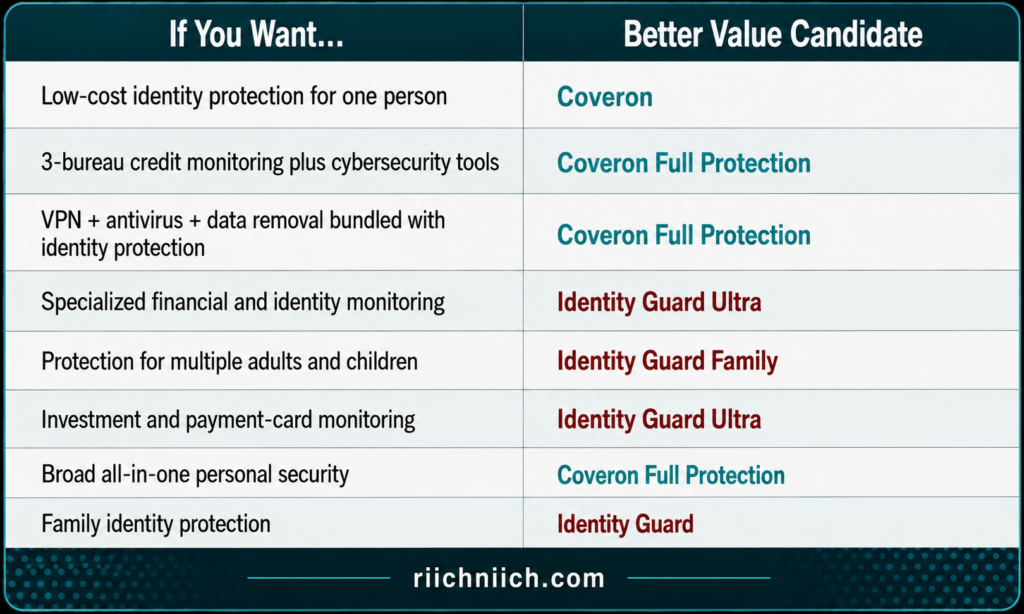
These aren’t universal winners. The best value still depends on the plan selected, current pricing, and the features you personally need.
Which Offers Better Value for the Money?
For most individual buyers, I give Coveron the advantage for overall value, especially with Full Protection.
Its current combination of 3-bureau credit monitoring, identity monitoring, financial account monitoring, dark web monitoring, fraud recovery, VPN protection, antivirus, and personal data removal creates a compelling package at its introductory price.
For families, however, I give Identity Guard the advantage because its family memberships can protect multiple adults and unlimited children under one subscription.
And for buyers who already own cybersecurity tools and primarily want more specialized identity and financial monitoring, Identity Guard Ultra deserves serious consideration.
So the value verdict in Coveron vs Identity Guard is:
Best value for an individual seeking all-in-one protection: Coveron
Best value for a family: Identity Guard
Best value for specialized monitoring: Identity Guard Ultra
Best value for combining identity protection + privacy + cybersecurity: Coveron Full Protection
Before purchasing either service, compare the current checkout price against the renewal price and make a simple list of which features you will genuinely use. That’s a much better way to judge value than choosing whichever company advertises the biggest discount.
Coveron vs Identity Guard: Ease of Use and Account Management
Identity theft protection works best when it doesn’t become another complicated security product you have to constantly manage. You should be able to set up monitoring, understand alerts, check your protection status, and find help without digging through confusing menus.
That makes ease of use an important buyer consideration in Coveron vs Identity Guard. Based on their current services, both are designed to centralize identity protection, but they handle account management somewhat differently.
Coveron Keeps Most Protection in One Web App
Coveron’s biggest usability advantage is consolidation. Coveron describes its identity theft protection features as working together inside a single web app, where customers can set up monitoring, review alerts, manage information, and access recovery features.
The initial setup is relatively straightforward:
- Choose a Coveron subscription and create your account.
- Verify your identity where required.
- Add the personal information you want monitored.
- Enable the appropriate monitoring features.
- Receive alerts when Coveron detects suspicious activity.
Coveron allows users to add information such as email addresses, phone numbers, payment card information, and other eligible personal details for monitoring. Some financial and credit features require additional identity verification.
For someone purchasing their first identity monitoring service, that relatively guided setup can make Coveron approachable.
Coveron’s Alerts Are Designed to Tell You What to Do Next
An identity theft alert isn’t very useful if you don’t understand what it means.
Coveron’s security alerts are designed to identify the problem and provide recommended actions. Depending on what Coveron detects, an alert could relate to leaked credentials, dark web exposure, suspicious credit activity, or another monitored security event.
For example, Coveron says its alerts may recommend actions such as changing an account password, enabling multi-factor authentication, or contacting your bank about suspicious credit activity.
That’s an important usability feature.
Imagine opening your identity protection dashboard and seeing:
“Potential threat detected.”
That tells you very little.
Compare that with:
“Your monitored credentials were exposed. Change this password, enable MFA, and review the affected account.”
The second alert gives you something actionable.
For buyers comparing Coveron vs Identity Guard, I would place significant value on clear alerts and next-step guidance, especially if you don’t consider yourself particularly technical.
Coveron Lets You Control What It Monitors
Coveron also gives users control over which eligible information they add for monitoring.
For example, if you want dark web monitoring for your Social Security number, you can add that information. If you also want an email address, phone number, or payment card monitored, you can add those eligible details as well.
Coveron says users can also manage notification preferences, including enabling or disabling certain product communications. Security alerts can appear in the Coveron web app, and certain suspicious-activity alerts are also delivered by email.
That matters because you shouldn’t have to constantly log into an identity protection dashboard just to find out whether something happened.
Credit Protection Can Also Be Managed From the Coveron Dashboard
Coveron’s account-management approach extends into credit protection.
For example, its TransUnion Credit Lock can be controlled through the Coveron dashboard. Coveron says users can navigate to financial monitoring and toggle the lock to restrict new credit application inquiries into their TransUnion file.
This is another example of why consolidation can matter.
Instead of purchasing identity monitoring and then managing every related feature through separate services, Coveron attempts to bring many of those controls into the same environment.
That convenience strengthens Coveron’s argument for buyers looking for all-in-one identity protection.
Identity Guard Provides Both Online and Mobile Account Management
Identity Guard also puts account management at the center of its service, particularly through its identity dashboard.
Its family protection documentation says each covered adult receives a private online identity dashboard where they can review alerts, manage monitoring, and update settings. Child identity monitoring is managed through the primary account holder.
Identity Guard also offers mobile access, and some account functions can be performed directly through its mobile app. For example, eligible Ultra members can lock and unlock their Experian credit file through the Identity Guard mobile app.
For buyers who prefer managing security from their phone, this can be a meaningful advantage.
You may not want to wait until you are sitting in front of a computer to investigate suspicious activity.
If an identity alert appears while you’re at work, traveling, or away from home, convenient mobile account access can make it easier to review the situation quickly.
Identity Guard’s Private Adult Dashboards Are Especially Useful for Families
This is one area where Identity Guard’s account-management design becomes particularly compelling.
If several adults share a family identity protection membership, they don’t necessarily want everyone else in the household seeing their personal alerts or financial information.
Identity Guard addresses that by giving each covered adult their own private dashboard.
Consider a household protecting:
A husband.
A wife.
An adult child.
A grandparent.
Each person can have different credit activity, financial accounts, alerts, and personal information.
Instead of funneling everything through one family member’s account, separate dashboards give adults more control over their own identity protection.
That makes Identity Guard particularly attractive for family identity protection, not simply because it covers more people, but because its account structure is designed to help multiple adults manage that protection independently.
More Features Can Mean More Setup
There is a tradeoff buyers should understand.
The more information you want an identity protection service to monitor, the more information you generally need to configure.
That applies to both Coveron and Identity Guard.
Setting up dark web monitoring, credit monitoring, financial account monitoring, personal information monitoring, fraud alerts, and other protections may require entering information, verifying your identity, and adjusting monitoring settings.
That initial setup shouldn’t necessarily be viewed as a negative.
An identity protection service can’t effectively monitor information you haven’t told it to monitor.
For example, Coveron explains that users need to add their details and complete applicable verification steps before certain dark web and credit alerts can begin.
The better question is whether the service makes that setup process understandable.
“Set It and Forget It” Isn’t the Goal
Identity monitoring should run quietly in the background, but you shouldn’t completely ignore your account after setup.
Your information changes.
You may get a new credit card.
Change your phone number.
Open a new financial account.
Start using another email address.
Or discover that old information has been exposed.
Keeping your monitored information current can help make your personal information monitoring more useful.
The ideal identity theft protection service should therefore require relatively little day-to-day work while still making it easy to update your protection when something changes.
What Happens When You Actually Need Help?
Ease of use becomes much more important during an identity theft incident.
When you’re dealing with fraudulent accounts or compromised information, you don’t want to spend hours trying to determine how to start the recovery process.
Coveron allows eligible customers to initiate the identity theft recovery process through their account. Its current recovery process can connect victims with a dedicated identity restoration case manager who helps with tasks such as contacting creditors, closing unauthorized accounts, and correcting identity records.
Identity Guard similarly provides fraud-resolution assistance on applicable coverage, including its White Glove Fraud Resolution service for Ultra members.
This is where ease of use becomes more than convenience.
A polished dashboard is nice.
But being able to quickly find an alert, understand what happened, access recovery support, and begin fixing the problem is far more important.
Which Is Easier to Use?
In Coveron vs Identity Guard, I would give Coveron a slight advantage for simplicity for an individual user.
Coveron’s current setup emphasizes a centralized web app, straightforward monitoring setup, actionable alerts, and the ability to manage several identity and financial protection features from one place. Coveron also specifically markets its service as easy to set up, with users creating an account, adding the information they want monitored, and enabling alerts.
However, Identity Guard has the stronger account-management argument for families and mobile-focused users.
Its private dashboards for covered adults make family protection easier to organize, while mobile access—including applicable credit-lock controls—provides additional flexibility for managing protection away from a computer.
So my buyer-intent assessment for Coveron vs Identity Guard is:
Best for straightforward individual account management: Coveron
Best for managing multiple adults under a family membership: Identity Guard
Best for centralized all-in-one monitoring: Coveron
Best for buyers who value dedicated family dashboards and mobile account access: Identity Guard
Ease of use probably shouldn’t determine your purchase by itself. Credit monitoring, identity theft insurance, recovery support, family coverage, and pricing are ultimately more important.
But if two services provide the protection you need at similar prices, the service you can actually understand and manage confidently is the better purchase.

Coveron vs Identity Guard: Customer Support and Identity Restoration
Customer support may seem like a secondary feature when you’re shopping for identity theft protection. But if someone actually steals your identity, support can quickly become one of the most important parts of the service.
You may need to dispute fraudulent accounts, contact financial institutions, correct credit reports, replace compromised documents, document losses, and determine which steps should happen first. In Coveron vs Identity Guard, both companies provide customer assistance and professional identity restoration services, but the way that support is delivered deserves a closer look.
Coveron Offers 24/7 Customer Support
Coveron currently advertises 24/7 customer support for questions involving subscriptions and accounts. That is a meaningful convenience because identity-related concerns don’t necessarily happen during normal business hours.
However, there is an important distinction between regular Coveron customer support and identity theft restoration assistance.
Customer support can help with the Coveron service itself.
Identity restoration support is what becomes important when you have actually experienced a covered identity theft incident.
Coveron’s recovery program provides access to a dedicated identity restoration case manager after an eligible customer files a claim with HSB, Coveron’s insurance partner.
That distinction is worth understanding before purchasing.
Coveron’s Case Manager Can Help With the Heavy Lifting
Coveron’s identity restoration support is designed to go beyond simply giving you a checklist.
According to Coveron, the assigned case manager can guide you through the recovery process and help with tasks such as:
- Contacting creditors
- Closing unauthorized accounts
- Correcting identity records
- Addressing damage to your credit
- Replacing affected documents
- Navigating the recovery process
Coveron says that in many cases, the restoration specialist can perform much of the legwork for the customer.
That could be extremely valuable after serious identity theft.
Imagine discovering three accounts you never opened, a collection notice you don’t recognize, and incorrect information appearing on your credit report.
A monitoring service may have helped you discover the problem.
But now you need to fix it.
This is where professional identity restoration can potentially justify part of the cost of a paid identity theft protection service.
How Do You Start Coveron’s Recovery Process?
Coveron’s process is relatively straightforward.
If you experience an incident that may qualify for coverage, you file a claim through your Coveron account with HSB. After the claim is initiated, eligible customers can receive help from an identity restoration case manager.
Coveron describes the process as:
Detect the problem → File a claim → Work with a restoration specialist → Recover eligible expenses
The restoration specialist can then help contact creditors, close unauthorized accounts, and work through the identity recovery process.
Coveron also currently advertises up to $2 million in reimbursement for eligible identity theft recovery expenses, subject to the policy’s terms, limits, exclusions, and $100 deductible.
That means Coveron’s recovery offering combines two things:
Professional assistance to repair the identity damage
and
Financial assistance for qualifying recovery expenses
For a buyer concerned about what would happen after serious identity theft, that combination strengthens Coveron’s overall value proposition.
Identity Guard Provides U.S.-Based Customer Care
Identity Guard also places a significant emphasis on customer assistance.
Its current plans include access to a U.S.-based Customer Care Team, along with fraud-resolution services and identity theft insurance.
Identity Guard also provides an online support system where customers can submit requests and include screenshots or other details that may help explain the issue.
But, as with Coveron, ordinary customer support shouldn’t be confused with professional identity restoration.
That is where Identity Guard’s White Glove Fraud Resolution becomes especially important.
What Is Identity Guard’s White Glove Fraud Resolution?
Identity Guard currently advertises White Glove Fraud Resolution with its protection offerings, although buyers should verify the exact assistance included with the plan they select.
Identity Guard describes its fraud-resolution assistance as helping victims deal with financial institutions, recover eligible stolen funds, and rebuild their credit after identity theft. Its family protection information specifically highlights White Glove Fraud Resolution for Ultra members.
That kind of support can be particularly valuable because identity theft recovery often requires dealing with multiple organizations simultaneously.
You may be contacting:
Your bank.
Credit card issuers.
Lenders.
Credit bureaus.
Government agencies.
Businesses where fraudulent accounts were opened.
Insurance administrators.
Trying to determine the correct order for all of those steps while also dealing with the financial consequences of fraud can become overwhelming.
A professional fraud-resolution service gives you someone familiar with the recovery process instead of forcing you to figure everything out from scratch.
Identity Restoration Can Be More Valuable Than Another Monitoring Feature
When comparing the best identity theft protection service, buyers naturally focus on monitoring features.
How many credit bureaus are monitored?
Does it monitor the dark web?
Does it watch financial accounts?
Does it monitor Social Security numbers?
Those are important questions.
But there is another question that may matter even more:
“What happens if the monitoring actually finds something?”
Suppose Service A monitors 15 categories while Service B monitors 12.
That difference may sound important while you’re shopping.
But if your identity is actually stolen, the difference between 12 and 15 monitoring categories may suddenly matter much less than whether you have an experienced specialist helping you clean up the damage.
That is why identity restoration services should carry significant weight in the Coveron vs Identity Guard purchase decision.
You Can Recover From Identity Theft Yourself
It is also important to be clear about what you’re paying for.
You do not need a paid identity theft protection service to report or recover from identity theft.
Depending on the type of fraud, recovery may involve contacting affected companies, closing fraudulent accounts, disputing inaccurate information, freezing credit reports, replacing compromised documents, and documenting what happened.
A paid restoration service primarily provides professional assistance, convenience, expertise, and potentially financial reimbursement for eligible expenses.
For some consumers, that may be worth paying for.
For others who are comfortable managing the process themselves, professional restoration assistance may carry less weight in the buying decision.
Support Matters Before Identity Theft Too
Customer service isn’t useful only after fraud occurs.
You may need assistance when:
A credit-monitoring feature isn’t activating.
Identity verification fails.
You don’t understand an alert.
You need to change monitored information.
A feature isn’t working correctly.
You have questions about coverage.
You need help determining whether an incident may qualify for a claim.
Coveron’s advertised 24/7 account and subscription support gives it a meaningful convenience advantage in this area.
Identity Guard’s U.S.-based Customer Care Team is also included across its currently advertised protection plans.
For someone who isn’t particularly comfortable troubleshooting security products alone, access to understandable human support can add real value to an identity protection subscription.
Which Has Better Customer Support and Identity Restoration?
In Coveron vs Identity Guard, both companies make strong arguments in this category.
Coveron stands out for its combination of 24/7 customer support and a dedicated identity restoration case manager for eligible recovery claims. The case manager can help navigate the restoration process, while Coveron’s recovery coverage can reimburse up to $2 million in qualifying expenses, subject to the applicable terms and limitations.
Identity Guard stands out with its U.S.-based Customer Care Team and established White Glove Fraud Resolution services. Its fraud-resolution support is designed to help identity theft victims navigate financial institutions, eligible stolen-funds recovery, and credit restoration.
For buyers who place a high priority on round-the-clock general customer support, I would give Coveron an advantage based on its currently advertised 24/7 availability.
For buyers who place greater emphasis on established fraud-resolution assistance, Identity Guard remains highly competitive.
Ultimately, I wouldn’t choose Coveron vs Identity Guard based on customer service alone. But I would absolutely consider identity restoration when deciding whether either subscription is worth the money.
You are not simply paying a company to tell you:
“Something went wrong.”
A good identity protection service should also help answer:
“What do I do now?”
And when serious identity theft happens, having an experienced person helping you work through creditors, fraudulent accounts, documentation, credit damage, and recovery could become one of the most valuable features you purchased.
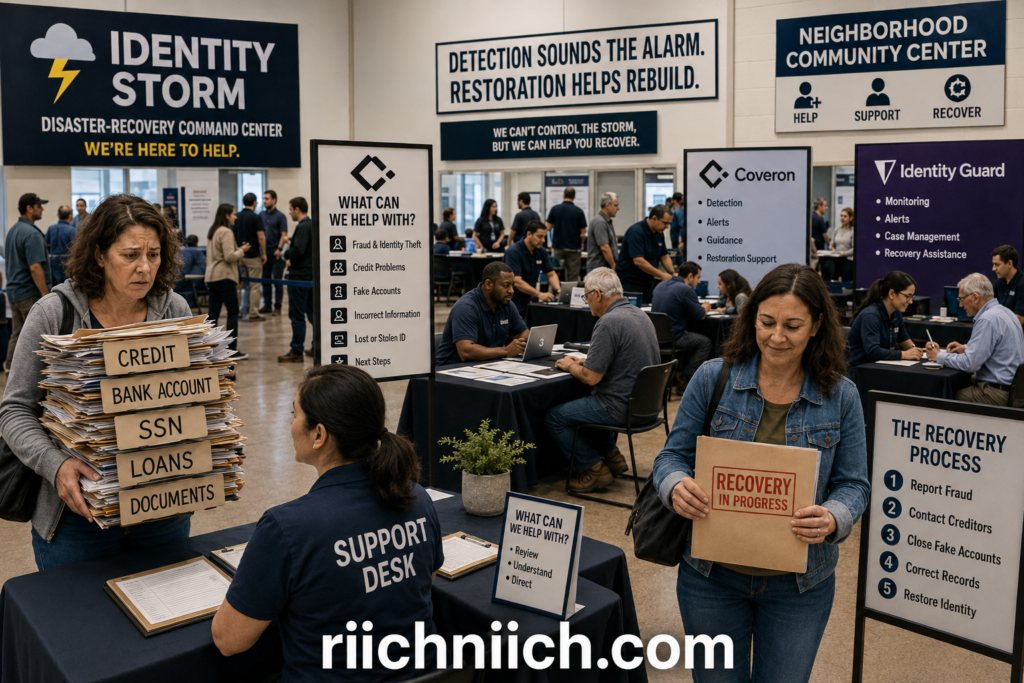
Coveron vs Identity Guard: Pros and Cons
No identity theft protection service is perfect. One provider may offer a better cybersecurity bundle, while another may provide stronger family coverage or more specialized financial monitoring.
That’s exactly what we see with Coveron vs Identity Guard. Coveron currently stands out for affordable individual protection and its combination of identity monitoring, credit protection, insurance, VPN, antivirus, and personal data removal. Identity Guard’s strengths are different: dedicated family memberships, multiple protection tiers, and more specialized monitoring in its higher-level plans.
Understanding those tradeoffs is more useful than simply asking which company has the longest feature list.
Coveron Pros
1. Excellent all-in-one protection for individuals
Coveron’s Full Protection plan combines several categories that people frequently purchase separately:
- 3-bureau credit monitoring
- Financial account monitoring
- Short-term loan monitoring
- Dark web monitoring
- Criminal records monitoring
- Malware breach alerts
- Secure VPN
- Next-generation antivirus
- Personal data removal
That gives Coveron a strong position for buyers searching for an all-in-one identity theft and cybersecurity service.
Instead of managing one subscription for identity protection, another for a VPN, another for antivirus, and another for data removal, an individual can potentially consolidate those protections into one Coveron subscription.
2. Competitive introductory pricing
Coveron is currently particularly aggressive on price.
Its 24-month introductory offers start at $2.99 per month for Scam Protection, $4.99 for Identity Theft Protection, and $8.99 for Full Protection. The Full Protection introductory term totals $215.76 for the first 24 months.
For someone comparing identity theft protection cost and features, that gives Coveron a significant buyer-intent advantage.
The important word, however, is introductory. Coveron states that the discounted price applies only to the initial subscription period, so buyers should check the renewal price before purchasing.
3. Strong credit and financial monitoring on higher tiers
Coveron’s Full Protection currently includes 3-bureau credit monitoring across Experian, Equifax, and TransUnion, along with financial account monitoring and short-term loan monitoring. Coveron also offers a TransUnion Credit Lock feature.
For buyers concerned about someone opening accounts or taking out loans using their identity, these features substantially strengthen the package.
4. Broader cybersecurity tools than traditional identity monitoring
This is arguably Coveron’s biggest differentiator in Coveron vs Identity Guard.
Coveron Full Protection doesn’t stop at detecting identity misuse. Its included antivirus is designed to block dangerous websites, detect phishing scams, scan downloads for malware, and block ads and trackers, while the VPN encrypts internet traffic. The package also includes personal data removal.
That gives Coveron a more preventive cybersecurity angle alongside traditional monitoring.
5. Multiple types of insurance protection
Coveron’s applicable plans currently advertise up to $2 million in identity theft recovery coverage, $50,000 in cyber extortion insurance, $25,000 in home title insurance, $10,000 in online fraud insurance, and $10,000 in cyberattack insurance. Coverage is subject to eligibility, policy terms, limits, and exclusions.
That broader collection of insurance benefits may appeal to buyers worried about risks beyond conventional identity theft.
6. 24/7 customer support
Coveron advertises 24/7 customer support for subscription and account questions.
That is a practical advantage if you don’t want your ability to get help restricted to standard business hours.
Coveron Cons
1. No dedicated family membership is currently advertised
This remains Coveron’s biggest weakness for certain buyers.
Its current pricing page centers on individual protection and does not present dedicated individual-versus-family membership choices like Identity Guard does. Identity Guard, by comparison, explicitly sells family plans.
If you’re protecting only yourself, this may not matter.
If you’re protecting several adults and children, it matters considerably.
2. Some of Coveron’s best features require Full Protection
The impressive Coveron feature list needs context.
The $2.99 Scam Protection plan doesn’t give you everything available from Coveron. Likewise, Identity Theft Protection provides 1-bureau rather than 3-bureau credit monitoring.
The VPN, next-generation antivirus, personal data removal, and 3-bureau credit monitoring are features of Full Protection.
So buyers shouldn’t see Coveron’s lowest advertised price and assume it includes the entire feature set.
3. Introductory pricing can make the service appear cheaper than its long-term cost
Coveron’s heavily discounted introductory pricing is attractive, but it can also make a quick price comparison misleading.
Coveron explicitly states that introductory pricing applies only to the first subscription period and that renewal pricing may be higher.
Always compare the checkout price and future renewal price, not just the promotional monthly equivalent.
4. It is still a newer identity protection brand
Coveron is a relatively new brand compared with Identity Guard. That isn’t evidence that Coveron provides inferior protection, but some buyers may prefer a service with a longer identity-protection track record.
For shoppers who value longevity and familiarity heavily, Identity Guard may therefore feel like the safer purchasing choice.
5. No identity theft protection service can prevent everything
Coveron itself clearly states that no single product can fully prevent identity theft or monitor every transaction.
That’s an important limitation—not just of Coveron, but of identity theft monitoring in general.
You’re buying additional monitoring, detection, security tools, insurance benefits, and recovery assistance, not a guarantee that identity theft will never happen.
Identity Guard Pros
1. Much stronger option for family protection
Identity Guard’s family offering is one of its biggest advantages in Coveron vs Identity Guard.
Its current plan page advertises family membership covering up to five adults and unlimited children.
That makes Identity Guard particularly attractive for parents, couples, multigenerational households, and anyone trying to protect several identities under one subscription.
2. Strong specialized monitoring on Ultra
Identity Guard Ultra goes beyond basic dark web and credit monitoring.
Its current feature lineup includes monitoring for areas such as bank accounts, social media, credit and debit cards, 401(k) and investment accounts, home titles, criminal records, and USPS address changes.
For buyers with investments or multiple financial accounts, those additional monitoring categories may be more valuable than Coveron’s broader cybersecurity bundle.
3. U.S.-based customer care
Identity Guard includes access to a U.S.-based Customer Care Team with its currently advertised memberships.
For buyers who prefer having access to human assistance when dealing with alerts or account issues, that’s a meaningful benefit.
4. White Glove Fraud Resolution
Identity Guard includes fraud-resolution support, and its family offering describes White Glove Fraud Resolution assistance that can help eligible victims report losses to financial institutions, recover stolen funds, and rebuild their credit.
That’s an important distinction between merely detecting identity theft and helping someone recover afterward.
5. Individual and family options
Identity Guard allows shoppers to choose protection based on household size instead of forcing everyone into the same membership structure.
This makes Identity Guard more flexible for buyers whose primary concern is protecting multiple people.
6. Private dashboards for covered adults
Each covered adult on Identity Guard’s family plan can receive a private online dashboard for viewing alerts, managing monitoring, and changing settings, while child monitoring is handled through the primary account holder.
That is a practical account-management advantage for households containing several adults.
Identity Guard Cons
1. Higher-tier protection can become expensive
Identity Guard becomes considerably more expensive as you move into its premium protection levels.
This doesn’t necessarily make it poor value—the higher tiers provide additional monitoring—but buyers should ask whether they will actually use those extra features.
Someone who doesn’t need investment, payment-card, title, or other specialized monitoring may not need to pay for the highest tier.
2. The strongest features are spread across higher plan levels
As with Coveron, don’t assume every Identity Guard feature is included with the cheapest membership.
Features such as more advanced financial and credit monitoring become increasingly important as you move into Identity Guard’s higher tiers.
That means the entry price alone isn’t enough to make a fair Coveron vs Identity Guard comparison.
3. It doesn’t match Coveron’s Full Protection cybersecurity bundle
Identity Guard provides useful online-security features, but Coveron Full Protection’s combination of VPN, next-generation antivirus, and personal data removal gives Coveron a particularly broad cybersecurity and privacy package.
This matters most for someone hoping to consolidate multiple personal-security subscriptions.
If you already have a VPN, antivirus, and data removal solution, however, this Coveron advantage becomes much less important.
4. Family coverage can be unnecessary for individual buyers
Identity Guard’s family offering is a major strength—but only if you actually need it.
A single person shouldn’t pay extra merely because a service can protect several people. For an individual, the better question is which plan provides the most useful features at the lowest sustainable cost.
Coveron vs Identity Guard Pros and Cons at a Glance
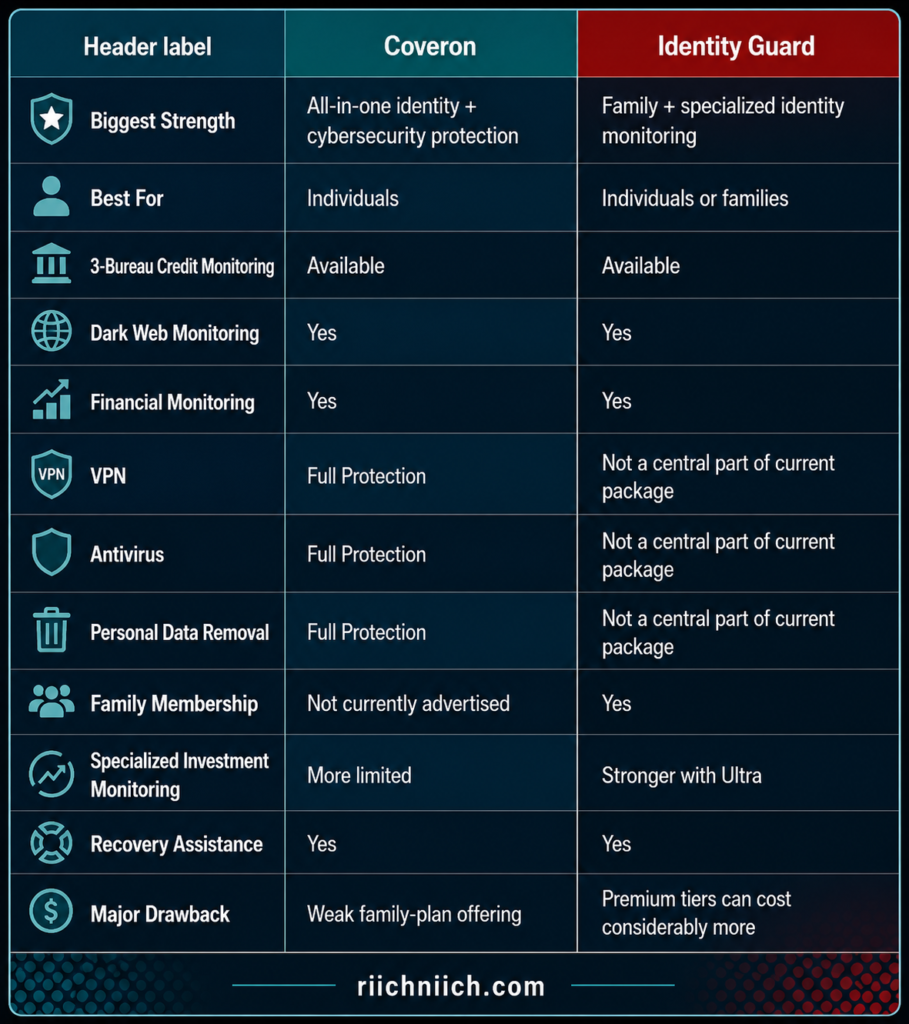
🚨 The exact features depend on the plan selected and can change, so buyers should verify the current plan details before subscribing.
Which Service Has the Better Pros-to-Cons Balance?
For an individual buyer, I currently lean toward Coveron if the goal is getting the broadest collection of identity, privacy, and cybersecurity features for the money.
Coveron Full Protection is especially compelling because it combines 3-bureau credit monitoring and identity monitoring with VPN protection, antivirus, personal data removal, financial monitoring, insurance benefits, and recovery assistance.
For a family, I lean toward Identity Guard.
The ability to cover multiple adults and unlimited children under a family membership changes the comparison significantly. Its higher tiers also provide specialized monitoring that some households may value more than Coveron’s additional cybersecurity tools.
So the biggest takeaway from Coveron vs Identity Guard is not that one company wins every category.
It’s that they are better suited to different buyers.
Choose Coveron if: you are primarily protecting yourself and want identity monitoring, credit protection, financial monitoring, privacy tools, and cybersecurity bundled together.
Choose Identity Guard if: you need family protection or place greater value on specialized identity and financial monitoring.
And regardless of which service you choose, identity theft protection should complement—not replace—good security habits such as strong unique passwords, multi-factor authentication, credit freezes when appropriate, careful account monitoring, and skepticism toward unexpected requests for personal information.
Who Should Choose Coveron?
Coveron makes the most sense for someone who wants more than basic identity monitoring. Its strongest selling point is the ability to combine identity theft protection, credit monitoring, financial monitoring, recovery assistance, online privacy, and cybersecurity tools under one subscription.
In the broader Coveron vs Identity Guard comparison, Coveron is particularly compelling for individual buyers who want an all-in-one personal security package rather than a family-focused identity protection service.
Choose Coveron If You Want All-in-One Protection
Coveron’s strongest case is Full Protection.
The plan currently combines:
- 3-bureau credit monitoring
- Dark web monitoring
- Financial account monitoring
- Short-term loan monitoring
- Criminal records monitoring
- Malware breach alerts
- Identity theft recovery assistance
- Up to $2 million in eligible identity theft recovery coverage
- Cyber extortion insurance
- Online fraud insurance
- Cyberattack insurance
- Home title insurance
- Secure VPN
- Next-generation antivirus
- Personal data removal
That combination makes Coveron particularly appealing if you don’t want to assemble your personal security setup from several different subscriptions.
Instead of thinking only about:
“Which identity theft protection service should I buy?”
you can think about:
“How many security subscriptions could this potentially replace?”
For the right buyer, that is where Coveron’s value becomes much more significant.
Choose Coveron If You’re Protecting Mainly Yourself
The Coveron vs Identity Guard decision changes considerably depending on whether you’re shopping for yourself or an entire household.
Coveron’s current lineup is especially attractive to an individual buyer who wants broad protection.
For example, someone living alone who wants credit monitoring, identity monitoring, fraud protection, a VPN, antivirus protection, and data removal may find Coveron Full Protection particularly convenient.
You’re not paying extra because you need to cover several family members. You’re evaluating the subscription based primarily on how much protection you personally receive for the price.
That’s an area where Coveron performs particularly well.
Choose Coveron If You Want 3-Bureau Credit Monitoring
If credit protection is one of your biggest concerns, Coveron Full Protection deserves consideration.
Its 3-bureau credit monitoring tracks activity across Experian, Equifax, and TransUnion. Coveron says users can receive alerts involving suspicious credit activity such as new accounts, hard inquiries, and other changes to their credit files.
That’s important because lenders don’t necessarily report information to every credit bureau.
Monitoring all three bureaus provides broader visibility than monitoring only one.
Coveron also offers credit-freeze assistance and a TransUnion Credit Lock with applicable protection.
However, paid credit monitoring shouldn’t be confused with a credit freeze. The Federal Trade Commission explains that credit freezes are free, don’t affect your credit score, and can help prevent criminals from opening new credit accounts in your name.
For someone serious about identity protection, using monitoring alongside free preventive tools such as credit freezes can create a stronger overall strategy.
Choose Coveron If You’re Concerned About More Than Credit Fraud
Identity theft doesn’t always begin with a new credit card appearing on your credit report.
Your email credentials could leak.
A criminal could attempt a short-term loan.
Your personal information could appear on the dark web.
Your identity could become associated with a criminal record.
Your financial account information could be compromised.
Coveron’s higher-tier plans monitor several of these categories rather than concentrating exclusively on traditional credit activity.
That makes Coveron appealing for buyers looking for broader identity monitoring and fraud protection.
Choose Coveron If You Want to Reduce Your Digital Footprint
This is one of the strongest reasons to consider Coveron Full Protection.
Monitoring tells you when personal information may already have been compromised.
Data removal takes a different approach: trying to reduce how much personal information is being collected and distributed by data brokers and people-search services.
Coveron Full Protection currently includes an Incogni-powered personal data removal service. Coveron says Incogni sends removal requests to data brokers and repeatedly works to remove eligible personal information from those databases.
That creates a useful combination:
Data removal → reduce unnecessary exposure
Dark web monitoring → detect compromised information
Credit and financial monitoring → watch for suspicious activity
Recovery assistance → help respond if identity theft occurs
For someone concerned about both online privacy and identity theft, this layered approach is one of Coveron’s strongest selling points.
Choose Coveron If You Don’t Already Have a VPN or Antivirus
Coveron Full Protection becomes more valuable if you’re starting without many cybersecurity tools.
The plan currently includes a secure VPN and next-generation antivirus. Coveron says its antivirus can help block dangerous websites, detect phishing attempts, scan downloaded files for malware, and block ads and trackers.
If you’re already paying for a VPN and antivirus you love, this advantage becomes less important.
But suppose you’re currently shopping for:
Identity theft protection.
A VPN.
Antivirus.
Data removal.
3-bureau credit monitoring.
Buying and managing those services individually could become expensive and inconvenient.
For that type of shopper, Coveron’s bundled approach is much more attractive.
Choose Coveron If You’re Worried About Online Scams
Not everyone researching identity protection is primarily worried about someone opening a credit card in their name.
Some people are more concerned about:
Phishing.
Impersonation scams.
Fraudulent websites.
Malware.
Account compromise.
Online purchases from fraudulent sellers.
Coveron’s protection extends into some of these areas.
Its applicable plans currently advertise up to $10,000 in online fraud insurance and $10,000 in cyberattack insurance, subject to the applicable policy terms, eligibility requirements, limits, and exclusions. Higher plans also include up to $50,000 in cyber extortion insurance.
Coveron therefore makes more sense for someone who views identity theft, online scams, and cybersecurity as interconnected problems rather than completely separate risks.
Choose Coveron If Recovery Assistance Matters to You
Monitoring is useful before and during identity theft.
But if someone actually steals your identity, you’ll probably care much more about how the service helps you recover.
Coveron’s Identity Theft Protection and Full Protection plans currently include professional identity theft recovery assistance and reimbursement of up to $2 million for eligible recovery expenses, subject to applicable policy terms and limits.
That can be valuable for someone who doesn’t want to navigate identity restoration completely alone.
You may need to deal with fraudulent accounts, creditors, financial institutions, credit records, replacement documents, and other consequences.
Having professional recovery support doesn’t guarantee that restoring your identity will be effortless, but it gives you assistance when the service matters most.
Choose Coveron If You Want Competitive Introductory Pricing
Price is another strong argument.
Coveron’s current two-year introductory offers are:
Scam Protection — $2.99/month
Identity Theft Protection — $4.99/month
Full Protection — $8.99/month
Coveron currently lists Full Protection at $215.76 for the first 24 months.
That makes Full Protection particularly aggressive considering the number of services included.
But don’t overlook one important detail:
These are introductory prices.
Coveron states that the promotional pricing applies only to the first subscription period and that renewal pricing can be higher.
So before purchasing, compare the introductory total with the expected renewal cost.
Who Probably Shouldn’t Choose Coveron?
Coveron isn’t automatically the best choice for everyone.
If your main goal is protecting multiple adults and children under one dedicated family membership, Identity Guard’s family structure is likely more attractive.
Coveron may also be less compelling if you already pay for—and are happy with—a VPN, antivirus, and data removal service. In that situation, some of Full Protection’s biggest advantages could simply duplicate tools you already own.
Likewise, someone primarily interested in highly specialized monitoring categories may find certain Identity Guard higher-tier features more relevant.
This is why Coveron vs Identity Guard shouldn’t be decided by counting features alone.
The better service is the one whose features match the risks you’re actually trying to address.
Coveron Is Best for This Type of Buyer
If Coveron looks like the better fit but you want to compare it with another major all-in-one identity protection service before buying, see our full Coveron vs Aura comparison.
Coveron is especially worth considering if you can say:
“I’m mainly protecting myself, I want strong identity and credit monitoring, and I’d rather bundle privacy and cybersecurity protection instead of paying for several separate services.”
That buyer is where Coveron shines.
Its Full Protection plan combines identity theft monitoring, 3-bureau credit monitoring, financial monitoring, dark web monitoring, recovery support, VPN protection, antivirus, and personal data removal in one package.
For an individual who needs most of those tools, Coveron could provide stronger value than buying them separately.
In the Coveron vs Identity Guard decision, I would therefore put Coveron near the top of the list for:
Individual buyers
Privacy-conscious buyers
People who want an all-in-one cybersecurity package
People who need a VPN and antivirus
People interested in automated personal data removal
People who want 3-bureau credit monitoring
People concerned about both identity theft and online scams
That doesn’t automatically make Coveron the winner of the entire comparison. But if those priorities describe what you’re looking for, Coveron is likely the stronger fit of the two.

Who Should Choose Identity Guard?
Identity Guard makes the most sense for buyers who want traditional identity theft protection with strong credit and financial monitoring, especially when protecting more than one person. While Coveron’s biggest advantage is its broad all-in-one cybersecurity bundle, Identity Guard’s strongest arguments are its family memberships, specialized monitoring features, credit protection, and fraud-resolution assistance.
In the Coveron vs Identity Guard comparison, I would look especially closely at Identity Guard if you’re protecting a family, have investments or multiple financial accounts, or simply don’t need Coveron’s bundled VPN, antivirus, and data removal tools.
Choose Identity Guard If You Need Family Identity Protection
This is probably the clearest reason to choose Identity Guard.
Identity Guard currently offers family memberships covering up to five adults and unlimited children. Covered adults receive their own private online dashboards, while child monitoring is managed through the primary account.
That can make Identity Guard considerably more practical for:
- Couples
- Parents with children
- Households with adult children
- Multigenerational households
- Families helping protect older relatives
If you’re protecting several people, don’t judge value based solely on the monthly subscription price.
Look at the cost per protected person.
A family plan that costs more than an individual subscription can still represent better value if it protects several identities under one membership.
This is one of Identity Guard’s strongest advantages in Coveron vs Identity Guard.
Choose Identity Guard If You Want to Protect Your Children
Children may not have mortgages, credit cards, or investment accounts, but their personal information can still be valuable to identity thieves.
The Federal Trade Commission warns that a criminal could potentially use a child’s Social Security number to apply for credit, obtain benefits, rent property, or establish utility services. Because children aren’t regularly applying for credit themselves, the fraud can sometimes remain unnoticed for years.
Identity Guard’s family protection includes child dark web monitoring designed to look for exposure involving information such as a child’s name, Social Security number, and date of birth.
For parents comparing family identity theft protection services, that is an important advantage.
You can also take additional preventive action without paying for a monitoring service. The FTC explains that parents and guardians can request a free credit freeze for a child under 16, making it harder for criminals to open new credit accounts using the child’s identity.
Paid monitoring and a free credit freeze can therefore serve different purposes.
Choose Identity Guard If You Want Specialized Financial Monitoring
This is another area where Identity Guard becomes particularly interesting.
Identity Guard Ultra currently expands beyond standard identity and credit monitoring into several more specialized categories, including:
- Bank account monitoring
- Credit and debit card monitoring
- 401(k) and investment account monitoring
- Home and auto title monitoring
- USPS address-change monitoring
- Social media monitoring
- Criminal and sex-offense monitoring
- 3-bureau credit monitoring
These features won’t be equally valuable to everyone.
But imagine someone with a substantial retirement account, multiple investment accounts, several payment cards, a home, and other financial assets.
That person may place much greater value on investment account monitoring and specialized financial alerts than on receiving another VPN or antivirus subscription.
For that type of buyer, Identity Guard Ultra can make a strong case in Coveron vs Identity Guard.
Choose Identity Guard If You Already Have Cybersecurity Tools
Coveron’s Full Protection bundle is one of its biggest advantages—but only if you need the tools being bundled.
Suppose you already have:
A VPN you’re satisfied with.
Antivirus protection.
A password manager.
A personal data removal service.
Good security settings on your devices.
In that situation, switching to Coveron Full Protection might duplicate several services you’re already paying for or already prefer.
Identity Guard can make more sense if you’re specifically shopping for identity theft protection, credit monitoring, financial monitoring, and fraud recovery assistance rather than trying to replace your entire cybersecurity setup.
That’s an important buyer-intent distinction.
The best value isn’t always the service with the most included features.
It’s the service that provides the most useful features you don’t already have.
Choose Identity Guard If 3-Bureau Credit Monitoring Is Important
Identity Guard’s Total and Ultra plans currently include 3-bureau credit monitoring, allowing eligible users to monitor activity involving Experian, Equifax, and TransUnion.
That’s important because fraudulent credit activity may not appear identically across all three credit bureaus.
Identity Guard also offers monthly credit scores with Total and Ultra, while Ultra adds an annual 3-bureau credit report and Experian Credit Lock.
For someone particularly concerned about new-account identity theft, broader credit visibility may justify moving beyond Identity Guard’s entry-level Value plan.
Just remember that credit monitoring is primarily a detection tool.
Choose Identity Guard If You Want Different Protection Levels
Not everyone needs premium identity theft protection.
Identity Guard currently offers three main tiers:
Value — Basic Identity Protection
Total — Standard Identity & Credit Protection
Ultra — Premium Identity & Credit Protection
That gives buyers flexibility.
Someone mainly concerned about basic identity monitoring may prefer Value.
Someone who wants 3-bureau credit monitoring and stronger financial protection can move to Total.
Someone who wants more extensive financial, investment, title, address-change, and identity monitoring can consider Ultra.
The key is not automatically buying Ultra because it has the longest feature list.
Choose the lowest tier that actually provides the protection you need.
Choose Identity Guard If Fraud Resolution Is a Major Priority
Identity theft monitoring can help you detect suspicious activity, but detection doesn’t repair the damage.
Identity Guard’s protection includes access to fraud-resolution assistance, and its Ultra family offering specifically highlights White Glove Fraud Resolution. Identity Guard says its fraud specialists can help eligible victims work through issues such as reporting fraud to financial institutions, recovering eligible stolen funds, and rebuilding their credit.
This can be particularly valuable if you don’t want to navigate identity theft recovery alone.
A serious incident could involve:
Fraudulent credit accounts.
Unauthorized financial activity.
Incorrect credit information.
Compromised personal records.
Multiple creditors.
Insurance claims.
Government reports.
Disputes with financial institutions.
Having professional assistance can turn a confusing recovery process into a more structured one.
That is an important part of Identity Guard’s value—not simply how many threats it monitors.
Choose Identity Guard If You Prefer a Longer Money-Back Guarantee
Identity Guard currently advertises a 60-day money-back guarantee with annual plans, subject to its applicable terms.
That gives annual-plan buyers additional time to evaluate the service.
A money-back guarantee shouldn’t be the primary reason you purchase identity theft protection, but it can reduce some of the risk when trying a paid service for the first time.
During that initial period, don’t just look at the dashboard.
Set up the monitoring you actually need.
Add eligible personal information.
Configure your alerts.
Explore the mobile app.
Review the credit-monitoring features included with your plan.
Make sure you understand how to contact customer support and initiate fraud resolution.
Then decide whether the service feels useful enough to keep.
Who Probably Shouldn’t Choose Identity Guard?
Identity Guard may be less compelling if you’re an individual specifically looking for one subscription that combines identity protection with broader cybersecurity and privacy tools.
Coveron Full Protection currently bundles a VPN, next-generation antivirus, and personal data removal alongside its identity, credit, and financial monitoring. That gives Coveron a strong advantage for someone trying to consolidate several personal-security subscriptions.
Identity Guard can also become relatively expensive at the premium level, so don’t automatically choose Ultra if its specialized monitoring features aren’t relevant to you.
For example, if you have no investment accounts, don’t own a home, and don’t care about some of Ultra’s more specialized monitoring categories, paying for the highest tier may provide limited additional value.
Identity Guard Is Best for This Type of Buyer
Identity Guard is especially worth considering if you can say:
“I want strong identity and credit monitoring, I need to protect more than one person, or I want specialized monitoring for my family’s financial information and accounts.”
That’s where Identity Guard becomes particularly strong in Coveron vs Identity Guard.
I would put Identity Guard near the top of the list for:
Families with children
Households with multiple adults
Parents concerned about child identity theft
Buyers who want 3-bureau credit monitoring
People with 401(k) or investment accounts
People who want specialized financial monitoring
Buyers who already have their preferred VPN and antivirus
People who value professional fraud-resolution assistance
For a single person trying to build an all-in-one identity, privacy, and cybersecurity setup, Coveron may provide the more compelling package.
But for a household—or a buyer who values specialized identity and financial monitoring over bundled cybersecurity extras—Identity Guard may be the better purchase in Coveron vs Identity Guard.

Is Coveron Worth It?
Yes, Coveron can be worth it, particularly for an individual who wants identity theft protection, credit monitoring, financial monitoring, recovery assistance, and cybersecurity tools bundled into one subscription.
However, whether Coveron is worth paying for depends heavily on which plan you choose and which of its features you will actually use.
In the Coveron vs Identity Guard comparison, Coveron’s strongest value comes from Full Protection. That plan currently combines 3-bureau credit monitoring with identity monitoring, financial monitoring, insurance benefits, a VPN, antivirus protection, and personal data removal.
For someone who would otherwise purchase several of those services separately, Coveron becomes much easier to justify.
What Are You Actually Paying Coveron to Do?
It’s important to understand that Coveron cannot guarantee that your identity will never be stolen.
No legitimate identity theft protection service can make that promise.
Coveron itself states that no single product can fully prevent identity theft or monitor every transaction.
Instead, you’re paying Coveron to provide additional layers of protection before, during, and after potential identity theft.
Depending on your plan, those layers can include:
- Credit monitoring
- Dark web monitoring
- Financial account monitoring
- Short-term loan monitoring
- Criminal records monitoring
- Malware breach alerts
- Security notifications
- Identity theft recovery assistance
- Identity theft insurance
- Online fraud and cyberattack insurance
- VPN protection
- Antivirus
- Personal data removal
That distinction matters when evaluating Coveron vs Identity Guard.
You’re not buying an invisible shield that makes identity theft impossible.
You’re buying monitoring, earlier detection, security tools, financial protection, and professional assistance if something goes wrong.
Coveron Identity Theft Protection Is Worth Considering
If identity theft is your primary concern, Coveron’s middle-tier Identity Theft Protection plan offers a surprisingly broad package for its current introductory price.
The plan currently starts at $4.99 per month when purchasing the first 24 months, totaling $119.76 for the introductory period. Its current 12-month introductory option is $5.99 per month.
It currently includes:
1-bureau credit monitoring
Financial account monitoring
Short-term loan monitoring
Dark web monitoring
Malware breach alerts
Criminal records monitoring
Up to $2 million in eligible identity theft recovery coverage
$50,000 cyber extortion insurance
$25,000 home title insurance
$10,000 online fraud insurance
$10,000 cyberattack insurance
For someone who wants dedicated identity monitoring and fraud protection without paying for Coveron’s complete cybersecurity bundle, this may be the sweet spot.
Coveron Full Protection Is Where the Value Gets Stronger
For buyers willing to spend more, Full Protection is the plan that makes Coveron especially compelling.
Coveron currently advertises Full Protection for $8.99 per month for the first 24 months, totaling $215.76 for the introductory term. Its 12-month introductory option is currently $9.99 per month.
Full Protection upgrades credit monitoring from one bureau to all three major credit bureaus—Experian, Equifax, and TransUnion. It also adds Coveron’s secure VPN, next-generation antivirus, and Incogni-powered personal data removal.
This changes the value calculation significantly.
You are no longer evaluating Coveron strictly as an identity theft protection subscription.
You’re effectively evaluating:
Identity theft protection
3-bureau credit monitoring
Financial monitoring
VPN
Antivirus
Personal data removal
Identity restoration and insurance benefits
For someone who genuinely wants most of those services, Coveron Full Protection can offer excellent value for the money.
The 3-Bureau Credit Monitoring Adds Real Value
One reason I would lean toward Full Protection for someone serious about identity protection is its 3-bureau credit monitoring.
Coveron says it monitors credit activity across Experian, Equifax, and TransUnion and can alert users about suspicious activity such as new accounts and inquiries.
Monitoring all three bureaus is preferable to relying solely on one bureau because lenders don’t necessarily report activity identically across all three.
However, credit monitoring is primarily a detection tool.
It alerts you to changes.
It doesn’t make new-account identity theft impossible.
That’s why I would still combine paid monitoring with free preventive measures such as credit freezes when appropriate.
The VPN, Antivirus, and Data Removal Can Change the Math
This is probably the biggest reason Coveron may be worth buying instead of viewing it as just another identity protection subscription.
Suppose you’re already considering paying for:
A VPN.
Antivirus software.
Personal data removal.
Credit monitoring.
Identity theft protection.
Those separate subscriptions can add up.
Coveron Full Protection bundles all of those categories together. Its antivirus is designed to block dangerous websites, detect phishing scams, scan downloads for malware, and stop ads and trackers, while its VPN encrypts internet traffic. Its included Incogni service handles personal data removal requests with data brokers and people-search sites.
For someone starting without these tools, that bundle could make Coveron substantially more valuable.
But there’s another side to this.
If you already have a VPN you love, strong antivirus protection, and a data removal subscription you’re satisfied with, Coveron’s Full Protection package becomes less impressive for you personally.
You don’t save money by replacing subscriptions if you aren’t actually replacing anything.
Coveron May Be Worth It If You Don’t Want to Monitor Everything Yourself
Many identity-protection tasks can be performed manually.
You can review credit reports.
Freeze your credit.
Monitor financial accounts.
Watch for suspicious emails.
Check account alerts.
Use strong unique passwords.
Enable multi-factor authentication.
Respond to data breaches.
The value of a paid service is partly automation and convenience.
Instead of manually checking multiple sources and hoping you notice something suspicious, an identity protection service monitors eligible information continuously and sends alerts when it detects something that may require your attention.
Coveron describes its service as combining monitoring, alerts, recovery, and support in one platform.
For someone who doesn’t want identity protection to become another weekly chore, that convenience can be worth paying for.
Recovery Support Is One of the Strongest Reasons to Pay
Identity monitoring becomes much easier to appreciate once you imagine what happens after identity theft actually occurs.
Finding suspicious activity is only the beginning.
You may need to contact creditors, dispute fraudulent accounts, replace documents, correct records, communicate with financial institutions, and document recovery expenses.
Coveron’s applicable identity protection plans currently provide professional recovery assistance and up to $2 million toward eligible identity theft recovery expenses, subject to policy terms and limitations. Coveron states that access to its identity restoration case manager requires filing a claim with HSB, its insurance partner.
For someone who would rather have professional help than navigate serious identity theft alone, this feature can significantly increase the value of the subscription.
But Don’t Buy Coveron Just Because of the $2 Million Number
The phrase “$2 million identity theft insurance” sounds enormous.
It needs context.
That doesn’t mean Coveron automatically writes you a $2 million check if someone steals your identity.
The coverage is for eligible identity theft recovery expenses and is subject to the applicable insurance policy, exclusions, limits, and requirements.
Insurance should therefore be treated as an important safety net—not the sole reason to purchase the service.
When evaluating Coveron vs Identity Guard, look beyond the headline insurance number and consider:
What expenses qualify?
What exclusions apply?
Are there sublimits?
What documentation is required?
How does the restoration process work?
How quickly can you access assistance?
Those questions tell you much more than the maximum advertised dollar amount.
The Introductory Price Is Excellent—but Watch the Renewal
There is one major pricing issue buyers shouldn’t overlook.
Coveron’s current prices are introductory offers.
The current two-year offers are:
Scam Protection — $2.99/month
Identity Theft Protection — $4.99/month
Full Protection — $8.99/month
Coveron explicitly states that introductory pricing is valid only for the first subscription period and that the subscription is subject to auto-renewal terms.
That means I would not judge whether Coveron is worth it based solely on the large discounted price displayed during the initial purchase.
Before subscribing, check the current renewal price and ask yourself whether you would still keep the service at that amount.
That’s the better test of long-term value.
Coveron Is Probably Worth It If…
Coveron becomes particularly compelling when several of these statements describe you:
You want identity theft protection for yourself.
You want 3-bureau credit monitoring.
You want financial and short-term loan monitoring.
You’re concerned about dark web exposure.
You don’t already have a VPN.
You need antivirus protection.
You want automated personal data removal.
You value professional identity restoration assistance.
You want several security tools under one subscription.
You don’t want to manually monitor everything yourself.
If most of those apply, Coveron Full Protection is likely worth serious consideration.
Coveron May Not Be Worth It If…
There are also situations where I wouldn’t rush to purchase it.
Coveron may provide less value if:
You already receive extensive credit monitoring for free.
You already have a VPN, antivirus, and data removal service you prefer.
You’re comfortable monitoring your identity and credit yourself.
You primarily need dedicated family protection.
You won’t use most of the features included with Full Protection.
You’re buying only because of the advertised insurance amount.
The biggest mistake would be purchasing a large security bundle simply because it looks impressive.
If you use only two features, the other ten don’t automatically create value.
Which Coveron Plan Is Most Worth It?
For someone who only wants basic online fraud and dark web protection, Scam Protection is the least expensive option.
For someone primarily concerned about identity theft, financial fraud, and credit activity, Identity Theft Protection offers considerably broader monitoring without requiring the highest-tier subscription.
But for someone looking at Coveron as a complete personal-security service, Full Protection is the plan I would choose.
The upgrade to 3-bureau credit monitoring plus VPN, antivirus, and personal data removal makes it substantially more comprehensive.
Coveron also currently provides a 30-day money-back guarantee, giving new customers a limited opportunity to evaluate the service under its refund terms.
So, Is Coveron Worth It?
For the right buyer, yes.
I think Coveron is particularly worth considering for an individual who wants one subscription covering multiple layers of personal security.
Its strongest package doesn’t merely monitor identity information. Coveron Full Protection currently combines 3-bureau credit monitoring, financial account monitoring, short-term loan monitoring, dark web monitoring, criminal records monitoring, identity theft recovery assistance, insurance benefits, VPN protection, antivirus, and personal data removal.
That is a compelling collection of features at the current introductory price.
But my answer changes if you’re buying for an entire family or if you already have several of Coveron’s cybersecurity tools.
That’s where the larger Coveron vs Identity Guard decision becomes important.
Coveron is more compelling for an individual who wants broad, all-in-one identity + privacy + cybersecurity protection.
Identity Guard becomes more compelling when family coverage or certain specialized monitoring features are the priority.
So I wouldn’t call Coveron universally worth it.
I’d call it very good value for the specific buyer who can take advantage of its entire security bundle.
And that’s ultimately the standard I would use before purchasing any identity theft protection service: don’t ask which provider gives you the most features. Ask which provider gives you the most features you will actually use.

Is Identity Guard Worth It?
Yes, Identity Guard can absolutely be worth it, especially if you want strong identity monitoring, 3-bureau credit monitoring, financial account protection, professional fraud resolution, or coverage for multiple family members.
But the value depends heavily on which plan you choose.
In the Coveron vs Identity Guard comparison, Identity Guard becomes particularly compelling for families and buyers who want specialized financial monitoring rather than a broader bundle of cybersecurity tools. Identity Guard currently offers three primary levels—Value, Total, and Ultra—with individual and family options.
What Are You Actually Paying Identity Guard to Do?
Identity Guard isn’t designed to make identity theft impossible.
Instead, you’re paying for additional monitoring, alerts, account-security tools, recovery assistance, and insurance that can help you detect and respond to identity fraud.
Depending on the plan you choose, Identity Guard currently offers features including:
- Data breach notifications
- Dark web monitoring
- High-risk transaction monitoring
- Bank account monitoring
- 3-bureau credit monitoring
- Monthly credit scores
- Credit and debit card monitoring
- 401(k) and investment account monitoring
- Social media monitoring
- Home and auto title monitoring
- Criminal and sex-offense monitoring
- USPS address-change monitoring
- Safe Browsing
- Password Manager
- Identity theft insurance
- Fraud-resolution assistance
Not every feature is available on every tier, which is why selecting the right Identity Guard plan matters.
The FTC also makes an important distinction between credit monitoring, broader identity monitoring, recovery services, and identity theft insurance. These services serve different purposes, so buyers should evaluate the entire protection package rather than assuming that monitoring alone prevents identity theft.
Identity Guard Value Is Worth It for Basic Identity Monitoring
Identity Guard Value is the entry-level option.
It currently provides basic identity protection with features such as data breach notifications, dark web monitoring, high-risk transaction monitoring, Safe Browsing, Password Manager access, U.S.-based customer care, and identity theft insurance.
For someone primarily concerned about compromised personal information and online identity threats, that can be enough.
However, there is a major limitation:
Value doesn’t include 3-bureau credit monitoring.
That’s important because someone shopping specifically for identity theft and credit protection may find Value too limited.
If monitoring activity across Experian, Equifax, and TransUnion is important to you, I would move up to Total.
Identity Guard Total May Be the Sweet Spot for Many Buyers
For many buyers, Total may provide the best balance between price and protection.
Identity Guard Total currently adds bank account monitoring and 3-bureau credit monitoring, along with a monthly credit score, while retaining Identity Guard’s core identity protection and online-security features.
That combination addresses two major identity theft risks:
Personal information exposure
and
fraudulent financial or credit activity
This is important in Coveron vs Identity Guard because someone doesn’t necessarily need every specialized feature offered by Ultra.
If your priorities are primarily:
Dark web monitoring.
Bank account monitoring.
Credit monitoring.
Fraud alerts.
Identity theft insurance.
Online account security.
Then Total may give you the protection you actually need without paying for every premium monitoring category.
Identity Guard Ultra Is Where the Service Becomes Much More Comprehensive
Ultra is where Identity Guard makes its strongest case for buyers seeking premium identity theft protection.
Its current feature lineup expands into areas including:
Credit and debit card monitoring
401(k) and investment account monitoring
Social media monitoring
Home and auto title monitoring
Criminal and sex-offense monitoring
USPS address-change monitoring
3-bureau credit monitoring
Experian Credit Lock
Annual 3-bureau credit reports
White Glove Fraud Resolution
Those features won’t be equally valuable to everyone.
But consider someone who owns a home, has retirement savings, maintains investment accounts, uses several payment cards, and has significant credit activity.
That buyer has more financial areas where suspicious activity could potentially occur.
For that person, Identity Guard Ultra can make considerably more sense than it would for someone with a relatively simple financial life.
Identity Guard Is Especially Worth Considering for Families
This may be the strongest argument for Identity Guard in the entire Coveron vs Identity Guard comparison.
Identity Guard currently advertises family memberships covering up to five adults and unlimited children.
That can substantially change the value calculation.
Imagine paying for protection for:
Two parents.
Three children.
An adult child.
A grandparent.
Instead of evaluating several separate identity protection subscriptions, an eligible Identity Guard family membership can cover multiple adults and children under one plan.
Identity Guard also provides each covered adult with a private identity dashboard, while child monitoring is controlled by the primary account holder.
For a larger household, that structure can make Identity Guard much easier to justify financially.
Child Identity Monitoring Adds More Value for Parents
Children can become victims of identity theft even though they don’t have traditional financial lives.
Identity Guard’s family protection currently includes child dark web monitoring, which can watch for exposure involving information such as a child’s name, Social Security number, and date of birth.
This is particularly valuable because child identity fraud may remain undiscovered until years later.
That said, parents shouldn’t rely exclusively on paid monitoring.
Free preventive measures such as placing a security freeze on a child’s credit file when appropriate can provide another layer of protection.
So for parents, Identity Guard may be most valuable as part of a broader family identity theft prevention strategy, rather than the only step you take.
Identity Guard May Be Worth It If You Have Investments
This is one of the areas where Identity Guard Ultra becomes particularly interesting.
Ultra currently includes 401(k) and investment account monitoring.
Someone with substantial retirement savings may place considerably more value on this feature than someone without investment accounts.
This illustrates an important point about whether Identity Guard is worth the money:
Value depends on what you have to protect.
If you have:
A home.
Retirement savings.
Investment accounts.
Multiple payment cards.
Several bank accounts.
Strong credit.
Then specialized monitoring can become more valuable because there are more financial assets and identity-related accounts to watch.
White Glove Fraud Resolution Can Be Worth Paying For
One of the easiest features to underestimate is professional recovery assistance.
Identity Guard currently includes identity theft insurance across its advertised memberships, while its Ultra offering includes White Glove Fraud Resolution. Identity Guard says its fraud-resolution specialists can assist eligible identity theft victims with reporting losses, recovering stolen funds, and rebuilding credit.
That could become extremely valuable after serious identity theft.
Finding the fraud is only the beginning.
You may still need to deal with:
Financial institutions.
Creditors.
Credit bureaus.
Fraudulent accounts.
Incorrect records.
Insurance claims.
Compromised documents.
Identity restoration.
That’s where paying for an identity protection service can make more sense than looking only at the number of monitoring features.
You’re also paying for help when something actually goes wrong.
But Don’t Buy Identity Guard Just Because of the Insurance Number
Identity Guard advertises identity theft insurance with its memberships, with coverage varying by plan and membership. Its current materials show $1 million coverage in applicable situations and higher aggregate amounts on certain offerings. Coverage is subject to the actual insurance policy’s terms, conditions, exclusions, and jurisdictional availability.
Don’t interpret that as guaranteed cash if your identity is stolen.
Identity theft insurance can cover certain eligible losses and recovery expenses according to the policy.
That’s different from automatically reimbursing every financial loss associated with every scam or fraud incident.
The FTC similarly advises consumers to understand what identity theft insurance actually covers when evaluating paid identity protection.
So I wouldn’t purchase Identity Guard solely because a large insurance figure looks impressive.
Look at the monitoring + recovery + insurance combination.
The 60-Day Money-Back Guarantee Helps
Identity Guard currently offers a 60-day money-back guarantee on annual plans.
That gives new annual subscribers an opportunity to evaluate whether the service actually fits their needs.
During that period, I would test more than the dashboard.
Set up the personal information you want monitored.
Configure alerts.
Explore the mobile app.
Connect eligible financial monitoring.
Review your credit-monitoring features if your plan includes them.
Look at the recovery-support process.
And determine whether the service feels useful enough that you would continue paying for it.
That is a much better test of value than simply signing up and forgetting about the account.
Watch Identity Guard’s Renewal Pricing
This is one of the biggest buyer-intent considerations.
Identity Guard’s current pricing page displays promotional and introductory prices alongside higher renewal prices.
For example, the standard annual individual pricing currently displayed includes:
Value — $7.50/month equivalent for the first year; renews at $8.99/month
Total — $16.67/month equivalent for the first year; renews at $19.99/month
Ultra — $25/month equivalent for the first year; renews at $29.99/month
Identity Guard is also displaying deeper promotional offers on some versions of its plan page, so your actual checkout price may be lower.
This is exactly why you shouldn’t decide whether Identity Guard is worth it based only on the promotional price.
Ask yourself:
Would I still consider this service worth paying for after the introductory discount expires?
If the answer is yes, you have a much stronger case for subscribing.
Identity Guard Is Probably Worth It If…
Identity Guard becomes particularly compelling when several of these describe you:
You want identity monitoring and fraud alerts.
You want 3-bureau credit monitoring.
You need protection for multiple family members.
You want child identity monitoring.
You have investment or retirement accounts.
You want bank and payment-card monitoring.
You value professional fraud-resolution assistance.
You want home or auto title monitoring.
You already have cybersecurity tools such as a VPN or antivirus and don’t need them bundled with identity protection.
If several of those apply, Identity Guard deserves serious consideration.
Identity Guard May Not Be Worth It If…
There are also buyers for whom Identity Guard makes less sense.
It may provide less value if:
You only need very basic identity monitoring and can get enough protection elsewhere for free.
You won’t use the specialized monitoring included with Ultra.
You mainly want an all-in-one package containing a VPN, antivirus, data removal, and identity protection.
You’re comfortable monitoring your credit and financial accounts yourself.
You’re choosing Ultra simply because it’s the most expensive plan rather than because you need its features.
That last point is especially important.
Ultra isn’t automatically the best purchase just because it offers the most protection.
The best plan is the least expensive plan that adequately covers the risks you care about.
Which Identity Guard Plan Is Most Worth It?
I would break it down this way:
Value: Best for someone who primarily wants affordable identity and dark web monitoring without comprehensive credit protection.
Total: Best for someone who wants a stronger combination of identity protection, bank account monitoring, and 3-bureau credit monitoring.
Ultra: Best for someone with more complex financial assets who wants specialized monitoring and premium fraud-resolution assistance.
For many typical individual buyers, Total may offer the best balance between cost and protection.
For someone with substantial investments, property, multiple financial accounts, or a higher concern about sophisticated identity fraud, Ultra becomes easier to justify.
And for families, the family versions deserve special consideration because one membership can protect multiple people.
So, Is Identity Guard Worth It?
For the right buyer, yes.
Identity Guard is particularly worth considering if you want identity theft protection combined with credit and financial monitoring, and its value becomes even stronger if you need to protect an entire family.
Its family structure is one of its biggest advantages, while Total and Ultra provide increasingly sophisticated monitoring for buyers concerned about credit activity, financial accounts, investments, property, and other forms of identity misuse.
In the larger Coveron vs Identity Guard decision, I would frame it this way:
Identity Guard is more compelling for families and buyers who prioritize specialized identity, credit, and financial monitoring.
Coveron is more compelling for individuals who want identity protection bundled with broader privacy and cybersecurity tools.
That makes Identity Guard worth the money when its particular strengths match your situation.
Don’t buy it simply because it has a long feature list.
Buy it if those features protect the people, accounts, credit, and financial assets you actually have.

Frequently Asked Questions About Coveron vs Identity Guard
Choosing between two identity theft protection services can become confusing once you start comparing credit monitoring, dark web alerts, insurance, recovery assistance, cybersecurity tools, family coverage, and different subscription tiers.
The following FAQs address some of the most important questions buyers may have before deciding between Coveron vs Identity Guard.
Is Coveron Better Than Identity Guard?
Neither service is better for every buyer.
Coveron vs Identity Guard largely comes down to whether you prioritize all-in-one cybersecurity protection or family and specialized financial monitoring.
Coveron’s Full Protection plan currently combines 3-bureau credit monitoring, financial account monitoring, short-term loan monitoring, dark web monitoring, criminal records monitoring, a VPN, next-generation antivirus, and personal data removal.
That makes Coveron especially compelling for an individual who wants several identity, privacy, and cybersecurity services bundled together.
Identity Guard becomes particularly attractive for families and buyers interested in more specialized monitoring. Its family memberships can currently cover up to five adults and unlimited children, while higher tiers offer features such as 3-bureau credit monitoring, bank account monitoring, investment monitoring, payment-card monitoring, title monitoring, and address-change monitoring.
So my general recommendation is:
Coveron: Better fit for individuals seeking broad identity + cybersecurity protection.
Identity Guard: Better fit for families and buyers prioritizing specialized identity and financial monitoring.
Which Is Better for Families: Coveron or Identity Guard?
Identity Guard is the stronger choice for families.
This is one of the clearest differences in Coveron vs Identity Guard.
Identity Guard currently offers family memberships covering up to five adults and unlimited children. Each enrolled adult can have a private dashboard, while the primary account holder manages child monitoring.
Identity Guard also provides child dark web monitoring designed to detect exposure involving information such as a child’s name, Social Security number, or date of birth.
Coveron’s current consumer lineup does not advertise a comparable dedicated family membership. Coveron’s own 2026 comparison material lists family plans as unavailable for Coveron.
If your primary objective is protecting several adults and children under one subscription, Identity Guard has the advantage.
Which Is Better for an Individual?
For an individual, I would lean toward Coveron Full Protection if you need most of the tools included in the bundle.
Coveron currently combines:
3-bureau credit monitoring + identity monitoring + financial monitoring + VPN + antivirus + personal data removal + recovery assistance and insurance benefits.
That’s a substantial amount of protection under one subscription.
However, Identity Guard may still be the better individual choice if you already have cybersecurity products you like and primarily want specialized identity, credit, and financial monitoring.
This is why the winner of Coveron vs Identity Guard can change depending on the buyer.
Does Coveron Offer 3-Bureau Credit Monitoring?
Yes—but not on every plan.
Coveron’s Full Protection plan currently includes monitoring across the three major credit bureaus. Coveron’s Identity Theft Protection tier provides 1-bureau monitoring instead.
Full Protection also currently includes a yearly 3-bureau credit report, monthly 1-bureau credit score, credit-freeze assistance, and TransUnion Credit Lock.
If comprehensive credit monitoring is a major reason you’re considering Coveron, Full Protection is the plan I would look at first.
Does Identity Guard Offer 3-Bureau Credit Monitoring?
Yes.
Identity Guard currently includes 3-bureau credit monitoring with its Total and Ultra protection levels. Its higher tiers also include additional credit features, with Ultra adding premium features such as Experian Credit Lock and a 3-bureau annual credit report.
Its entry-level Value membership is aimed more at basic identity protection, so buyers specifically seeking comprehensive credit monitoring should compare Total and Ultra rather than judging Identity Guard solely by its cheapest plan.
Do Coveron and Identity Guard Monitor the Dark Web?
Yes. Both services provide dark web monitoring.
Coveron currently includes dark web monitoring across its advertised Scam Protection, Identity Theft Protection, and Full Protection tiers. It also provides malware breach alerts designed to warn users when personal information appears on the dark web following malware-related exposure.
Identity Guard’s identity protection also includes dark web monitoring and data breach notifications. Its family protection can monitor personal information for adults and certain identifying information belonging to children.
Dark web monitoring is useful for detection, but it cannot remove stolen information from criminal databases or guarantee that your information won’t be misused.
Does Coveron Include a VPN?
Coveron’s Full Protection plan currently includes a secure, high-speed VPN.
This is one of Coveron’s biggest advantages for buyers looking for an all-in-one security service.
A VPN encrypts internet traffic between your device and the VPN service, which can be particularly useful when using networks you don’t completely trust.
However, a VPN should not be confused with identity theft protection.
A VPN cannot prevent someone from opening an account with previously stolen personal information, and it won’t eliminate phishing, social engineering, or every other type of online fraud.
Think of it as another security layer, not an identity theft shield.
Does Coveron Include Antivirus Protection?
Yes, Coveron Full Protection currently includes next-generation antivirus protection.
Coveron describes it as providing protection against dangerous websites, phishing scams, malicious downloads, ads, and trackers.
This contributes significantly to Coveron’s buyer value because it moves the service beyond traditional identity monitoring.
For someone who currently needs identity protection and device security, Coveron could potentially replace multiple separate subscriptions.
Does Coveron Remove Personal Information From the Internet?
Coveron Full Protection currently includes an Incogni-powered personal data removal service designed to remove eligible personal information from data brokers and people-search sites.
That’s an important difference between monitoring exposure and reducing exposure.
Dark web monitoring looks for information that may already have been compromised.
Data removal attempts to reduce how much personal information is available through participating data brokers and people-search databases.
It won’t erase every piece of information about you from the internet, but it adds a useful privacy component to Coveron’s overall protection package.
Which Service Is Better for Financial Account Monitoring?
Both offer financial monitoring, but Identity Guard Ultra may appeal more to buyers with complex financial lives.
Coveron’s higher tiers currently include financial account monitoring and short-term loan monitoring.
Identity Guard’s higher-level protection extends into categories including bank accounts, credit and debit cards, and 401(k) and investment accounts.
If your primary concern is monitoring retirement accounts, investments, payment cards, and other financial assets, Identity Guard deserves especially close consideration.
If you want financial monitoring combined with broader cybersecurity and privacy protection, Coveron may provide the more attractive overall bundle.
Which Service Is Better for Someone With a 401(k) or Investments?
I would lean toward Identity Guard Ultra.
Identity Guard currently lists 401(k) and investment account monitoring among its premium identity protection features.
That makes Ultra especially interesting for someone with significant retirement or investment assets.
It doesn’t necessarily mean every investor needs Ultra. But specialized monitoring becomes more valuable when you actually have the accounts being monitored.
That’s a recurring theme when evaluating Coveron vs Identity Guard: don’t pay for a feature simply because it sounds impressive. Pay for features that protect assets you actually have.
Do Both Services Offer Identity Theft Insurance?
Yes, although the coverage structures are different, and buyers should read the applicable policy documents rather than comparing only the largest advertised numbers.
Coveron’s applicable plans currently advertise up to $2 million in identity theft recovery coverage, along with separate insurance benefits for certain cyber extortion, home title, online fraud, and cyberattack losses.
Identity Guard currently advertises identity theft insurance with its memberships, including $1 million in applicable individual coverage and higher aggregate amounts for qualifying family memberships.
Insurance coverage is subject to eligibility, limits, exclusions, policy terms, and other requirements.
In other words:
Don’t choose either service simply because one headline insurance number is larger.
Compare what the policy actually covers.
Will Coveron or Identity Guard Prevent Identity Theft?
No.
Neither service can guarantee that identity theft won’t happen.
Coveron explicitly states that no single product can fully prevent identity theft or monitor every transaction.
Identity theft protection services are primarily designed to provide combinations of:
Monitoring
Alerts
Security tools
Recovery assistance
Insurance
They should supplement—not replace—basic identity security habits such as strong unique passwords, multi-factor authentication, careful financial account monitoring, and credit freezes when appropriate.
Which Service Is Better After Your Identity Has Already Been Stolen?
Both provide recovery-related assistance, although the processes and coverage differ.
Coveron provides professional guidance as part of eligible identity theft recovery claims and advertises reimbursement for qualifying recovery costs according to its applicable insurance policy.
Identity Guard provides fraud-resolution assistance, with its family protection materials describing White Glove Fraud Resolution that can help eligible victims report losses, recover eligible stolen funds, and rebuild credit.
If you’re already an identity theft victim, you also don’t have to wait for a paid service before taking action. The Federal Trade Commission provides free identity theft reporting and personalized recovery guidance through IdentityTheft.gov.
Which Service Has the Better Money-Back Guarantee?
Identity Guard currently has the longer advertised refund period for qualifying annual memberships.
Coveron advertises a 30-day money-back guarantee.
Identity Guard advertises a 60-day money-back guarantee on annual plans.
That gives Identity Guard annual subscribers more time to decide whether the service fits their needs.
However, refund policies can change, so verify the current terms before purchasing either service.
Is Coveron Cheaper Than Identity Guard?
At current introductory pricing, Coveron can be considerably cheaper depending on which plans and billing periods you’re comparing.
For example, Coveron’s current 24-month introductory pricing is:
Scam Protection — $2.99/month
Identity Theft Protection — $4.99/month
Full Protection — $8.99/month
The advertised Full Protection total is currently $215.76 for the first 24 months.
Identity Guard’s pricing depends on the tier, whether you’re purchasing individual or family protection, annual versus monthly billing, and the promotion available when you purchase.
But don’t compare these services using introductory prices alone.
Check the renewal price before subscribing.
A service that looks cheaper during year one may not remain the cheapest option long term.
Is Coveron the Same as NordProtect?
Coveron is the identity protection brand that succeeded NordProtect. Coveron’s current site describes its identity theft protection as developed by the team behind NordVPN.
If you previously encountered NordProtect while researching identity theft protection, that helps explain why you may now see Coveron instead.
For a buyer, the more important question isn’t simply the old brand name—it is what Coveron’s current plans, features, pricing, insurance terms, and protection actually provide today.
Which Coveron Plan Offers the Best Value?
For someone specifically interested in Coveron’s broadest protection, I would choose Full Protection.
It currently adds several important features beyond Coveron’s lower tiers, including:
3-bureau credit monitoring
Secure VPN
Next-generation antivirus
Personal data removal
while retaining financial monitoring, dark web monitoring, criminal records monitoring, recovery assistance, and applicable insurance benefits.
For someone who doesn’t need VPN, antivirus, data removal, or 3-bureau monitoring, however, Identity Theft Protection may offer a better balance between price and features.
Which Identity Guard Plan Offers the Best Value?
For many individual buyers, Identity Guard Total may provide the strongest middle ground.
It adds 3-bureau credit monitoring and bank account monitoring without requiring buyers to pay for all of Ultra’s specialized monitoring categories.
Ultra makes more sense when you actually need premium features such as investment, payment-card, title, social media, criminal-record, or address-change monitoring.
For families, I would evaluate the family versions separately because protecting multiple people under one membership can substantially change the value calculation.
What Is the Biggest Difference Between Coveron and Identity Guard?
If I had to reduce the entire Coveron vs Identity Guard comparison to one difference, it would be this:
Coveron focuses heavily on combining identity protection with broader cybersecurity and online privacy tools.
Identity Guard is particularly strong for family coverage and specialized identity, credit, and financial monitoring.
Coveron’s Full Protection package is attractive for someone who wants a VPN, antivirus, data removal, credit monitoring, identity monitoring, and recovery protection together.
Identity Guard becomes particularly attractive when protecting several family members or when advanced financial monitoring matters more than replacing separate cybersecurity subscriptions.
Which Should I Buy: Coveron or Identity Guard?
For an individual who needs a broad collection of security tools, I would lean toward Coveron Full Protection.
For a family, I would lean toward Identity Guard.
For someone with substantial 401(k), investment, or other financial assets, I would give Identity Guard Ultra particularly serious consideration.
For someone who already pays separately for a VPN, antivirus, data removal, and identity protection, Coveron could potentially simplify that setup.
Ultimately, the winner of Coveron vs Identity Guard depends less on which service has the longest feature list and more on which features you will actually use.
Before purchasing either service, compare the current checkout price, renewal cost, monitoring features, number of people covered, insurance terms, and recovery support.
That’s the comparison that tells you whether you’re buying meaningful protection—or simply paying for features that look impressive on a pricing page.

Final Verdict: Coveron vs Identity Guard
After comparing identity monitoring, credit protection, dark web monitoring, financial account monitoring, insurance, recovery support, cybersecurity features, family coverage, pricing, and overall value, the winner of Coveron vs Identity Guard depends primarily on who you’re protecting and what type of protection you actually need.
Both are legitimate identity theft protection options, but they approach the problem differently.
My overall pick for an individual: Coveron Full Protection.
My overall pick for a family: Identity Guard.
Coveron has the advantage for buyers who want an all-in-one identity, privacy, and cybersecurity package, while Identity Guard has the advantage for households that need family coverage and more specialized financial monitoring.
Coveron Wins for All-in-One Personal Protection
For an individual buyer, Coveron Full Protection offers an unusually broad combination of services.
It currently includes:
- 3-bureau credit monitoring
- Financial account monitoring
- Short-term loan monitoring
- Dark web monitoring
- Malware breach alerts
- Criminal records monitoring
- Credit freeze assistance
- TransUnion Credit Lock
- Identity theft recovery assistance
- Up to $2 million in eligible identity theft recovery coverage
- Secure VPN
- Next-generation antivirus
- Personal data removal
Coveron’s current two-year introductory price for Full Protection is $8.99 per month, or $215.76 for the first 24 months. Pricing is promotional and subject to renewal terms.
That’s why Coveron ultimately earns my recommendation for the individual buyer.
You’re not simply purchasing identity monitoring.
You’re potentially replacing several separate security services with one subscription.
Identity Guard Wins for Families
The result changes significantly when multiple people need protection.
Identity Guard’s family memberships can currently cover up to five adults and unlimited children. Its family protection can also include child SSN monitoring, financial transaction monitoring, 3-bureau credit monitoring, and other identity protection features depending on the selected tier.
That gives Identity Guard a substantial advantage for:
Parents with children.
Couples protecting an entire household.
Families with adult children.
Multigenerational households.
People who want several family members protected without purchasing individual subscriptions for everyone.
Coveron’s current consumer offering, by contrast, remains centered on individual protection; Coveron’s own 2026 comparison material lists family plans as unavailable.
For that reason, Identity Guard is my choice for family identity theft protection.
Coveron Wins for Cybersecurity and Privacy
This is probably the clearest Coveron victory in Coveron vs Identity Guard.
Coveron Full Protection includes a secure VPN, next-generation antivirus, and Incogni-powered personal data removal alongside its identity and credit monitoring features.
That creates a layered security approach:
VPN → protects internet traffic
Antivirus → helps defend devices against malware, phishing, and dangerous websites
Data removal → helps reduce personal information held by data brokers
Dark web monitoring → watches for compromised personal information
Credit monitoring → watches for suspicious credit activity
Financial monitoring → watches eligible financial accounts
Recovery support → helps if identity theft occurs
For someone building a personal cybersecurity setup from scratch, that is a compelling package.
If you already have a VPN, antivirus, and data removal service you prefer, however, this advantage becomes less important.
Identity Guard Wins for Specialized Financial Monitoring
Identity Guard fights back strongly when we move into specialized monitoring.
Its premium Ultra protection currently includes features such as credit and debit card monitoring, 401(k) and investment account monitoring, home and auto title monitoring, criminal and sex-offense monitoring, social media monitoring, and USPS address-change monitoring, alongside 3-bureau credit monitoring.
Those aren’t features every buyer needs.
But someone with substantial retirement savings, investments, property, multiple financial accounts, and several payment cards may find those monitoring categories extremely valuable.
For that buyer, Identity Guard Ultra may provide more relevant protection than receiving additional cybersecurity tools.
Both Are Strong for Credit Monitoring
Credit protection is much closer.
Coveron Full Protection currently provides monitoring across Experian, Equifax, and TransUnion, along with credit-freeze assistance, a TransUnion Credit Lock, credit scores, and a yearly 3-bureau credit report.
Identity Guard’s Total and Ultra offerings also provide 3-bureau credit monitoring, while Ultra adds features such as Experian Credit Lock and an annual 3-bureau credit report.
So I wouldn’t choose between Coveron vs Identity Guard based solely on 3-bureau monitoring.
Both can provide strong credit protection when you select the appropriate plan.
Coveron Has the Stronger Bundle Value for an Individual
This is where the buying decision gets interesting.
If you compare only identity-monitoring features, Identity Guard is highly competitive.
But Coveron’s value increases when you ask:
“What else would I have to buy separately?”
An individual might otherwise pay separately for:
Identity theft protection.
Credit monitoring.
VPN service.
Antivirus.
Personal data removal.
Financial monitoring.
Coveron Full Protection currently combines all of those categories under one subscription.
At its current introductory pricing, that makes Coveron especially attractive to someone who actually needs those services.
But don’t make the mistake of comparing only promotional prices.
Coveron clearly states that its discounted pricing applies to the initial subscription period, so check the current renewal terms before purchasing.
Identity Guard Has the Stronger Household Value
Identity Guard’s value works differently.
Its family membership isn’t attractive because it bundles a large collection of unrelated cybersecurity tools.
It’s attractive because one membership can protect multiple identities.
That’s a major distinction.
An individual might look at Identity Guard family pricing and think Coveron is cheaper.
A parent protecting multiple adults and children may look at the exact same prices and reach the opposite conclusion.
The better question is:
How much am I paying per person for protection I actually need?
For a larger household, Identity Guard can make much more financial sense.
What About Identity Theft Recovery?
Both services recognize something extremely important:
Detecting identity theft isn’t enough.
You also need a plan for what happens afterward.
Coveron’s current applicable plans include professional identity theft recovery guidance and up to $2 million in reimbursement for eligible identity recovery expenses, subject to the policy’s terms, limitations, and exclusions. Access to a restoration case manager requires filing a claim through Coveron’s insurance partner.
Identity Guard includes White Glove Fraud Resolution and identity theft insurance in its currently advertised memberships, with coverage depending on the individual or family plan.
I consider recovery support a major selling point for both services.
After serious identity theft, having someone help you navigate fraudulent accounts, creditors, financial institutions, credit damage, documentation, and recovery could become far more valuable than another monitoring feature.
Coveron vs Identity Guard: Final Scorecard
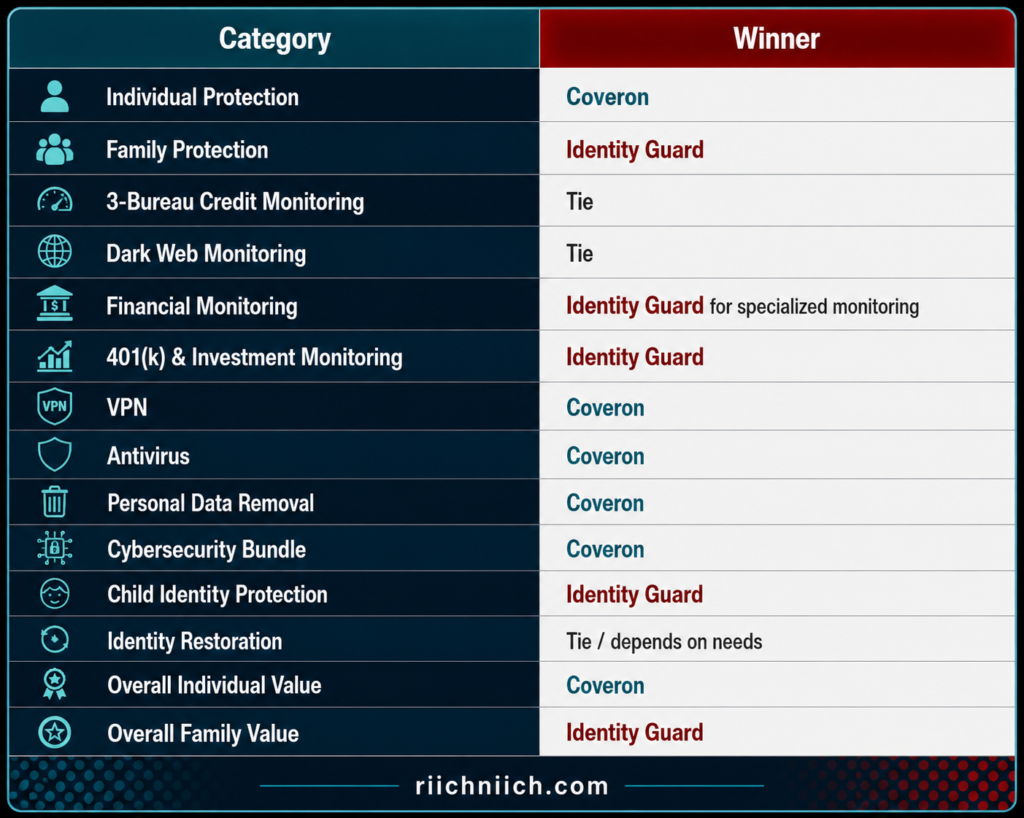
🚨 Features vary by plan and can change, so verify the current offering before purchasing.
Choose Coveron If…
I would choose Coveron if you’re mainly protecting yourself and want to consolidate several security services.
Coveron Full Protection is particularly compelling if you want:
Identity theft protection
3-bureau credit monitoring
Dark web monitoring
Financial monitoring
A VPN
Antivirus
Personal data removal
Identity restoration assistance
under one subscription.
That combination is Coveron’s strongest competitive advantage.
If you’re leaning toward Coveron but want one more head-to-head comparison before purchasing, our Coveron vs Aura breakdown can help you determine whether Coveron is still the stronger fit.
Choose Identity Guard If…
I would choose Identity Guard if you’re protecting multiple people or want more specialized identity and financial monitoring.
Identity Guard becomes particularly compelling if you want:
Family identity theft protection
Child identity monitoring
3-bureau credit monitoring
Bank account monitoring
401(k) and investment monitoring
Credit and debit card monitoring
Title monitoring
Address-change monitoring
Professional fraud resolution
For families, those advantages are significant enough that I would choose Identity Guard over Coveron.
The Winner: Coveron or Identity Guard?
If I had to declare one overall winner for the typical individual buyer, my pick is:
Coveron Full Protection.
The deciding factor isn’t that Coveron beats Identity Guard at every type of monitoring. It doesn’t.
The deciding factor is how much Coveron combines into one package.
For an individual who needs identity protection, 3-bureau credit monitoring, financial monitoring, VPN protection, antivirus, personal data removal, and identity restoration support, Coveron Full Protection provides an unusually comprehensive bundle.
But there’s an important exception.
If you’re buying identity theft protection for your family, I would choose Identity Guard instead.
Identity Guard’s ability to protect up to five adults and unlimited children, combined with its stronger specialized monitoring options, makes it much better suited to households.
So the final result of Coveron vs Identity Guard is:
Best for individuals: Coveron
Best for families: Identity Guard
Best for all-in-one cybersecurity: Coveron
Best for specialized financial monitoring: Identity Guard
Best overall for the typical individual buyer: Coveron Full Protection
Ultimately, don’t buy either service simply because it has the longest feature list.
Choose the service that protects the people, accounts, credit, devices, financial assets, and personal information that actually matter in your life.
That’s where the real value of identity theft protection is found.