


The amazon payout protection scam can sound surprisingly legitimate—especially when the caller knows your name and leaves a calm, professional voicemail about “Payout Protection for your Amazon account.” That is exactly what happened to us. The caller identified herself as “Ashley” and asked for a callback, but we never returned the call or spoke with anyone.
So, is Amazon Payout Protection real, and does Amazon call customers about something like this? In this guide, we’ll break down the voicemail we received, the warning signs to watch for, how to verify whether an Amazon call is legitimate, and what to do if you’ve already called back or shared information. We’ll also explain when tools such as identity theft protection, data removal services, password managers, or security software may actually be worth paying for.
Table of Contents
Amazon Payout Protection Scam: 🔥 Quick Answer
The amazon payout protection scam appears to be a suspicious Amazon impersonation tactic designed to get you to return an unsolicited phone call. One of our team members received a voicemail from a woman identifying herself as “Ashley,” who said she was calling about “payout Protection” for their Amazon account and asked us to call her back. We did not return the call.
The exact voicemail said:
“Hi Riich, this is Ashley calling about payout Protection for your Amazon account. Please give me a call back at your earliest convenience. Thank you.”
What immediately stands out is how little information the message provides. There is no explanation of what “Payout Protection” is, no order number, no case or reference number, no specific problem with the Amazon account, and no explanation of why a callback is necessary.
We also could not verify an Amazon consumer service matching the caller’s description of “Payout Protection for your Amazon account.” That does not mean every communication involving Amazon and the word “payout” is fraudulent—Amazon has legitimate payment and seller-related services. The problem is the combination of an unsolicited voicemail, vague account-related language, and a request to call an unfamiliar number back.
That pattern is consistent with warnings from the Federal Trade Commission (FTC) about Amazon impersonation scams. The FTC specifically advises consumers not to call back a number left in an unexpected voicemail or message claiming to be from Amazon. Instead, if you are concerned about your account, log in directly through Amazon’s website or app and independently verify whether there is actually a problem.
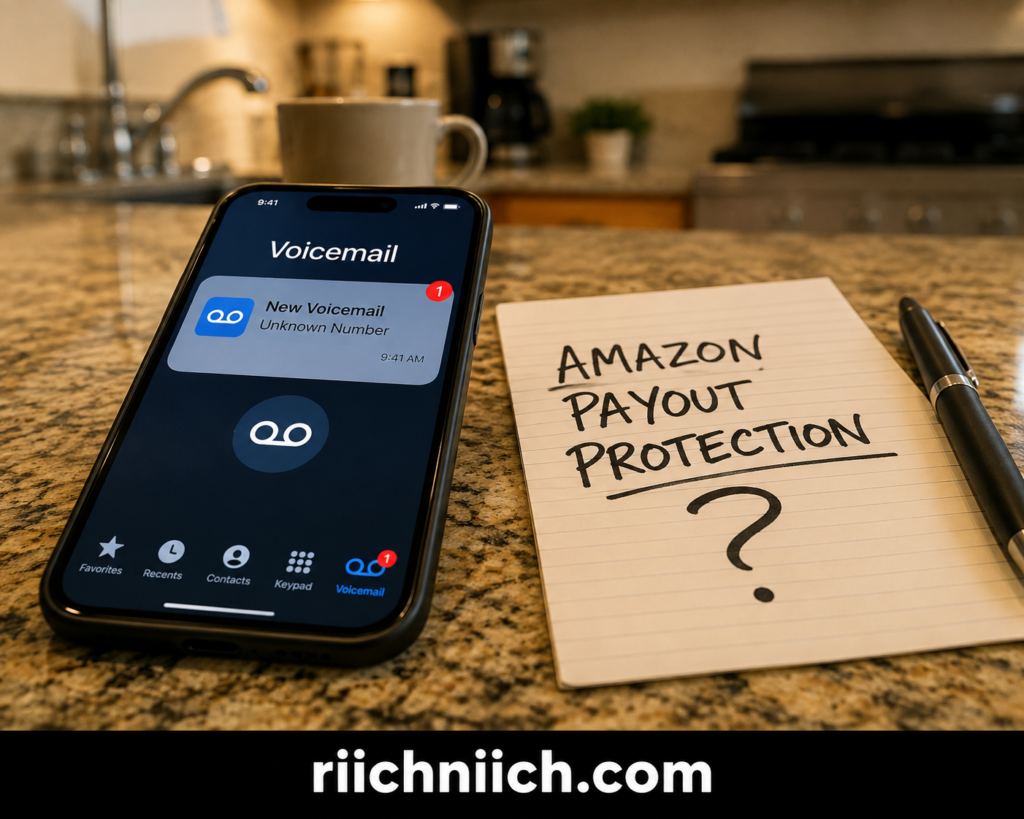
The safest response is not to call back
If you receive a similar Amazon payout protection voicemail, do not use the callback number provided in the message. Check your Amazon account independently. If you need assistance, navigate to Amazon yourself rather than relying on contact information supplied by an unexpected caller.
This matters because getting someone to call back can be the beginning—not the end—of an impersonation scam. The FTC has documented Amazon impersonators using unexpected communications to lure consumers into conversations where scammers may eventually seek personal information, account access, remote access to a device, gift-card payments, or money transfers.
The fact that a caller knows your name or phone number does not prove the voicemail is legitimate. Scammers can use personal information to make an otherwise vague message sound more convincing.
For readers concerned that their personal information is already circulating online, this is also a good time to review what information is publicly exposed and strengthen account security. Later in this guide, we’ll explain how identity theft protection, password security, and data-removal services may help reduce different types of risk—and when paying for those services actually makes sense.
For now, the key takeaway is simple: if you receive a voicemail similar to mine, don’t call the supplied number back just because the caller mentions your Amazon account. Verify the situation independently first. The FTC recommends contacting the organization through a website, phone number, or other contact method you already know is legitimate rather than using information supplied in an unexpected message.
What Is the Amazon Payout Protection Scam?
The amazon payout protection scam is a suspicious phone-call or voicemail tactic in which someone claims to be contacting you about “Payout Protection” connected to your Amazon account. The message may sound professional and harmless, but its immediate goal can be surprisingly simple: get you to call the provided phone number back.
In the voicemail we received, the caller identified herself as “Ashley,” mentioned “payout Protection for your Amazon account,” and asked me to return the call. She did not explain what Payout Protection was, identify a specific Amazon department, mention an order or transaction, provide a case number, or explain why their account supposedly needed attention.
That vagueness is important. Instead of frightening you with an obvious threat, a message like this can create a curiosity gap: What is Payout Protection? Is something wrong with my Amazon account? Am I supposed to have this?
Calling back could give the person on the other end an opportunity to introduce the real pitch.
Why this resembles an Amazon impersonation scam
Amazon impersonation scams are not new, although the stories scammers use can change.
The Federal Trade Commission warns that business impersonators may contact consumers by phone, email, text, or social media while pretending to represent a familiar company. The initial message may claim there is a problem with an account and direct the recipient to call a number. If the person responds, the scammer may attempt to obtain personal information, payment, or access to a computer.
The FTC has documented Amazon-specific variations involving supposed unauthorized purchases, compromised accounts, refunds, and suspicious activity. In one Amazon scam scenario, the FTC specifically warns consumers not to call a number left in a voicemail or text. Instead, consumers should access their Amazon account independently through the legitimate website or app.
That’s why an Amazon payout protection voicemail should not automatically be trusted simply because the message knows your name or mentions your Amazon account.
What is the scammer trying to accomplish?
With the specific voicemail we received, we cannot know exactly what would have happened next because we did not call back. That’s an important distinction. We would not claim that every voicemail using this wording follows an identical script.
However, documented Amazon impersonation scams show why returning an unsolicited call can be risky.
Depending on the scheme, an impersonator may eventually try to obtain your:
- Amazon login credentials
- Credit or debit card information
- Bank account information
- Verification codes
- Other personal information
- Money through gift cards or transfers
- Remote access to your computer or other device
The FTC has documented Amazon impersonators using supposed refunds and compromised accounts to persuade victims to send money, purchase gift cards, or provide remote computer access.
Amazon Pay also warns customers not to send money to someone whose identity they cannot verify and cautions against requests involving gift-card claim codes or payments made outside legitimate channels.
Why “Payout Protection” deserves extra scrutiny
“Payout Protection” sounds like the name of a financial-security feature. That’s what makes the wording effective: it sounds important without telling you anything specific.
A recipient might reasonably wonder whether money is waiting for them, whether a payout is being held, whether their account needs additional protection, or whether something has gone wrong.
But a professional-sounding phrase is not proof that the caller represents Amazon.
If you receive an Amazon payout protection call or Amazon payout protection voicemail, don’t use the callback number simply to find out what the caller means. Go directly to your Amazon account through the website or official app and check for legitimate account notifications.
That approach also protects you from caller-ID spoofing. The FTC warns that scammers can manipulate caller ID to make a call appear to come from Amazon, so the name or number displayed on your phone should not be treated as verification.
For anyone who has already called back or disclosed personal information, the situation becomes more serious. Later in this guide, we’ll cover the steps you can take to secure your Amazon account, protect your identity, monitor for suspicious activity, and determine whether paid identity protection or data-removal services make sense for your situation.
The Exact Amazon Payout Protection Voicemail We Received
One reason we decided to investigate the amazon payout protection scam was that the voicemail we received did not sound like the stereotypical scam call. There was no aggressive threat, no claim that hundreds of dollars had been charged to the account, and no demand to act “within 24 hours.”
Instead, the voicemail was short, calm, personalized, and deliberately vague.
Here are the exact words from the voicemail:
“Hi Riich, this is Ashley calling about payout Protection for your Amazon account. Please give me a call back at your earliest convenience. Thank you.”
That was the entire message.
We did not call the number back, provide any information, click a link, or interact with the caller. Instead, we investigated the claim independently.
That decision is consistent with FTC guidance. The FTC specifically warns consumers who receive unexpected Amazon-related calls or messages not to call a number that was left in a voicemail or text. If you’re concerned about your Amazon account, the safer approach is to access Amazon independently through the website or app.

Why this voicemail caught our attention
The most interesting part of this Amazon payout protection voicemail isn’t what “Ashley” said. It’s what she didn’t say.
The voicemail didn’t provide:
- A specific Amazon department
- An order or transaction number
- A case or reference number
- An explanation of what “Payout Protection” means
- A reason the Amazon account supposedly requires attention
- An explanation of why a phone call is necessary
- A way to verify the caller’s identity independently
Instead, the message gives the listener just enough information to become curious.
The phrase “Payout Protection for your Amazon account” sounds financial and security-related. Someone hearing it for the first time could reasonably wonder whether there is money waiting for them, a problem with their Amazon account, or a security feature that needs to be activated.
And because the caller used the recipient’s name, the voicemail can feel more legitimate than a completely generic robocall.
But knowing your name does not authenticate the caller.
The callback request is the most important part
The voicemail doesn’t directly ask for a password, credit card number, verification code, or payment.
It asks for one thing:
Call back.
That’s important because documented business impersonation scams can begin with an innocent-looking request to call a number. According to the FTC, scammers impersonating familiar businesses may first claim there’s an account problem and provide a number to call. Once someone makes contact, the scammer may attempt to obtain personal information, money, or even access to the person’s computer.
The FTC has documented similar fake Amazon calls where the initial message provides a phone number or asks the recipient to connect with “support.” Its advice is straightforward: don’t use the number the caller gives you. Contact the company using information you independently know is legitimate.
That doesn’t tell us exactly what would have happened had we returned this particular call. Because we didn’t call back, we cannot responsibly claim to know what “Ashley” would have requested next.
But we didn’t need to call back to investigate the message safely.
A polite voicemail can still deserve scrutiny
Another unusual characteristic of this message is the absence of extreme urgency.
Many people know to be suspicious when a caller says:
“Your account will be closed immediately.”
“You’ve been charged $999.”
“Your account has been hacked.”
“Press 1 right now.”
This voicemail used none of those tactics.
“Please give me a call back at your earliest convenience” sounds much more like a routine business call.
That is precisely why consumers shouldn’t judge an Amazon scam voicemail only by whether the caller sounds threatening. A professional voice, polite wording, knowledge of your name, or mention of a recognizable company does not independently establish that the communication is legitimate.
Amazon Pay’s own scam guidance advises people not to make payments to someone whose identity they cannot verify and warns about several schemes that misuse Amazon’s name or payment services.
What we did instead of calling back
We took the safer route: we didn’t engage with the number in the voicemail.
If you receive the same or a similar amazon payout protection scam message, you don’t need to call an unfamiliar number just to determine whether something is wrong with your account.
Open Amazon independently, sign in through the legitimate website or official app, and check your account directly. If you need customer support, initiate that contact yourself instead of using the callback information contained in an unexpected voicemail.
The FTC recommends essentially the same approach for suspicious Amazon communications: check the Amazon account directly and don’t rely on the number supplied by the unexpected caller.
This becomes even more important if you already returned the call or disclosed information. Later in this guide, we’ll cover what to do if you called back, how to secure your Amazon account, and when additional protections such as identity theft monitoring or personal-data removal services may be worth paying for.
Why the Amazon Payout Protection Voicemail Sounds Legitimate
One of the more concerning things about the amazon payout protection scam is that the voicemail does not immediately sound like a scam. There is no robotic voice threatening to close your account, no demand for money, and no dramatic warning about an unauthorized $1,000 purchase.
Instead, the message sounds like an ordinary business callback:
“Hi Riich, this is Ashley calling about payout Protection for your Amazon account. Please give me a call back at your earliest convenience. Thank you.”
That calm approach can make an Amazon scam voicemail easier to underestimate. The FTC warns that phone scammers do not always use threats; some deliberately act friendly and helpful while trying to obtain money or personal information.
Here are the specific details that can make this voicemail sound believable.
1. The caller knows your name
The voicemail begins with “Hi Riich.”
Hearing your actual name can immediately make a call feel more personal. You may think, If this were a random scammer, how would they know who I am?
But knowing someone’s name is not proof that the caller has access to their Amazon account. Names and phone numbers can circulate through public records, marketing databases, data brokers, breached databases, social media profiles, and other sources.
This is one reason reducing the amount of personal information exposed online can be worthwhile. If your name, phone number, address, email address, and other identifying details are widely available, scammers may have more information they can potentially use to personalize future approaches.
For readers who discover that a significant amount of their personal information is exposed online, a reputable data removal service may be worth considering rather than manually tracking dozens of data brokers and people-search sites. It cannot stop every scam call, but reducing unnecessary exposure can be one part of a broader privacy strategy.
2. “Payout Protection” sounds like a real financial service
The phrase “Payout Protection” sounds official.
Both words are familiar in financial and security contexts:
Payout suggests money, refunds, earnings, or account funds.
Protection suggests security, fraud prevention, insurance, or account safeguards.
Put them together with “your Amazon account,” and the phrase can sound like the name of an Amazon security feature even if the recipient has never heard of it.
That is exactly where curiosity can take over:
Do I have money waiting for me?
Is there a problem with a payment?
Did Amazon add some new protection feature?
Is someone trying to access my account?
The voicemail doesn’t answer any of those questions. Calling back is presented as the way to find out.
That ambiguity is one of the reasons an unexpected Amazon payout protection call deserves independent verification.
3. The caller uses a normal first name
“This is Ashley” sounds much different from an anonymous automated warning.
There is nothing inherently suspicious about someone introducing themselves by first name, of course. But a first name alone also doesn’t provide enough information to verify who is calling.
The voicemail doesn’t identify an Amazon department, job title, case number, extension, or other information that would independently establish the caller’s relationship with Amazon.
The FTC warns that impersonators can pretend to represent businesses people already recognize and trust.
4. There is no aggressive urgency
This may be the most interesting part of the voicemail.
Many scam warnings teach consumers to watch for phrases such as:
- “Act immediately.”
- “Your account will be suspended.”
- “You have 24 hours.”
- “Your account has been compromised.”
- “Press 1 now.”
Our voicemail doesn’t do that.
Instead, “Ashley” says:
“Please give me a call back at your earliest convenience.”
That’s polite. It sounds like something a bank employee, insurance representative, doctor’s office, or customer-service agent might say.
And that can potentially lower your guard.
The FTC notes that scammers use different approaches: some threaten or frighten people, while others act friendly and helpful.
So don’t assume a fake Amazon phone call must sound threatening to be suspicious.
5. Amazon is a company millions of people already recognize
Mentioning Amazon immediately gives the message familiarity.
A caller doesn’t need to explain what Amazon is or hope that you happen to do business with an obscure company. For many recipients, having an Amazon account is entirely plausible.
That’s useful for an impersonator because the recipient may begin thinking about their actual Amazon account rather than questioning whether the caller represents Amazon in the first place.
The FTC even maintains an example of an Amazon impersonation robocall involving supposed suspicious charges. Its recommendation is to hang up or delete the message and, if concerned about charges, access Amazon independently or use customer-support information you know is legitimate.
6. Nothing is requested—yet
Perhaps the smartest feature of the voicemail is what it doesn’t ask you to do.
The caller doesn’t immediately request your:
Password.
Credit card number.
Bank information.
Social Security number.
Verification code.
Gift card.
Instead, she asks you to call back.
That makes the voicemail itself seem relatively harmless.
However, the FTC’s guidance on business impersonation scams describes a similar general pattern: someone receives a message that appears to come from a familiar business, is told there is some type of account issue, and is instructed to call a number. Once contact is established, the impersonator may seek money or personal information.
We don’t know what this particular caller would have requested because we did not call back, so it would be wrong to claim we know the next step of this specific call.
But that’s also why you don’t need to call back simply to investigate.
Professional-sounding does not mean verified
The lesson from the amazon payout protection scam is not that every unexpected Amazon call is automatically fraudulent. It’s that professional wording is not authentication.
A caller can know your name.
A voicemail can sound polite.
A financial term can sound legitimate.
A caller ID can even appear convincing—the FTC warns that scammers can spoof names and phone numbers displayed on caller ID.
None of those things independently prove you’re talking to Amazon.
If you receive an unexpected voicemail about your Amazon account, don’t rely on the callback information in the message to verify it. Open Amazon independently through the official website or app and investigate from there.
And if a suspicious interaction has already progressed beyond a voicemail—especially if you’ve disclosed login credentials, financial information, verification codes, or other sensitive information—it’s worth taking additional protective measures immediately. Later in this guide, we’ll look at when strengthening your account security is enough and when paid identity theft protection, monitoring, or personal-data removal services may be worth the cost.
Is Amazon Payout Protection a Real Amazon Service?
Based on the official Amazon resources we reviewed, we could not verify a consumer Amazon service called “Payout Protection” that matches the service described in the voicemail we received. That makes the unsolicited message about “Payout Protection for your Amazon account” a significant reason for caution when investigating the amazon payout protection scam.
There is an important distinction, however: Amazon does use legitimate terminology involving payouts, payments, and protection in other parts of its business.
For example, Amazon has legitimate seller payouts—also called disbursements—and eligible U.S. sellers may use a feature called Amazon Express Payout to receive funds faster. Amazon Pay also has an A-to-z Guarantee for qualifying purchases.
Amazon Pay documentation even references a Payment Protection Policy for certain qualifying seller/business transactions and chargebacks.
Those are real Amazon programs and policies.
But they are not the same thing as an unsolicited caller vaguely offering or discussing “Payout Protection for your Amazon account.”
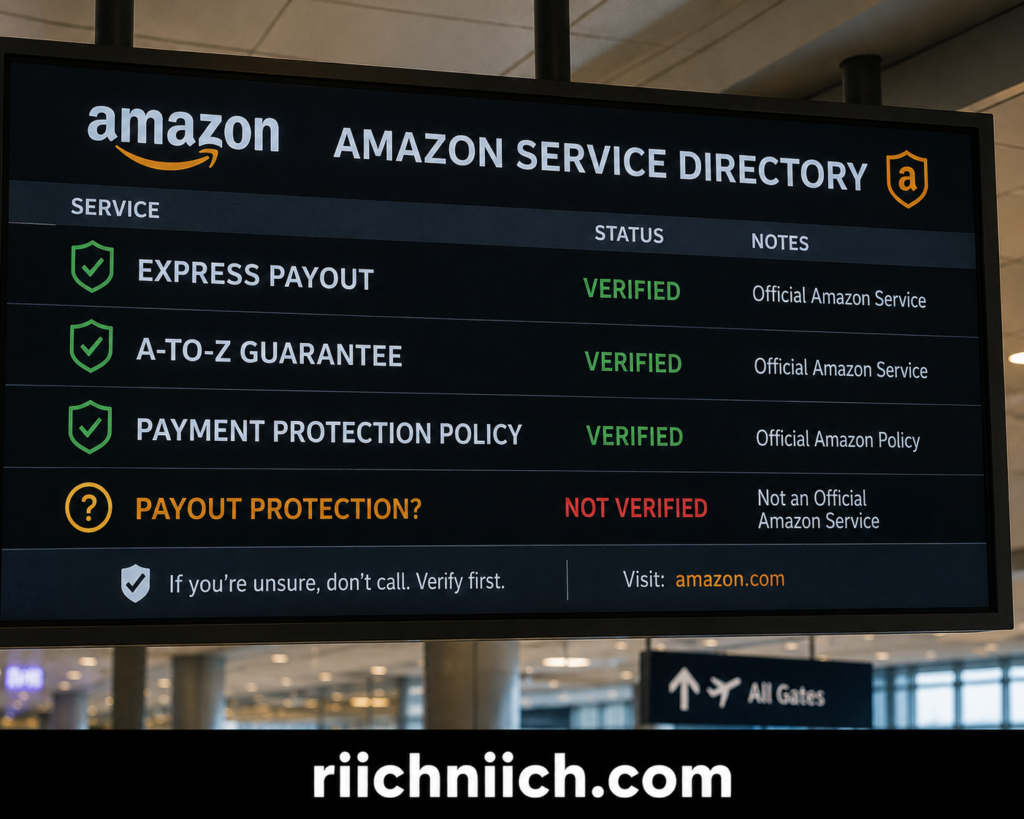
Real Amazon terminology can make a suspicious call more convincing
This is one reason the wording in the voicemail deserves attention.
Amazon really does use the word “payout” when discussing payments to sellers. According to Amazon’s seller documentation, sellers can review their payouts and disbursements through the Payments Dashboard in Seller Central.
Amazon also genuinely offers different forms of transaction protection. Its A-to-z Guarantee, for example, protects qualifying purchases and can reimburse eligible buyers in certain circumstances.
So if someone leaves a voicemail saying they’re calling about “Payout Protection,” the phrase may sound plausible because both words resemble terminology Amazon legitimately uses elsewhere.
But plausible terminology is not verification.
If you are an ordinary Amazon shopper and suddenly receive an Amazon payout protection voicemail, don’t assume the caller is legitimate simply because the service name sounds like something Amazon might offer.
Don’t confuse “Payout Protection” with Amazon Express Payout
This distinction is particularly important for Amazon sellers.
Amazon Express Payout is real.
Amazon says eligible sellers in its U.S. store can enroll in Express Payout to receive payouts within 24 hours. Sellers can also view balances, scheduled disbursements, and previous payouts through Seller Central.
That does not authenticate a random phone call about “Payout Protection.”
If you’re an Amazon seller and receive a suspicious Amazon payout protection call, go directly to Seller Central and review your Payments Dashboard rather than relying on the callback number supplied in the voicemail.
Don’t confuse it with Amazon’s A-to-z Guarantee either
Amazon also provides legitimate purchase protection through its A-to-Z Guarantee.
For eligible Amazon Pay purchases, the guarantee can cover issues such as qualifying purchases that aren’t delivered or certain problems with the item received. Amazon states that the A-to-z Guarantee is free for buyers.
Again, that’s very different from receiving an unexplained voicemail saying someone wants to discuss “Payout Protection for your Amazon account.”
A legitimate Amazon protection program existing somewhere in Amazon’s ecosystem does not mean that this particular caller represents Amazon.
What about Amazon’s Payment Protection Policy?
There is another similarly named Amazon policy worth clarifying.
Amazon Pay documentation describes a Payment Protection Policy that can protect qualifying Business or Seller Accounts from certain unauthorized-payment chargebacks when specific requirements are met.
Notice the terminology:
Payment Protection Policy
not:
Payout Protection
Those phrases sound similar, but they should not be treated as interchangeable.
This is precisely why independently verifying an unexpected call matters. Someone hearing “Payout Protection” could easily associate it with legitimate Amazon terms involving payments, payouts, fraud protection, or account security.
How should you verify an Amazon service?
If someone calls about an unfamiliar Amazon service, don’t ask the caller to prove that the service exists. Verify it independently.
Instead of returning the number supplied in an unexpected voicemail:
- Open Amazon yourself rather than following instructions from the caller.
- Sign in to your account directly.
- Check your orders, messages, payments, and account notifications.
- If you’re a seller, check Seller Central and your Payments Dashboard.
- Contact Amazon through its official support channels if you still have questions.
This also prevents a scammer from controlling both sides of the verification process.
If you’re concerned that someone may have accessed your account, Amazon recommends securing the account with a strong password and two-step verification.
The bottom line
We found legitimate Amazon services and policies involving payouts, payments, and protection. What we did not find was an official consumer Amazon service matching the voicemail’s unexplained description of “Payout Protection for your Amazon account.”
That difference matters.
It would be inaccurate to claim that Amazon never uses similar terminology. It clearly does. But it would be equally risky to assume an unsolicited caller is legitimate simply because their language sounds Amazon-related.
For the amazon payout protection scam, the safest approach is to treat an unexpected voicemail like this as unverified, avoid calling the supplied number, and investigate through Amazon’s official channels instead.
And if you’ve already returned the call and disclosed passwords, verification codes, banking information, or other sensitive data, don’t stop at simply blocking the number. Later in this guide, we’ll cover the additional account-security and identity-protection steps worth taking—and when paying for identity theft monitoring or personal-data removal may make sense.
Does Amazon Call Customers About Payout Protection?
Amazon can contact customers by phone in certain circumstances, so the simple answer to “does Amazon call customers?” is yes, sometimes. However, we could not verify an official Amazon consumer service called “Payout Protection” that matches the unsolicited voicemail we received.
That distinction is important when evaluating the amazon payout protection scam.
A phone call mentioning Amazon is not automatically fraudulent simply because it is a phone call. For example, legitimate phone contact can occur in connection with customer support or delivery-related issues. Amazon’s seller documentation also confirms that its Anonymous Communication Platform can connect delivery services with customers when they need information such as a gate code or confirmation that someone is available for a signature-required delivery.
What should raise suspicion is an unexpected Amazon payout protection call that provides little explanation, asks you to return a supplied phone number, and references a service you cannot independently verify.
That’s what happened with the voicemail we received.
Amazon may call—but that doesn’t mean this caller was Amazon
This is where consumers need to be careful.
It would be inaccurate to tell readers:
“Amazon never calls customers.”
That’s too broad.
Instead, the question should be whether this particular call can be independently verified as coming from Amazon.
The FTC specifically warns about scammers who spoof phone numbers to make it appear that Amazon is calling. In a documented Amazon impersonation scheme, scammers contact consumers about supposed suspicious purchases and then build an elaborate story involving account or identity fraud.
Caller ID therefore isn’t enough.
A caller knowing your name isn’t enough.
A professional-sounding representative isn’t enough.
And mentioning your Amazon account isn’t enough.
What makes a “Payout Protection” call different?
The voicemail we received did not mention a delivery, customer-support request, order, refund, or another Amazon interaction we had initiated.
Instead, the caller said:
“Hi Riich, this is Ashley calling about payout Protection for your Amazon account. Please give me a call back at your earliest convenience. Thank you.”
That’s remarkably vague.
If you’re trying to determine whether an Amazon payout protection voicemail is legitimate, ask yourself:
- Did I request that Amazon contact me?
- Is there a corresponding notification inside my Amazon account?
- Does the message identify the specific transaction or issue?
- Can I verify the issue without using the callback number?
- Can I find the claimed service through Amazon’s official resources?
If you cannot independently verify the reason for the call, don’t let curiosity be the reason you call back.
Don’t use the voicemail’s phone number to verify the voicemail
This is one of the most important lessons in the amazon payout protection scam.
Suppose someone leaves a message claiming to represent Amazon and provides a callback number. Calling that number and asking, “Is this really Amazon?” doesn’t independently verify anything.
You’re asking the same person who made the claim to authenticate the claim.
Instead, create a separate path to verification.
Open Amazon through the official app or type the Amazon website into your browser yourself. Check your orders, account notifications, messages, payments, and other relevant information. If something genuinely concerns you, initiate contact with Amazon through its official customer-support options.
The FTC gives essentially the same advice for suspicious Amazon calls: don’t call back the number that called you or a number supplied in a voicemail or text. If you’re worried about your Amazon account, log in through the website or app instead.
What if the caller ID actually says “Amazon”?
That still doesn’t prove the call is legitimate.
Scammers can use caller ID spoofing, which allows them to manipulate the information appearing on your phone. In the Amazon scam documented by the FTC, scammers spoofed numbers specifically to make victims believe Amazon was calling.
That means even seeing something convincing on your screen should not override other warning signs.
A better rule is:
Trust what you can independently verify—not what appears on caller ID.
What would a fake Amazon caller want?
An unexpected call may initially seem harmless because the caller hasn’t asked for anything sensitive yet.
But documented Amazon impersonation scams show how the conversation can escalate.
The FTC has described fake Amazon calls in which a recording claims something is wrong with the victim’s account—such as a suspicious purchase, lost package, or unfulfilled order—and then instructs the person to press a button or call a number. The eventual objective may be obtaining account passwords, credit card information, or other personal information.
Because we never returned the “Payout Protection” call, we don’t know what this particular caller would have requested. We shouldn’t speculate and present it as fact.
What we can say is that the callback request matches a known risk pattern closely enough that returning an unfamiliar number isn’t necessary to investigate it.
If you’re still unsure, check your Amazon account yourself
If you’re wondering how to tell if an Amazon call is real, independent verification is your strongest defense.
The FTC maintains an actual example of an Amazon impersonation robocall and advises people who are worried about potential charges to log into their Amazon account or contact Amazon using customer-support information they know is legitimate.
So if someone calls about “Payout Protection,” don’t feel pressured to solve the mystery by returning the number.
Check Amazon—not the caller.
And if you already called back and provided an Amazon password, verification code, credit card information, banking information, or other sensitive data, the situation changes. Securing the affected accounts should become the priority. Depending on what was exposed, credit monitoring, identity theft protection, or personal-data removal services may also be worth considering rather than waiting to see whether the information is misused.
How the Amazon Payout Protection Scam May Work
The amazon payout protection scam may work differently from the aggressive Amazon phone scams many people recognize. Instead of immediately claiming that your account has been hacked or that you’ve made an expensive purchase, the voicemail we received used a much softer approach: create curiosity first and get the recipient to call back.
Because we did not return the call, we cannot say exactly what this particular caller would have done next. However, documented Amazon and business-impersonation scams give us a good picture of how a callback scheme could potentially progress.
The FTC describes business impersonation scams that begin with a call, text, email, or other message appearing to come from a familiar company. The recipient is encouraged to call a number, and once contact is established, the scammer may attempt to obtain personal information, money, or access to a computer.

Step 1: The voicemail gets your attention
The first stage may not require fear at all.
Our message simply said:
“Hi Riich, this is Ashley calling about payout Protection for your Amazon account. Please give me a call back at your earliest convenience. Thank you.”
The phrase “Payout Protection” raises a question without answering it.
The recipient may start wondering:
Is there a problem with my money?
Did Amazon owe me a payout?
Is my Amazon account at risk?
What exactly am I supposed to be protecting?
Instead of explaining the issue, the voicemail gives you a way to satisfy that curiosity:
Call back.
That’s why a vague Amazon payout protection voicemail can potentially be effective even without threats.
Step 2: You return the call
This may be the critical transition.
The original voicemail hasn’t asked you for money or sensitive information. If you voluntarily return the call, however, the person answering now has an opportunity to continue the conversation.
The FTC specifically warns consumers about Amazon impersonation schemes and advises people not to call back a number that called them or a number supplied in an unexpected voicemail or text. Instead, concerned customers should access their Amazon account independently through the website or app.
This is why calling back “just to see what they want” isn’t worth the risk.
Step 3: The caller introduces the supposed problem
We don’t know what “Ashley” would have said next, so we should not pretend that we do.
But this is where a typical business impersonation scheme may introduce a story explaining why the company supposedly needs your attention.
The FTC has documented Amazon impersonators using stories involving unauthorized purchases, compromised accounts, refunds, and identity theft. In one documented version, victims are told that suspicious activity on their Amazon account is connected to a much larger identity-theft problem.
A caller using the words “Payout Protection” could potentially introduce a different story. Until the caller’s identity and the claimed service are independently verified, anything they tell you should be treated as unverified.
Step 4: The caller tries to establish trust
A sophisticated impersonator doesn’t necessarily need to ask for your password immediately.
The caller may first try to convince you that they’re helping.
They could potentially know basic information about you, use professional terminology, provide a supposed employee name, or refer repeatedly to “your Amazon account.”
None of those things prove the person represents Amazon.
Amazon itself warns users in its account-security guidance that legitimate representatives will not ask for sensitive information such as passwords, full bank-account details, or credit-card numbers over the phone in contexts such as its KDP service.
The more convincing the caller sounds, the more important independent verification becomes.
Step 5: The conversation may move toward information, access, or money
This is where documented impersonation scams can become financially dangerous.
According to the FTC, business impersonators may eventually ask victims for personal information, a Social Security number, payment by gift card, cryptocurrency or wire transfer, or access to their computer.
Amazon impersonation scams have also involved supposed refunds. In one documented scheme, scammers manipulated transfers between a victim’s own accounts to create the appearance that Amazon had accidentally refunded too much money. The victim was then persuaded to “return” money that actually belonged to the victim.
Another variation tells victims they need to purchase gift cards to supposedly protect a compromised account. The FTC is unequivocal about this: legitimate businesses do not require payment through gift cards.
Amazon Pay likewise advises customers not to make payments to someone whose identity they cannot confirm.
Step 6: A small disclosure can lead to a bigger problem
Even if you never send money, giving an impersonator sensitive information can create additional risks.
For example, depending on what someone discloses, a scammer could potentially obtain information useful for targeting an online account, financial account, or future phishing attempt.
This is also where buyer intent becomes relevant.
If all you received was a voicemail and you never interacted with the caller, there is generally no reason to panic and immediately purchase every security product available. Delete or block the suspicious contact, verify your Amazon account independently, and continue monitoring your accounts.
But if you called back and disclosed sensitive personal or financial information, stronger protection may make sense. Depending on what was exposed, that could include changing compromised passwords, enabling two-step verification, monitoring financial accounts and credit reports, or considering a reputable identity theft protection service for ongoing monitoring and recovery assistance.
Similarly, if you’re concerned about how an unknown caller obtained your name and phone number, a personal-data removal service can help reduce information available through participating data brokers and people-search databases. It won’t make you invisible to scammers or eliminate scam calls, but it can be one component of a broader privacy strategy.
The entire scam may depend on one decision
That’s what makes the amazon payout protection scam particularly interesting.
The voicemail itself may accomplish very little.
It doesn’t need your password.
It doesn’t need your credit card.
It doesn’t need you to download anything.
It needs you to call back.
Once you return the call, the person on the other end has an opportunity to explain what “Payout Protection” supposedly means and potentially move the conversation toward whatever their real objective is.
That’s why the safest move is also the simplest: don’t use the callback number in an unexpected Amazon voicemail.
If you’re worried about your account, access Amazon independently. The FTC recommends the same basic approach for suspicious Amazon calls: don’t trust the caller ID or callback number; instead, log in through Amazon’s website or app to investigate the supposed problem.
That single decision breaks the potential chain before the caller gets the opportunity to turn curiosity into trust—and trust into a financial or identity problem.
Why Does the Caller Already Know Your Name?
One of the details that can make the amazon payout protection scam feel convincing is surprisingly simple: the caller already knows your name.
The voicemail we received didn’t begin with a generic “Dear Amazon customer.” The caller said:
“Hi Riich, this is Ashley…”
Hearing your name can create an immediate sense of legitimacy. You might think, How would a random scammer know my name unless they actually had information about my Amazon account?
But a caller knowing your name does not mean they have access to your Amazon account, and it does not prove they’re calling from Amazon.
If you’re wondering how criminals get enough personal information to make scams sound convincing, our guide on How Identity Theft Happens explains the most common ways personal data gets exposed and misused.
Names and phone numbers can be collected, purchased, exposed, or pieced together from many places. In some cases, scammers may have surprisingly detailed information about a person before they ever make contact.
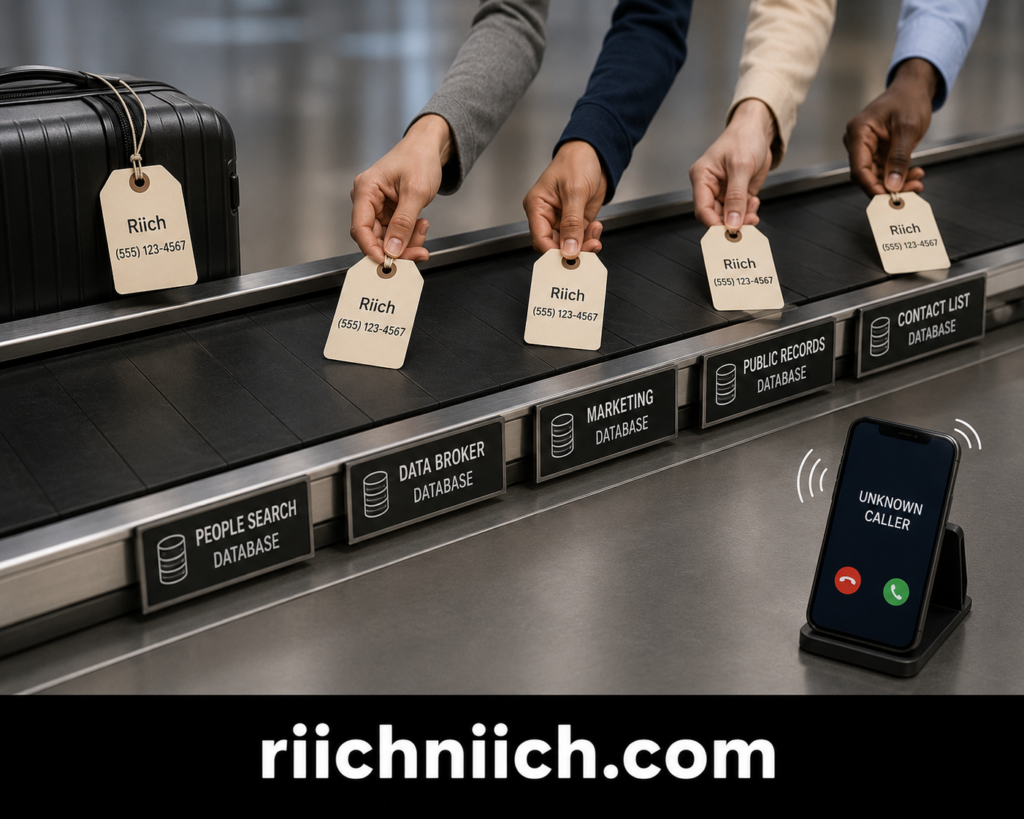
Your name and phone number may already be available online
Think about how many times you’ve provided your name and phone number over the years.
Online shopping.
Rewards programs.
Apps.
Insurance quotes.
Contest entries.
Business forms.
Social media.
Property or other public records.
Marketing forms.
People-search websites.
Not every organization collecting this information sells it, and having information online doesn’t necessarily mean it has been compromised. But personal information can spread across a surprisingly large ecosystem.
Data brokers are one part of that ecosystem. These companies collect information about consumers from various sources and may combine, analyze, and distribute it for different purposes.
The FTC has documented the potential for serious abuse when consumer information ends up in the wrong hands. In one enforcement action, the FTC alleged that data brokers supplied scammers with consumer information that included names, addresses, phone numbers and much more sensitive financial data.
So when an unfamiliar caller knows your name, don’t automatically assume the information came from the company they’re claiming to represent.
A data breach is another possibility
Personal information can also become exposed through data breaches.
Depending on the breach, exposed information might include names, email addresses, phone numbers, usernames, passwords, dates of birth, addresses, financial information, or other data.
That doesn’t mean the person who left a suspicious voicemail necessarily obtained your information from a breach. We have no evidence showing where the caller in our voicemail obtained the recipient’s name.
That’s an important distinction.
But it does explain why a scammer knowing basic information about you isn’t necessarily surprising. Consumer information can be assembled and transferred across different sources, and the FTC has long identified privacy and identity-theft risks associated with the collection and distribution of consumer data.
People-search sites can make personalization easier
Another potential source is a people-search website.
Search someone’s name on certain sites and you may find information connecting that person with phone numbers, addresses, relatives, approximate ages, or previous locations.
This can make an otherwise generic fake Amazon phone call sound personalized.
Imagine the difference:
“Hello, we’re calling about your Amazon account.”
versus:
“Hi Riich, I’m calling about Payout Protection for your Amazon account.”
The second version immediately sounds as though the caller knows something about you.
But the caller may simply have your name associated with your phone number.
That is not the same thing as knowing anything about your Amazon account.
Your information may have been collected as a marketing lead
There is another possibility that consumers sometimes overlook: lead-generation data.
Information submitted to online forms can sometimes pass through multiple businesses. The FTC has previously taken enforcement action involving consumer information originally collected through online loan applications and subsequently sold to third parties that allegedly had no legitimate need for the information.
That doesn’t mean every form you complete online results in your information reaching scammers. It doesn’t.
It demonstrates something more important: personal information can travel much farther than the consumer who originally provided it may realize.
That’s why hearing your own name in an Amazon scam voicemail should never be treated as authentication.
Scammers may research their targets
Some impersonation attempts can also involve research.
The Commodity Futures Trading Commission warns that fraudsters may research social-media profiles and learn details such as a target’s profession, school, location, or interests before making contact.
That information can then make the interaction feel less random.
The scammer doesn’t necessarily need access to a secret database. Sometimes information people voluntarily publish online can provide enough context to make a fraudulent approach more convincing.
And scammers can pair that personalization with another trick: caller ID spoofing. The FTC warns that scammers can manipulate caller ID so virtually any name or number appears on your screen.
That creates a dangerous combination:
They know your name + the caller ID looks convincing = the call feels legitimate.
Neither proves that it is.
Can removing your information from data brokers help?
This is where there is genuine buyer intent for people concerned about their privacy.
If searching your name reveals phone numbers, addresses, emails, relatives, and other personal details across numerous people-search sites and data brokers, you essentially have two options:
Remove the information manually by finding each company’s opt-out procedure and submitting removal requests yourself.
Or:
Use a data removal service to automate much of the process and continue checking participating data brokers for information that reappears.
A reputable data removal service cannot guarantee that scammers will never find your name or phone number, stop every unwanted call, erase information from every source, or remove data that criminals already possess.
But for someone whose information is widely exposed, paying for a data removal service can make sense if you don’t want to repeatedly find and manage dozens of individual opt-out requests yourself.
That’s a much stronger reason to purchase one than believing it will somehow make you completely invisible online.
Should you buy identity theft protection just because a caller knows your name?
Usually, not for that reason alone.
If the only thing that happened was receiving the amazon payout protection scam voicemail and you never called back or disclosed information, hearing your name doesn’t automatically mean your identity has been stolen.
However, the situation changes if you’ve discovered other warning signs—for example, unfamiliar financial accounts, fraudulent transactions, unexpected credit activity, compromised credentials, or sensitive information exposed in a breach.
In those circumstances, a reputable identity theft protection service may be worth considering for ongoing monitoring, alerts, and recovery assistance.
The important thing is to buy protection based on your actual level of exposure and the features you need—not because a suspicious caller managed to say your first name.
Knowing your name is not proof of anything
This is the main takeaway.
When “Ashley” said “Hi Riich,” it made the Amazon payout protection voicemail sound more personal.
But we don’t know where the caller obtained the name.
It could potentially have come from public information, a people-search database, marketing data, a breach, online research, or another source entirely. Claiming we know which source would be speculation.
What we do know is that scammers impersonate recognizable businesses and can use convincing information and technology to make their stories more believable. The FTC advises consumers who receive unexpected messages to contact the company independently using contact information they know is legitimate rather than information supplied in the suspicious message.
So if someone leaves an unexpected voicemail claiming to represent Amazon and already knows your name, don’t let personalization replace verification.
And if that voicemail makes you realize just how much of your personal information is publicly available, that’s a good reason to audit your exposure. From there, you can decide whether manual opt-outs are enough or whether paying for a data removal service is worth the convenience and ongoing monitoring.
🚩 7 Red Flags of an Amazon Payout Protection Scam
The amazon payout protection scam can be difficult to recognize because the voicemail may sound calm, professional, and surprisingly ordinary. In the message we received, there was no threat, no demand for immediate payment, and no claim that the Amazon account had been hacked.
But a scam doesn’t need to sound frightening to deserve scrutiny.
The FTC warns that business impersonation scams can begin with an unexpected communication that appears to come from a familiar company and encourages you to call a supplied number. Amazon impersonation scams have specifically used unexpected calls and messages to draw consumers into further contact.
Here are seven red flags to watch for if you receive an Amazon payout protection call or similar voicemail.
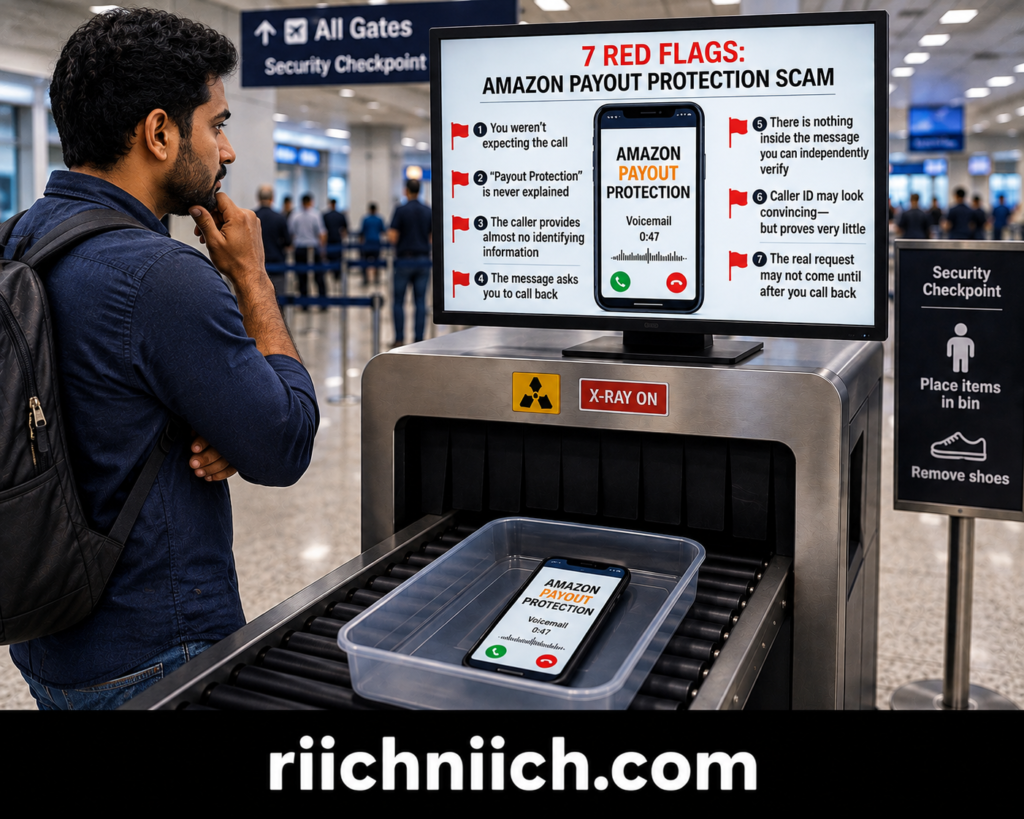
1. You weren’t expecting the call
The first red flag is simple: Amazon-related contact arrives out of nowhere.
In our case, we hadn’t initiated a conversation about “Payout Protection.” The voicemail unexpectedly claimed someone needed to speak with us about it.
An unexpected call isn’t proof of fraud by itself. However, when someone contacts you unexpectedly while claiming to represent a company you recognize, verification should come before engagement.
The FTC recommends not giving money or personal information to someone who contacts you unexpectedly. If you’re unsure whether the communication is genuine, contact the business independently using contact information you’ve looked up yourself.
2. “Payout Protection” is never explained
The second red flag is the vagueness of the supposed service.
The voicemail says:
“…calling about payout Protection for your Amazon account.”
But what exactly does that mean?
The caller doesn’t explain whether “Payout Protection” involves a purchase, refund, seller payment, account-security feature, fraud issue, or something else.
As we discussed earlier, Amazon has legitimate services and policies involving payouts, payments, guarantees, and protection. But we have not verified a consumer service matching the vague “Payout Protection for your Amazon account” description in this voicemail.
That unexplained terminology can create a curiosity gap that encourages you to call back simply to find out what the caller means.
Don’t let curiosity become your method of verification.
3. The caller provides almost no identifying information
The caller identifies herself simply as:
“Ashley.”
There’s no department.
No job title.
No case number.
No extension.
No order number.
No transaction details.
No explanation of why Amazon supposedly needs to speak with you.
A name can make an Amazon scam call sound more personal, but a first name doesn’t verify someone’s employment or identity.
The same applies when the caller knows your name. Personal information can make an impersonation attempt sound convincing, but it does not prove the caller has access to your Amazon account.
4. The message asks you to call back
This is probably the biggest red flag in the voicemail we received.
The caller’s only clear request is:
“Please give me a call back at your earliest convenience.”
The FTC specifically warns consumers about Amazon impersonation scams and advises them not to call back the number that called or a number supplied in a voicemail or text. If you’re concerned about your Amazon account, the FTC recommends logging in independently through Amazon’s website or app.
Think of it this way:
The phone number contained in a suspicious voicemail should not be used to determine whether that same voicemail is legitimate.
Verify through a separate channel.
5. There is nothing inside the message you can independently verify
A legitimate-sounding voicemail becomes more suspicious when it gives you no independent way to confirm the supposed issue.
If the message says there’s a problem with your Amazon account, check your Amazon account yourself.
Don’t ask the caller whether the caller is legitimate.
The FTC’s guidance on fake Amazon support calls recommends contacting the company through a phone number or website you already know is genuine when you receive an unexpected message about an account problem.
That creates a useful rule for evaluating the amazon payout protection scam:
Verify the claim without using anything the caller gave you.
If you can find no corresponding problem after independently checking your account, that’s another reason not to engage with the callback number.
6. Caller ID may look convincing—but proves very little
Suppose your phone actually displays:
Amazon
Or perhaps the number looks local or otherwise familiar.
That still isn’t enough.
Caller ID can be spoofed. The FTC warns that scammers can manipulate caller ID so that virtually any name or number appears on your screen.
This means you shouldn’t judge whether an Amazon phone scam is legitimate based solely on:
The displayed company name + phone number + professional voice + caller knowing your name.
Those things can feel convincing when combined, but independent verification remains more reliable.
7. The real request may not come until after you call back
This is the red flag that’s easiest to miss.
The voicemail we received doesn’t request a password.
It doesn’t ask for a verification code.
It doesn’t request money.
It doesn’t tell us to purchase gift cards.
That might make the message seem harmless.
But the FTC describes business impersonation scams where an initial message directs the recipient to call a number, and the subsequent interaction leads to requests for personal information, payment, or computer access.
Amazon impersonation scams have also involved requests for gift cards or remote access to a victim’s computer. The FTC warns consumers never to give remote access to someone who unexpectedly contacts them and never to pay someone demanding gift cards.
We don’t know whether the caller who left our particular voicemail intended to do any of those things because we didn’t call back.
That’s worth emphasizing.
We’re identifying documented scam warning signs—not claiming to know what “Ashley” would have said next.
One red flag should make you verify—not panic
Receiving a suspicious voicemail doesn’t automatically mean your Amazon account has been compromised or your identity has been stolen.
If you never called back, clicked anything, provided information, or granted access to a device, don’t assume the worst simply because someone knew your name.
Instead:
Don’t call the supplied number. Verify your Amazon account independently. Block suspicious callers when appropriate. Monitor your accounts.
However, if you did call back and the conversation progressed to passwords, verification codes, credit card or banking information, remote computer access, money transfers, cryptocurrency, or gift cards, the situation requires more immediate action. The FTC identifies unusual payment demands—including gift cards, cryptocurrency, payment apps, and wire transfers—as classic scam warning signs.
At that point, strengthening account security and monitoring for identity or financial misuse becomes much more important. Depending on what information was exposed, paying for an identity theft protection service may also be worth considering for monitoring and recovery assistance.
Likewise, if the call makes you realize your name, phone number, address, and other personal details are widely exposed across people-search sites and data brokers, a data removal service may be worth the cost if you’d rather automate recurring opt-out requests than handle them manually.
The key lesson from these seven red flags of the amazon payout protection scam is straightforward: a voicemail doesn’t need to threaten you to be suspicious.
Sometimes the most important warning sign is simply an unfamiliar caller using a familiar company’s name and asking you to call back.
What Happens If You Call the Number Back?
If you receive an amazon payout protection scam voicemail, you may be tempted to call the number back just to find out what “Payout Protection” means. That is exactly what we chose not to do.
Because we never returned the call, we cannot say what the person who identified herself as “Ashley” would have said or requested. However, FTC guidance on Amazon and other business impersonation scams shows why calling an unfamiliar number back can turn a vague voicemail into a much more serious interaction.
The FTC warns that business impersonation scams often begin with an unexpected message about a supposed account problem followed by instructions to call a number. Once someone calls, the impersonator may seek personal information, payment, or access to a computer.

Calling back opens the conversation
The original voicemail we received only asked for one action:
Call back.
That’s important because an Amazon payout protection voicemail doesn’t need to steal anything from you immediately. Getting you onto the phone gives the caller an opportunity to explain the supposed problem, answer your questions, establish credibility, and potentially ask for information later.
The FTC specifically advises consumers who receive suspicious Amazon communications not to call back the number that called them or a number left in a voicemail or text. Instead, if you’re concerned about an Amazon purchase or account issue, log in independently through Amazon’s website or app.
The caller may introduce a more serious story
The vague voicemail may only be the opening.
After you return an Amazon scam call, an impersonator could introduce a story designed to make the situation feel more urgent.
Documented Amazon impersonation schemes have included claims involving unauthorized purchases, compromised accounts, refunds, hackers, and identity theft. In one FTC-documented version, victims were told hackers had accessed their accounts and that buying gift cards was supposedly necessary to protect them.
That does not mean the caller who contacted us would have used any particular one of these stories. We didn’t call back, so we don’t know.
The lesson is that you shouldn’t assume the vague explanation in the voicemail represents the caller’s entire pitch.
They may ask you to “verify” your identity
A caller claiming to represent Amazon might make a request sound routine:
“Before I can access your account, I need to verify some information.”
Be extremely careful.
A supposed verification process could become an attempt to collect information useful for account takeover, identity fraud, or future scams.
Business impersonators may seek personal information such as Social Security numbers, and Amazon-related impersonation attempts may target login credentials or financial information. Amazon representatives have also warned sellers that fake Amazon calls, emails, and texts can be designed to obtain login credentials, payment information, or access to seller accounts.
Never provide a password, one-time verification code, full payment-card information, Social Security number, or other sensitive information merely because an unexpected caller claims they need to “verify” your account.
They could ask you to install software or provide remote access
This is an especially serious warning sign.
A fake representative might claim they need to examine your account, process a refund, remove a security problem, or help protect your device. The conversation could then move toward installing remote-access software.
Don’t do it.
The FTC specifically warns against giving remote computer access to someone who contacts you unexpectedly. Remote access can expose personal and financial information, including access to online banking accounts.
Once a stranger can remotely control your computer, the situation is much more dangerous than a suspicious voicemail.
A fake refund may enter the conversation
Another documented Amazon impersonation technique involves a supposed refund.
The FTC describes a scheme where an Amazon impersonator claims to refund an unauthorized purchase but makes it appear that too much money was accidentally returned. In reality, the scammer manipulates transfers between the victim’s own accounts. The victim is then persuaded to “return” money that was theirs all along.
This is why you should be suspicious if an unexpected fake Amazon phone call suddenly turns into a discussion about moving money between accounts.
Don’t allow the caller to guide you through your online banking account, and don’t give them remote access to watch you log in.
They may eventually ask for an unusual payment
Another major warning sign is being told that you need to pay to solve the supposed problem.
Business impersonators commonly demand payment through methods that make recovering money difficult, including gift cards, cryptocurrency, wire transfers, and similar methods. The FTC states that a legitimate business will not demand gift cards as payment.
If your Amazon payout protection call suddenly turns into:
“Buy gift cards.”
“Send cryptocurrency.”
“Wire the money.”
“Move your money to protect it.”
Stop the conversation.
Do not follow the caller’s instructions.
What if you called back but didn’t give them anything?
Calling the number back doesn’t automatically mean your Amazon account or identity has been compromised.
If you called but did not provide sensitive information, send money, click links, install software, give remote access, or disclose verification codes, the appropriate response is generally to end the interaction, block the number, and independently check your Amazon account for anything unusual.
Don’t panic simply because you spoke with someone.
However, remain alert for additional calls, texts, or emails. Someone who knows you’re willing to respond may potentially attempt another approach.
What if you gave them personal information?
This is where the response needs to match what you disclosed.
If you gave the caller an Amazon password, change it immediately and make sure you aren’t reusing that password elsewhere.
If you disclosed financial information, contact the relevant bank or card issuer through a verified number.
If you provided a one-time security code, check the associated account immediately.
If you granted remote access, disconnect the device and take appropriate security steps before using it for sensitive activity.
If highly sensitive personal information was exposed, monitoring your credit and identity becomes more important.
This is also where paying for identity theft protection can become more reasonable. A person who merely received a voicemail may not need another subscription. Someone who disclosed sensitive information, however, may value ongoing monitoring, alerts, and access to identity-restoration assistance if misuse occurs.
Similarly, if the incident reveals that your name, phone number, email address, and other personal details are widely available online, a reputable data removal service may be worth considering to reduce exposure across participating data brokers and people-search sites. Neither service can undo information already disclosed to a scammer, but each can address a different part of your ongoing risk.
Don’t call back just to investigate
This is perhaps the most important point about the amazon payout protection scam.
You don’t need to call the number to determine whether something is wrong with your Amazon account.
Instead:
Open Amazon independently. Check your orders and account activity. Look for legitimate notifications. Contact Amazon through an official channel you navigate to yourself if necessary.
The FTC’s advice is clear: when you’re worried about an unexpected Amazon communication, don’t trust the number supplied by the caller. Check through Amazon’s website or app instead.
The safest outcome is exactly what happened in our case:
The voicemail arrived. We didn’t call back. The conversation never had a chance to progress.
What Information Could an Amazon Impersonation Scammer Be After?
The amazon payout protection scam may begin with nothing more than a vague voicemail asking you to call back, but the real value to an impersonator may come from what happens after contact is established.
We don’t know what the caller who left our voicemail wanted because we never called back. However, the FTC warns that business impersonators may try to obtain personal information, money, or access to a victim’s computer. Amazon impersonation scams have also involved fake refunds, gift cards, and remote access to financial accounts.
That means you should be extremely cautious if an Amazon payout protection call progresses from a simple conversation to questions about your account, identity, finances, or security.

1. Your Amazon login credentials
One potential target is your Amazon account itself.
An impersonator might try to get your email address, username, password, or other login information while making the request sound like part of a normal verification process.
For example, someone could claim they need information to:
“Verify your Amazon account.”
“Activate your protection.”
“Cancel an unauthorized transaction.”
“Confirm your identity.”
“Secure your account.”
Don’t let reassuring terminology change what is actually happening.
Amazon’s own seller-security guidance warns that callers claiming to represent Amazon should not be asking for passwords, bank-account PINs, credit-card numbers, security codes, or answers to security questions.
If an unexpected caller asks for your Amazon password, stop the conversation.
2. Your one-time verification code
This is one of the most important pieces of information to protect.
Suppose someone already has your password—or is attempting to reset it. Your multi-factor authentication code may be the remaining barrier keeping them out.
A scammer may therefore tell you:
“I’m sending you a code to verify your identity. Read it back to me.”
Don’t.
The FTC explains that verification codes act as a second security layer and warns that scammers sometimes manufacture an account problem specifically to convince victims to reveal the code.
Amazon also recommends enabling two-step verification so that knowing the password alone isn’t enough to access an account.
A good rule is simple:
A security code sent to you is for you—not the person on the phone.
3. Your credit or debit card information
An Amazon impersonator may also be interested in payment information.
Be suspicious if a supposed representative asks you to provide or “confirm” a full:
- Credit card number
- Debit card number
- Expiration date
- Security code
- Billing information
A caller might already know a small amount of information about you and ask you to provide the missing pieces.
Don’t assume that knowing your name, phone number, or even some account-related information proves the caller is legitimate.
If you think there’s a genuine billing problem with Amazon, end the call and investigate through your Amazon account independently rather than providing financial information to an unexpected caller.
4. Your bank account information
Banking information can be an especially valuable target.
The FTC has documented an Amazon impersonation scam in which victims were persuaded to give scammers remote access to their computers. Scammers then manipulated transfers between the victims’ own bank accounts to create the illusion that Amazon had accidentally issued an excessive refund. Victims were subsequently persuaded to send money back.
That is why you should never allow someone from an unexpected fake Amazon phone call to walk you through your online banking account.
Don’t provide:
Bank account numbers.
Banking passwords.
PINs.
Verification codes.
Or remote access to the device you use for banking.
5. Your Social Security number and identity information
Some business impersonators are after more than account credentials.
The FTC warns that impersonation scammers may ask for personal information such as a Social Security number.
Other identifying information can also become valuable when combined with data a scammer already possesses.
That’s why questions about your date of birth, address, security-question answers, financial information, or other sensitive identity details should immediately raise concern when they come from an unsolicited caller.
This is where the risk can move beyond an Amazon account and toward identity theft.
If highly sensitive identity information has already been disclosed, monitoring for misuse becomes more important. Depending on the information exposed and your level of concern, a reputable identity theft protection service may be worth paying for if you want ongoing monitoring, alerts, and professional recovery assistance rather than handling everything yourself.
6. Remote access to your computer
Sometimes the information isn’t requested directly.
Instead, a scammer may attempt to get access to the device containing the information.
A supposed representative could claim that they need to connect to your computer to investigate suspicious activity, process a refund, secure your account, or correct a problem.
The FTC specifically warns consumers not to give remote computer access to someone who contacts them unexpectedly, because doing so can expose personal and financial information, including bank accounts.
Remote-access scams can be especially dangerous because you’re potentially giving a stranger a window into far more than one Amazon account.
7. Gift card numbers or direct payments
Sometimes the target isn’t information at all.
It’s your money.
The FTC has documented Amazon impersonation scams in which victims were told to purchase gift cards to supposedly protect compromised accounts. Once a scammer obtains the gift card number and PIN, they can take the money loaded onto the card.
The rule here couldn’t be clearer:
If someone claiming to represent Amazon tells you to buy gift cards and provide the numbers or PINs as payment, it’s a scam.
The FTC says no legitimate business or government agency will tell you to buy gift cards to pay them.
8. Information that can make the next scam more convincing
Not every piece of information needs to produce an immediate payoff.
A caller may also be interested in learning more about you.
Confirming seemingly harmless information—your email address, full name, where you bank, whether you have an Amazon account, or which security services you use—could potentially provide additional context for future social-engineering attempts.
This is why you shouldn’t treat a conversation as harmless merely because the caller hasn’t requested money yet.
The Amazon scam voicemail we received already contained one correct piece of personal information: the recipient’s first name.
We don’t know where that information came from.
However, if you discover that your name, phone number, address, email address, and other personal information are widely exposed across people-search websites and data brokers, a data removal service may be worth considering. These services cannot guarantee that scammers will never obtain your information, but they can automate removal requests across participating data brokers and reduce some unnecessary public exposure.
What should you never give an unexpected Amazon caller?
The safest approach is to assume that sensitive information should never be provided simply because someone called you and claimed to represent Amazon.
Be particularly protective of your:
Passwords, verification codes, Social Security number, full payment-card information, bank credentials, PINs, security-question answers, gift card numbers, and remote access to your devices.
If a caller requests any of these, end the conversation and verify the supposed issue independently.
Amazon recommends protecting accounts with strong passwords and two-step verification, which provides another security barrier if a password becomes compromised.
The amount of information exposed should guide what protection you buy
Receiving the amazon payout protection scam voicemail by itself does not mean you need to immediately purchase identity theft protection, antivirus software, a password manager, and a data removal subscription.
Match the solution to the problem.
If you only received the voicemail and never engaged, independently check your Amazon account, block or ignore the suspicious number, and remain alert.
If you gave away an Amazon password, change it immediately, secure any other account where that password was reused, and enable two-step verification.
If you disclosed highly sensitive identity or financial information, stronger monitoring may be justified, and that’s where paying for a reputable identity theft protection service can offer meaningful convenience and recovery support.
And if the incident makes you realize that too much of your personal information is publicly available, a data removal service may make sense if you’d rather pay to automate recurring removals instead of managing dozens of opt-outs yourself.
The amazon payout protection scam may begin with a five-second request to call back. The information potentially at risk, however, can be worth considerably more than the voicemail makes it seem.
What To Do If You Receive an Amazon Payout Protection Scam Voicemail
If you receive an amazon payout protection scam voicemail similar to the one we received, the most important thing is not to let curiosity pull you into the conversation. You do not need to call the number back to determine whether there is actually a problem with your Amazon account.
The FTC specifically warns consumers not to call a number left in an unexpected Amazon voicemail or text. Instead, if you’re concerned about your account, access Amazon independently through the official website or app.
If all you received was the voicemail and you never interacted with the caller, your response can be relatively simple.

1. Don’t call the number back
Start here.
Even if you only want to ask what “Payout Protection” means, don’t use the callback number supplied in the voicemail.
The FTC’s guidance on Amazon impersonation scams specifically says not to call back an unknown number and to use information obtained independently from Amazon instead.
Calling back isn’t necessary to investigate the message.
In our case, we never called “Ashley” back. That meant the person behind the voicemail never had an opportunity to explain the supposed service, ask questions, request information, or move the conversation further.
If you receive the same Amazon payout protection voicemail, doing nothing with the callback number may be the safest first move.
2. Check your Amazon account independently
Next, determine whether anything is actually wrong.
Don’t use a link, phone number, or other contact information provided by the caller. Open the Amazon app yourself or navigate to Amazon through your browser.
Check for:
- Orders you don’t recognize
- Unexpected account changes
- Suspicious payment activity
- Password or security changes
- Legitimate Amazon notifications
- Other unusual account activity
If everything appears normal, don’t manufacture a problem simply because the voicemail says there is something called “Payout Protection.”
The FTC recommends this independent-verification approach for suspicious Amazon calls. If you’re concerned about a purchase or account issue, log in through Amazon’s website or app instead of calling the number supplied in the unexpected message.
3. Don’t trust caller ID as verification
Your phone might display a normal-looking number. It could even display a recognizable business name.
That still doesn’t establish that the call came from Amazon.
The FTC warns that scammers can spoof caller ID, making a call appear to come from a trusted business.
That’s why you should verify the claimed account problem rather than trying to verify the phone number displayed on your screen.
Think of it this way:
Caller ID tells you what your phone was shown—not necessarily who is actually calling.
4. Save evidence before deleting the voicemail
Before deleting a suspicious Amazon scam voicemail, consider documenting it.
Save or write down:
The callback number, caller-ID number, caller’s stated name, exact wording of the voicemail, and date and time you received it.
A screenshot of the call information can also be useful.
This information becomes particularly valuable if you decide to report the call. The FTC asks consumers reporting phone scams to include the number that received the call, the caller-ID number, any callback number provided, and the date and time when available.
In our case, keeping the voicemail also allowed us to examine the exact language instead of relying on memory.
5. Block the suspicious number
Once you’ve preserved anything you need, you can block the number.
Blocking one phone number won’t stop every scammer. Fraudsters can change numbers and use caller-ID spoofing.
However, there’s little reason to leave a known suspicious number free to repeatedly contact you.
The FTC recommends using call-blocking and call-labeling tools to help reduce unwanted scam calls.
6. Report the call
You can also report a suspected fake Amazon phone call.
If you lost money or have information about the suspected scammer, the FTC directs consumers to ReportFraud.ftc.gov. If you didn’t lose money and simply want to report an unwanted call, the FTC also provides reporting through DoNotCall.gov.
Amazon-related suspicious communications can also be reported through Amazon’s legitimate reporting and customer-support channels rather than through contact information supplied by the caller.
Reporting may feel unnecessary when you didn’t lose money, but reports help regulators and phone providers identify patterns and improve scam-call detection. The FTC says reported phone numbers are shared with partners working on call-blocking and call-labeling solutions.
7. Don’t give anyone a verification code
If the suspicious caller contacts you again, be particularly careful if they send a security code to your phone and ask you to read it back.
Never give them the code.
The FTC warns that scammers may create a fake account emergency and then ask for a verification code. If someone obtains the right credentials plus that code, they may be able to access the account the code was intended to protect.
The same caution applies to passwords, PINs, payment-card information, banking credentials, and security-question answers.
8. Never install software for an unexpected caller
If someone claiming to represent Amazon eventually tells you to install software or allow them to remotely control your computer, stop.
The FTC specifically warns consumers not to give remote computer access to someone who contacts them unexpectedly. Amazon impersonation scams have used remote access as part of schemes involving financial accounts.
Don’t allow a supposed Amazon representative to watch you log into your bank account, move money, install remote-access applications, or control your screen.
9. Don’t send money to “protect” your account
The word “Protection” in the amazon payout protection scam deserves special attention.
If a caller eventually claims you need to move money, purchase gift cards, send cryptocurrency, wire funds, or otherwise pay to “protect” your Amazon account or money, stop communicating.
Amazon Pay warns against sending money or gift-card claim codes to someone claiming Amazon will guarantee or protect a transaction.
The FTC is equally clear that you should not transfer money simply because an unexpected caller says doing so will protect it.
Do you need to buy identity theft protection after receiving the voicemail?
Not necessarily.
This is an important distinction because buying security products out of fear isn’t the goal.
If you simply received the amazon payout protection scam voicemail, didn’t call back, didn’t click anything, didn’t provide information, and didn’t grant anyone access to a device, receiving the message alone does not prove your identity has been stolen.
You can verify your Amazon account, preserve the evidence, block the number, report it, and remain alert.
But the calculation changes if you interacted with the caller and exposed sensitive information.
If you provided a Social Security number, financial information, account credentials, verification codes, or other sensitive identity data, a reputable identity theft protection service may be worth considering for ongoing monitoring, alerts, and recovery assistance.
Likewise, if you’re concerned because the caller already knew your name and you discover that your phone number, address, email, and other information are widely exposed online, a data removal service may be worth paying for if you want recurring data-broker opt-outs handled for you.
Neither service magically reverses a scam. The value is in helping address the ongoing risk that remains after exposure.
If you only received the voicemail, keep your response simple
For someone in the same situation we were in, there’s no reason to panic.
The voicemail arrived.
We didn’t call back.
We didn’t provide information.
We investigated the claim independently.
That’s the response we would recommend to anyone receiving a similar amazon payout protection scam voicemail.
And if you’ve already gone beyond that point—perhaps you called the number and spoke with someone—the next steps depend heavily on exactly what happened during that conversation. The following sections will explain what to do if you called back and, more importantly, what to do immediately if you already gave the caller personal or financial information.
What To Do If You Already Called Back
If you already returned a call connected to the amazon payout protection scam, don’t assume that simply making the phone call means your Amazon account or identity has been compromised. What matters most is what happened during the conversation.
If you called the number, asked what the voicemail was about, and then hung up without providing sensitive information, sending money, clicking a link, installing software, or granting access to your device, your risk is very different from someone who handed over an Amazon password or banking information.
The FTC has documented Amazon impersonation scams where victims who called numbers in unexpected messages were connected to fake Amazon representatives and then drawn into more elaborate schemes. The FTC’s recommendation is to avoid numbers supplied in unexpected communications and verify concerns directly through the company instead.

If you called back but gave them nothing
This is the lowest-risk scenario.
Maybe you returned the Amazon payout protection call, heard the caller’s explanation, became suspicious, and hung up.
If you did not provide sensitive information or take any action they requested, there is generally no reason to assume that calling alone gave the person access to your Amazon account.
Still, take a few sensible precautions:
- Block the suspicious number.
- Check your Amazon account independently for unfamiliar activity.
- Be alert for follow-up calls, emails, and text messages.
- Don’t respond if the caller contacts you again.
- Report the suspicious communication to Amazon or the FTC.
Amazon’s current scam guidance says consumers who receive a suspicious phone call, text, or email should verify the issue directly through the Amazon app or website. Amazon also says it will not ask customers to make payments or bank transfers on another website, install software for customer support, or grant remote access to a device.
If you confirmed basic personal information
Suppose the caller asked:
“Is this Riich?”
“Is this still your phone number?”
“Is this your email address?”
And you answered.
That isn’t the same as handing over your Social Security number or bank credentials, but you should still end further communication.
Confirming information can tell an unknown caller that the phone number is active and the information they already possess is accurate. That may make future phishing or impersonation attempts easier to personalize.
Be especially skeptical of subsequent communications claiming to come from Amazon, your bank, a government agency, or another company. Don’t assume a second caller is legitimate simply because they know something discussed during the first call.
If the experience also reveals that your name, phone number, email address, or home address is widely exposed through people-search websites and data brokers, this may be a reasonable time to consider whether a paid data removal service is worth it. These services cannot erase information scammers already possess, but they can reduce information available from participating data brokers without requiring you to manage every opt-out manually.
If you gave them your Amazon password
Treat this more seriously.
Change your Amazon password immediately.
Do this by navigating directly to Amazon yourself—not through a link the caller sends you.
If you’ve reused the same password on your email, banking, social media, or other accounts, change those passwords too. Password reuse can turn the compromise of one credential into a much larger security problem.
You should also enable two-step verification if you haven’t already. Amazon’s security guidance recommends two-step verification as an additional layer protecting the account.
This is also a situation where a reputable password manager may be worth buying. A password manager can generate and store unique passwords so you don’t have to reuse the same credentials across multiple accounts.
If you gave them a verification code
A one-time password or verification code deserves immediate attention.
A caller might make the request sound harmless:
“I’m sending you a code so I can verify that you’re the account owner.”
Don’t share it.
Amazon specifically says legitimate representatives will not ask for an OTP over the phone.
If you’ve already given someone a verification code, immediately check the account associated with that code. Change the password, review account activity and security settings, and look for changes you didn’t make.
Don’t assume the code was harmless simply because it expired afterward. The important question is whether it was used while it was valid.
If you installed software or gave them remote access
This is a much more serious scenario.
Amazon says it will not ask customers to download or install software to connect with customer service or grant remote access to their devices.
The FTC has also documented Amazon impersonation scams involving remote computer access. In some cases, scammers used that access as part of fake-refund schemes involving victims’ online banking accounts.
If you granted remote access, disconnect the device from the internet and remove the remote-access software. Don’t use that device to access sensitive financial accounts until you’re confident it is secure.
If the caller had an opportunity to view or control your banking, email, Amazon, or other important accounts, change those credentials from a different trusted device.
A reputable security or antivirus product may also be worth considering if you’re concerned that unwanted software was installed. The FTC warns that remote-access and tech-support scammers can install malware capable of accessing sensitive information such as usernames and passwords.
If you sent money
Contact the company that handled the payment as quickly as possible.
That might be your:
Bank.
Credit-card issuer.
Debit-card issuer.
Payment app.
Wire-transfer provider.
Gift-card issuer.
Explain that the transaction resulted from a suspected scam and ask whether it can be stopped, reversed, disputed, or otherwise recovered.
Don’t continue communicating with the caller because they promise to return your money.
And be careful about recovery scams afterward. Someone who already paid a scammer can become a target for another person promising to recover the lost money for an upfront fee.
The FTC has documented Amazon impersonators using fake refunds, gift cards, and other tactics to obtain victims’ money.
If you provided highly sensitive identity information
If the amazon payout protection scam progressed to information such as your Social Security number, banking credentials, or other highly sensitive identifying information, protecting yourself against identity misuse becomes more important.
At that point, consider steps such as:
Changing affected passwords, contacting financial institutions, monitoring financial accounts, checking your credit reports, and considering a credit freeze when appropriate.
The FTC directs consumers who believe someone obtained access to their personal information or accounts to IdentityTheft.gov for a personalized recovery plan.
This is also one of the situations where paying for identity theft protection can make considerably more sense.
You don’t necessarily need a paid service merely because you answered a suspicious phone call. But if sensitive identity information has actually been exposed, you may value continuous monitoring, alerts, insurance benefits where applicable, and professional identity-restoration assistance.
The alternative is handling monitoring and recovery yourself, which can be perfectly reasonable—but it requires more of your time and attention.
Report the call after securing yourself
Security comes first. Reporting comes afterward.
Amazon currently provides a self-service reporting tool for suspicious communications and also accepts reports from non-customers. Amazon says these reports help it identify bad actors and take action against scam infrastructure.
You can also report suspected fraud to the FTC.
Keep the voicemail, phone number, screenshots, payment records, emails, text messages, and any other evidence until you’ve completed your reports and addressed any financial or account issues.
Match your response to what actually happened
The biggest mistake after returning a suspicious call is treating every situation as equally serious.
If you called and gave them nothing, verify your account, block the caller, report the incident, and remain alert.
If you gave them a password, change it immediately and secure accounts where that password was reused.
If you shared a verification code, secure the affected account immediately.
If you granted remote access, treat the device and accounts accessed from it as potentially exposed.
If you sent money, contact the financial provider immediately.
And if you disclosed highly sensitive identity information, consider stronger monitoring and recovery measures—including whether paying for a reputable identity theft protection service is worthwhile.
That’s an important buyer-intent distinction for this article: don’t buy protection simply because you’re scared. Buy it when the level of exposure makes the monitoring, automation, or recovery assistance valuable to you.
The amazon payout protection scam may begin with an innocent-sounding voicemail. But if you’ve already called back, the most useful question isn’t “Did I make a mistake by calling?”
It’s:
“What information or access did I actually give them?”
Your answer to that question determines what you should do next.
What To Do If You Gave the Caller Personal or Financial Information
If the amazon payout protection scam has progressed beyond a voicemail and you already gave the caller personal or financial information, the situation is more serious—but the right response depends on exactly what you shared.
A password requires a different response than a credit card number. A Social Security number creates different risks than simply confirming your email address. And if you gave someone remote access to your device, you need to address the device as well as the accounts accessed through it.
The FTC recommends acting quickly after giving information to a scammer. Depending on what was exposed, that can include changing passwords, contacting financial institutions, checking credit reports, placing a credit freeze, and using IdentityTheft.gov for a personalized recovery plan.
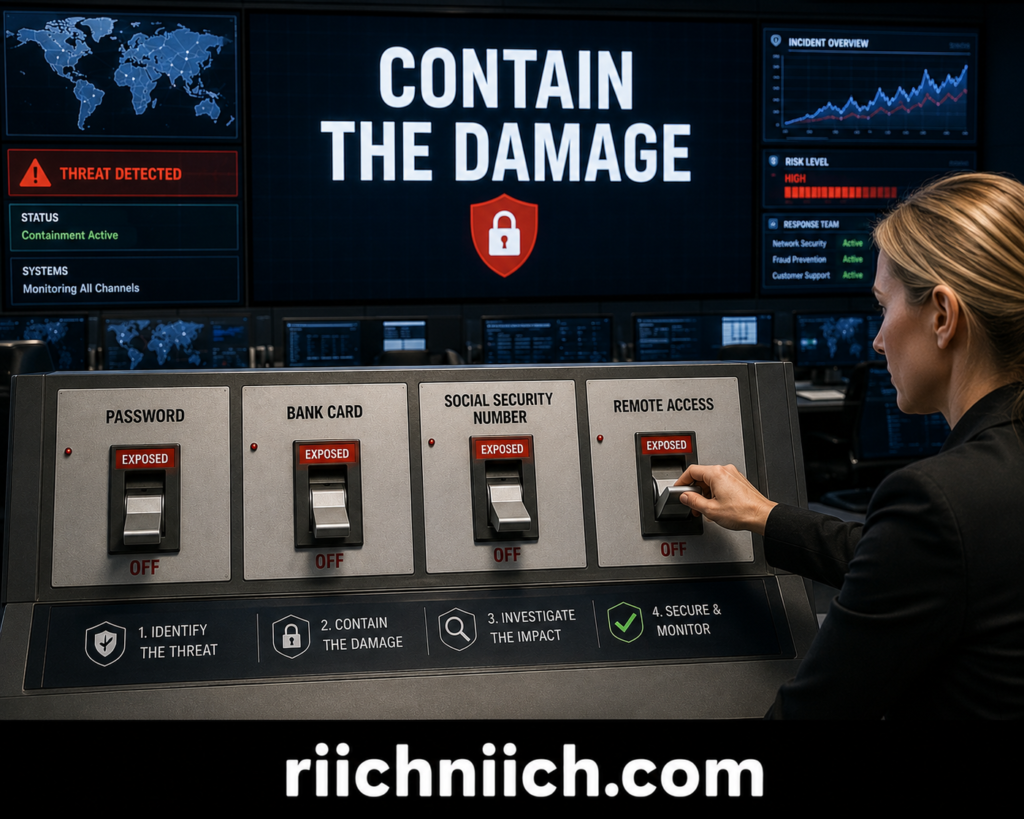
If you gave them your Amazon password
Change the password immediately by going directly to your Amazon account. Do not use a password-reset link sent by the caller.
Create a new, strong password that you aren’t using anywhere else. If your old Amazon password was reused on another account—especially your email, banking, payment, or social-media accounts—change it there too.
The FTC specifically recommends changing a compromised username/password combination and changing the password anywhere else it was reused.
You should also review your Amazon account for unfamiliar orders, addresses, payment methods, account changes, or other suspicious activity.
And if password reuse is a recurring problem, this is one of the situations where paying for a reputable password manager can be worthwhile. A password manager can create and store unique passwords for different accounts, reducing the damage one stolen password can cause.
If you gave them a verification code
Treat this as urgent.
A verification code is designed to provide an additional security barrier. If you gave a code to someone claiming to represent Amazon, immediately check the account associated with that code and change its password.
Don’t assume you’re safe because the code has since expired.
The important question is whether someone used it while it was active.
Also review security settings, active sessions, recovery information, and recent account activity. If you see a device or session you don’t recognize, sign it out.
For important accounts, enable multi-factor authentication wherever available. The FTC recommends strong passwords and multi-factor authentication because MFA makes it harder for someone to access an account even when they obtain the password.
If you gave them your credit or debit card information
Contact the card issuer using the number on the back of your card or another contact method you independently know is legitimate.
Tell them that your card information may have been disclosed during a suspected scam.
Ask whether the card should be blocked and replaced, and review recent transactions for anything you don’t recognize.
Do not use a phone number provided by the person who called you. The Consumer Financial Protection Bureau recommends independently contacting your card provider when someone unexpectedly contacts you seeking account information.
If fraudulent transactions have already occurred, tell the issuer immediately and ask about disputing the charges.
If you gave them your bank information
Contact your bank’s fraud or security department immediately through an independently verified number.
Explain exactly what was exposed—for example:
- Bank account number
- Debit-card information
- Online banking username
- Online banking password
- PIN
- Verification code
If you also transferred money, tell the bank that the transaction was connected to a suspected scam and ask whether it can be stopped or reversed.
The FTC recommends contacting the financial institution or payment provider as quickly as possible after fraudulent transfers and asking whether the transaction can be reversed.
And don’t follow instructions from anyone claiming you need to move your money somewhere else to protect it. The Consumer Financial Protection Bureau (CFPB) warns that legitimate financial institutions and government agencies do not tell consumers to send money, withdraw cash, purchase gift cards, or transfer cryptocurrency to “protect” their funds.
If you gave them your Social Security number
This is one of the situations where we would take stronger identity-protection measures.
A Social Security number can potentially be used in identity fraud, including attempts to open accounts in your name.
Start with the FTC’s IdentityTheft.gov resources. The FTC specifically directs people who gave a scammer their Social Security number to IdentityTheft.gov for situation-specific steps, including credit monitoring guidance.
You should also seriously consider placing a credit freeze with all three nationwide credit bureaus.
A credit freeze restricts prospective creditors’ access to your credit file, making it harder for an identity thief to open new credit accounts in your name. Credit freezes are free, don’t affect your credit score, and remain in place until you lift them.
A freeze is different from a paid credit lock. The CFPB notes that credit-reporting companies may sell credit-lock products, but a security freeze is available free by law.
If you gave them other identifying information
Maybe you didn’t disclose your Social Security number but gave the caller your:
Full date of birth.
Home address.
Email address.
Mother’s maiden name.
Security-question answers.
Employer.
Financial institution.
Other identifying details.
The level of risk depends on the information and what the caller already possessed.
Review your important accounts and change security questions or credentials that could now be easier to guess. The FTC specifically cautions against security-question answers that can be discovered through public records or online research.
This is also where reducing publicly exposed information can become useful.
If your name, phone number, address, email address, relatives, and other identifying details are spread across data brokers and people-search sites, a data removal service may be worth paying for if you want those opt-out requests handled on an ongoing basis.
It won’t remove information you already gave the caller, and no legitimate service can promise to erase you from the internet completely. Its value is in reducing future unnecessary exposure.
If you gave them remote access to your computer or phone
Treat the device as potentially compromised.
Disconnect it from the internet and stop using it for sensitive activities until you’ve addressed the problem.
The FTC recommends updating your security software, running a security scan, and removing anything identified as a problem when a scammer has obtained remote access to a computer.
Change important passwords from a different trusted device, particularly for:
Email.
Banking.
Amazon.
Payment services.
Social media.
Cloud storage.
Your email account deserves special attention because access to your email can potentially be used to reset passwords for other accounts.
If you’re concerned that malicious software may have been installed, this is also one of the stronger buyer-intent situations for a reputable antivirus or security suite. Paying for security software can make sense when you’re purchasing capabilities you actually need—such as malware scanning, phishing protection, or ongoing device protection—rather than buying it simply because you received a suspicious voicemail.
Freeze your credit if sensitive identity information was exposed
If the amazon payout protection scam resulted in exposure of information that could potentially be used to open accounts in your name, a credit freeze deserves serious consideration.
This protection is free.
You need to freeze your credit separately with Equifax, Experian, and TransUnion. While the freeze is active, prospective creditors generally cannot access your credit report, which makes opening new credit in your name considerably more difficult.
You can temporarily lift the freeze when you legitimately need to apply for credit.
A fraud alert is another option. Unlike a freeze, it doesn’t block access to your credit report; instead, it tells businesses to verify your identity before opening new credit. An initial fraud alert is free and lasts one year.
Check your credit reports and financial accounts
Don’t wait for an alert telling you something happened.
Review your:
Bank statements, credit-card transactions, Amazon activity, and credit reports.
Look for unfamiliar withdrawals, charges, accounts, addresses, or other activity.
If you’re concerned that your information may already be in use, check these 13 Warning Signs Someone Stole Your Identity so you know which suspicious activity deserves immediate attention.
The FTC identifies unexplained charges, withdrawals, bills, and credit accounts as potential signs that someone is misusing personal information.
If you find evidence of identity theft, IdentityTheft.gov can generate a personalized recovery plan and Identity Theft Report to help you work through the problem.
Should you pay for identity theft protection now?
This is where the answer becomes very different from someone who merely received the voicemail.
If you never called back and disclosed nothing, buying identity theft protection solely because of the voicemail may be unnecessary.
If you actually disclosed sensitive personal or financial information, however, a paid identity theft protection service may become much easier to justify.
Depending on the service and plan, you’re generally paying for convenience and additional assistance such as:
Credit or identity monitoring, alerts, dark-web monitoring, identity-restoration assistance, and potentially identity theft insurance subject to the policy’s terms and exclusions.
But remember that many important protections are available for free.
You can freeze your credit yourself.
You can review your credit reports.
You can contact your banks.
You can change your passwords.
And IdentityTheft.gov provides a free personalized recovery plan.
So the question isn’t “Do I have to buy identity theft protection?”
You don’t.
The better buyer-intent question is:
“Would I rather monitor and manage this risk myself, or pay a reputable service to provide additional monitoring and recovery support?”
For someone whose sensitive information has genuinely been exposed, the second option may be worth the cost.
Report the incident after you’ve secured your accounts
Once you’ve addressed the immediate risks, document and report what happened.
The FTC says scam reports help investigators identify trends, build cases, educate consumers, and share information about emerging fraud.
Keep copies of the voicemail, phone number, screenshots, emails, text messages, receipts, bank records, and any other evidence associated with the incident.
Act based on what was exposed—not fear
If you gave someone information during an amazon payout protection scam, the most useful thing you can do is identify exactly what the caller received and respond accordingly.
Password exposed? Change it.
Verification code exposed? Secure the account immediately.
Card information exposed? Contact the issuer.
Bank credentials exposed? Contact the bank.
Social Security number exposed? Consider freezing your credit and follow IdentityTheft.gov’s recovery guidance.
Remote access granted? Secure the device and change important credentials from another trusted device.
And if the amount of information exposed makes ongoing monitoring difficult to manage yourself, that’s when paying for identity theft protection can become a practical purchase rather than a fear-driven one.
The goal after the amazon payout protection scam isn’t to buy every security product available. It’s to close the specific doors that were opened—and add additional protection where the remaining risk justifies it.
How To Protect Your Amazon Account After a Suspicious Call
After receiving an amazon payout protection scam voicemail or another suspicious Amazon call, protecting your account does not have to be complicated. The key is to secure your account through Amazon directly, not through the phone number, link, or instructions supplied by the caller.
The FTC specifically recommends logging in through Amazon’s website or app when you’re worried about suspicious account activity instead of calling a number supplied in an unexpected voicemail or text. Scammers can also spoof caller ID, so even a call that appears to come from Amazon should not be your verification method.
If you only received the voicemail and never interacted with the caller, these steps are largely preventive. If you already shared a password, verification code, payment information, or other sensitive data, they become much more important.
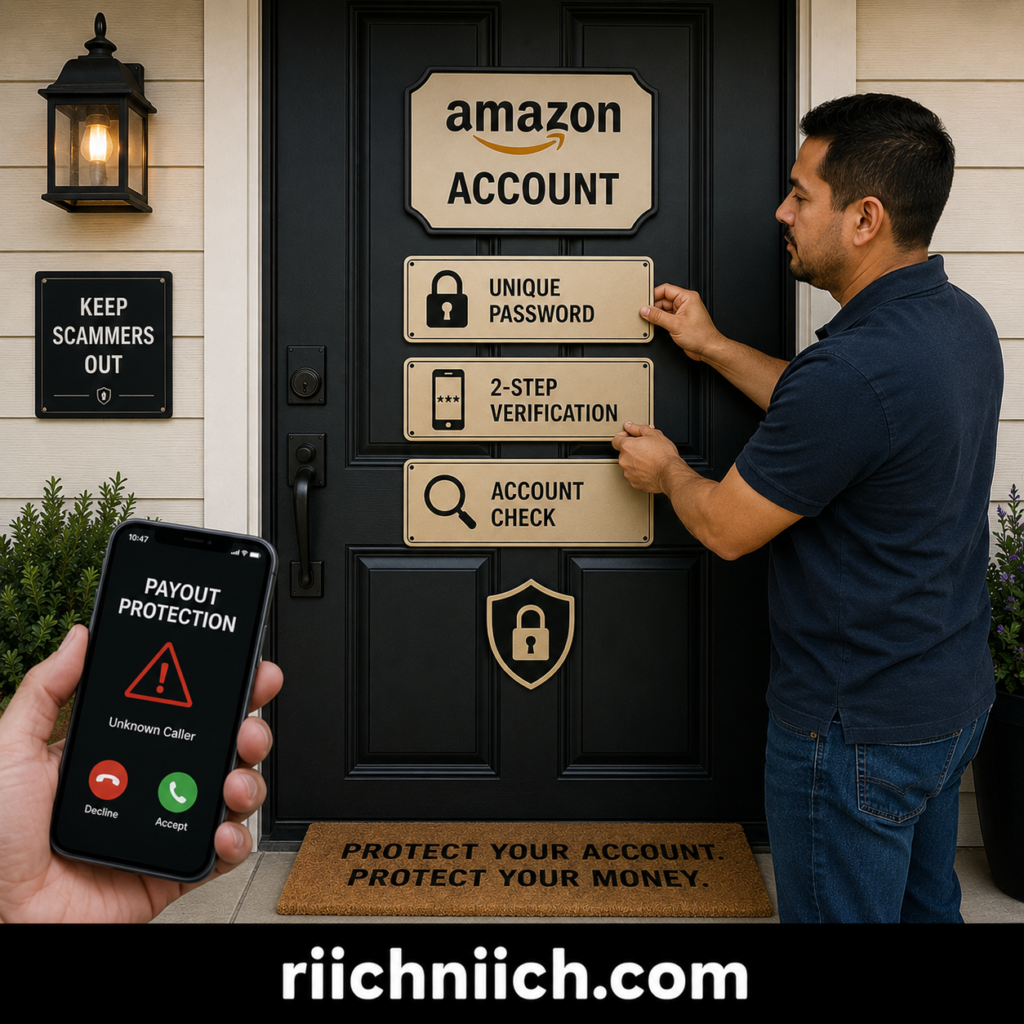
Change your Amazon password if there is any chance it was exposed
If you gave the suspicious caller your Amazon password—or entered it somewhere the caller directed you—change it immediately.
Go directly to Amazon rather than following a password-reset link sent by someone else.
Your new password should be unique to Amazon. If you were using the same password for Amazon and another important account, change it on the other account too.
Amazon recommends keeping your password confidential and avoiding common words or easily guessed information.
This is also where a password manager can be worth paying for.
If remembering dozens of unique passwords causes you to reuse the same ones, a reputable password manager can generate and store strong, unique credentials for your accounts. The biggest benefit isn’t convenience alone: compromising one password is much less damaging when that password doesn’t unlock five other accounts.
If you want help choosing one, compare our Best Password Managers to find the right option for protecting your Amazon, email, banking, and other important accounts.
Turn on two-step verification
A strong password should not be your only layer of protection.
Amazon offers two-step verification (2SV), which requires an additional one-time password when signing in. Amazon’s documentation says this additional security step means that someone who obtains your password cannot use the password alone to enter the account.
Amazon supports verification methods that include phone-based codes and authenticator apps.
If you haven’t enabled 2SV yet, this is one of the most valuable free security upgrades you can make after receiving an Amazon scam call.
Never give a verification code to a caller
Turning on two-step verification won’t help as much if you voluntarily hand the second security factor to a scammer.
Imagine someone claiming to represent Amazon says:
“I’m sending a security code to your phone. Please read that number back to me so I can verify your account.”
Don’t do it.
The FTC explains that scammers specifically target verification codes because the combination of your password and the code may allow them to get past two-factor authentication.
Treat your one-time security code like a temporary password:
It is for you to enter—not for someone on the phone.
Check your account information for unauthorized changes
Don’t stop at changing the password.
Review the information associated with your Amazon account and look for anything you don’t recognize.
Pay particular attention to:
- Email address
- Phone number
- Shipping addresses
- Payment methods
- Security settings
- Recent orders
- Account changes
Amazon’s own security guidance recommends reviewing account information after suspicious activity and changing the password immediately when there are signs of unauthorized access.
If you find an unfamiliar address, payment method, or other change, document it before correcting it in case you need the information when reporting the incident.
Review your Amazon orders and transactions
Look through your recent purchases rather than relying on what a caller tells you.
If someone says:
“There’s a suspicious purchase on your Amazon account.”
Don’t ask them for more information.
Check the account yourself.
The FTC specifically recommends logging into Amazon’s website or app to determine whether there is actually a suspicious purchase.
This is one of the easiest ways to break an Amazon impersonation scam: move the investigation away from the caller and into an account you accessed independently.
Secure the email account connected to Amazon
Your email account deserves just as much attention as Amazon.
Why?
Because email is often used for:
Password resets.
Security notifications.
Order confirmations.
Account-recovery messages.
Verification.
If someone gains control of the email address associated with your Amazon account, securing Amazon alone may not solve the entire problem.
Make sure your email account has a strong, unique password and multi-factor authentication as well.
If your Amazon and email accounts currently share the same password, change that.
This is another situation where a password manager becomes valuable. Instead of remembering variations of the same password, you can maintain separate credentials for Amazon, email, banking, social media, and other important accounts.
👉 If you want an easier way to keep separate passwords for all of those accounts, NordPass can generate and securely store unique passwords so you don’t have to rely on password reuse.
Watch for unexpected two-step verification requests
An unexpected Amazon security code can itself be a warning sign.
Amazon’s documentation identifies unexpected 2SV requests as one form of unusual account activity worth investigating. It recommends changing your password and reviewing account activity when suspicious behavior appears.
If you’re sitting at home and suddenly receive an Amazon verification code even though you weren’t trying to log in, don’t approve anything and don’t give the code to anyone who contacts you.
Someone could be attempting to access the account.
Don’t install software for “Amazon support”
An Amazon payout protection scam could potentially become much more dangerous if a caller convinces you to install remote-access software.
The FTC has documented Amazon impersonation scams involving remote computer access and warns consumers not to give remote access to someone who contacts them unexpectedly.
If a supposed Amazon representative says:
“Download this program so I can secure your account.”
“Let me connect to your computer.”
“Open your banking account while I’m connected.”
Stop.
Those requests should immediately change the way you view the call.
If you already installed software at an unexpected caller’s direction, secure the device before using it for sensitive activity. In that situation, purchasing a reputable antivirus or security suite may be worth considering, particularly if you want ongoing malware scanning, phishing protection, and additional device-security features.
Protect your saved payment methods
Amazon accounts often contain saved credit or debit cards, which makes account security especially important.
Review your payment methods and remove anything unfamiliar.
Then check the actual bank or card accounts associated with Amazon for suspicious transactions.
If you see charges you don’t recognize, contact the bank or card issuer using the number on your card, statement, or official banking app—not a number supplied by the suspicious caller.
If there is evidence that payment information was actually compromised, consider asking the issuer whether the card should be replaced.
Be prepared for follow-up scams
Don’t assume the Amazon payout protection voicemail will be the last communication.
After one suspicious contact, remain particularly cautious about subsequent calls, texts, and emails claiming to involve:
Amazon account security.
Refunds.
Suspicious purchases.
Identity theft.
Your bank.
Law enforcement.
Government agencies.
The second contact could sound more convincing because the caller may already know information about you.
The FTC warns that impersonation schemes can become elaborate, with scammers sometimes moving victims from a supposed Amazon problem into claims involving identity theft or financial accounts.
Should you pay for extra protection?
This depends on what actually happened.
If you simply received the amazon payout protection scam voicemail and never responded, you probably don’t need to start buying security subscriptions because of the voicemail alone.
Start with the free protections:
Use a unique password. Enable two-step verification. Review your Amazon account. Secure your email. Monitor your transactions.
But additional paid protection becomes easier to justify as your exposure increases.
A password manager can be worthwhile if password reuse is one of your security weaknesses.
A security or antivirus suite may be worthwhile if you’re concerned about phishing, malicious downloads, or device security.
A data removal service may be worth considering if you discover that your name, phone number, email, address, and other personal details are widely exposed through data brokers and people-search sites.
And identity theft protection can make more sense if sensitive identity or financial information was actually disclosed and you want ongoing monitoring, alerts, and recovery assistance.
The goal isn’t to buy every cybersecurity product available. It’s to match the protection to the risk you’re actually facing.
Keep Amazon security separate from the caller
The simplest way to protect yourself after the amazon payout protection scam is to create a hard boundary between the suspicious caller and your Amazon account.
Don’t use their phone number.
Don’t use their links.
Don’t install their software.
Don’t give them verification codes.
Instead, navigate to Amazon independently and manage your security from inside your legitimate account. The FTC’s guidance for Amazon impersonation scams follows the same principle: if you’re worried about an Amazon issue, verify it through Amazon’s website or app rather than trusting the person who unexpectedly contacted you.
The suspicious voicemail may have been designed to get you onto the phone. Strengthening your account directly means you can protect yourself without ever giving the caller that opportunity.
How To Protect Your Identity After an Amazon Impersonation Scam
Protecting your Amazon account is only part of the response to the amazon payout protection scam. If an impersonator obtained personal information—not just an Amazon password—you should also consider whether your identity itself could be at risk.
The level of protection you need depends on what happened. If you only received the voicemail and never called back, that alone does not mean someone stole your identity. But if you disclosed your Social Security number, date of birth, financial information, account credentials, or other sensitive data, taking additional precautions can help limit the damage.
The FTC recommends different recovery steps depending on what information was exposed. Its IdentityTheft.gov service can also create a personalized recovery plan if your information is actually being misused.
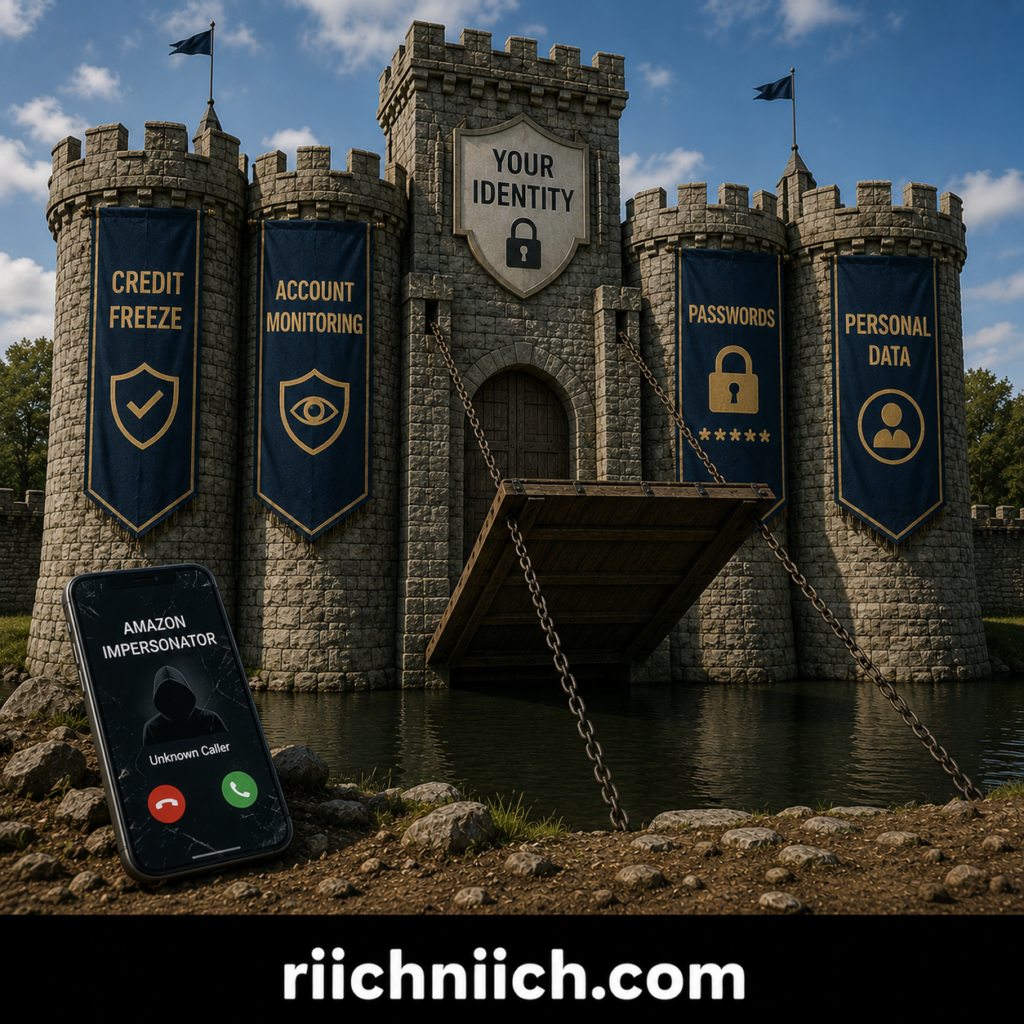
Start by identifying exactly what information was exposed
Before buying a security service or freezing every account you have, determine what the caller actually obtained.
There is a significant difference between a scammer knowing your:
Name and phone number
and having your:
Social Security number, banking credentials, passwords, verification codes, or payment-card information.
If the Amazon impersonation scam never progressed beyond the caller already knowing your name, your immediate identity-theft risk is much lower than it would be if you voluntarily disclosed highly sensitive information.
But if sensitive information was exposed, write down exactly what the caller received. That list will determine which accounts and protections need your attention.
Place a credit freeze if sensitive identity information was exposed
If someone obtained information that could potentially be used to apply for credit in your name, a credit freeze is one of the strongest free protections available.
A credit freeze prevents prospective creditors from accessing your credit report. Because lenders generally check your credit before opening an account, that can make it much harder for an identity thief to open new credit in your name.
The FTC says credit freezes are:
Free to place and lift, available to anyone, and do not affect your credit score.
You need to contact Equifax, Experian, and TransUnion separately to freeze all three credit files. A freeze remains in place until you lift it.
This is worth emphasizing because you do not need to purchase identity theft protection to freeze your credit. It’s a free protection available directly to consumers.
Consider adding a fraud alert
A fraud alert works differently from a credit freeze.
Rather than restricting access to your credit report, a fraud alert tells businesses to take additional steps to verify your identity before opening new credit in your name.
An initial fraud alert is free and lasts for one year. Unlike a credit freeze, you only need to contact one of the three nationwide credit bureaus to establish an initial fraud alert; that bureau must notify the other two.
If you’ve actually experienced identity theft and have an FTC Identity Theft Report or police report, you may qualify for an extended fraud alert lasting seven years.
A fraud alert can be useful, but don’t confuse it with a freeze. If preventing new credit accounts is your primary concern, the FTC describes a credit freeze as the stronger barrier.
Check your credit reports for accounts you don’t recognize
Don’t wait until a collection notice arrives.
Review your credit reports and look for:
- Credit cards you didn’t open
- Loans you don’t recognize
- Unfamiliar addresses
- Accounts you never applied for
- Other suspicious changes
The FTC identifies unfamiliar accounts on your credit reports as one potential sign of identity theft. It also recommends watching bank and credit-card statements for withdrawals and purchases you didn’t make.
If you discover fraudulent accounts, report the identity theft through IdentityTheft.gov. The service can generate an Identity Theft Report and personalized recovery plan to help you dispute fraudulent accounts and repair the damage.
Monitor your existing financial accounts too
A credit freeze primarily helps prevent new credit accounts from being opened. It does not prevent a criminal from misusing an account they can already access. The CFPB specifically notes this limitation.
That’s why you should also monitor your:
Checking accounts, savings accounts, credit cards, payment apps, and other financial accounts.
Look for small transactions as well as large ones. A transaction doesn’t have to empty your bank account to deserve investigation.
If you find something suspicious, contact the financial institution using its official app, website, statement, or the number printed on your card—not information supplied by the person who called you.
Secure your email account
Your email account can become a gateway to many other accounts.
If someone controls your email, they may potentially intercept security notifications or initiate password resets for other services.
Use a strong, unique password for your email and enable multi-factor authentication.
If you gave an impersonator a password that you also use for email, change your email password immediately.
The FTC recommends creating a new strong password after giving credentials to a scammer and changing that password anywhere else it was reused.
This is also where purchasing a password manager can make practical sense. If remembering unique passwords across dozens of accounts is causing you to reuse credentials, a password manager can generate and securely store different passwords for each account.
Watch for the second scam
After an Amazon scam call, don’t focus exclusively on Amazon.
If a scammer already has some of your information, another suspicious communication could claim to come from:
Your bank.
A credit bureau.
The FTC.
Law enforcement.
Another retailer.
A fraud department.
An identity protection company.
The story may change while the underlying goal remains the same: convince you to trust the caller because they already know something about you.
The CFPB recently reiterated that identity-theft victims should contact financial institutions and government agencies directly through official websites and numbers, noting that scammers even impersonate organizations such as the FTC.
So don’t let a caller’s knowledge of the earlier fake Amazon phone call automatically establish credibility.
Reduce unnecessary personal information online
Protecting your identity isn’t only about monitoring what happens after information is stolen. You can also work on reducing unnecessary information available in the first place.
Search your name, phone number, email address, and other identifying information online and see what appears.
You may discover information across:
People-search sites, data brokers, old accounts, public-facing profiles, and other databases.
You can submit opt-out requests yourself where removal is available.
But if your information appears across many data brokers and you don’t want to repeatedly manage individual removals, this is one of the strongest buyer-intent cases for a data removal service.
A reputable data removal service can automate opt-out requests across participating brokers and periodically check whether information reappears.
It cannot guarantee that scammers will never find your information. It cannot remove information from every database. And it cannot retrieve information already obtained by a criminal.
What you’re paying for is primarily automation, coverage, and ongoing removal work.
Consider identity theft protection if your exposure justifies it
After the amazon payout protection scam, you may wonder whether you should buy identity theft protection.
The answer depends heavily on what happened.
If you only received the voicemail: probably not solely because of this incident.
If you called back but disclosed nothing sensitive: additional paid protection may still be unnecessary.
If you disclosed highly sensitive identity or financial information: identity theft protection becomes much easier to justify.
Depending on the provider and plan, paid identity theft protection may combine features such as credit monitoring, identity monitoring, dark-web monitoring, alerts, restoration assistance, and identity theft insurance subject to the policy’s limitations and exclusions.
The advantage is largely convenience and assistance.
Many important protections remain available for free. You can freeze your credit yourself, place fraud alerts yourself, review your credit reports, monitor your financial accounts, change passwords, and use the FTC’s recovery resources without paying for a subscription.
But someone dealing with significant exposure may prefer having a service continuously monitoring multiple signals and providing recovery assistance if something goes wrong.
That’s where the purchase can offer real value.
Use IdentityTheft.gov if your information is actually being misused
If you discover that someone has opened accounts, made purchases, created debts, or otherwise used your identity, move beyond simple monitoring.
Report the identity theft through IdentityTheft.gov.
The FTC’s service creates an Identity Theft Report and personalized recovery plan based on what happened. That plan can include closing fraudulent accounts, removing fraudulent charges, correcting credit reports, and placing stronger fraud protections.
The CFPB likewise recommends reporting identity theft there and says victims should close affected accounts and contact the fraud or security departments of their financial institutions.
Build layers instead of relying on one product
There isn’t one product that makes identity theft impossible.
A stronger response to the amazon payout protection scam uses several layers:
Unique passwords protect individual accounts.
Multi-factor authentication adds another login barrier.
Credit freezes help prevent fraudulent new credit.
Account monitoring helps identify suspicious activity.
Data removal can reduce some publicly exposed personal information.
Identity theft protection can add monitoring and recovery assistance.
These protections solve different problems.
That’s also the best way to approach paid security products. Don’t buy a service because a scammer frightened you. Buy it when its specific features solve a risk or workload you would otherwise have to manage yourself.
If all you received was a suspicious voicemail, basic precautions may be enough. But if an Amazon impersonation scam exposed sensitive information, taking stronger identity-protection measures now can be considerably easier than trying to repair identity theft after the damage has already spread.
Can Identity Theft Protection Help After a Scam Call?
Yes, identity theft protection can help after a scam call, but whether it’s worth paying for depends on what actually happened.
If you only received the amazon payout protection scam voicemail and never called back, shared information, clicked a link, or gave anyone access to your device, buying identity theft protection solely because of the voicemail may be unnecessary.
The situation changes if you spoke with the caller and disclosed sensitive information such as your Social Security number, financial details, account credentials, or other personal data. At that point, ongoing monitoring and professional recovery assistance can become much more valuable.
The Consumer Financial Protection Bureau explains that identity theft services may monitor personally identifiable information across credit applications, public records, websites, and other sources for signs of misuse. Some services also provide help correcting problems if identity theft occurs.
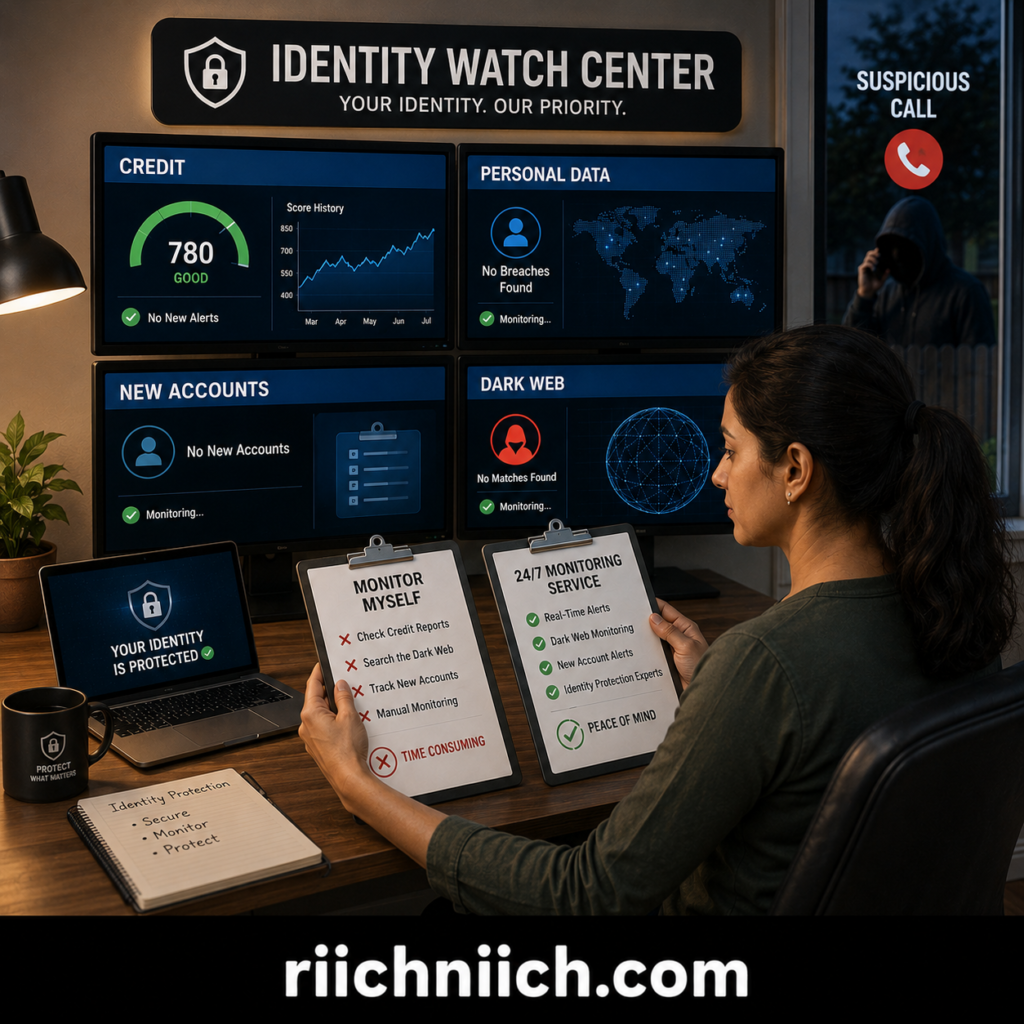
What does identity theft protection actually do?
Identity theft protection doesn’t create an invisible shield around your identity.
Instead, depending on the provider and plan, a service may combine several tools, including:
- Credit monitoring
- Identity monitoring
- Alerts about suspicious changes
- Monitoring of certain websites where stolen information may circulate
- Public-record monitoring
- Identity recovery assistance
- Identity theft insurance
The exact features vary considerably by provider and plan, which is why you should compare what is actually monitored rather than choosing a service based only on the words “identity theft protection.”
The FTC explains that credit monitoring can alert you to certain changes on your credit reports, such as a new credit card or loan appearing. Broader identity monitoring may look beyond credit reports for signs that your information is being used elsewhere.
Identity theft protection is better at detection than prevention
This distinction is extremely important after an Amazon impersonation scam.
Identity theft protection generally cannot stop someone from stealing information in the first place.
The CFPB specifically cautions that most credit-monitoring services do not prevent personal information from being stolen; they typically alert you to certain activity after something has changed.
Think of it like a home alarm system.
The alarm doesn’t make burglary physically impossible. Its value comes from detecting suspicious activity quickly and helping you respond.
That’s a more realistic way to evaluate identity theft protection.
When identity theft protection may be worth paying for
After an amazon payout protection scam, I’d consider paid identity theft protection much more seriously if you disclosed information that could create an ongoing identity-fraud risk.
For example, it may be worth considering if a scammer obtained your:
Social Security number, date of birth combined with other identifying information, financial-account details, important account credentials, or enough personal information that you’re genuinely concerned about identity misuse.
It may also be worthwhile if you simply don’t want to monitor multiple sources yourself.
That’s really where the buyer intent lies.
You’re not necessarily paying for something you cannot do without the service. You’re paying for automation, broader monitoring, faster alerts, and potentially professional assistance if identity theft occurs.
For someone with significant exposure who doesn’t want to continuously check everything manually, that convenience can justify the subscription cost.
Recovery assistance may be one of the most valuable features
Monitoring gets most of the attention, but identity restoration assistance can be equally important.
The FTC explains that some identity recovery services provide counselors or case managers who can help victims work through the recovery process. Depending on the service, they may help prepare communications to creditors and debt collectors, deal with documents, or assist with credit freezes. Some services can even communicate with institutions on your behalf when properly authorized.
That’s worth considering when comparing identity theft protection services.
A flashy dashboard showing your credit score may be less valuable during an actual identity-theft event than having access to someone who can help you work through the recovery process.
What about identity theft insurance?
Many paid identity theft protection plans advertise insurance.
Read the details carefully.
Identity theft insurance does not necessarily reimburse money that a scammer steals from you.
The FTC explains that identity theft insurance may cover certain expenses associated with recovering your identity, such as document costs, lost wages, or legal expenses, depending on the policy. Coverage, deductibles, exclusions, and reimbursement limits vary.
So don’t choose a plan simply because the advertisement says:
“$1 million identity theft insurance.”
Find out what that number actually covers.
What identity theft protection cannot do
This is just as important as understanding what it can do.
A paid service generally cannot guarantee that:
Your identity will never be stolen.
A scammer will never contact you again.
Nobody will ever open an account in your name.
Your information will disappear from the internet.
Every type of identity fraud will be detected.
The CFPB notes that monitoring services vary widely in what they cover, while the FTC points out that some types of misuse may not appear in standard credit or identity monitoring.
That’s why we would be skeptical of any identity theft protection product marketed as though paying a subscription makes identity theft impossible.
It doesn’t.
Don’t overlook the protections you can get for free
Before paying for identity theft protection after the amazon payout protection scam, use the free protections available to you.
One of the strongest is a credit freeze.
A security freeze prevents prospective creditors from accessing your credit file, making it much harder for an identity thief to open new credit accounts in your name. Under federal law, freezing and unfreezing your credit with Equifax, Experian, and TransUnion is free.
A credit freeze is particularly important because you do not need to pay an identity protection company to get one.
You can also review your credit reports, monitor financial accounts, use strong unique passwords, enable multi-factor authentication, and report actual identity theft through IdentityTheft.gov.
If your identity has already been stolen, the CFPB recommends closing affected accounts, contacting the fraud departments of financial institutions, reporting the theft through IdentityTheft.gov, and considering fraud alerts or security freezes.
Identity theft protection vs. credit monitoring
Don’t assume these are exactly the same product.
Credit monitoring primarily watches your credit reports for changes.
Identity monitoring may search additional sources for signs that your personal information is being misused.
A more comprehensive identity theft protection package may combine both with restoration assistance and insurance.
The CFPB notes that identity monitoring services may examine personally identifiable information in credit applications, public records, websites, and other places for unusual activity.
For someone whose Social Security number or other highly sensitive information was exposed during a fake Amazon phone call, broader identity monitoring may therefore be more relevant than a basic one-bureau credit-monitoring plan.
What should you look for before buying?
If you decide identity theft protection is worth paying for, compare the substance of the plans rather than choosing whichever company has the biggest advertisement.
We would prioritize:
Three-bureau credit monitoring rather than monitoring only one credit bureau.
Identity monitoring beyond credit reports.
Fast, useful alerts.
Dark-web or compromised-credential monitoring where offered.
Professional identity restoration assistance.
Clear insurance terms and exclusions.
Transparent pricing and cancellation terms.
Ready to compare your options? See our Best Identity Theft Protection Services to compare leading providers, features, monitoring, recovery support, and overall value before you buy.
The CFPB specifically recommends understanding exactly what you’re receiving before subscribing because prices and features vary widely.
This is also why comparing reputable identity theft protection services before purchasing makes more sense than signing up for the first company you see immediately after a frightening scam call.
So, should you buy identity theft protection after this scam?
Here’s the simplest way we would decide.
If you only received the voicemail and never engaged, start with free account-security measures and monitoring.
If you called back but didn’t disclose sensitive information, continue monitoring your accounts and remain alert for follow-up scams.
If you gave away highly sensitive personal or financial information, paid identity theft protection becomes considerably more attractive—especially if you want someone else continuously monitoring for suspicious activity and helping you recover if your identity is misused.
👉 If sensitive personal information was exposed and you want ongoing monitoring and recovery support, see what Identity Guard offers and choose the level of protection that fits your situation.
And if identity theft has actually occurred, don’t rely solely on a commercial monitoring service. Report it through IdentityTheft.gov and take direct steps such as securing compromised accounts and freezing your credit. The CFPB’s current identity-theft guidance recommends these actions immediately after confirmed identity theft.
The amazon payout protection scam doesn’t automatically mean you need another monthly subscription. But if sensitive information has genuinely been exposed, a good identity theft protection service can provide monitoring, alerts, and recovery assistance that may be worth paying for—particularly if you’d rather not manage all of that monitoring yourself.
Can a Data Removal Service Reduce the Personal Information Scammers Can Find?
Yes. A data removal service can help reduce the amount of personal information available through participating data brokers and people-search sites, which may make it harder for scammers to quickly find details they could use to personalize a call. But it cannot erase you from the internet or guarantee that you’ll never receive another scam call.
That distinction matters when discussing the amazon payout protection scam.
The voicemail we received already contained one piece of accurate information: the recipient’s first name. We don’t know where the caller obtained it, and we should not assume it came from a data broker. However, people-search sites can make information such as names, addresses, phone numbers, and related details available to others. The FTC confirms that consumers generally have two options for opting out of these sites: do it yourself for free or pay a service to handle opt-outs for you.
Want to remove those listings yourself? Follow our How to Opt Out of Data Brokers guide for a step-by-step process for finding data broker profiles and submitting removal requests.
For someone who discovers their personal information scattered across numerous sites, paying for a data removal service can therefore be a practical privacy investment—particularly if you don’t want to manage dozens of opt-out requests yourself.

What does a data removal service actually do?
Data removal services typically search participating data brokers and people-search sites for information associated with you and submit opt-out or deletion requests on your behalf.
Depending on the service, that could involve information such as your:
- Name
- Phone number
- Email address
- Home address
- Age or date-of-birth information
- Previous addresses
- Other identifying information
The exact information that can be removed depends on the data broker, applicable law, the service you’re using, and where the information originated.
This isn’t just a theoretical privacy issue. California’s privacy regulator defines data brokers as businesses that gather and sell consumer information the consumer didn’t provide directly to them. California’s new DROP system allows eligible California residents to send one deletion request covering more than 600 registered data brokers, demonstrating just how large the data-broker ecosystem has become.
Could removing your information actually reduce scam calls?
Potentially—but don’t expect a guarantee.
Reducing the availability and sale of your personal information can remove some of the raw material used for targeted marketing, spam, and potentially fraud.
California’s privacy regulator specifically says limiting how personal data is sold can reduce unwanted texts, calls, and emails, although results vary and may take time. It also says limiting the spread of personal information can reduce the risk of identity theft and targeted fraud.
That’s an important distinction.
A reputable data removal service shouldn’t promise:
“Pay us and scammers won’t be able to find you.”
That’s unrealistic.
A better expectation is:
“Reduce unnecessary exposure so there are fewer easy places for strangers to obtain information about you.”
For someone concerned about an Amazon scam voicemail where the caller already knew their name, that’s a much more defensible reason to consider data removal.
What information can’t a data removal service erase?
Data removal has limitations.
The FTC warns that opting out of people-search sites does not necessarily remove your information from public records. Information may also continue appearing in records associated with relatives, neighbors, or other people, and previously removed information can sometimes reappear.
A data removal service also cannot retrieve information that:
A scammer already downloaded.
Was exposed in a previous data breach.
Must remain publicly available by law.
Exists on a service the removal company doesn’t cover.
Is stored privately by businesses with a legitimate or legally permitted reason to retain it.
And no data removal service can guarantee that your information will never appear online again.
That’s why we would avoid any service making claims that sound like “complete internet erasure.”
Data removal is different from identity theft protection
These two services solve different problems.
A data removal service primarily focuses on reducing information available through covered data brokers and people-search sources.
An identity theft protection service primarily focuses on detecting potential misuse of your identity and helping you respond if something goes wrong.
Think about the difference this way:
Data removal asks:
“How can I reduce unnecessary personal information that’s already circulating?”
Identity theft protection asks:
“How can I detect and respond if someone starts misusing my information?”
Someone concerned about the amazon payout protection scam could potentially benefit from either, both, or neither depending on what happened.
If you merely received a voicemail and never engaged, identity theft protection may be unnecessary solely because of that incident.
But if searching yourself reveals pages of exposed personal information across people-search sites, data removal addresses a problem you can actually see.
Can you remove the information yourself for free?
Absolutely.
This is important from a buyer-intent perspective because readers should know what they’re paying for.
The FTC says you can opt out of people-search sites yourself one by one for free, or pay a service to do it for you.
If you’d rather start with the DIY approach, our guide on How to Remove Your Personal Information From the Internet walks you through finding exposed information and removing it yourself step by step.
So you’re generally not paying because removal is impossible without a subscription.
You’re paying for:
Convenience.
Automation.
Coverage across multiple sites.
Recurring scans.
Repeated removal requests when information returns.
Less time spent finding and completing individual opt-out procedures.
If you’re comfortable handling dozens of opt-outs and periodically checking whether your information has reappeared, the DIY approach can save money.
If that sounds like something you’ll start and never finish, paying for automation may be worthwhile.
There may also be free privacy tools available where you live
Before paying for a data removal service, check whether your state provides privacy rights or centralized deletion tools.
California provides an especially strong current example. Its Delete Request and Opt-out Platform (DROP) allows California residents to submit one request directing registered data brokers to delete and stop selling qualifying personal information. The service is free.
As of August 1, 2026, registered data brokers are required to begin processing DROP deletion requests at least every 45 days, subject to applicable exemptions.
That doesn’t mean residents everywhere have identical rights, but it demonstrates why you should check the free options available to you before buying a commercial service.
When is a paid data removal service worth it?
We would consider paying for one when three things are true:
Your information is widely exposed. Searching your name, phone number, or email reveals numerous people-search and data-broker listings.
You value your time. You don’t want to find individual opt-out pages, verify requests, maintain a spreadsheet, and periodically repeat the process.
You want ongoing removal. You’re looking for a service that continues checking participating brokers instead of performing a one-time cleanup.
The FTC specifically notes that information can reappear on people-search sites when public records change, which is one reason recurring monitoring can have value.
For someone in that situation, paying for a reputable data removal service can make sense.
👉 If you’d rather automate the process than repeatedly chase data brokers yourself, see how Incogni can help remove your personal information from participating data brokers and continue sending removal requests over time.
What should you compare before buying a data removal service?
Don’t choose one based solely on the number of websites advertised on the homepage.
Look closely at:
Broker coverage: How many meaningful data brokers and people-search sites are actually covered?
Recurring scans: Does the service check whether your information comes back?
Removal frequency: How often are new requests submitted?
Reporting: Can you see where your information was found and what was removed?
Custom removals: Can you request removal from a site the automated system didn’t detect?
Family coverage: Can other household members be included if you need it?
Pricing: Is the subscription cost reasonable compared with the amount of manual work it replaces?
Cancellation and privacy policies: You’re giving a privacy company personal information so it can locate your records. Understand how that information is handled.
This is where comparing reputable services before purchasing becomes important. The best data removal service isn’t necessarily the one advertising the largest number—it’s the one whose coverage, removal frequency, privacy practices, and price match what you actually need.
Data removal should be one layer, not your entire defense
Even the best data removal service won’t stop every fake Amazon phone call.
Use it alongside other protections:
Unique passwords.
Multi-factor authentication.
Credit freezes when appropriate.
Careful verification of unexpected calls.
Account and financial monitoring.
Identity theft protection when the exposure justifies it.
Healthy skepticism when a stranger already knows something about you.
The amazon payout protection scam illustrates why that last point matters.
The caller knowing your name can make a voicemail sound legitimate, but personal information isn’t authentication.
If your information is widely exposed online, reducing that exposure is worthwhile. You can do the work yourself for free where opt-outs are available, take advantage of government privacy tools available to you, or pay a data removal service to automate much of the process.
The service won’t make you invisible. But for someone who wants less personal information circulating through data brokers—and doesn’t want data removal to become another recurring chore—the convenience can be worth paying for.
How To Tell If a Call or Message Is Really From Amazon
The safest way to determine whether a call, voicemail, text, or email is really from Amazon is not to trust the communication itself. Instead, verify the claim independently through your Amazon account.
That rule is especially important with the amazon payout protection scam because a suspicious message can look or sound surprisingly legitimate. A caller may know your name, use Amazon-related terminology, leave a professional voicemail, or even appear to be calling from a familiar number.
None of those things proves the caller is actually Amazon.
The FTC warns that scammers can spoof caller ID to make a call appear to come from Amazon. If you’re concerned about a supposed Amazon purchase or account problem, the FTC recommends logging in through Amazon’s website or app rather than calling a number provided in an unexpected voicemail or text.
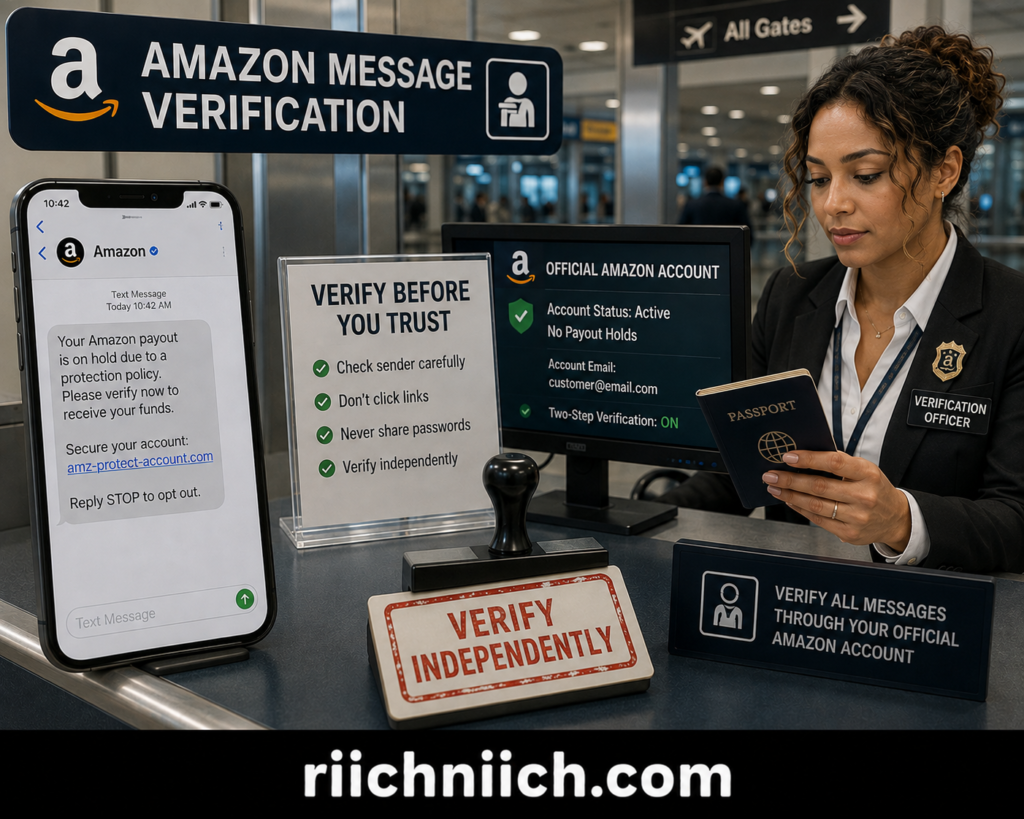
Don’t use caller ID as proof
Seeing “Amazon” on your phone doesn’t mean Amazon is calling.
Caller ID can be spoofed.
The FTC specifically warns consumers not to trust caller ID when evaluating an unexpected Amazon call because scammers can manipulate the number displayed on your phone.
The same applies if the number looks local.
And a caller knowing your name doesn’t authenticate them either.
That matters with the Amazon payout protection voicemail we received because the caller began by using the recipient’s name. Personalization makes a call feel more credible, but it does not prove the caller has any connection to your Amazon account.
Check Amazon yourself instead of calling back
Suppose you receive a voicemail saying:
“There’s a problem with your Amazon account.”
Or:
“We’re calling about Payout Protection for your Amazon account.”
Don’t call the supplied number to find out whether the claim is legitimate.
Open the Amazon app yourself or navigate independently to Amazon and check your account.
Look for an actual problem involving your:
Orders, payments, account information, security settings, or other account activity.
The FTC recommends exactly this approach for suspicious Amazon calls and texts: check your account through Amazon’s website or app instead of using the callback number provided in the message.
This is one of the strongest habits you can develop for recognizing an Amazon impersonation scam:
The person making the claim shouldn’t also control how you verify the claim.
Be suspicious if the caller asks for sensitive information
Pay close attention to what the supposed Amazon representative asks you to provide.
Amazon guidance for sellers says Amazon will not ask callers for sensitive information such as an Amazon password, bank-account PIN, full credit-card number, credit-card security code, or security-question answers.
Amazon’s KDP security guidance similarly states that although calls may occur in rare circumstances, KDP will not ask for sensitive information such as a password, full bank-account details, or credit-card number over the phone.
So if a supposed Amazon representative starts asking you to “verify” sensitive credentials, treat that as a major warning sign.
Never give a caller your verification code
A caller may attempt to make this sound completely normal.
They might say they’re sending a code to your phone to:
Confirm your identity.
Secure your Amazon account.
Cancel a transaction.
Verify that you’re the account owner.
Don’t assume the request is legitimate simply because a real security code arrives.
A scammer attempting to access your account could trigger a genuine verification code and then try to persuade you to hand it over.
A legitimate security feature can therefore become part of the scam.
If you receive an unexpected verification code, go directly to the associated account and investigate rather than giving the code to someone who contacted you.
Watch for requests to install software
Another major warning sign is a supposed Amazon representative asking you to download software or grant remote access to your computer.
The FTC has documented Amazon impersonation scams involving remote access and warns consumers not to give remote computer access to someone who contacts them unexpectedly. Doing so can expose personal and financial information, including online banking accounts.
If someone claiming to represent Amazon says:
“I need to connect to your computer.”
“Install this security application.”
“Open your bank account while I’m connected.”
Stop.
That’s not how you should verify an Amazon account problem.
Be extremely suspicious of requests for unusual payments
A genuine Amazon-related issue should not turn into instructions to buy gift cards, wire money, send cryptocurrency, or transfer money somewhere to “protect” it.
Amazon Pay specifically warns consumers against sending money or gift-card claim codes to someone claiming that Amazon or Amazon Pay will guarantee a transaction, refund the funds, or hold money in escrow.
The FTC also identifies gift-card demands as a hallmark of Amazon impersonation scams.
This is particularly relevant to the amazon payout protection scam because the word “Protection” could make a financial request sound plausible.
Never move money merely because someone says doing so will “protect” your Amazon account.
Check links before trusting an Amazon email or text
A fake Amazon message may direct you to a website that looks almost identical to Amazon.
The purpose can be to trick you into entering your Amazon username, password, payment information, or other credentials.
Amazon Pay warns that spoofed emails can link to fraudulent websites designed to resemble legitimate Amazon pages. Its guidance recommends checking the actual destination rather than assuming visible link text is genuine.
An even safer approach for an unexpected Amazon message is:
Don’t click the link at all.
Open Amazon yourself.
The FTC gave the same advice in a 2025 warning about fake Amazon refund texts: don’t click links in unexpected messages; check your Amazon account independently through the website or app.
Examine the actual sender address on emails
Don’t rely solely on the display name.
An email might display:
Amazon Customer Service
while actually originating from an unrelated address.
Amazon Pay recommends checking the return address when evaluating suspected phishing messages and warns that fraudulent messages may use addresses designed to look Amazon-related.
Amazon’s seller guidance likewise advises examining the actual sender address rather than relying on the displayed sender name.
However, don’t make email-address inspection your only security test. Sender information can be forged, and phishing techniques continue to improve.
Independent account verification is still safer.
Don’t assume good grammar means the message is legitimate
Misspellings, awkward grammar, strange formatting, and obvious errors can certainly be warning signs.
Amazon Pay specifically advises consumers to look for grammatical and typographical errors when identifying phishing messages.
But here’s the important part:
A perfectly written message can still be a scam.
The voicemail we received is a good example of why.
It was short.
Professional.
Polite.
There was no screaming.
No outrageous threat.
No obvious grammatical disaster.
That’s why you shouldn’t depend on the old rule that scam messages always “look fake.”
Evaluate what the sender wants you to do, not merely how professional the message sounds.
Look for urgency—but remember that some scams are intentionally calm
Many scams attempt to create urgency.
You may be told:
Your account will be suspended.
Someone made a large purchase.
Your identity has been stolen.
Your money is at risk.
But the amazon payout protection scam demonstrates another possibility: curiosity instead of panic.
The voicemail we received simply asked for a callback “at your earliest convenience.”
There was no major threat.
That makes an important point for readers searching does Amazon call customers or trying to determine whether an Amazon voicemail is real:
Lack of urgency doesn’t automatically make a message legitimate.
A calm scammer is still a scammer.
Does Amazon ever call customers?
Amazon-related phone calls can occur in legitimate circumstances, so the rule should not be simplified to “Amazon never calls anyone.”
For example, Amazon’s KDP documentation explicitly says that it may call users in rare circumstances. However, it also states that KDP will not request sensitive information such as passwords, full bank-account information, or credit-card numbers over the phone.
So the better answer to does Amazon call customers is:
Amazon may contact customers or users in some circumstances, but an unexpected caller claiming to represent Amazon should never be trusted solely because they know your name, know something about your account, or appear to call from an Amazon-related number.
Verify independently.
That’s much safer than trying to memorize every legitimate reason Amazon might call.
Use this simple Amazon verification test
When you receive an unexpected Amazon call, voicemail, email, or text, ask yourself four questions:
Did I initiate this interaction?
Can I confirm the supposed problem inside my Amazon account?
Is the person asking for passwords, verification codes, financial information, remote access, or unusual payments?
Can I verify everything without using the phone number or link they provided?
If you cannot independently verify the claim, don’t continue the interaction.
This simple test is far more reliable than judging the person’s voice, caller ID, professionalism, or knowledge of your name.
What if you’re still unsure?
End the communication.
Then contact Amazon through a channel you independently know is legitimate.
The FTC recommends this broader strategy for impersonation scams: when you’re unsure whether a communication is genuine, contact the business using contact information you looked up yourself rather than information supplied in the suspicious communication.
Amazon also provides mechanisms for reporting suspicious communications, while suspicious phishing emails should not be opened, replied to, or used to access attached links.
The same principle applies whether you’re dealing with an Amazon payout protection call, suspicious purchase notification, refund message, security warning, or another Amazon-related communication.
Security tools can help—but verification remains your strongest defense
You don’t necessarily need to purchase a security product simply because you received the amazon payout protection scam voicemail.
But different tools can strengthen different parts of your defense.
A password manager can help prevent password reuse.
A security suite can add phishing, malicious-site, and malware protection depending on the product.
A data removal service can help reduce personal information available through participating data brokers and people-search sites.
And identity theft protection can provide monitoring and recovery assistance if sensitive personal information has actually been exposed.
Those can all be useful purchases in the right situation.
But none replaces the most important habit:
When someone unexpectedly claims to be Amazon, don’t let that person control the verification process.
Open Amazon independently. Check the account yourself. And if you cannot confirm what they’re telling you through a legitimate channel, don’t give them information, money, codes, or access.
That one habit can stop an amazon payout protection scam before a professional-sounding voicemail becomes a much bigger problem.
How To Report an Amazon Payout Protection Scam
If you receive an amazon payout protection scam voicemail, reporting it can help Amazon, regulators, phone carriers, and law enforcement identify patterns behind Amazon impersonation attempts.
You don’t need to have lost money before making a report. In fact, the FTC specifically accepts reports about unwanted scam calls even when no financial loss occurred. The most useful reports include details such as the number that received the call, the number shown on caller ID, any callback number provided, and the date and time of the call.
For the voicemail we received, that means the exact wording, the name “Ashley,” the callback number, and the date and time of the call are all details worth preserving.
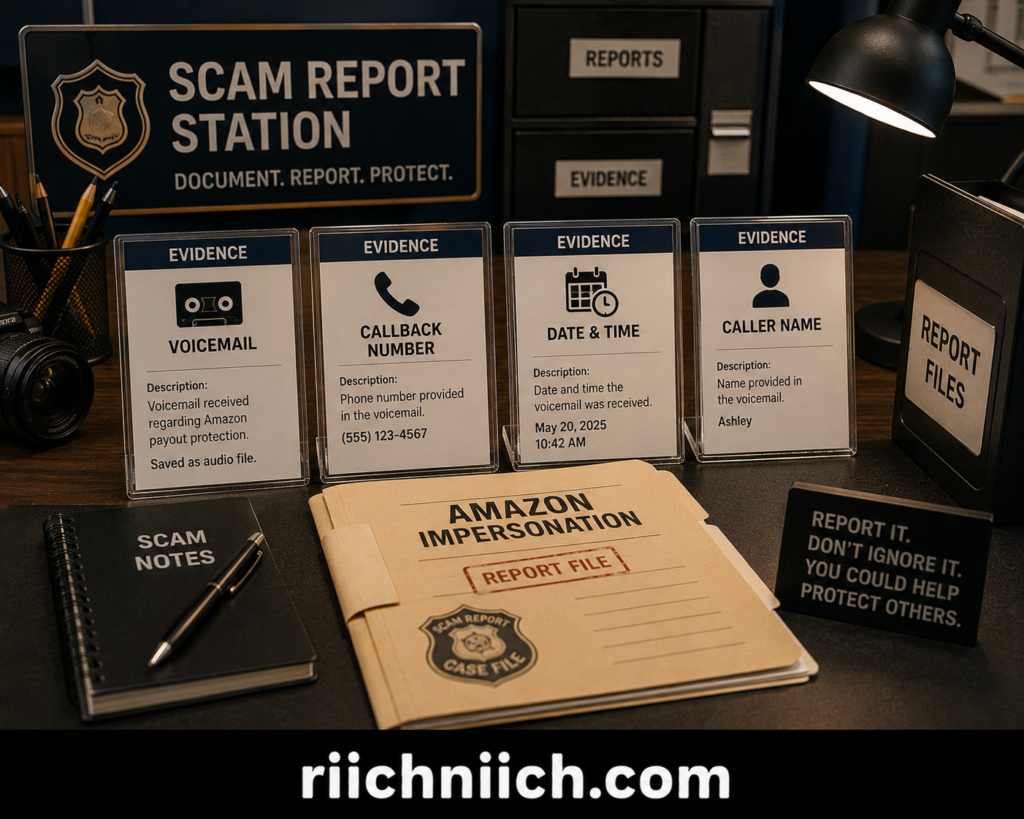
1. Save the voicemail before deleting it
Don’t immediately erase an Amazon payout protection voicemail.
First, preserve whatever information you have.
That may include:
- The voicemail recording
- Exact transcript of the message
- Caller ID number
- Callback number
- Date and time
- Name used by the caller
- Screenshots of the call history
- Any follow-up texts or emails
For example, our voicemail said:
“Hi Riich, this is Ashley calling about payout Protection for your Amazon account. Please give me a call back at your earliest convenience. Thank you.”
Saving the exact language is more useful than trying to reconstruct the message from memory later.
The FTC specifically asks consumers reporting suspicious calls to include the caller-ID number—even when they believe it may be fake—as well as any callback number and the date and time of the call.
2. Report the suspicious communication to Amazon
Because the caller is claiming to contact you about an Amazon account, Amazon should be one of the places you report it.
Amazon representatives have directed users to report suspicious communications to reportascam@amazon.com, and Amazon provides reporting mechanisms for suspected impersonation attempts.
When reporting the amazon payout protection scam, provide as much factual information as possible without speculating about what the caller intended to do.
You could report:
Caller name: Ashley
Claim: Calling about “Payout Protection” for an Amazon account
Contact type: Voicemail
Action requested: Call the supplied number back
Did you return the call?: No
Did you provide information?: No
Then include the exact voicemail transcript and phone-number information.
That gives Amazon something concrete to investigate.
3. Report the scam to the FTC
The FTC is another important place to report an Amazon impersonation scam.
If you lost money or have information about the scammer, the FTC directs consumers to ReportFraud.ftc.gov. If you didn’t lose money and simply want to report an unwanted call, the FTC directs consumers to DoNotCall.gov.
When filing a fraud report, you can identify the incident as an impersonator scam involving someone pretending to represent a well-known or trusted business. The FTC says reports contribute to investigations, enforcement efforts, and understanding emerging scam trends.
That’s particularly valuable with an unusual phrase such as “Payout Protection.”
If other consumers begin receiving the same Amazon payout protection call and report similar wording, callback numbers, or tactics, those individual reports can collectively reveal a larger pattern.
4. Report an unwanted call even if you didn’t lose money
This is especially relevant to our situation.
We didn’t call the number back.
We didn’t give the caller information.
We didn’t send money.
That doesn’t mean the voicemail can’t be reported.
The FTC specifically says consumers who didn’t lose money and simply want to report an unwanted call can use DoNotCall.gov.
When reporting, include both the number displayed on caller ID and any different number the voicemail instructed you to call.
That’s important because the FTC warns that caller ID can be spoofed. In documented Amazon impersonation scams, scammers have manipulated caller ID to make it appear that Amazon was calling.
5. Consider reporting the call to the FCC
The Federal Communications Commission also accepts complaints involving unwanted calls, texts, and caller-ID spoofing.
The FCC says unwanted-call complaints provide information that can support policy and enforcement efforts, although filing a complaint does not mean the FCC will individually resolve your particular call.
For an unwanted call, the FCC instructs consumers to select “unwanted calls/texts” as the phone issue and the appropriate unwanted-call subcategory.
The FCC also recommends including as much information as possible in reports about impersonation calls, such as the caller-ID number, number receiving the call, time of the call, and any recording or screenshot available.
6. Report it to your phone carrier when appropriate
Your mobile carrier or phone may also provide a Report Spam, Report Junk, or similar option.
Use it when available.
Phone carriers use scam-detection and call-labeling systems to identify suspicious traffic. The FTC says phone numbers submitted through its reporting systems are also shared with partners working on call-blocking and call-labeling solutions.
After you’ve preserved the evidence you need, you can also block the number.
Just remember that blocking one number doesn’t guarantee the caller cannot contact you again from another number.
7. If you lost money, reporting is not your first step
If the amazon payout protection scam resulted in an actual payment, your priorities change.
Contact the financial institution or payment provider first.
Depending on how you paid, that could mean your:
Bank.
Credit-card issuer.
Debit-card issuer.
Payment app.
Wire-transfer company.
Gift-card company.
Tell them that the transaction was connected to a suspected scam and ask whether it can be stopped, reversed, disputed, or recovered.
Then file a fraud report with the FTC.
The FTC specifically directs people who lost money to a phone scam to ReportFraud.ftc.gov rather than merely submitting an unwanted-call report.
Reporting is important, but trying to stop the financial damage takes priority.
8. If your identity was compromised, use IdentityTheft.gov
If the fake Amazon phone call resulted in someone obtaining sensitive personal information or actually misusing your identity, don’t stop with a scam report.
The FTC directs consumers who believe someone has gained access to their accounts or personal information to IdentityTheft.gov, where they can get steps for determining whether their identity has been misused and recovering from identity theft.
This becomes particularly important if you discover fraudulent accounts, unauthorized transactions, or other evidence that your personal information is actively being misused.
Should you report the scam even if nothing happened?
Yes, we would.
Our situation is a good example.
We received an unexpected voicemail referring to “Payout Protection” for an Amazon account. The caller knew the recipient’s first name and asked for a callback.
We didn’t call.
We didn’t provide information.
We didn’t lose money.
But those facts don’t make the report worthless.
The FTC says reports about unwanted calls help identify illegal callers and calling patterns, assist law enforcement, and provide information to partners working on call-blocking and labeling technology.
In other words, you don’t have to become a victim before your information becomes useful.
Reporting the scam doesn’t replace protecting yourself
Reporting the amazon payout protection scam is one part of the response—not the entire response.
If you only received the voicemail, preserve the evidence, report it, block the number, and independently check your Amazon account.
If you exposed an Amazon password, secure the account.
If you exposed financial information, contact the relevant financial institution.
If sensitive identity information was compromised, consider credit freezes, identity monitoring, and the FTC’s identity-theft recovery resources.
And if the incident reveals that large amounts of your personal information are publicly exposed, a data removal service may be worth considering to automate opt-outs across participating data brokers. If sensitive information was actually compromised, a reputable identity theft protection service may also be worth paying for if you want ongoing monitoring, alerts, and professional recovery assistance.
Those services don’t replace reporting, and reporting doesn’t replace security.
Your report could help identify a larger pattern
The unusual thing about this particular amazon payout protection scam is the wording.
“Payout Protection” sounds official enough to create curiosity, yet the voicemail provides almost no explanation.
That makes preserving the exact terminology particularly important.
If you receive a similar voicemail, don’t call the number back just to investigate it. The FTC’s guidance on Amazon impersonation scams is to use Amazon’s website or app instead of a callback number supplied in an unexpected voicemail or message.
Document it.
Report it to Amazon.
Report it to the FTC.
Consider an FCC complaint when appropriate.
Then block the number and move on—unless you actually shared information or lost money, in which case securing your accounts and finances becomes the immediate priority.
The more accurately consumers report an amazon payout protection scam, the better chance Amazon, regulators, phone carriers, and law enforcement have of recognizing the pattern behind these calls.
Common Amazon Impersonation Scams To Watch For
The amazon payout protection scam is only one example of a much larger problem: scammers using Amazon’s name to make an unexpected call, voicemail, email, or text message seem trustworthy.
Amazon says impersonators use multiple channels—including phone calls, texts, emails, and social media—and its recent customer reports show scams involving account access, fake orders, shipping problems, refunds, membership renewals, and product recalls. Amazon says 28% of Amazon impersonation scams reported by customers globally in 2025 involved attempts to gain access to customer accounts.
The stories change, but the objective is often similar: get you to click, call, pay, install something, or disclose information before you independently verify the claim.

1. Fake Amazon order confirmation scams
This is one of the classic Amazon impersonation tactics.
You receive a call, text, or email claiming that an expensive item has been purchased through your Amazon account.
Maybe it’s a laptop.
A television.
A smartphone.
Or another expensive product you know you didn’t order.
The message may provide a phone number to call if you want to cancel or dispute the purchase.
That’s the hook.
Amazon says fake order confirmations remain a common impersonation tactic, and its 2026 scam-trend guidance specifically warns about fraudulent purchase updates designed to look like legitimate Amazon communications.
Instead of calling the number, open Amazon yourself and check Your Orders.
If the supposed $1,200 laptop isn’t in your Amazon account, don’t let a stranger on the phone convince you otherwise.
2. Fake Amazon refund scams
Refunds are especially effective bait because the scammer appears to be offering you money instead of asking for it.
The FTC documented a 2025 Amazon phishing campaign involving text messages claiming there was a problem with a product the recipient purchased. The message offered a full refund if the recipient clicked a link. There was no real refund—the link was designed to steal personal information or money.
Another version can become much more elaborate.
The FTC has documented Amazon impersonators who supposedly issue a refund and then claim they accidentally sent too much money. In reality, the scammer may manipulate transfers between the victim’s own bank accounts and then persuade the victim to “return” money that actually belonged to the victim.
If an unexpected Amazon refund requires you to call someone, grant remote access, move money, or return an “overpayment,” stop and independently verify the situation.
3. Fake Amazon account security calls
This scam creates fear instead of curiosity.
Someone claims:
“Your Amazon account has been compromised.”
“Someone is trying to access your account.”
“We detected suspicious activity.”
“Your account will be locked unless you verify your identity.”
The caller may then request a password, one-time verification code, payment information, or remote access to your device.
Amazon says account-related impersonation attempts reported by customers have included scammers asking victims to install software or share one-time passwords. Amazon also says it will not request sensitive information outside its website or app.
This is where having a password manager can provide additional value. Unique passwords limit the damage if one credential is compromised, while multi-factor authentication adds another barrier to account access.
But don’t defeat that protection yourself by giving a caller your verification code.
4. Fake Amazon delivery or package scams
You may receive a message claiming there is a problem delivering your Amazon package.
The scam might say:
Delivery failed.
Address confirmation required.
Package held.
Additional delivery fee required.
Update your payment information.
Amazon says package-delivery issues were the most common tactic in customer-reported Amazon impersonation scams from September through November 2025, accounting for 34% of reports during that period.
The message may be particularly convincing when you’re genuinely expecting an Amazon delivery.
Don’t use the supplied link.
Go directly to Your Orders in Amazon’s website or app and check the tracking information yourself.
5. Fake Prime membership renewal scams
Another tactic involves your Amazon Prime membership.
A message may claim your Prime subscription is:
About to expire.
Being automatically renewed at a high price.
Suspended because of a payment problem.
Waiting for payment verification.
The message then directs you to call a number or provide credit-card information.
Amazon specifically warned consumers in 2025 about an increase in membership renewal scams in which impersonators request credit-card information to supposedly renew a subscription. Amazon advises customers to make subscription changes or payments only through the company’s website or app.
If there’s really a problem with your Prime membership, you should be able to investigate it from inside your Amazon account.
6. Fake Amazon product recall scams
This variation takes advantage of something consumers normally take very seriously: product safety.
Amazon warned in March 2026 about fraudulent product-recall notices claiming that something the recipient purchased had been recalled. The fake email then encouraged the customer to click a link to determine whether the order qualified for a refund.
According to Amazon, those links led to third-party phishing websites designed to steal login credentials, payment information, or personal data.
A recall notice can create an especially strong reaction because ignoring a genuine safety recall could be dangerous.
That’s precisely why independent verification matters.
Check your Amazon account and legitimate recall information rather than trusting the link contained in an unexpected message.
7. Fake Amazon tech support scams
A supposed Amazon representative might claim your account or computer has been compromised and offer to “help.”
Then comes the dangerous part:
“Install this software.”
“Let me connect to your computer.”
“Open your bank account so we can verify the refund.”
The FTC warns that tech-support impersonators may request remote access, pretend to discover a computer problem, and then demand payment through gift cards, wire transfers, bank transfers, cryptocurrency, or payment apps.
Amazon also says legitimate companies do not need remote access to your device for routine order or delivery issues.
If you already gave an impersonator remote access, securing the device becomes a priority. That’s also a situation where paying for a reputable antivirus or cybersecurity suite may be worthwhile, particularly if you want malware scanning and ongoing device protection.
8. Amazon gift card scams
A scammer may claim that purchasing Amazon gift cards will solve an account problem.
You could be told the gift cards are necessary to:
Protect your account.
Reverse fraudulent charges.
Pay a security fee.
Verify your identity.
Return an accidental refund.
Don’t do it.
The FTC has specifically documented Amazon impersonators telling victims to purchase gift cards to supposedly protect compromised accounts. Once the victim gives the scammer the card number and PIN, the scammer takes the money.
Amazon’s current guidance is equally clear: it will never ask you to purchase a gift card as part of resolving an account issue.
9. Fake Amazon payment or bank-transfer scams
Sometimes an impersonator skips gift cards and tries to persuade you to move money directly.
The story might involve:
A compromised account.
An unauthorized purchase.
A refund.
A supposedly unsafe bank account.
A “secure” account where your money needs to be temporarily transferred.
Do not move money because an unexpected caller tells you it needs protection.
Amazon says it will not call customers and ask them to make a payment or bank transfer on another website; legitimate payments are handled through Amazon’s app, website, or physical stores.
This is particularly relevant to an Amazon payout protection call because financial-sounding terminology can make a request involving money seem more believable.
10. Fake Amazon refund or settlement offers
Scammers also take advantage of real news about refunds.
For example, after Amazon agreed to a major FTC settlement involving Prime enrollment and cancellation practices, the FTC specifically warned that scammers may use well-known settlements to contact consumers and claim they can help obtain a refund.
The FTC emphasized that neither it nor Amazon would require consumers to pay money to receive that refund, and anyone promising special access or a guaranteed refund should be treated as suspicious.
This creates an important rule:
A real Amazon story can still be used as the foundation for a fake Amazon message.
Don’t assume the communication is genuine merely because the event it references actually happened.
11. Amazon phishing emails and text messages
Not every Amazon impersonation scam involves a phone conversation.
Some are designed to get you onto a fake website.
A message may contain an Amazon logo, familiar formatting, your name, information about a supposed order, and a button that says:
VERIFY ACCOUNT
TRACK PACKAGE
CLAIM REFUND
UPDATE PAYMENT
CANCEL ORDER
The destination may imitate Amazon’s login page and ask for your credentials or financial information.
The FTC’s 2025 Amazon refund warning provides a real example: recipients were sent unexpected refund texts containing phishing links intended to steal information or money.
The safest response is often the simplest:
Don’t click. Open Amazon independently.
The story changes, but the verification method shouldn’t
That’s the important connection between these scams and the amazon payout protection scam.
One caller says:
“Payout Protection.”
Another says:
“Unauthorized purchase.”
Another says:
“Your Prime membership is expiring.”
Another says:
“Your package can’t be delivered.”
Another says:
“You’re owed a refund.”
Another says:
“Your account has been hacked.”
The story changes.
Your response shouldn’t.
Amazon’s current guidance says that when you’re unsure about an Amazon-related phone call, email, text, product recall, job opportunity, purchase, or account problem, go directly to Amazon’s website or app and verify it there before taking action.
Security tools can reduce different parts of the risk
No single security product will stop every Amazon impersonation attempt, so buyer intent should be tied to the specific problem you’re trying to solve.
A password manager can help prevent password reuse and make account takeovers harder after one password is compromised.
A security suite or antivirus product can provide additional protection against malicious websites, phishing attempts, and malware, depending on the product.
A data removal service can reduce personal information available through participating people-search sites and data brokers, potentially making it harder for strangers to quickly gather details about you.
And identity theft protection can provide monitoring, alerts, and recovery assistance if highly sensitive information has already been exposed.
You don’t necessarily need all four.
The better approach is to identify where you’re vulnerable and purchase the protection that actually addresses that weakness.
Learn the pattern instead of memorizing every scam
New Amazon impersonation stories will continue appearing.
That’s why memorizing every individual script isn’t enough.
Instead, learn the pattern:
Unexpected Amazon contact → convincing story → request for action → sensitive information, access, link, or money.
If you recognize that sequence, even a completely new variation becomes easier to spot.
The amazon payout protection scam is a perfect example. “Payout Protection” may sound unfamiliar, but the safest response remains the same as with a fake refund, package alert, Prime renewal, or account-security warning:
Don’t let the person contacting you control the verification process.
Go directly to Amazon.
Check the supposed problem yourself.
And if the communication asks for passwords, verification codes, remote access, gift cards, unusual payments, or sensitive personal information, stop engaging and report it.
Frequently Asked Questions About the Amazon Payout Protection Scam
The amazon payout protection scam can be confusing because the voicemail may sound much more professional and less threatening than the Amazon scams many people expect. Below are answers to the most important questions someone may have after receiving an Amazon payout protection call, voicemail, text, or other suspicious communication.
The key rule throughout these answers is simple: verify Amazon-related claims independently through Amazon rather than through the person who contacted you. The FTC specifically recommends logging into Amazon through the website or app instead of calling a number supplied in an unexpected voicemail or text.
Is Amazon Payout Protection a real Amazon service?
We have not found evidence of an official Amazon consumer service matching the vague description “Payout Protection for your Amazon account” used in the voicemail we received.
That doesn’t mean Amazon never uses the words “payout” or “protection” in other contexts. Amazon operates many services involving payments, sellers, guarantees, and account security.
The red flag is the specific unsolicited voicemail claiming to be about “Payout Protection,” providing virtually no explanation, and asking the recipient to call back.
If you receive the same message, don’t call the supplied number to ask what the service is. Check your Amazon account independently.
Does Amazon call customers?
Yes, legitimate Amazon-related calls can occur in some circumstances, so saying “Amazon never calls customers” would be inaccurate.
The better question is whether the specific call you received can be independently verified.
A caller knowing your name, mentioning your Amazon account, sounding professional, or displaying an Amazon-looking caller ID does not prove the call is legitimate. The FTC warns that scammers can spoof phone numbers to make calls appear to come from Amazon.
If you’re asking does Amazon call customers because you just received an unexpected voicemail, don’t rely on the incoming call for verification. Access your Amazon account independently and contact Amazon through a channel you know is legitimate if necessary.
Why would someone call about “Payout Protection”?
We don’t know what the caller who contacted us intended because we did not return the call.
That’s an important limitation.
The wording could potentially be designed to create curiosity:
What payout?
What needs protecting?
Is something wrong with my Amazon account?
The only action requested in our voicemail was to call back.
The FTC has documented Amazon impersonation schemes in which unexpected calls or messages lead victims into conversations involving fake account problems, refunds, compromised accounts, gift cards, and remote computer access.
We cannot say that this particular caller intended to use any of those tactics. We can say that there is no reason to return a suspicious call simply to find out.
Why did the caller know my name?
A caller knowing your name does not necessarily mean your Amazon account was compromised.
Names and phone numbers can potentially be connected through people-search websites, data brokers, marketing databases, public information, breached data, online profiles, and other sources.
We do not know how the caller in our case obtained the recipient’s name.
The important lesson is that knowing your name is not authentication.
Someone saying:
“Hi [your name], I’m calling about your Amazon account”
may sound much more believable than:
“Hello, Amazon customer.”
But personalization should never replace independent verification.
Should I call the Amazon payout protection number back?
No.
If you suspect an amazon payout protection scam, don’t call the number supplied in the voicemail just to investigate.
The FTC specifically advises consumers dealing with suspicious Amazon calls not to call back the number that called or a number provided in an unexpected voicemail or text. Instead, log into Amazon through the website or app.
If there’s really a problem with your Amazon account, investigate it inside your actual account.
What if I already called the number?
Calling back by itself does not automatically mean you’ve been hacked or had your identity stolen.
The more important question is:
What happened after you called?
If you spoke with someone but didn’t provide passwords, verification codes, personal information, payment information, money, or remote access to a device, your risk is very different from someone who disclosed sensitive information.
End further contact, block the number, independently check your Amazon account, and watch for follow-up phishing attempts.
If you did provide sensitive information, respond according to what was exposed.
What if I gave the caller my Amazon password?
Change it immediately by accessing Amazon independently.
If you’ve used the same password on another website, change it there too.
This is one reason a password manager may be worth paying for. A password manager can generate and store unique passwords so one compromised password doesn’t automatically expose several other accounts.
You should also enable multi-factor authentication on important accounts wherever available.
What if the caller asks me for an Amazon verification code?
Don’t give it to them.
A verification code is a security credential.
A scammer who already has or is attempting to reset your login information may try to convince you that the code is required to “verify” your identity.
If you receive a security code you didn’t request, investigate the associated account independently.
Never assume the person requesting the code is legitimate merely because a real verification code actually arrived on your phone.
Will Amazon ask me to buy gift cards to protect my account?
No.
Amazon Pay specifically warns consumers not to provide Amazon gift-card claim codes by phone, text, or email as payment to a third-party merchant. It also warns against sending money to someone claiming Amazon will guarantee or protect a transaction.
The FTC has documented Amazon impersonators telling victims to purchase gift cards and provide the numbers and PINs to supposedly protect compromised accounts.
If an Amazon-related conversation turns into:
“Buy gift cards.”
Stop.
That’s a major scam warning sign.
Will Amazon ask for remote access to my computer?
You should not give remote computer access to someone who unexpectedly contacts you claiming to represent Amazon.
The FTC specifically warns against granting remote access to unexpected callers because doing so can expose personal and financial information—including access to bank accounts.
If a supposed Amazon representative tells you to download remote-access software, don’t do it.
If you’ve already granted access, secure the device and change important passwords from another trusted device.
Does receiving the voicemail mean my Amazon account was hacked?
No.
Receiving an Amazon scam voicemail does not by itself prove that anyone accessed your Amazon account.
Even if the caller knows your name or phone number, that doesn’t establish that they know your Amazon password or have access to your account.
Check your Amazon account independently for suspicious orders, account changes, payment methods, addresses, or other activity.
If everything looks normal and you never interacted with the caller, don’t assume an account takeover occurred simply because the voicemail arrived.
Does receiving the voicemail mean my identity was stolen?
Again, not necessarily.
There is a big difference between someone knowing your name and someone actively using your Social Security number, financial information, or other sensitive data fraudulently.
If you never called back and never disclosed anything, receiving the amazon payout protection scam voicemail alone isn’t evidence of identity theft.
If you actually discover accounts or financial activity you don’t recognize, however, the CFPB recommends closing compromised accounts, contacting financial institutions, reporting identity theft through IdentityTheft.gov, and considering fraud alerts or security freezes.
Should I freeze my credit after receiving the voicemail?
Probably not because of the voicemail alone.
A credit freeze becomes much more relevant if sensitive identity information has been exposed or you believe you’re at meaningful risk of new-account fraud.
A credit freeze prevents prospective creditors from accessing your credit file, which can make it harder for an identity thief to open new credit accounts in your name. Freezes are free, don’t affect your credit score, and must be placed separately with Equifax, Experian, and TransUnion.
Importantly, a credit freeze doesn’t prevent someone from taking over an existing account.
Should I buy identity theft protection after an Amazon scam call?
It depends on what happened.
If you only received the voicemail, you probably don’t need to purchase identity theft protection solely because of it.
If you gave the caller highly sensitive personal or financial information, paid identity theft protection becomes easier to justify.
Identity monitoring services may watch personal information across credit applications, public records, websites, and other sources for unusual activity, and some services offer assistance when identity theft occurs.
But paid monitoring isn’t a magic prevention system. The CFPB notes that most credit-monitoring services primarily alert you to certain activity rather than preventing your information from being stolen.
That’s why the strongest buyer-intent question isn’t:
“Am I scared enough to buy identity theft protection?”
It’s:
“Was enough sensitive information exposed that ongoing monitoring and professional recovery assistance would be valuable to me?”
Can a data removal service stop Amazon scam calls?
No data removal service can guarantee that.
A data removal service may help reduce information available through participating data brokers and people-search sites. That can be useful if your name, phone number, address, email address, and other details are widely exposed online.
But it cannot retrieve information a scammer already possesses, remove every public record, erase every breach, or guarantee that scammers won’t contact you.
The buyer value is primarily reducing unnecessary exposure and automating recurring opt-out work.
If you’re willing to perform individual opt-outs yourself, you may not need to pay for the service. If your information appears across many sites and you don’t want to repeatedly manage removals, paying for automation may make more sense.
What should I do if I receive the same voicemail?
If you receive a voicemail mentioning “Payout Protection for your Amazon account,” I would take these steps:
- Don’t call the supplied number.
- Save the voicemail and callback number.
- Check your Amazon account independently.
- Don’t provide passwords, verification codes, financial information, or remote access.
- Report the suspicious communication.
- Block the number after preserving any evidence you need.
The FTC’s guidance follows the same core principle: don’t call a number supplied in an unexpected Amazon communication; independently access Amazon instead.
What if I receive an Amazon refund text instead?
Be suspicious of unexpected refund messages too.
The FTC warned in 2025 about texts impersonating Amazon that claimed there was a problem with something the recipient purchased and offered a refund through a link. The link was part of a phishing attempt designed to steal money or personal information.
Don’t click the link.
Open Amazon independently and check whether the supposed order, recall, or refund actually exists.
How do I know whether an Amazon message is legitimate?
Don’t try to make the decision solely from:
The logo.
The caller ID.
The sender’s name.
Professional grammar.
The fact that they know your name.
How convincing the story sounds.
Instead, ask whether you can verify the claim without using anything supplied in the suspicious communication.
If someone says there’s a suspicious Amazon purchase, open Amazon yourself.
If they say there’s an account problem, check your account yourself.
If they claim you need to call Amazon, obtain Amazon’s contact information independently.
The FTC specifically recommends contacting a company using information you know is legitimate rather than information provided by an unexpected caller.
What’s the biggest warning sign of the Amazon Payout Protection voicemail?
For the voicemail we received, it’s the combination of vagueness and the callback request.
The caller identifies herself as “Ashley,” says she’s calling about “Payout Protection for your Amazon account,” and asks for a callback.
But the voicemail doesn’t explain:
What Payout Protection is.
Why the account supposedly needs it.
What happened.
What transaction is involved.
What Amazon department is calling.
Why a callback is necessary.
That’s why the safest response to the amazon payout protection scam is not to satisfy your curiosity by calling the number.
Verify independently.
If nothing is wrong with your Amazon account and you never engaged with the caller, there may be nothing else you need to do beyond documenting, reporting, and blocking the suspicious contact.
And if you did provide sensitive information, that’s when stronger measures—such as changing compromised passwords, contacting financial institutions, freezing your credit when appropriate, using identity-theft recovery resources, and potentially paying for identity theft protection—become much more relevant.
Final Verdict: Is the Amazon Payout Protection Scam Legitimate?
Based on what we found, we would not treat an unsolicited “Payout Protection” voicemail as a legitimate Amazon communication. We found no official Amazon consumer service that matches the vague “Payout Protection for your Amazon account” description used in the voicemail we received.
That said, there is an important distinction: because we did not call the number back, we cannot know exactly who was behind this particular voicemail or what would have happened next. What we can say is that the message has characteristics that justify treating it as suspicious and not returning the call.
The voicemail said:
“Hi Riich, this is Ashley calling about payout Protection for your Amazon account. Please give me a call back at your earliest convenience. Thank you.”
No transaction was identified. No order was mentioned. No explanation of “Payout Protection” was provided. The caller simply wanted a callback.
That is enough reason to verify the claim independently instead of calling the supplied number.
The FTC gives the same advice for unexpected Amazon-related calls and messages: don’t trust caller ID, don’t call a number supplied in an unexpected voicemail, and check the supposed problem by logging into Amazon through the website or app.
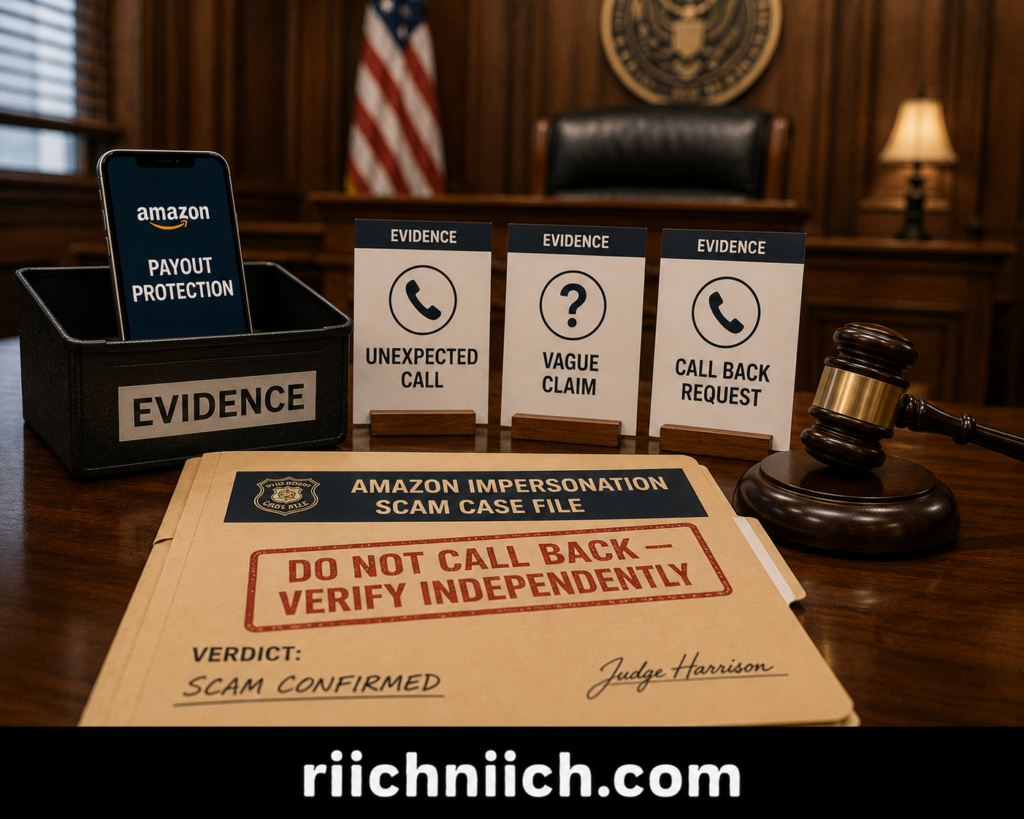
Why we would not call the number back
The biggest issue with the amazon payout protection scam isn’t simply that the terminology sounds unusual.
It’s that the caller controls the next step.
You receive an unexpected voicemail.
You’re told it’s about your Amazon account.
You’re given an unfamiliar phrase—“Payout Protection.”
Naturally, you want to know what it means.
And the only way the voicemail offers to answer that question is:
Call us back.
That’s exactly what you shouldn’t do.
The FTC warns consumers not to use phone numbers or links supplied in unexpected messages. If you think the underlying claim could be legitimate, contact the company using information you independently know is genuine.
That means you don’t need to solve the mystery by talking to “Ashley.”
Open Amazon yourself and verify your account independently.
Does Amazon call customers?
Yes, legitimate Amazon-related calls can occur in some circumstances. That’s why we would not tell readers that every Amazon phone call is automatically fraudulent.
But if you’re searching does Amazon call customers because an unexpected person just left you an Amazon voicemail, the better question is:
Can I independently verify what this caller is telling me?
A professional voice doesn’t prove anything.
Knowing your name doesn’t prove anything.
An Amazon-looking caller ID doesn’t prove anything.
The FTC specifically warns that scammers can spoof caller ID to make it appear that Amazon is calling.
So don’t authenticate the caller based on what appears on your phone.
Authenticate the claim through Amazon independently.
The voicemail doesn’t mean your Amazon account was hacked
Receiving an Amazon payout protection voicemail does not automatically mean someone has accessed your Amazon account.
That’s an important point because fear can lead people to take unnecessary actions—or buy products they don’t actually need.
If you received the voicemail but:
Didn’t call back.
Didn’t click anything.
Didn’t provide your Amazon password.
Didn’t share a verification code.
Didn’t provide financial information.
Didn’t install software.
Didn’t grant remote access.
then the voicemail itself is not evidence that your Amazon account or identity has been compromised.
Check your Amazon account independently, preserve the voicemail if you plan to report it, block the suspicious number, and remain alert for follow-up attempts.
The caller knowing your name doesn’t make the call legitimate
This is one of the details that can make the amazon payout protection scam particularly convincing.
The voicemail didn’t begin with:
“Dear Amazon customer.”
The caller used the recipient’s actual first name.
That personal detail can create instant credibility.
But don’t confuse personalization with authentication.
A stranger knowing your name and phone number does not prove they have access to your Amazon account. Personal information can circulate through many sources, and we don’t know how this particular caller obtained the name.
The correct response remains the same:
Verify the Amazon claim—not the caller’s knowledge about you.
What should you do if you receive the same voicemail?
If you receive an Amazon payout protection call or voicemail similar to ours, you don’t need to investigate the caller yourself.
Do this instead:
- Don’t call the supplied number back.
- Save the voicemail and phone number if you intend to report it.
- Open Amazon independently and check your account.
- Don’t provide passwords, verification codes, personal information, or payment information.
- Don’t install software or grant remote access.
- Report the suspicious communication when appropriate.
- Block the number after preserving any evidence you need.
Amazon Pay also warns consumers against sending money or gift-card codes to someone whose identity they cannot verify or to someone claiming Amazon will guarantee a transaction or refund funds.
If you already called back, don’t panic—respond to what actually happened
Calling the number does not automatically mean you’ve lost money or had your identity stolen.
What matters is what you gave the caller.
If you called and disclosed nothing sensitive, end communication, block the number, and independently review your Amazon account.
If you gave them your Amazon password, change it immediately and change it anywhere else you reused it.
If you gave them a verification code, secure the affected account immediately.
If you disclosed bank or card information, contact the financial institution directly.
If you provided a Social Security number or other highly sensitive identity information, consider stronger measures such as a credit freeze and use IdentityTheft.gov if identity theft is suspected.
And if you granted remote access to your device, secure the device and change important passwords from another trusted device.
The FTC has documented Amazon impersonation schemes involving fake refunds, gift-card demands, and remote access to victims’ computers.
Do you need to buy cybersecurity protection because of this voicemail?
Not necessarily.
If all you did was receive the amazon payout protection scam voicemail and delete or ignore it, you don’t need to rush out and purchase several security subscriptions.
Start with free protections:
Use unique passwords.
Enable multi-factor authentication.
Freeze your credit when your exposure justifies it.
Check your Amazon account directly.
Monitor your financial accounts.
But this incident may expose weaknesses worth fixing.
If you’re concerned that any of your login information may already be exposed, follow our How to Secure Your Online Accounts After a Data Breach guide to strengthen your passwords, review account activity, and lock down your most important accounts.
If you’re reusing passwords across accounts, a password manager may be worth buying.
If your personal information is scattered across people-search sites and data brokers, a data removal service may be worth paying for to automate recurring opt-outs.
If highly sensitive identity information was actually exposed, identity theft protection becomes much easier to justify because monitoring, alerts, and professional recovery assistance may save you considerable time if misuse occurs.
And if you installed suspicious software or granted someone access to your device, a reputable security or antivirus product may be worth considering.
The important point is:
Buy protection to solve an actual security problem—not because a suspicious voicemail frightened you into purchasing something.
Our final verdict on the Amazon Payout Protection voicemail
Our verdict is straightforward:
Do not treat an unsolicited “Payout Protection” voicemail as legitimate Amazon communication unless you independently verify the underlying claim through Amazon.
For the voicemail we received, we found no reason that would justify calling the supplied number back.
And fortunately, we didn’t.
The broader threat is well established. The FTC has repeatedly documented scammers impersonating Amazon through calls and messages involving suspicious purchases, compromised accounts, fake refunds, remote access, and demands for money. The FTC’s advice is consistent: don’t use the contact information supplied by an unexpected caller; verify the story through a channel you independently know is legitimate.
So if you found this article because someone left you a voicemail saying they’re calling about “Payout Protection for your Amazon account,” remember this:
You don’t have to call them back to find out whether something is wrong.
Open Amazon yourself.
Check your account.
Verify independently.
And if there is no corresponding issue inside your legitimate Amazon account, don’t let curiosity pull you into a conversation with an unknown caller.
That’s the safest response to the amazon payout protection scam—and the same principle can protect you from the next Amazon impersonation scam, even when the story and terminology change.