

Learning how to place a fraud alert can be one of the quickest steps you take when you suspect your personal information has been exposed or stolen. A fraud alert is free, adds an extra identity-verification step before certain new credit is approved, and can help make it harder for an identity thief to open accounts in your name. In this guide, you’ll learn how fraud alerts work, how to set one up with the credit bureaus, how long they last, and whether you should combine one with a credit freeze or identity theft protection.
Table of Contents
🔥 Quick Answer: How to Place a Fraud Alert
If you’re worried that someone may use your personal information to open a new account, knowing how to place a fraud alert can give you an extra layer of protection. A fraud alert tells businesses checking your credit report that they should take additional steps to verify your identity before approving new credit in your name.
You only need to contact one of the three major credit bureaus—Equifax, Experian, or TransUnion—to place a fraud alert. The bureau you contact is required to notify the other two, so you do not normally have to submit three separate requests.
For most consumers, the standard option is an initial fraud alert, which lasts for one year and can be renewed. People who have experienced identity theft may qualify for an extended fraud alert, which can remain on their credit file for seven years. Eligible active-duty military members can also request an active duty fraud alert.
Placing a fraud alert is free, and it does not prevent you from applying for new credit. However, a lender or creditor may take additional steps to confirm that the person requesting credit is actually you.
If your personal information has been exposed in a data breach, you notice signs of identity theft, or you simply believe someone may try to open an account in your name, a fraud alert can be a useful first line of defense. You can place one directly through Equifax, Experian, or TransUnion.
A fraud alert is only one part of protecting your identity, though. It does not monitor every use of your personal information, remove exposed data from the internet, or provide full identity-theft recovery assistance. If you want broader protection, an identity theft protection service with credit monitoring, identity monitoring, dark web monitoring, alerts, and recovery support may be worth considering alongside a fraud alert.

What Is a Fraud Alert?
A fraud alert is a notice placed on your credit reports that tells businesses and lenders that they should take extra steps to verify your identity before opening new credit in your name. If you are concerned that your personal information has been stolen, exposed in a data breach, or used for identity theft, learning how to place a fraud alert can add an important layer of protection to your credit file.
Think of a fraud alert as a warning flag attached to your credit report. When a lender checks your credit because someone is applying for a credit card, loan, or another type of credit in your name, the alert signals that the applicant’s identity should be verified before the account is approved.
A fraud alert does not lock or freeze your credit report. You can still apply for credit, and businesses can still access your credit report when legally permitted. The difference is that the fraud alert encourages additional identity verification during the application process.
Fraud alerts are free. Under federal law, you can request one from any of the three nationwide credit bureaus: Equifax, Experian, or TransUnion. When you place a fraud alert with one bureau, that bureau must notify the other two so they can also place fraud alerts on their files for you. The Federal Trade Commission’s (FTC) identitytheft.gov also provides official information and recovery guidance if you believe your identity has already been stolen.
This makes a credit fraud alert particularly useful when you notice suspicious activity, lose sensitive identification, receive notice that your information was exposed, or have another reason to believe someone could attempt new-account fraud using your identity.
However, a fraud alert has limitations. It is primarily designed to make fraudulent new credit accounts more difficult to open. It does not continuously monitor all uses of your identity or provide complete identity-theft recovery assistance.
That distinction matters when deciding how much protection you need. Someone who simply suspects their information may have been compromised might start with a free fraud alert, while someone dealing with broader exposure may also consider credit monitoring, identity monitoring, dark web monitoring, and identity theft recovery services for additional protection.
How Does a Fraud Alert Work?
A fraud alert works by adding a warning to your credit file that tells lenders and other businesses to verify your identity before opening new credit in your name. If you’re learning how to place a fraud alert, the important thing to understand is that the alert creates an additional identity-verification step rather than completely blocking access to your credit report.
Here’s a simple example: suppose an identity thief gets your Social Security number and other personal information and attempts to open a new credit card. When the card issuer checks your credit report, the fraud alert indicates that your identity should be verified before new credit is approved. This could involve contacting you to confirm that you actually submitted the application.
Unlike a credit freeze, a credit fraud alert does not prevent lenders from accessing your credit report. Your credit remains available for legitimate applications, which can make a fraud alert more convenient if you expect to apply for a credit card, auto loan, mortgage, or other financing soon.
Another advantage is that you don’t have to contact every credit bureau separately. To how to place a fraud alert, you can contact Equifax, Experian, or TransUnion. The bureau you contact must notify the other two so that fraud alerts can be added to your credit files with all three bureaus.
The standard initial fraud alert is free and lasts one year, and you can renew it. If you’ve experienced identity theft and meet the requirements, an extended fraud alert can last seven years.
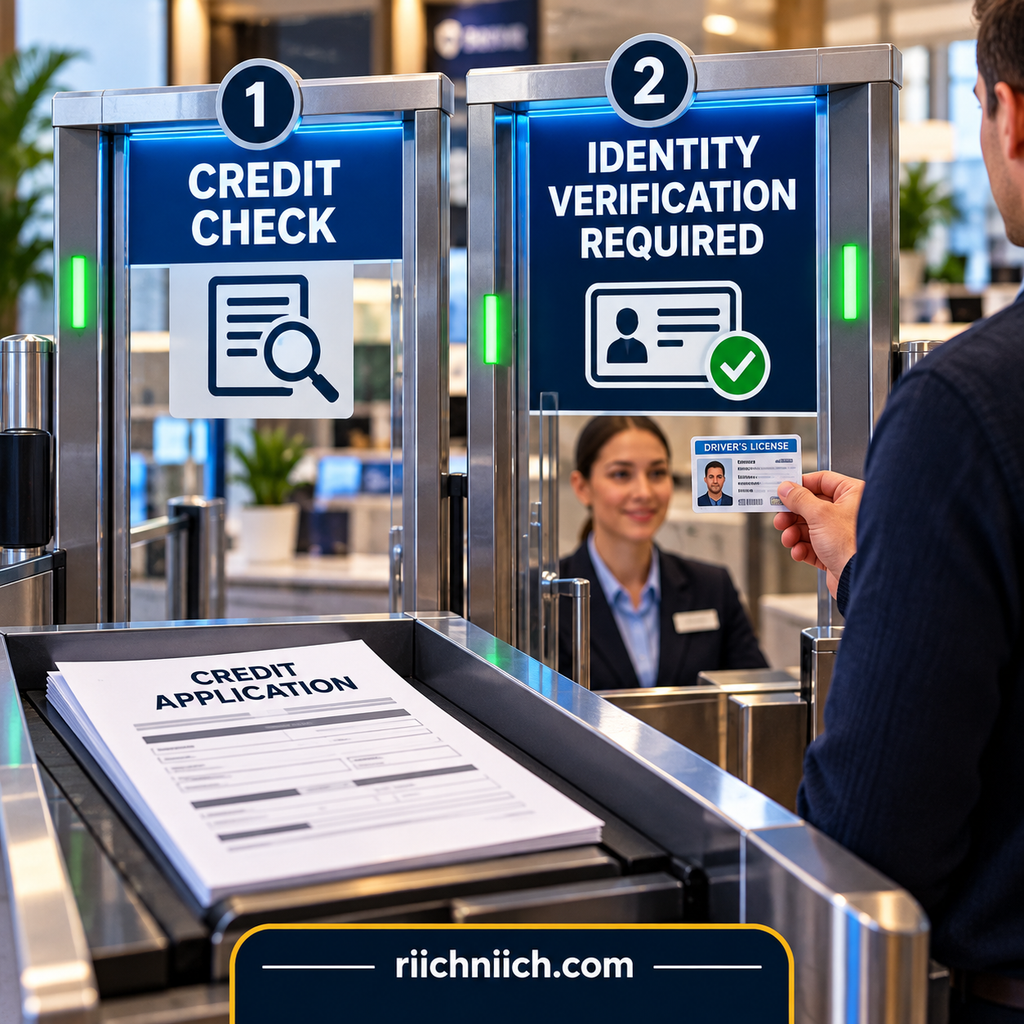
A fraud alert can make it harder for an identity thief to successfully open new credit accounts, but it shouldn’t be treated as complete identity protection. It doesn’t continuously watch every place your personal information could be misused. The FTC notes that consumers can also use a credit freeze alongside a fraud alert when additional protection against new-account identity theft is appropriate.
If you’re concerned that your information has already been compromised, broader protection may also be worth considering. An identity theft protection service can add features such as credit monitoring, identity monitoring, dark web monitoring, suspicious-activity alerts, and recovery assistance. That can complement a fraud alert by watching for threats that a credit-report warning alone may not detect.
What Does a Fraud Alert Do?
A fraud alert adds an extra identity-verification step when a creditor checks your credit report for certain new credit requests. If you’re researching how to place a fraud alert, its main purpose is to make it harder for an identity thief to use your personal information to obtain credit in your name.
According to the Consumer Financial Protection Bureau (CFPB), a fraud alert requires creditors who check your credit report to take steps to verify your identity before opening a new account, issuing an additional card, or increasing a credit limit based on your request.
In practical terms, a credit fraud alert can help:
- Add an identity-verification step before certain new credit is approved.
- Warn prospective creditors that you may be at risk of fraud or identity theft.
- Make it more difficult for someone using stolen information to successfully impersonate you during a credit application.
- Protect you without completely restricting legitimate access to your credit report.
For example, imagine a criminal has enough of your personal information to apply for a credit card in your name. The lender pulls your credit report and sees the fraud alert on your credit report. Before approving the application, the creditor must take reasonable steps to confirm the applicant is actually you.
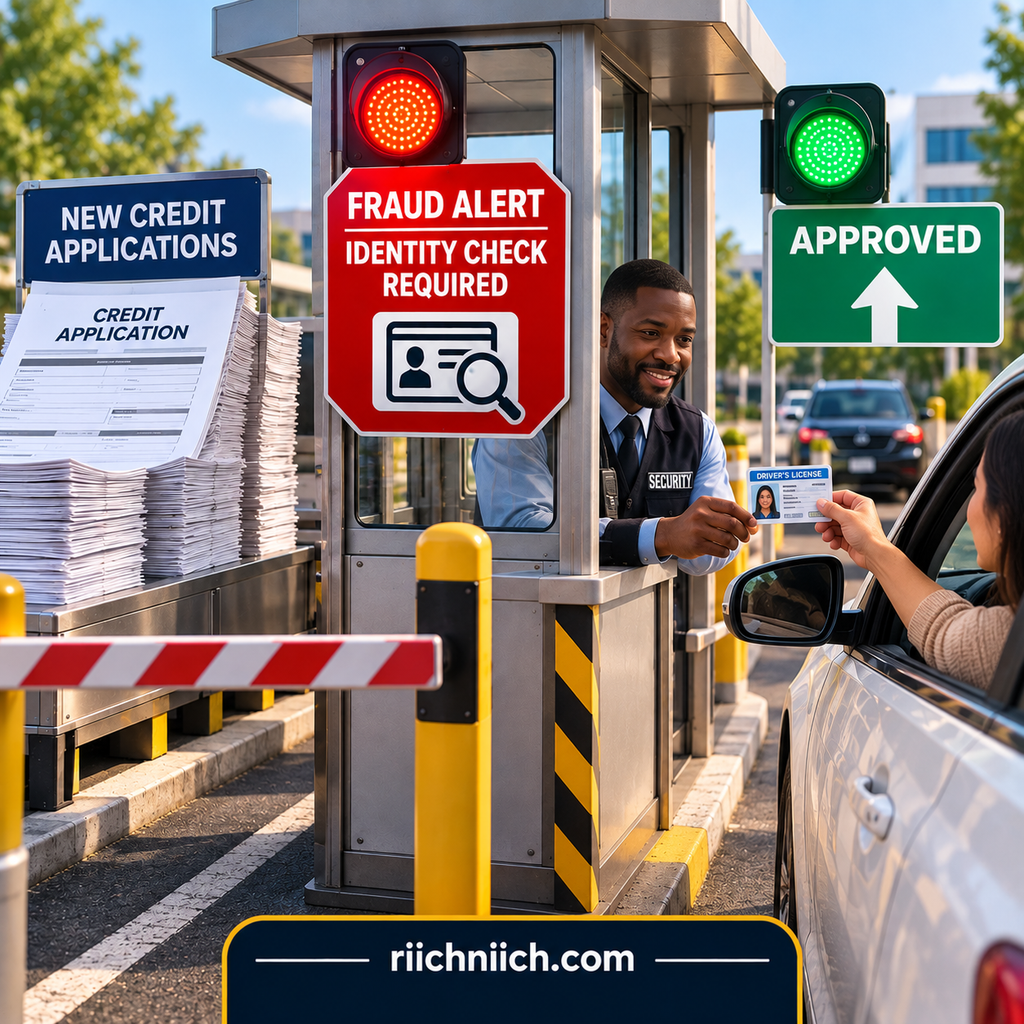
However, a fraud alert is not the same as a credit freeze. It does not block businesses from accessing your credit report, and it does not guarantee that fraudulent credit can never be opened. A credit freeze generally provides a stronger barrier against new-account identity theft because prospective creditors typically cannot access your frozen credit file until the freeze is lifted.
A fraud alert also does not continuously monitor your identity. It won’t necessarily warn you if stolen personal information appears online or is misused outside the credit-reporting system. Credit and identity monitoring services serve a different purpose: they may monitor credit-file changes or other uses of personal information and send alerts when suspicious activity is detected.
That distinction is important when deciding how much protection you need. A free fraud alert can be a useful layer of defense if you suspect your information has been compromised. If you want broader monitoring and recovery features, you may also consider an identity theft protection service that includes credit monitoring, identity monitoring, dark web monitoring, alerts, and recovery assistance.
Who Should Place a Fraud Alert?
A fraud alert is designed for people who believe they are—or may soon become—victims of fraud or identity theft. If you are researching how to place a fraud alert, it may be worth considering when there is a real reason to believe your personal information could be used to apply for credit in your name. The FTC says an initial fraud alert is available to anyone who is or suspects they may be affected by identity theft.
You may want to place a fraud alert if:
- Your Social Security number, driver’s license information, or other sensitive personal information has been exposed.
- You receive notice that your information was involved in a data breach.
- Your wallet, driver’s license, Social Security card, or other identifying documents are lost or stolen.
- You notice a credit inquiry you don’t recognize.
- You discover an account on your credit report that you didn’t open.
- A creditor or debt collector contacts you about an account or debt that isn’t yours.
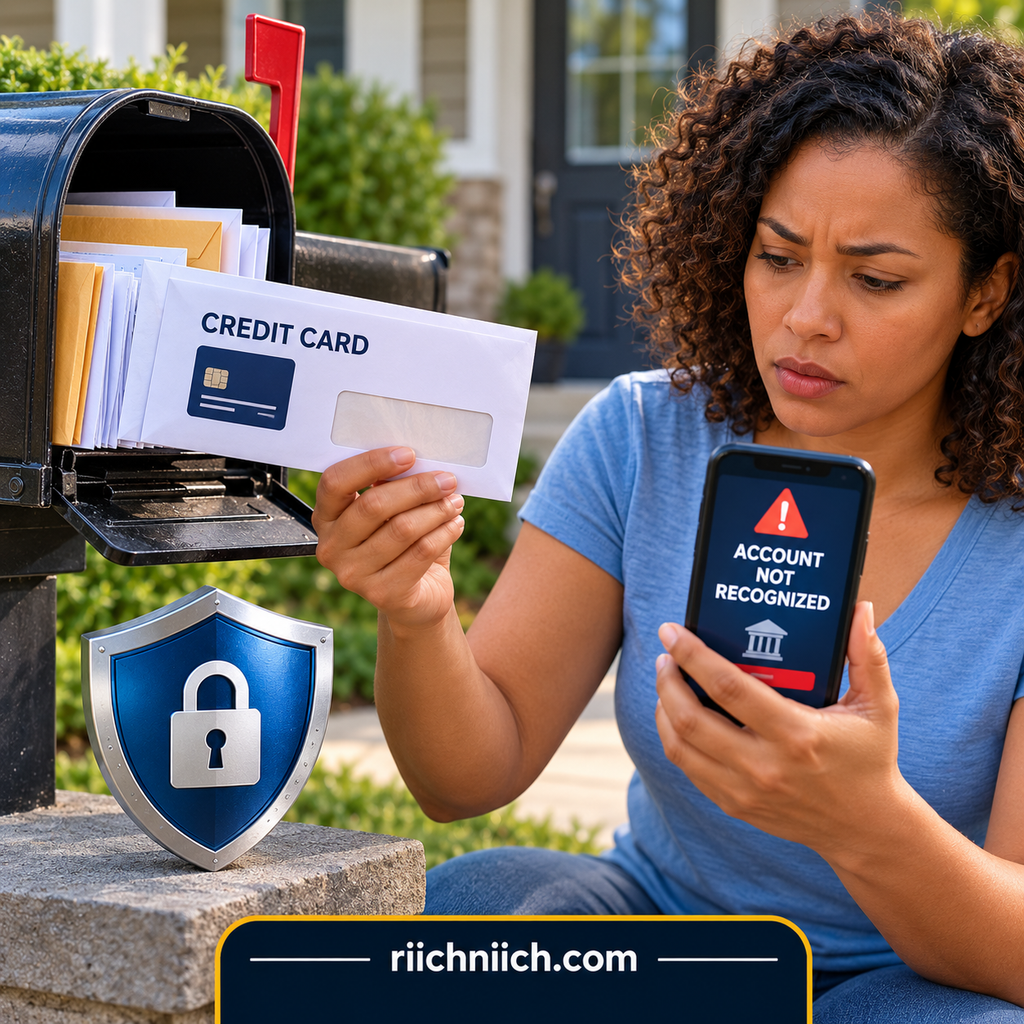
- You receive unexpected bills, credit cards, or account notices in your name.
- You have already experienced identity theft or new-account fraud.
Unrecognized inquiries and accounts can be warning signs of identity theft, so checking your credit reports is particularly important if you notice either one. The CFPB recommends reviewing your reports for inquiries from unfamiliar companies, accounts you didn’t open, and incorrect account information.
Your situation also determines which type of fraud alert may apply. If you merely suspect identity theft or believe you’re about to become a victim, an initial fraud alert lasts one year and can be renewed. If your identity has actually been stolen and you’ve completed the required identity theft report, you may qualify for an extended fraud alert lasting seven years. Active-duty servicemembers have a separate active-duty fraud alert option.
If you have confirmed identity theft, placing a fraud alert shouldn’t be your only response. You can use the federal government’s IdentityTheft.gov recovery system to report the theft and receive a personalized recovery plan. The CFPB also recommends taking additional steps such as closing compromised accounts and considering a security freeze.
For people who want ongoing visibility rather than only the protection provided by a fraud alert, identity theft protection may provide additional value. Depending on the service, identity monitoring can watch personal information across credit applications, public records, websites, and other sources and may provide recovery assistance if identity theft occurs. Features and prices vary, so compare exactly what a service monitors and what recovery support is included before paying for a plan.
A fraud alert can therefore be a useful free first layer of protection, while credit freezes and identity theft protection services address different parts of the problem. The right combination depends on whether you simply suspect exposure, have confirmed identity theft, or want broader ongoing monitoring.
When Should You Place a Fraud Alert?
You should consider placing a fraud alert when you believe you are, or are about to become, a victim of fraud or identity theft. If you are researching how to place a fraud alert, acting soon after you notice a warning sign can add an extra identity-verification step before certain new credit is approved in your name.
Common situations where a fraud alert on your credit report may make sense include:
- Your Social Security number or other sensitive information was exposed in a data breach.
- Your wallet, driver’s license, Social Security card, or other identifying documents were lost or stolen.
- You discover a credit inquiry or new account that you don’t recognize.
- You receive a bill, credit card, or collection notice for an account you never opened.
- Someone attempted to use your personal information to apply for credit.
- You responded to a phishing scam and disclosed sensitive information that could be used for identity theft.
- You have already discovered that someone is using your identity.
The timing matters because a fraud alert is designed to make it more difficult for a thief to turn stolen personal information into new credit. An initial fraud alert is free, lasts one year, and can be renewed. You only have to contact one of the three nationwide credit bureaus; that bureau must notify the other two.
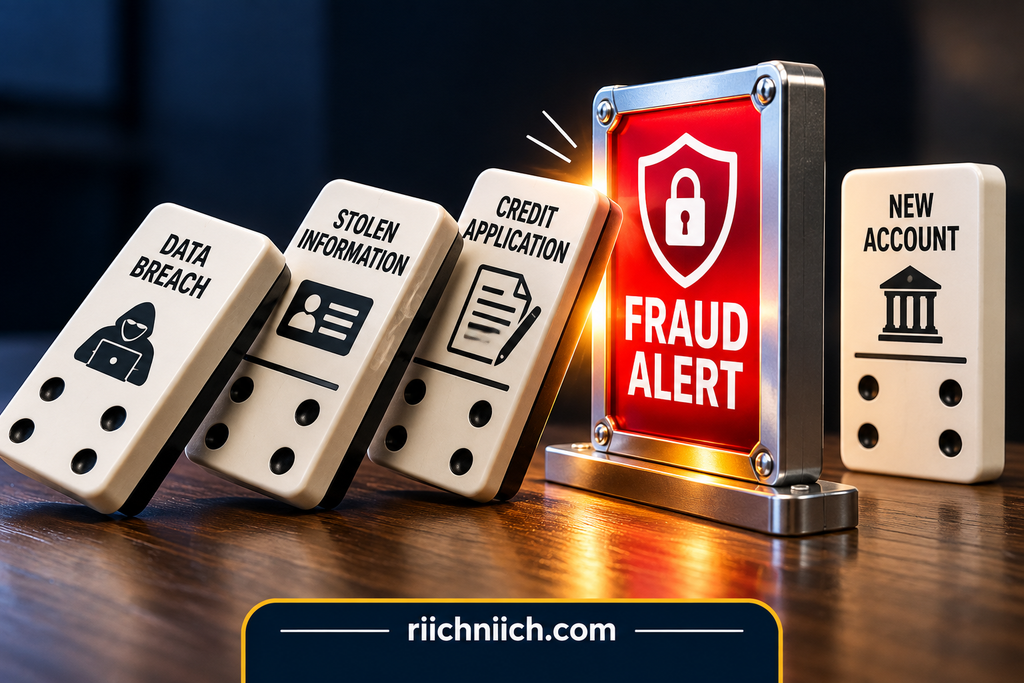
If you have confirmed identity theft, your response should go beyond simply placing an initial alert. You may qualify for an extended fraud alert, which lasts seven years after meeting the identity-theft-report requirements. The CFPB also recommends closing compromised accounts, reporting the theft through IdentityTheft.gov, and considering a security freeze.
A fraud alert can also be used alongside a credit freeze. The FTC specifically notes that consumers can place an initial fraud alert even when their credit is already frozen.
For someone whose information has been broadly exposed, another consideration is ongoing monitoring. A fraud alert focuses primarily on additional verification for new credit, whereas identity and credit monitoring services may watch for changes or suspicious uses of personal information and send alerts when activity is detected.
That doesn’t mean everyone needs to pay for identity theft protection. But if you’re dealing with a serious data breach, repeated exposure of personal information, or previous identity theft, it can be worth comparing services that combine credit monitoring, identity monitoring, dark web monitoring, alerts, and recovery assistance rather than relying on a fraud alert alone.
What Are the Different Types of Fraud Alerts?
There are three types of fraud alerts you can place on your credit report: an initial fraud alert, extended fraud alert, and active duty fraud alert. Each serves a different situation, so understanding which one applies to you is an important part of learning how to place a fraud alert.
Initial Fraud Alert
An initial fraud alert is designed for anyone who believes they are—or may become—a victim of fraud or identity theft. This could make sense after a data breach, a lost wallet, suspicious activity, or another situation where your personal information may have been compromised.
An initial fraud alert:
- Is free.
- Lasts for one year.
- Can be renewed after it expires.
- Tells businesses to take steps to verify your identity before approving certain new credit requests.
- Requires you to contact only one of the three nationwide credit bureaus; that bureau must notify the other two.
For many consumers researching how to place a fraud alert, this will be the appropriate starting point when they suspect identity theft but haven’t necessarily confirmed that their identity has already been stolen.
Extended Fraud Alert
An extended fraud alert provides longer-lasting protection for people who have actually experienced identity theft.
To qualify, you’ll generally need an identity theft report, such as one created through the FTC’s IdentityTheft.gov or a police report. An extended fraud alert lasts seven years and is also free.
It also removes your name from the credit bureaus’ marketing lists for unsolicited credit and insurance offers for five years, unless you request otherwise.
This option may be more appropriate if a thief has already opened accounts, attempted to obtain credit, or otherwise used your identity—not simply when your information may have been exposed.
Active Duty Fraud Alert
An active duty fraud alert is specifically available to active-duty servicemembers. It adds identity-verification protections while the servicemember is away from their usual duty station.
An active duty fraud alert:
- Is free.
- Lasts for one year.
- Can be renewed for the length of a deployment.
- Requires businesses to take reasonable steps to verify identity for covered credit requests.
- Removes the servicemember from prescreened credit and insurance marketing lists for two years, unless they request otherwise.
The CFPB also notes that a servicemember who may be difficult to contact while deployed can appoint a personal representative to help place or remove an active duty alert.
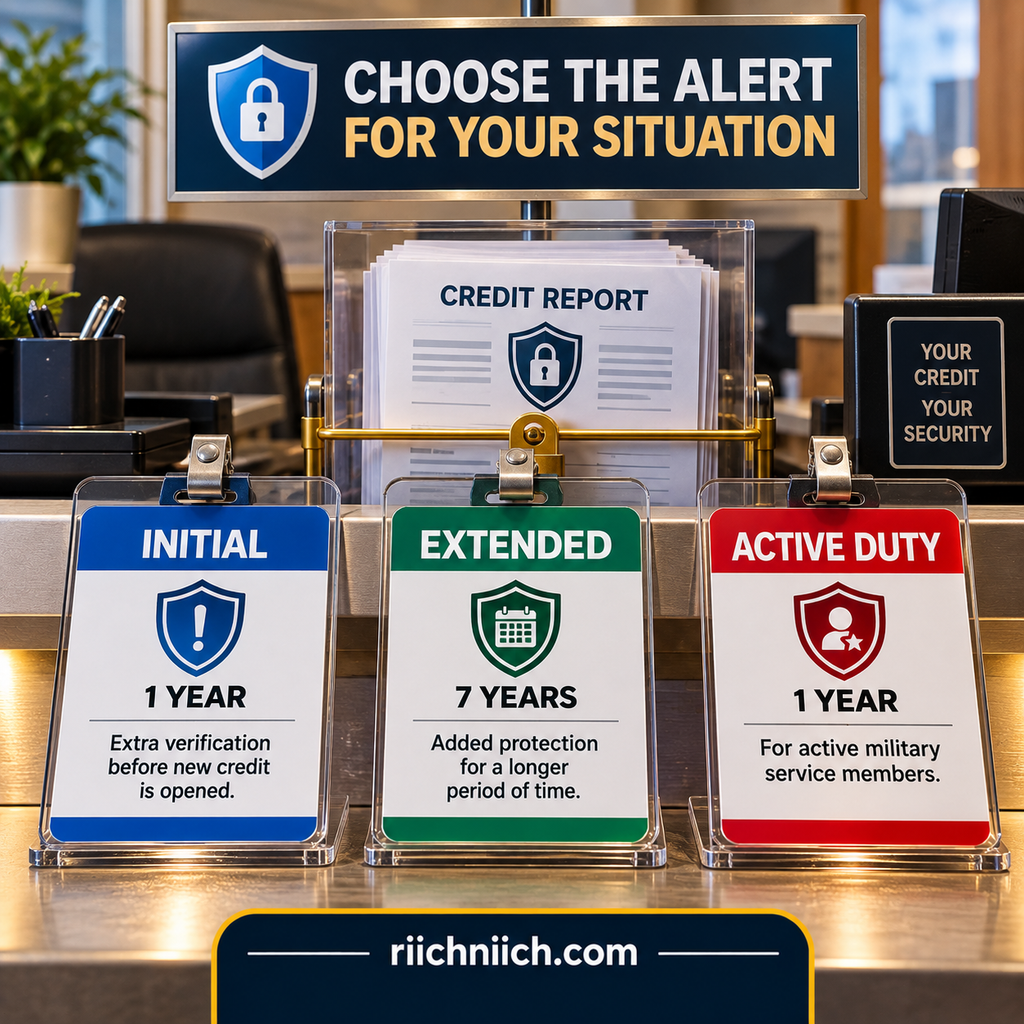
The right fraud alert depends primarily on why you need protection. An initial alert is intended for suspected fraud or identity theft, an extended alert is available to qualifying identity-theft victims, and an active duty alert is designed for eligible servicemembers.
Whichever type applies to you, remember that a fraud alert is primarily a credit-file protection tool. It doesn’t provide the broader monitoring that some consumers may want after serious personal-data exposure. If you’re concerned about information appearing on the dark web, unauthorized changes to your credit, or needing help recovering from identity theft, you may also want to compare identity theft protection services that include credit monitoring, identity monitoring, dark web monitoring, alerts, and recovery assistance. The CFPB recommends checking exactly what an identity-monitoring service covers, along with its fees, trial periods, cancellation requirements, and restrictions before signing up.
What Is an Initial Fraud Alert?
An initial fraud alert is a free notice placed on your credit reports when you believe you are—or may soon become—a victim of fraud or identity theft. If you’re learning how to place a fraud alert, an initial fraud alert is usually the starting option when you suspect your personal information has been compromised but don’t necessarily have proof that identity theft has already occurred.
Once an initial fraud alert appears on your credit file, creditors must take reasonable steps to verify that a new credit request is actually coming from you before approving it. This can make it more difficult for an identity thief to use stolen personal information to open a new credit card, loan, or other credit account in your name.
An initial fraud alert:
- Is completely free.
- Lasts for one year.
- Can be renewed when it expires.
- Can be requested if you believe you are or may become a victim of identity theft.
- Requires you to contact only one of the three nationwide credit bureaus.
- Gives you the right to request a free credit report from each of the three nationwide credit bureaus, separate from your regular free annual reports.
For example, suppose your Social Security number and other personal information were exposed in a data breach, but you haven’t discovered any fraudulent accounts yet. Placing an initial fraud alert can add an identity-verification checkpoint while you review your credit reports and watch for suspicious activity.
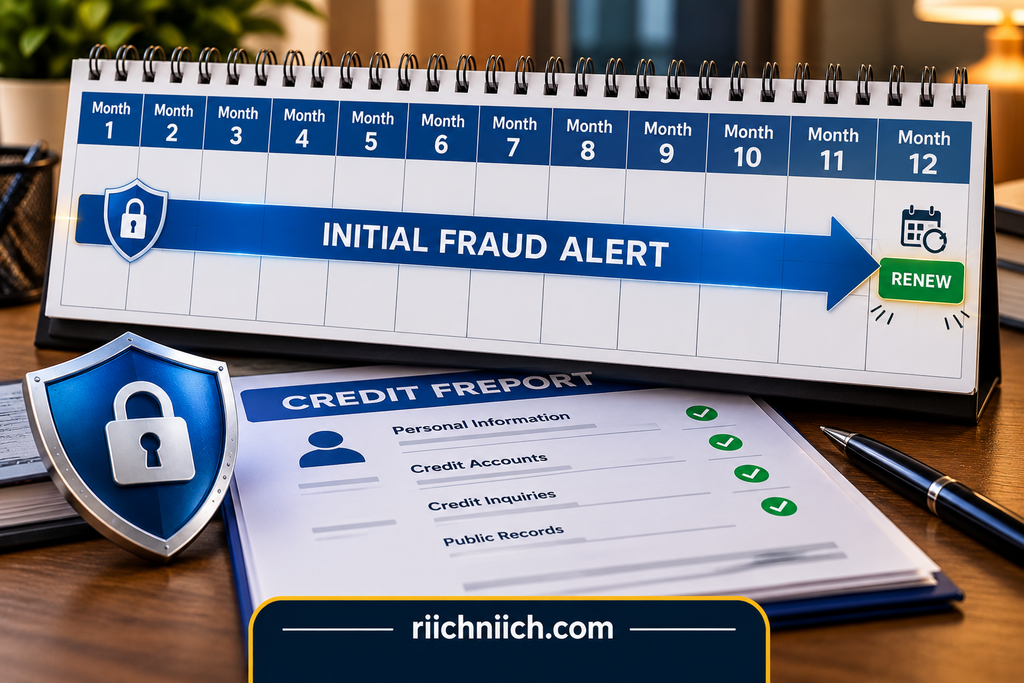
One of the biggest conveniences of an initial fraud alert is that you don’t need to place separate alerts with Equifax, Experian, and TransUnion. Contact one nationwide credit bureau, and that bureau must notify the other two to place alerts on your credit files as well.
An initial fraud alert also doesn’t block access to your credit report the way a credit freeze generally does. That may appeal to someone who wants additional identity verification while still expecting to apply for a mortgage, auto loan, credit card, apartment, or other product that could involve a credit check.
However, an initial fraud alert should not be confused with complete identity theft protection. It doesn’t continuously monitor the dark web, financial accounts, or every possible use of your personal information. Credit and identity monitoring services also don’t prevent all identity theft, but they may provide alerts after certain changes or suspicious activity are detected. The CFPB recommends understanding exactly what a paid monitoring service covers and costs before signing up.
For someone dealing with significant personal-data exposure or previous identity theft, this is where identity theft protection services may provide additional value. When comparing paid options, look for features such as three-bureau credit monitoring, identity monitoring, dark web monitoring, fast alerts, and identity restoration assistance rather than choosing a service based on price alone.
What Is an Extended Fraud Alert?
An extended fraud alert is a longer-lasting credit protection available to people who have experienced identity theft. Unlike an initial fraud alert, which is intended for people who suspect they may be affected by identity theft, an extended fraud alert requires you to have experienced identity theft and completed an FTC Identity Theft Report at IdentityTheft.gov or filed a police report.
If you’re researching how to place a fraud alert after someone has actually stolen or misused your identity, an extended fraud alert may be the more appropriate option because it remains on your credit reports for seven years.
With an extended fraud alert in place, businesses reviewing your credit report must take additional steps to verify that a request for new credit is really coming from you before approving it. Unlike a credit freeze, however, the alert does not prevent businesses from accessing your credit report.
An extended fraud alert:
- Is free.
- Lasts for seven years unless removed sooner.
- Is available to qualifying victims of identity theft.
- Requires identity verification before covered new credit is approved.
- Removes you from the credit bureaus’ marketing lists for unsolicited credit and insurance offers for five years, unless you ask otherwise.
- Can be placed by contacting one of the three nationwide credit bureaus; that bureau must notify the other two.
You can use the FTC’s official IdentityTheft.gov website to report identity theft and create a personalized recovery plan.
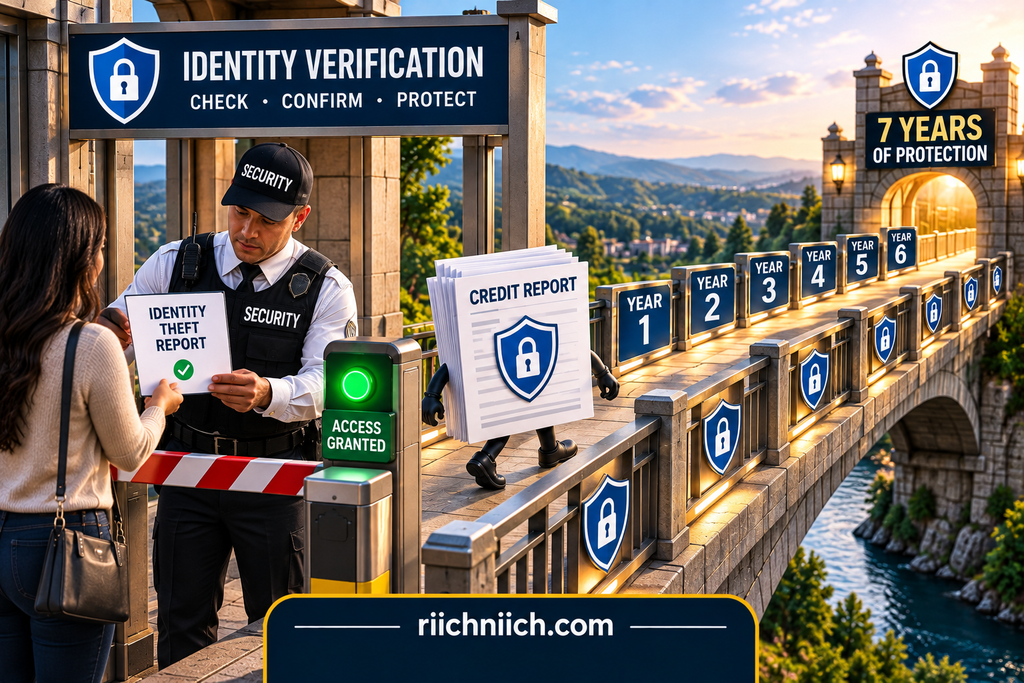
An extended fraud alert can be especially useful if a criminal has already opened an account in your name, attempted to obtain credit using your identity, or otherwise misused your personal information. It provides a longer period of added verification so you don’t have to renew a standard one-year fraud alert every year.
However, even a seven-year fraud alert does not protect against every form of identity theft. Criminals can misuse stolen personal information in ways that don’t necessarily involve pulling your credit report, including certain tax, government-benefit, medical, or existing-account fraud. The FTC notes that credit and identity monitoring services also have limitations, so no single tool should be viewed as complete protection.
If you’ve already experienced identity theft, broader identity theft protection and recovery services may therefore be worth comparing alongside an extended fraud alert. Look closely at whether a service includes three-bureau credit monitoring, identity monitoring, dark web monitoring, rapid alerts, and hands-on identity restoration assistance. The value is not simply receiving another alert—it is having additional monitoring and recovery support if your stolen information is used again.
What Is an Active Duty Fraud Alert?
An active duty fraud alert is a free credit protection specifically available to eligible military servicemembers who are on active duty and assigned away from their usual duty station. It tells businesses checking your credit report to take reasonable steps to verify your identity before approving certain new credit requests.
For servicemembers researching how to place a fraud alert, the active duty option can be especially useful before or during a deployment, when being away from home may make suspicious credit activity more difficult to notice or resolve quickly.
An active duty fraud alert:
- Is free.
- Lasts for 12 months unless you remove it sooner.
- Can be renewed if your deployment continues beyond the initial 12 months.
- Requires creditors to take reasonable steps to verify your identity before opening certain new accounts, issuing an additional card, or increasing a credit limit.
- Removes your name from nationwide credit bureaus’ prescreened marketing lists for unsolicited credit and insurance offers for two years, unless you request otherwise.
- Can be placed by contacting one of the three nationwide credit bureaus rather than submitting separate requests to all three.
This can add another obstacle for an identity thief who obtains a servicemember’s Social Security number, date of birth, address, or other personal information and attempts to use it for new-account fraud while the servicemember is away.

Another useful feature is the ability to designate a personal representative. If contacting the credit bureaus while deployed could be difficult, the CFPB says a servicemember can assign a representative who can act on their behalf, including placing or removing an active duty alert.
However, an active duty fraud alert shouldn’t be mistaken for a complete block on new credit. It does not prevent businesses from accessing your credit report the way a security freeze generally does. The FTC recommends that servicemembers consider a credit freeze as another protection and notes that eligible active-duty military consumers can also receive free electronic credit monitoring.
That broader protection can matter during a long deployment. A fraud alert focuses on identity verification around certain credit requests, while credit or identity monitoring can help identify suspicious changes after they occur.
For servicemembers who want additional coverage, it may therefore be worth comparing identity theft protection services based on features such as three-bureau credit monitoring, identity monitoring, dark web monitoring, fast alerts, and identity restoration assistance. Before paying for a service, also check whether you already qualify for free active-duty credit monitoring, so you aren’t paying for protection you can receive at no cost.
What Information Do You Need to Place a Fraud Alert?
The information you need depends on which credit bureau you contact, how you submit the request, and which type of fraud alert you’re requesting. If you’re learning how to place a fraud alert, having your identification and contact information ready beforehand can make the process easier.
For an initial fraud alert, you may be asked to provide or verify information such as:
- Your full legal name
- Your current address
- Your date of birth
- Your Social Security number
- A phone number that may be used by creditors to verify your identity
- Additional information or documents needed to confirm your identity
The exact requirements can vary by bureau and submission method. For example, Experian says a fraud-alert request submitted by mail should include your full name, Social Security number, date of birth, addresses for the previous two years, a government-issued ID, and a copy of a utility bill or bank statement showing identifying information.
TransUnion says a fraud-alert request submitted by mail should include your name, address, Social Security number, and a phone number creditors can use to verify your identity.
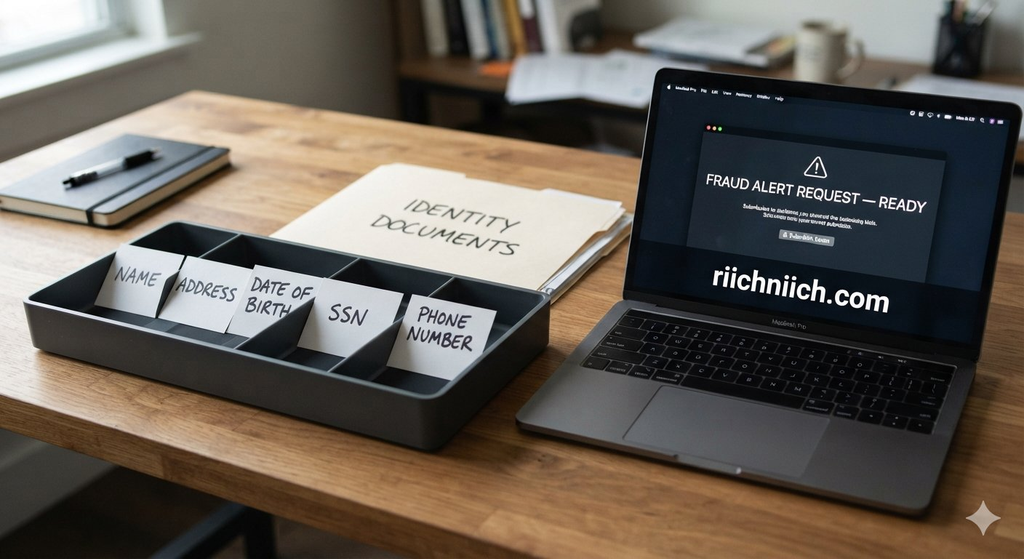
The requirements become more extensive if you’re requesting an extended fraud alert. Because this type of credit fraud alert is reserved for identity-theft victims, you’ll need documentation showing that you’ve experienced identity theft. The FTC says you can qualify by completing an FTC Identity Theft Report through IdentityTheft.gov or by filing a police report.
For example, Experian requires proof of identity theft before placing an extended fraud alert, while TransUnion says an extended alert requires proof that you’re an identity-theft victim and an identity theft report.
You also don’t need to prepare three separate fraud-alert applications just because you have credit reports with Equifax, Experian, and TransUnion. For placement, you can contact one of the three nationwide credit bureaus, and that bureau is required to notify the other two.
Before submitting sensitive documents, make sure you’re using the official website, phone number, or mailing address of the credit bureau. Avoid following unsolicited links in emails or text messages asking you to provide your Social Security number or identification documents.
And remember that providing information for a fraud alert doesn’t give you ongoing monitoring of your identity. If your personal information has already been exposed and you want additional oversight, you may also want to compare identity theft protection services offering three-bureau credit monitoring, identity monitoring, dark web monitoring, suspicious-activity alerts, and recovery assistance. A fraud alert and monitoring serve different purposes, so consider the features you actually need before paying for additional protection.
How to Place a Fraud Alert With Equifax
If you choose Equifax when learning how to place a fraud alert, you can submit your request online or by mail. Placing, updating, or removing an Equifax fraud alert is free. Equifax’s current fraud-alert form lists initial one-year, active-duty, and extended seven-year fraud alerts as available options.
For most people, the online option is the simplest place to start. Equifax says fraud alerts can be managed online through its myEquifax service.
To place an Equifax fraud alert online:
- Go to the official Equifax website and access myEquifax.
- Sign in to your account or create one if necessary.
- Find the option for managing a fraud alert.
- Select the type of alert you need, such as an initial one-year fraud alert.
- Enter or verify the requested personal and contact information.
- Complete any identity-verification steps.
- Review your information carefully and submit the request.
- Save your confirmation for your records.
One major advantage is that you do not have to repeat the process separately with Experian and TransUnion. When you successfully place a fraud alert through one of the nationwide credit bureaus, that bureau is responsible for notifying the other two.
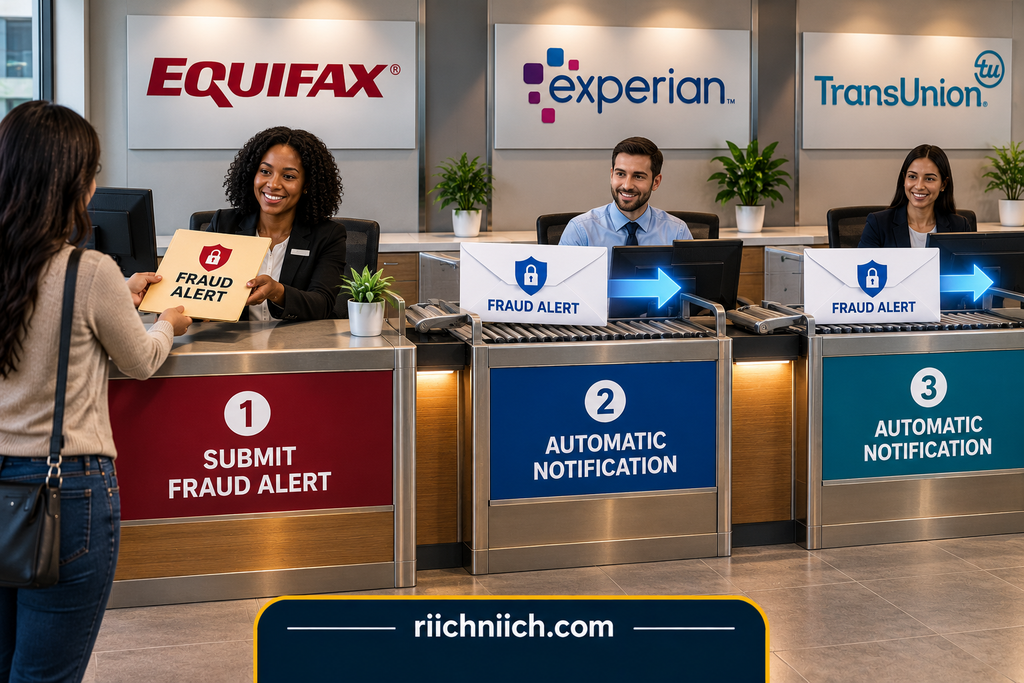
If you prefer to place your Equifax fraud alert by mail, Equifax provides an official Fraud Alert Request Form. The form requests identifying information such as your name, current address, Social Security number, date of birth, and contact information. It also requires specified proof of identity and proof of your current mailing address.
For an extended seven-year fraud alert, additional documentation is required. Equifax’s current form states that you must include a police report, FTC Identity Theft Report, or Affidavit of Fraud confirming fraud and/or identity theft.
Before sending Social Security information, identification documents, or other sensitive data, make sure you’re dealing directly with Equifax. Avoid fraud-alert links sent through unexpected emails or text messages; navigate to the official site yourself.
Placing the alert is an important step, but it shouldn’t be mistaken for ongoing identity monitoring. If your information has already been exposed or stolen, you may also want to compare identity theft protection services offering three-bureau credit monitoring, dark web monitoring, identity monitoring, fast alerts, and identity restoration assistance. That broader coverage can help you watch for suspicious activity that an Equifax fraud alert alone isn’t designed to detect.
How to Place a Fraud Alert With Experian
If you choose Experian when learning how to place a fraud alert, you can submit your request online, by phone, or by mail. Experian does not charge a fee to place a fraud alert, and its online Fraud Alert Center allows you to manage the alert directly.
For most people, the online process will be the simplest. To place an Experian fraud alert online:
- Visit Experian’s official Fraud Alert Center.
- Create a free Experian account or sign in to an existing account.
- Select the type of fraud alert you need: initial, extended, or active duty.
- Confirm the requested personal information.
- Experian may ask you to confirm a phone number that lenders can use to help verify your identity. You can choose not to include a phone number.
- Follow the remaining instructions and submit your fraud alert request.
- Keep the confirmation for your records.
If you’re placing an initial fraud alert or active duty fraud alert online, Experian says the alert can be added to your Experian credit file in real time. An initial or active duty alert lasts one year, while an extended fraud alert lasts seven years.
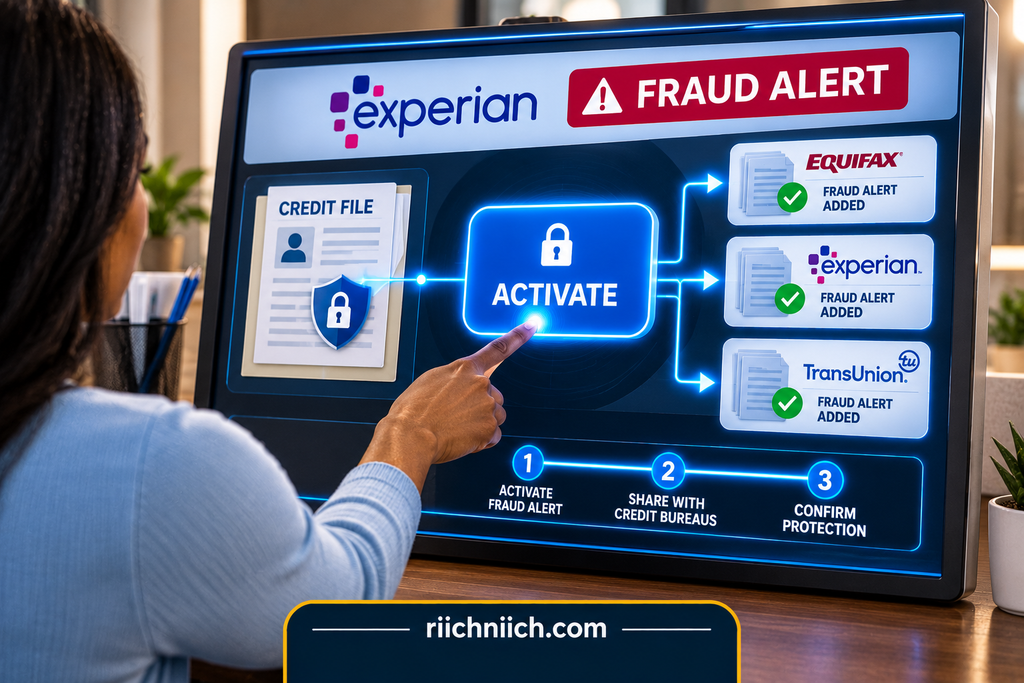
One important advantage is that you do not need to separately place the fraud alert with Equifax and TransUnion. After Experian places your fraud alert, it notifies the other two nationwide credit bureaus so alerts can be added to those credit files as well.
If you’re requesting an extended fraud alert because you’ve experienced identity theft, additional documentation is required. Experian says you’ll need proof of identity theft, such as an FTC identity theft report or police report, and you can follow its instructions to upload supporting documents or submit them by mail.
You can also request an Experian fraud alert by phone at 1-888-397-3742 or submit a written request by mail. Experian says mailed requests should include identifying information and documentation such as your full name, Social Security number, date of birth, addresses for the previous two years, government-issued identification, and a qualifying utility bill or bank statement.
A fraud alert can add an important barrier against new-account fraud, but it isn’t a complete identity-monitoring system. If your Social Security number or other sensitive information has already been exposed, you may also want to compare identity theft protection services offering three-bureau credit monitoring, dark web monitoring, identity monitoring, fast alerts, and identity restoration assistance. The goal is to cover suspicious activity beyond what a fraud alert alone is designed to address.
How to Place a Fraud Alert With TransUnion
If you choose TransUnion when learning how to place a fraud alert, you can submit your request online, by phone, or by mail. TransUnion says placing or removing a fraud alert is free, and the fastest method is through its online Service Center.
To place a TransUnion fraud alert online:
- Go to the official TransUnion Fraud Alerts page.
- Sign in to your TransUnion Service Center account or create a free account.
- Select Fraud Alert.
- Choose the type of alert you need: initial fraud alert, extended fraud alert, or active duty fraud alert.
- Provide the requested contact and identity-verification information.
- Add a phone number that creditors can use to help verify your identity when applicable.
- Review your information and submit the request.
- Keep your confirmation for your records.
For an initial fraud alert, TransUnion says the alert lasts for one year. An active duty fraud alert also lasts one year, while an extended fraud alert lasts seven years and requires proof that you have been a victim of identity theft.
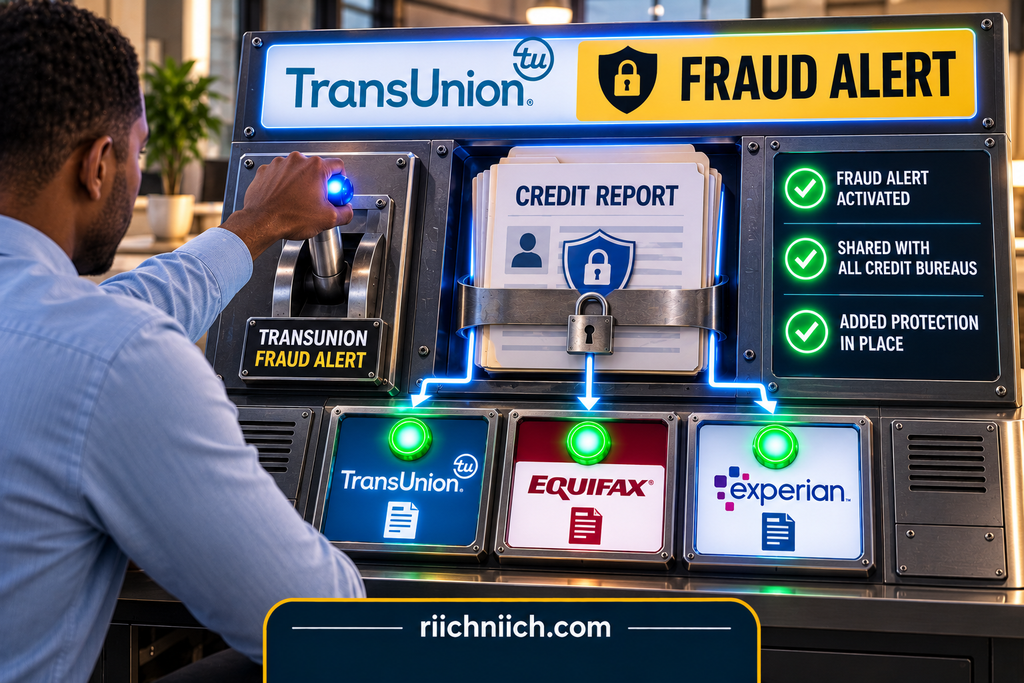
One of the biggest conveniences of using TransUnion is that you do not need to place the fraud alert separately with Equifax and Experian. Once the fraud alert is placed with TransUnion, TransUnion notifies the other two nationwide credit bureaus so they can add a fraud alert to your credit reports as well.
If you don’t want to use the online Service Center, you can also request an initial or active duty fraud alert by phone at 800-916-8800. TransUnion says extended fraud alerts must be requested online or by mail because additional identity-theft documentation is required.
For a mailed request, TransUnion instructs consumers to include their name, address, and Social Security number. If you’re requesting an extended fraud alert by mail, you’ll also need to provide proof that you’ve been a victim of identity theft.
TransUnion also says a fraud alert placed online or by phone typically appears on your credit report the same day. A mailed request can take up to three business days after TransUnion receives it.
A fraud alert can make fraudulent new credit more difficult to obtain, but it isn’t a complete identity-protection system. If your Social Security number or other sensitive information has already been exposed, you may also want to compare identity theft protection services offering three-bureau credit monitoring, identity monitoring, dark web monitoring, fast alerts, and identity restoration assistance. These features can provide broader monitoring for suspicious activity that a TransUnion fraud alert alone isn’t designed to detect.
Do You Need to Contact All Three Credit Bureaus?
No. When placing a fraud alert, you do not need to contact Equifax, Experian, and TransUnion separately. If you’re learning how to place a fraud alert, you only need to submit your request to one of the three nationwide credit bureaus. That bureau is required to notify the other two so fraud alerts can be added to your credit files with them as well.
For example, you can choose to place your fraud alert with:
- Equifax
- Experian
- TransUnion
Once the bureau you selected processes the request, it handles notifying the other two. This rule applies to initial fraud alerts, extended fraud alerts, and active duty fraud alerts.
That makes a fraud alert easier to set up than a credit freeze. With a credit freeze, you must contact all three credit bureaus individually if you want your Equifax, Experian, and TransUnion credit files frozen. A fraud alert requires only one initial contact.
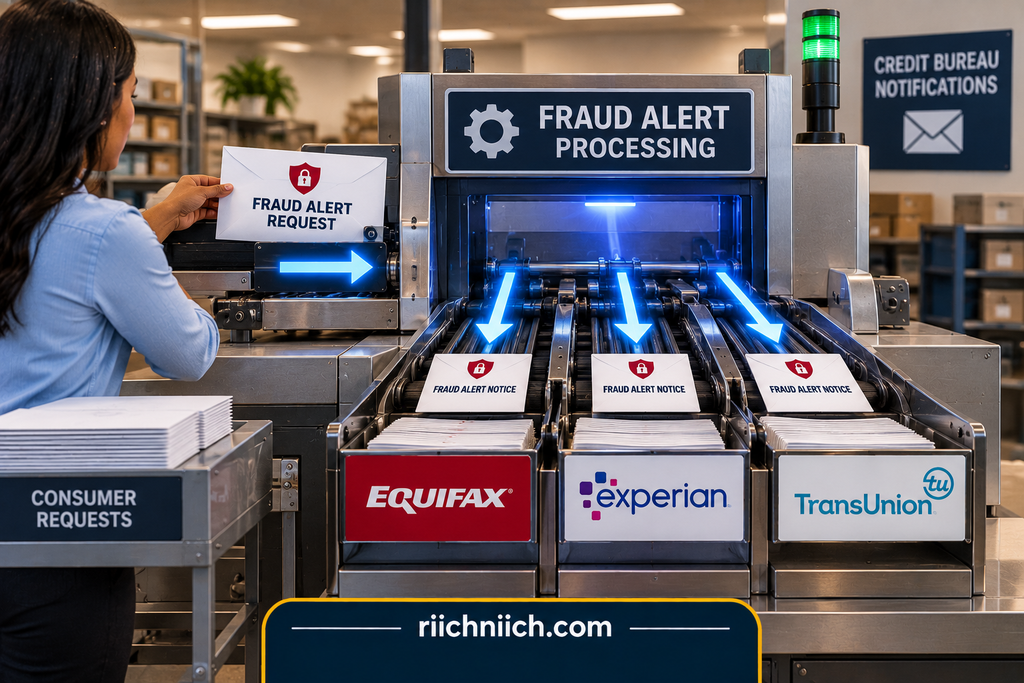
After placing the alert, it’s still smart to review all three of your credit reports for suspicious activity. An account or inquiry could appear on one credit report but not another. The FTC recommends checking your reports for accounts you don’t recognize because they can be a warning sign of identity theft.
If you’re placing an initial fraud alert, there’s another benefit: the FTC says you’re entitled to request a free credit report from each of the three credit bureaus after placing the alert.
This distinction is also important when deciding whether a fraud alert provides enough protection for your situation. A fraud alert tells creditors to take steps to verify your identity, while a credit freeze generally prevents prospective creditors from accessing your frozen credit file. You can also have a fraud alert and credit freeze in place at the same time.
If your personal information has already been exposed or stolen, you may want protection beyond a fraud alert. An identity theft protection service offering three-bureau credit monitoring, identity monitoring, dark web monitoring, suspicious-activity alerts, and identity restoration assistance can provide broader ongoing monitoring. The key is comparing exactly what each service monitors rather than assuming that a fraud alert alone covers every form of identity theft.
What Happens After You Place a Fraud Alert?
After you learn how to place a fraud alert and successfully submit your request, the credit bureau you contacted must notify the other two nationwide credit bureaus. That means you don’t have to repeat the fraud-alert process separately with Equifax, Experian, and TransUnion.
Once the alert is active, it becomes part of your credit file. When a business checks your credit report for a covered credit request, the fraud alert tells the creditor to take steps to verify your identity before approving the request. The CFPB explains that this protection applies before opening a new account, issuing an additional card, or increasing a credit limit based on your request.
For example, if an identity thief uses your stolen personal information to apply for a new credit card, the lender may see the fraud alert on your credit report and contact you or otherwise verify the applicant’s identity before proceeding. The goal is to create another checkpoint between the criminal and the new credit account.

Your credit report is not locked after you place a fraud alert. Businesses with a permissible purpose can still access your credit report, and you can continue applying for legitimate credit. This is one of the major differences between a credit fraud alert and a credit freeze. A freeze generally restricts prospective creditors from accessing your frozen credit file, while a fraud alert allows access but adds an identity-verification requirement.
If you placed an initial fraud alert, it lasts for one year and can be renewed. You are also entitled to request a free credit report from each of the three nationwide credit bureaus after placing an initial fraud alert. This is a good opportunity to examine all three reports for accounts, inquiries, or other activity you don’t recognize.
If you discover fraudulent accounts or confirm that someone has stolen your identity, don’t rely on the fraud alert alone. The FTC recommends contacting the companies where the fraud occurred, reviewing your credit reports, placing a credit freeze if you haven’t already, and reporting the identity theft through IdentityTheft.gov to receive a personalized recovery plan.
A fraud alert also doesn’t continuously monitor your personal information. It won’t necessarily tell you if your information appears on the dark web or is misused in ways that don’t involve a covered credit check. The FTC recommends watching your bills, bank statements, and credit reports for signs of identity theft.
This is where a broader identity theft protection service may offer additional value. If your information has already been exposed, consider comparing services that include three-bureau credit monitoring, identity monitoring, dark web monitoring, fast alerts, and identity restoration assistance. A fraud alert can provide an important credit safeguard, while ongoing monitoring can help you watch for suspicious activity beyond the credit-application process.
How Long Does a Fraud Alert Last?
How long a fraud alert lasts depends on which type of fraud alert you place. If you’re learning how to place a fraud alert, it’s important to know the expiration period so you don’t accidentally let your protection end while your personal information may still be at risk.
There are three main time periods:
- Initial fraud alert: lasts one year and can be renewed.
- Extended fraud alert: lasts seven years and is available to qualifying identity-theft victims.
- Active duty fraud alert: lasts one year and can be renewed for the length of a servicemember’s deployment.
Initial Fraud Alert: One Year
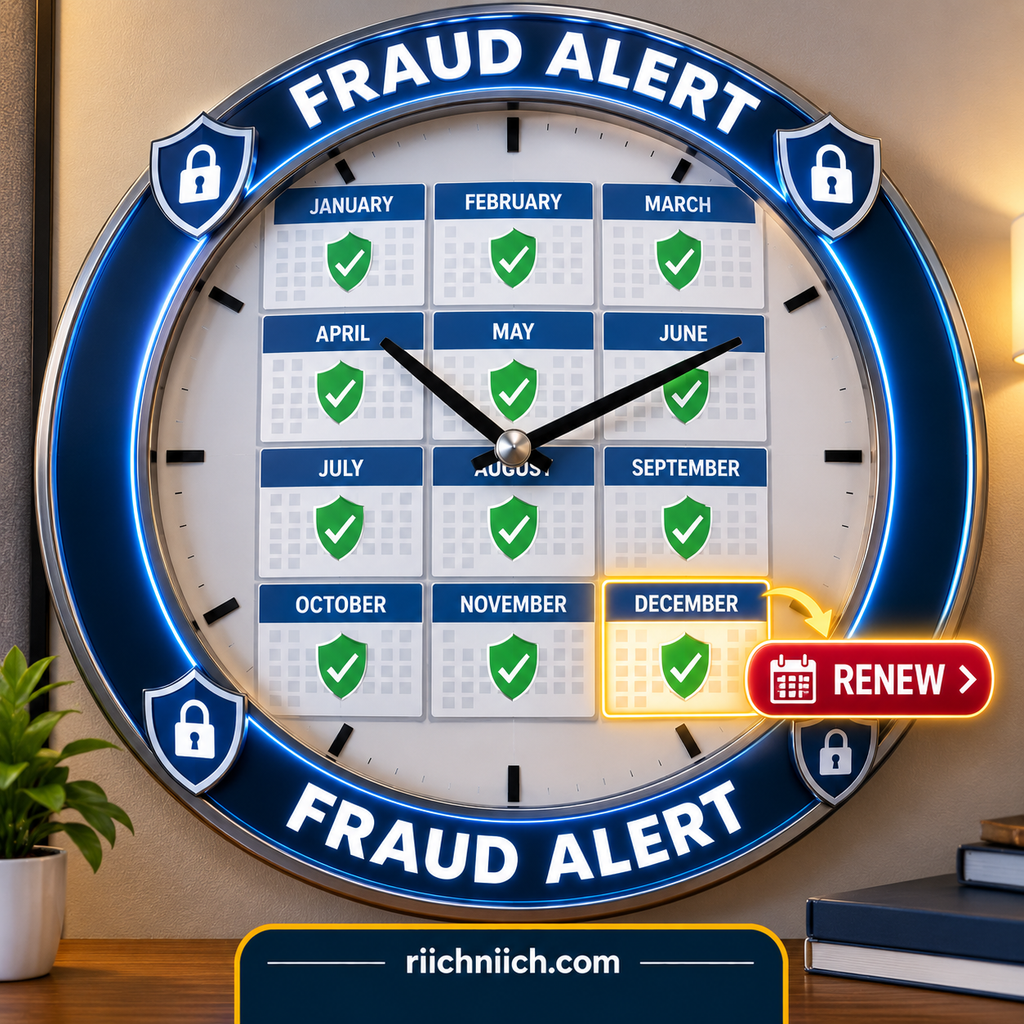
A standard initial fraud alert lasts one year. After that year, the alert ends and is removed unless you place another fraud alert. There is no fee to renew it.
This means that if your Social Security number or other sensitive information remains exposed after a data breach, you may want to renew the alert rather than assume the risk has disappeared simply because a year has passed.
Extended Fraud Alert: Seven Years
If you’ve experienced identity theft and meet the requirements for an extended fraud alert, the protection lasts seven years. The FTC says qualifying consumers must have completed an FTC Identity Theft Report through IdentityTheft.gov or filed a police report.
An extended fraud alert can make sense when your information has already been misused and you want longer-lasting verification requirements without renewing an initial alert every year.
Active Duty Fraud Alert: One Year
An active duty fraud alert lasts 12 months. If your deployment continues beyond that period, you can place another active duty alert on your credit file.
Knowing these expiration periods is important because a fraud alert doesn’t provide permanent protection. Even while an alert is active, it also doesn’t continuously monitor your personal information for other signs of identity theft.
If you’re concerned about what happens between credit applications, you may want to compare identity theft protection services offering three-bureau credit monitoring, identity monitoring, dark web monitoring, fast alerts, and identity restoration assistance. For consumers whose information has already been exposed, ongoing monitoring can complement a fraud alert by watching for suspicious activity the alert itself isn’t designed to detect.
How to Renew a Fraud Alert
If your fraud alert is approaching its expiration date and you still believe your personal information could be misused, you can renew the protection for free. When learning how to place a fraud alert, it is also important to understand that an initial fraud alert does not automatically remain on your credit file indefinitely. An initial fraud alert lasts one year, and after it expires, you can place another fraud alert if you still want the protection.
Renewing an initial fraud alert is essentially the process of placing another fraud alert. You can:
- Choose one of the three nationwide credit bureaus: Equifax, Experian, or TransUnion.
- Visit the bureau’s official fraud-alert page or use another available request method.
- Provide the requested identifying information.
- Request another initial fraud alert.
- Complete any required identity-verification steps.
- Save the confirmation for your records.
You only need to contact one credit bureau. The bureau you contact must notify the other two so the fraud alert can be placed across your credit files. There is no charge to renew an initial fraud alert.
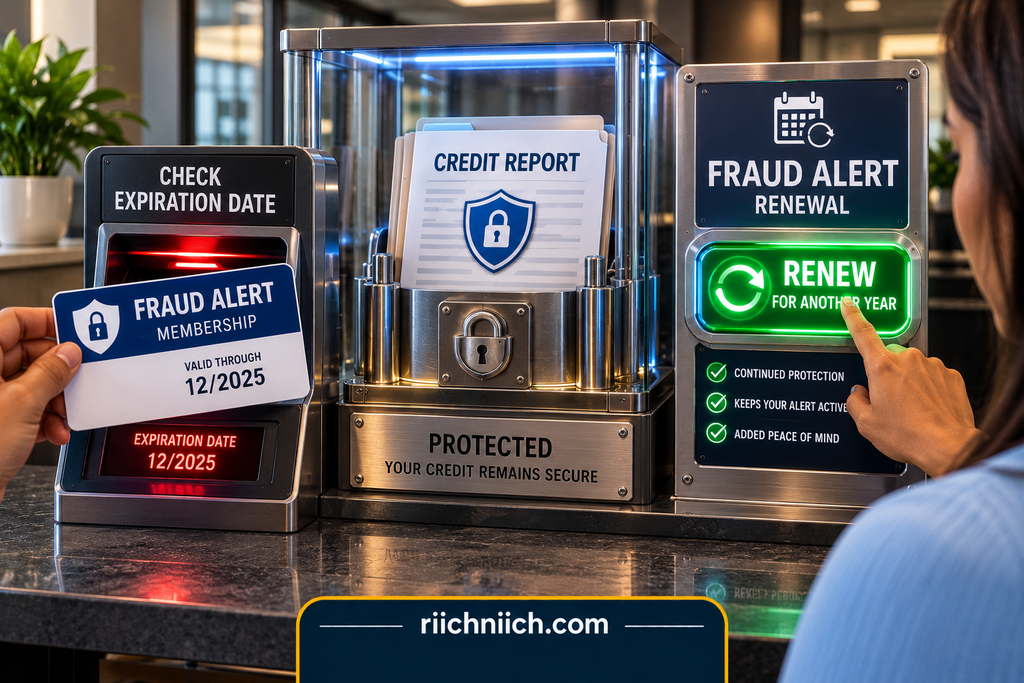
The renewal rules are different for an extended fraud alert. An extended alert lasts seven years. The FTC says you can choose to renew it, but you will need to resubmit your FTC Identity Theft Report or police report to qualify for another extended alert.
For an active duty fraud alert, the initial alert lasts one year. Eligible servicemembers can renew the alert for the length of their deployment if additional protection is needed.
If your Social Security number or other sensitive information has been exposed, don’t assume the danger disappears when your fraud alert expires. Stolen personal information can remain useful to criminals long after the original breach. Renewing your credit fraud alert can maintain the added identity-verification requirement, but it still does not provide continuous monitoring for every possible misuse of your information.
That is where paid protection may become worth comparing. If you want more than a renewed fraud alert, look for an identity theft protection service offering three-bureau credit monitoring, identity monitoring, dark web monitoring, fast alerts, and identity restoration assistance. Credit monitoring generally alerts you after certain changes occur and does not itself prevent fraudulent information from appearing, so compare the actual monitoring and recovery features before paying for a service.
How to Remove a Fraud Alert
You don’t have to keep a fraud alert on your credit reports until it expires. If the risk that caused you to place the alert has been resolved, you can request to have it removed early. Understanding removal is another useful part of knowing how to place a fraud alert, especially if you no longer want the additional identity-verification step when applying for new credit.
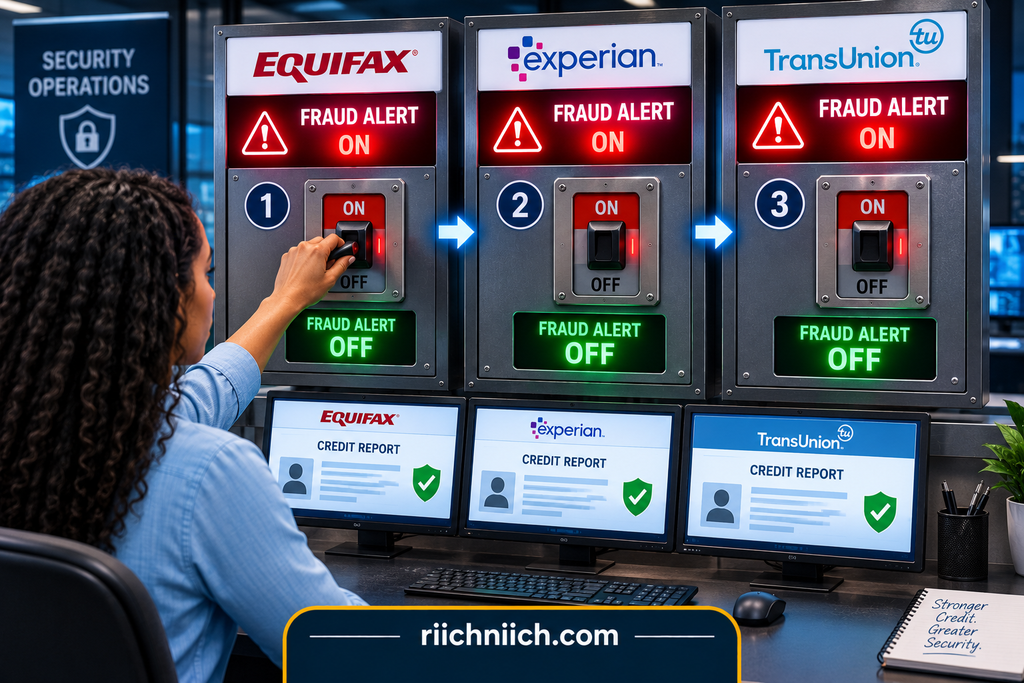
There is one important difference between placing and removing a fraud alert: when you place an alert, you only need to contact one nationwide credit bureau, and that bureau notifies the other two. When you want to remove the alert early from all three credit reports, you generally need to contact Equifax, Experian, and TransUnion separately. Experian and TransUnion both specifically state that the bureaus do not automatically notify one another when an alert is removed.
To remove a fraud alert from all three credit files:
- Contact Equifax and request removal from your Equifax credit file.
- Contact Experian and request removal from your Experian credit file.
- Contact TransUnion and request removal from your TransUnion credit file.
- Complete any identity-verification requirements requested by each bureau.
- Save your confirmations in case you need to verify later that the alerts were removed.
Each bureau provides its own removal process, so follow the instructions on its official website rather than assuming that removing the alert from one report removes it everywhere.
You also don’t necessarily need to remove a fraud alert simply because you’re applying for a mortgage, auto loan, credit card, or other financing. Unlike a credit freeze, a fraud alert doesn’t prevent prospective creditors from accessing your credit report. You can still apply for and obtain credit, although the creditor’s additional identity-verification procedures may sometimes slow the application process.
If you don’t remove the alert early, it will eventually expire on its own. An initial fraud alert and active duty fraud alert generally expire after one year, while an extended fraud alert lasts seven years.
Before removing an alert, consider why you placed it originally. If your Social Security number or other sensitive information was exposed in a data breach, removing the alert doesn’t make that exposed information disappear. If you’re still concerned about new-account identity theft, you may want to keep the fraud alert in place or consider a credit freeze, which provides a stronger restriction on access to your credit file. The FTC notes that a freeze is free and remains in place until you lift it.
For consumers who want broader ongoing protection, this may also be a good time to compare identity theft protection services. Look for useful features such as three-bureau credit monitoring, identity monitoring, dark web monitoring, fast alerts, and identity restoration assistance. These services address different risks than a fraud alert, so compare what is actually monitored and what recovery support is included before choosing a paid plan.
Can You Still Apply for Credit With a Fraud Alert?
Yes. You can still apply for and receive new credit while a fraud alert is on your credit reports. If you’re learning how to place a fraud alert, this is an important distinction: a fraud alert does not block lenders from accessing your credit report. Instead, it tells them to take steps to verify your identity before granting new credit in your name.
That means you can still apply for products such as:
- Credit cards
- Auto loans
- Mortgages
- Personal loans
- Student loans
- Other forms of new credit
The difference is that the lender may need to confirm that you are actually the person submitting the application before approving it. Depending on the lender and application, that additional verification could make the process take a little longer.
For example, imagine you’re shopping for a new car and apply for financing at the dealership. The lender can still review your credit report even though it contains a fraud alert. However, the alert tells the lender to verify your identity before granting the new credit.

This is one of the biggest differences between a fraud alert and a credit freeze. A fraud alert leaves your credit report accessible to businesses but adds identity verification. A credit freeze generally prevents prospective creditors from accessing your frozen credit report, so you normally need to temporarily lift the freeze when applying for new credit.
Because of this, you generally do not need to remove a fraud alert before applying for credit. If you legitimately submitted the application, you simply need to be prepared to complete any additional identity-verification steps requested by the lender.
This can make a credit fraud alert appealing to consumers who want an additional safeguard against new-account identity theft without restricting legitimate access to their credit reports.
However, convenience shouldn’t be confused with complete protection. A fraud alert is focused primarily on new credit and doesn’t continuously monitor every possible misuse of your personal information. The FTC recommends continuing to review your credit reports, bills, and financial statements for activity you don’t recognize.
If your Social Security number or other sensitive information has already been exposed, you may also want to compare identity theft protection services offering three-bureau credit monitoring, identity monitoring, dark web monitoring, fast alerts, and identity restoration assistance. These features can provide broader ongoing monitoring while your fraud alert adds another verification step when someone attempts to obtain new credit in your name.
What Can a Fraud Alert Protect You From?
A fraud alert is mainly designed to help protect you against new-account fraud and certain other credit-related identity theft. If you are learning how to place a fraud alert, the key benefit is that creditors checking your credit report must take steps to verify your identity before approving certain credit requests.
This extra verification can make it more difficult for someone with your stolen personal information to successfully:
- Open a new credit card in your name.
- Take out a loan using your identity.
- Open another type of new credit account in your name.
- Request an additional card on an existing credit account.
- Request certain credit-limit increases while pretending to be you.
For example, suppose a criminal obtains your Social Security number, date of birth, and address after a data breach. They use that information to submit a credit card application in your name. If a fraud alert on your credit report is active, the creditor must take reasonable steps to verify that the request is actually coming from you before approving the new account.
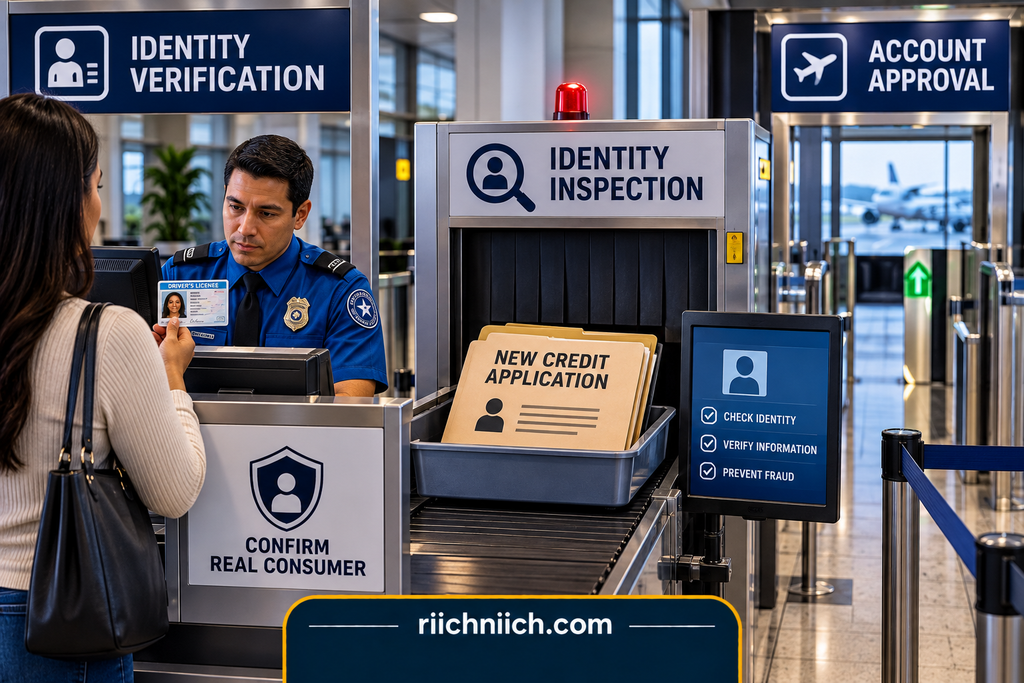
A credit fraud alert can be particularly useful after a data breach, lost or stolen identification, phishing incident, or other exposure of sensitive personal information. It can also help someone who has already experienced identity theft by making it harder for a thief to continue opening new credit accounts. The FTC specifically notes that fraud alerts and credit freezes can help stop someone who has already stolen your identity from misusing it again.
However, a fraud alert does not guarantee that all identity theft will be prevented. It does not block access to your credit report, and it isn’t designed to stop every possible misuse of your Social Security number or other personal information. The FTC recommends continuing to review your bank statements, bills, and credit reports for activity you don’t recognize.
If preventing fraudulent new credit is your biggest concern, you may also consider a credit freeze. A freeze generally prevents prospective creditors from accessing your credit report, creating a stronger barrier to opening new accounts. You can have both a credit freeze and fraud alert in place at the same time.
For consumers who want protection beyond the credit-application process, an identity theft protection service may also be worth comparing. Look for useful features such as three-bureau credit monitoring, identity monitoring, dark web monitoring, suspicious-activity alerts, and identity restoration assistance. A fraud alert can provide an important layer against new-account fraud, while broader monitoring can help watch for other warning signs that a fraud alert itself isn’t designed to detect.
What Does a Fraud Alert Not Protect You From?
A fraud alert is useful for reducing the risk of new-account identity theft, but it does not protect every part of your identity or finances. If you’re learning how to place a fraud alert, it’s just as important to understand these limitations so you don’t assume your personal information is fully protected once the alert is active.
A fraud alert generally does not protect you from:
- Fraudulent charges on an existing credit card
- Unauthorized withdrawals or transactions from an existing bank account
- An identity thief taking over certain existing online accounts
- Tax identity theft
- Medical identity theft
- Fraud involving government benefits
- Criminals using stolen usernames and passwords
- Your personal information being exposed or sold on the dark web
- Phishing, impersonation, or other scams designed to steal additional information
- Every attempt to misuse your Social Security number or other personal information
The reason is simple: a fraud alert is primarily attached to your credit file. It requires creditors checking your credit report to take steps to verify your identity before opening a new account, issuing an additional card, or increasing a credit limit based on your request. It is not a universal lock on your identity.
For example, if a criminal already has the login credentials for your existing bank account, a fraud alert on your credit report doesn’t automatically stop that person from attempting to access the account. Likewise, a fraud alert won’t remove your Social Security number, email address, or other personal information from places where it may already have been exposed.
If your personal details are publicly available online, our guide on how to remove your personal information from the internet explains how to reduce that exposure.

Another important limitation is that a fraud alert does not completely block new credit from being opened. Unlike a credit freeze, businesses can still access your credit report while a fraud alert is active. The alert instead requires additional identity-verification measures. The CFPB specifically notes that a fraud alert does not prevent a lender from opening credit in your name in the same way a freeze restricts access to your credit file.
That’s why consumers dealing with serious exposure may want to use multiple layers of protection. For your online accounts, using one of the best password managers can also help you create and store strong, unique passwords instead of reusing credentials across multiple sites. A credit freeze can provide a stronger barrier against fraudulent new accounts, while strong passwords and two-factor authentication can help protect existing online accounts. You should also continue reviewing credit reports, bank statements, and bills for activity you don’t recognize.
If your personal information has already been stolen or exposed in a major data breach, broader monitoring may also be worth considering. An identity theft protection service can offer features such as three-bureau credit monitoring, identity monitoring, dark web monitoring, suspicious-activity alerts, and identity restoration assistance. Keep in mind that monitoring generally alerts you after certain activity or changes are detected rather than preventing every form of identity theft.
The goal isn’t to replace your free fraud alert with a paid service. It’s to understand what each protection tool actually does so you can decide whether a fraud alert, credit freeze, ongoing monitoring, or a combination of them fits the level of protection you want.
Fraud Alert vs Credit Freeze: What Is the Difference?
A fraud alert and credit freeze both help protect against new-account identity theft, but they work in very different ways. If you are learning how to place a fraud alert, the biggest difference to understand is verification versus restriction.
A fraud alert leaves your credit report accessible but tells businesses checking it to take steps to verify your identity before granting certain new credit. A credit freeze, also called a security freeze, generally prevents prospective creditors from accessing your credit file until you lift the freeze.
If you want the stronger option, follow our step-by-step guide on how to freeze your credit at all three credit bureaus.
Here is the difference at a glance:
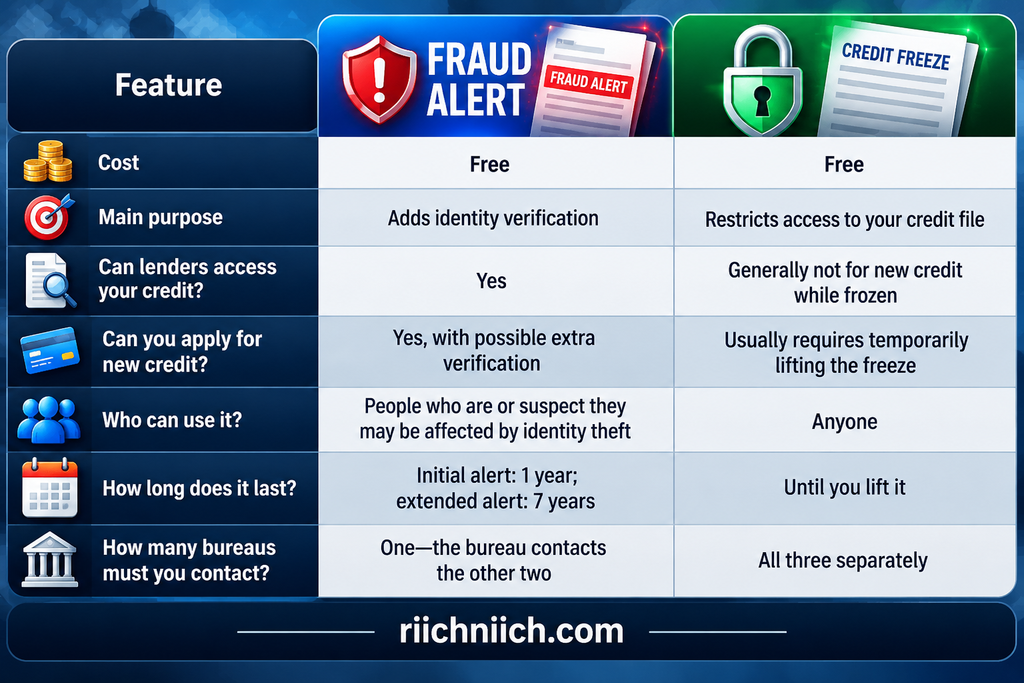
For example, imagine an identity thief applies for a new credit card using your stolen Social Security number. With a fraud alert on your credit report, the lender can access your report but must take steps to verify that the person requesting the credit is actually you. With a credit freeze, the lender generally cannot access the frozen credit file in the first place, making it much harder to approve the fraudulent application.
Another major difference is how you set them up. To place a fraud alert across your credit files, you contact only one of the three nationwide credit bureaus, and that bureau must notify the other two. To freeze your credit with all three bureaus, you must contact Equifax, Experian, and TransUnion individually.
A credit freeze also stays in place until you remove it, while an initial fraud alert lasts one year and can be renewed. If you have experienced identity theft and meet the requirements, an extended fraud alert can remain in place for seven years.
You don’t necessarily have to choose only one. The FTC confirms that you can have a credit freeze and fraud alert at the same time. Someone whose sensitive personal information has been exposed may decide to use a freeze to restrict access to their credit files while also maintaining a fraud alert for additional identity verification.
Neither option, however, provides complete identity monitoring. A credit freeze and fraud alert primarily address risks involving your credit file and new credit; they don’t prevent every form of identity theft or account takeover.
If your Social Security number or other sensitive information has already been exposed, you may therefore want to compare identity theft protection services offering features such as three-bureau credit monitoring, identity monitoring, dark web monitoring, fast alerts, and identity restoration assistance. Paid monitoring is not a replacement for a free fraud alert or credit freeze, and the CFPB cautions that monitoring services generally cannot prevent identity theft before it happens.
Should You Place a Fraud Alert or Freeze Your Credit?
Whether you should place a fraud alert or freeze your credit depends largely on how much restriction you want around new credit applications. Both options are free and can help reduce the risk of new-account identity theft, but they provide different levels of protection.
If you’re researching how to place a fraud alert because you suspect your personal information may have been compromised, a fraud alert may make sense when you want additional identity verification without restricting access to your credit reports. A lender can still access your credit report, but it must take steps to verify your identity before granting certain new credit.
A fraud alert may be worth considering when:
- You suspect you may become a victim of identity theft.
- Your wallet or identification was lost or stolen.
- Your personal information may have been exposed.
- You notice a suspicious credit inquiry or other warning sign.
- You expect to apply for credit soon and don’t want to repeatedly lift a freeze.
An initial fraud alert is free, lasts one year, and can be renewed. You only need to contact one of the three nationwide credit bureaus, which must notify the other two.
A credit freeze provides a stronger restriction on new-credit access. While the freeze is active, prospective creditors generally cannot access your frozen credit file, which can make it much harder for an identity thief to open a new account in your name. Anyone can freeze their credit, even if they haven’t experienced identity theft or a data breach.
A credit freeze may make sense when:
- Your Social Security number or other sensitive information has been exposed.
- You’ve already experienced identity theft.
- You don’t expect to apply for new credit frequently.
- You want to restrict access to your credit files rather than rely primarily on additional identity verification.
- You want a protection that stays in place until you decide to lift it.
Unlike a fraud alert, you’ll need to contact Equifax, Experian, and TransUnion separately to freeze all three credit files. When you legitimately need new credit, you can temporarily lift the appropriate freeze for free and restore it afterward.
When you’re ready to apply for a loan, credit card, or other financing, see our guide on how to unfreeze your credit and restore access when you’re finished.
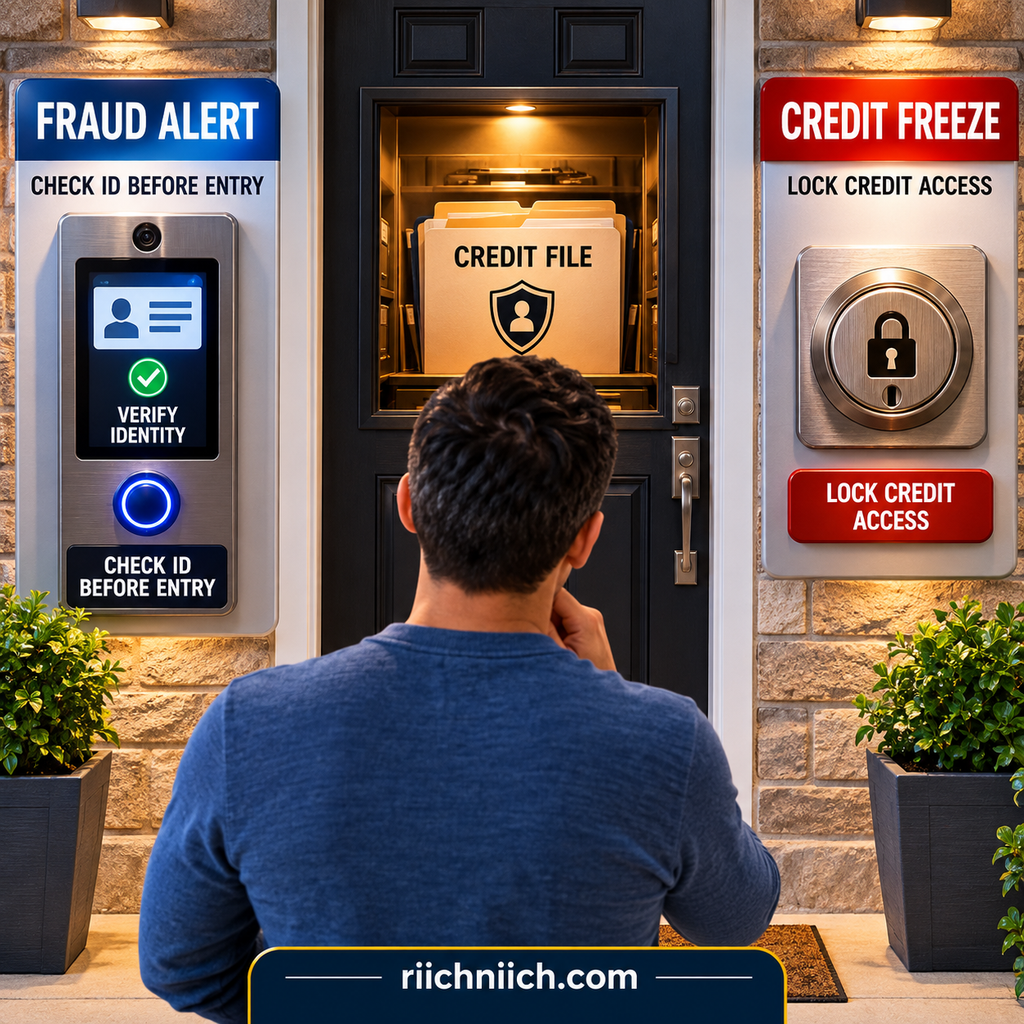
You also don’t have to choose between them. The FTC says you can place a fraud alert even when a credit freeze is already active. Using both creates two different safeguards: the freeze restricts access to your credit file, while the fraud alert tells businesses to verify your identity when it applies.
However, neither option monitors every way criminals can misuse stolen personal information. If your information has already been exposed, you may also want to compare identity theft protection services that include features such as three-bureau credit monitoring, identity monitoring, dark web monitoring, fast alerts, and identity restoration assistance.
Paid monitoring shouldn’t replace the free protections available to you. The CFPB notes that credit and identity monitoring services generally cannot prevent identity theft before it happens. Their value is primarily in helping detect certain changes or suspicious activity and, depending on the service, providing assistance if identity theft occurs.
For many consumers, the decision comes down to this: a fraud alert adds verification, while a credit freeze restricts access. If your information has been seriously exposed, you can also use both and add ongoing monitoring if you want broader visibility into potential identity-theft warning signs.
What to Do If Your Personal Information Has Already Been Exposed
If your Social Security number, driver’s license information, account credentials, or other sensitive information has already been exposed, act before you see obvious signs of identity theft. Stolen information can sometimes remain unused for months or years before a criminal attempts to open an account or commit fraud.
If you’re researching how to place a fraud alert because of a data breach or suspected exposure, a fraud alert can be a useful first layer of protection. An initial fraud alert is free, lasts one year, and requires lenders to take steps to verify your identity before granting new credit in your name. You only need to contact one of the three nationwide credit bureaus to place it; that bureau must notify the other two.
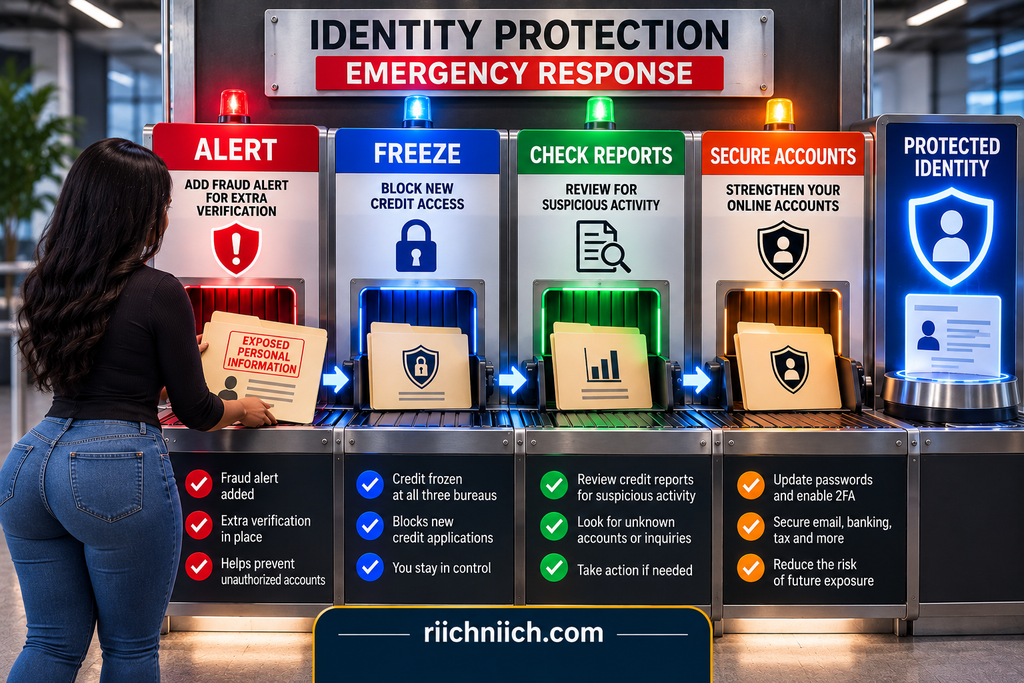
Start with these steps:
- Place a fraud alert. This adds an identity-verification step when someone attempts to obtain certain new credit in your name.
- Consider freezing your credit. If highly sensitive information such as your Social Security number was exposed, a credit freeze provides a stronger barrier by restricting prospective creditors’ access to your credit file. You’ll need to freeze your credit separately with Equifax, Experian, and TransUnion.
- Review all three credit reports. Look for accounts, inquiries, addresses, or other information you don’t recognize. The FTC recommends checking credit reports after sensitive information is exposed.
- Secure affected accounts. Change compromised passwords and PINs, especially if login credentials were part of the exposure. Don’t reuse the replacement password on other accounts. If the exposure came from a breach, use our step-by-step guide on how to secure your online accounts after a data breach to lock down your email, financial accounts, passwords, and other important logins.
- Watch your financial accounts. Review bank and credit-card statements for withdrawals, purchases, or other activity you didn’t authorize.
- Report actual identity theft. If you discover that someone has already used your information, report it through IdentityTheft.gov. The FTC provides an Identity Theft Report and personalized recovery plan.
If the exposure has already turned into fraud, follow our complete guide on what to do immediately if your identity is stolen to start securing your accounts and recovering your identity.
The type of information exposed matters. If only a password was compromised, securing the affected account and any other accounts using the same password should be a priority. If your Social Security number or other information useful for opening credit accounts was exposed, a fraud alert on your credit reports and credit freezes deserve stronger consideration. You can also take additional steps to protect your Social Security number from further misuse after it has been exposed.
If fraudulent accounts have already appeared, don’t stop at monitoring. Contact the companies where the fraud occurred, ask them to close or freeze affected accounts, and report the identity theft. The CFPB also explains that identity-theft victims can request that fraudulent information be blocked from their consumer reports by providing the appropriate identity-theft documentation.
Exposure also doesn’t necessarily end when the original breach is over. Once information has been stolen, you should continue watching for suspicious credit and account activity. If the breached company offers free credit monitoring or identity theft protection, the FTC recommends taking advantage of those services.
If free monitoring isn’t available—or you want broader ongoing coverage—this is also a situation where comparing identity theft protection services can make sense. Look for features such as three-bureau credit monitoring, identity monitoring, dark web monitoring, fast alerts, and identity restoration assistance. The goal is not to replace your fraud alert or credit freeze, but to add monitoring and recovery support around those free protections.
A data breach cannot always be undone, but you can make stolen information much harder to use successfully. A combination of a fraud alert, credit freezes, account security, regular credit checks, and ongoing monitoring can give you multiple layers of protection after your personal information has already been exposed.
Should You Use Identity Theft Protection After Placing a Fraud Alert?
Placing a fraud alert is an important security step, but it does not provide complete identity theft protection. If you’re learning how to place a fraud alert, it’s worth understanding where the fraud alert ends and where additional monitoring may provide value.
A fraud alert primarily helps with new credit applications. It tells lenders to take steps to verify your identity before granting certain new credit in your name. An identity theft protection service can potentially monitor a much broader range of activity, depending on the features included in the plan.
For example, identity theft protection services may include:
- Three-bureau credit monitoring
- Identity monitoring
- Dark web or compromised-information monitoring
- Alerts about suspicious changes to your credit files
- Public-record monitoring
- Identity theft recovery or restoration assistance
- Identity theft insurance, depending on the provider and plan
The FTC explains that credit monitoring typically watches for changes to your credit reports, while identity monitoring may search additional databases and websites for signs that your personal information is being misused.

This distinction becomes especially important if you placed a fraud alert after identity theft or a data breach. A credit fraud alert can make it harder for someone to successfully open new credit in your name, but it doesn’t continuously search for every possible sign that your exposed information is being misused.
For someone whose Social Security number, driver’s license information, email address, phone number, or other sensitive information has already been exposed, broader monitoring can therefore provide an additional layer of visibility.
👉 If you want broader monitoring after placing a fraud alert, Aura is worth considering for its combination of credit monitoring, identity monitoring, dark web monitoring, and identity theft recovery support.
However, identity theft protection isn’t required just because you placed a fraud alert. There are several free protections you can use first. You can review your credit reports yourself, place a free fraud alert, and freeze your credit at no cost. If a company offers you free credit monitoring after a data breach, the FTC recommends taking advantage of it.
Paid identity theft protection becomes more attractive when you want convenience, broader monitoring, faster notifications, or professional recovery assistance rather than managing everything yourself.
If you want to compare your options, see our guide to the best identity theft protection services for monitoring, alerts, and recovery support.
Before paying for a service, compare exactly what you’re getting. The CFPB recommends checking the features, price, trial terms, cancellation requirements, and other restrictions because identity monitoring services can vary significantly.
Also remember that monitoring is not prevention. A service may alert you when certain suspicious activity is detected, but it cannot guarantee that your identity will never be stolen. The CFPB specifically cautions that most monitoring services don’t prevent your information from being stolen; they generally alert you after certain activity has occurred.
That’s why identity theft protection is better viewed as another layer, not a replacement for a fraud alert or credit freeze.
If you’re considering paying for protection after placing a fraud alert, prioritize services that provide meaningful coverage for the price—particularly three-bureau credit monitoring, broader identity monitoring, dark web monitoring, useful alerts, and hands-on identity restoration assistance. Those are the features that can expand your protection beyond what a fraud alert does by itself.
What to Look for in an Identity Theft Protection Service
If you’ve learned how to place a fraud alert and want broader protection, an identity theft protection service can add monitoring and recovery features that a fraud alert doesn’t provide by itself. However, plans can vary significantly, so it’s important to compare the actual features rather than choosing a service based only on its advertising or insurance amount.
The CFPB notes that identity monitoring services may monitor personal information across credit applications, public records, websites, and other sources for activity that could indicate identity theft. Some services also include credit monitoring, recovery assistance, and identity theft insurance.
Here are the features worth prioritizing:
Three-bureau credit monitoring. Look for monitoring across Equifax, Experian, and TransUnion, rather than only one credit bureau. Credit monitoring can alert you to changes such as new accounts, credit inquiries, changes to personal information, and other activity appearing on your reports. The FTC recommends checking exactly which bureaus a service monitors before paying for it.
Identity monitoring beyond your credit reports. Identity theft doesn’t always create an immediate change to your credit. A stronger service may monitor additional sources for signs that your personal information is being misused.
👉 If broader identity monitoring is important to you, Identity Guard is one service worth comparing for monitoring your identity and alerting you to potential signs of suspicious activity.
Dark web monitoring. Look for monitoring that searches for sensitive information associated with you in places where stolen information may be traded or exposed. This can be particularly useful if your email address, passwords, Social Security number, or other personal information has previously been compromised.
Fast, useful alerts. Monitoring is much more valuable when you’re notified quickly and the alert clearly explains what happened. Look for multiple notification options—such as app, text, or email alerts—and make sure you understand which events actually trigger a notification.

Identity restoration assistance. Detection is only part of the equation. If your identity is stolen, having access to a dedicated restoration specialist or case manager can make the recovery process easier. The FTC explains that recovery services may help victims work through documents, creditors, credit freezes, and other steps needed to repair identity-theft damage.
Identity theft insurance with clear coverage. Don’t choose a plan solely because it advertises a large insurance limit. Read what the policy actually covers, along with deductibles, exclusions, and reimbursement requirements. The FTC notes that identity theft insurance may cover certain recovery-related expenses but generally does not simply reimburse all money stolen by scammers.
Coverage that matches your household. If you’re protecting more than yourself, compare individual and family plans carefully. Check how many adults and children are covered and whether each family member receives the same monitoring features.
Straightforward pricing and cancellation terms. Compare the monthly or annual price against the monitoring and recovery services you’re actually receiving. Pay particular attention to introductory pricing, automatic renewals, trial periods, cancellation requirements, and features restricted to higher-priced plans. The CFPB specifically recommends understanding these conditions before enrolling.
Before paying for any service, also check what protection you may already have. Your bank, credit-card issuer, employer, insurer, or a company involved in a data breach may provide some monitoring at no additional cost. Free credit freezes, fraud alerts, and regular credit-report reviews should remain part of your protection strategy regardless of whether you purchase a monitoring service.
The strongest value usually comes from a service that combines three-bureau credit monitoring, broader identity monitoring, dark web monitoring, timely alerts, and hands-on restoration assistance at a price that makes sense for your needs.
Most importantly, don’t treat any identity theft protection service as a guarantee that identity theft won’t happen. Monitoring services generally help detect suspicious activity and assist with recovery rather than preventing every misuse of your information.
When comparing identity theft protection plans, focus on what is monitored, how quickly you’re alerted, and what happens if your identity is actually stolen. Those details will tell you far more about the value of a service than a long list of features you may never use.
Is Identity Theft Protection Worth It With a Fraud Alert?
Identity theft protection can be worth it even if you already have a fraud alert, especially if your personal information has been exposed or you want broader monitoring and recovery support. If you’ve learned how to place a fraud alert, the important thing to remember is that a fraud alert and an identity theft protection service perform different jobs.
A fraud alert on your credit report focuses primarily on new credit. It requires lenders to take certain steps to verify your identity before granting new credit in your name. Identity theft protection services may monitor additional information and activity that doesn’t necessarily appear on your credit report.
That additional protection may be worth paying for if you want features such as:
- Three-bureau credit monitoring
- Broader identity monitoring
- Dark web or compromised-information monitoring
- Notifications about suspicious credit activity
- Monitoring of certain public records and databases
- Identity restoration or recovery assistance
- Identity theft insurance, depending on the plan
The FTC explains that identity monitoring can look beyond your credit reports for potential warning signs, including information appearing in certain public records, applications for services, or websites where stolen information may be traded.

When Identity Theft Protection May Be Worth the Cost
A paid service becomes more attractive when you have more to monitor than your credit report alone.
For example, it may be worth considering if your Social Security number or other sensitive information has been exposed in a data breach, you’ve previously experienced identity theft, you want multiple credit bureaus monitored automatically, or you want professional assistance available if your identity is stolen.
👉 If keeping a closer watch on your credit is one of your main priorities, IdentityIQ is another identity theft protection service worth comparing for credit and identity monitoring.
Recovery support can be particularly valuable for someone who doesn’t want to handle every step alone. Some identity recovery services provide counselors or case managers who can help with creditors, documentation, credit freezes, and other parts of the recovery process.
When You May Not Need to Pay
Identity theft protection isn’t automatically worth paying for just because you’ve placed a credit fraud alert.
You can do several important things yourself for free. Fraud alerts and credit freezes are free, and consumers can also regularly review their credit reports. The CFPB notes that paid monitoring generally doesn’t prevent your personal information from being stolen; its main function is to notify you when certain activity or changes are detected.
You should also check whether you already receive monitoring through a bank, credit-card issuer, employer, insurance provider, or a company involved in a data breach. The FTC recommends taking advantage of free credit monitoring when it’s offered following a breach.
Think of It as an Additional Layer
The strongest reason to buy identity theft protection is not because a fraud alert is inadequate at its job. It’s because a fraud alert has a specific job.
A fraud alert adds identity verification around new credit. A credit freeze can restrict access to your credit file. Identity theft protection can add monitoring, notifications, and potentially recovery assistance. These protections can complement one another rather than replace one another.
So, is identity theft protection worth it with a fraud alert? It can be if you value broader monitoring, faster awareness of certain suspicious activity, and hands-on recovery support. If you’re comfortable monitoring your own credit and accounts and using free protections, paying for another service may provide less value.
For buyers comparing plans, focus on what you’re actually getting for the price. Prioritize three-bureau credit monitoring, comprehensive identity monitoring, dark web monitoring, useful alerts, and strong restoration assistance rather than simply choosing the service advertising the longest feature list or largest insurance number. The CFPB recommends reviewing the features, costs, trial periods, fees, and cancellation requirements before signing up.
Frequently Asked Questions About How to Place a Fraud Alert
Below are additional questions consumers often have after learning how to place a fraud alert. These cover practical details that haven’t already been addressed above and can help you better understand what to expect while a fraud alert is on your credit file.
Does a Fraud Alert Hurt Your Credit Score?
No. Placing a fraud alert on your credit report does not lower your credit score. A fraud alert is a security measure placed on your credit file; it is not a negative credit event such as a missed payment, collection account, or high credit-card balance.
You can therefore add a credit fraud alert when you suspect identity theft without worrying that the alert itself will damage your credit score. The FTC also confirms that fraud alerts are free.
Will a Fraud Alert Show Up When a Lender Checks My Credit?
Yes. The purpose of a fraud alert on your credit report is to notify a creditor reviewing your file that additional identity verification is required before certain new credit is granted.
The CFPB explains that a fraud alert requires creditors checking your credit report to take steps to verify your identity before opening a new account, issuing an additional card, or increasing a credit limit based on your request.
Does a Fraud Alert Affect Your Existing Credit Cards?
A fraud alert does not shut down your existing credit cards or prevent you from continuing to use legitimate accounts. Its primary purpose is to add identity verification when someone tries to obtain certain new credit or make specified credit requests using your identity.
You should still monitor existing credit-card and bank accounts for transactions you don’t recognize because a fraud alert isn’t designed to stop unauthorized purchases or account takeovers.
Can a Fraud Alert Cause You to Be Denied Credit?
A fraud alert by itself is not a statement that you’re a bad credit risk. It tells the creditor to verify your identity before granting certain new credit.
A lender can still evaluate your application using its normal underwriting criteria, including your credit history, income, debt, and other applicable factors. The additional verification may add another step to the application process, but the fraud alert itself is designed as an identity-theft safeguard rather than a negative credit mark.
Can You Check Your Own Credit Report With a Fraud Alert?
Yes. A fraud alert doesn’t prevent you from checking your own credit reports.
In fact, placing an initial fraud alert gives you the right to request an additional free credit report from each of the three nationwide credit reporting companies. The CFPB confirms that consumers can receive additional free reports when an initial fraud alert has been placed.
Review those reports carefully for unfamiliar accounts, inquiries, addresses, or other information that could indicate identity theft.
Does Checking Your Credit Report After Placing a Fraud Alert Lower Your Score?
No. Checking your own credit report is considered a soft inquiry, and soft inquiries don’t affect your credit scores.
That means you can continue reviewing your credit reports after adding a fraud alert without worrying that your own checks will damage your score.
Does a Fraud Alert Stop Prescreened Credit Card Offers?
It depends on the type of fraud alert.
An initial fraud alert does not automatically provide the same long-term removal from prescreened marketing lists that comes with an extended fraud alert. With an extended fraud alert, the credit bureaus must remove you from their marketing lists for unsolicited credit and insurance offers for five years unless you ask them not to.
So, if stopping prescreened offers is one of your goals, pay attention to the type of fraud alert you’ve placed rather than assuming every alert provides the same benefit.
Will a Fraud Alert Stop Debt Collectors From Contacting You?
No. A fraud alert isn’t designed to stop legitimate debt collection activity.
However, if a debt collector contacts you about an account you don’t recognize, don’t automatically pay it. The FTC recommends getting validation information and disputing a debt you believe isn’t yours. An unfamiliar collection account can also be a warning sign that someone has used your identity.
If you discover actual identity theft, the CFPB recommends reporting it through the FTC’s IdentityTheft.gov recovery process and taking steps to address compromised accounts.
Can a Fraud Alert Protect More Than One Person in a Household?
No. A fraud alert is connected to an individual consumer’s credit file, so placing one on your credit report doesn’t automatically place an alert on your spouse’s, partner’s, or another family member’s credit file.
If another adult in your household also believes their personal information is at risk, they should evaluate their own credit files and take the appropriate protective steps separately.
Should You Pay a Company to Place a Fraud Alert for You?
Generally, there is no reason to pay simply to place a standard fraud alert. Fraud alerts are free, and you can request one directly through a nationwide credit bureau. For an initial fraud alert, contacting one bureau is enough because that bureau must notify the other two.
Where a paid service may provide additional value is after the fraud alert is established. If you want three-bureau credit monitoring, broader identity monitoring, dark web monitoring, suspicious-activity alerts, or hands-on restoration assistance, you can compare identity theft protection services based on those additional features.
The fraud alert itself should remain free—the reason to pay for identity theft protection is the additional monitoring and recovery support, not access to the fraud alert.
Conclusion: How to Place a Fraud Alert
Knowing how to place a fraud alert gives you a simple, free way to add an extra layer of protection to your credit reports when you believe your personal information may be at risk.
The process is straightforward: contact Equifax, Experian, or TransUnion and request the appropriate fraud alert. You only need to contact one credit bureau to place the alert because that bureau is required to notify the other two. An initial fraud alert lasts one year and can be renewed, while qualifying identity theft victims can place an extended fraud alert that lasts seven years. Active-duty servicemembers also have a one-year active duty fraud alert available to them.
The biggest advantage of a fraud alert on your credit report is that it adds identity verification without completely restricting access to your credit file. Businesses can still access your report when permitted, but lenders must take steps to verify your identity before granting new credit in your name.

However, don’t treat a credit fraud alert as complete identity theft protection. It won’t prevent every type of fraud, stop criminals from attempting to access existing accounts, or continuously monitor all the places where your personal information could be misused. The FTC recommends continuing to review your credit reports, bills, and financial accounts for activity you don’t recognize.
If your Social Security number or other highly sensitive information has already been exposed, consider adding a credit freeze as another layer. A freeze is also free, but unlike a fraud alert, it generally prevents prospective creditors from accessing your frozen credit file and remains in place until you lift it. You can have a fraud alert and credit freeze at the same time.
For consumers who want more ongoing visibility, an identity theft protection service may also be worth comparing. Look beyond flashy insurance limits and prioritize useful features such as three-bureau credit monitoring, identity monitoring, dark web monitoring, fast alerts, and hands-on identity restoration assistance.
The bottom line is simple: placing a fraud alert is free, relatively easy, and can make it harder for an identity thief to successfully open new credit in your name.
Use the fraud alert as one layer of your protection—not the only one. Combine it with strong account security, regular credit-report reviews, a credit freeze when appropriate, and broader identity monitoring if you want additional protection and recovery support.
Pingback: How to Recover From Identity Theft - Riich Niich