

If you’re trying to figure out how to recover from identity theft, acting quickly can help you stop additional fraud and start repairing the damage. Identity theft can affect your credit, bank accounts, Social Security number, taxes, online accounts, and other personal information—but recovery is possible with the right steps.
In this guide, you’ll learn how to report identity theft, secure your accounts, freeze your credit, dispute fraudulent information, restore your identity, and protect yourself from future misuse. You’ll also learn when identity theft protection and restoration services may be worth considering during and after recovery.
Table of Contents
🔥 Quick Answer: How to Recover From Identity Theft
If you’re trying to figure out how to recover from identity theft, start by acting quickly and handling the most urgent risks first. Identity theft recovery usually involves reporting the theft, stopping fraudulent activity, securing compromised accounts, protecting your credit, disputing unauthorized accounts or charges, and monitoring your identity for additional misuse.
Start with these steps:
- Document the fraud. Save suspicious emails, account statements, transaction records, letters, screenshots, and other evidence related to the identity theft.
- Report the identity theft to the FTC. Visit IdentityTheft.gov to report what happened and create a personalized recovery plan.
- Contact affected companies immediately. Tell banks, credit card issuers, lenders, or other businesses about accounts or transactions you did not authorize.
- Freeze your credit. Contact Equifax, Experian, and TransUnion individually to restrict access to your credit files and make it harder for someone to open new credit accounts in your name.
- Consider placing a fraud alert. A fraud alert tells potential creditors to take additional steps to verify your identity before extending new credit.
- Review your credit reports. Look for unfamiliar accounts, inquiries, addresses, balances, or other information that could indicate additional fraud. You can obtain your reports through AnnualCreditReport.com.
- Dispute fraudulent information. Contact the appropriate credit bureau and the company that reported the fraudulent account or transaction.
- Secure your online accounts. Change compromised passwords, use unique passwords, enable two-factor authentication where available, and sign out unknown devices or sessions.
- Continue monitoring your identity. Identity theft can involve more than your credit report. Watch your financial accounts, credit files, email accounts, personal information, and other important records for new signs of misuse.
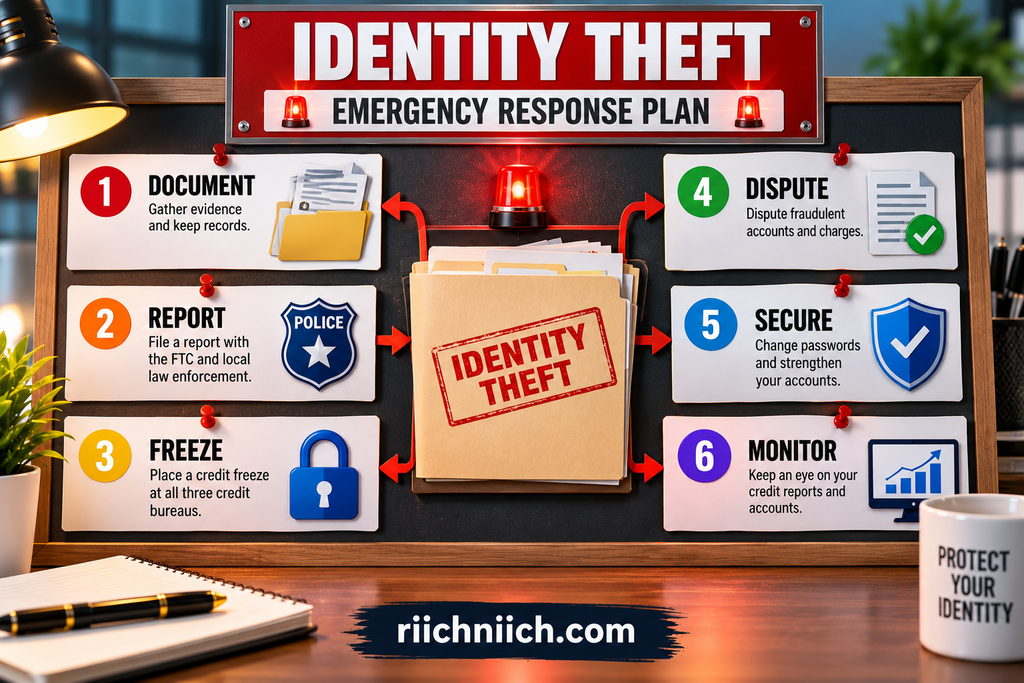
Recovering from identity theft can be relatively straightforward when the fraud is limited to one account, but more complicated cases may require months of disputes, documentation, follow-ups, and monitoring. Keep copies of your identity theft report, correspondence, dispute letters, confirmation numbers, account statements, and notes from conversations with companies throughout the identity theft recovery process.
You also don’t necessarily have to manage every part of recovery alone. Some paid identity theft protection services include identity restoration services, recovery specialists, credit monitoring, identity monitoring, and identity theft insurance. These services cannot magically erase identity theft, but the right service can reduce the amount of recovery work you have to manage yourself—especially if multiple accounts or pieces of personal information have been compromised.
Buyer-intent takeaway: If your identity has already been stolen, prioritize stopping the fraud and securing your accounts first. Then consider whether an identity theft protection service with hands-on restoration support would make the recovery process easier and provide useful ongoing monitoring after the immediate problem is resolved.
What Happens After Your Identity Is Stolen?
Understanding what can happen after identity theft is an important part of learning how to recover from identity theft. Once a criminal has your personal information, the damage may extend beyond a single unauthorized charge. Your credit, financial accounts, online accounts, Social Security number, tax records, and other parts of your identity could potentially be affected.
Identity theft can also continue without being immediately obvious. A criminal may use stolen information weeks or months later, which is why the identity theft recovery process should include both fixing existing problems and watching for new fraudulent activity.

What Can Happen After Identity Theft?
The exact consequences depend on what information was stolen and how criminals use it. You could discover:
- New accounts opened in your name. Someone may attempt to use your identity to apply for credit cards, loans, financing, or other accounts.
- Unauthorized transactions. Existing bank or credit card accounts could be used to make purchases or transfers.
- Credit report problems. Fraudulent accounts, balances, inquiries, or missed payments may appear on your credit reports.
- Account takeovers. Criminals may gain access to email, banking, shopping, social media, or other online accounts.
- Tax identity theft. A stolen Social Security number could potentially be used to file a fraudulent tax return. The IRS Identity Theft Central provides information for taxpayers dealing with tax-related identity theft.
- Medical identity theft. Someone could misuse your personal information in connection with medical care or insurance.
- Government-benefit fraud. Stolen information may potentially be used to fraudulently seek benefits in another person’s name.
- Collection activity. You might receive bills or collection notices for debts you never created.
The Federal Trade Commission (FTC) provides recovery information through IdentityTheft.gov, including personalized recovery steps based on the type of identity theft involved.
The Damage May Not Stop With the First Fraudulent Account
One of the biggest mistakes after discovering identity theft is assuming that fixing the first fraudulent account solves the entire problem.
If a criminal still possesses your Social Security number, driver’s license information, email credentials, or other sensitive data, that information could potentially be misused again. That’s why what to do after identity theft involves more than closing one account.
You may need to dispute fraudulent information, freeze your credit, secure compromised accounts, replace certain credentials when appropriate, and continue monitoring for additional warning signs.
Recovery Can Require Ongoing Monitoring
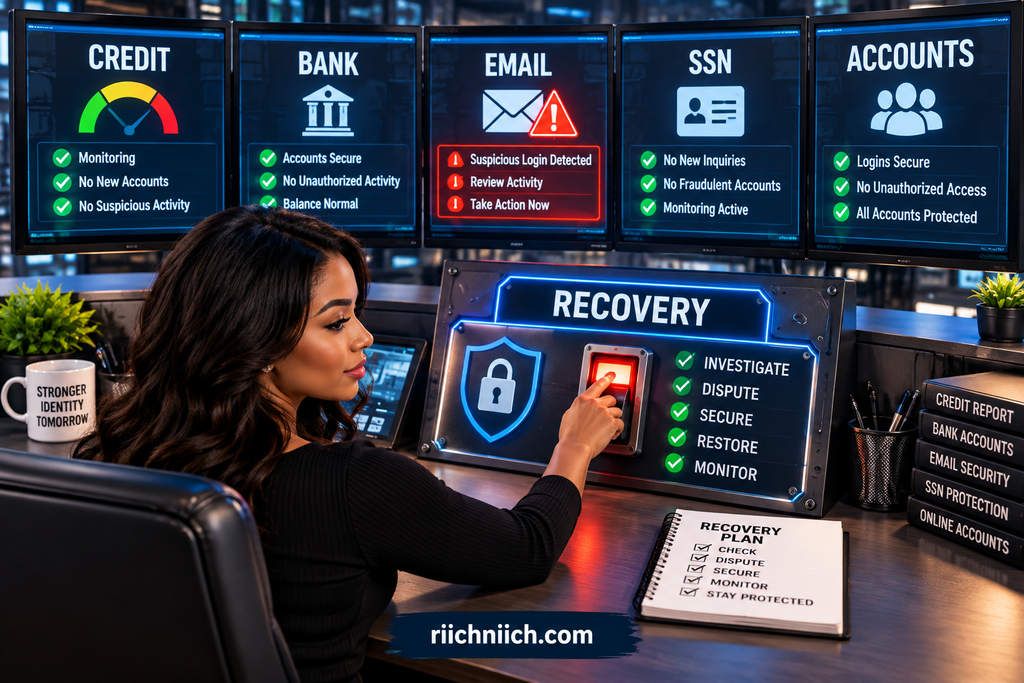
Even after you’ve completed the initial identity theft recovery steps, keeping watch over your information remains important.
You can monitor your credit reports and financial accounts yourself. Depending on the severity of the theft, you may also consider a paid identity theft protection service that provides features such as credit monitoring, identity monitoring, alerts, restoration assistance, and identity theft insurance.
For someone dealing with widespread fraud, identity theft restoration services can be particularly valuable because restoration specialists may help guide you through disputes, documentation, and communication with affected organizations.
That doesn’t mean everyone who experiences identity theft needs to purchase a service. But when comparing identity theft protection, look beyond basic alerts. Hands-on recovery assistance can be one of the most important features for someone whose identity has already been compromised.
Ultimately, understanding how to recover from identity theft means recognizing that recovery has two goals: repair the damage that has already happened and reduce the chances that the stolen information can cause additional problems.
How to Recover From Identity Theft Step-by-Step
Step 1: Document the Identity Theft
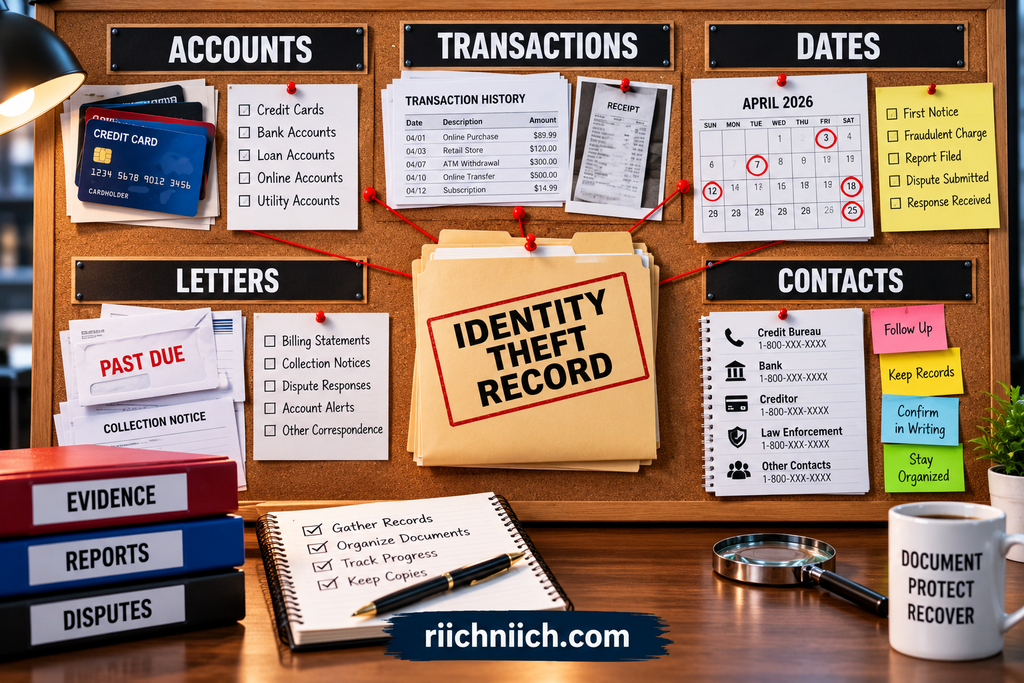
One of the first things to do when learning how to recover from identity theft is create a clear record of what happened. Good documentation can make the identity theft recovery process easier when you contact banks, lenders, credit bureaus, government agencies, or other companies to dispute fraudulent activity.
Start a dedicated digital or physical recovery folder and save anything connected to the theft. This can include:
- Bank and credit card statements showing unauthorized transactions
- Collection notices for debts you don’t recognize
- Credit reports showing unfamiliar accounts or inquiries
- Emails, text messages, or letters related to suspicious activity
- Screenshots of fraudulent transactions or account changes
- Notices about compromised personal information
- Bills for products or services you never purchased
- Dates and approximate times when you first noticed the fraud
- Names and contact information for companies involved
- Confirmation numbers from calls, reports, and disputes
The FTC specifically recommends writing down who you contacted and when and keeping copies of letters you send during recovery.
Build an Identity Theft Timeline
Creating a simple timeline can help you understand how the fraud developed.
For example, record when you received the first suspicious alert, when an unauthorized account appeared, when you contacted the company, what the company told you, and what action was taken.
For every phone call or online dispute, consider recording:
Date → Company → Department → Representative → What Happened → Action Taken → Confirmation Number → Next Step
This can become especially valuable if your identity theft recovery steps stretch across several weeks or involve multiple organizations.
Keep the original documents whenever possible and send copies when a company or agency requests supporting evidence. Also protect your recovery records carefully because they may contain sensitive financial and personal information. The FTC recommends securely storing documents containing personal information.
Save Evidence Before Closing Fraudulent Accounts
If you discover a fraudulent account, don’t immediately delete every message or piece of information associated with it.
Take screenshots or download relevant records first. Depending on the situation, records such as applications, transaction details, receipts, signatures, or contact information could help establish that the activity wasn’t yours.
Federal law also gives identity theft victims the right to request certain business records relating to fraudulent transactions or accounts. The FTC explains how to request these records and provides sample letters through IdentityTheft.gov.
Keep Your Recovery Records Organized Until the Case Is Resolved
Don’t throw away your documentation just because a fraudulent charge disappears or one account is closed. Identity theft can involve multiple accounts or different types of personal information, so you may need earlier records again during a later dispute.
This is also where paid identity theft restoration services can become useful for more complicated cases. Some identity theft protection services provide dedicated recovery specialists who can help victims understand which documents they need, organize the recovery process, and work through the steps required to restore their identity.
If you’re comparing identity theft protection services after your information has already been compromised, look beyond monitoring alerts. Hands-on identity restoration assistance may provide more practical value during an active recovery than monitoring alone.
The goal of documenting everything isn’t to create unnecessary paperwork. It’s to build an evidence trail you can rely on while following the remaining steps for how to recover from identity theft. Once your evidence is organized, you’ll be better prepared to report the theft, dispute fraudulent activity, and prove which accounts or transactions don’t belong to you.
Step 2: Report the Identity Theft to the FTC
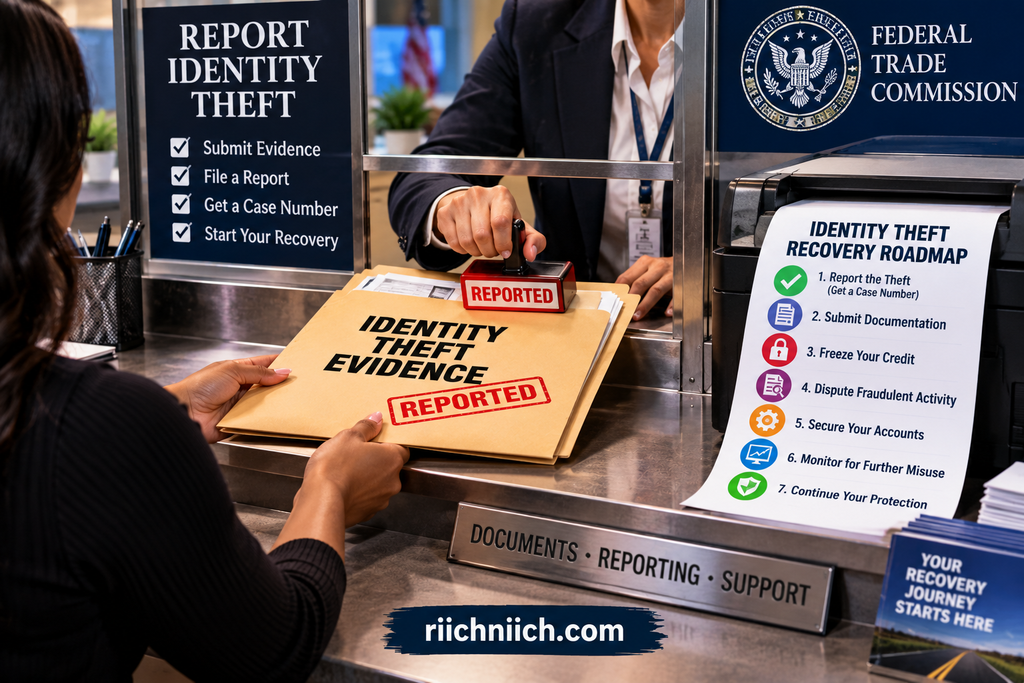
An important step in how to recover from identity theft is officially reporting the theft to the Federal Trade Commission (FTC). Your FTC report creates a record of the identity theft and gives you a personalized recovery plan based on the type of fraud you’re dealing with.
You can report identity theft for free through IdentityTheft.gov. The FTC recommends providing as many details as possible about what happened. Based on your information, the site can generate an FTC Identity Theft Report and a personalized identity theft recovery plan.
When completing your report, be prepared to provide information such as:
- What personal information was compromised
- Which accounts were affected
- Fraudulent accounts or transactions you’ve discovered
- When you first noticed the identity theft
- Companies or financial institutions involved
- Other details or evidence you’ve collected
This is where the documentation from Step 1 becomes especially useful.
What Do You Get After Reporting Identity Theft to the FTC?
Your FTC Identity Theft Report is more than a record of what happened. The FTC says it can help demonstrate to businesses that your identity was stolen and support you as you work through problems caused by the theft.
IdentityTheft.gov can also provide:
- A personalized recovery plan
- Step-by-step recovery instructions
- Pre-filled letters and forms
- Tools for tracking your recovery progress
- Guidance for dealing with credit bureaus, businesses, and debt collectors
The site provides guidance for more than 30 types of identity theft, so your identity theft recovery steps may differ depending on whether you’re dealing with fraudulent credit accounts, tax identity theft, account takeover, medical identity theft, or another form of fraud.
If you create an IdentityTheft.gov account, you can return to your recovery plan, update it, and track your progress. If you choose not to create an account, the FTC says you should print and save your Identity Theft Report and recovery plan immediately, because you won’t be able to access or update them after leaving the page.
Why Your FTC Identity Theft Report Matters
Recovering from identity theft can mean dealing with several organizations at once. You may need to dispute fraudulent accounts, correct your credit reports, stop collection attempts, or prove that certain transactions weren’t yours.
Having an FTC Identity Theft Report gives you an official document to use throughout that process. Depending on your situation, your recovery plan may direct you to close fraudulent accounts, correct credit-report information, remove unauthorized charges, freeze your credit, or take other specific actions.
The FTC Report Doesn’t Fix Everything Automatically
Submitting an FTC report is a major part of how to recover from identity theft, but it doesn’t automatically remove fraudulent accounts, refund stolen money, or repair your credit.
The FTC states that it does not resolve individual consumer reports. Instead, IdentityTheft.gov gives you the documentation and recovery instructions you can use to take action with the appropriate organizations.
That means you’ll still need to follow through with banks, lenders, credit bureaus, debt collectors, government agencies, and other affected organizations as necessary.
This is also where identity theft restoration services may become attractive to someone facing a complicated recovery. Some paid identity theft protection services provide restoration specialists who help victims navigate recovery tasks and understand what needs to be done next.
If you’re shopping for identity theft protection after your identity has already been stolen, don’t evaluate a service based only on monitoring alerts. Look closely at whether the plan includes hands-on identity restoration assistance, recovery specialists, credit monitoring, identity monitoring, and identity theft insurance.
Those features won’t replace your FTC Identity Theft Report or guarantee that every problem will be resolved, but they can provide additional support while you work through a complex identity theft recovery process.
Once you’ve submitted and saved your FTC Identity Theft Report, keep it with the documentation you collected in Step 1. You’ll likely need those records as you move into the next stages of how to recover from identity theft.
Step 3: Contact the Companies Where Fraud Happened
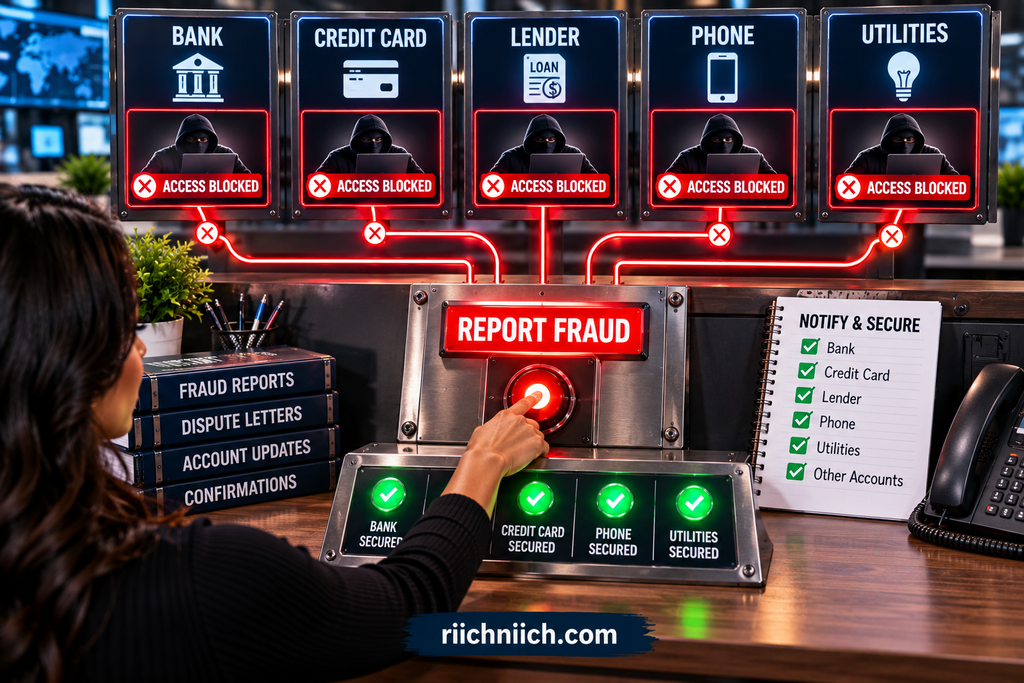
The next step in how to recover from identity theft is contacting every company where you know fraudulent activity occurred. This could include your bank, credit card issuer, lender, retailer, utility provider, wireless carrier, or another company where someone opened or misused an account in your name.
Contact the company’s fraud department directly and explain that you’re a victim of identity theft. The FTC recommends asking the company to close or freeze affected accounts so additional charges cannot be made without your authorization.
For existing accounts that were compromised, you may also need to change your username, password, PIN, security questions, or other login credentials.
When contacting each company:
- Tell the fraud department that your identity was stolen.
- Identify the accounts or transactions you didn’t authorize.
- Ask them to close fraudulent accounts opened in your name.
- Ask them to remove unauthorized charges from legitimate accounts.
- Ask whether they need your FTC Identity Theft Report or additional documentation.
- Request written confirmation of the company’s resolution.
- Record the representative’s name, date of contact, confirmation number, and next steps.
Be careful about how you contact the company. If you received an unexpected fraud call, text, or email, don’t automatically use the contact information provided in that message. The FTC recommends independently contacting the company through its official app or website or using the number on a recent statement or the back of your card.
Ask for Fraudulent Accounts to Be Closed
If an identity thief opened an entirely new account in your name, contact that company’s fraud department and request that the account be closed.
Once you have an FTC Identity Theft Report, the FTC recommends asking the business for written confirmation stating that the fraudulent account isn’t yours, you aren’t responsible for it, and it has been removed from your credit report. Keep that confirmation with your other identity theft recovery records in case the account reappears later.
A company may request a copy of your FTC Identity Theft Report or ask you to complete its identity theft dispute form.
The FTC also provides an official sample dispute letter for fraudulent new accounts that you can customize when contacting a company.
Dispute Unauthorized Charges on Existing Accounts
Sometimes an identity thief doesn’t open a new account—they gain access to one you already have.
Review the affected account carefully and identify every transaction you don’t recognize. Tell the company’s fraud department which charges are fraudulent and ask for them to be removed.
The FTC provides a separate sample dispute letter for fraudulent charges on existing accounts that can help you document the dispute.
Don’t assume that finding one fraudulent transaction means you’ve found them all. Review previous statements for additional unauthorized purchases, transfers, withdrawals, or account changes.
Ask for Written Confirmation
Don’t rely solely on a phone conversation saying the problem has been fixed.
Ask the company to send you written confirmation of the outcome. Depending on the situation, you want documentation showing that the fraudulent account was closed, unauthorized charges were removed, or you aren’t responsible for the fraudulent debt.
Save these letters with your FTC Identity Theft Report and other recovery documents.
This paper trail can become important if a fraudulent account later appears on your credit report, a debt collector contacts you, or you need to prove that you’ve already disputed the account.
You May Be Able to Request Records About the Fraud
If someone opened an account or conducted transactions using your identity, you may want to know exactly what information was used.
Under Section 609(e) of the Fair Credit Reporting Act, identity theft victims can have a right to request certain transaction or application records from businesses where identity theft occurred. The FTC explains that these records might include information such as an identity thief’s application, signature, account information, or other details connected with the fraudulent transaction. Specific documentation requirements apply to these requests.
Those records can help establish that you weren’t responsible for the account and may also assist law enforcement investigating the theft.
Keep Following Up Until Each Account Is Resolved
Contacting businesses can become one of the most time-consuming parts of the identity theft recovery process, particularly when fraud involves several companies.
Create a simple status for every affected account:
Reported → Under Investigation → Documents Submitted → Fraud Removed → Written Confirmation Received
Don’t mark an account as resolved until you’ve received appropriate confirmation and verified that the fraudulent activity is no longer causing problems.
This is also where identity theft restoration services can have significant buyer value. If you’re dealing with numerous fraudulent accounts, repeatedly contacting fraud departments, submitting documents, tracking disputes, and following up can become difficult to manage.
Some paid identity theft protection plans provide dedicated restoration specialists who can help guide victims through recovery. When comparing services after identity theft has already happened, pay particular attention to restoration assistance, credit and identity monitoring, recovery support, and identity theft insurance—not simply the number of alerts a service advertises.
Knowing how to recover from identity theft ultimately requires stopping the fraud at its source. Once the affected companies have been notified, the next priority is preventing the thief from easily using your information to open additional credit accounts in your name.
Step 4: Freeze Your Credit at All Three Credit Bureaus
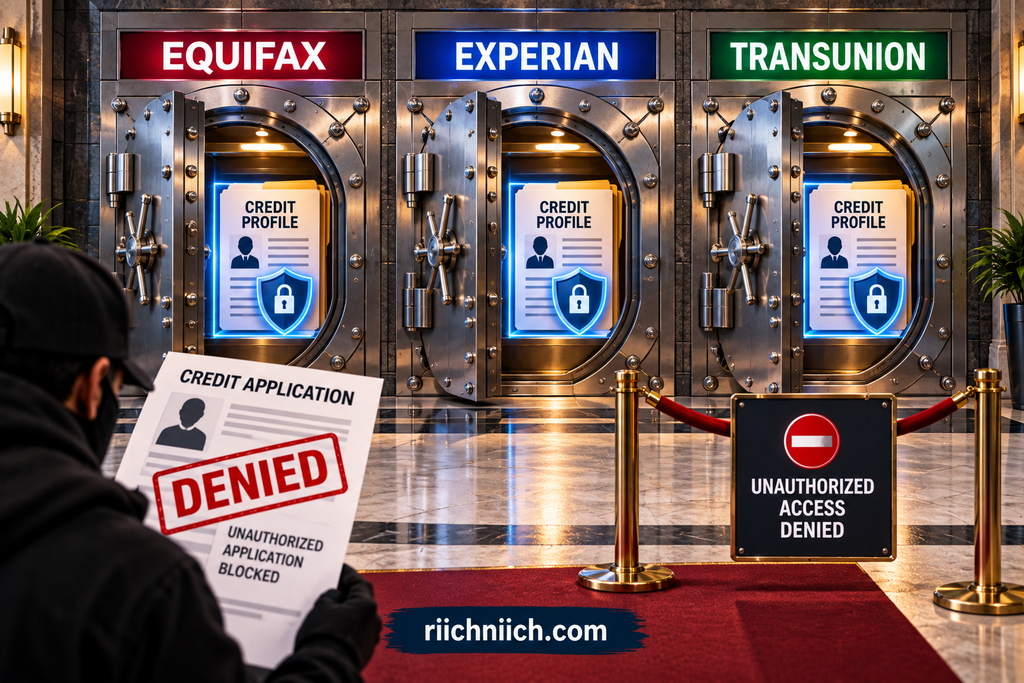
Freezing your credit is one of the strongest steps you can take when learning how to recover from identity theft. A credit freeze, also called a security freeze, restricts prospective creditors from accessing your credit file. Because lenders typically won’t open a new credit account without reviewing your credit report, a freeze can make it much harder for an identity thief to open additional accounts in your name.
If you have never done this before, follow our step-by-step guide on how to freeze your credit with Equifax, Experian, and TransUnion.
If your personal information has already been misused, don’t freeze just one credit report. You need to contact Equifax, Experian, and TransUnion separately because placing a freeze with one bureau does not automatically freeze your files with the other two.
You can place and remove security freezes for free under federal law, and freezing your credit does not hurt your credit score.
How to Freeze All Three Credit Reports
You can request a security freeze directly from each nationwide credit bureau. The FTC provides links to all three bureaus through its official Credit Freezes and Fraud Alerts guide.
Complete the process with:
Follow each bureau’s instructions and complete its identity-verification process. Keep any confirmation information or account credentials associated with your freezes somewhere secure—you’ll need access when you eventually want to temporarily lift or remove a freeze.
If you request a freeze electronically or by telephone, a nationwide credit reporting company generally must place it within one business day. Requests made by mail generally must be placed within three business days after the bureau receives the request.
What Does a Credit Freeze Actually Stop?
A credit freeze primarily protects against new-account fraud.
For example, imagine an identity thief has your Social Security number, date of birth, and other personal information and attempts to apply for a new credit card in your name. If the lender tries to access a frozen credit file, access is restricted. Because prospective creditors typically need that information before extending credit, the freeze can stop many fraudulent new-credit attempts.
However, a credit freeze doesn’t fix accounts that have already been compromised. It also doesn’t replace the other identity theft recovery steps in this guide. Consumer Finance Protection Bureau (CFPB) guidance notes that a security freeze does not affect accounts you’ve already opened.
That’s why you should still monitor your existing bank accounts, credit cards, email accounts, and other sensitive accounts for unauthorized activity.
You Can Still Use Your Existing Credit Cards
Freezing your credit doesn’t shut down your existing credit accounts.
You can generally continue using your existing credit cards and other established accounts because a freeze is designed to restrict access to your credit file for new credit applications, rather than close the accounts you already have. Certain existing creditors and other permitted entities may also continue accessing your file while a freeze is active.
You can also continue reviewing your own credit reports.
What If You Need to Apply for Credit Later?
A credit freeze isn’t permanent in the sense that you’re locked out forever.
You can temporarily lift the freeze when you legitimately need someone to access your credit—for example, when applying for a credit card, auto loan, or mortgage—and restore the freeze afterward.
If you know which credit bureau the lender will check, the FTC says you can lift the freeze at that bureau and then freeze it again after the credit check is finished.
Under federal requirements, a freeze requested to be lifted through secure electronic means or by toll-free telephone generally must be removed within one hour.
A Credit Freeze Is Free—Don’t Confuse It With a Credit Lock
You don’t need to purchase a paid credit-lock product simply to freeze your credit.
The CFPB distinguishes paid credit locks from security freezes and notes that consumers have a legal right to free security freezes.
That distinction is particularly important during the identity theft recovery process. When you’re already dealing with fraudulent accounts or stolen personal information, you shouldn’t have to pay just to restrict access to your three major credit files.
A Credit Freeze and Identity Monitoring Do Different Jobs
A credit freeze is powerful, but it isn’t complete identity protection.
It primarily restricts access to your credit file to help prevent fraudulent new credit accounts. It won’t necessarily warn you if your email address appears in a breach, someone attempts to take over an existing account, your personal information surfaces elsewhere, or another type of identity fraud occurs.
This is where buyer intent becomes important.
If you’re considering an identity theft protection service after experiencing identity theft, don’t pay for a service simply because it offers credit monitoring. The CFPB notes that monitoring services alert consumers to certain changes but don’t prevent identity theft from happening.
Instead, compare whether a paid plan adds meaningful protection beyond what you can already do yourself for free. Depending on your needs, valuable features may include multi-bureau credit monitoring, broader identity monitoring, dedicated restoration specialists, recovery assistance, and identity theft insurance.
Freezing all three credit files should therefore be viewed as one layer of how to recover from identity theft, not the entire solution. It can help stop an identity thief from turning stolen information into additional credit accounts while you continue repairing existing damage and monitoring for other forms of misuse.
Step 5: Place a Fraud Alert on Your Credit Report
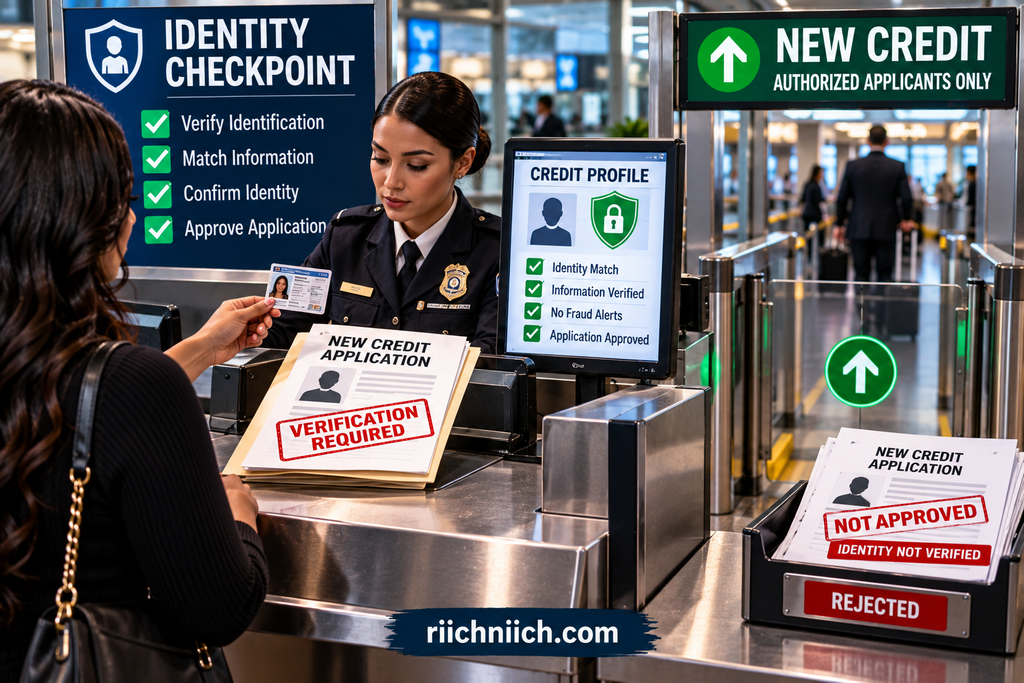
Another important step in how to recover from identity theft is placing a fraud alert on your credit reports. A fraud alert tells creditors that they should take additional steps to verify your identity before approving certain new credit requests in your name.
Unlike a credit freeze, you do not need to contact all three credit bureaus separately to place a fraud alert. Contact Equifax, Experian, or TransUnion, and the bureau you contact is required to notify the other two. The alert is then added to your credit files with all three bureaus.
For the complete process, see how to place a fraud alert and learn which type of alert may apply to your situation.
You can find the official credit-bureau contact information through the FTC’s Credit Freezes and Fraud Alerts guide.
Which Type of Fraud Alert Should You Place?
There are different types of fraud alerts, but two are particularly relevant during the identity theft recovery process.
Initial fraud alert: If you believe you are—or may become—a victim of identity theft, you can place a free initial fraud alert. It lasts one year and can be renewed. Placing one also allows you to request a free credit report from each of the three nationwide credit bureaus.
Extended fraud alert: If your identity has actually been stolen and you have completed an FTC Identity Theft Report through IdentityTheft.gov or filed a police report, you may qualify for an extended fraud alert. It lasts seven years.
Because this guide focuses on how to recover from identity theft after theft has occurred, the seven-year extended fraud alert may be particularly relevant if you meet the requirements.
What Does an Extended Fraud Alert Do?
An extended fraud alert provides a longer-lasting verification layer while you’re recovering.
Before approving new credit, businesses checking your credit report must take steps to verify that the person requesting the credit is actually you. An extended alert also removes you from the credit bureaus’ marketing lists for unsolicited credit and insurance offers for five years unless you choose otherwise.
This can be useful when stolen personal information—such as your Social Security number, date of birth, or driver’s license information—may remain in criminals’ possession long after you’ve resolved the original fraudulent account.
Can You Have a Credit Freeze and Fraud Alert at the Same Time?
Yes.
You can place a fraud alert even when your credit is already frozen.
The two tools work differently:
A credit freeze restricts prospective creditors’ access to your credit file, making it difficult to open new credit accounts until the freeze is lifted.
A fraud alert leaves your credit report accessible but requires creditors to take steps to verify your identity before granting certain new credit requests.
For an identity theft victim, using both can provide complementary layers during recovery.
A Fraud Alert Doesn’t Monitor Everything
A fraud alert is useful, but it shouldn’t be mistaken for complete identity monitoring.
It is primarily connected to credit-related identity verification. It won’t necessarily tell you that someone has accessed your email, attempted to take over a bank account, misused other personal information, or exposed your information elsewhere.
That distinction matters when considering paid identity theft protection after a theft.
If you’re comparing identity theft restoration services or identity protection plans, consider what the service provides beyond a fraud alert that you can place yourself for free.
Depending on your situation, useful paid features could include multi-bureau credit monitoring, broader identity monitoring, account alerts, dedicated recovery specialists, restoration assistance, and identity theft insurance.
The key is not paying for something you can already do for free. A fraud alert itself is free.
If you purchase identity theft protection during the identity theft recovery process, the value should come from the additional monitoring, restoration support, insurance, and convenience the service provides.
Placing a fraud alert is therefore another protective layer in how to recover from identity theft: your credit freeze can restrict access to your credit files, while the fraud alert provides an additional identity-verification warning for creditors.
Step 6: Review All Three Credit Reports for Fraud
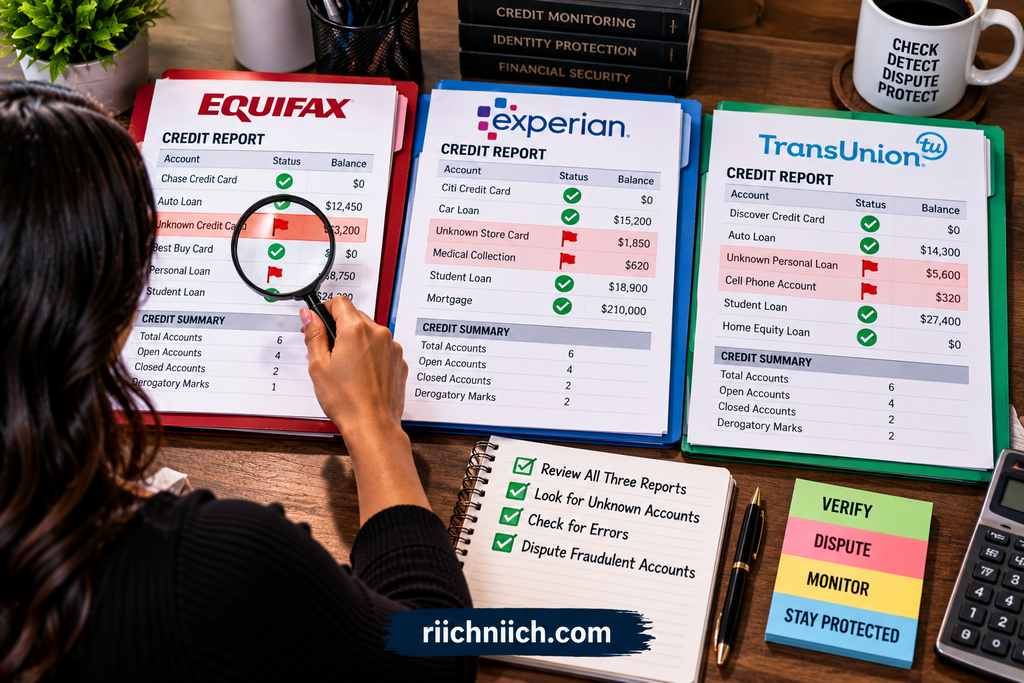
A critical part of how to recover from identity theft is carefully reviewing your credit reports from Equifax, Experian, and TransUnion. Don’t assume that because you found one fraudulent account, you’ve found everything an identity thief attempted to do with your information.
The three credit bureaus can contain different information because creditors don’t necessarily report the same information to every bureau. That’s why the FTC recommends reviewing all three credit reports, rather than checking only one.
You can obtain your reports through AnnualCreditReport.com, the federally authorized source for free credit reports. The FTC currently says consumers can check their reports from each of the three bureaus once a week for free through AnnualCreditReport.com.
What Should You Look for on Your Credit Reports?
Don’t look only at your credit score. During the identity theft recovery process, you need to examine the actual information appearing throughout each credit report.
Check for:
- Credit cards you never opened
- Loans or financing accounts you don’t recognize
- Collection accounts that aren’t yours
- Hard inquiries associated with applications you didn’t make
- Incorrect balances or credit limits
- Accounts incorrectly showing late or missed payments
- Accounts you closed that are still reported as open
- The same fraudulent debt appearing more than once
- Addresses, phone numbers, or other identifying information you don’t recognize
- Accounts belonging to someone with a similar name
- Changes to existing accounts that you didn’t authorize
The CFPB specifically recommends checking for identity-information errors, accounts resulting from identity theft, incorrect account statuses, duplicate debts, and incorrect balances or credit limits.
Compare the Three Reports Side by Side
One of the easiest ways to find suspicious activity is to compare your Equifax, Experian, and TransUnion reports rather than reviewing them weeks apart.
Create a simple checklist:
Account Name → Equifax → Experian → TransUnion → Recognized? → Action Needed
For example, you might discover a fraudulent credit card appearing on Experian and TransUnion but not Equifax. Another unauthorized account might appear only on Equifax.
That doesn’t necessarily mean something is wrong with the other reports. Creditors may provide information differently across the three bureaus.
If you find an unfamiliar creditor, investigate before automatically assuming it’s fraudulent. The CFPB notes that legitimate accounts can sometimes appear under an unfamiliar name—for example, a retailer’s credit card may appear under the name of the bank that actually issued it.
Pay Special Attention to Accounts You Never Opened
An unfamiliar credit card, personal loan, auto loan, financing account, or collection account deserves immediate attention.
Write down:
The creditor’s name, account number, balance, date opened, account status, and which credit bureau is reporting it.
Compare that information with the documentation you’ve already collected during your identity theft recovery steps.
If you determine that an account or other information resulted from identity theft, you can take action to have it blocked or removed. The CFPB says identity theft victims can request that credit reporting companies block fraudulent information by providing an identity theft report, proof of identity, and a letter identifying the fraudulent information. When the requirements are satisfied, the credit reporting company generally must block the information within four business days after receiving the request.
We’ll cover the dispute process more closely in the next step.
Don’t Ignore Small Changes
Identity theft doesn’t always appear as a huge fraudulent loan.
A new address, unfamiliar inquiry, incorrect phone number, or account you don’t remember opening may be worth investigating. Look at your report line by line rather than scanning only the largest balances.
You should also save copies of the credit reports you’re reviewing. Highlight or mark every suspicious item so you have a clear record of what needs to be disputed.
This creates a before-and-after record that can help you determine whether fraudulent information was successfully removed later.
Continue Checking Your Reports During Recovery
Reviewing your credit reports shouldn’t necessarily be a one-time task after identity theft.
Even after you’ve disputed the fraud you’ve already discovered, continue watching for new accounts or information that shouldn’t be there. Stolen personal information can remain usable after the original incident has been resolved.
The CFPB recommends checking credit reports regularly because errors can affect your credit history and credit score.
Do You Need Paid Credit Monitoring After Identity Theft?
You can review your credit reports yourself for free, so you don’t necessarily need to pay a company simply to access your credit information.
However, manual checking requires you to remember to return and review your reports. A credit or identity monitoring service may provide additional convenience by alerting you when certain changes are detected.
For someone researching how to recover from identity theft, that’s where buyer intent should focus: What does the paid service provide beyond the protections and reports you can already access yourself?
If you’re comparing identity theft protection services, consider features such as:
- Three-bureau credit monitoring
- Alerts for new credit activity
- Broader identity monitoring
- Dedicated identity restoration specialists
- Assistance disputing identity theft
- Recovery support
- Identity theft insurance
Credit monitoring itself doesn’t prevent identity theft. Its value is helping you detect potentially suspicious changes sooner so you can investigate and respond. The CFPB specifically distinguishes monitoring from identity-theft prevention.
That distinction matters when choosing a paid service. If your identity has already been compromised, a plan combining monitoring with hands-on restoration support may offer more practical recovery value than a service that primarily sends alerts.
Reviewing all three reports gives you a clearer picture of the damage and identifies exactly what needs to be corrected. The next part of how to recover from identity theft is taking those suspicious accounts and inaccurate records and formally disputing the fraudulent information.
Step 7: Dispute Fraudulent Accounts and Information
Once you’ve identified accounts or information that resulted from identity theft, the next part of how to recover from identity theft is getting that fraudulent information corrected or blocked.
Identity theft can leave behind unfamiliar credit cards, loans, collections, balances, late payments, inquiries, or other information that doesn’t belong to you. Leaving those items on your credit reports could affect your credit history and potentially create problems when you apply for legitimate credit later.
If you discovered a credit card, loan, or other account you never opened, here’s what to do when someone opened an account in your name.
You have the right to dispute inaccurate or incomplete information on your credit reports. The Consumer Financial Protection Bureau (CFPB) recommends disputing incorrect information with both the credit reporting company and the company that supplied the information, known as the furnisher.
Start With the Fraudulent Items You Found
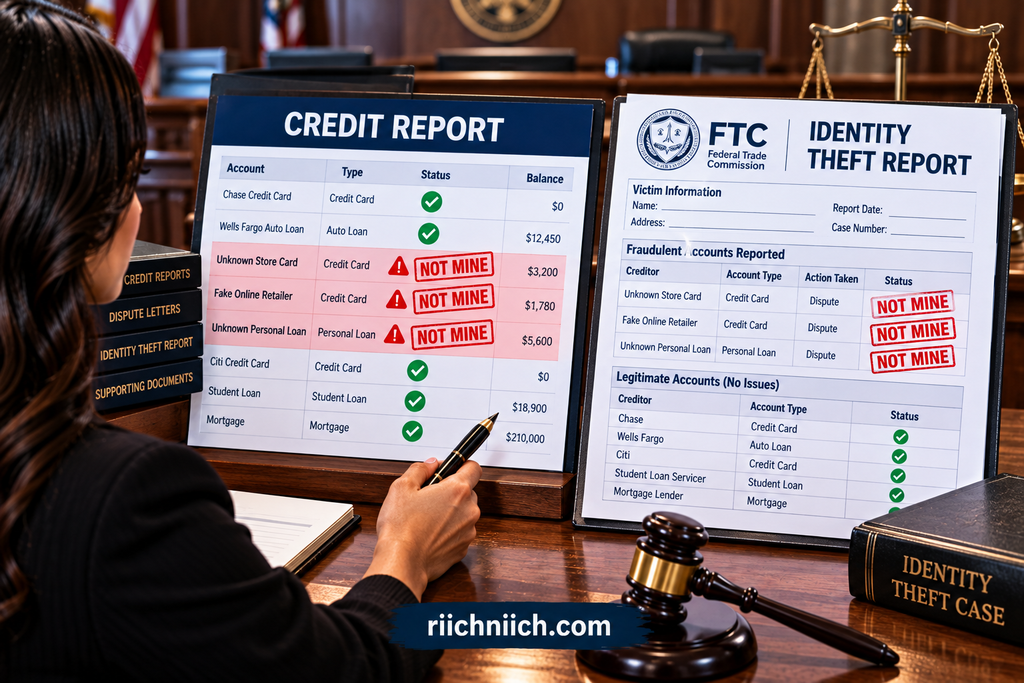
Go back through the Equifax, Experian, and TransUnion reports you reviewed in Step 6 and create a list of every item you believe resulted from identity theft.
For each item, record:
- Name of the creditor or collection company
- Account number or partial account number
- Date the account was opened
- Current balance
- Which credit bureau is reporting it
- Why you believe the information is fraudulent
- Any supporting documents you have
Be specific. Instead of simply stating that your credit report contains identity theft, identify each account or piece of information you want corrected or blocked.
This makes your identity theft recovery process easier to track and creates a record you can reference if the problem isn’t resolved the first time.
Ask the Credit Bureaus to Block Identity Theft Information
Identity theft victims have protections specifically designed for fraudulent credit-report information.
The CFPB says you can ask a credit reporting company to block fraudulent information by providing:
- An identity theft report, such as the report created through IdentityTheft.gov
- Proof of your identity
- A letter identifying the fraudulent debts or information
When the applicable requirements are met, the credit reporting company generally must block the identity-theft information within four business days after receiving your request.
The FTC provides an official IdentityTheft.gov credit bureau dispute letter that can help you prepare your request.
Dispute the Information With the Company That Reported It
Don’t stop with the credit bureaus.
If a bank, lender, credit card issuer, collection company, or another business supplied the fraudulent information, contact that company as well.
Explain that you’re an identity theft victim, identify the account or information that isn’t yours, and provide the requested supporting documentation.
The CFPB says furnishers generally must investigate disputes and respond within 30 days after receiving them. If an investigation determines that information is wrong or cannot be verified, the furnisher must update or remove it and notify the credit reporting companies to which it supplied the inaccurate information.
For fraudulent accounts opened in your name, you can also use the FTC’s IdentityTheft.gov fraudulent-account dispute letter.
Include Evidence With Your Dispute
Your dispute should clearly explain what happened and why the information isn’t yours.
Depending on your situation, supporting documents could include copies of your:
FTC Identity Theft Report → Credit Report → Fraudulent Account Information → Company Correspondence → Supporting Statements
Don’t send your only copy of an important document. The CFPB recommends sending copies rather than originals and keeping copies of your dispute correspondence and supporting records. If you mail a dispute, you can also use certified mail with a return receipt to create a record that it was received.
Don’t Pay Someone Just to Exercise Your Dispute Rights
Be cautious of companies promising to magically erase every negative item from your credit report.
Accurate negative information generally cannot be removed simply because you don’t want it there. Fraudulent information caused by identity theft, however, is different and can be disputed or blocked when appropriate.
The CFPB specifically warns that consumers already have the legal right to dispute inaccurate information for free and don’t need to pay someone simply to exercise that right.
That distinction is especially important when you’re already dealing with the financial consequences of identity theft.
Check Your Credit Reports Again After the Disputes
Don’t assume the identity theft recovery steps are finished as soon as you submit your disputes.
Save your confirmation numbers and correspondence, then review your credit reports again after the investigations are completed.
Verify that:
- Fraudulent accounts have been removed or blocked
- Fraudulent balances no longer appear
- Incorrect late payments have been corrected
- Collections caused by identity theft are gone
- Your legitimate accounts haven’t been accidentally changed
- The same fraudulent information hasn’t appeared elsewhere
If a dispute isn’t handled properly, the CFPB provides a complaint process for problems involving credit reporting.
Where Identity Restoration Services Can Help
Disputing one fraudulent account may be manageable on your own. Disputing multiple credit cards, loans, collections, and other fraudulent records across several organizations can be much more time-consuming.
That’s where buyer intent becomes important.
If you’re considering a paid identity theft protection service during recovery, don’t choose one simply because it promises credit alerts. Look at whether the service provides hands-on identity restoration assistance and access to specialists who can help you understand the recovery process, organize documentation, and work through disputes.
Useful features to compare may include dedicated restoration specialists, three-bureau credit monitoring, broader identity monitoring, recovery assistance, and identity theft insurance.
No service can guarantee that every fraudulent item will disappear immediately, and you retain the right to dispute inaccurate information yourself for free. But for a complicated case, professional restoration assistance may reduce how much of the identity theft recovery process you have to navigate alone.
Successfully disputing fraudulent accounts is one of the most important parts of how to recover from identity theft because it moves you from simply detecting the damage to actually correcting it. Once the fraudulent credit information is being addressed, the next priority is making sure your bank and credit card accounts are secure against additional unauthorized activity.
Step 8: Secure Your Bank and Credit Card Accounts
Securing your financial accounts is a critical part of how to recover from identity theft. Even if you’ve frozen your credit, an identity thief may still try to misuse bank accounts or credit cards that are already open. A credit freeze primarily helps with new-account fraud; it does not prevent fraudulent transactions on existing accounts.
Start by reviewing every checking account, savings account, debit card, and credit card you use. Look closely for transactions you don’t recognize—including very small charges or withdrawals. The CFPB warns that criminals sometimes test stolen account information with a small transaction before attempting larger ones.
If you find suspicious activity, contact your financial institution’s fraud department immediately.
You may need to:
- Report unauthorized charges or withdrawals.
- Lock or cancel compromised cards.
- Request replacement cards with new numbers.
- Change your debit-card PIN.
- Change online banking passwords.
- Review and update account recovery information.
- Remove devices you don’t recognize from your account.
- Enable multi-factor authentication when available.
- Ask whether your account number itself should be changed.
- Review automatic payments that may need to be moved to a replacement card or account.
Use the bank’s official app, website, a recent statement, or the phone number printed on the back of your card to make contact. Don’t rely on a phone number provided in an unexpected fraud text, email, or call because scammers may impersonate financial institutions.

Report Unauthorized Bank Transactions Quickly
If money has disappeared from your bank account, don’t wait to see whether another fraudulent transaction appears.
Contact your bank or credit union as soon as you discover the unauthorized activity. The amount you could potentially be responsible for with unauthorized debit-card transactions can depend on how quickly you report the loss or theft.
For example, if a physical debit card is lost or stolen, federal protections can vary significantly depending on when you notify the financial institution. If an unauthorized electronic transaction appears on your statement even though your card wasn’t lost or stolen, reporting deadlines also apply.
That makes speed especially important during the identity theft recovery process.
Keep documentation showing when you discovered the transaction, when you reported it, whom you spoke with, and any dispute or case number you received.
Replace Compromised Cards and Credentials
Removing fraudulent transactions doesn’t necessarily secure the account that allowed them to happen.
If your debit or credit card information has been compromised, ask the issuer whether the card should be canceled and replaced. The CFPB recommends canceling a compromised card and having it replaced when suspicious transactions indicate the card information has been stolen.
Remember to update legitimate recurring payments after receiving a new card number. This might include utilities, insurance, subscriptions, phone bills, or other automatic payments.
If your bank account credentials were exposed—not just your card—ask your bank whether additional changes are appropriate.
Strengthen Access to Your Financial Accounts
Your next goal should be making it harder for the identity thief to regain access.
Change compromised passwords and avoid reusing the same password across multiple financial accounts. If your bank or card issuer offers multi-factor authentication, enable it. The FTC notes that multi-factor authentication adds another credential to the login process, making it harder for someone with a stolen username and password to access the account.
Also review:
Phone number → Email address → Mailing address → Authorized users → Linked accounts → Connected devices → Security alerts
Make sure everything belongs to you.
Pay particular attention to the email address and phone number attached to the account. Those may be used for password resets and security codes, so unauthorized changes could potentially help an attacker regain access.
Turn On Transaction and Account Alerts
Don’t rely solely on monthly statements after identity theft.
If your financial institution offers alerts, consider enabling notifications for purchases, withdrawals, transfers, password changes, new payees, unusual activity, or other important account events.
Continue reviewing statements yourself as well. The FTC recommends checking bank and credit card statements and reporting transactions you don’t recognize promptly.
The goal is simple: the sooner you know something happened, the sooner you can investigate it.
Credit Cards and Debit Cards Have Different Protections
Don’t assume the dispute process is identical for every financial account.
Federal law provides protections for unauthorized credit-card charges, and the FTC explains that your potential liability for unauthorized credit-card use is generally limited to $50 under federal law, with circumstances where you owe nothing.
Debit-card and electronic-fund-transfer protections work differently and can depend more heavily on how quickly the problem is reported.
You can review the CFPB’s official guidance on unauthorized bank transactions and the FTC’s guidance on lost or stolen credit and debit cards for the applicable rules.
Continue Monitoring After the Immediate Fraud Is Fixed
Don’t stop watching your accounts simply because the bank issued a replacement card or refunded a fraudulent transaction.
The CFPB notes that fraudulent charges can appear months after account information was stolen.
Continue checking:
Bank transactions → Credit card activity → Transfers → Automatic payments → Account alerts → Contact information
This ongoing monitoring is an important part of how to recover from identity theft because stolen financial information may be used more than once.
When Paid Identity Protection May Add Value
You can secure your bank and credit card accounts yourself, and you shouldn’t pay an identity theft protection company merely to perform basic steps that your financial institution already provides.
The buyer-intent question is whether a paid service provides additional protection and recovery support that’s valuable to you.
For someone recovering from widespread identity theft, useful features to compare may include broader identity monitoring, credit monitoring, financial-account alerts where offered, dedicated restoration specialists, recovery assistance, and identity theft insurance.
Remember that monitoring is primarily about detection, not guaranteed prevention. A service may help alert you to certain suspicious activity, but you still need strong account security and prompt action when something looks wrong.
For a simple case involving one compromised card, you may be comfortable managing recovery yourself. But if several financial accounts and pieces of personal information have been compromised, a service with hands-on identity restoration support may be more valuable than a monitoring-only plan.
Securing your financial accounts closes another major door criminals may try to use. The next part of how to recover from identity theft is securing the online accounts and passwords that could potentially give an identity thief access to even more of your personal information.
Step 9: Change Compromised Passwords and Secure Online Accounts
Changing compromised passwords is an essential part of how to recover from identity theft because access to one online account can sometimes give an identity thief access to much more.
Your email account deserves particular attention. Email is often used to reset passwords for banking, shopping, social media, and other accounts. The FTC warns that someone who controls your email could potentially request password-reset links for your other accounts and use them to lock you out.
If your primary email was compromised during the identity theft, follow these additional steps for what to do if your email account gets hacked.
Start with your most important accounts:
- Primary email accounts
- Banking and financial accounts
- Credit card accounts
- Payment apps
- Shopping accounts that store payment information
- Social media accounts
- Cloud storage accounts
- Mobile carrier account
- Tax and government-related accounts
- Password manager, if you use one
If you know a password was exposed, change it immediately. If you reused that same password anywhere else, change it on every account where it was used.

Give Every Important Account a Unique Password
Password reuse can turn one compromised account into several.
Suppose an identity thief obtains the email address and password you used on a shopping website. If you’ve reused those credentials for your email, financial account, or another service, the criminal can try the same combination elsewhere.
That’s why your identity theft recovery steps should include replacing reused passwords with unique ones.
Cyberersecurity and Infrastructure Security Agency (CISA) recommends passwords that are long, random, and unique and suggests using a password manager to create and store them.
Avoid building new passwords around easily discovered information such as your name, birthday, pet, hometown, or favorite team.
Consider Using a Password Manager
Creating a unique password for every account sounds simple until you’re trying to remember dozens of them.
That’s where a password manager can help.
A password manager can generate, store, and autofill unique passwords so you don’t have to memorize every credential yourself. CISA specifically recommends password managers as one way to make strong, unique passwords practical across multiple accounts.
This creates natural buyer intent during the identity theft recovery process. If you’re considering paying for a password manager, look for a reputable service that supports strong password generation, secure storage, multi-device access, and multi-factor authentication for the password-manager account itself.
Turn On Multi-Factor Authentication
Changing your password is only part of securing an account.
Enable multi-factor authentication (MFA) or two-factor authentication (2FA) wherever it’s available. MFA requires another form of verification in addition to your password. Depending on the account, that might involve an authenticator app, security key, biometric verification, or another authentication method.
CISA recommends enabling MFA on every account or application that offers it.
Where an account supports phishing-resistant authentication—such as certain security-key or passkey-based methods—that can provide stronger protection against phishing than manually entered one-time codes.
Sign Out of Other Devices and Sessions
Changing a password may not be the only action needed after an account takeover.
After regaining control, check the account’s security settings for active sessions, logged-in devices, trusted devices, or recent login activity.
Remove anything you don’t recognize.
The FTC recommends signing out of all devices after recovering a hacked email or social media account. This can force someone who still has an active session to authenticate again.
Then review your account recovery information.
Make sure the recovery email address and phone number belong to you. Remove unfamiliar recovery methods that an attacker may have added.
Check Whether the Criminal Changed Anything
Don’t assume an account is clean just because you’ve changed its password.
For email accounts, check for:
Forwarding Rules → Filters → Recovery Addresses → Sent Messages → Deleted Messages → Connected Apps → Active Sessions
The FTC specifically recommends looking for unauthorized email-forwarding rules after recovering a hacked account. An attacker could create a forwarding rule that silently sends copies of your incoming messages elsewhere.
For social media and other accounts, look for unfamiliar posts, messages, friends, purchases, profile changes, or linked applications.
Secure Your Email Account First if Multiple Accounts Were Compromised
If you’re dealing with several compromised online accounts, your primary email should be near the top of your recovery list.
That’s because email often functions as the recovery doorway for everything else.
Secure the email password, enable MFA, verify recovery information, remove unauthorized forwarding rules, review active sessions, and then work outward through your other accounts.
The FTC provides an official guide for recovering a hacked email or social media account with additional recovery steps.
Do You Need Paid Security Tools After Identity Theft?
You can change passwords, enable MFA, and secure accounts yourself for free. Paying for a service doesn’t replace these basic security steps.
The buyer-intent question is whether a paid tool makes ongoing protection easier or provides additional capabilities you actually need.
A password manager may be valuable if managing dozens of unique credentials yourself is difficult. An identity theft protection service may provide additional value if you’re looking for broader identity monitoring, credit monitoring, restoration specialists, recovery assistance, or identity theft insurance.
For someone researching how to recover from identity theft, the strongest combination isn’t simply buying another security product. It’s securing the accounts directly and then deciding whether additional monitoring or recovery services solve a problem you don’t want to manage manually.
Once your passwords and online accounts are secured, the next stage of how to recover from identity theft is protecting the high-value personal information—especially your Social Security number and other identifying data—that criminals may continue trying to misuse.
Step 10: Protect Your Social Security Number and Other Personal Information
Protecting your Social Security number (SSN) is one of the most important parts of how to recover from identity theft because an SSN can remain useful to criminals even after you’ve closed fraudulent accounts and changed compromised passwords.
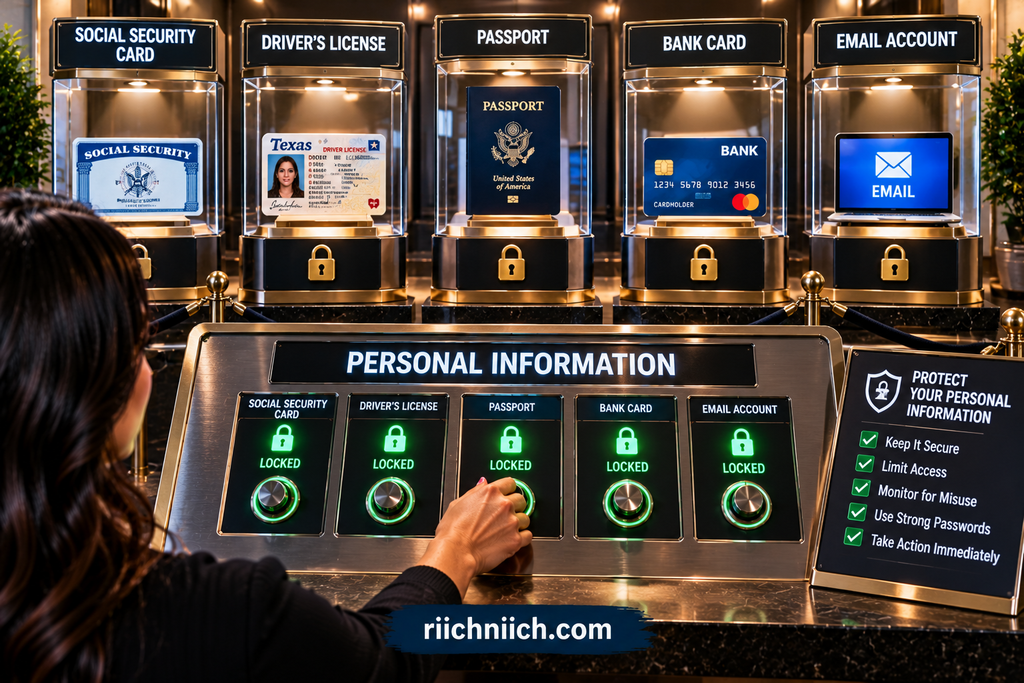
Your SSN is also only one piece of the problem. Identity thieves may possess other personally identifiable information (PII), including your name, address, driver’s license number, passport number, bank information, email address, or other identifying data. The Internal Revenue Service (IRS) identifies all of these as examples of PII that should be protected.
After identity theft, assume that information you know was exposed could potentially be used again. Your goal is to make that stolen information less useful by securing the accounts and records connected to it.
Stop Carrying Your Social Security Card
Unless you specifically need your physical Social Security card, keep it somewhere secure rather than carrying it in your wallet or purse.
The Social Security Administration recommends keeping the card in a safe place, carrying it only when necessary, and avoiding unnecessary disclosure of your SSN.
If a business asks for your Social Security number, consider asking:
Why do you need it? → How will you use it? → How will you protect it? → What happens if I don’t provide it?
Not every request for your SSN is fraudulent, and there are legitimate situations where it may be required. The point is to avoid providing it automatically when it isn’t necessary.
Check Your Social Security Record
If your SSN has been exposed, create or sign in to your personal my Social Security account and review your information.
SSA recommends checking your earnings record and benefit information for suspicious activity. Someone fraudulently using your SSN for employment could potentially cause earnings that aren’t yours to appear on your Social Security record.
If you find earnings that don’t belong to you, SSA provides a process for requesting a correction.
This is an important part of the identity theft recovery process because credit reports aren’t the only records that may show evidence of identity misuse.
Consider an IRS Identity Protection PIN
If someone has your Social Security number, tax identity theft should also be on your radar.
The IRS offers an Identity Protection PIN (IP PIN), a six-digit number that helps prevent someone else from filing a federal tax return using your SSN or ITIN. Anyone with an SSN or ITIN who can successfully verify their identity can request one.
You can learn more or request one through the IRS Identity Protection PIN program.
A new IP PIN is generated each year, and you’ll need to use the current PIN when filing applicable federal tax returns. Keep it private—the IRS says it should generally only be shared with your trusted tax professional when you’re ready to file.
Protect More Than Your Social Security Number
One mistake during identity theft recovery is focusing exclusively on the SSN.
Criminals can potentially combine several pieces of information to impersonate you. Review what information was exposed and protect each affected area appropriately.
For example:
Driver’s license compromised: Contact the appropriate state motor vehicle agency if replacement or reporting is necessary.
Passport compromised: Follow U.S. State Department procedures if the passport itself was lost, stolen, or otherwise needs to be reported.
Bank information compromised: Work directly with your financial institution to secure the affected accounts.
Email compromised: Change credentials, enable multi-factor authentication, review recovery settings, and remove unfamiliar sessions.
Tax information compromised: Review your IRS account and consider an IP PIN.
Social Security information compromised: Review your Social Security record and continue monitoring for signs of misuse.
The objective isn’t necessarily to replace every document you own. It’s to identify what information was actually compromised and what protections are available for that specific information.
Be Extra Careful With Calls Asking for Your SSN
After identity theft, be particularly cautious about unexpected calls, emails, texts, or messages asking you to “verify” personal information.
SSA’s Office of Inspector General warned in August 2026 about scammers pretending to be Social Security employees and asking for SSNs under the pretense of verifying employment records, addresses, or fraudulent benefit applications. SSA advises against providing personal information to unexpected contacts.
A legitimate-looking caller ID isn’t enough to establish that a caller is genuine.
If someone unexpectedly claims to represent Social Security, a bank, the IRS, or another organization and requests sensitive information, end the communication and contact the organization independently using an official channel.
Can You Change Your Social Security Number After Identity Theft?
Don’t assume that getting a new SSN is the normal solution after identity theft.
SSA may assign a different number in certain circumstances, including some cases where a person is being disadvantaged by someone using their number and has tried to fix the problem. However, SSA generally requires evidence and documentation, and changing the number doesn’t automatically erase the problems connected with the old SSN.
For most identity theft victims, the immediate priorities remain reporting the theft, securing accounts, freezing credit, disputing fraudulent information, reviewing Social Security records, and monitoring for additional misuse.
Should You Pay for Identity Monitoring After Your SSN Is Exposed?
This is where the buyer-intent decision becomes more important.
You cannot simply make a stolen SSN secret again. Once sensitive personal information has been exposed, your focus shifts toward limiting how it can be used and detecting suspicious activity quickly.
You can perform many of these steps yourself for free. But if you’re comparing paid identity theft protection services after a serious compromise, look for features that provide value beyond basic credit monitoring.
Depending on your needs, that may include:
- Social Security number monitoring
- Dark web monitoring
- Three-bureau credit monitoring
- Financial-account monitoring or alerts where available
- Identity restoration specialists
- Hands-on recovery assistance
- Identity theft insurance
No monitoring service can guarantee that your SSN or other personal information will never be misused. Alerts are primarily designed to help you detect potential problems, while restoration services can help with the response if identity theft occurs again.
For someone dealing with widespread exposure of an SSN and other sensitive information, a service combining broad monitoring with hands-on restoration assistance may offer more practical value than a basic credit-monitoring plan alone.
The goal of how to recover from identity theft isn’t simply fixing today’s fraudulent account. It’s also making your stolen personal information harder to exploit tomorrow and putting systems in place that help you recognize new misuse as quickly as possible.
How to Recover From Identity Theft Based on the Type of Fraud
There isn’t one recovery process that works exactly the same for every identity theft victim. An important part of how to recover from identity theft is identifying what type of fraud actually occurred and then taking the recovery steps that address that specific problem.
For example, a fraudulent credit card application requires different action than someone using your identity to obtain medical treatment or file a tax return. The FTC’s IdentityTheft.gov provides recovery guidance for more than 30 types of identity theft and can create a personalized recovery plan based on what happened.
The first question should therefore be: How was my identity actually used?

Match the Recovery Steps to the Fraud
Here’s a simple way to determine where your identity theft recovery process should focus:
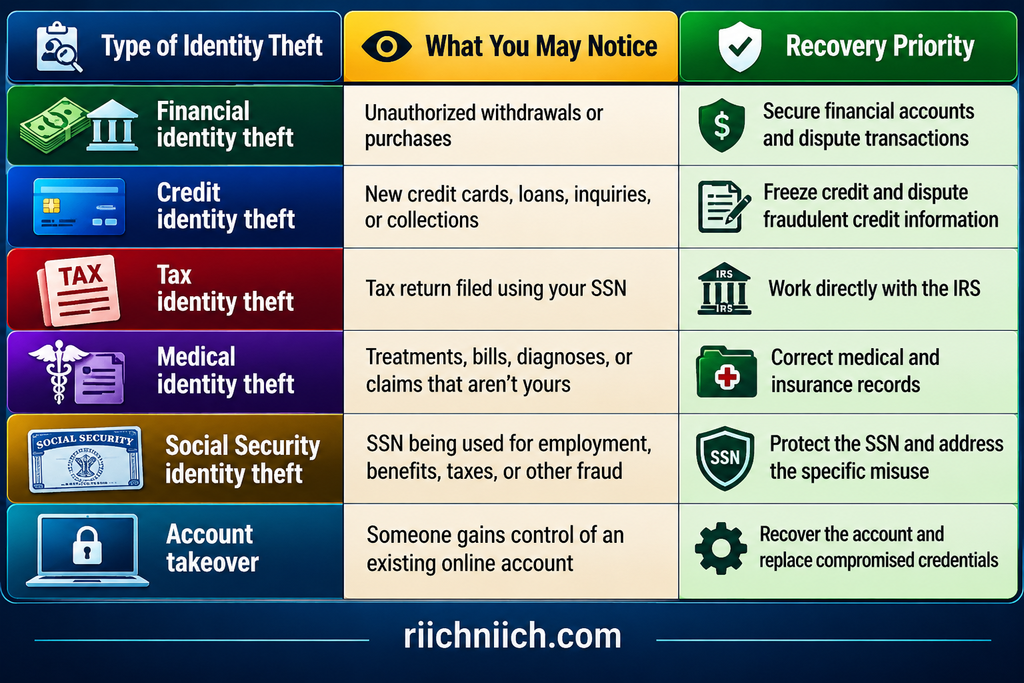
The FTC notes that identity thieves may use stolen information for purchases, new credit accounts, utility accounts, tax refunds, employment, medical care, and other forms of impersonation.
You May Be Dealing With More Than One Type
Identity theft doesn’t always stay in one category.
Someone who obtains your Social Security number and other personal information could potentially use it to apply for credit, commit tax fraud, or impersonate you elsewhere. Someone who compromises your email could potentially use password-reset links to take control of additional accounts.
That means you shouldn’t stop investigating simply because you’ve identified the first type of fraud.
For example:
Unauthorized credit card + unfamiliar loan + compromised email = three separate problems requiring different recovery actions.
Your IdentityTheft.gov recovery plan can help organize the appropriate steps based on the information you provide. The site can also generate an Identity Theft Report and provide forms and letters for use with credit bureaus, businesses, and debt collectors.
Don’t Assume Credit Monitoring Covers Every Type of Identity Theft
This distinction becomes especially important when comparing paid identity theft protection services.
Credit monitoring can help detect certain changes to your credit reports, such as a new loan or credit card appearing. But the FTC notes that credit monitoring generally won’t alert you if someone withdraws money directly from your bank account or uses your Social Security number to fraudulently obtain a tax refund.
Identity monitoring can look beyond traditional credit reports, but it also has limitations. No monitoring service can guarantee detection of every possible use of your identity.
That’s why someone researching how to recover from identity theft should compare services based on the types of protection and recovery assistance they actually provide, rather than assuming every identity protection plan covers the same risks.
Depending on your situation, useful buyer-intent features may include:
- Three-bureau credit monitoring
- Broader identity monitoring
- Social Security number monitoring
- Financial-account alerts where available
- Dedicated identity restoration specialists
- Hands-on recovery assistance
- Identity theft insurance
The FTC explains that identity recovery services may provide counselors or case managers who help victims with recovery tasks, including reviewing documents, preparing correspondence, and dealing with creditors or other institutions when properly authorized.
Choose Recovery Support Based on the Complexity of the Theft
Someone dealing with one fraudulent credit card may be comfortable handling the identity theft recovery steps independently.
Someone dealing with fraudulent loans, compromised bank accounts, stolen credentials, tax fraud, and other misuse at the same time may place much greater value on professional restoration assistance.
Before paying for a service, check exactly what its restoration program does and what its identity theft insurance covers. The FTC notes that identity theft insurance may cover certain recovery expenses but generally doesn’t reimburse the money that scammers stole, and policy exclusions or deductibles may apply.
The key to how to recover from identity theft is matching the response to the damage. Identify every type of fraud involved, follow the appropriate recovery process for each one, and then decide whether you want to manage those steps yourself or use an identity restoration service for additional support.
Next, we’ll break down the major types individually, starting with financial identity theft.
How to Recover From Financial Identity Theft
Financial identity theft happens when someone uses your personal or financial information without permission to access money, make purchases, withdraw funds, or misuse financial accounts. If this happens, knowing how to recover from identity theft means acting quickly to stop additional losses and regain control of every affected account.
Warning signs can include:
- Bank withdrawals you didn’t make
- Debit or credit card purchases you don’t recognize
- Unauthorized money transfers
- Checks you didn’t write
- Changes to account contact information
- New payees or linked accounts you didn’t add
- Unexpected account lockouts or password changes
- Bills or financial statements that suddenly stop arriving
Even a small unfamiliar transaction deserves attention. The CFPB warns that thieves sometimes make a small withdrawal first and return for a larger amount if it goes unnoticed.

Contact the Financial Institution Immediately
If you discover unauthorized activity, contact the bank, credit union, credit card issuer, or other financial institution through an official channel.
Tell the fraud department that you believe the transactions resulted from identity theft and identify every transaction you didn’t authorize.
Depending on what was compromised, ask whether you should:
Lock the card → Replace the card → Change the PIN → Reset online banking credentials → Restrict transfers → Close the account → Open a replacement account
Don’t wait for the next statement before reporting suspicious activity. Federal protections for unauthorized electronic fund transfers can depend significantly on how quickly you notify your financial institution.
💵 The CFPB provides official guidance for recovering money after an unauthorized bank transaction.
Understand the Reporting Deadlines
Timing can matter greatly with financial identity theft.
For example, if your debit card is lost or stolen and you notify the bank within two business days after discovering the loss or theft, federal law generally limits your potential responsibility to no more than $50 in unauthorized transactions. Waiting longer can increase your potential liability. Different rules apply when the card itself wasn’t lost but an unauthorized electronic transaction appears on your statement.
Credit cards have different protections. Under federal law, responsibility for unauthorized credit-card charges is generally limited to $50, and there are circumstances in which you owe nothing.
The important takeaway for your identity theft recovery process is simple: report financial fraud as soon as you discover it.
Secure the Account, Not Just the Card
Replacing a compromised debit or credit card may not be enough.
Ask the financial institution what was actually compromised.
If only the card number was stolen, replacing the card may address the immediate problem. But if someone gained access to your online banking credentials or bank-account information, additional security measures may be necessary.
Review:
- Passwords
- PINs
- Security questions
- Recovery email addresses
- Phone numbers
- Authorized users
- Linked external accounts
- Automatic transfers
- New payees
- Connected devices
- Recent login activity
If a criminal changed your contact information, make sure the correct information is restored before considering the account secure.
Document Every Financial Dispute
Keep a record of each unauthorized transaction and every conversation you have with the financial institution.
Record:
Transaction → Amount → Date Discovered → Date Reported → Representative → Case Number → Resolution
If the institution asks you to provide written confirmation or additional documents, respond promptly and keep copies.
For certain unauthorized electronic transfers, a bank or credit union generally has 10 business days to investigate after notification. If it can’t complete the investigation within that period, federal rules may require a temporary credit while the investigation continues, subject to applicable requirements and exceptions.
Report the Identity Theft Beyond Your Bank
Fixing the fraudulent transaction doesn’t necessarily mean the underlying identity theft is over.
If someone has enough personal information to access one financial account, determine whether your information was also used elsewhere.
Report identity theft through IdentityTheft.gov to create an FTC Identity Theft Report and personalized recovery plan. The CFPB also recommends closing compromised accounts, contacting financial institutions’ fraud departments, reporting the theft, and protecting your credit after identity theft.
Then review your credit reports for unfamiliar accounts or inquiries and continue monitoring your other financial accounts.
Watch for Repeat Financial Fraud
Don’t assume that receiving a refund or replacement card means your financial identity theft recovery is complete.
Continue checking bank and credit card statements for additional unauthorized activity. The FTC recommends watching accounts after card theft and reporting fraudulent charges promptly.
Consider enabling available alerts for:
Purchases → Withdrawals → Transfers → Login attempts → Password changes → New payees → Contact-information changes
Can Identity Theft Protection Help With Financial Identity Theft?
This is where buyer intent matters.
You don’t necessarily need to purchase identity theft protection to dispute unauthorized transactions. Your bank, credit union, or card issuer should be your first contact, and federal consumer protections may apply.
However, financial identity theft can become more complicated when the criminal has compromised multiple accounts or several pieces of personal information.
If you’re considering a paid identity theft protection service after financial fraud, compare what the service provides beyond basic credit monitoring. Useful features may include broader identity monitoring, financial-account alerts where available, three-bureau credit monitoring, dedicated restoration specialists, recovery assistance, and identity theft insurance.
Credit monitoring alone has an important limitation: the FTC notes that it generally won’t alert you when someone simply withdraws money from your bank account.
For someone researching how to recover from identity theft, that means a service offering broader monitoring plus hands-on restoration assistance may provide more recovery value than a plan focused primarily on credit-report alerts.
But read the terms carefully, particularly for identity theft insurance. Insurance and restoration benefits vary by provider and shouldn’t be assumed to reimburse every dollar stolen.
The goal when recovering from financial identity theft is to stop the unauthorized activity, dispute the transactions, secure every affected financial account, and continue watching for additional misuse. Once the financial damage is contained, you can determine whether ongoing monitoring and professional restoration support are worth paying for based on the severity of the theft.
How to Recover From Credit Identity Theft
Credit identity theft happens when someone uses your personal information to open or attempt to open credit accounts in your name. This could include fraudulent credit cards, personal loans, auto financing, retail financing, or other forms of credit.
When learning how to recover from identity theft, credit identity theft requires two priorities: remove the fraudulent credit activity that’s already appeared and make it harder for criminals to open additional accounts.
Warning signs can include:
- A credit card or loan you never opened
- A hard credit inquiry you don’t recognize
- Collection notices for unfamiliar debts
- Unexpected changes to your credit score
- A lender contacting you about an application you never submitted
- New accounts appearing on one or more credit reports
- Late payments associated with accounts that aren’t yours
- Credit being unexpectedly denied because of unfamiliar debts
The CFPB recommends reviewing your credit reports for accounts resulting from identity theft as well as incorrect balances, account statuses, personal information, and duplicate debts.

Identify Every Fraudulent Credit Account
Start by reviewing all three credit reports and creating a list of anything you don’t recognize.
For every suspicious item, record:
Creditor → Account Number → Date Opened → Balance → Credit Bureau → Status → Action Needed
Don’t assume an unfamiliar account appearing on only one credit report isn’t important. Review Equifax, Experian, and TransUnion individually.
IdentityTheft.gov says consumers can currently check all three reports weekly for free through AnnualCreditReport.com.
You should also look beyond open accounts. An unfamiliar hard inquiry could indicate that someone attempted to obtain credit using your identity even if the application didn’t result in an account.
Close Fraudulent Accounts Opened in Your Name
Once you confirm an account is fraudulent, contact the company’s fraud department directly.
Tell the company that you’re an identity theft victim and that you didn’t open or authorize the account.
Ask the company to:
- Close the fraudulent account.
- Stop additional activity on it.
- Confirm that you aren’t responsible for the debt.
- Stop reporting fraudulent information to the credit bureaus.
- Provide written confirmation of the resolution.
The FTC recommends keeping the company’s confirmation letter because you may need it if the fraudulent account appears on your credit report again.
The FTC also provides a free Identity Theft Dispute Letter for fraudulent new accounts that you can customize and send to the company.
Block Fraudulent Information From Your Credit Reports
Closing the account isn’t enough if the fraudulent information remains on your credit reports.
Identity theft victims have specific rights for addressing credit information created by the theft.
The CFPB says you can request that credit reporting companies block fraudulent debts and information by providing an identity theft report, proof of your identity, and a letter identifying the fraudulent information. When the applicable requirements are satisfied, the credit reporting company generally must block the fraudulent information within four business days after receiving the request.
IdentityTheft.gov provides a free Credit Bureau Identity Theft Dispute Letter you can use as a starting point.
Keep copies of everything you submit.
Don’t Confuse Identity Theft With Legitimate Negative Credit Information
This distinction is important.
If an account genuinely belongs to you and the negative information is accurate, you generally cannot have it removed simply because it’s hurting your credit.
Fraudulent information caused by identity theft is different.
The CFPB states that consumers can dispute negative information resulting from identity theft, while accurate negative information generally cannot simply be removed. It also warns against companies claiming they can remove accurate negative information from credit reports.
So don’t pay a so-called credit repair company simply to exercise dispute rights you already have for free.
Freeze Your Credit to Help Stop New Accounts
Removing fraudulent accounts addresses the damage that’s already happened. A credit freeze helps address what could happen next.
A security freeze prevents prospective creditors from accessing your credit file until you lift or remove the freeze. Because businesses typically need access to your credit report before opening new credit, this can make it substantially harder for an identity thief to open another credit account in your name.
You’ll need to freeze your files separately with Equifax, Experian, and TransUnion.
Security freezes are free under federal law.
Consider an Extended Fraud Alert
If you’re an identity theft victim, you may also qualify for an extended fraud alert.
IdentityTheft.gov says an extended fraud alert lasts seven years and requires businesses to contact you before granting new credit in your name. Unlike a credit freeze, you only need to contact one of the three nationwide credit bureaus to initiate the extended alert; that bureau must notify the others. You’ll need to provide an FTC Identity Theft Report as part of the process.
A credit freeze and fraud alert perform different functions, and an identity theft victim can use both as part of a broader identity theft recovery plan.
Check That the Fraud Is Actually Gone
After your disputes are processed, review your credit reports again.
Confirm that:
Fraudulent account removed → Fraudulent balance removed → Incorrect late payments removed → Fraudulent collection removed → Credit information corrected
Keep the original reports and the corrected versions.
If the same fraudulent account returns later, your documentation can help show that you previously reported and disputed it.
IdentityTheft.gov recommends continuing to review your credit reports regularly so you can spot new fraud quickly.
Can Identity Theft Protection Help With Credit Identity Theft?
Credit identity theft is one situation where the difference between monitoring and restoration becomes particularly important.
You can freeze your credit and dispute fraudulent information yourself for free. You don’t need to purchase identity theft protection simply to obtain those rights.
However, if you’re dealing with multiple fraudulent accounts across several creditors and credit bureaus, managing the recovery process can become time-consuming.
That’s where a paid identity theft protection service may offer additional value.
For someone researching how to recover from identity theft, buyer-intent features worth comparing include:
- Three-bureau credit monitoring
- Alerts for new credit activity
- Broader identity monitoring
- Dedicated identity restoration specialists
- Hands-on recovery assistance
- Identity theft insurance
The strongest buyer-intent distinction is this: monitoring helps you detect potential new problems, while restoration assistance helps you deal with problems that have already happened.
If you’re already recovering from credit identity theft, a service offering both may provide more practical value than a basic monitoring-only plan.
The goal of credit identity theft recovery is to get fraudulent accounts and information off your credit files, protect your reports against additional unauthorized credit applications, and continue monitoring for signs that your stolen information is being used again. Those are core parts of how to recover from identity theft when the damage has reached your credit.
How to Recover From Tax Identity Theft
Tax identity theft happens when someone uses your Social Security number (SSN) or Individual Taxpayer Identification Number (ITIN) for tax-related fraud—most commonly to file a federal tax return in your name and attempt to claim a refund.
When learning how to recover from identity theft, tax identity theft requires a different response than fraudulent credit cards or bank transactions because you’ll need to work directly with the IRS to correct the tax problem.
You might discover tax identity theft when:
- Your electronically filed tax return is rejected because a return was already filed using your SSN.
- The IRS contacts you about a tax return you didn’t file.
- You receive an unexpected IRS identity-verification notice.
- Someone fraudulently claims you or your dependent.
- Your SSN is fraudulently used for employment purposes.
- You receive a tax refund even though you didn’t file a return.
The IRS specifically recognizes fraudulent returns, fraudulent dependent claims, and employment-related SSN misuse as forms of tax-related identity theft.
Respond to IRS Notices Immediately
If the IRS sends you a letter or notice about a suspicious tax return, follow the instructions in that specific notice.
Don’t ignore it, even if you know you didn’t file the return in question.
For certain notices, the IRS directs taxpayers to its Identity and Tax Return Verification Service. If you didn’t file the return, you can use the verification process to tell the IRS that the return isn’t yours.
Use the contact information printed on the official IRS notice rather than calling a phone number contained in an unexpected email or text message.
The IRS maintains an official Identity Theft Guide for Individuals explaining the appropriate recovery process.
Continue Filing Your Legitimate Tax Return
Discovering tax identity theft doesn’t eliminate your obligation to file your legitimate tax return.
If an identity thief has already filed electronically using your information, you may not be able to e-file your legitimate return normally. Follow the IRS instructions for your specific situation and continue working through the verification or filing process.
Keep copies of:
Your legitimate return → IRS notices → Identity-verification records → Identity theft documents → Correspondence → Case numbers
These records can become important if the recovery process continues into future tax years.
Do You Need IRS Form 14039?
Form 14039, Identity Theft Affidavit, is used in certain tax-related identity theft situations—but the IRS says most people don’t need to file it.
The current February 2026 version covers situations including someone fraudulently filing a federal tax return, fraudulently claiming a dependent, or fraudulently using an SSN or ITIN for employment.
Importantly, don’t automatically submit Form 14039 simply because you suspect identity theft.
The IRS says not to file it in several circumstances, including when you’ve already submitted it for the incident, when the IRS has already sent you certain notices or letters, or when you’re directed to use the Identity and Tax Return Verification Service.
If your situation requires the affidavit, use the official IRS Form 14039 and follow its submission instructions.
Get an IRS Identity Protection PIN
One of the strongest steps you can take after tax identity theft is obtaining an Identity Protection PIN (IP PIN).
An IP PIN is a six-digit number known to you and the IRS that helps prevent someone else from successfully filing a federal tax return using your SSN or ITIN. Anyone with an SSN or ITIN who can verify their identity can enroll in the program.
A new IP PIN is generated each year.
Once you have one, it must be entered correctly on applicable federal tax returns. An incorrect or missing IP PIN can cause an electronically filed return to be rejected or a paper return to be delayed while the IRS verifies it.
You can learn more through the official IRS Identity Protection PIN program.
Keep your IP PIN private. The IRS says it should generally only be disclosed to your trusted tax professional when you’re ready to file your return, and the IRS will not call, email, or text you asking for it.
Check Whether Your SSN Was Used for Employment
Tax identity theft can involve more than fraudulent tax returns.
Someone may use your Social Security number for employment, causing wages you didn’t earn to become associated with your identity.
The IRS specifically recognizes fraudulent employment use of an SSN or ITIN as an identity theft issue. Its guidance also recommends additional protective actions when employment-related identity theft occurs.
If you discover unfamiliar earnings or employment records, don’t assume they’re harmless simply because money wasn’t directly taken from your bank account. Investigate and correct the records through the appropriate agencies.
Protect Yourself Against Another Fraudulent Return
Recovering from the immediate tax problem is only one part of your identity theft recovery plan.
If a criminal has your SSN, the underlying personal information may remain compromised even after the IRS resolves the fraudulent return.
Continue protecting yourself by:
- Using your IP PIN every year as required.
- Securing your IRS Online Account.
- Protecting your Social Security number.
- Monitoring your credit reports.
- Keeping your email account secure.
- Watching for additional identity theft.
- Keeping IRS correspondence and recovery records.
The IRS encourages taxpayers to opt into the IP PIN program as a proactive defense against fraudulent federal tax returns.
Can Identity Theft Protection Help With Tax Identity Theft?
This is where it’s important to understand what you’re actually paying for.
An identity theft protection company cannot replace the IRS or independently correct a fraudulent federal tax return. You’ll still need to follow the IRS recovery process.
However, tax identity theft can indicate that highly sensitive information—particularly your SSN—has been compromised. That creates the possibility of other types of identity fraud beyond taxes.
For someone researching how to recover from identity theft, a paid identity protection service may be more useful when it provides protection beyond ordinary credit monitoring.
Buyer-intent features worth comparing include:
- Social Security number monitoring
- Dark web monitoring
- Three-bureau credit monitoring
- Broader identity monitoring
- Dedicated identity restoration specialists
- Hands-on recovery assistance
- Identity theft insurance
The important distinction is that an IP PIN helps protect your federal tax return, while broader identity monitoring and restoration services are designed to address other ways your stolen information might be misused.
If tax identity theft is the only problem and you’re comfortable handling the recovery yourself, the IRS provides the primary tools you need at no charge. If the incident is part of a larger identity theft problem involving your credit, financial accounts, SSN, or online accounts, paying for broader monitoring and restoration assistance may provide additional value.
Ultimately, how to recover from identity theft involving taxes comes down to verifying the fraud with the IRS, filing your legitimate return, following the correct IRS recovery process, obtaining an IP PIN, and continuing to protect the personal information that allowed the tax fraud to happen in the first place.
How to Recover From Medical Identity Theft
Medical identity theft happens when someone uses your personal information—such as your name, Social Security number, health insurance information, or Medicare number—to receive medical care, obtain prescription drugs, buy medical equipment, or submit fraudulent insurance claims.
When learning how to recover from identity theft, medical identity theft requires special attention because the damage may go beyond money or credit. If another person’s diagnoses, medications, treatments, allergies, or medical history become mixed with yours, inaccurate information could remain in your medical records and potentially affect future care.
Warning signs can include:
- Medical bills for treatment you never received
- Explanation of Benefits (EOB) statements showing unfamiliar services
- Prescriptions you never filled
- Doctors or medical facilities you don’t recognize
- Medical collection accounts that aren’t yours
- Insurance claims you didn’t submit
- Notices saying you’ve reached a health insurance benefit limit unexpectedly
- Incorrect diagnoses, medications, procedures, or other information in your medical records
Don’t treat an unfamiliar medical bill as an ordinary billing mistake until you’ve investigated it.

Review Your Explanation of Benefits and Medical Bills
Start by determining where your medical identity was used.
Review recent medical bills and Explanation of Benefits statements from your health insurance company. Compare the dates, providers, treatments, prescriptions, and charges with medical care you actually received.
Create a simple record:
Provider → Date → Service → Amount → Insurance Claim → Mine / Not Mine → Action Taken
The FTC recommends reviewing EOB statements and medical bills for services, providers, and prescriptions you don’t recognize.
If you’re on Medicare, review your Medicare statements for unfamiliar services or equipment as well. Centers for Medicare & Medicaid Services (CMS) provides official channels for reporting suspected Medicare fraud.
Get Copies of the Medical Records Involved
Unlike credit reports, there isn’t one central report containing your complete medical history.
If you believe someone used your identity at multiple healthcare organizations, you may need to contact each affected:
Doctor → Clinic → Hospital → Pharmacy → Laboratory → Health Plan
Request copies of the medical and billing records associated with the suspected fraud.
Under HIPAA, you generally have the right to inspect and obtain copies of medical and billing records maintained by covered healthcare providers and health plans, subject to certain exceptions.
Review those records carefully for unfamiliar visits, diagnoses, prescriptions, procedures, equipment, or other information.
Correct Medical Records Contaminated by Identity Theft
This can be one of the most important medical identity theft recovery steps.
If you discover information that belongs to the identity thief rather than you, contact the healthcare provider or health plan and request that the inaccurate information be corrected.
HHS says that if you believe information in your medical or billing record is incorrect, you can request an amendment. If the provider or health plan created the information, it must respond to the request and must amend inaccurate or incomplete information when required. If it denies the request, you have the right to submit a statement of disagreement that becomes part of the record.
The FTC also recommends reporting medical identity theft errors in writing and keeping proof that your request was received.
Keep copies of:
- The original incorrect record
- Your correction request
- Supporting identity theft documentation
- Delivery confirmation
- The provider’s response
- The corrected record
This documentation can be important if incorrect medical information reappears later.
Contact Your Health Insurance Company
If fraudulent medical services were billed to your insurance, contact the insurer’s fraud department.
Explain which claims aren’t yours and ask what documentation is required to dispute them.
You may need to correct more than a bill. Fraudulent claims could affect your insurance records, benefit usage, or other healthcare information.
If your health insurance identification number or Medicare number has been compromised, ask whether additional steps are necessary to protect the account.
For Medicare specifically, CMS says beneficiaries can report suspicious activity through Medicare and provides dedicated fraud-reporting resources.
Dispute Medical Debts That Aren’t Yours
Medical identity theft can also create financial problems if fraudulent medical bills are sent to collections.
If you find a medical collection account you don’t recognize, don’t assume you must pay it simply because it appears under your name.
Document that the medical services resulted from identity theft and dispute inaccurate information with the appropriate organizations.
The FTC recommends reviewing your credit reports for medical debts you don’t recognize and using IdentityTheft.gov’s recovery process to address identity-theft-related billing errors.
Report the Medical Identity Theft
Correcting one fraudulent medical record doesn’t necessarily address the underlying identity theft.
Report the incident through IdentityTheft.gov and create an FTC recovery plan. The FTC specifically recommends doing this because someone who used your personal information for medical care may also try to use it for other types of identity fraud.
Then continue watching your credit, financial accounts, insurance statements, and other records for additional misuse.
Protect Your Medical Information Going Forward
Once the fraudulent records and claims are being corrected, reduce the chances of additional medical identity theft.
Keep insurance cards, medical records, prescriptions, EOB statements, and other documents containing sensitive information secure. Before disposing of them, destroy or obscure personal information.
Be especially careful with unexpected calls, emails, or text messages asking for your:
Health insurance number → Medicare number → Social Security number → Medical information
The FTC recommends contacting the healthcare organization directly through a trusted phone number or website instead of providing medical information in response to an unexpected message.
Can Identity Theft Protection Help With Medical Identity Theft?
Medical identity theft demonstrates why credit monitoring alone isn’t complete identity protection.
A fraudulent medical claim may never appear as a new credit account. And no identity protection service can automatically clean incorrect diagnoses or treatments from every healthcare provider’s medical records.
You’ll still need to work with the affected healthcare providers, insurers, and government agencies when appropriate.
However, someone researching how to recover from identity theft may find a paid identity protection service more valuable if the medical fraud is part of a broader compromise involving an SSN, insurance information, financial accounts, or other personal data.
Buyer-intent features worth comparing include:
- Broader identity monitoring
- Social Security number monitoring
- Dark web monitoring
- Three-bureau credit monitoring
- Dedicated identity restoration specialists
- Hands-on recovery assistance
- Identity theft insurance
The key feature after medical identity theft may be restoration assistance rather than monitoring alone. If multiple providers, insurers, collection agencies, and credit bureaus are involved, having a restoration specialist help organize the recovery process could reduce some of the administrative burden.
That doesn’t replace your right to obtain and correct your medical records. It provides additional help managing a complicated identity theft recovery process.
Ultimately, how to recover from identity theft involving medical information means doing more than disputing a fraudulent bill. You need to identify where your medical identity was used, review the associated records, correct inaccurate medical information, dispute fraudulent claims and debts, and continue watching for signs that the same stolen information is being used elsewhere.
How to Recover From Social Security Identity Theft
Social Security identity theft happens when someone obtains your Social Security number (SSN) and uses it without permission. Unlike a stolen credit card number, an SSN is a long-term identifier, so recovering from this type of identity theft usually means protecting the number from further misuse rather than simply replacing it.
When learning how to recover from identity theft, SSN theft deserves special attention because criminals may potentially use the number for multiple forms of fraud, including opening credit accounts, filing fraudulent tax returns, obtaining employment, or attempting to access government benefits.
The Social Security Administration recommends checking your Social Security earnings record, reviewing your credit reports, contacting the IRS when tax or employment misuse is involved, and reporting identity theft to the FTC.

.
Determine How Your Social Security Number Was Used
Finding out that your SSN was exposed and discovering that someone actually used it are two different situations.
If you know your SSN was stolen, look for evidence that can tell you what kind of identity theft you’re dealing with.
Check for:
- Credit accounts or inquiries you don’t recognize
- Earnings from employers you never worked for
- IRS notices about tax returns you didn’t file
- Government benefits activity you don’t recognize
- Collection accounts that aren’t yours
- Bank or financial accounts opened using your identity
- Unexpected identity-verification notices
This matters because there isn’t one single procedure that fixes every form of Social Security identity theft.
If the thief used your SSN for credit fraud, you’ll need to address your credit reports. If it was used for employment, you’ll need to correct your earnings record. If it was used for tax fraud, you’ll need to work with the IRS.
Report the Identity Theft to the FTC
If someone is misusing your SSN, report the identity theft through IdentityTheft.gov.
SSA specifically directs people who believe they’re victims of identity theft to the FTC. SSA can help correct problems with your Social Security records, but it doesn’t handle the broader identity theft recovery process itself.
Your FTC Identity Theft Report and recovery plan can help document the theft as you work with businesses and other organizations.
Keep copies of your:
FTC report → Fraudulent-account records → Credit reports → IRS notices → SSA correspondence → Dispute letters → Company responses
These documents create an evidence trail if the stolen SSN continues to cause problems.
Review Your Social Security Earnings Record
Someone could use your SSN for employment, causing wages that you never earned to appear on your Social Security record.
Sign in to your personal ‘my Social Security’ account and review your earnings history.
Look year by year and compare the reported earnings with your actual employment history.
If you find earnings that don’t belong to you, SSA says you may be able to request a correction online. If online correction isn’t available for your situation, SSA may require you to visit an office, verify your identity, and provide additional information. In some cases, Form SSA-7008 and supporting documentation may be required.
Correcting this information matters because your Social Security earnings record can affect future benefit estimates and eligibility determinations.
Protect Your Credit From SSN Misuse
If an identity thief has your SSN, don’t limit your identity theft recovery plan to Social Security records.
Review all three credit reports for unfamiliar:
Credit Cards → Loans → Hard Inquiries → Addresses → Collections → Other Accounts
If you haven’t already done so, consider freezing your credit with Equifax, Experian, and TransUnion. A credit freeze can make it significantly harder for someone to use stolen personal information to open new credit accounts because prospective creditors generally can’t access the frozen credit file.
If fraudulent accounts already exist, dispute them and follow the appropriate process for blocking identity-theft-related information from your credit reports.
Remember: a credit freeze doesn’t make your stolen SSN private again. It helps restrict one important way criminals might try to use it.
Protect Your Tax Identity With an IP PIN
A stolen Social Security number can also be used for tax identity theft.
Consider obtaining an IRS Identity Protection PIN (IP PIN).
An IP PIN is a six-digit number that helps prevent someone else from filing a federal tax return using your SSN. Anyone with an SSN or ITIN who can verify their identity is eligible to enroll, and a new IP PIN is generated each year.
You can enroll through the official IRS IP PIN program.
Once you have an IP PIN, protect it carefully. The IRS says it should generally be known only to you and your trusted tax professional when you’re ready to file. The IRS will not call, email, or text asking you for the number.
Don’t Give Your SSN to Someone Who Calls You Unexpectedly
SSN identity theft can create another vulnerability: recovery scams.
Someone may contact you claiming to be from Social Security and offer to “check” whether your SSN has been compromised.
In August 2026, SSA’s Office of Inspector General specifically warned about scammers using this approach. It says legitimate SSA and SSA OIG employees will not unexpectedly contact you asking for personal information or bank details, threaten to suspend your SSN, or tell you to move money to protect it.
If an unexpected caller claims there is a problem with your Social Security number, don’t provide the number simply to “verify” your identity.
Contact Social Security independently through an official channel.
Do You Need a New Social Security Number?
Usually, getting a new SSN isn’t the first solution to Social Security identity theft.
SSA says new numbers are available only in limited circumstances. For identity theft, SSA instructs victims to first report the number as stolen and attempt to resolve the problems caused by the misuse. If you continue to experience problems when using the original number, you can speak with SSA about whether a new number may be appropriate.
Even then, you’ll need documentation showing that the misuse continues despite your attempts to correct it.
You can review SSA’s official requirements for requesting a new Social Security number.
Changing your SSN also doesn’t automatically erase the history associated with the old number or eliminate every consequence of identity theft. That’s why the first priority is usually correcting the fraudulent activity and protecting your existing identity records.
Continue Monitoring After the Immediate Fraud Is Fixed
Social Security identity theft can require longer-term monitoring because the underlying number may remain compromised.
After you’ve completed the immediate steps to recover from identity theft, continue watching:
- Your Social Security earnings record
- All three credit reports
- Bank and financial accounts
- IRS activity and notices
- Government benefit information
- New-account alerts
- Collection notices
- Unexpected identity-verification requests
This is particularly important if your SSN was exposed alongside other information such as your date of birth, address, driver’s license number, or account credentials.
Can Identity Theft Protection Help After Your SSN Is Stolen?
This is one of the stronger buyer-intent situations for comparing identity theft protection services because you generally cannot simply replace a compromised SSN the way you would replace a credit card.
However, paid protection doesn’t make a stolen SSN secret again, and no service can guarantee that criminals will never try to use it.
The question is whether you want additional monitoring and recovery support around the compromised identity.
For someone researching how to recover from identity theft after SSN theft, compare services based on features such as:
- Social Security number monitoring
- Dark web monitoring
- Three-bureau credit monitoring
- New-account alerts
- Broader identity monitoring
- Dedicated identity restoration specialists
- Hands-on recovery assistance
- Identity theft insurance
The distinction between monitoring and restoration is especially important here. Monitoring may alert you to certain signs that your identity is being misused, while restoration assistance can help you respond if another fraudulent account or identity theft incident occurs.
If your SSN was exposed but there is no evidence of active misuse, you may decide that free protective measures and careful monitoring are sufficient. If criminals have already used your SSN across multiple areas—such as credit, taxes, employment, or financial accounts—the additional support of a comprehensive identity theft protection and restoration service may be more valuable.
Ultimately, how to recover from identity theft involving your Social Security number means identifying every way the number was misused, correcting the affected records, protecting your credit and tax identity, and continuing to monitor for new fraud long after the first incident has been resolved.
How to Recover From Account Takeover
Account takeover happens when someone gains unauthorized access to an existing account and begins using it as if they were you. The target could be your email, bank account, social media profile, shopping account, payment app, mobile carrier account, cloud storage, or another online service.
When learning how to recover from identity theft, account takeover requires more than changing a password. You need to regain control, remove the intruder’s access, undo unauthorized changes, determine what information was exposed, and secure any other accounts that may now be at risk.
Common warning signs include:
- Your password suddenly stops working.
- You receive a password-reset notification you didn’t request.
- Your email address or phone number was changed.
- An unfamiliar device or location appears in login history.
- Messages or posts were sent from your account without you.
- Purchases or transfers appear that you didn’t authorize.
- New recovery methods or connected applications appear.
- You receive MFA requests you didn’t initiate.
The FTC recommends using the provider’s official account-recovery process when you’ve been locked out and then securing the account after access is restored.

Recover the Account Through the Official Provider
If you can still access the account, immediately change the password and review the security settings.
If you’ve been locked out, use the provider’s official account recovery or hacked account process.
You may be asked to verify your identity using:
Recovery email → Phone number → Backup code → Trusted device → Identity verification
Avoid account-recovery links sent through unexpected emails, texts, or direct messages. A criminal who already compromised your account could also attempt to trick you with a fake recovery page.
Sign Out Every Other Device and Session
Regaining access doesn’t necessarily remove the attacker.
Someone may still have an active authenticated session on another phone, computer, browser, or application.
Once you’re back inside the account:
Change Password → Sign Out All Sessions → Remove Unknown Devices → Revoke Suspicious Access
The FTC specifically recommends signing out of all devices after recovering a hacked account so anyone still logged in is forced out.
Review the account’s recent login history as well. Save screenshots of suspicious devices, locations, or activity if they could be useful for documenting the identity theft.
Remove Changes the Attacker Made
Account takeover can continue even after you replace the password if the attacker changed other settings.
Review:
- Recovery email addresses
- Recovery phone numbers
- Trusted devices
- Connected applications
- Authorized users
- Security questions
- Payment methods
- Shipping addresses
- Automatic forwarding rules
- Account permissions
- MFA methods
Email accounts deserve especially careful inspection.
The FTC recommends checking email forwarding rules because an attacker may configure your messages to automatically forward to another address. You should also review sent and deleted messages for activity you didn’t perform.
Remove anything you don’t recognize.
Secure Your Email Before Recovering Connected Accounts
If your primary email was taken over, treat it as a high-priority part of your identity theft recovery process.
Email often serves as the recovery channel for other online accounts. Someone controlling your inbox may be able to request password-reset links for banking, shopping, social media, and other services.
The FTC specifically warns that a compromised email account can be used to reset passwords for other accounts.
After securing your email, work outward through important connected accounts:
Banking → Credit Cards → Payment Apps → Mobile Carrier → Shopping → Social Media → Cloud Storage
Change any password that was reused on the compromised account.
Turn On Multi-Factor Authentication
Once you’ve recovered the account, enable multi-factor authentication (MFA) wherever available.
MFA requires another authentication factor in addition to the password, making a stolen password alone less useful to an attacker. CISA recommends MFA for accounts including email, financial services, social media, and online stores.
When an account offers several choices, stronger phishing-resistant authentication methods are preferable where practical. CISA identifies security keys among the strongest options and notes that text or email codes provide weaker protection than stronger MFA methods.
Check What the Attacker Did While Inside
Recovering the account doesn’t tell you what happened while the criminal controlled it.
Review the account’s history carefully.
For a bank or payment account, check transactions, transfers, payees, and linked accounts.
For an email account, check sent messages, deleted messages, forwarding rules, password-reset emails, and connected applications.
For a shopping account, check purchases, payment methods, addresses, and stored personal information.
For a social media account, check posts, messages, friends or followers added, advertisements, and connected applications.
For a mobile carrier account, check account changes, devices, and security settings.
Document suspicious activity before deleting or correcting it.
If the attacker obtained financial information, your SSN, or other sensitive information while inside the account, your account takeover recovery may need to expand into a broader identity theft recovery plan.
Warn People if Messages Were Sent From Your Account
Account takeover can affect other people too.
An attacker may impersonate you and send phishing links, requests for money, fake investment opportunities, or malicious attachments to your contacts.
The FTC recommends notifying contacts after an email or social media hack so they know to ignore suspicious messages or requests that appeared to come from you.
Do this especially if you can see that unauthorized messages were actually sent.
Report Identity Theft if Personal Information Was Stolen
Not every hacked account automatically becomes identity theft.
But if the attacker used or stole personal information to impersonate you, open accounts, make transactions, or commit other fraud, report the incident through the FTC’s official identity theft recovery system.
Then determine whether you also need to freeze your credit, dispute fraudulent transactions, secure financial accounts, or protect other personal information.
Can Identity Theft Protection Help After Account Takeover?
This is where buyer intent becomes more specific.
A paid identity theft protection service usually cannot replace the account provider’s own recovery process. If your email, bank, or social media account is taken over, you’ll still need to work with that provider to regain access.
The potential value comes after or alongside recovery.
If the attacker accessed sensitive personal information, you may want broader monitoring to help identify whether that information is later used elsewhere.
For someone researching how to recover from identity theft, useful features to compare can include:
- Dark web monitoring
- Compromised-credential monitoring
- Social Security number monitoring
- Three-bureau credit monitoring
- New-account alerts
- Broader identity monitoring
- Dedicated restoration specialists
- Hands-on identity theft recovery assistance
- Identity theft insurance
CISA notes that credential-monitoring services can be used to monitor for compromised credentials appearing on the dark web, although monitoring should complement—not replace—strong account security.
If only one low-risk account was compromised and you quickly regained control, you may be comfortable handling the recovery yourself. But if an attacker gained access to your primary email, financial accounts, SSN, or multiple connected accounts, broader identity monitoring and professional restoration assistance may provide more practical value.
Ultimately, how to recover from identity theft involving account takeover means more than getting back into the account. You need to remove every path the attacker could use to return, investigate what happened while they had access, secure connected accounts, and monitor for signs that information stolen during the takeover is being used for additional fraud.
How Long Does It Take to Recover From Identity Theft?
There is no single timeline for how to recover from identity theft. Some victims can resolve a limited problem in a few days or weeks, while complicated cases involving multiple fraudulent accounts, damaged credit, tax identity theft, medical identity theft, or repeated misuse can take much longer.
The biggest factor is how much damage the identity thief caused before the fraud was discovered.
A stolen credit card number with one unauthorized charge may be relatively straightforward to resolve. But if someone used your Social Security number to open several accounts, accumulated debts, changed account information, and filed a fraudulent tax return, you’ll be dealing with several separate recovery processes.
That’s why identity theft recovery is better viewed as a series of problems to resolve rather than one fixed countdown.

What Can Make Identity Theft Recovery Take Longer?
Your identity theft recovery timeline will depend on factors such as:
- How quickly you discovered the theft
- How many accounts were affected
- What type of identity theft occurred
- Whether fraudulent information reached your credit reports
- Whether your Social Security number was compromised
- Whether multiple companies or agencies are involved
- How quickly businesses respond to your disputes
- Whether additional fraud appears during recovery
- Whether you have complete documentation
The FTC’s IdentityTheft.gov creates a personalized recovery plan based on the specific identity theft you’re dealing with and lets you track your progress through the recovery process.
Some Recovery Steps Have Specific Timelines
Although there isn’t a universal identity theft recovery deadline, certain parts of the process have legal or procedural timeframes.
For example, if qualifying identity-theft information appears on your credit report and you provide the required identity theft report, proof of identity, and written identification of the fraudulent information, a credit reporting company generally must block that information within four business days after receiving the request.
A standard credit-report dispute generally must be investigated within 30 days, although certain circumstances can extend the investigation to 45 days. After completing its investigation, the credit reporting company generally has five business days to notify you of the results.
Consumer Financial Protection Bureau
Unauthorized bank transactions operate under different rules. After you notify your bank or credit union about an unauthorized electronic transaction, it generally has 10 business days to investigate, although additional rules and exceptions can affect the process.
Consumer Financial Protection Bureau
These timelines don’t necessarily mean your entire identity theft recovery process will be finished within four, 10, 30, or 45 days. They apply to particular parts of the recovery.
Simple Cases May Be Resolved Faster
Imagine someone steals your credit card information and makes several unauthorized purchases, but your Social Security number, email, and other accounts remain secure.
Your recovery may primarily involve:
Report Charges → Replace Card → Dispute Transactions → Change Credentials → Monitor Account
That can be considerably simpler than recovering from widespread identity theft.
The same principle applies to an isolated account takeover. If you quickly regain control, remove unauthorized sessions, replace the compromised password, enable MFA, and confirm that no sensitive information was stolen, the active recovery phase may be relatively short.
Complex Identity Theft Can Take Much Longer
Recovery becomes more difficult when one stolen identity creates problems across several areas.
For example:
Fraudulent loan → Credit damage → Collection account → Stolen SSN → Tax fraud → Account takeover
Each problem may involve a different organization and recovery process.
You could find yourself working simultaneously with:
- Banks
- Credit card issuers
- Lenders
- Credit bureaus
- Debt collectors
- The FTC
- IRS
- Social Security Administration
- Healthcare providers
- Insurance companies
- Online account providers
Even after one organization corrects its records, you may still be waiting for another organization to complete its investigation.
Recovery Isn’t Finished Just Because the Fraudulent Account Is Closed
This is an important distinction.
Closing a fraudulent account addresses one consequence of identity theft. It doesn’t necessarily mean the underlying identity is secure.
Before considering your recovery substantially complete, verify that:
Fraudulent accounts are closed → Unauthorized transactions are addressed → Credit reports are corrected → Compromised passwords are replaced → Affected personal information is protected → Important records are corrected
Then continue monitoring.
IdentityTheft.gov recommends reviewing credit reports regularly after identity theft so you can identify new fraud quickly. It currently notes that consumers can check their three reports weekly for free through AnnualCreditReport.com.
Your Recovery Timeline Can Restart
One frustrating aspect of identity theft is that new fraud can appear after you’ve already fixed the original problem.
For example, you might successfully remove a fraudulent credit card from your credit report and then discover an unfamiliar loan several months later.
That’s particularly possible when long-term personal information—such as your Social Security number—was compromised.
Think of recovery as having two stages:
Stage 1: Repair the known damage.
Stage 2: Watch for additional misuse.
The second stage doesn’t necessarily mean you’ll constantly be dealing with fraud. It means continuing reasonable monitoring so that another problem doesn’t remain unnoticed for months.
Can You Speed Up Identity Theft Recovery?
You can’t control how quickly every company or government agency completes an investigation, but you can reduce unnecessary delays.
Keep your recovery organized.
Maintain one folder containing:
- FTC Identity Theft Report
- Credit reports
- Fraudulent account statements
- Dispute letters
- Confirmation numbers
- Company correspondence
- Police report, if applicable
- Government notices
- Dates and names of representatives you contacted
Respond promptly when an organization requests legitimate supporting documentation.
IdentityTheft.gov also provides pre-filled letters and forms and lets registered users track recovery steps, which can make a complicated recovery process easier to organize.
Can Identity Theft Protection Make Recovery Easier?
This is where the buyer-intent question becomes especially relevant.
Paying for identity theft protection doesn’t guarantee that your case will be resolved faster. Banks, credit bureaus, government agencies, and other organizations still control their own investigation and correction timelines.
The potential value is reducing how much of the recovery process you have to manage alone.
If you’re comparing identity theft protection after becoming a victim, look closely at whether the service includes:
- Dedicated identity restoration specialists
- Hands-on recovery assistance
- Three-bureau credit monitoring
- Broader identity monitoring
- Social Security number monitoring
- Dark web monitoring
- Identity theft insurance
Someone dealing with one fraudulent transaction may decide that paying for recovery assistance isn’t necessary.
But someone dealing with multiple fraudulent accounts, damaged credit, a compromised SSN, tax fraud, or repeated identity misuse may place much greater value on having a dedicated restoration specialist helping organize the recovery process.
The FTC notes that IdentityTheft.gov itself provides free personalized recovery plans, tracking tools, and pre-filled letters and forms, so compare any paid service against the assistance you can already receive for free.
Ultimately, there is no guaranteed number of days for how to recover from identity theft. The more widespread the fraud, the more organizations you’ll usually need to work with—and the longer complete recovery can take. Acting quickly, documenting everything, following up on unresolved disputes, and continuing to monitor your identity can help keep the recovery process moving in the right direction.
Can Identity Theft Damage Your Credit?
Yes. Identity theft can damage your credit when a criminal uses your personal information to open accounts, borrow money, accumulate debt, or create other fraudulent information that ends up on your credit reports.
Understanding this connection is an important part of how to recover from identity theft because simply closing a fraudulent account doesn’t necessarily remove the damage it caused to your credit history.
Identity theft may lead to:
- Fraudulent credit cards or loans
- Unfamiliar hard credit inquiries
- Missed payments on accounts you never opened
- Maxed-out fraudulent credit accounts
- Collection accounts for debts that aren’t yours
- Incorrect balances or account statuses
- Lower credit scores resulting from fraudulent credit-report information
The CFPB specifically recommends checking credit reports for accounts resulting from identity theft, incorrect late-payment information, inaccurate balances, unfamiliar personal information, and other errors.
Consumer Financial Protection Bureau

How Identity Theft Can Lower Your Credit Score
Identity theft itself doesn’t automatically lower your credit score. The credit activity created by the identity thief can cause the damage.
For example, imagine someone uses your information to open a credit card.
They run up a large balance and never make a payment.
That fraudulent account could potentially introduce several damaging pieces of information into your credit file:
New Credit Inquiry → New Account → High Balance → Missed Payments → Collection Activity
Even though you didn’t create the debt, a lender reviewing your credit report may initially see an account reported under your identity until the fraud is identified and corrected.
This is why acting quickly is so important during the identity theft recovery process.
Check All Three Credit Reports for Damage
Don’t assume fraudulent information will appear identically across all three nationwide credit bureaus.
Review your reports from Equifax, Experian, and TransUnion and look for:
Accounts you didn’t open → Inquiries you didn’t authorize → Addresses you don’t recognize → Incorrect balances → Late payments that aren’t yours → Collections you don’t recognize
IdentityTheft.gov says consumers can currently check their reports from all three bureaus weekly for free through AnnualCreditReport.com.
Compare the reports side by side and create a list of every suspicious item.
Can Fraudulent Information Be Removed From Your Credit Report?
Yes. Identity theft victims have specific rights for addressing fraudulent information on their credit reports.
The CFPB says you can ask credit reporting companies to block fraudulent debts and information by providing:
- An identity theft report
- Proof of your identity
- A letter identifying the fraudulent debts or information
After receiving a qualifying request, credit reporting companies generally must block the identity-theft-related information within four business days. They must also notify the companies that supplied the information.
IdentityTheft.gov provides a free sample identity theft letter that can be used when requesting a block.
Keep copies of everything you submit and every response you receive.
Identity Theft Damage Is Different From Legitimate Negative Credit History
This distinction matters.
If you legitimately opened an account and accurately missed payments, identity theft protections generally can’t be used simply to remove that negative information.
But if the account or negative information resulted from identity theft, you have the right to dispute it and may qualify to have it blocked.
The CFPB warns that accurate negative information generally cannot simply be removed from a credit report, while information resulting from identity theft can be disputed. It also notes that consumers already have the legal right to dispute inaccuracies at no cost.
So be cautious about paying a credit-repair company that promises to erase legitimate negative information.
Will Your Credit Score Recover After Identity Theft?
If identity-theft-related information is hurting your credit score, correcting or blocking that fraudulent information can allow your credit reports—and the credit scores calculated from them—to reflect your legitimate credit history more accurately.
But don’t focus only on the score.
During credit identity theft recovery, the priority should be correcting the underlying credit-report information.
Think of it this way:
Fraudulent Account Removed → Fraudulent Balance Removed → Fraudulent Late Payments Removed → Credit File Corrected → Score Recalculated From Updated Information
Exactly how your score changes depends on the rest of your credit file and the scoring model being used, so there isn’t a guaranteed number of points your score will increase.
Freeze Your Credit While Repairing the Damage
Correcting existing fraudulent information solves one problem. You also want to make it harder for the identity thief to create new credit damage.
A credit freeze restricts prospective creditors from accessing your credit file. Because creditors typically review a credit report before approving new credit, a freeze can help prevent criminals from opening additional accounts in your name.
You’ll need to contact Equifax, Experian, and TransUnion separately to freeze all three files.
Credit freezes are free, and the CFPB confirms that placing one doesn’t affect your credit scores.
A freeze doesn’t repair fraudulent accounts that already exist, however. You’ll still need to dispute or block those items separately.
Continue Checking Your Credit After the Fraud Is Removed
Don’t stop monitoring immediately after your credit reports look correct.
If the identity thief still has your Social Security number or other personal information, they may attempt to use it again.
IdentityTheft.gov recommends reviewing your credit reports regularly after identity theft to help spot new fraud quickly.
Watch especially for:
- New hard inquiries
- Newly opened accounts
- Unexpected balances
- New collection accounts
- Unfamiliar addresses
- Accounts that you previously disputed reappearing
Save your corrected credit reports along with confirmation letters showing that fraudulent accounts were removed. If an old problem reappears, you’ll have documentation of the earlier resolution.
Can Identity Theft Protection Help Protect Your Credit After Identity Theft?
This is where buyer intent becomes important.
You don’t need to purchase identity theft protection to freeze your credit, review your reports, or exercise your legal right to dispute fraudulent information. Those protections are available without paying an identity protection company.
But someone who has already experienced credit identity theft may want faster awareness of future credit activity and additional help if fraud happens again.
If you’re comparing paid identity theft protection services, useful features can include:
- Three-bureau credit monitoring
- New-account alerts
- Credit inquiry alerts
- Social Security number monitoring
- Dark web monitoring
- Broader identity monitoring
- Dedicated identity restoration specialists
- Hands-on recovery assistance
- Identity theft insurance
The most important distinction is between monitoring and restoration.
Monitoring can alert you to certain changes that could indicate new fraud. Restoration assistance can help you respond when fraudulent accounts or other identity problems have already occurred.
For someone researching how to recover from identity theft, a service combining three-bureau credit monitoring with hands-on identity restoration may offer more practical value after serious credit identity theft than a basic service that only shows credit scores or sends limited alerts.
Ultimately, identity theft can damage your credit—but fraudulent credit information doesn’t have to be treated as legitimate debt. Identifying the fraudulent accounts, documenting the theft, blocking or disputing inaccurate information, freezing your credit, and continuing to monitor your reports are key parts of how to recover from identity theft and restore an accurate credit history.
How to Remove Identity Theft From Your Credit Report
If fraudulent accounts, collections, balances, inquiries, or other identity-theft-related information appears on your credit reports, you have federal rights to challenge it. An important part of how to recover from identity theft is making sure your credit files reflect your actual credit history—not activity created by an identity thief.
The process is more specific than simply asking a credit bureau to “delete” an account. Identity theft victims can request a block of information resulting from the theft when they provide the required documentation. The CFPB says qualifying identity-theft information generally must be blocked within four business days after the credit reporting company receives the required request.
Start With All Three Credit Reports
Before trying to remove anything, identify exactly what needs to be corrected.
Review your Equifax, Experian, and TransUnion credit reports separately and mark every item you believe resulted from identity theft.
Look for:
- Credit cards you never opened
- Loans you didn’t authorize
- Collection accounts that aren’t yours
- Fraudulent balances
- Late payments connected to fraudulent accounts
- Unfamiliar hard inquiries
- Addresses or other personal information you don’t recognize
Create a master list showing:
Credit Bureau → Company → Account → Fraudulent Information → Action Taken → Status
An identity thief may create information that appears on one credit report but not another, so don’t assume correcting one report automatically cleans up all three.
Get an FTC Identity Theft Report
If you haven’t already, report the theft through IdentityTheft.gov.
This gives you an FTC Identity Theft Report and a personalized recovery plan. The FTC says having an Identity Theft Report also gives you a stronger process for getting fraudulent credit information blocked than using an ordinary credit dispute alone.
Keep the report with your other recovery documents.
You’ll use it as evidence that the accounts or information you’re challenging resulted from identity theft.
Ask Each Credit Bureau to Block the Fraudulent Information
This is one of the most important steps when learning how to recover from identity theft involving your credit.
According to the CFPB, you can request that a credit reporting company block fraudulent information by providing:
1. Your Identity Theft Report
2. Proof of your identity
3. A letter identifying the fraudulent debts or information
The official FTC sample letter also instructs victims to include a copy of the credit report with the fraudulent items identified.
Send the appropriate documentation to each credit bureau reporting the fraudulent information.
The FTC provides a ready-to-customize Identity Theft Letter to a Credit Bureau.
Once the credit reporting company receives a qualifying request, the FCRA generally requires it to block the identity-theft-related information within four business days. The bureau must also notify the company that supplied the information.
Contact the Company That Reported the Fraudulent Account
Don’t rely exclusively on the credit bureaus.
Contact the lender, credit card issuer, collection agency, or other company responsible for furnishing the fraudulent information.
Tell its fraud department that:
The account resulted from identity theft → You didn’t open or authorize it → You dispute the debt → It should stop reporting the fraudulent information
For fraudulent new accounts, IdentityTheft.gov provides a separate letter you can send directly to the company. The letter requests that the account be closed, that the victim be absolved of the fraudulent charges, and that the company stop furnishing the identity-theft-related information to credit reporting agencies.
You can access the FTC’s identity theft sample letters for both new fraudulent accounts and unauthorized activity involving existing accounts.
Ask for written confirmation after the company resolves the fraud.
Keep Proof of Everything You Send
Documentation is critical during the identity theft recovery process.
Keep copies of:
- Your FTC Identity Theft Report
- Credit reports showing the fraud
- Dispute or blocking letters
- Supporting documents
- Company responses
- Credit bureau responses
- Confirmation that fraudulent accounts were closed
- Corrected credit reports
- Dates and names of representatives you contacted
If you’re mailing documents, keep proof that they were delivered.
Don’t send your only original copies of important identity theft documents.
Check Your Credit Reports Again
Don’t assume the problem is finished just because you submitted the paperwork.
Review your reports again and verify that the identity-theft-related information has actually been blocked or corrected.
Check for:
Fraudulent Account Gone → Fraudulent Balance Gone → False Late Payments Gone → Fraudulent Collection Gone → Report Information Correct
The FTC recommends monitoring your credit reports after disputes to confirm inaccurate information has been removed.
Keep copies of the corrected reports. They create a before-and-after record showing what was changed.
What If the Fraudulent Account Comes Back?
Keep your documentation even after the account disappears.
If fraudulent information reappears, you’ll want proof that it was previously identified as identity theft and addressed.
Also remember that a credit bureau can decline or rescind an identity theft block in certain circumstances—for example, if it reasonably determines the block was requested in error, resulted from a material misrepresentation, or falls within another statutory exception.
If you continue having problems with credit reporting after following the dispute or identity theft blocking process, the CFPB accepts consumer complaints about credit reporting problems.
Don’t Pay a Credit Repair Company Just to Exercise Your Rights
You generally don’t need to pay someone simply to dispute identity-theft-related information.
The CFPB states that consumers have a legal right to dispute inaccurate information directly with credit reporting companies and furnishers for free. It also warns consumers to be cautious of companies claiming they can remove accurate, current negative information from a credit report.
That’s an important distinction:
Fraudulent account caused by identity theft: challenge it.
Accurate account that legitimately belongs to you: identity theft protections aren’t a way to erase accurate negative history.
Focus on removing information that genuinely resulted from identity theft.
Freeze Your Credit After Removing the Fraud
Cleaning your credit report addresses the existing damage. It doesn’t necessarily stop someone who still has your personal information from trying again.
Consider keeping your credit frozen with Equifax, Experian, and TransUnion.
A security freeze prevents prospective creditors from accessing your credit file, which can help stop an identity thief from opening another credit account in your name. Federal law gives you the right to place freezes for free.
A freeze doesn’t remove fraudulent information already on your reports, so think of the two protections differently:
Identity Theft Block = Cleans up qualifying fraudulent credit information
Credit Freeze = Helps prevent certain new fraudulent credit accounts
Can Identity Theft Protection Help Keep Your Credit Clean?
You can report identity theft, request blocks, dispute inaccurate information, freeze your credit, and monitor your credit reports without purchasing an identity theft protection service.
That makes the buyer-intent question less about whether you can remove identity theft yourself and more about how much ongoing monitoring and recovery assistance you want afterward.
For someone researching how to recover from identity theft, useful paid features may include:
- Three-bureau credit monitoring
- New-account alerts
- Credit inquiry alerts
- Social Security number monitoring
- Dark web monitoring
- Broader identity monitoring
- Dedicated identity restoration specialists
- Hands-on recovery assistance
- Identity theft insurance
The FTC notes that whether you monitor your reports yourself, use free monitoring, or pay for monitoring, checking your credit regularly remains important.
If you only have one fraudulent item and feel comfortable managing the dispute yourself, paid restoration may offer limited additional value. But if you’re trying to remove multiple fraudulent accounts, collections, balances, and inquiries across all three credit bureaus, hands-on restoration assistance may make a complicated recovery process easier to manage.
Ultimately, removing fraudulent credit information is a major part of how to recover from identity theft. Document the fraud, obtain your FTC Identity Theft Report, identify every fraudulent item, request blocks from each affected credit bureau, contact the companies reporting the information, and verify afterward that your credit files accurately reflect your credit history—not the identity thief’s activity.
What Documents Should You Keep During Identity Theft Recovery?
Good documentation is one of the most important parts of how to recover from identity theft. Identity theft recovery can involve banks, lenders, credit bureaus, government agencies, debt collectors, healthcare providers, and online companies—and you may need to prove the same fraud more than once.
Instead of relying on emails scattered across your inbox or trying to remember who you spoke with, create a dedicated identity theft recovery file and keep everything related to the case together.
IdentityTheft.gov specifically recommends keeping copies of letters you send, recording who you contacted and when, and saving confirmation letters showing that fraudulent accounts or charges were resolved.
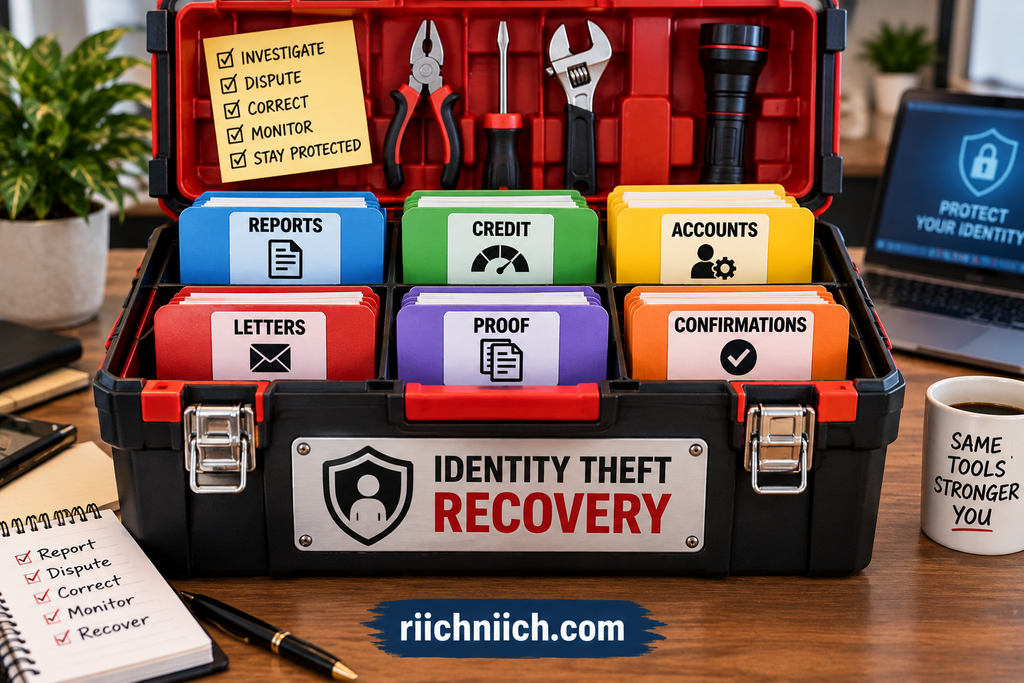
Keep Your FTC Identity Theft Report and Recovery Plan
Your FTC Identity Theft Report should be one of the most important documents in your recovery file.
After reporting identity theft through IdentityTheft.gov, you can receive an Identity Theft Report and personalized recovery plan. The report can help establish to businesses that you’re an identity theft victim and can support certain rights during the recovery process.
Save:
- Your FTC Identity Theft Report
- Your personalized recovery plan
- Any confirmation or reference numbers
- Copies of forms generated through IdentityTheft.gov
- Any updates to your recovery plan
One important detail: IdentityTheft.gov says that if you don’t create an account, you should print and save the Identity Theft Report and recovery plan immediately, because you won’t be able to access or update them after leaving the page.
Keep Your Credit Reports
Save copies of your credit reports showing the fraudulent activity.
Don’t immediately discard the original report after an account has been removed. A before-and-after record can help establish what happened if the fraudulent information reappears.
Keep copies showing:
Fraudulent Account → Fraudulent Inquiry → Incorrect Balance → False Collection → Correction or Removal
You may also want to save a clean credit report after the dispute is resolved.
The CFPB recommends including copies—not originals—of documents supporting a credit-report dispute.
Keep Every Fraudulent Bill, Statement, and Notice
Don’t throw away something simply because you know the account isn’t yours.
That document could become evidence.
Keep copies of relevant:
- Bank statements
- Credit card statements
- Loan documents
- Collection notices
- Medical bills
- Explanation of Benefits statements
- IRS notices
- Fraudulent-account statements
- Transaction histories
- Emails or letters concerning unauthorized activity
IdentityTheft.gov specifically lists bills, IRS notices, and other evidence of the theft as useful documentation when reporting identity theft to police.
If something arrives by mail, consider scanning or photographing it before sending a copy elsewhere.
Keep Copies of Every Dispute Letter You Send
Never send your only copy of an important identity theft document.
Keep the exact version of every letter you send to:
Credit Bureaus → Banks → Lenders → Debt Collectors → Credit Card Companies → Government Agencies → Other Affected Businesses
IdentityTheft.gov provides official sample letters for disputing fraudulent new accounts, unauthorized activity on existing accounts, fraudulent credit-report information, debt collection, and obtaining business records connected with identity theft.
You can find them through the government’s IdentityTheft.gov Sample Letters.
Also keep any supporting documents you included with each letter so you know exactly what the recipient received.
Keep Proof That Your Documents Were Received
Knowing that you sent something and proving that an organization received it are different things.
Depending on how you submitted a dispute or identity theft document, save applicable:
- Certified-mail receipts
- Tracking numbers
- Delivery confirmations
- Online submission confirmations
- Confirmation emails
- Screenshots of successful submissions
- Case numbers
Create a simple record:
Date Sent → Organization → Document → Delivery Method → Confirmation Number → Date Received → Status
This can become especially useful if an organization later says it never received your documentation.
Keep Records of Every Phone Call
Your paper trail shouldn’t be limited to documents.
Every time you speak with a company about the identity theft, record:
Date → Time → Company → Department → Representative → Phone Number → What Was Discussed → Case Number → Next Step
IdentityTheft.gov repeatedly recommends writing down who you contacted and when throughout the identity theft recovery process.
If someone promises that an account will be closed or fraudulent information will be removed, record the conversation—but also ask for written confirmation whenever possible.
A written resolution is much stronger documentation than relying on your memory of a phone conversation months later.
Keep Written Confirmation That Fraud Was Resolved
Don’t discard your recovery records simply because a company tells you the problem has been fixed.
Ask for confirmation showing the resolution.
Depending on the situation, that might include a letter stating:
- A fraudulent account was closed.
- You aren’t responsible for the debt.
- Fraudulent charges were removed.
- Incorrect information was removed from your credit report.
- A collection account was withdrawn.
- Your account information was corrected.
IdentityTheft.gov specifically recommends keeping letters confirming that fraudulent accounts aren’t yours, that you aren’t liable for them, and that the information was removed from your credit report. It notes that these letters may be useful if the fraudulent account appears again.
Keep Police Reports When Applicable
Not every identity theft case requires a police report, but if you file one, keep a complete copy.
IdentityTheft.gov says victims who choose to report identity theft to local police should bring their FTC Identity Theft Report, government-issued photo ID, proof of address, and other evidence of the theft. It also recommends requesting and keeping a copy of the resulting police report.
That report could become useful if another organization requests additional documentation of the crime.
Keep Business Records Related to the Identity Theft
You may also be able to obtain records showing how the identity thief used your information.
For example, if someone opened a fraudulent credit card in your name, relevant business records could include the application or transaction records.
IdentityTheft.gov explains that identity theft victims can request copies of business records related to the theft and provides a sample letter for doing so.
These records can be valuable if you’re dealing with a complicated identity theft recovery process, repeated disputes, or multiple fraudulent accounts.
Should You Keep Paper or Digital Copies?
Ideally, keep your identity theft recovery records organized and securely backed up.
You might maintain:
Physical Folder: Original notices, mailed correspondence, receipts, and important confirmations.
Secure Digital Folder: Scanned documents, screenshots, PDFs, emails, and electronic confirmations.
Organize the folders by category rather than putting everything into one large pile.
For example:
01 — FTC Report
02 — Credit Reports
03 — Fraudulent Accounts
04 — Disputes
05 — Financial Records
06 — Government Records
07 — Correspondence
08 — Resolution Letters
Because these files may contain SSNs, account numbers, addresses, and other sensitive information, don’t leave them somewhere easily accessible. The FTC recommends securely storing documents containing personal and financial information and shredding sensitive documents when they’re no longer needed.
How Long Should You Keep Identity Theft Recovery Documents?
There isn’t one universal retention period that applies to every identity theft document.
Some records may be useful long after the immediate dispute is resolved—especially documents proving that an account was fraudulent or that you weren’t responsible for a debt.
At minimum, don’t rush to destroy:
FTC Identity Theft Reports → Police Reports → Fraud Resolution Letters → Corrected Credit Records → Important Government Correspondence
Other financial and tax records may have their own retention requirements. The FTC, for example, recommends keeping certain financial documents for a year, many tax-related records for at least three years, and certain vital records permanently.
When you eventually dispose of sensitive documents, shred physical copies and securely delete electronic copies you no longer need.
Can Identity Theft Restoration Services Help Organize the Recovery?
This is where buyer intent becomes practical.
You can document and manage an identity theft case yourself, and the FTC provides free recovery plans, sample letters, and other tools.
But a complex case can generate a surprising amount of paperwork.
If you’re comparing paid services while researching how to recover from identity theft, look beyond basic monitoring and ask what happens after you become a victim.
Useful buyer-intent features may include:
- A dedicated identity restoration specialist
- Hands-on recovery assistance
- Help organizing disputes and documentation
- Assistance contacting affected organizations
- Three-bureau credit monitoring
- Broader identity monitoring
- Identity theft insurance
Someone dealing with one fraudulent charge may not need that level of assistance. But if your identity theft recovery plan involves several lenders, all three credit bureaus, financial institutions, government agencies, and repeated disputes, having a dedicated restoration specialist may make the administrative side of recovery easier to manage.
The key is to keep everything until you’re confident the problem is resolved and you no longer need the documentation. Good records can help you prove what happened, show what actions you’ve already taken, challenge fraudulent information, and respond much faster if the same identity theft problem returns later.
Should You Contact the Police After Identity Theft?
Yes, filing a police report can be a useful part of how to recover from identity theft, especially when the theft involves significant financial loss, multiple fraudulent accounts, criminal impersonation, or a company asks you for additional documentation.
However, a police report is not a replacement for reporting identity theft to the FTC. IdentityTheft.gov recommends reporting the theft to the FTC first to create an FTC Identity Theft Report and personalized recovery plan. It also explains that you may choose to file a report with your local police and that the police report may be needed for other recovery steps.
Think of the two reports as serving different purposes:
FTC Identity Theft Report → Helps document the identity theft and guides your recovery
Police Report → Creates a local law-enforcement record of the crime and may provide additional documentation
For a serious or complicated case, having both can strengthen your identity theft recovery records.
When Should You File a Police Report for Identity Theft?
A police report can be particularly useful when:
- You know or suspect who stole your identity.
- Significant money or property was stolen.
- Multiple fraudulent accounts were opened.
- A creditor or business specifically requests a police report.
- You need additional documentation to obtain identity-theft-related business records.
- Someone used your identity during an arrest or other criminal activity.
- The identity theft continues despite your attempts to stop it.
- You need a stronger paper trail documenting the crime.
The CFPB currently advises identity theft victims to report the theft to both local police and IdentityTheft.gov as part of their response.
A police report doesn’t guarantee that officers will identify or arrest the identity thief. Its immediate value during the identity theft recovery process may be the official documentation it creates.
What Should You Bring to the Police?
Don’t walk into the police department with only a verbal explanation if you already have evidence available.
IdentityTheft.gov recommends bringing:
- A copy of your FTC Identity Theft Report
- A government-issued photo ID
- Proof of your address
- Bills, IRS notices, or other evidence of the theft
Tell the police that someone stole your identity and that you want to file an identity theft report. Then ask for a copy of the completed police report for your records.
If possible, organize your evidence before you go.
FTC Report → Fraudulent Accounts → Transactions → Credit Reports → Company Correspondence → Supporting Evidence
That can make it easier to explain exactly what happened.
What Information Should Be Included in the Police Report?
Give law enforcement as much accurate information as you reasonably can.
That could include:
- When you discovered the identity theft
- Fraudulent accounts you found
- Unauthorized transactions
- Companies involved
- Amounts stolen
- Personal information that was compromised
- Suspicious emails, texts, or communications
- Information you have about the suspected identity thief
- Actions you’ve already taken
Don’t guess about information you don’t know.
Before leaving, get the report number and ask how to obtain a complete copy if one isn’t immediately available.
Store the report with your other identity theft recovery documents.
A Police Report Can Help You Obtain Fraudulent Account Records
There is another reason a police report can become valuable: obtaining records from the business where the identity theft occurred.
Under Section 609(e) of the Fair Credit Reporting Act, identity theft victims have rights to obtain certain transaction and application records associated with the theft.
The FTC explains that a victim requesting these records should provide proof of identity, an FTC Identity Theft Report, and a police report. Businesses generally have 30 days after receiving a qualifying written request to provide the records free of charge.
Those records might help establish:
Where the account was opened → Information used on the application → Transactions made → Contact information provided → Other details associated with the fraud
They can help you document that the account wasn’t yours and may also provide information useful to law enforcement.
What If Someone Used Your Identity During a Crime?
This situation deserves special attention.
Criminal identity theft occurs when someone uses another person’s identity in connection with an arrest, citation, investigation, or other criminal matter.
If that happens, correcting your credit report isn’t enough.
IdentityTheft.gov recommends contacting the law-enforcement agency that arrested the identity thief. You may need to provide fingerprints, photographs, and identifying documents so authorities can distinguish you from the impersonator. The FTC also recommends asking the agency to correct its records and provide a clearance letter or certificate of release declaring your innocence.
If the case reached a court, you may also need to work with the court or district attorney to correct court records.
Keep any clearance documentation you receive.
What If the Police Don’t Investigate the Case?
A police report and a police investigation aren’t the same thing.
Your local department may take a report without launching an extensive investigation, particularly if the perpetrator is unknown or the fraud crosses jurisdictions.
That doesn’t necessarily make the report useless.
IdentityTheft.gov specifically tells law-enforcement agencies that local police can assist identity theft victims by taking a police report when requested, and notes that some businesses require one before removing fraudulent debts from an affected account.
Continue your identity theft recovery steps even if an investigation doesn’t immediately move forward.
Don’t wait for police before:
Closing fraudulent accounts → Securing compromised accounts → Freezing your credit → Disputing fraudulent information → Changing compromised passwords → Monitoring for additional fraud
These actions address the ongoing financial and identity risks.
Should You Report Online Identity Theft to the FBI?
Certain internet-enabled fraud can also be reported to the FBI’s Internet Crime Complaint Center (IC3).
The CFPB identifies the FBI, FTC, state attorneys general, and local police as possible places to report scams and fraud.
That doesn’t mean every stolen password or fraudulent credit-card charge requires multiple law-enforcement reports. Follow the reporting steps appropriate to what actually happened and keep copies of any reports you submit.
Watch Out for Criminals Pretending to Be Police
Identity theft victims can be targeted again by recovery scams.
Be suspicious if someone unexpectedly contacts you claiming to be law enforcement and demands money to resolve an identity theft case.
The FTC warns that scammers impersonate police and may threaten arrest unless the victim sends money through cash, gift cards, cryptocurrency, payment apps, or other methods. Real law-enforcement officers won’t demand those payments to prevent an arrest.
If you’re unsure whether a call is legitimate, independently locate the agency’s official contact information rather than calling a number supplied by the caller.
Can Identity Theft Protection Help With Police Reports and Recovery?
This is where buyer intent matters.
You don’t need to purchase identity theft protection to report identity theft to the FTC or police. IdentityTheft.gov provides a free recovery plan, along with pre-filled letters and forms for many recovery situations.
But if your case becomes complicated, a paid identity theft protection service with hands-on restoration assistance may help you organize the recovery process.
When comparing identity theft protection services after becoming a victim, look for features such as:
- Dedicated identity restoration specialists
- Hands-on recovery assistance
- Assistance organizing recovery documentation
- Three-bureau credit monitoring
- Social Security number monitoring
- Dark web monitoring
- Broader identity monitoring
- Identity theft insurance
Pay particular attention to the difference between monitoring and restoration.
Monitoring is designed to alert you to certain signs of potential identity misuse. Restoration services are designed to help you work through problems after identity theft has occurred.
For someone researching how to recover from identity theft after a single unauthorized transaction, extensive restoration assistance may not be necessary. But if you’re juggling police reports, fraudulent loans, credit disputes, stolen personal information, and several affected companies, access to a dedicated restoration specialist may be considerably more useful.
A police report won’t repair identity theft by itself. But it can create an important official record, support certain recovery actions, and provide documentation you may need later. File the appropriate reports, save copies of everything, and continue addressing the financial accounts, credit reports, personal information, and online accounts affected by the theft.
Should You Change Your Social Security Number After Identity Theft?
Usually, no. If your Social Security number has been stolen or exposed, getting a new SSN is generally not the first step in how to recover from identity theft.
The Social Security Administration says it may assign a different number to an identity theft victim only when the person has attempted to fix the problems caused by the misuse but continues to be disadvantaged by using the original number. SSA describes getting a new number as something that may be available in rare cases.
For most victims, the better first response is to secure the identity connected to the existing SSN:
Report the Identity Theft → Freeze Credit → Dispute Fraud → Secure Accounts → Protect Tax Returns → Monitor for New Misuse
Changing the number is generally something to consider only if serious problems continue despite those recovery efforts.
When Might SSA Give You a New Social Security Number?
Identity theft alone doesn’t automatically qualify you for a new number.
According to SSA, an identity theft victim may qualify when they have tried to resolve problems resulting from misuse of the existing SSN but continue to experience problems because of it.
SSA also allows new numbers in certain other circumstances unrelated to identity theft, such as when more than one person is using the same number or in some cases involving harassment, abuse, or life endangerment.
For an identity theft case, that means:
SSN Stolen does not automatically equal New SSN Issued.
You should first document what happened and take appropriate identity theft recovery steps to stop the misuse.
What Should You Do Before Trying to Change Your SSN?
If someone has your Social Security number, concentrate first on limiting what they can do with it.
Your identity theft recovery plan may include:
- Report the identity theft through IdentityTheft.gov.
- Freeze your credit with Equifax, Experian, and TransUnion.
- Dispute fraudulent credit accounts.
- Close accounts opened without your permission.
- Secure compromised financial and online accounts.
- Review your Social Security earnings record.
- Protect your federal tax return with an IRS IP PIN.
- Continue monitoring your credit and identity for additional misuse.
SSA specifically directs people who believe their SSN was stolen to report the identity theft and begin protecting themselves before pursuing a different number.
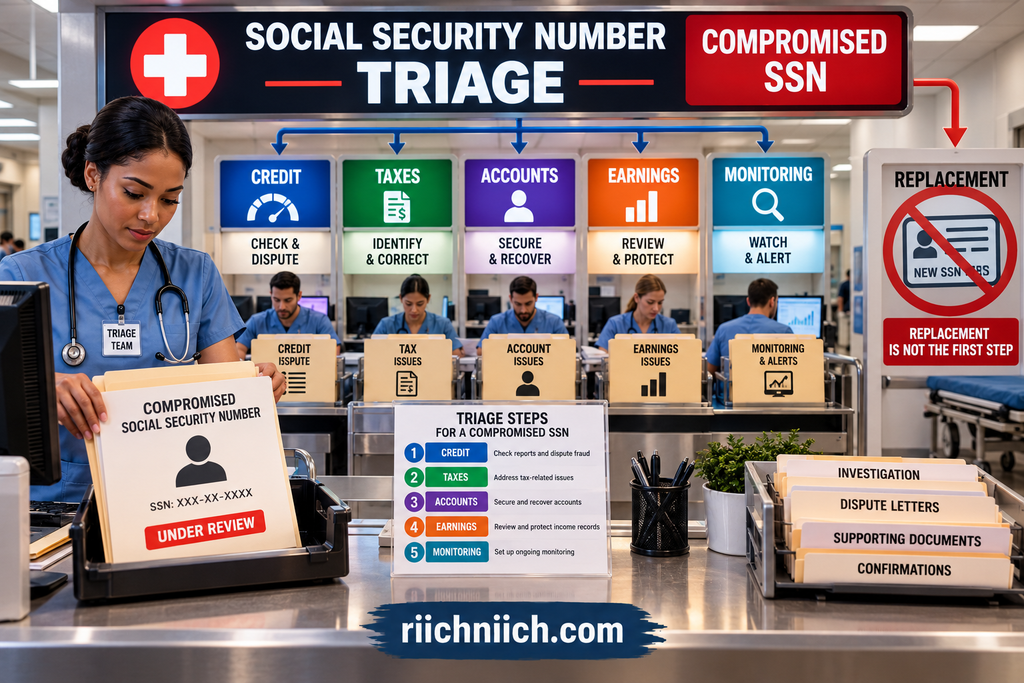
Check Your Social Security Earnings Record
Someone can misuse a stolen SSN for employment, so your credit reports aren’t the only records worth checking.
Review your earnings history through your personal ‘my Social Security‘ account.
SSA says that if earnings appear on your record that don’t belong to you, you may be able to request a correction online. If online correction isn’t available, SSA can work with you through a Social Security office and may request Form SSA-7008 and supporting documentation.
Pay attention to employers or earnings you don’t recognize.
Incorrect earnings should be addressed because changes to your Social Security earnings record can potentially affect benefit calculations and eligibility determinations.
Protect Your Tax Return With an IRS IP PIN
A stolen SSN can also be used for tax identity theft.
One of the strongest targeted protections available is an IRS Identity Protection PIN (IP PIN).
An IP PIN is a six-digit number known to you and the IRS that helps prevent someone else from filing a federal tax return using your SSN. A new IP PIN is generated each year.
Anyone with an SSN or ITIN who can verify their identity can enroll in the program.
This doesn’t change your Social Security number. It adds another identity-verification layer specifically around federal tax filing.
A New Social Security Number Doesn’t Erase Your Old Identity
This is one of the biggest reasons not to think of a new SSN as a complete reset button.
Getting another Social Security number doesn’t automatically erase the consequences of identity theft or make the original number disappear from every historical record.
Your existing financial, government, employment, and credit history still needs to be handled correctly.
In earlier congressional testimony explaining SSA policy, the agency noted that assigning a new SSN can itself create difficulties because a lack of history associated with the new number may complicate things such as obtaining credit, financing a vehicle, or getting a mortgage.
So a new SSN should not be viewed as:
Old Identity Deleted → Fraud Deleted → Fresh Credit History → Problem Solved
Identity theft recovery still requires correcting the damage the thief already caused.
How Do You Request a New Social Security Number?
If you’ve already attempted to resolve the identity theft but continue experiencing problems from misuse of your SSN, you can ask SSA whether your situation qualifies.
SSA currently instructs applicants to schedule an appointment and bring evidence showing that problems continue because of the existing number. You’ll also need documentation proving your:
- Identity
- Age
- U.S. citizenship or immigration status
An SSA representative will review the situation to determine whether you qualify and, if you do, explain the advantages and disadvantages of receiving another number.
Don’t pay a third party claiming it can simply obtain a new SSN for you. Work directly with the Social Security Administration.
Continue Protecting Your Identity Even If You Receive a New SSN
A different number doesn’t eliminate the need for identity security.
The personal information stolen alongside your SSN could include your:
Name → Date of Birth → Address → Email → Phone Number → Driver’s License → Passport → Financial Information
Those pieces of information can still be valuable to an identity thief.
Continue securing your financial accounts, monitoring your credit reports, protecting your online accounts, limiting unnecessary sharing of your SSN, and watching for suspicious activity.
The IRS recommends keeping documents displaying your SSN secure, not routinely carrying your Social Security card, sharing the number only when necessary, protecting financial information, and checking your credit reports regularly.
Can Identity Theft Protection Help After Your SSN Is Stolen?
This is where buyer intent becomes especially important.
A paid identity theft protection service cannot simply replace your Social Security number, and it can’t guarantee that a stolen SSN will never be misused again.
Its potential value is helping you watch for signs that the compromised identity is being used elsewhere and assisting with recovery if new fraud appears.
If your SSN has already been exposed, features worth comparing can include:
- Social Security number monitoring
- Three-bureau credit monitoring
- New-account alerts
- Credit inquiry alerts
- Dark web monitoring
- Financial account monitoring
- Broader identity monitoring
- Dedicated identity restoration specialists
- Hands-on recovery assistance
- Identity theft insurance
For someone researching how to recover from identity theft after an SSN compromise, restoration assistance and broad monitoring may matter more than basic credit-score tracking alone.
If your number was merely exposed but hasn’t been misused, you may decide that free protections—such as credit freezes, regular credit-report reviews, an IRS IP PIN, and account alerts—are sufficient.
But if your SSN has already been used for multiple fraudulent accounts, tax identity theft, employment identity theft, or repeated fraud, a service offering both monitoring and hands-on identity restoration may provide more practical value.
Ultimately, changing your Social Security number is generally a last-resort recovery option rather than the first response to identity theft. For most victims, how to recover from identity theft involving an exposed SSN starts with stopping the existing fraud, protecting credit, securing tax filings, correcting affected records, and monitoring for additional misuse. A new SSN becomes worth discussing directly with SSA when you’ve taken reasonable recovery steps and the misuse of your original number continues to cause serious problems.
What Should You Do If Identity Theft Keeps Happening?
If identity theft keeps happening after you’ve already disputed fraudulent accounts or secured compromised information, don’t just repeat the same recovery steps. Repeated identity theft can indicate that the criminal still has access to something valuable—such as your Social Security number, email account, financial information, login credentials, or another source of personal information.
At this stage, how to recover from identity theft becomes less about fixing individual incidents and more about identifying the remaining path the thief is using to come back.
Start by asking:
What keeps getting targeted? → What information would be needed? → Where could the criminal still have access? → What protection haven’t I added yet?
The CFPB recommends closing affected accounts, reporting identity theft through IdentityTheft.gov, protecting your credit with fraud alerts or security freezes, and addressing fraudulent credit information.
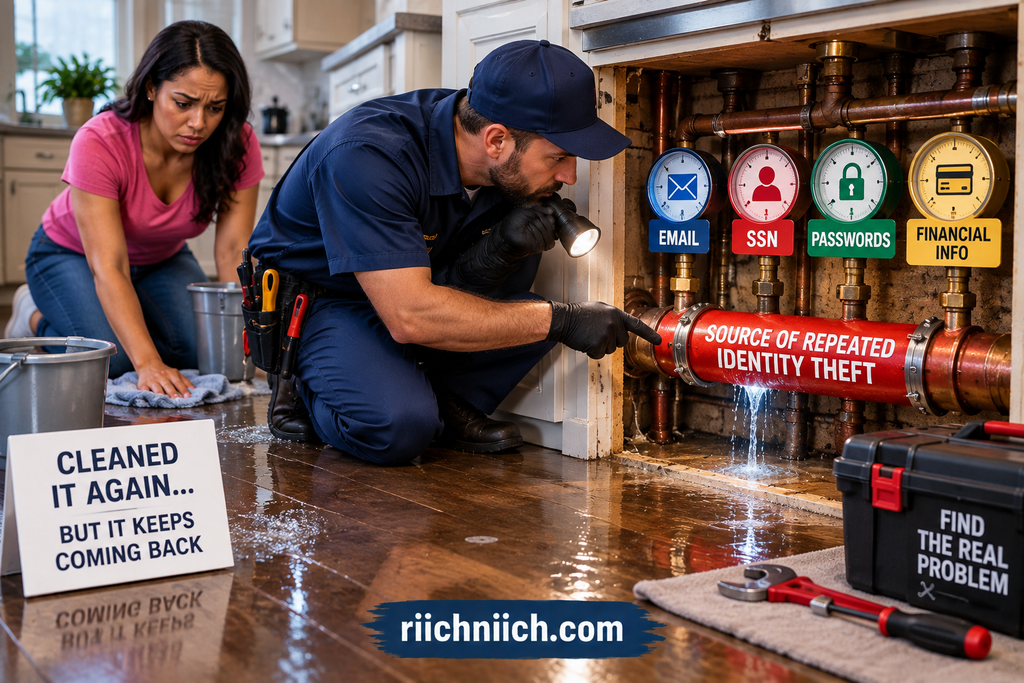
Look for the Pattern Behind the Repeated Fraud
Write down every identity theft incident you’ve experienced.
Then compare them.
For example:
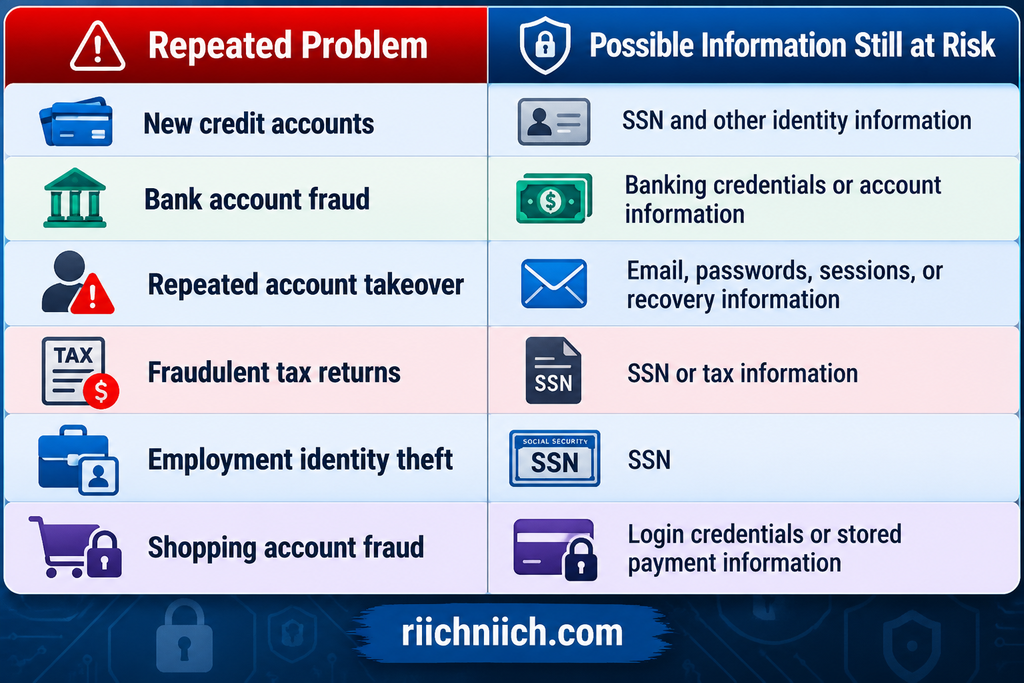
Don’t assume every new incident came from the same original breach.
Your information could have been exposed through multiple sources over time. The goal is to determine whether you’re dealing with one unresolved compromise or several different vulnerabilities.
Keep Your Credit Frozen
If someone repeatedly tries to open credit accounts in your name, consider keeping your credit frozen instead of temporarily relying on monitoring alone.
A credit freeze restricts prospective creditors from accessing your credit file and can help prevent criminals from opening certain new accounts. Federal law allows you to freeze and unfreeze your credit for free. You must freeze your files separately with Equifax, Experian, and TransUnion.
Remember that a credit freeze doesn’t stop every type of identity theft.
It generally won’t prevent someone from:
- Taking over an existing account
- Making fraudulent transactions on an existing account
- Filing a fraudulent tax return
- Misusing your SSN for employment
- Attempting certain non-credit forms of identity fraud
Think of a credit freeze as one layer—not the entire identity theft recovery plan.
Secure Your Email From the Ground Up
If different online accounts keep getting compromised, investigate your primary email account.
Your email can act as the recovery hub for:
Banking → Shopping → Social Media → Cloud Storage → Payment Apps → Other Online Accounts
Change the email password to a strong, unique password that isn’t used anywhere else.
Then review:
- Logged-in devices
- Active sessions
- Recovery email addresses
- Recovery phone numbers
- Email forwarding rules
- Filters
- Connected applications
- App passwords
- MFA methods
Remove anything you don’t recognize and sign out unfamiliar sessions.
If you reused your compromised password elsewhere, change those passwords too.
This is one situation where a password manager can become useful because it makes maintaining unique passwords across many accounts considerably easier.
Protect Your Social Security Number From Different Types of Misuse
If repeated identity theft involves your Social Security number, don’t focus exclusively on your credit reports.
An SSN can potentially be misused for purposes involving credit, employment, taxes, or other identity fraud.
SSA recommends checking the earnings posted to your Social Security record if you suspect someone is using your SSN. If you find earnings that aren’t yours, SSA currently allows some people to request an earnings correction online; otherwise, the issue can be handled through a Social Security office.
Use your personal ‘my Social Security’ account to review your earnings history.
If you discover an employer or earnings you don’t recognize, address the problem rather than assuming that fixing your credit reports also fixed the SSN misuse.
Protect Your Tax Return With an IP PIN
If your SSN has been compromised, consider adding an IRS Identity Protection PIN.
An IP PIN is a six-digit number known to you and the IRS that helps prevent someone else from filing a federal tax return using your SSN or ITIN. Anyone with an SSN or ITIN who can verify their identity is eligible to enroll, and the IRS generates a new IP PIN each year.
This protection is particularly relevant if you’re worried that repeated identity theft could spread into tax identity theft.
Recheck Previously Corrected Fraud
Repeated identity theft doesn’t always mean the criminal created something completely new.
Sometimes an old problem can reappear.
Review your credit reports and compare them with the documentation you kept from previous disputes.
Look for:
Previously Removed Account Reappeared → Old Collection Returned → New Balance Reported → New Inquiry Appeared → Another Fraudulent Account Opened
If identity-theft-related information appears on your credit report, the CFPB says you can request a block by providing an identity theft report, proof of identity, and a letter identifying the fraudulent information. Qualifying fraudulent information generally must be blocked within four business days after the credit reporting company receives the required request.
This is why keeping old resolution letters and corrected credit reports matters.
Update Your Identity Theft Recovery Plan
If new fraud appears, update your report through IdentityTheft.gov rather than treating every incident as an unrelated problem.
Document:
What Happened → When It Happened → Account Involved → Information Used → Company Contacted → Action Taken → Resolution
Also keep:
- New fraudulent statements
- Credit reports
- Company correspondence
- Dispute confirmations
- FTC documentation
- Police reports, if applicable
- Screenshots
- Case numbers
- Resolution letters
A clear timeline can make patterns easier to identify and make future disputes easier to document.
Be Careful of Identity Theft Recovery Scams
Repeated identity theft can make people more willing to pay anyone promising to make the problem disappear.
That’s exactly when you should be cautious.
Don’t give sensitive information to someone who unexpectedly contacts you claiming they need your SSN, banking information, passwords, or payment to “protect” your identity.
SSA’s Office of Inspector General recently warned that scammers may claim they need someone’s SSN to check for fraudulent employment, addresses, or benefits activity. SSA advises people not to provide personal information to unexpected contacts and to check their records directly through official channels.
Go directly to the organization’s official website instead of using links or phone numbers supplied in an unexpected message.
When Does Paid Identity Theft Protection Become More Valuable?
This is where buyer intent changes significantly.
Someone who experienced one fraudulent transaction that was quickly resolved may be comfortable monitoring their identity without paying for a service.
Repeated identity theft is different.
If you’re repeatedly dealing with:
New Accounts → Account Takeovers → SSN Misuse → Credit Changes → Dark Web Exposure → New Fraud
you may want a system that watches several areas instead of manually checking everything yourself.
When comparing identity theft protection services, consider features such as:
- Three-bureau credit monitoring
- New-account alerts
- Credit inquiry alerts
- Social Security number monitoring
- Dark web monitoring
- Financial account monitoring
- Compromised-credential monitoring
- Broader identity monitoring
- Dedicated identity restoration specialists
- Hands-on recovery assistance
- Identity theft insurance
But understand what you’re purchasing.
Monitoring can help detect certain warning signs. It cannot guarantee that identity theft will never happen again.
For someone researching how to recover from identity theft after repeated incidents, the more valuable feature may actually be hands-on identity restoration rather than monitoring alone.
A dedicated restoration specialist may help organize disputes, communicate with affected organizations, work through recovery steps, and keep a complicated case moving.
Build a Stronger System Instead of Fixing One Problem at a Time
When identity theft keeps returning, think in layers.
Credit: Keep all three credit files frozen when you aren’t applying for credit.
Financial Accounts: Use transaction alerts and regularly review activity.
Email: Use a unique password and strong MFA.
Passwords: Stop reusing passwords across accounts.
Taxes: Consider an IRS IP PIN.
Social Security: Review your earnings record for unfamiliar activity.
Online Accounts: Review devices, recovery methods, and connected applications.
Identity Monitoring: Watch for new signs that your personal information is being used.
The IRS likewise recommends protecting all personally identifiable information—not only the SSN—including financial accounts, email addresses, driver’s license numbers, and passport numbers.
Repeated identity theft doesn’t necessarily mean every previous recovery step failed. It may mean the thief still possesses information that remains useful or another vulnerability hasn’t been secured.
The long-term goal of how to recover from identity theft is therefore not just to clean up each fraudulent account as it appears. It’s to identify where the repeated fraud is coming from, close as many remaining access points as possible, strengthen protection around information that can’t easily be changed, and detect new misuse quickly.
If identity theft continues across multiple areas despite those protections, that’s also when a comprehensive identity theft protection service with broad monitoring and dedicated restoration assistance may provide considerably more value than a basic credit-monitoring service alone.
Can Identity Theft Protection Help You Recover?
Yes, identity theft protection can help with recovery, but the amount of help depends heavily on the service and plan you choose.
When researching how to recover from identity theft, it’s important to distinguish between identity monitoring and identity restoration. Monitoring primarily looks for warning signs of identity misuse. Restoration services are designed to help you deal with the damage after identity theft has already happened.
👉 If you want broader monitoring plus hands-on recovery support in one service, see what Aura includes for identity theft protection and restoration.
The CFPB notes that some identity theft services may help consumers correct problems after identity theft occurs, while services and coverage can vary significantly.
That means the most useful service for an identity theft victim isn’t necessarily the one offering the largest number of alerts. Hands-on restoration assistance may matter considerably more once you’re already dealing with fraud.

What Can Identity Theft Protection Do After Identity Theft?
Depending on the provider and plan, an identity theft protection service may combine several tools:
Monitoring → Alerts → Recovery Assistance → Restoration → Insurance
The FTC separates these services into four general categories: credit monitoring, identity monitoring, identity recovery services, and identity theft insurance.
For someone already dealing with identity theft, the recovery-related features deserve especially close attention.
A comprehensive service may provide:
- A dedicated identity restoration specialist
- Assistance organizing your recovery steps
- Help contacting affected companies
- Guidance disputing fraudulent accounts
- Credit monitoring
- Social Security number monitoring
- Dark web monitoring
- Alerts about certain suspicious activity
- Identity theft insurance
- Ongoing monitoring after recovery
Exactly what’s included depends on the service and subscription level, so check the plan details rather than assuming every advertised identity protection feature includes hands-on restoration.
What Does an Identity Restoration Specialist Do?
A restoration specialist can act as a central point of contact while you’re trying to fix identity theft.
Instead of figuring out every recovery step alone, you may receive guidance on which organizations need to be contacted, what documentation may be required, and what should happen next.
Depending on the service, assistance could involve situations such as:
Fraudulent Account → Credit Dispute → Stolen SSN → Account Takeover → Collection Notice → Continued Monitoring
This can become valuable when your identity theft recovery process involves several organizations simultaneously.
However, don’t assume that “restoration” means the company will handle absolutely everything for you.
Ask specifically:
- Will I receive a dedicated restoration specialist?
- Does the specialist work directly with creditors or only advise me?
- Is restoration available for pre-existing identity theft?
- Is there a limit on restoration assistance?
- Does restoration cover tax, medical, criminal, and financial identity theft?
- Will the service help with account takeover?
- Is restoration included in my plan or an additional service?
Those questions can reveal more about the practical value of a service than a long list of monitoring features.
Identity Monitoring and Identity Restoration Are Not the Same
This distinction is critical when comparing identity theft protection services.
Monitoring watches for certain changes or suspicious activity.
Restoration helps you respond after a problem has been discovered.
For example, credit monitoring may alert you when a new credit account appears on your credit report. But an alert by itself doesn’t close the fraudulent account, dispute the debt, correct your credit report, or complete your other identity theft recovery steps.
The CFPB specifically warns that most monitoring services don’t prevent personal information from being stolen; they generally alert consumers after certain activity has occurred.
So if you’ve already become an identity theft victim, don’t evaluate a service solely by asking:
“How much does it monitor?”
Also ask:
“What happens after the service finds something?”
Can Identity Theft Protection Fix Your Credit?
Identity theft protection can potentially assist you with the recovery process, but it doesn’t have special authority to erase information from your credit reports.
If fraudulent information appears on your credit report, you already have federal rights to challenge it.
The CFPB says identity theft victims can request that credit reporting companies block fraudulent information by submitting an Identity Theft Report, proof of identity, and a letter identifying the fraudulent debts or information.
A restoration service may help you navigate that process, but your underlying consumer rights don’t depend on purchasing a subscription.
This is an important consideration when deciding whether identity theft protection is worth paying for.
You’re primarily paying for things such as convenience, monitoring, alerts, organization, professional recovery assistance, and potentially insurance—not the legal right to dispute fraud.
Can Identity Theft Protection Stop Identity Theft From Happening Again?
No identity theft protection service can guarantee that you’ll never experience identity theft again.
Monitoring can help detect certain warning signs, but it doesn’t make your personal information impossible to steal.
The CFPB specifically cautions that consumers sometimes believe identity protection or credit monitoring services prevent identity theft before it occurs, when monitoring generally works by alerting consumers to certain activity after it happens.
That’s why identity protection should complement—not replace—basic security measures such as:
Credit Freezes + Unique Passwords + MFA + Transaction Alerts + Secure Email + Regular Account Reviews
A credit freeze can be particularly valuable because it restricts prospective creditors from accessing your credit file and can help stop certain fraudulent new-credit accounts. Freezes are available at no cost under federal law.
What About Identity Theft Insurance?
Many identity theft protection plans advertise identity theft insurance, but don’t confuse insurance with reimbursement for every dollar stolen.
Coverage varies by policy.
The FTC explains that identity theft insurance may cover certain costs associated with recovery, such as expenses involved in reclaiming your identity and repairing credit reports. Some policies may cover costs such as lost wages, legal fees, or other expenses, while others may offer different coverage.
Before buying a plan, check:
- Coverage limits
- Deductibles
- Exclusions
- Reimbursement requirements
- Lost-wage coverage
- Legal-expense coverage
- Stolen-funds coverage, if offered
- Whether expenses require prior approval
Don’t judge two identity protection plans solely because both advertise “$1 million identity theft insurance.” The underlying coverage, limits, exclusions, and eligible expenses can differ.
You Can Recover From Identity Theft Without Paying for a Service
This is equally important.
You do not have to purchase identity theft protection to recover from identity theft.
The federal government’s IdentityTheft.gov provides victims with a free Identity Theft Report and personalized recovery plan. If you create an account, the service can walk you through recovery steps, update your plan, track progress, and pre-fill certain forms and letters.
Free protections are also available for your credit.
For example, you can freeze your credit with all three nationwide credit reporting companies for free.
So the real buyer-intent question isn’t:
“Do I have to pay to recover?”
You don’t.
The better question is:
“Would professional restoration assistance and ongoing monitoring make my recovery easier?”
When Could Identity Theft Protection Be More Valuable?
The value of paid protection tends to depend on the complexity of your situation and how much of the recovery work you’re comfortable handling yourself.
Consider two situations.
Situation 1: One fraudulent credit card charge
You contact the card issuer, replace the card, change your credentials, monitor the account, and resolve the problem quickly.
You may feel comfortable handling that recovery yourself.
Situation 2: Multiple forms of identity theft
Someone has opened credit accounts, compromised your email, used your SSN, created collections, and attempted additional fraud.
Now your identity theft recovery checklist could involve:
FTC → Credit Bureaus → Banks → Lenders → Debt Collectors → Government Agencies → Online Accounts
A dedicated restoration specialist may be considerably more useful in the second situation.
What Should You Look for in Identity Theft Protection After Becoming a Victim?
If you’re shopping for identity theft protection specifically because you’ve already experienced identity theft, prioritize recovery capabilities, not flashy extras.
Look closely for:
- Dedicated identity restoration specialists
- Hands-on restoration assistance
- Three-bureau credit monitoring
- New-account and credit inquiry alerts
- Social Security number monitoring
- Dark web monitoring
- Financial account monitoring
- Compromised-credential monitoring
- Identity theft insurance
- Family coverage, if needed
Also check whether the service will help with identity theft that occurred before you subscribed. Coverage and restoration rules can vary, so read the terms before purchasing.
The CFPB recommends understanding exactly what an identity monitoring service includes before signing up because prices and services vary.
Is Identity Theft Protection Worth Considering During Recovery?
For someone researching how to recover from identity theft, paid identity theft protection makes the most sense when the service solves a problem you actually have.
If you’re comfortable handling disputes, freezing your credit, monitoring your reports, contacting affected companies, and following your free IdentityTheft.gov recovery plan, you may decide that you don’t need a paid service.
But if you’re dealing with multiple fraudulent accounts, damaged credit, SSN misuse, repeated identity theft, account takeovers, or a complicated recovery involving several organizations, hands-on identity restoration can become much more valuable.
The key is not simply buying the service with the longest feature list.
Look for a service that combines:
Broad Monitoring + Useful Alerts + Strong Restoration Assistance + Appropriate Insurance
Ultimately, identity theft protection cannot undo identity theft automatically. But the right service can provide monitoring, organization, professional recovery assistance, and financial protection that may make how to recover from identity theft easier to manage—particularly when the damage extends beyond a single fraudulent account.
What Do Identity Theft Restoration Services Actually Do?
Identity theft restoration services help victims repair the damage after identity theft has already occurred. Instead of only watching for suspicious activity, restoration focuses on helping you work through the actual identity theft recovery process.
This distinction matters when researching how to recover from identity theft.
Identity Monitoring = Looks for warning signs
Identity Restoration = Helps you respond to and resolve the damage
According to the FTC, identity recovery services typically provide access to counselors or case managers who help victims restore their identity. Depending on the service, they may help prepare letters to creditors and debt collectors, assist with credit freezes, guide you through recovery documents, or—in some cases—deal with organizations on your behalf after you formally authorize them.

You May Get a Dedicated Restoration Specialist
One of the most useful features to look for is access to an identity restoration specialist, counselor, or case manager.
Instead of figuring out every recovery step yourself, this person may help you determine:
What Was Compromised → Who Needs to Be Contacted → What Documents Are Needed → What Needs to Be Disputed → What Needs Follow-Up
The FTC confirms that recovery services commonly provide counselors or case managers to help victims through the process.
This can become especially valuable when you’re dealing with several forms of fraud at the same time.
For example, your recovery could involve:
- A fraudulent credit card
- An unauthorized bank transaction
- A collection account
- A compromised Social Security number
- A damaged credit report
- An account takeover
Instead of treating each incident as a completely separate problem, a restoration specialist may help organize them into one identity theft recovery plan.
👉 If having professional guidance during a complicated recovery is important to you, check Identity Guard’s identity protection and recovery options.
Restoration Services May Help With Credit Disputes
Credit problems can become one of the most time-consuming parts of recovery.
If identity theft creates fraudulent accounts or other inaccurate information on your credit reports, you may need to contact the affected companies and credit bureaus.
An identity restoration service may help you identify the necessary documents, prepare dispute correspondence, track responses, and follow up on unresolved problems.
But remember: you already have federal rights to dispute identity-theft-related information yourself.
IdentityTheft.gov provides free sample letters for fraudulent new accounts, unauthorized activity on existing accounts, fraudulent credit-report information, debt collection problems, and requests for business records related to identity theft.
You’re therefore paying a restoration service primarily for assistance, organization, expertise, and convenience—not for rights you couldn’t exercise yourself.
They May Help Contact Creditors and Other Companies
Identity theft recovery can involve a lot of phone calls, letters, documentation, and follow-up.
Depending on the provider and plan, a restoration specialist may help you communicate with:
Banks → Credit Card Issuers → Lenders → Credit Bureaus → Debt Collectors → Other Affected Organizations
Some services provide guidance while you make the contacts.
Others may take a more hands-on approach.
The FTC says some identity recovery services will deal with creditors or other institutions for victims when the victim formally gives the service authority to act on their behalf.
That’s an important feature to investigate before purchasing a service.
Ask:
“Will you tell me what to do, or will your restoration specialist actually help do it?”
The difference can be significant.
They May Help Organize Your Recovery Documents
Identity theft can generate a large amount of paperwork.
You may be dealing with:
- FTC Identity Theft Reports
- Credit reports
- Fraudulent statements
- Dispute letters
- Collection notices
- Bank records
- Police reports
- Government correspondence
- Confirmation letters
- Case numbers
A restoration specialist may help you determine which documents are relevant to each recovery step and what needs to be retained.
IdentityTheft.gov itself emphasizes keeping records throughout recovery, including who you contacted, when you contacted them, letters you sent, and written confirmations showing that fraudulent accounts or charges were resolved.
For someone dealing with extensive identity theft, simply having a structured process for managing the paperwork can be valuable.
They May Help With Fraudulent Accounts and Charges
Suppose someone opened a credit card using your identity.
The identity theft restoration process could involve:
Identify Account → Contact Fraud Department → Document Identity Theft → Close Account → Dispute Debt → Correct Credit Report → Obtain Written Confirmation
IdentityTheft.gov provides specific procedures and sample letters for disputing fraudulent new accounts and unauthorized activity on existing accounts.
A restoration service may help guide you through those steps and track what remains unresolved.
The service doesn’t magically erase the fraudulent account. The bank, lender, credit bureau, or other organization still has its own investigation and correction procedures.
They May Help With Debt Collectors
Identity theft sometimes isn’t discovered until a collection notice arrives.
If someone opened an account in your name and never paid it, the debt could eventually be sent to collections.
A restoration specialist may help you determine how to respond, what supporting documents are needed, and which organizations need to receive the dispute.
IdentityTheft.gov provides a specific sample letter for stopping debt collectors from attempting to collect debts resulting from identity theft. It also provides procedures for contacting the original business and requesting information about how the fraudulent debt was created.
Again, these rights are available without purchasing identity theft protection.
The potential value of restoration is having someone help you navigate and organize the process.
They May Help You Protect Your Credit During Recovery
Restoration shouldn’t focus exclusively on fixing yesterday’s fraud.
You also want to make it harder for someone to create additional damage while you’re recovering.
The FTC specifically identifies help placing a credit freeze as one service an identity recovery provider may offer.
A restoration specialist might therefore help you understand how to:
Freeze Credit → Review Reports → Identify Fraud → Dispute Information → Monitor for New Activity
However, you don’t need a paid company to freeze your credit.
Credit freezes can be placed directly with Equifax, Experian, and TransUnion.
That makes assistance with a freeze a convenience feature—not a reason by itself to purchase an identity theft protection service.
Restoration Doesn’t Mean Every Problem Is Handled for You
This is where buyers need to read the details carefully.
The word “restoration” can sound as though you hand the company your identity theft case and everything gets fixed automatically.
That’s not necessarily how it works.
Some services may primarily provide instructions and guidance. Others may offer more hands-on assistance, including contacting organizations after receiving authorization from you.
Before purchasing, ask:
- Do I get a dedicated restoration specialist?
- Is restoration available 24/7?
- Does the specialist contact companies for me?
- Will you help prepare dispute letters?
- Do you help with all three credit bureaus?
- Is restoration available for identity theft that occurred before I subscribed?
- Do you help with tax identity theft?
- Do you help with medical identity theft?
- Do you help with account takeover?
- Do you help with Social Security number misuse?
- Is there a limit on restoration assistance?
The answers can tell you much more about the service than the number of monitoring alerts advertised.
What Identity Theft Restoration Services Cannot Do
Even a strong restoration service has limitations.
It generally cannot:
- Guarantee that identity theft won’t happen again
- Instantly erase fraudulent information
- Force every company to resolve a dispute immediately
- Prevent every possible use of a stolen SSN
- Replace law enforcement or government agencies
- Guarantee recovery of stolen money
- Replace good password and account security
- Make compromised personal information disappear from the internet
Restoration should therefore be viewed as professional recovery assistance, not an automatic identity reset.
The CFPB similarly notes that identity monitoring services vary widely and that some services may help consumers correct problems after identity theft occurs. Consumers should understand exactly what they’re receiving before subscribing.
Is Identity Theft Insurance Part of Restoration?
Sometimes—but they’re not the same thing.
Restoration assistance helps you work through the recovery.
Identity theft insurance may reimburse certain eligible expenses associated with recovery.
The FTC says identity theft insurance may cover certain out-of-pocket recovery expenses such as copying documents, postage, notarization, lost wages, and legal fees, depending on the policy. It also cautions that identity theft insurance generally doesn’t reimburse money stolen by scammers, and coverage can have other limitations.
Always check:
Coverage Limit → Deductible → Covered Expenses → Exclusions → Reimbursement Requirements
Don’t assume that a large advertised insurance amount means every financial loss caused by identity theft will be reimbursed.
Can You Get Identity Restoration Help for Free?
Yes—at least for many important recovery tasks.
IdentityTheft.gov is the federal government’s free identity theft recovery resource. After reporting identity theft, it can create an Identity Theft Report and personalized recovery plan. If you create an account, the system can guide you through recovery steps, track your progress, update your plan, and pre-fill certain forms and letters.
That means paid restoration isn’t required for how to recover from identity theft.
The decision comes down to how complicated your case is and how much assistance you want.
When Are Identity Theft Restoration Services Most Valuable?
Consider the difference between these two situations.
Simple case: One fraudulent credit card charge appears. You report it immediately, replace the card, secure the account, and the issuer resolves the charge.
You may have little need for extensive restoration assistance.
Complex case: Someone opened several accounts, damaged your credit, compromised your SSN, took over your email, created collection debts, and continues attempting additional fraud.
Now you’re potentially coordinating with:
FTC → Credit Bureaus → Banks → Lenders → Debt Collectors → Government Agencies → Online Accounts
That’s where a dedicated restoration specialist may provide considerably more practical value.
For someone researching how to recover from identity theft, the strongest identity theft restoration services aren’t simply monitoring your information and sending alerts. Their real value comes after something goes wrong—helping organize the recovery, navigate disputes, communicate with affected organizations, understand required documentation, and continue working through unresolved problems.
That’s why, when comparing identity theft protection services, don’t stop at “What does this service monitor?”
Ask the more important recovery question:
“If my identity is stolen tomorrow, exactly what will this company do to help me fix it?”
What Should You Look for in an Identity Theft Protection Service?
When you’re comparing identity theft protection services, don’t choose based on the longest feature list or the biggest insurance number. Focus on what the service monitors, how quickly it alerts you, and what help you receive if identity theft actually happens.
That becomes especially important when researching how to recover from identity theft. A service that sends alerts may help you detect suspicious activity, but a service with strong identity theft restoration services may be much more useful once you’re already dealing with fraud.
The FTC separates identity protection into several categories, including credit monitoring, identity monitoring, identity recovery services, and identity theft insurance. These features do different jobs, so a strong service should provide the combination that matches the risks you’re trying to cover.

Look for Three-Bureau Credit Monitoring
If credit protection is important to you, check whether the service monitors all three nationwide credit bureaus—Equifax, Experian, and TransUnion.
Don’t assume it does.
The FTC notes that credit monitoring services may monitor one, two, or all three bureaus. Depending on the service, alerts may include new accounts, credit inquiries, late-payment reporting, credit-limit changes, or changes to personal information appearing on your reports.
When comparing plans, ask:
- Does it monitor all three credit bureaus?
- How frequently does monitoring occur?
- Will I receive new-account alerts?
- Will I receive hard-inquiry alerts?
- How quickly are alerts delivered?
- Can I easily see which bureau reported the activity?
For someone recovering from credit identity theft, three-bureau monitoring may provide broader visibility than monitoring only one credit file.
But remember that credit monitoring doesn’t prevent identity theft. The CFPB specifically cautions that monitoring generally alerts you to certain activity rather than stopping your information from being stolen.
Look Beyond Credit Monitoring
Identity theft can happen without immediately appearing on your credit report.
Someone might misuse your:
Social Security Number → Email → Phone Number → Bank Information → Online Accounts → Other Personal Information
That’s why broader identity monitoring can matter.
The FTC says identity monitoring services may search various databases for new or inaccurate information involving your identity, including certain public records, address changes, utility or wireless-service applications, payday-loan activity, social media, and websites where stolen information is traded.
No service monitors everything, however.
The FTC also notes that many identity monitoring services won’t alert consumers to certain types of tax, Medicare, Medicaid, Social Security, unemployment, or other benefits fraud.
Read the actual coverage details rather than assuming “identity monitoring” means every possible type of identity theft.
Look for Strong Identity Restoration Services
If you’re buying protection because you’ve already experienced identity theft—or you’re concerned about the difficulty of recovering from it—restoration should be one of your highest-priority features.
Ask whether the plan includes a dedicated restoration specialist or case manager.
The FTC says identity recovery services may provide counselors or case managers who help victims write letters to creditors and debt collectors, place credit freezes, review necessary documents, and work through other recovery tasks. Some services may even communicate with creditors or institutions on your behalf if you formally authorize them.
Before purchasing, find out:
- Do I receive a dedicated restoration specialist?
- Is restoration included or an extra charge?
- Will the specialist actually contact companies for me?
- Will they help with credit disputes?
- Do they help with fraudulent accounts and collections?
- Do they assist with account takeover?
- Do they help with SSN, tax, or medical identity theft?
- Is restoration available for identity theft that happened before I subscribed?
For someone focused on how to recover from identity theft, these answers can matter more than receiving another credit score dashboard.
Look for Fast, Useful Alerts
An alert isn’t particularly helpful if you don’t understand what happened or what to do next.
Look for alerts that clearly explain:
What Changed → Where It Happened → Why It Matters → What You Should Do
Also check how alerts are delivered.
Email alone may be sufficient for some people. Others may prefer text, mobile-app push notifications, or multiple notification methods.
The goal is to discover suspicious activity early enough that you can investigate it before the damage spreads.
The CFPB recommends watching financial statements and credit reports for warning signs such as unfamiliar withdrawals, accounts you didn’t open, and inquiries from companies you never contacted.
👉 If keeping a closer watch on your credit is a priority after identity theft, explore IdentityIQ’s credit monitoring and identity protection options.
Look for Social Security Number and Dark Web Monitoring
If your Social Security number has already been exposed, SSN monitoring may be especially relevant.
Also check whether the service includes dark web or compromised-information monitoring.
If you’re unsure what this feature actually watches for, learn how dark web monitoring works and what it can—and cannot—tell you about exposed information.
These tools may alert you when certain personal information is discovered in monitored sources associated with stolen data.
But understand the limitation:
Finding your information doesn’t remove it from criminals’ possession.
An alert gives you information you can act on.
For example, discovering compromised login credentials could prompt you to change passwords, secure affected accounts, review active sessions, and strengthen MFA.
If an SSN has been exposed, you might respond by reviewing your credit reports, freezing your credit, securing tax filings, and watching for other forms of identity misuse.
Look for Financial Account Monitoring
Credit monitoring and financial account monitoring aren’t the same thing.
The FTC specifically notes that credit monitoring won’t alert you when someone simply withdraws money from your bank account.
If financial fraud is one of your biggest concerns, check whether the service offers monitoring or alerts involving:
- Bank accounts
- Credit cards
- Investment accounts
- Large transactions
- Unusual financial activity
Also use the alerts provided directly by your financial institutions.
Your bank or credit card issuer may already allow you to receive notifications for purchases, withdrawals, transfers, declined transactions, or changes to your account.
Identity theft protection should add another layer to your security, not replace the protections your existing accounts already provide.
Look Closely at Identity Theft Insurance
A large insurance figure can make a plan look impressive, but read what the policy actually covers.
Identity theft insurance isn’t automatically the same as stolen-funds reimbursement.
According to the FTC, identity theft insurance may cover certain expenses associated with reclaiming your identity, such as document-copying costs, postage, notarization, lost wages, and legal fees. The FTC also notes that identity theft insurance generally doesn’t reimburse money stolen by scammers, and policies may have other limitations.
Before purchasing, check:
Coverage Limit → Deductible → Covered Expenses → Exclusions → Lost Wages → Legal Expenses → Stolen-Funds Coverage
Don’t compare plans based solely on an advertised dollar amount.
Check Whether Family Protection Is Included
If you’re protecting more than yourself, look carefully at family coverage.
A family plan may be more practical than purchasing several individual subscriptions—but only if the protection actually covers the people you need.
Check:
- Number of adults covered
- Number of children covered
- Child identity monitoring
- Restoration assistance for family members
- Insurance coverage per person versus per plan
- Whether adult children or elderly parents can be included
Don’t assume “family plan” means unlimited household coverage.
Compare the actual terms.
Look for Easy Credit Freeze Management—but Know What Is Free
Some identity protection services make it easier to manage credit security features.
Convenience can be useful, but don’t pay for a plan solely because it advertises something you already have the legal right to do for free.
For example, security freezes are available free directly from the three nationwide credit reporting companies. The CFPB says a security freeze prevents prospective creditors from accessing your credit file and can help prevent an identity thief from opening certain new credit accounts in your name.
A paid service may make managing parts of your protection more convenient, but that convenience should be evaluated alongside its other features.
Check the Service’s Limitations
Before subscribing, read the limitations just as carefully as the benefits.
No legitimate identity theft protection service should make you believe it can:
- Guarantee identity theft will never happen
- Prevent every fraudulent transaction
- Detect every form of identity theft
- Remove all of your personal information from the internet
- Guarantee recovery of every stolen dollar
- Instantly repair your credit
- Replace strong passwords, MFA, or credit freezes
The CFPB specifically notes that prices and services vary widely and recommends understanding exactly what you’re getting before subscribing—including trial periods, fees, cancellation requirements, and other conditions.
Check the Price Against What You Already Get for Free
Before paying, check whether you already receive identity or credit monitoring through:
- Your bank
- Credit card issuer
- Employer
- Insurance company
- A previous data breach settlement or notification
The FTC notes that consumers may receive monitoring or recovery services through banks, credit unions, credit card providers, employers, or insurance companies.
You can also review your credit reports yourself and place credit freezes for free.
And if identity theft actually occurs, IdentityTheft.gov provides a free personalized recovery plan, Identity Theft Report, and tools to help victims work through the recovery process.
The question isn’t simply whether a paid service offers useful features.
It’s whether it provides enough additional monitoring, convenience, and restoration assistance to justify the price for you.
Prioritize Recovery Help If You’ve Already Been a Victim
Someone who has never experienced identity theft may primarily want early detection.
Someone who has already experienced it may have different priorities.
If you’re researching how to recover from identity theft, I would pay especially close attention to:
Three-Bureau Credit Monitoring + Broad Identity Monitoring + Fast Alerts + Dedicated Restoration Assistance + Appropriate Insurance
Why?
Because another alert alone doesn’t solve the problem.
You want to know what happens after the alert.
The FTC confirms that IdentityTheft.gov already provides free personalized recovery plans, progress tracking, and pre-filled letters and forms.
A paid service therefore becomes more compelling when it adds something meaningful beyond those free resources—particularly hands-on identity restoration, broader monitoring, and useful insurance coverage.
Ultimately, the best way to evaluate an identity theft protection service is to ask one simple buyer-intent question:
“If my identity is stolen, will this service only tell me—or will it actually help me recover?”
For someone focused on how to recover from identity theft, that difference can be far more important than flashy dashboards, credit-score features, or an unusually long list of alerts.
Is Identity Theft Protection Worth It After Your Identity Is Stolen?
Identity theft protection can be worth it after your identity is stolen, especially if your personal information remains exposed, the fraud affected multiple accounts, or you want professional help managing recovery.
But it isn’t automatically necessary for every victim.
When you’re researching how to recover from identity theft, the real question is whether a paid service gives you enough additional monitoring, restoration assistance, convenience, and financial protection to justify the cost.
The CFPB notes that identity monitoring services vary widely in both price and features, and some services may help consumers correct problems after identity theft occurs.
So instead of asking:
“Do I need identity theft protection?”
Ask:
“What would this service do for me that I’m not already doing myself?”

Why Identity Theft Protection Can Become More Valuable After Identity Theft
Before identity theft happens, monitoring is mostly about detecting warning signs.
After identity theft, the situation changes.
You may already know that criminals possess information such as your:
- Social Security number
- Date of birth
- Address
- Email address
- Phone number
- Financial information
- Login credentials
- Driver’s license information
Some of that information can be changed.
Some can’t easily be changed.
That means recovery isn’t necessarily finished just because you’ve closed one fraudulent account.
You may need to watch for additional attempts to use the same stolen information.
This is where ongoing identity monitoring can become useful.
The FTC explains that identity monitoring services may check databases and other sources for signs that personal information is being misused, including certain public records, address changes, new utility or wireless services, payday-loan activity, and sites where stolen information is traded. But no monitoring service detects every type of identity theft.
Monitoring Is More Valuable When Your Information Is Already Compromised
Suppose your SSN was exposed in a data breach but nobody has used it yet.
You know there’s risk, but you don’t know whether fraud will occur.
Now consider someone whose identity has already been stolen and used to open accounts.
That person knows the information isn’t merely exposed—it has already been successfully misused.
Monitoring can help watch for certain new warning signs, such as:
New Account → Credit Inquiry → Credit Report Change → Compromised Information → Suspicious Identity Activity
However, paid monitoring shouldn’t create a false sense of security.
The CFPB emphasizes that most monitoring services don’t prevent personal information from being stolen; they generally alert you after certain activity occurs.
That’s why monitoring should work alongside credit freezes, strong account security, transaction alerts, MFA, and regular account reviews.
Restoration Assistance May Be the Bigger Reason to Pay
If you’ve already become a victim, identity restoration services may be more valuable than monitoring alone.
The FTC says identity recovery services may provide counselors or case managers who help victims write letters to creditors and debt collectors, place credit freezes, and work through necessary recovery documents. Some services may communicate with creditors or other institutions on the victim’s behalf when formally authorized.
That can be particularly useful when your identity theft recovery process involves several problems simultaneously.
For example:
Fraudulent Credit Account + Collection Debt + SSN Misuse + Account Takeover + Damaged Credit
Trying to coordinate every organization yourself can become time-consuming.
A dedicated restoration specialist may help keep the process organized and guide you through unresolved problems.
If you’re buying identity theft protection specifically because you’ve already become a victim, I’d give restoration assistance considerably more weight than extras such as credit-score simulators or financial dashboards.
When Identity Theft Protection May Be Worth Paying For
Paid identity theft protection may provide greater value when:
- Your Social Security number has been compromised.
- You’ve experienced multiple forms of identity theft.
- Fraud keeps happening after your initial recovery.
- Several fraudulent accounts were opened.
- Your credit reports require extensive corrections.
- You’re dealing with fraudulent collections.
- Your online accounts were also compromised.
- You don’t want to manage the entire recovery process yourself.
- You want ongoing monitoring after recovery.
- You value having access to a restoration specialist.
- The plan includes insurance coverage that’s useful for your situation.
The more complicated your identity theft recovery plan becomes, the more valuable hands-on assistance can potentially be.
When It May Not Be Worth Paying For
There are also situations where paying for identity theft protection may provide relatively little additional value.
Suppose someone made one unauthorized credit card purchase.
You immediately reported it, the issuer replaced the card, the charge was removed, your other information wasn’t compromised, and there are no additional signs of identity theft.
You may decide that free protections and your own monitoring are enough.
You can already:
Freeze Your Credit → Review Credit Reports → Set Bank Alerts → Use MFA → Monitor Accounts → Report Identity Theft
without purchasing a subscription.
The CFPB notes that security freezes are free and generally prevent prospective creditors from accessing your credit file, helping prevent certain new accounts from being opened by an identity thief.
And IdentityTheft.gov provides identity theft victims with an Identity Theft Report and personalized recovery plan. An account can also help you track progress and prepare certain forms and letters.
So don’t pay for identity protection because you believe it’s the only way to recover. It isn’t.
Identity Theft Protection Doesn’t Replace a Credit Freeze
This distinction is important.
If your main concern is someone opening new credit accounts, don’t assume paid monitoring provides stronger protection than freezing your credit.
Monitoring may tell you something happened.
A credit freeze can help restrict certain new credit from being opened in the first place by preventing prospective creditors from accessing your credit file.
That’s why someone who has already experienced credit identity theft may want both:
Credit Freeze = Prevention Layer
Identity Monitoring = Detection Layer
Identity Restoration = Recovery Layer
They perform different jobs.
What About Identity Theft Insurance?
Insurance can add value, but don’t purchase a plan based solely on a large advertised coverage amount.
The FTC says identity theft insurance may cover certain recovery-related expenses, including document-copying costs, postage, notarization, lost wages, and legal fees. It also notes that identity theft insurance generally doesn’t reimburse money stolen by scammers, and policies can contain other limitations.
Before buying, check:
- Coverage limits
- Deductibles
- Covered expenses
- Exclusions
- Lost-wage coverage
- Legal expenses
- Stolen-funds coverage, if offered
- Reimbursement requirements
A “$1 million” headline doesn’t tell you exactly what the policy will pay.
Read the actual coverage.
Check Whether You Already Have Free Protection
Before purchasing another subscription, find out whether you’re already receiving protection elsewhere.
The FTC notes that identity monitoring, recovery services, or related benefits may sometimes be available through your:
Bank → Credit Union → Credit Card Provider → Employer → Insurance Company
You may also have received complimentary monitoring after a data breach.
Compare those existing benefits with the paid service you’re considering.
If your current coverage already includes the features you need, buying another service could create unnecessary overlap.
Don’t Pay Someone Just to Exercise Rights You Already Have
This is another important buyer consideration.
You don’t need a paid identity protection company simply to dispute fraudulent information on your credit report.
The CFPB says consumers have the legal right to dispute inaccurate information directly with credit reporting companies and furnishers at no cost. Identity-theft-related information can also be disputed and removed or blocked when the appropriate requirements are met.
You’re not buying special consumer rights when you subscribe to identity theft protection.
You’re potentially paying for:
Convenience + Monitoring + Alerts + Organization + Professional Restoration Assistance + Insurance
That’s a much better way to evaluate the purchase.
What Features Matter Most After Your Identity Is Stolen?
If you’re shopping specifically because you’ve already experienced identity theft, I’d focus less on the number of features and more on the features directly connected to identity theft recovery.
Look closely at:
Three-Bureau Credit Monitoring
Useful for detecting certain new credit activity across Equifax, Experian, and TransUnion.
Broader Identity Monitoring
Looks beyond traditional credit reports for certain signs that personal information may be misused.
Social Security Number Monitoring
Particularly relevant if your SSN was exposed or stolen.
Dark Web Monitoring
May alert you when monitored personal information or credentials are discovered in sources associated with stolen data.
Financial Account Monitoring
Can provide another layer of visibility around financial activity, depending on the service.
Fast Alerts
Alerts should tell you what happened and give you enough information to investigate quickly.
Dedicated Identity Restoration
Potentially one of the most important features for someone who’s already experienced identity theft.
Identity Theft Insurance
Can provide additional financial protection for eligible recovery expenses, depending on the policy.
If you want to compare these features across providers, see our guide to the best identity theft protection services before choosing a plan.
Think About the Cost of Your Time, Too
Price isn’t only about the monthly subscription.
Consider the amount of work involved in a complicated recovery.
You could be contacting:
Banks → Credit Bureaus → Lenders → Debt Collectors → Government Agencies → Online Services
You might also be preparing documents, tracking disputes, making follow-up calls, monitoring credit reports, and keeping records of every resolution.
IdentityTheft.gov can help organize much of this for free.
But some people may still decide that paying for access to professional restoration assistance is worth it simply because they don’t want to navigate a complicated recovery alone.
That’s a legitimate part of the value calculation.
So, Is Identity Theft Protection Worth It After Identity Theft?
It depends primarily on how much risk remains and how much assistance you want.
If the identity theft was limited, completely resolved, and you’re comfortable using free credit freezes, credit reports, financial alerts, and IdentityTheft.gov, a paid subscription may provide limited additional value.
If your SSN and other sensitive information were stolen, you’re experiencing repeated fraud, several accounts were affected, or you want professional help with the steps to recover from identity theft, paid protection can become considerably more useful.
For someone researching how to recover from identity theft, we would prioritize a service that delivers:
Broad Monitoring + Three-Bureau Credit Monitoring + Fast Alerts + Strong Identity Restoration + Useful Insurance
rather than choosing one simply because it advertises the largest number of features.
The most important buyer-intent question is:
“Now that my identity has already been stolen, will this service give me enough additional monitoring and recovery assistance to make the monthly cost worthwhile?”
If the answer is yes—and especially if the plan provides strong hands-on restoration—that’s where identity theft protection can provide its greatest value after identity theft.
How to Protect Yourself After Recovering From Identity Theft
Finishing the identity theft recovery process doesn’t mean you should stop protecting your information. Once your identity has been stolen, some of the exposed information—especially your Social Security number, date of birth, or other identifying details—may remain useful to criminals for years.
That’s why the final stage of how to recover from identity theft should be moving from recovery mode to long-term protection.
Your goal is simple:
Keep Credit Protected → Secure Accounts → Watch Financial Activity → Protect Personal Information → Monitor for New Fraud
The IRS recommends continuing to protect personally identifiable information such as your SSN, financial account numbers, email address, driver’s license number, and passport number. It also recommends regularly checking your credit reports and Social Security earnings record.

Keep Your Credit Frozen When You Don’t Need It
If you’ve recovered from credit identity theft, consider keeping your credit frozen until you actually need to apply for new credit.
A credit freeze prevents prospective creditors from accessing your credit file, which can help prevent someone from opening certain new credit accounts in your name. Freezes are free, don’t affect your credit score, and remain in place until you lift them.
Remember that you need to freeze your credit separately with:
- Equifax
- Experian
- TransUnion
When you legitimately need new credit, you can temporarily lift the appropriate freeze and restore it afterward.
This can be especially valuable if your Social Security number was stolen because, unlike a compromised password or credit card number, an SSN isn’t something you can simply replace whenever it becomes exposed.
Continue Reviewing Your Credit Reports
Don’t assume that because the original fraudulent accounts were removed, nothing else will appear.
Continue checking your credit reports for:
- Accounts you don’t recognize
- Unfamiliar credit inquiries
- Collections that aren’t yours
- Incorrect addresses
- Unexpected balances
- Previously removed fraudulent information
- Other unexplained changes
The CFPB recommends continuing to protect your credit history and finances after identity theft, and federal protections allow victims to use fraud alerts or security freezes as additional safeguards.
Consider making credit-report reviews part of your regular financial routine rather than something you do only when fraud occurs.
Keep Financial Account Alerts Turned On
Your credit report isn’t the only place to watch.
Keep transaction alerts enabled on your:
Checking Accounts → Savings Accounts → Credit Cards → Payment Apps → Investment Accounts
Depending on your financial institution, you may be able to receive notifications for purchases, withdrawals, transfers, password changes, declined transactions, or other account activity.
Consider setting low transaction thresholds if your institution allows it.
Identity thieves sometimes begin with smaller transactions before attempting larger ones. Early alerts give you an opportunity to investigate suspicious activity quickly.
Strengthen Your Passwords
If any online accounts were involved in the identity theft, don’t return to your old password habits after recovery.
Use a different, strong password for each important account.
Prioritize:
- Primary email
- Banking
- Credit cards
- Payment apps
- Shopping accounts
- Social media
- Cloud storage
- Mobile carrier
- Government accounts
- Password manager
A password manager can make this considerably easier because you don’t have to memorize a unique password for every account.
Also avoid making minor variations of the same password.
RiichPassword1 → RiichPassword2 → RiichPassword3 is still password reuse in practice.
Use Strong Multi-Factor Authentication
A stolen password becomes less useful if another form of verification is required.
Turn on multi-factor authentication wherever it’s available, particularly for your:
Email → Financial Accounts → Password Manager → Cloud Storage → Social Media → Government Accounts
When stronger authentication methods such as authenticator apps, security keys, or passkeys are available and appropriate, consider using them instead of relying exclusively on passwords.
Pay particular attention to your primary email account.
Someone who controls your email may be able to reset passwords for several other services.
Protect Your Social Security Number
If your SSN was part of the identity theft, assume it requires long-term protection.
The IRS recommends keeping documents displaying your SSN secure, not routinely carrying your Social Security card, sharing your number only when necessary, and checking your Social Security earnings record annually.
Before providing your SSN, ask:
Why do you need it?
Is it required?
How will it be protected?
Can another identifier be used instead?
Also be cautious when someone unexpectedly contacts you asking you to “verify” your SSN.
A criminal who already possesses part of your identity may try to trick you into providing the remaining information they need.
Consider an IRS IP PIN
Protecting yourself after identity theft should extend beyond credit.
If someone has your SSN, tax identity theft is another risk to consider.
An IRS Identity Protection PIN (IP PIN) is a six-digit number that helps prevent someone else from filing a federal tax return using your SSN or ITIN. Anyone with an SSN or ITIN who can verify their identity can enroll, and the IRS generates a new IP PIN each year.
Keep the number private. The IRS specifically warns that unexpected calls, emails, or texts asking for your IP PIN are scams.
Secure Your Recovery Information
One overlooked vulnerability is the information used to recover your accounts.
Check your important accounts for:
- Recovery email addresses
- Recovery phone numbers
- Trusted devices
- Active sessions
- Connected applications
- Backup authentication methods
Remove anything you don’t recognize.
Also make sure an old phone number or email address you no longer control isn’t still being used for account recovery.
Your account can have a strong password and still be vulnerable if someone controls the password-reset route.
Be More Selective About Sharing Personal Information
After recovering your identity, reduce the amount of information available for the next criminal to collect.
Think beyond your SSN.
The IRS identifies personally identifiable information as including items such as names, addresses, telephone numbers, SSNs, bank and credit card numbers, email addresses, driver’s license numbers, and passport numbers.
Before entering sensitive information into a website or giving it to an organization, consider whether it’s actually necessary.
The less unnecessary information you distribute, the fewer places there are for that information to potentially become exposed later.
Don’t Ignore New Data Breaches
Recovering from one identity theft incident doesn’t protect you from the next data breach.
If you’re notified that another company holding your information has been breached, find out exactly what information was exposed.
A compromised password requires a different response than an exposed SSN.
If sensitive identifying information is involved, review your existing protections and determine whether additional action is necessary.
The FTC specifically recommends credit freezes as an important protection when an SSN or other sensitive information has been exposed or misused.
Keep Your Identity Theft Recovery Records
Don’t immediately throw away your recovery documentation just because the original case appears resolved.
Keep your important records organized, including:
FTC Report → Dispute Letters → Fraudulent Statements → Credit Reports → Resolution Letters → Case Numbers → Police Report, If Applicable
Why?
A fraudulent account could reappear, a debt collector could contact you later, or another organization could ask for documentation of the original identity theft.
Your previous records can help establish what happened and what was already resolved.
Watch for Repeat Identity Theft
After recovery, pay attention to warning signs such as:
- Unexpected credit inquiries
- Bills for accounts you didn’t open
- Missing financial statements
- Password-reset messages you didn’t request
- MFA codes you didn’t trigger
- Unfamiliar transactions
- Collection notices
- Tax notices you weren’t expecting
- Changes to your Social Security earnings history
- New-account notifications
One strange event doesn’t automatically mean your identity has been stolen again.
But don’t ignore it.
Investigate early.
The faster you recognize new fraud, the sooner you can begin the appropriate identity theft recovery steps.
Should You Keep Identity Theft Protection After Recovery?
This is where paid protection can become more relevant.
Recovering from identity theft doesn’t necessarily mean the stolen information is no longer circulating.
If your SSN, financial information, login credentials, or other sensitive information was exposed, you may decide that ongoing identity monitoring is worth paying for.
When comparing services, look for features such as:
- Three-bureau credit monitoring
- New-account alerts
- Credit inquiry alerts
- Social Security number monitoring
- Dark web monitoring
- Financial account monitoring
- Compromised-credential alerts
- Dedicated identity restoration assistance
- Identity theft insurance
But don’t purchase a service believing it can guarantee that identity theft won’t happen again.
Paid monitoring should complement your security habits, not replace them.
For someone who has already gone through how to recover from identity theft, one of the biggest advantages may be having both ongoing monitoring and restoration assistance available if another incident occurs.
Free Protection vs. Paid Identity Theft Protection
You can build a strong post-recovery security system without paying a monthly subscription.
Free protections include:
Credit Freezes + Credit Report Reviews + Bank Alerts + MFA + IRS IP PIN + Strong Passwords + Account Reviews
For many people, that may be enough.
Paid identity theft protection becomes more compelling when you want:
Broader Monitoring + Centralized Alerts + Ongoing Identity Monitoring + Professional Restoration Assistance + Insurance
The decision should depend on the amount of exposure you experienced, your risk level, how much monitoring you’re willing to handle yourself, and whether professional recovery assistance would be valuable if fraud happens again.
Make Identity Protection an Ongoing Habit
The best time to strengthen your security isn’t only immediately after fraud.
Make protection part of your normal routine.
Once your recovery is complete, use these additional strategies for how to protect yourself from identity theft and reduce the chances of going through the same recovery process again.
Regularly: Review financial activity and security alerts.
Periodically: Check your credit reports and important account settings.
When Applying for Credit: Temporarily lift the necessary credit freeze and restore it afterward.
Each Tax Year: Retrieve and protect your current IRS IP PIN if you’re enrolled. The IRS issues a new IP PIN each year.
Whenever a Breach Happens: Determine what information was exposed and respond based on that information.
The final goal of how to recover from identity theft isn’t simply getting fraudulent accounts removed and returning everything to normal. It’s coming out of the recovery process with stronger credit protection, better account security, tighter control over your personal information, and a system for detecting future problems early.
Identity theft protection can add another layer—particularly if you want broader monitoring and hands-on restoration support—but the strongest long-term defense combines those services, when appropriate, with the security habits you control yourself.
Frequently Asked Questions About How to Recover From Identity Theft
Even after you’ve completed the main steps of how to recover from identity theft, you may run into situations that aren’t covered by the standard recovery checklist. These questions address some of those less obvious problems, including debt collectors, family members, fraudulent tax records, and situations where someone else may need to help with your recovery.
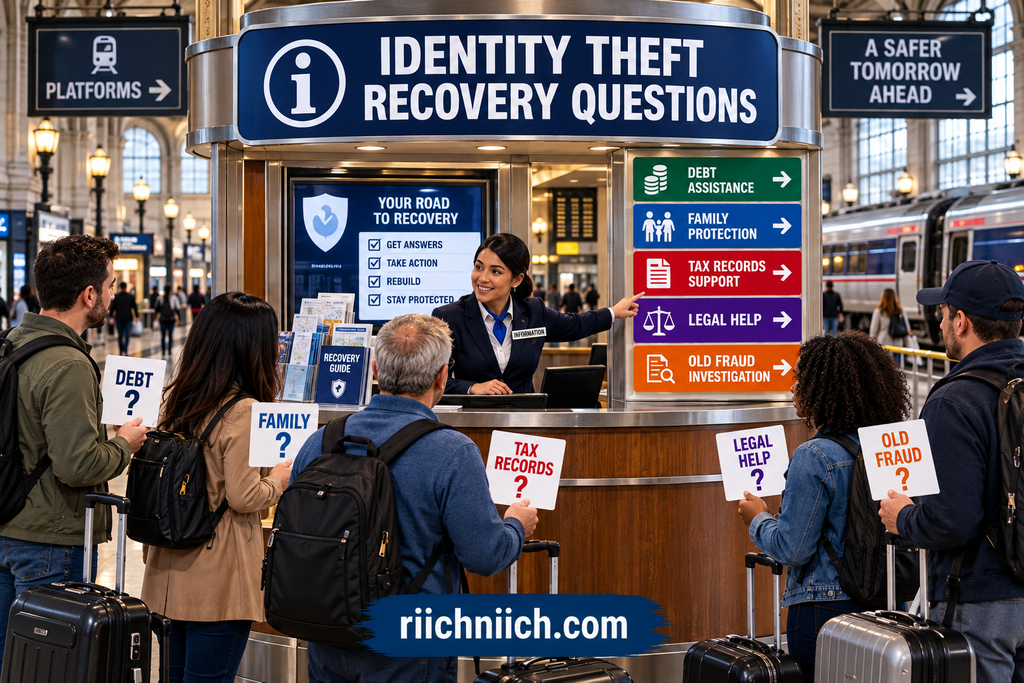
Can a Debt Collector Make Me Pay a Debt Created by an Identity Thief?
You shouldn’t assume you’re responsible for a debt simply because a collector says it’s in your name.
If you don’t recognize the debt, request information about it and dispute it rather than paying it just to make the collection calls stop.
The CFPB says consumers generally have 30 days after receiving the debt-validation information to dispute the debt in writing. If you submit the appropriate written dispute during that period, the collector generally must pause collection of the disputed amount until it provides verification.
Keep copies of your correspondence, Identity Theft Report, account records, and any confirmation showing the account resulted from identity theft.
What Should I Do If a Debt Collector Contacts Me Years After the Identity Theft?
Don’t ignore it simply because you thought your identity theft recovery process was finished.
First, verify that the collector and debt are legitimate. Ask for information identifying the creditor, amount owed, and how to dispute the debt.
The CFPB recommends keeping letters and messages you receive as well as copies of correspondence you send.
Then compare the collection with your old identity theft records.
If it’s connected to previously documented fraud, those records could help establish that the debt isn’t yours.
This is one reason keeping your identity theft recovery documents after the original fraud is resolved can be valuable.
What If Someone Used My Identity to Get a Job?
Employment-related identity theft can happen when someone uses another person’s Social Security number for employment.
If you discover wages or an employer you don’t recognize, investigate rather than assuming it’s only a credit problem.
The IRS specifically identifies using someone’s information to obtain a job or income as a form of identity misuse that may require additional action.
Check your Social Security earnings record as well as relevant tax records for information that doesn’t belong to you.
Employment identity theft is a good example of why how to recover from identity theft can extend beyond fixing fraudulent credit accounts.
Can I Get a Copy of a Fraudulent Tax Return Filed in My Name?
Yes, in certain circumstances.
If someone used your name and Social Security number to file a fraudulent federal tax return, the IRS allows identity theft victims—or certain authorized people acting for them—to request a redacted copy of that fraudulent return using Form 4506-F.
The IRS says the request must include information such as your name, SSN, mailing address, the tax year involved, and your signature.
That can provide additional documentation when recovering from tax identity theft.
What If My Spouse or Dependent Is Also Affected by the Same Identity Theft?
Don’t assume that fixing your identity automatically fixes theirs.
Each affected person may have separate accounts, records, tax information, credit files, or government records that need attention.
For example, the IRS says that when filing a joint return, each taxpayer who has been assigned an IP PIN must enter their own IP PIN on the return. Dependents who have an assigned IP PIN may also need it included.
Handle each affected person’s information individually and document which fraudulent activity belongs to which identity.
If a child’s information was used fraudulently, IdentityTheft.gov provides specific child identity theft recovery steps, including contacting the company where the fraud occurred and explaining that the child is a minor.
Can Someone Help Me Recover From Identity Theft If I’m Unable to Handle Everything Myself?
Yes, but the type of authorization required depends on what needs to be done.
For example, the IRS permits certain authorized representatives to request identity-theft-related tax information for a victim when the proper authorization requirements are met.
Paid identity theft restoration services may also provide case managers or specialists who help victims navigate recovery.
If you’re considering professional help because the recovery has become overwhelming, determine exactly what the person or service is authorized to do:
Give Advice → Prepare Documents → Make Calls With You → Contact Organizations for You
Be cautious about giving anyone unrestricted access to your financial accounts, passwords, SSN, or other sensitive information simply because they claim they can “fix” identity theft.
What If I Discover Another Fraudulent Account After I Thought My Case Was Closed?
Treat the newly discovered account as a new piece of the existing identity theft case.
Don’t assume the previous resolution automatically covers it.
Document the account, contact the company where the fraud occurred, and determine whether the fraudulent information has reached your credit reports or a debt collector.
If it appears on a consumer credit report, identity theft victims can request that qualifying fraudulent information be blocked by providing the required identity theft documentation. The CFPB says credit reporting companies generally must block qualifying fraudulent information within four business days after receiving the required materials.
Then add the new incident to your recovery records.
One overlooked account can surface months later, which is why an identity theft recovery plan should include follow-up even after the major problems appear resolved.
Can Identity Theft Affect Me Even If No Money Was Stolen?
Yes.
Identity theft isn’t limited to someone emptying a bank account.
A criminal could use stolen information to create accounts, obtain services, file tax documents, seek employment, or create other records associated with your identity.
For example, the IRS specifically recognizes tax-related and employment-related identity theft.
So don’t measure the seriousness of identity theft solely by immediate financial loss.
Sometimes the biggest problem is incorrect information becoming attached to your identity, which may not be discovered until later.
What If I Receive an IRS Identity Theft Notice After I’ve Already Recovered?
Don’t assume the notice is automatically connected to an old resolved case, and don’t ignore it.
Verify that the notice is legitimate and follow the instructions provided by the IRS.
The IRS advises identity theft victims to follow instructions in legitimate IRS letters or notices, maintain records of contacts and correspondence, and continue filing required tax returns.
You may also be able to review tax records through your IRS Online Account. The IRS says victims can continue using its transcript services, although additional instructions may sometimes be required when identity theft affects a request.
Use contact information from the official IRS website rather than calling a number provided in an unexpected email or text.
Should I Pay a Company That Promises to Completely Erase My Identity Theft History?
Be cautious.
No legitimate company can guarantee that every trace of identity theft will instantly disappear from every credit, financial, government, or business record.
Many important identity theft recovery steps are available directly to consumers without paying a company, including reporting identity theft, disputing fraudulent credit information, freezing credit, and using government recovery resources.
Paid identity theft protection may still be worthwhile when it provides useful services such as:
- Broad identity monitoring
- Three-bureau credit monitoring
- Fast alerts
- Dedicated restoration assistance
- Help organizing a complicated recovery
- Identity theft insurance
But the value comes from the additional service and assistance, not from buying special rights that aren’t otherwise available to you.
For someone researching how to recover from identity theft, that distinction is important: free government and consumer protections can provide the foundation for recovery, while a strong paid service can add convenience, ongoing monitoring, and professional restoration support when you want additional help.
Conclusion: How to Recover From Identity Theft
The most important thing to remember about how to recover from identity theft is that recovery isn’t one single action. It’s a process of stopping the fraud, documenting what happened, correcting the damage, securing your identity, and watching for additional misuse.
The faster you respond, the sooner you can begin limiting the damage.
A strong identity theft recovery plan generally follows this path:
Document the Fraud → Report Identity Theft → Contact Affected Companies → Freeze Credit → Add a Fraud Alert → Review Credit Reports → Dispute Fraud → Secure Accounts → Protect Personal Information → Monitor for New Activity
IdentityTheft.gov provides an official Identity Theft Report and personalized recovery plan based on what happened to you. If you create an account, you can also track your progress and access forms and letters throughout the recovery process.

Start With the Most Urgent Problems
Not every identity theft victim will need exactly the same recovery steps.
Someone dealing with one compromised credit card has a different identity theft recovery process from someone facing:
- Multiple fraudulent credit accounts
- Stolen bank funds
- Social Security number misuse
- Tax identity theft
- Medical identity theft
- Account takeover
- Fraudulent collections
- Several forms of identity theft simultaneously
Start with the areas where additional damage can happen quickly.
Contact affected companies, secure compromised accounts, change exposed login credentials, and report the identity theft.
The CFPB currently recommends closing compromised accounts, contacting the fraud or security departments of affected financial institutions, reporting the theft through IdentityTheft.gov, and protecting your credit with fraud alerts or security freezes.
Don’t Just Stop the Fraud—Correct the Damage
Stopping a criminal from doing more damage is only part of how to recover from identity theft.
You also need to clean up what already happened.
That could mean:
Close Fraudulent Accounts → Remove Unauthorized Charges → Dispute Fraudulent Debts → Correct Credit Reports → Resolve Collections → Correct Government or Medical Records
If fraudulent information appears on your credit reports, identity theft victims have specific rights to request that qualifying information be blocked. The CFPB says victims can submit an Identity Theft Report, proof of identity, and a letter identifying the fraudulent information; qualifying information generally must be blocked within four business days after the credit reporting company receives the required materials.
Keep written confirmation whenever a fraudulent account, charge, or credit-report entry is resolved.
Those records could become extremely valuable if the problem reappears later.
Protect the Information the Criminal May Still Have
Recovery doesn’t make stolen personal information disappear.
If someone obtained your Social Security number, date of birth, email address, driver’s license information, financial information, or other sensitive data, assume some of that information could still be available for future misuse.
That’s why your identity theft recovery checklist shouldn’t end when the last fraudulent account is removed.
Continue protecting:
Credit → Banking → Email → Passwords → SSN → Taxes → Online Accounts → Government IDs
A credit freeze can be particularly useful after identity theft. It prevents prospective creditors from accessing your credit file and can help stop thieves from opening certain new credit accounts. Freezes are free and don’t affect your credit score, although they don’t prevent existing-account takeover.
Don’t Expect Recovery to Happen Overnight
Some identity theft problems can be resolved relatively quickly.
Others require repeated disputes, documentation, follow-up calls, investigations, and corrections.
Your recovery time depends on:
- Type of identity theft
- Number of accounts affected
- Amount of information compromised
- Number of companies involved
- Whether credit reports were affected
- Whether government records were affected
- Whether fraud continues after the initial recovery
The important thing is to keep moving each unresolved problem toward a documented resolution.
Keep a record of:
Who You Contacted → When You Contacted Them → What You Sent → Case Number → Response → Final Resolution
IdentityTheft.gov specifically recommends recording who you contacted and when, while also keeping resolution letters for fraudulent accounts and charges.
Use Free Recovery Resources Before Paying for Help
You don’t need to purchase identity theft protection just to exercise your rights as an identity theft victim.
IdentityTheft.gov provides free recovery plans, checklists, sample letters, and information about your identity theft rights.
The CFPB also confirms that consumers have the right to dispute inaccurate credit information directly with credit reporting companies and furnishers at no cost.
That makes free government resources an excellent starting point.
Paid services should provide additional value, not replace protections you can already access for free.
When Paid Identity Theft Protection May Be Worth Considering
This is where buyer intent becomes important.
You can absolutely recover from identity theft without purchasing an identity theft protection service.
But that doesn’t mean a paid service has no value.
If your identity theft is complicated, your sensitive information remains exposed, or you’re concerned about future misuse, you may value having:
- Three-bureau credit monitoring
- Social Security number monitoring
- Dark web monitoring
- Financial account monitoring
- New-account alerts
- Credit inquiry alerts
- Compromised-credential monitoring
- Dedicated identity restoration specialists
- Hands-on recovery assistance
- Identity theft insurance
The CFPB notes that identity monitoring services vary in price and features and that free or lower-cost protections such as security freezes and fraud alerts are also available.
So don’t judge an identity theft protection service solely by the number of features advertised.
For someone researching how to recover from identity theft, I’d pay especially close attention to:
Monitoring + Restoration Assistance + Insurance
Monitoring helps watch for certain new problems.
Restoration assistance helps when something actually goes wrong.
Insurance may cover certain eligible recovery expenses, depending on the policy.
Recovery Isn’t Finished Until You Have a Long-Term Protection Plan
The final stage of identity theft recovery should be prevention and early detection.
After you’ve corrected the damage:
Keep credit frozen when appropriate.
Continue reviewing your credit reports.
Keep transaction alerts enabled.
Use unique passwords.
Turn on strong multi-factor authentication.
Protect your primary email account.
Limit unnecessary sharing of your SSN.
Secure your tax identity.
Keep your recovery documents.
Watch for new warning signs.
And if you decide to purchase identity theft protection, use it as an additional security layer, not a replacement for these habits.
The Bottom Line
The best approach to how to recover from identity theft is to work systematically rather than trying to solve everything at once.
Start by stopping immediate fraud. Then document what happened, report the identity theft, secure affected accounts, freeze your credit when appropriate, review your credit reports, dispute fraudulent information, and correct any other records affected by the theft.
After the immediate damage is repaired, shift your attention to long-term identity protection.
If your case is relatively simple and you’re comfortable managing your own security, free resources such as IdentityTheft.gov, credit freezes, credit-report reviews, account alerts, and strong authentication may provide much of what you need.
If the identity theft is complicated, keeps returning, or involves sensitive information that remains exposed, a comprehensive identity theft protection service may be worth considering—particularly one that combines broad monitoring with strong, hands-on identity restoration assistance.

Identity theft can create a long recovery process, but the objective is clear:
Stop the Fraud → Repair the Damage → Secure Your Identity → Stay Protected
That’s the complete approach to how to recover from identity theft—not simply getting back to where you were before the theft, but building stronger protection around your identity for what comes next.

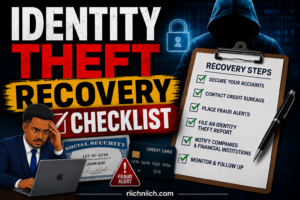
Pingback: Best Identity Monitoring Service: What to Look for Before You Choose - Riich Niich
Pingback: How Criminals Use Stolen Personal Information: 11 Ways Your Data Gets Misused - Riich Niich