

Choosing the best dark web monitoring services starts with knowing what you’re actually paying for. An exposure alert can be useful, but monitored information, recovery support, and renewal prices vary between plans.
This guide compares Aura, Identity Guard, LifeLock, Experian IdentityWorks, and Coveron to help you decide which features matter, when free monitoring may be enough, and whether a paid subscription fits your needs. You’ll also learn what these services cannot do—so you can choose with realistic expectations.
Table of Contents
🔥 Quick Answer: What Are the Best Dark Web Monitoring Services?
The best dark web monitoring services combine monitoring for exposed personal information with clear alerts and practical help responding to a breach. Aura, Identity Guard, and LifeLock are worth comparing, with the right choice depending on the information you want monitored and whether you also need credit monitoring or identity restoration support.
Here is a quick starting point for your buying decision:
- Aura: Consider it if you want dark web monitoring alongside broader identity protection, credit monitoring, and digital security tools in one subscription. It monitors dark web and breach sources for exposed personal information and credentials.
- Identity Guard: Consider it if your priority is personal information monitoring and identity alerts. Compare its plans carefully to determine which additional features you need beyond the included dark web monitoring.
- LifeLock: Consider it if you want dark web monitoring paired with identity restoration support. Its service monitors multiple sources for personal information, and restoration support is available after enrollment.
When comparing dark web monitoring cost, look beyond the introductory monthly price. Check the renewal rate, which personal details you can register, how many people the subscription covers, and what assistance is included after an alert. Email dark web monitoring may cover only part of your needs if you also want monitoring for your Social Security number or financial account details.
Keep your expectations realistic: dark web monitoring searches the sources a provider can access. An alert gives you an opportunity to respond; it does not mean the service has removed the exposed information or stopped someone from using it. Monitoring coverage also varies by subscription.
The strongest reason to pay is useful coverage plus support you would otherwise lack. Before subscribing to one of the best dark web monitoring services, choose the plan that covers your priorities at a renewal price you are comfortable paying.
👉 Want dark web alerts, credit monitoring, and recovery assistance in one subscription? Check Aura’s current plans and pricing to see whether the included benefits fit your needs.
The Best Dark Web Monitoring Services Compared at a Glance
Comparing the best dark web monitoring services starts with a simple question: What useful protection are you getting for your subscription? Several providers combine dark web monitoring with credit alerts, identity restoration assistance, or online security tools. The better value depends on which features you need—and which you already have.
This dark web monitoring service comparison highlights each provider’s potential fit and the details to check before paying.
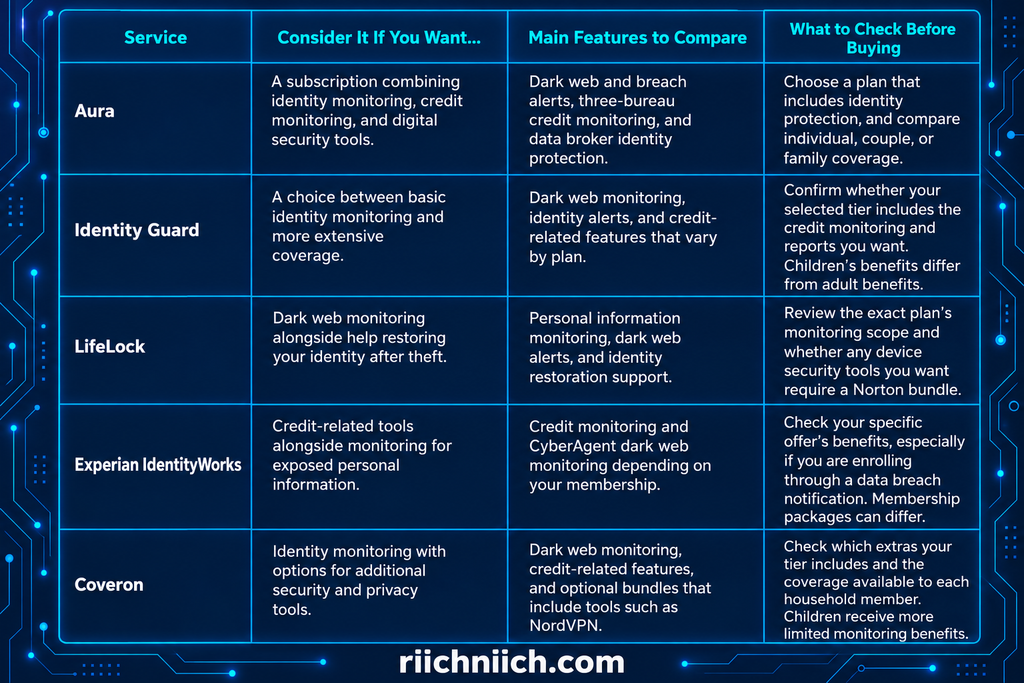
These are buying considerations, not rankings of detection speed or accuracy. A longer feature list does not establish that a provider will find more exposed information or alert you first.
Before choosing among the best dark web monitoring services, compare these three details:
- Information covered: Does the plan provide the email dark web monitoring you need? Can you also register other details you want monitored, such as your Social Security number?
- Help after an alert: Does the subscription provide instructions only, or access to someone who can assist with identity recovery?
- Total subscription cost: Compare the amount due at checkout, the renewal price, and any extra charges for household coverage.
For example, if you already pay for a VPN and receive credit monitoring elsewhere, another bundle may duplicate those benefits. If you want dark web monitoring for families, check what each adult and child actually receives before comparing prices.
Choose the lowest-cost plan that meets your coverage and support needs—not simply the plan with the lowest advertised starting price.
How We Compare Dark Web Monitoring Services
To compare the best dark web monitoring services, we focus on what you receive for your money: the information monitored, the usefulness of alerts, the help available after identity theft, and the ongoing subscription cost.
This is a comparison of documented features and plan terms, not a hands-on test of detection speed. Provider descriptions help explain what a subscription includes, but they do not prove that one service discovers every breach or consistently sends alerts before another.
Here are the criteria that guide our dark web monitoring service comparison.
Personal Information Coverage
We look at which types of personal information a provider says it monitors and what you must register to activate that coverage. Email dark web monitoring may be enough for someone seeking basic breach notifications, while another buyer may want Social Security number dark web monitoring and coverage for additional identifiers.
We also consider registration limits. A plan that monitors one email address may be less useful if you regularly use several personal accounts.
Alert Details and Practical Guidance
We look for documented information about how dark web monitoring alerts are delivered and what guidance accompanies them. A useful alert should help you understand what information was detected and what action to consider next.
We do not treat “24/7 monitoring” as proof of instant detection. Without comparable testing, claims about which provider is fastest should not determine your purchase.
Recovery Assistance
Dark web monitoring and identity theft protection can appear in the same subscription, but their benefits serve different purposes. We distinguish exposure alerts from access to specialists who can help resolve identity theft.
The Federal Trade Commission’s (FTC) guide to identity theft explains the differences between monitoring, recovery services, and insurance—an important distinction when evaluating what a paid plan actually provides.
Subscription Cost and Renewal Terms
Our approach to dark web monitoring cost considers the introductory offer, billing commitment, and renewal terms. A monthly equivalent advertised for an annual subscription should not be confused with a month-to-month payment.
Trial conditions and cancellation requirements also matter. The FTC’s subscription guidance recommends checking these terms before enrolling, including what you will be charged after a trial or promotional period.

Household Coverage and Useful Extras
For dark web monitoring for families, we consider who qualifies for coverage and whether children receive different benefits from adults. A family label alone does not establish that everyone receives the same protection.
We also consider whether bundled features add practical value. Credit monitoring, a VPN, or other security tools can make a subscription more useful—but paying twice for tools you already have reduces that value.
Transparency About Limitations
We favor clear explanations of what is included, what requires an upgrade, and what the service cannot do. When a feature or limit is unclear, it should remain an unanswered question rather than become an assumed benefit.
Ultimately, our comparison of the best dark web monitoring services centers on documented coverage, useful support, and total cost. Those criteria give you a stronger basis for buying than a promotional discount or an impressive-sounding feature count alone.
What Information Can Dark Web Monitoring Services Detect?
The best dark web monitoring services can detect exposed personal information in the breach databases, forums, marketplaces, and other sources they monitor. Depending on the provider and your plan, that information may include email addresses, leaked passwords, Social Security numbers, financial account details, and government-issued identification numbers.
Before subscribing, check exactly which information you can register. A service offering email dark web monitoring does not necessarily include monitoring for your passport, driver’s license, or bank account numbers.
Email Addresses and Exposed Login Credentials
Email addresses are a common starting point for dark web monitoring. A service may notify you when a registered address appears in a breach record, sometimes alongside a password or other account information.
The alert may identify the affected website, although the original source is not always known. An exposed email address also does not automatically mean someone has accessed your inbox. It may have appeared in a breach involving a shopping account, forum, or another service where you used that address. Norton’s dark web monitoring documentation explains that some alerts identify a breach source while others cannot.
For buyers, the useful question is: How many email addresses can I monitor under this subscription? Include older addresses that remain connected to accounts you still use.
Social Security Numbers and Other Personal Identifiers
Some services support Social Security number dark web monitoring, along with details such as your date of birth, phone number, and home address.
Broader plans may also let you register additional identifiers:
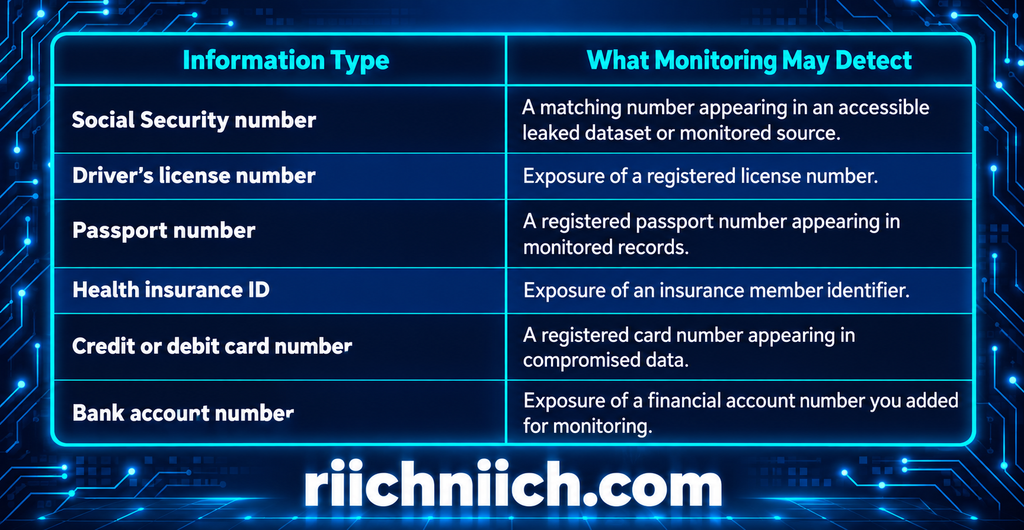
These categories are available from some providers, but they are not universal. For example, Identity Guard’s published watchlist supports these identifiers and sets separate registration limits for each category.
Monitoring a document number should not be interpreted as a promise to detect every photograph, scan, or fraudulent use of that document.
Financial Information Exposure vs Account Activity
When comparing dark web monitoring for personal information, distinguish finding an exposed account number from detecting activity inside that account.
A dark web alert about a bank account number does not necessarily mean the service watches your transactions. Likewise, detecting an exposed Social Security number is different from identifying a new credit account opened in your name. Transaction monitoring and credit monitoring are separate features that may be bundled into a subscription.
The FTC’s identity theft guidance explains these different monitoring services, helping buyers understand what each benefit covers.
Registered Information Determines Your Coverage
Some details may be enrolled automatically, while others must be added to a watchlist. After signing up, review the dashboard to confirm that the supported information you want monitored is actually registered.
When choosing among the best dark web monitoring services, prioritize coverage that matches your real accounts and identifiers. A subscription’s value depends on whether it monitors the information that matters to you—not simply whether “dark web monitoring” appears on its feature list.
What Dark Web Monitoring Cannot Protect You From
Even the best dark web monitoring services cannot stop every breach, prevent every scam, or guarantee that your identity will remain safe. Their main purpose is to notify you when they detect exposed information in the sources they monitor.
Understanding these limits helps you decide whether a subscription offers useful protection—and which additional safeguards you still need.
It Cannot Prevent a Company From Leaking Your Information
A monitoring subscription cannot control how your employer, healthcare provider, retailer, or another organization stores your data. If that organization experiences a breach, monitoring does not stop the initial exposure.
Dark web monitoring alerts may help you learn about detected leaks, but the service cannot guarantee that you will receive an alert before criminals use the information.
It Cannot See Every Criminal Marketplace or Private Exchange
No provider has complete visibility into every place stolen information is stored or shared. Criminals may exchange data privately, retain it for their own use, or circulate it through sources your provider does not monitor.
No alerts does not mean no exposure. Treat a quiet dashboard as an absence of detected matches, rather than proof that your information has never been compromised.
This is also why “continuous monitoring” should not be interpreted as continuous visibility into the entire dark web.
It Cannot Erase Every Copy of Your Exposed Data
Finding leaked information is different from removing it. Once someone has copied a stolen dataset, a monitoring provider cannot reliably retrieve or erase every copy.
Some subscriptions include data broker removal, but that is a separate feature targeting listings on participating or supported websites. It should not be mistaken for deletion of stolen records from criminal databases.
Before paying more for a bundle, check exactly what its removal feature covers.

It Cannot Stop You From Entering Your Password on a Fake Website
Dark web monitoring itself does not block every phishing message, malicious download, or fraudulent login page. A scammer could steal and immediately use your credentials without first publishing them in a monitored source.
The FTC’s phishing guidance recommends additional safeguards, including updated security software and multifactor authentication. These protections address risks that exposure monitoring alone does not cover.
When comparing dark web monitoring and identity theft protection bundles, verify whether advertised scam protection or device security tools are included, require installation, or cost extra.
It Cannot Automatically Block New Credit or Unauthorized Payments
An exposure alert does not automatically freeze your credit, decline a card transaction, or prevent someone from attempting to open an account. For an additional safeguard against unauthorized new credit accounts, follow our guide on how to freeze your credit at all three credit bureaus.
The Consumer Financial Protection Bureau identifies a credit freeze as a separate measure that generally prevents new credit from being opened in your name. Monitoring and a freeze serve different purposes.
Similarly, monitoring a leaked card number is not the same as having your bank watch and block suspicious purchases.
It Cannot Complete Every Recovery Step for You
An alert does not automatically change affected passwords, replace compromised cards, or resolve fraudulent accounts. Restoration specialists may assist when that benefit is included, but you may still need to verify your identity, authorize actions, and provide documents.
For your buying decision, ask: Does this plan simply notify me, or does it provide practical assistance when something goes wrong?
The best dark web monitoring services are worth evaluating for the information and support they provide. Pay for coverage that fills a real gap in your protection, with the understanding that alerts work best when paired with secure accounts and timely action.
Aura: Dark Web Monitoring With Broader Identity Protection
Aura is worth considering when comparing the best dark web monitoring services if you want exposure alerts alongside credit monitoring, identity recovery assistance, and security tools. Its appeal is the combination of benefits in one subscription, particularly for buyers who would otherwise purchase several services separately.
Our assessment: Aura is a strong option for broader protection, but its value depends on how much of the bundle you will actually use.
What Does Aura Monitor?
Aura’s published coverage includes email dark web monitoring for up to 10 email addresses per user. It also describes alerts for registered personal information, including Social Security numbers, phone numbers, passport numbers, driver’s license information, and health insurance IDs found online.
That makes it worth evaluating if you maintain multiple email accounts or want monitoring beyond exposed login credentials. After enrolling, check that the supported details you want monitored have been added correctly.
What Makes Aura More Than a Breach Alert Service?
Aura’s Individual, Couple, and Family identity protection plans list:
- Three-bureau credit monitoring across Equifax, Experian, and TransUnion.
- U.S.-based fraud remediation assistance to help resolve identity theft.
- Antivirus, a VPN, and a password manager.
- Financial transaction alerts and additional identity-related monitoring.
These are separate benefits within the bundle; dark web monitoring itself does not perform all these functions.
For example, a buyer concerned about both leaked credentials and unfamiliar credit activity may find the combination useful. Someone who already has satisfactory credit monitoring and security software should examine the overlap before adding another subscription.
How Much Does Aura Cost?
At the time of review, Aura’s official pricing page lists these identity protection plans:
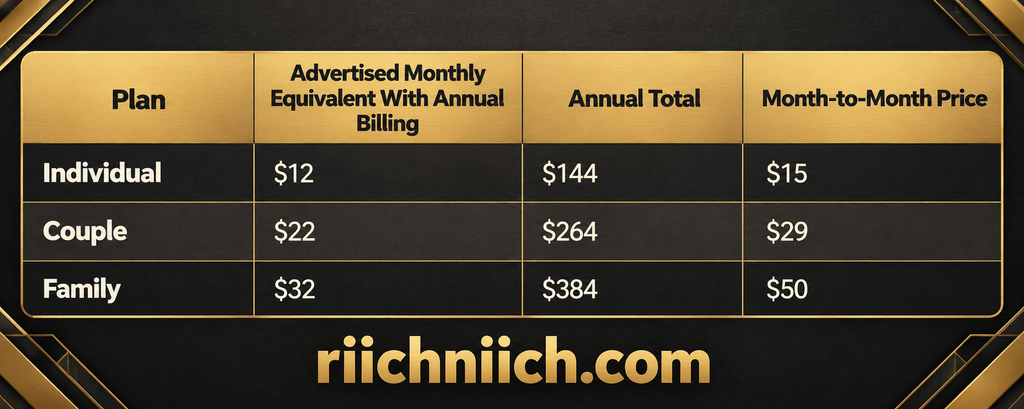
The Family plan lists coverage for five adults and unlimited children. Aura also advertises a 14-day trial and a 60-day money-back guarantee for annual plans. Offers can change; confirm checkout pricing, renewal terms, and eligibility before enrolling.
These prices cover a broader subscription, so they should not be interpreted as the cost of dark web monitoring alone.
Who Should Consider Aura?
Aura is most compelling if you want to consolidate several protection needs. It deserves a place on your shortlist if you want monitoring for multiple identifiers, credit alerts, and access to recovery assistance.
It may be more than you need if your only goal is an occasional email breach check. When weighing free vs paid dark web monitoring, ask whether the additional support and tools solve a problem you currently have.
For a closer look at the subscription’s benefits and trade-offs, read our, ‘Is Aura Worth It?’ review before choosing a plan.
Among the best dark web monitoring services, Aura’s buying appeal is its broader package. Compare the Individual, Couple, and Family options, then choose the smallest plan that covers the people and benefits you need.
Identity Guard: Dark Web Monitoring and Identity Alerts
Identity Guard deserves consideration among the best dark web monitoring services if you want personal information monitoring with a choice of protection levels. Its Value, Total, and Ultra plans let you compare basic identity protection with options that add credit-related benefits.
Its main buying appeal is flexibility: you can evaluate the entry-level plan for exposure alerts and consider an upgrade when you need additional monitoring.
What Can Identity Guard Monitor?
Identity Guard uses a personal Watchlist to check registered information against dark web sites, forums, breach lists, and other monitored sources.
According to its official FAQ, supported Watchlist limits include:
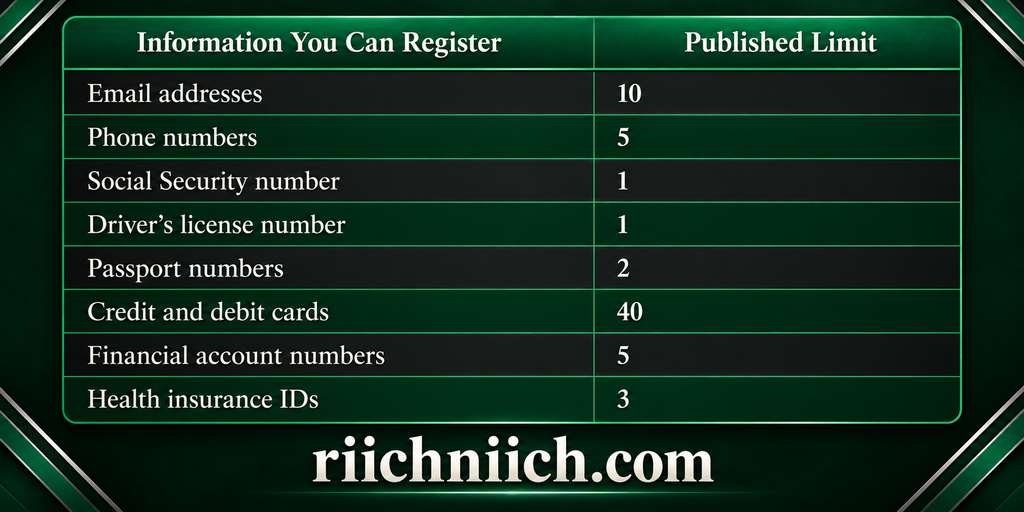
These options make Identity Guard worth evaluating if you want email dark web monitoring alongside coverage for several other personal identifiers. Confirm the limits applicable to your membership before enrolling.
The practical benefit depends on setup. Add the supported details you want monitored rather than assuming every account or document is covered automatically.
Which Identity Guard Plan Should You Consider?
The most useful starting point is deciding whether you need credit monitoring in addition to dark web monitoring and identity alerts.
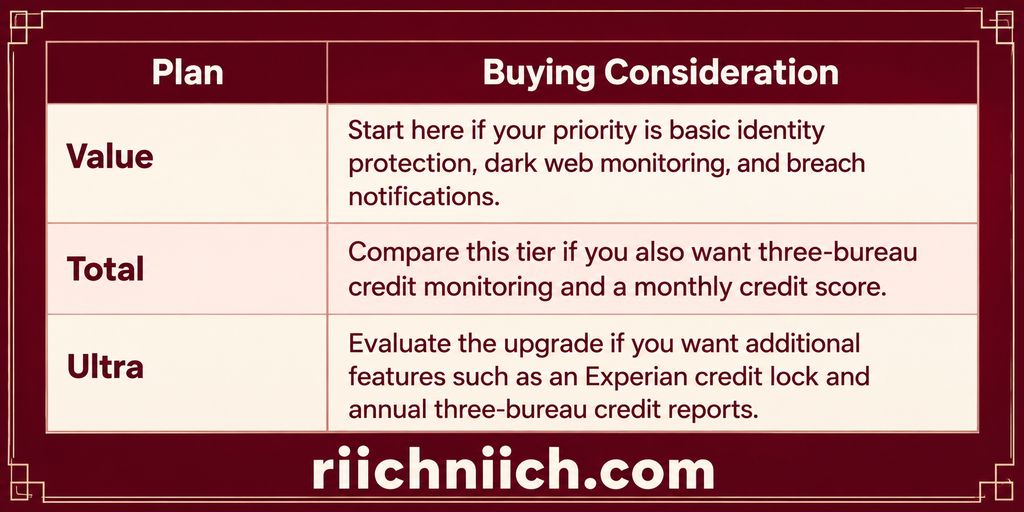
Review the selected offer’s complete feature list on Identity Guard’s plans page, since benefits and promotions can change.
Paying for a higher tier does not, by itself, establish better dark web detection. The upgrade should be justified by specific additional benefits you want.
If you are deciding between these two providers, our Aura vs Identity Guard comparison examines their pricing, monitoring features, and recovery support.
What Should You Check About the Price?
Identity Guard advertises different introductory offers, so compare the first-year total and renewal charge attached to the offer you select. An advertised monthly equivalent may require annual payment.
Its plans page lists a 60-day money-back guarantee for annual subscriptions. Check the applicable terms before treating that guarantee as a substitute for reviewing the plan carefully.
When assessing dark web monitoring cost, ask whether an upgrade fills a gap. If you already receive satisfactory credit monitoring elsewhere, the additional cost of Total or Ultra may be harder to justify.
Who Is Identity Guard a Good Fit For?
Based on its documented features, Identity Guard is a sensible shortlist option for buyers who want to register multiple identifiers and choose how much additional protection to purchase.
For dark web monitoring for families, check adult and child benefits separately. Identity Guard also notes that some older family memberships have different adult limits, so existing customers should verify their coverage before changing plans.
When comparing the best dark web monitoring services, start with Identity Guard’s Value plan and identify exactly what you would gain by upgrading. Choose Total or Ultra when their additional features meet a need you would otherwise leave uncovered.
👉 Find the coverage level that fits your budget: Compare Identity Guard’s Value, Total, and Ultra plans to see what each tier includes and what it costs at renewal.
LifeLock: Dark Web Monitoring With Identity Restoration Support
LifeLock is worth considering among the best dark web monitoring services if you want exposure alerts backed by access to identity restoration specialists. Its appeal is especially relevant to buyers who want professional assistance with the paperwork, calls, and disputes that can follow identity theft.
Our assessment: LifeLock deserves a place on your shortlist when recovery support is a priority, provided the selected plan’s coverage and renewal price fit your needs.
What Does LifeLock’s Dark Web Monitoring Cover?
LifeLock’s dark web monitoring searches for registered personal information in the sources it can access. Its U.S. support documentation lists email addresses, phone numbers, Social Security numbers, credit card numbers, and other identifiers.
Published monitoring limits include up to five email addresses, five phone numbers, and 10 credit card numbers. Additional supported information includes passport and driver’s license numbers. Check the coverage associated with your specific subscription when enrolling.
For buyers seeking email dark web monitoring, the registration limit matters. Count the addresses you still use before purchasing, including older accounts connected to shopping, financial services, or account recovery.
How Does Identity Restoration Support Help?
LifeLock states that a U.S.-based restoration specialist can assist members with calls, paperwork, and disputes when identity theft occurs. It also offers 24/7 live member support.
An important purchase condition appears in
LifeLock’s explanation of its services: monitoring and restoration support begin with membership and are not retroactive. Do not assume a new subscription will cover an identity theft incident that already happened.
This distinction matters when comparing dark web monitoring and identity theft protection. An exposure alert tells you information was detected; restoration assistance addresses the separate problem of resolving identity misuse.
Which LifeLock Plan Should You Compare?
LifeLock currently offers Core, Advanced, and Total plans, alongside Norton 360 with LifeLock bundles.
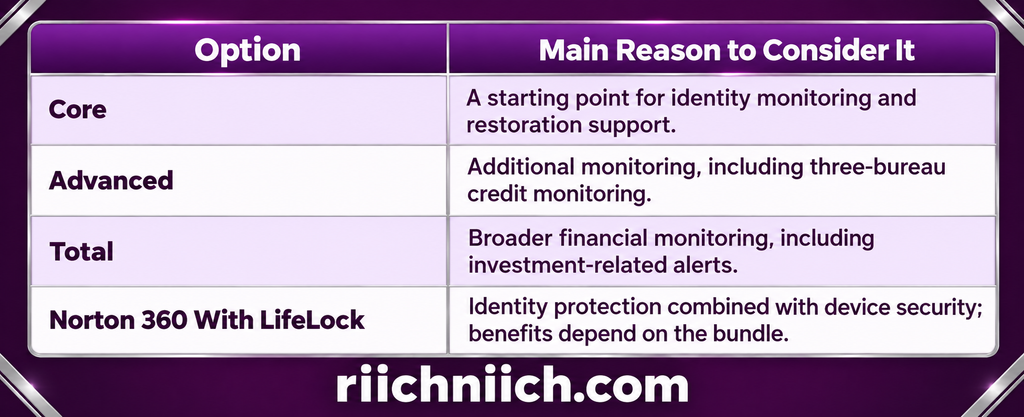
🚨 Use LifeLock’s official plan comparison to verify the exact features. Similar branding does not mean every subscription includes the same credit coverage, account limits, or device protection.
To compare LifeLock’s approach with another bundled option, read our Aura vs LifeLock comparison before committing to a subscription.
What Should You Check Before Paying?
When evaluating LifeLock’s dark web monitoring cost, compare the introductory charge with the renewal price. Also confirm whether the advertised amount is a monthly payment or a monthly equivalent billed annually.
LifeLock advertises a 60-day money-back guarantee for annual plans. Review the applicable cancellation and refund terms before enrolling.
For your own comparison, write down three requirements: the people you need covered, the accounts you want monitored, and whether you need device security. That makes it easier to identify a useful upgrade instead of selecting the most expensive tier by default.
Among the best dark web monitoring services, LifeLock is most compelling for buyers who value monitoring alongside human recovery assistance. Choose the plan whose documented benefits meet your needs at a renewal price you are comfortable maintaining.
Experian IdentityWorks: Dark Web Monitoring and Credit Monitoring
Experian IdentityWorks is worth considering among the best dark web monitoring services if you want exposure alerts alongside credit monitoring. Its main appeal is the ability to monitor for leaked personal information while also tracking changes that could signal credit-related identity misuse.
Our assessment: IdentityWorks is a practical shortlist option for buyers who place a high value on credit monitoring as part of their identity protection subscription.
What Does Experian’s Dark Web Monitoring Do?
Experian offers dark web surveillance that searches monitored sources for exposed personal information. Its IdentityWorks documentation describes sources including internet forums, dark web chat channels, hidden web services, and malware-related data.
Dark web monitoring alerts may include a possible breach source. However, Experian explains that an unfamiliar company name could belong to a third-party organization connected to a business you have used. An alert therefore needs context before you can determine which account might be affected.
Before subscribing, confirm that the plan supports the identifiers you want monitored. If email dark web monitoring or Social Security number dark web monitoring is your priority, check the registration options and complete the required setup.
Why Pair It With Credit Monitoring?
Experian’s advertised premium protection includes dark web surveillance and monitoring across Experian, Equifax, and TransUnion. It also lists Experian CreditLock and fraud resolution support.
The combination addresses two different concerns:
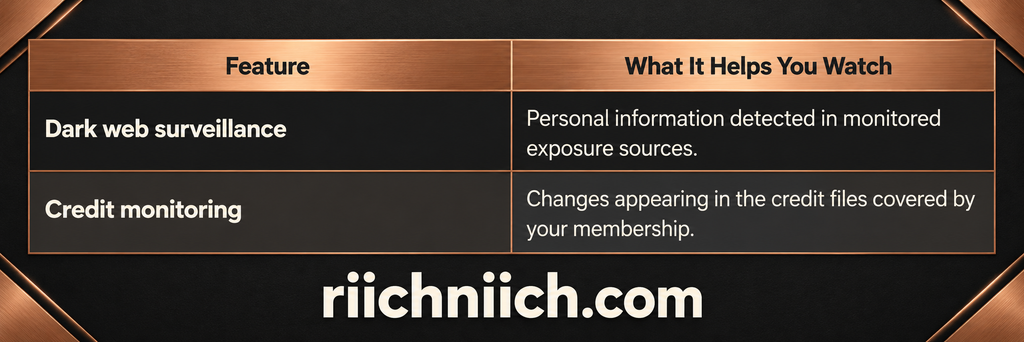
For a buyer concerned about both exposed information and unfamiliar credit activity, having these benefits together may justify a paid subscription. Neither feature guarantees that every instance of identity theft will be detected.
How Much Does Experian IdentityWorks Cost?
At the time of review, Experian’s official protection page advertises a seven-day trial followed by $24.99 per month for IdentityWorks Premium. A credit card is required, and billing continues unless you cancel within the trial period. At that monthly rate, 12 months would cost $299.88.
Confirm the offer and terms shown during enrollment, particularly when choosing household coverage or entering through a promotional link.
When evaluating dark web monitoring cost, consider how much you value the credit-related benefits. Paying for the full package is harder to justify if you only need a basic exposure check.
Already Offered IdentityWorks After a Data Breach?
If a breach notification includes complimentary IdentityWorks membership, review that offer before purchasing another subscription. Check its monitoring scope, enrollment deadline, membership duration, and restoration benefits.
Breach-sponsored memberships can include dark web surveillance and identity restoration assistance, but the specific notification controls what you receive. Do not assume its benefits match a retail Premium subscription.
This can materially change your buying decision: an existing complimentary membership may already provide some of the coverage you were planning to purchase.
Who Should Consider Experian IdentityWorks?
IdentityWorks makes the most sense for someone who wants dark web monitoring and credit monitoring together and expects to use both. It is less compelling if its main benefits duplicate services you already receive.
Our Aura vs Experian IdentityWorks comparison takes a closer look at their credit features, identity monitoring, and overall subscription value.
When comparing the best dark web monitoring services, check your existing Experian membership first, then identify what the paid offer adds. Choose IdentityWorks when its credit coverage, exposure alerts, and support justify the ongoing subscription cost for you.
Coveron: Dark Web Monitoring With Identity Theft Protection
Coveron is worth evaluating among the best dark web monitoring services if you want exposure alerts with the option to add credit monitoring and broader identity protection. Its different subscription levels make the plan you choose especially important: dark web monitoring is included in several options, but the additional protection varies.
Our assessment is that Coveron is most compelling when its monitoring and bundled tools fill gaps in your existing protection.
What Does Coveron Monitor?
Coveron’s dark web monitoring page lists monitoring for email addresses, Social Security numbers, phone numbers, and credit or debit card numbers.
You select the supported details you want monitored, and Coveron checks them against leaked information in its monitored sources. When it identifies a match, it provides an alert explaining what was exposed and suggested next steps.
For buyers seeking email dark web monitoring or Social Security number dark web monitoring, that provides a useful starting point. Before subscribing, confirm the registration limits and whether the specific identifiers you want covered are supported.
Which Coveron Plan Should You Consider?
Coveron’s current pricing page separates its offerings into three main options:
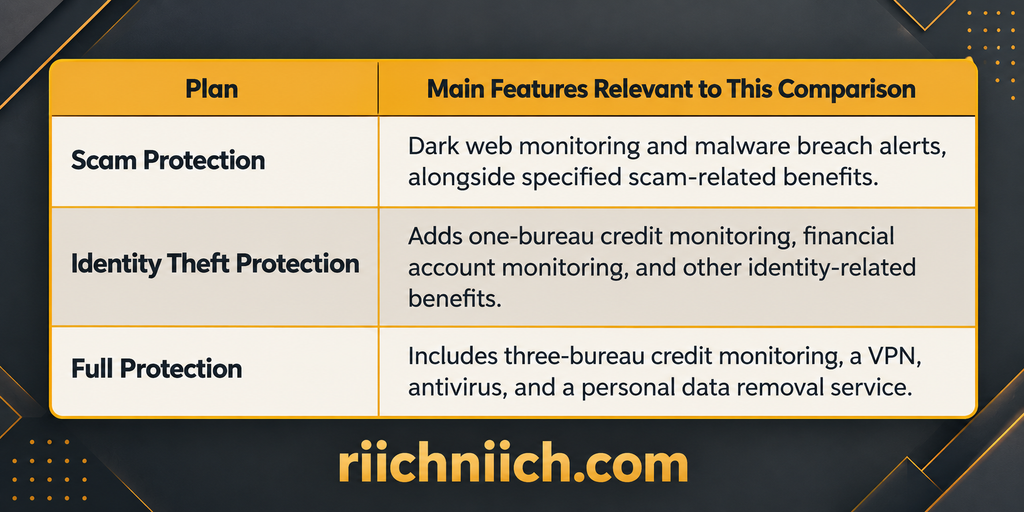
Check the selected offer on Coveron’s official pricing page before purchasing. The lowest-priced option should not be assumed to include the full identity protection package.
The key buying decision is whether you need exposure alerts alone or a broader subscription. If credit monitoring is a priority, the difference between one-bureau and three-bureau coverage deserves particular attention.
How Much Does Coveron Cost?
At the time of review, Coveron advertises these individual introductory offers with a two-year commitment:
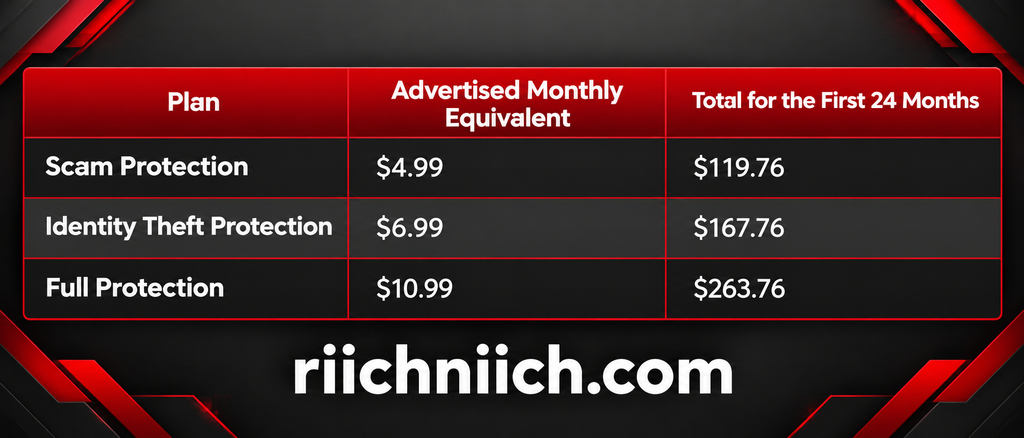
🚨 These are prepaid introductory offers, not month-to-month charges. Sales tax may apply. Confirm renewal pricing, billing duration, and the terms of the advertised 30-day money-back guarantee at checkout.
When comparing dark web monitoring cost, weigh the upfront commitment against the features you expect to use. A lower monthly equivalent offers less value if you are purchasing tools you already have or do not need.
When Is Coveron Worth Considering?
Coveron deserves a closer look if you want to combine monitoring with other services and prefer choosing between different levels of coverage. The broader package may be useful if you also need device security and privacy tools.
However, additional tools only add value when you activate and use them. Before upgrading, check your existing subscriptions for overlapping benefits.
If both providers are on your shortlist, use our Coveron vs Identity Guard comparison to evaluate their plans and decide which benefits matter most to you.
For buyers comparing the best dark web monitoring services, choose Coveron based on the specific plan’s coverage and total cost. Start with your monitoring needs, then decide whether the added credit coverage and security tools justify the higher subscription price.
👉 Choose the package that matches your priorities: Compare Coveron’s current protection plans and check the included monitoring, upfront payment, and renewal terms.
How Much Do Dark Web Monitoring Services Cost?
Among the paid plans reviewed here, dark web monitoring starts at about $5 per month with a prepaid promotional subscription, while broader individual protection can cost $15–$30 or more per month. Family coverage can cost more. The price depends on the provider, billing commitment, and additional benefits—not just the monitoring itself.
When comparing the best dark web monitoring services, look at three numbers: what you pay upfront, what the subscription costs over a full year, and what you will pay when it renews.
Advertised Monthly Price vs Actual Payment
A low monthly rate can require paying for one or two years in advance. These examples show why the billing details matter:
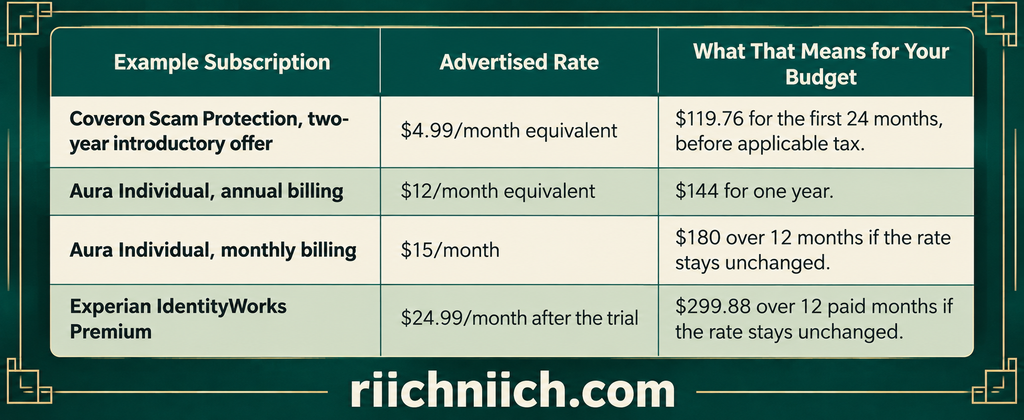
These examples reflect advertised offers at the time of review and do not provide identical coverage. Confirm the selected offer’s billing and renewal terms before subscribing.
Annual billing can reduce the total cost, but monthly billing may suit you better if you want a shorter commitment. Choose based on both affordability and how confident you are that the service meets your needs.
What Are You Paying for Beyond Dark Web Alerts?
Dark web monitoring cost often includes other services within the subscription. Features that may explain a higher price include:
- Credit monitoring: Check whether it covers one bureau or all three.
- Identity restoration assistance: Evaluate the practical support available after identity theft.
- Household coverage: Compare the number of eligible adults and children.
- Security and privacy tools: Consider whether you need the included VPN, antivirus, password manager, or data removal service.
For example, Aura’s identity protection plans bundle credit monitoring and security tools, while Coveron reserves some additional benefits for its Full Protection tier. This makes a feature-by-feature comparison more useful than comparing starting prices alone.
Check the Cost After the Promotion Ends
An introductory discount should be treated as a temporary saving. Before buying, record the renewal amount and the length of the next billing period.
The FTC’s guidance on trials and automatic renewals recommends checking future charges and cancellation requirements before enrolling. A free trial can become a paid subscription unless you cancel on time.
For a fair dark web monitoring service comparison, calculate costs over the same period. Comparing one provider’s discounted first month with another provider’s full annual rate can make the wrong option appear cheaper.
How Much Should You Spend?
Set your budget around the coverage you will use. If you mainly want email exposure alerts, a broader subscription needs a clear additional benefit to justify its cost. If you want credit monitoring and recovery assistance too, a combined plan may make more sense.
Also count only realistic savings. A bundled VPN saves you money only if it meets your needs and replaces a subscription you would otherwise keep paying for.
Choose the lowest total cost that meets your essential requirements. The best dark web monitoring services offer better value when their coverage fills a real gap and their renewal price remains affordable.
Free vs Paid Dark Web Monitoring: What Are You Paying For?
When comparing the best dark web monitoring services, the biggest question is whether a paid subscription adds something useful beyond a free exposure check. Paying may give you broader coverage, ongoing alerts, and recovery assistance—but a subscription fee alone does not prove better detection.
The right choice depends on what the free option already provides and which additional benefits you need.
A Free Scan Is Different From Ongoing Monitoring
A one-time dark web scan checks for information found in the provider’s available data at that moment. Ongoing monitoring continues checking and can notify you about newly detected matches.
Do not assume every free service is limited to a single scan. Some offer continuing breach notifications, while others provide an initial report and require payment for ongoing coverage. Experian, for example, distinguishes its free dark web scan from the dark web surveillance available through a paid premium membership.
Before upgrading, ask: Will the free option notify me about future findings, and which information will it monitor?
What Can a Paid Subscription Add?
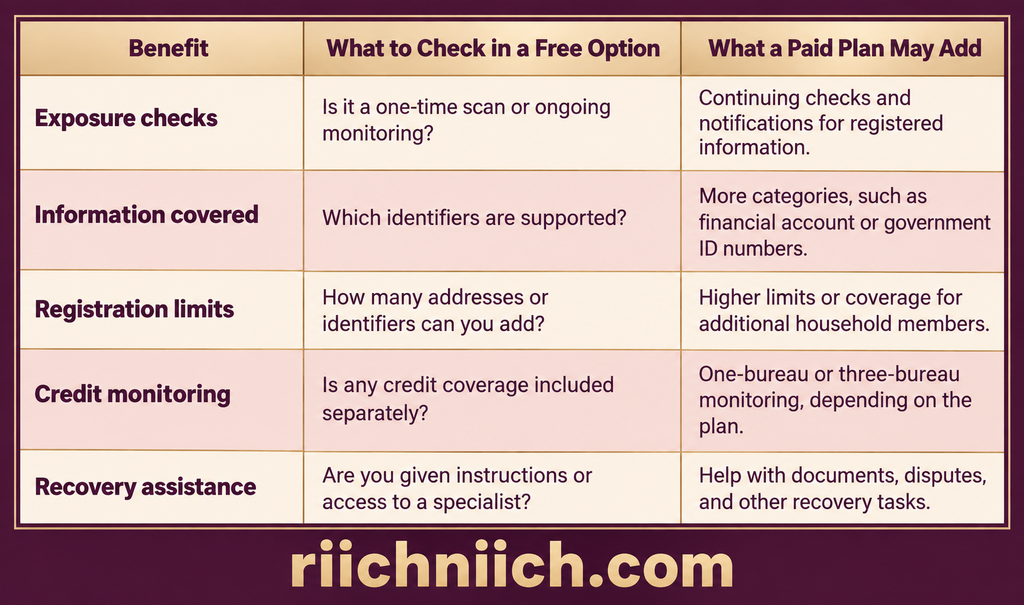
These are features to compare, not benefits automatically included with every paid service. Provider documentation shows that watchlist limits, credit coverage, and assistance vary by subscription.
The FTC’s guide to identity theft services also distinguishes monitoring from recovery assistance. A paid plan may include access to a counselor or case manager, but some recovery tasks can be completed yourself at little or no cost.
When Might Free Monitoring Be Enough?
A free option may meet your needs if your main goal is email dark web monitoring, it provides the notifications you want, and you are comfortable handling follow-up steps yourself.
Also check benefits you already receive. Your employer, bank, credit card provider, or insurance company may offer identity-related services. The FTC recommends considering these existing sources of coverage before purchasing another subscription.
A useful free service does not become inadequate simply because a premium upgrade is available.
When Is Paying More Justified?
A paid subscription becomes easier to justify when you can identify a specific gap:
- You need monitoring for additional identifiers that your free service does not support.
- You want coverage for more household members.
- You want credit monitoring alongside exposure alerts.
- You value access to professional identity restoration assistance.
For example, paying for recovery support may appeal to someone who would find coordinating disputes and paperwork difficult. Paying only to receive another version of the same email breach alert may offer less value.
Upgrade for a clearly defined benefit, not simply because a scan found exposed information. When choosing among the best dark web monitoring services, compare what you already have with what the paid plan adds, then decide whether that difference earns its ongoing cost.
Standalone Dark Web Monitoring vs Identity Theft Protection Bundles
When comparing the best dark web monitoring services, decide whether you need a dedicated exposure-monitoring tool or a subscription covering several identity-related risks. Standalone monitoring can fill a specific gap, while a bundle may offer better value when you need several of its benefits.
This decision is separate from free vs paid dark web monitoring. Here, the question is how much protection you want to combine under one subscription.
What Is the Difference?
Standalone dark web monitoring focuses on detecting exposed information in the sources a provider monitors. An identity theft protection bundle combines that function with additional services, which may include credit monitoring, identity misuse alerts, and restoration assistance.
The FTC’s explanation of identity theft services distinguishes these functions and notes that recovery services may be included or cost extra. Always check the selected plan rather than assuming the bundle contains every benefit.
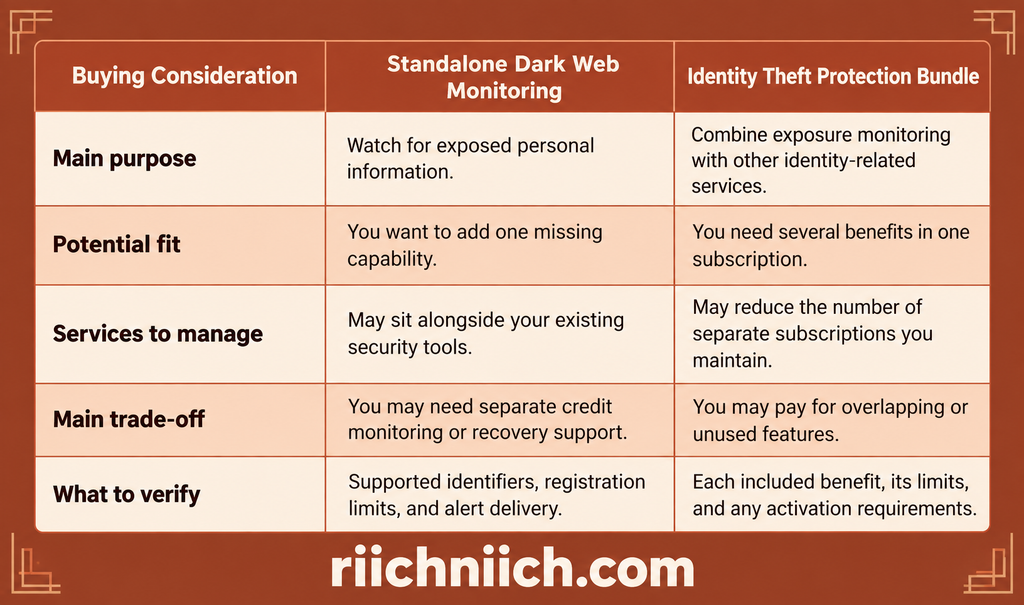
Neither format proves better dark web detection. A larger bundle can provide more types of protection without necessarily finding exposed information sooner.
When Standalone Monitoring Makes Sense
A dedicated service is worth considering if you already have satisfactory credit monitoring, account security tools, and access to recovery support. In that situation, your remaining need may simply be monitoring for exposed credentials or other personal information.
For example, if your existing arrangements cover most of your concerns, adding email dark web monitoring may be more practical than replacing everything with a bundle.
Before buying, confirm that the standalone service supports the information you actually want monitored. A narrowly focused tool can be a good fit, but only if its scope matches your needs.
When a Protection Bundle Makes Sense
A bundle deserves closer consideration when you want exposure alerts, credit monitoring, and professional recovery help but do not already have those services.
For a broader selection of packages, explore our guide to the Best Identity Theft Protection Services and compare the benefits beyond dark web alerts.
Some packages also include device security and privacy tools. For example, Aura’s identity protection plans list credit monitoring, fraud remediation, antivirus, a VPN, and a password manager alongside identity protection.
The convenience may matter as much as the feature count. However, check whether the tools require separate installation or setup; purchasing a subscription does not necessarily activate every benefit.
Compare the Cost of the Protection You Will Actually Keep
Use the same billing period when comparing the two approaches:
Standalone monitoring + separate services you need = your combined cost.
Compare that total with the bundle’s renewal price. Count savings only when you would actually cancel a separate subscription.
For example, a hypothetical $180 annual bundle would save $40 compared with $220 in separate services—but only if it adequately replaces those services. If you keep paying for them, the bundle adds another expense.
Choose among the best dark web monitoring services based on the gaps you need to fill. Buy standalone monitoring for a specific missing capability; choose a bundle when several included benefits justify its total cost.
How to Choose the Best Dark Web Monitoring Services for Your Needs
Choosing among the best dark web monitoring services becomes easier when you start with your own requirements. Before comparing discounts, identify what information you want monitored, who needs coverage, and how much help you would want after an alert.
Build a shortlist around essential benefits, then compare the cost of the plans that meet those requirements.
Start With Your Main Reason for Buying
Write down the problem you want the subscription to address. This keeps a long feature list from distracting you from your actual needs.
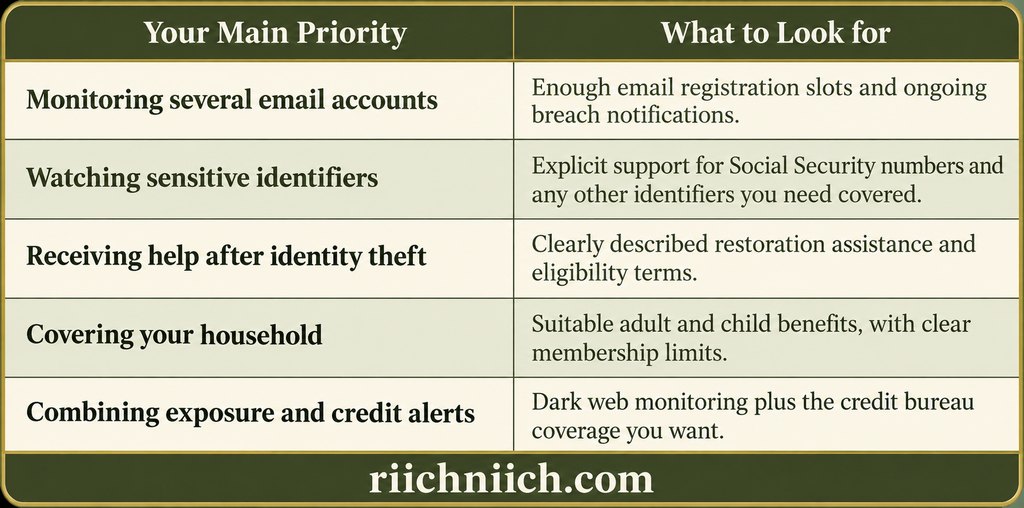
For example, someone with six active email addresses should check registration limits before choosing a plan based on price. A service that cannot cover a must-have requirement should come off the shortlist.
Compare Exact Plans, Not Just Brand Names
Choose two or three specific subscriptions to compare. Record the plan name, billing term, household size, and included benefits.
The Consumer Financial Protection Bureau’s guidance on identity monitoring emphasizes understanding what you receive before enrolling because prices and services vary widely.
If a feature is unclear, ask the provider a direct question before purchasing: “Does this exact plan include the coverage I need?” Keep the answer with your subscription details.
Review How You Will Use the Service
A subscription needs to fit your routine. Check whether you can easily register information, manage dark web monitoring alerts, and contact support.
During an available trial, assess practical questions:
- Can you tell which identifiers are actively monitored?
- Are the alert explanations and recommended actions understandable?
- Can you find the support options without searching through several pages?
- Are important features still waiting for you to activate them?
A short trial can help you assess usability. It cannot establish which provider detects the most breaches, and receiving no alerts during the trial does not prove the service is ineffective.
Check How the Provider Handles Your Information
Dark web monitoring for personal information may require registering sensitive details. Before entering them, review the provider’s privacy policy and account security settings.
Look for clear explanations of what information is collected, how it is used, and what happens when you close your account. Also check whether multifactor authentication is available for the monitoring account itself.
If you cannot find an understandable answer to a privacy question that matters to you, resolve it before enrolling.
Set Your Budget Using the Renewal Price
Use the ongoing cost as your affordability test. An introductory offer can help you try a service, but it should not be the only reason you choose it.
The FTC’s subscription guidance recommends checking trial deadlines, cancellation requirements, and automatic renewal charges. Save those details and set a reminder before the relevant deadline.
Once two plans meet your essential requirements, compare their total cost and usability. Give extra features weight only if you expect to use them.
The best purchase is a plan you can afford, understand, and use consistently. Choose from the best dark web monitoring services by matching documented coverage to your needs—not by treating the biggest discount or longest feature list as the deciding factor.
Dark Web Monitoring for Individuals vs Families
The best dark web monitoring services should cover the people who need protection without making you pay for unused memberships. An individual plan can suit one adult, while a couple or family subscription may offer better value when several people need monitoring.
The important distinction is coverage per person—not simply how many people appear on the plan. Adults and children may receive different benefits, and each member may need separate enrollment.
When an Individual Plan Makes Sense
Dark web monitoring for individuals is a practical choice when you only need coverage for yourself. Before purchasing, check whether the plan supports your email addresses, phone numbers, and other identifiers within its registration limits.
Do not confuse multiple monitored email addresses with multiple covered people. Having room for several addresses does not automatically authorize you to add another adult’s information or extend restoration benefits to them.
If you want to protect a partner too, compare a two-adult subscription with two individual memberships before moving to a larger family plan.
What Should a Family Plan Include?
When evaluating dark web monitoring for families, check these details before paying:
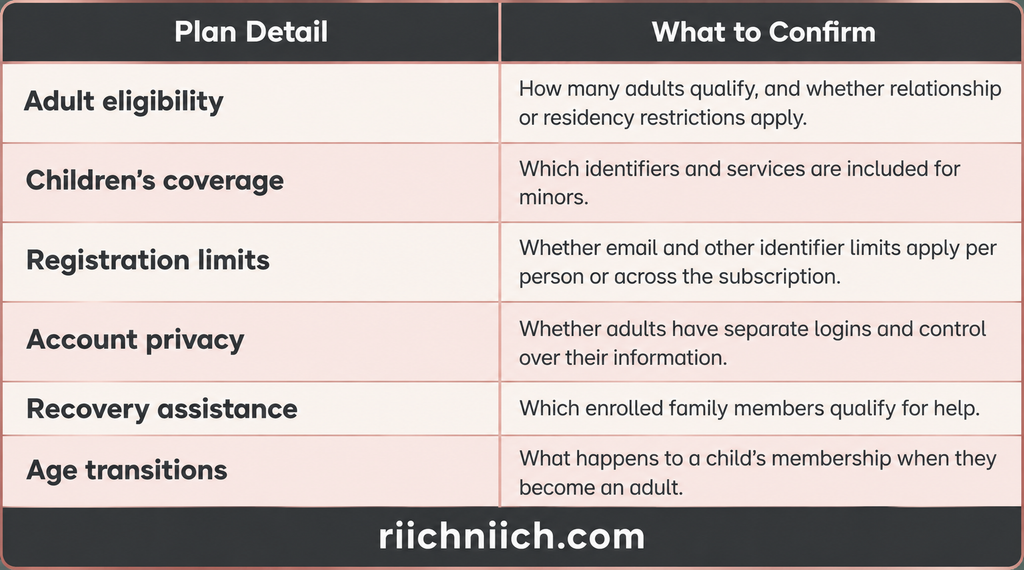
For help comparing household subscriptions, see our guide to the Best Identity Theft Protection for Families, including the benefits to evaluate for adults and children.
For example, Identity Guard’s family enrollment guidance describes inviting adults to establish their own accounts, while a parent or guardian enrolls minors. It also states that members cannot access one another’s personal information or accounts. Other providers may handle family access differently.
Children May Receive Different Protection
A family subscription should not be assumed to provide adult-level benefits to children. Identity Guard, for example, specifies that child members receive online account monitoring and Social Security number monitoring rather than the full adult feature set.
When assessing Social Security number dark web monitoring for a child, ask what it detects and whether the plan includes assistance if misuse occurs.
Monitoring also serves a different purpose from a child’s credit freeze. The FTC’s child identity theft guidance explains how parents and guardians can request a free freeze for children under 16 to help prevent new credit accounts from being opened in their names.
Compare the Cost for Your Actual Household
Calculate the cost using the number of people you will enroll, rather than the maximum the plan advertises.
For example, a hypothetical $360 annual family subscription works out to $90 per person for four enrolled members. If only two people use it, the effective cost becomes $180 each. This calculation helps compare prices, but remember that adult and child benefits may differ.
Also confirm that everyone you want to include is eligible—particularly adult children, relatives living elsewhere, or members of a blended household.
Choose an individual plan for one person, compare couple coverage for two adults, and consider a family plan when its additional memberships provide useful benefits. Among the best dark web monitoring services, the stronger household value comes from suitable coverage for each enrolled person at an affordable total cost.
What to Do After Receiving a Dark Web Monitoring Alert
A dark web monitoring alert means a service detected information that may match yours in a source it monitors. It does not automatically mean someone has accessed your accounts or stolen your identity. Your next step should depend on what was exposed and whether you find evidence of misuse.
When comparing the best dark web monitoring services, look for alerts that explain the finding clearly and help you decide what to do next.
Verify the Alert Through Your Account
Open the provider’s official app or visit its website directly to review the notification. Avoid entering sensitive information through an unexpected email or text link.
Check which identifier was detected, whether a breach source is listed, and whether the information is current. If the alert displays separate breach and detection dates, do not assume the date you received it is when the exposure happened.
Match Your Response to the Information Exposed
The FTC’s guidance for lost or exposed information provides next steps based on the type of information involved. A credit freeze can help restrict new credit accounts, but it does not address every possible misuse of an exposed Social Security number.
Secure Accounts That Show Signs of Unauthorized Access
If you notice unfamiliar logins, changed recovery details, or messages you did not send, take additional action. Change the password, sign out other sessions, and verify your recovery email and phone number.
To make unique passwords easier to create and manage, compare the options in our Best Password Managers guide.
For a compromised email account, also check for forwarding rules you did not create. The FTC’s account recovery instructions explain these steps and why securing your inbox matters for protecting other accounts.

Contact Restoration Support if You Find Misuse
If your subscription includes identity restoration assistance, contact the provider when you discover unfamiliar accounts, unauthorized transactions, or other signs of identity theft. Ask what help applies to your situation and which actions you need to complete yourself.
If someone has used your identity, report it through IdentityTheft.gov to receive a personalized recovery plan. Save relevant alerts, case numbers, and records of your communications.
You do not need to purchase a new subscription before taking protective action. If you already pay for support, use the benefits available under your membership.
Judge the Service by How Well It Helps You Respond
This is where dark web monitoring alerts become useful: they should help you identify the affected information and take an appropriate next step.
When evaluating the best dark web monitoring services, give weight to understandable alerts and accessible assistance. A useful service helps you move from a warning to action without making every notification feel like a confirmed identity theft emergency.
Is Dark Web Monitoring Worth Paying For?
Dark web monitoring can be worth paying for when it adds useful coverage or support you do not already have. The strongest reason to subscribe is a clear combination of monitored information, actionable alerts, and assistance that fits your needs.
When comparing the best dark web monitoring services, judge the subscription by what it helps you do—not simply by how many alerts it sends.
When the Subscription Can Justify Its Cost
A paid service becomes more appealing when you want several personal identifiers monitored, coverage for household members, or help navigating identity recovery.
Recovery assistance may be particularly valuable if you would struggle to manage disputes, documents, and calls on your own. The FTC’s guide to identity theft services explains that recovery services can provide counselors or case managers, and some can work with institutions on your behalf when authorized.
That does not mean everyone needs professional assistance. It means the time and effort you might save deserve a place in your buying decision alongside dark web monitoring cost.
When Paying May Add Little Value
A subscription may be difficult to justify if it largely duplicates coverage you already receive or includes tools you do not expect to use.
If you are still weighing a subscription against managing protection yourself, our guide on whether you really need identity theft protection can help you assess the trade-offs.
Before buying, check whether your employer, bank, credit card provider, or insurance company already provides relevant benefits. The FTC identifies these as possible sources of monitoring and recovery services.
Also avoid treating a frightening scan result as an automatic reason to upgrade. Finding exposed information tells you to assess the exposure and respond; it does not establish that the most expensive plan is the right purchase.
Use This Simple Value Test
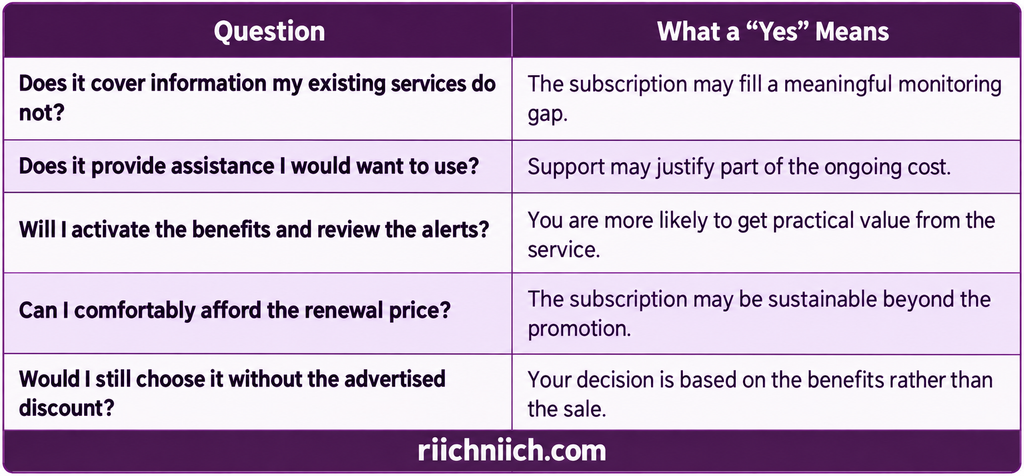
If you cannot identify a useful benefit beyond what you already have, reconsider the purchase or choose a lower-cost option.
Peace of Mind Should Come From Understanding the Coverage
It is reasonable to value reassurance, but that reassurance should come from knowing what is monitored and what help is available. A quiet dashboard cannot guarantee that your information is safe, and frequent notifications do not necessarily prove superior protection.
The Consumer Financial Protection Bureau advises consumers to understand the services and terms before enrolling. That is especially useful when comparing dark web monitoring and identity theft protection packages with similar marketing claims.
Our buying recommendation: pay when the plan fills a specific gap, offers support you value, and remains affordable at renewal. The best dark web monitoring services earn their place in your budget through useful coverage and assistance you can actually use.
Frequently Asked Questions About the Best Dark Web Monitoring Services
These additional questions can help you compare the best dark web monitoring services when your situation involves existing credit freezes, workplace accounts, or changing providers.
Can I Enroll in Dark Web Monitoring While My Credit Is Frozen?
Generally, a credit freeze does not prevent a service from checking monitored sources for exposed personal information. However, a bundled credit-monitoring feature may have separate verification or activation requirements.
Identity Guard specifically states that consumers can enroll with a credit freeze in place. Check the selected provider’s instructions before temporarily lifting any freeze.
Do I Need to Visit the Dark Web or Install Tor to Use Monitoring?
No. Consumer dark web monitoring services perform the searches on their systems. You register supported information and review findings through the provider’s website, app, or notifications.
Coveron’s monitoring explanation describes automatic checks that run after you select the details to monitor. You do not need to search criminal marketplaces yourself.
Can I Add My Work Email Address to a Personal Monitoring Plan?
Check both the provider’s rules and your employer’s security policy before registering a workplace address. If permitted, email dark web monitoring may help identify exposure involving that specific address, but it should not be treated as company-wide protection.
Monitoring one address does not establish coverage for your employer’s domain, coworkers, or business systems. For business coverage, ask about domain monitoring and commercial eligibility before buying a personal subscription.
Can I Keep My U.S. Monitoring Subscription if I Move Abroad?
Do not assume that access to the website means every benefit remains available after moving. Ask the provider about residency requirements, supported identifiers, credit-monitoring eligibility, and restoration coverage in your destination country.
For example, Aura’s international availability guidance states that fraud protection, credit monitoring, and parental controls are available only to users based in the United States. Check eligibility before committing to a long subscription if an overseas move is planned.
What Should I Check Before Switching Monitoring Providers?
Save any alert history or case records you want to retain, then confirm that the new service supports your required identifiers. Complete enrollment and check activation status before relying on the replacement.
If you have an open restoration case, ask the existing provider what cancellation would mean for that assistance. Also confirm the new provider’s treatment of incidents that began before enrollment; LifeLock, for example, states that its monitoring and restoration support are not retroactive.
When switching among the best dark web monitoring services, weigh continuity of support alongside price. A cheaper subscription may offer poor value if it leaves an existing problem without the assistance you expected.
Conclusion: Choosing the Best Dark Web Monitoring Services
The best dark web monitoring services give you useful exposure alerts, coverage for the information you want monitored, and support that justifies the ongoing cost. Our recommendation is to choose based on the protection you need at the renewal price you can afford.
Based on the documented features reviewed in this guide, these providers deserve consideration for different buying priorities:
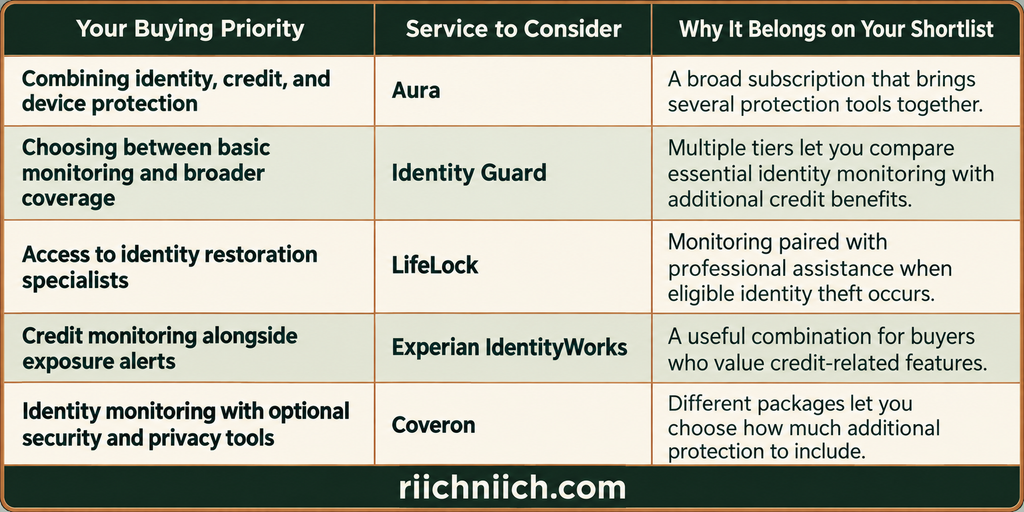
These are recommendations by intended use, not claims that one provider consistently detects breaches faster than another. Features and eligibility depend on the selected subscription.
If you want several protections in one subscription, start by comparing Aura’s relevant plan with the closest alternatives above. If your needs are narrower, compare the least expensive plans that meet them before paying for additional tools.
For dark web monitoring for families, prioritize the benefits each person receives. For an individual seeking email dark web monitoring, check whether existing or free coverage already meets that need.

Before subscribing, confirm your chosen plan’s monitored identifiers, recovery assistance, and total renewal cost. The Consumer Financial Protection Bureau likewise recommends understanding the specific services and terms before enrolling.
Choose the plan that fills a real gap, complete its monitoring setup, and act on relevant alerts. The best dark web monitoring services earn their place in your budget by helping you recognize exposure and respond with clearer information and appropriate support.

Pingback: How Criminals Use Stolen Personal Information: 11 Ways Your Data Gets Misused - Riich Niich