
Knowing how to know if someone is using your identity can help you catch suspicious activity before it turns into a much bigger financial problem. Identity theft is not always obvious—an unfamiliar credit inquiry, unexpected transaction, strange login alert, or account you never opened could be an early warning sign.
In this guide, you’ll learn exactly what to check, the warning signs you should never ignore, what to do if you discover identity theft, and how credit freezes, account security, and identity theft protection services can help you monitor your personal information and reduce the risk of further damage.
Table of Contents
Quick Answer: How To Know If Someone Is Using Your Identity
If you want to know how to know if someone is using your identity, start by looking for activity you cannot explain across your credit reports, financial accounts, mail, online accounts, and government records. Identity theft does not always begin with money disappearing from your bank account. Sometimes the first clue is a new credit inquiry, an unfamiliar account, a password-reset notification, or a bill for something you never purchased.
Some of the most important warning signs include:
- New credit cards, loans, or other accounts you did not open
- Hard inquiries on your credit report that you do not recognize
- Bank or credit card transactions you did not make
- Bills or collection notices for unfamiliar debts
- Unexpected password-reset or login notifications
- Changes to your contact information that you did not authorize
- Missing bills or financial statements
- Problems filing your tax return because one was already submitted
- Notices involving government benefits you never requested
- Your Social Security number or other personal information appearing in a known data breach
Do not rely on a single warning sign. Someone using your personal information may only use part of your identity at first, which can make fraudulent activity difficult to notice.
Start With Your Credit Reports
One of the best places to investigate possible identity theft is your credit history. Visit AnnualCreditReport.com, the federally authorized source for free credit reports, and carefully review your reports for accounts, balances, addresses, and inquiries you do not recognize.
You can also review guidance from the Federal Trade Commission’s IdentityTheft.gov if you discover evidence that someone has stolen or misused your personal information.
Do Not Ignore Small Warning Signs
A fraudulent account does not necessarily begin with a massive transaction. Criminals may test stolen information with smaller activity before attempting something more damaging.
If you notice something suspicious, investigate it immediately. Check your credit reports, contact the financial institution involved, change compromised passwords, enable multi-factor authentication, and consider placing a credit freeze when appropriate.
The Consumer Financial Protection Bureau also provides information about recognizing identity theft and responding when your personal or financial information has been misused.
Where Identity Protection Can Help
Checking everything manually is possible, but it requires you to continue watching multiple sources over time. This is where paid identity theft protection can become valuable.
Identity monitoring services may watch for certain changes involving your credit, personal information, financial accounts, or compromised information and send alerts when suspicious activity is detected. Depending on the provider and plan, additional features may include identity restoration assistance and identity theft insurance.
If you are concerned that your information has already been exposed—or you simply do not want to monitor everything yourself—an identity theft protection service may be worth considering. The important thing is to compare monitoring coverage, alert speed, restoration support, insurance terms, family coverage, and price rather than choosing a service based on advertising alone.
Bottom line: The best way to understand how to know if someone is using your identity is to actively look for activity that does not belong to you and act quickly when something appears suspicious. Free credit reports and account monitoring are excellent starting points, while a reputable identity protection service can provide an additional layer of ongoing monitoring for people who want broader protection and alerts.
What Does It Mean If Someone Is Using Your Identity?
If someone is using your identity, it means another person is using your personal information without your permission to impersonate you, access accounts, obtain money or services, open new accounts, or commit other forms of fraud. The information involved could include your Social Security number, name, date of birth, email address, phone number, financial information, login credentials, or government-issued identification.
Understanding how to know if someone is using your identity is important because identity misuse can happen gradually. A criminal does not necessarily need every piece of information about you. They may combine information obtained from data breaches, phishing scams, stolen credentials, data brokers, or social engineering to create a more complete profile.
For example, someone could potentially use stolen personal information to:
- Apply for a credit card or loan in your name
- Take over an existing financial or online account
- Make unauthorized purchases
- Redirect account communications
- Attempt to access your tax or government-benefit information
- Use stolen credentials to impersonate you online
- Create fraudulent accounts using your information
- Attempt to obtain services under your identity
According to the Federal Trade Commission’s IdentityTheft.gov, identity theft occurs when someone uses your personal or financial information without your permission. The consequences can extend beyond unauthorized purchases and may involve fraudulent accounts, credit damage, or significant time spent proving that certain transactions and debts are not yours.
Identity Theft Can Happen Without You Knowing Immediately
One reason identity theft can become expensive is that the victim may not discover it right away.
A criminal might open an account using your information and direct statements to a different address or email account. You may not realize anything happened until an unfamiliar account appears on your credit report, a collection agency contacts you, or you receive an unexpected security notification.
This is why learning how to know if someone is using your identity involves looking beyond your checking account. Your credit reports, credit inquiries, financial statements, email security alerts, online accounts, tax records, and other sensitive accounts can all provide clues.
The Consumer Financial Protection Bureau provides resources for reviewing credit reports and disputing information you believe is inaccurate.
Identity Misuse Can Take Different Forms
Not every case looks the same. Someone might misuse your existing accounts, while another criminal could use stolen information to establish completely new accounts.
That distinction matters when deciding how much protection you need.
Checking your bank and credit card accounts can help uncover unauthorized transactions, but it may not reveal a fraudulent loan or credit account opened elsewhere. Likewise, credit monitoring can be valuable, but credit activity represents only one area where stolen personal information might be misused.
That is one reason some consumers consider broader identity theft protection. Depending on the provider and plan, a service may combine credit monitoring with additional identity monitoring, compromised-information alerts, restoration assistance, and identity theft insurance.
If you are comparing paid protection, look closely at what information is actually monitored, how quickly alerts are delivered, which credit bureaus are included, what restoration services are provided, and the limitations of any insurance coverage. More features do not automatically mean better protection if those features do not address the risks that matter to you.
No identity protection service can guarantee that identity theft will never happen. Its value is primarily in helping you detect certain warning signs sooner and providing assistance if your identity is compromised.
Why Early Detection Matters
The longer fraudulent activity continues unnoticed, the more accounts, transactions, or records you may eventually need to investigate and correct.
Knowing how to know if someone is using your identity gives you an opportunity to recognize suspicious activity earlier. Watch for unfamiliar accounts, unexpected credit inquiries, unexplained transactions, collection notices, password changes, and security alerts.
If you discover evidence of identity theft, the Federal Trade Commission’s recovery guidance can help you build a recovery plan based on what information was compromised.
The goal is not to become anxious about every notification. It is to create a system that makes unusual activity easier to spot. You can do that yourself by regularly checking your accounts and credit reports, or you can supplement those habits with an identity theft protection service that monitors certain risks continuously.
Why It Is Important to Know If Someone Is Using Your Identity
Learning how to know if someone is using your identity matters because identity theft can continue quietly before you recognize the damage. The sooner you detect suspicious activity, the sooner you can investigate it, secure affected accounts, dispute fraudulent information, and take steps to prevent additional misuse.
Identity theft is not limited to someone stealing money from your bank account. Stolen personal information may potentially be used to open credit accounts, take over existing accounts, make unauthorized purchases, obtain services, or impersonate you.
According to the Federal Trade Commission’s identity theft guidance, identity theft occurs when someone uses your personal or financial information without permission. Knowing the signs of identity theft can therefore be just as important as protecting the information in the first place.
Identity Theft Can Grow Before You Notice It
Imagine discovering one unfamiliar credit card on your credit report. You investigate and learn that it was opened months earlier.
During that time, the person using your information may have attempted additional fraudulent activity.
That is why recognizing identity theft warning signs early is so important. An unexpected credit inquiry, unfamiliar transaction, strange collection notice, new account, or unexplained login notification should not automatically be dismissed.
One unusual event does not necessarily prove identity theft, but it gives you a reason to investigate.
When you understand how to know if someone is using your identity, these small warning signs become much easier to recognize.

Your Credit Could Be Affected
Fraudulent credit activity can potentially damage your credit profile if it is not identified and corrected.
For example, an identity thief could attempt to open an account using your information and then fail to make payments. You might not discover the account until you review your credit report, receive a collection notice, or experience an unexpected change involving your credit.
You can review your reports through AnnualCreditReport.com, the federally authorized website for obtaining free credit reports.
Look carefully for unfamiliar:
- Credit cards
- Loans
- Hard inquiries
- Addresses
- Balances
- Payment activity
- Collection accounts
Checking your credit regularly can help you find signs that someone is using your personal information before you apply for a mortgage, vehicle loan, apartment, or another financial product where your credit history could matter.
Identity Theft Can Affect More Than Your Credit
Your credit reports are important, but they do not show every possible type of identity misuse.
Someone could potentially compromise an existing online account, use stolen login credentials, attempt tax-related identity theft, or misuse other personal information without immediately creating a new account on your credit report.
The IRS identity theft resources explain warning signs and steps related specifically to tax identity theft.
This is why checking only your credit score is not enough when you are trying to determine how to know if someone is using your identity.
Your broader monitoring strategy should include financial accounts, credit reports, important online accounts, email security notifications, and other sensitive records.
Early Detection Can Make Recovery More Manageable
Discovering identity theft can require contacting financial institutions, changing passwords, disputing fraudulent accounts, freezing your credit, documenting what happened, and monitoring for additional misuse.
Finding suspicious activity earlier can help you begin those steps sooner.
If you confirm that someone has misused your information, IdentityTheft.gov can help you create a personalized recovery plan and document the identity theft.
You should also keep records of suspicious transactions, letters, emails, phone calls, disputes, and confirmation numbers. Having documentation can make it easier to keep track of your recovery efforts.
Monitoring Can Reduce the Burden of Checking Everything Yourself
You can monitor many identity theft warning signs yourself for free, and everyone should maintain basic security habits regardless of whether they pay for additional protection.
However, manually checking multiple accounts and records takes time.
This is where identity theft protection services can become attractive for consumers who want additional monitoring.
Depending on the provider and plan, paid services may offer features such as:
- Credit monitoring
- Identity monitoring
- Dark web monitoring
- Alerts about certain suspicious activity
- Identity restoration assistance
- Identity theft insurance
- Family monitoring options
These services cannot guarantee that identity theft will be prevented. Instead, their primary value is helping monitor certain risks, alerting you to potentially suspicious activity, and providing assistance if identity theft occurs.
If you are considering paying for protection, compare the monitoring coverage, number of credit bureaus monitored, alert speed, restoration support, insurance terms, family coverage, and total cost before choosing a plan.
The Cost of Waiting Can Be Higher Than the Cost of Monitoring
Not everyone needs a paid identity theft protection service. Someone who is comfortable checking credit reports, monitoring accounts, using strong passwords, enabling multi-factor authentication, and responding to alerts may prefer a do-it-yourself approach.
But convenience has value too.
For someone whose information has already appeared in data breaches, who manages multiple financial accounts, or who simply wants another layer of monitoring, paying for identity theft protection may make sense.
The buyer-intent question is therefore not simply, “Which service has the most features?”
It is:
How much monitoring do you want to handle yourself, and how much would you rather automate?
Understanding how to know if someone is using your identity puts you in a better position to answer that question. Whether you choose free monitoring methods, paid identity theft protection, or a combination of both, the objective is the same: spot suspicious activity as early as possible and act before the problem becomes harder to resolve.
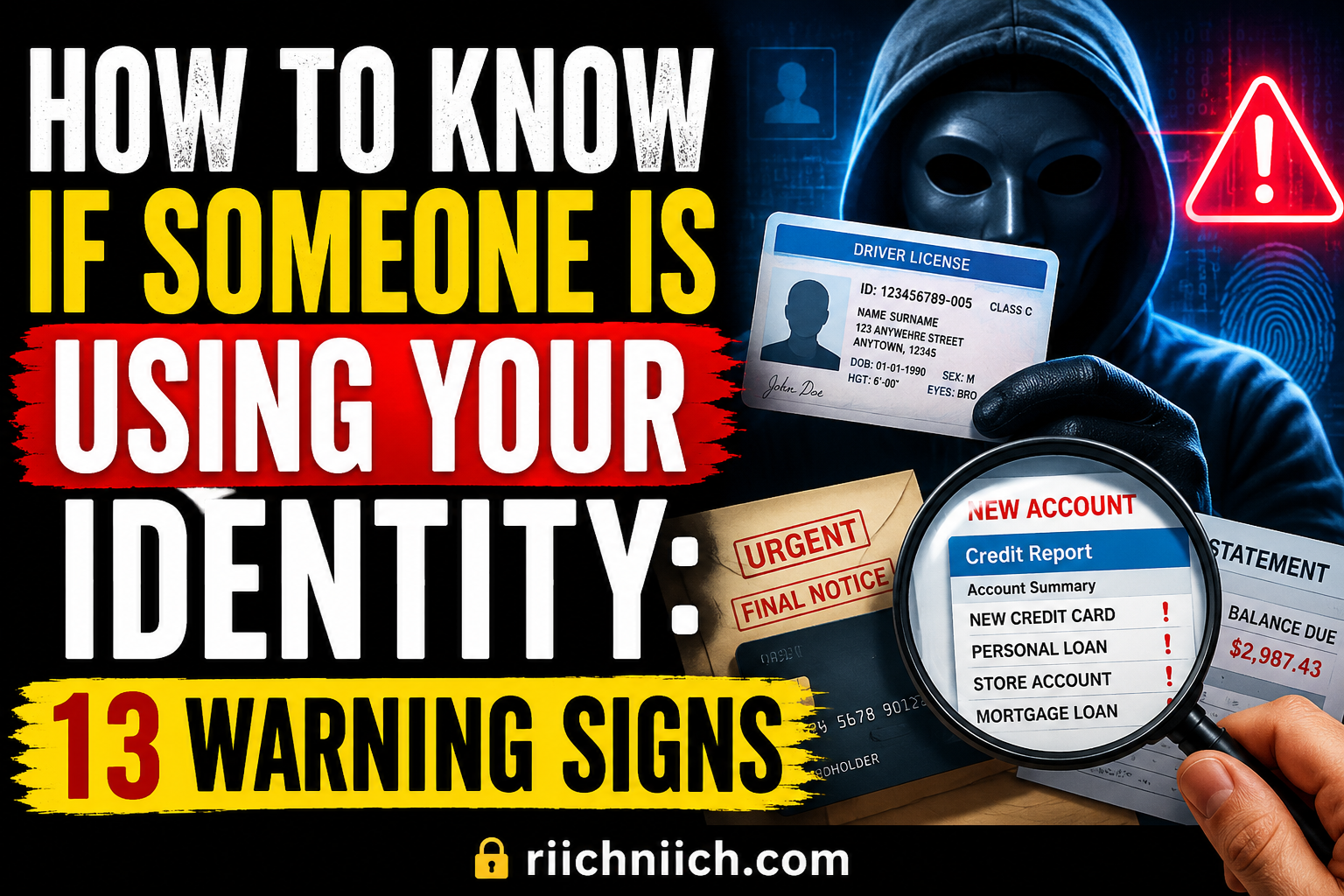
13 Warning Signs Someone May Be Using Your Identity
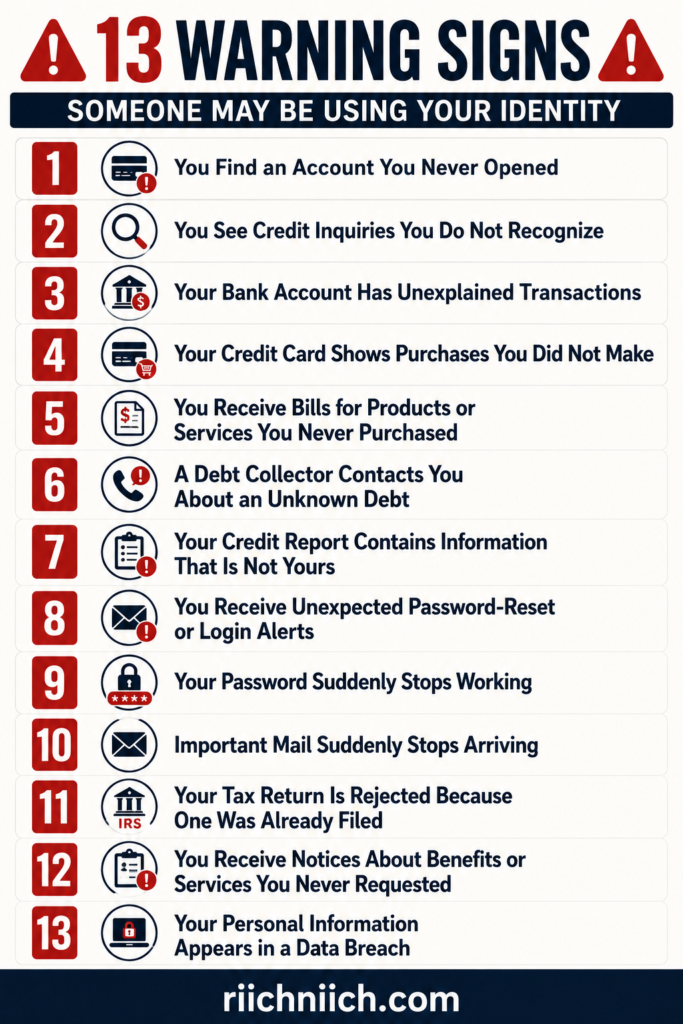
One of the most important parts of learning how to know if someone is using your identity is recognizing warning signs before fraudulent activity becomes more difficult to resolve. Identity theft can affect your credit, financial accounts, online accounts, taxes, government benefits, and other areas of your life.
A single unusual event does not automatically mean someone stole your identity. However, multiple unexplained changes—or one serious warning sign—should be investigated promptly.
Here are 13 signs of identity theft you should not ignore.
1. You Find an Account You Never Opened
An unfamiliar credit card, personal loan, retail account, or other financial account is one of the strongest warning signs that someone may be using your personal information.
Review the lender name, opening date, balance, and payment history. If the account definitely does not belong to you, contact the company involved and investigate immediately.
You can obtain your official credit reports through AnnualCreditReport.com and review them for accounts you do not recognize.
2. You See Credit Inquiries You Do Not Recognize
A hard inquiry can appear when a lender checks your credit after receiving an application for credit.
If you see an inquiry from a company you never contacted, find out why it occurred. An unfamiliar inquiry could indicate that someone attempted to apply for credit using your information.
When researching how to know if someone is using your identity, credit inquiries deserve attention because they can sometimes appear before you discover a fraudulent account.
3. Your Bank Account Has Unexplained Transactions
Review checking and savings accounts for withdrawals, transfers, purchases, or other transactions you did not authorize.
Do not automatically ignore a transaction simply because the amount is small. If you cannot identify it after checking the merchant information, contact your financial institution.
Turn on transaction notifications when available so unusual activity is easier to notice.
4. Your Credit Card Shows Purchases You Did Not Make
An unfamiliar credit card purchase could be a billing mistake, forgotten subscription, authorized-user purchase, or fraud.
Investigate before assuming which one it is.
If the transaction is fraudulent, contact the card issuer promptly and follow its process for securing the account and disputing the charge.
5. You Receive Bills for Products or Services You Never Purchased
An unexpected bill should not automatically be thrown away as junk mail.
Someone may have used your identity to establish an account or obtain a service.
Contact the company using contact information you independently verify rather than calling an unfamiliar number printed on a suspicious message. Ask what account was created, when it was opened, and what identifying information was used.
6. A Debt Collector Contacts You About an Unknown Debt
Receiving a collection notice for a debt you do not recognize can be a major warning sign.
First, verify that the collection company and debt are legitimate. Scammers can also impersonate debt collectors.
If the debt is real but does not belong to you, investigate whether an account was fraudulently opened using your identity.
The Consumer Financial Protection Bureau provides information about dealing with debt collectors and understanding your rights.
7. Your Credit Report Contains Information That Is Not Yours
Do not check only the account balances.
Look for unfamiliar:
- Accounts
- Inquiries
- Addresses
- Names or name variations
- Employers
- Collection accounts
Not every incorrect item is evidence of identity theft. Credit-reporting errors can occur for other reasons. But information that clearly has nothing to do with you deserves investigation.
Knowing how to know if someone is using your identity means learning to distinguish ordinary errors from activity that could indicate someone is impersonating you.
8. You Receive Unexpected Password-Reset or Login Alerts
Your email inbox can act like an early-warning system.
Pay attention to unexpected notifications such as:
- Password-reset requests
- Verification codes you did not request
- Login attempts from unfamiliar devices
- Email-address changes
- Phone-number changes
- Multi-factor authentication requests you did not initiate
Never approve an authentication request simply because it appears on your phone.
Instead, open the company’s official app or website independently and review your account security.
9. Your Password Suddenly Stops Working
If a password you know is correct suddenly stops working, someone may have gained access to the account and changed the credentials.
It could also be a technical issue, so investigate before assuming identity theft.
Check your email for password-change notifications and review the account’s recent activity after regaining access.
Your email account deserves especially strong protection because password-reset links for other services often go there.
10. Important Mail Suddenly Stops Arriving
Missing financial statements, credit cards, insurance documents, or other important mail can sometimes indicate that contact information was changed without your permission.
Check the affected account directly.
Confirm that your:
- Mailing address
- Email address
- Phone number
- Notification preferences
are still correct.
If you suspect unauthorized mail changes, contact the company involved and investigate further.
11. Your Tax Return Is Rejected Because One Was Already Filed
Tax-related identity theft can occur when someone uses stolen personal information to file a fraudulent tax return.
If the IRS receives a suspicious return involving your information, you may receive a notice or encounter a problem when attempting to file legitimately.
The IRS Identity Theft Central provides official information about tax-related identity theft, warning signs, and steps taxpayers can take.
Never provide sensitive information in response to an unexpected call, text, or email claiming to be the IRS.
12. You Receive Notices About Benefits or Services You Never Requested
Unexpected communications involving unemployment benefits, government programs, insurance claims, or other services may indicate that someone has used your personal information.
Do not ignore the notice simply because you never applied.
Verify the communication through the appropriate organization’s official website or phone number and determine whether an account, application, or claim exists in your name.
13. Your Personal Information Appears in a Data Breach
A data breach does not automatically mean someone is actively using your identity.
However, it can increase your exposure.
Depending on the breach, compromised information might include email addresses, passwords, phone numbers, dates of birth, financial information, or Social Security numbers.
The type of information exposed should determine your response.
A compromised password should be changed anywhere it was reused. Exposure of highly sensitive identifying information may justify stronger precautions, including reviewing credit reports and considering a credit freeze.
What Should You Do If You Notice One of These Warning Signs?
If you are researching how to know if someone is using your identity because something suspicious has already happened, do not wait for additional warning signs before investigating.
Start by determining exactly what occurred. Review the affected account, check your credit reports when relevant, change compromised passwords, contact the financial institution or company involved, and document what you discover.
If you confirm identity theft, IdentityTheft.gov can provide a recovery plan based on your situation.
When Identity Theft Monitoring May Be Worth Paying For
You can perform many of these checks yourself for free.
The challenge is consistency.
Identity thieves do not operate according to your schedule, and most people are unlikely to manually check their credit reports, financial accounts, exposed credentials, and other identity signals every day.
That is where paid identity theft protection can provide additional value.
Depending on the provider and plan, an identity protection service may monitor certain credit and identity signals and send alerts when potentially suspicious activity is detected. Some plans also include restoration assistance and identity theft insurance.
When comparing identity theft protection services, prioritize:
- Three-bureau credit monitoring if comprehensive credit monitoring is important to you
- Fast, useful alerts
- Dark web and identity monitoring
- Financial account monitoring, where offered
- Identity restoration assistance
- Clear identity theft insurance terms
- Family coverage if protecting multiple people
- A price you can realistically maintain
Do not buy a service simply because it promises a long list of features. Choose one based on the risks you actually want monitored.
Most importantly, remember that monitoring is not prevention. No identity theft protection service can guarantee that criminals will never obtain or misuse your information.
The advantage is detection and support.
Understanding the warning signs—and knowing how to know if someone is using your identity—gives you the opportunity to identify suspicious activity sooner, while a reputable identity theft protection service can provide an additional layer of ongoing monitoring when you do not want to handle every check manually.
How To Know If Someone Is Using Your Identity by Checking Your Credit Reports
One of the most effective ways to learn how to know if someone is using your identity is to review your credit reports for activity you do not recognize. If a criminal uses your personal information to apply for a credit card, loan, or another type of credit account, evidence of that activity may appear on one or more of your credit reports.
Your credit reports contain more than your credit score. They provide a history of credit accounts and related information reported to the credit bureaus, making them an important place to look for signs of identity theft.
You can request your official credit reports through AnnualCreditReport.com, the federally authorized source for free credit reports.
Check All Three Credit Reports
Do not assume that reviewing one credit report gives you the complete picture.
The three nationwide credit reporting companies are Equifax, Experian, and TransUnion. Because information can differ among the three reports, suspicious activity could potentially appear on one report but not another.
When checking for identity theft, compare all three and look for inconsistencies.

Look for Accounts You Never Opened
Start with the accounts section of each report.
Look for unfamiliar:
- Credit cards
- Personal loans
- Auto loans
- Mortgages
- Retail financing accounts
- Collection accounts
- Other reported credit accounts
Pay attention to the date the account was opened, lender name, balance, payment history, and account status.
An unfamiliar company name does not automatically mean fraud. Sometimes a creditor appears under the name of its parent company or financing partner. Research the account before assuming someone stole your identity.
However, if you confirm that an account was never yours, treat it seriously.
Review Hard Credit Inquiries
When someone applies for certain types of credit, the lender may request access to the applicant’s credit report, resulting in a hard inquiry.
Review your reports for inquiries from companies you do not recognize.
An unfamiliar hard inquiry can be particularly important because it may indicate that someone attempted to obtain credit using your personal information—even if the application was unsuccessful.
If you find one, contact the company associated with the inquiry and ask why your credit was accessed.
Check for Addresses You Do Not Recognize
Your credit reports may contain current and previous addresses associated with your credit history.
An unfamiliar address does not automatically prove identity theft. Reporting mistakes, old account information, or clerical errors can create inaccuracies.
But an address you have never used deserves additional investigation, especially when it appears alongside an unfamiliar account.
Criminals may attempt to direct communications associated with fraudulent accounts somewhere the victim will not see them.
Examine Collection Accounts Carefully
An unexpected collection account can be one of the first ways someone discovers identity theft.
You might receive a collection notice for a credit card, utility account, service, or other debt you never opened.
Compare the collection information against your credit reports and determine which original creditor is associated with the debt.
Do not pay an unfamiliar collection simply to make the problem disappear. First determine whether the debt actually belongs to you.
The Consumer Financial Protection Bureau provides guidance about credit reports, disputes, and consumer rights.
Compare Balances and Payment History
An account can belong to you while still containing activity you do not recognize.
Look for unexpected:
- Balance increases
- Late payments
- Account-status changes
- New revolving balances
- Accounts that suddenly become delinquent
If something does not match your records, contact the creditor directly.
This is an important part of understanding how to know if someone is using your identity because identity theft is not limited to criminals opening completely new accounts. Existing accounts can also be compromised.

What If You Find an Account That Is Not Yours?
If you confirm fraudulent information on your credit report, act quickly.
Contact the company that reported the account and explain that you believe it resulted from identity theft. Keep copies of correspondence and document dates, names, reference numbers, and actions taken.
You can also dispute inaccurate information with the appropriate credit reporting company.
If identity theft has occurred, IdentityTheft.gov can help you create a recovery plan based on your circumstances.
Depending on the situation, you may also want to place a fraud alert or freeze your credit.
Consider Freezing Your Credit
A credit freeze restricts access to your credit file and can make it harder for identity thieves to open new credit accounts in your name.
You must generally place the freeze separately with each nationwide credit bureau.
A freeze does not prevent every type of identity theft, nor does it stop someone from misusing an existing account. However, it can be an important defensive measure when you believe sensitive personal information has been compromised.
The Federal Trade Commission’s credit freeze guidance explains how freezes and fraud alerts work.
Credit Monitoring Can Make This Process Easier
Checking your credit reports yourself is an excellent habit—and it costs nothing through the authorized sources.
The limitation is that a credit report shows you what has already been reported when you check it. If you only review your reports occasionally, potentially suspicious activity could occur between those reviews.
This is where credit monitoring and broader identity theft protection services can add convenience.
Depending on the service and plan, monitoring may alert you to certain events such as:
- New credit inquiries
- Newly reported accounts
- Significant account changes
- Certain personal-information changes
- Potentially compromised information
- Other suspicious identity activity
For someone specifically researching how to know if someone is using your identity, automatic alerts can reduce the need to rely entirely on periodic manual checks.
For a more detailed walkthrough, see my guide on How to Check Your Credit Report for Signs of Identity Theft, including what suspicious accounts and inquiries to look for.
Is Paid Identity Theft Protection Worth It for Credit Monitoring?
That depends on how much monitoring you want to manage yourself.
If you regularly check all three credit reports, use account alerts, freeze your credit when appropriate, protect your passwords, and carefully monitor financial activity, you can perform many important identity-protection tasks without paying a monthly fee.
A paid identity theft protection service becomes more compelling when you want ongoing monitoring plus additional identity-related features and recovery assistance in one place.
When comparing services, do not assume every plan provides the same credit monitoring. Look specifically at:
- Whether one or all three credit bureaus are monitored
- How quickly alerts are delivered
- What types of credit changes trigger notifications
- Whether identity and dark web monitoring are included
- Whether restoration specialists are available after identity theft
- Identity theft insurance limits and exclusions
- Individual versus family coverage
- Renewal pricing
The best service is not necessarily the one with the longest feature list. It is the one that provides monitoring and recovery features that complement what you are already doing yourself.
Checking your credit reports remains one of the strongest starting points for understanding how to know if someone is using your identity. Combine regular credit-report reviews with account alerts, strong security practices, and—if you want more automated monitoring—a reputable identity theft protection service.
How To Check If Someone Opened Accounts in Your Name
Checking for accounts you did not open is an essential part of learning how to know if someone is using your identity. A criminal who obtains enough of your personal information may attempt to open credit cards, loans, utility accounts, wireless accounts, or other services using your identity.
The problem is that you may not receive the bills or account notifications. A fraudster could provide different contact information, allowing the account to remain unnoticed until it appears on your credit report, becomes delinquent, or reaches collections.
The sooner you find an unauthorized account, the sooner you can dispute it and take steps to protect your identity from additional misuse.
Start With Your Credit Reports
Your credit reports should be one of your first stops when looking for unauthorized accounts.
Request your reports from AnnualCreditReport.com and carefully review the accounts reported by each credit bureau.
Pay attention to unfamiliar credit cards, personal loans, auto loans, retail financing accounts, mortgages, collection accounts, and other credit accounts.
Do not look only at accounts with large balances. A fraudulent account with a small balance—or even a zero balance—still deserves investigation.
Compare the opening dates and creditor names with your own financial records. If you cannot identify an account, research the creditor before concluding that it is fraudulent. Financial institutions sometimes appear on credit reports under names that differ from the brands consumers recognize.

Look for Credit Inquiries You Did Not Authorize
An unfamiliar account may not be the first evidence of attempted identity theft.
A credit inquiry could appear earlier.
When a lender receives an application for certain types of credit, it may check the applicant’s credit. If someone applies using your identity, that inquiry could appear on your credit report even if the application is eventually denied.
Review the inquiries on all of your credit reports and investigate companies you do not recognize.
If you find an unfamiliar hard inquiry, contact the company through independently verified contact information and ask why your credit report was accessed.
Pay Attention to Unexpected Bills and Statements
Your mailbox and email inbox can provide additional clues.
An unexpected welcome letter, credit card, loan statement, payment reminder, or past-due notice should never be automatically dismissed as junk.
If a legitimate company contacts you about an account you do not recognize, determine whether someone opened the account using your information.
Avoid clicking links or calling numbers contained in suspicious emails or text messages. Instead, locate the company’s official website independently and contact it through verified channels.
This prevents a phishing scam designed to look like identity theft from tricking you into revealing even more personal information.
Investigate Collection Notices for Unknown Debts
A collection notice may be the first indication that a fraudulent account has existed for months.
If a debt collector contacts you about an account you do not recognize, verify both the collector and the underlying debt.
Ask for information about the original creditor and compare the debt against your own records and credit reports.
The Consumer Financial Protection Bureau’s debt collection resources explain consumers’ rights when dealing with debt collectors.
Do not assume an unfamiliar debt belongs to you simply because a collector has your name, address, or other personal information.
Check Accounts That May Not Appear on a Traditional Credit Report
Credit reports are extremely useful, but they are not a complete record of every account that could potentially be opened using stolen personal information.
Depending on the type of fraud, someone might attempt to establish services or accounts that do not immediately appear on your traditional credit reports.
That is why understanding how to know if someone is using your identity requires looking beyond your credit file.
Pay attention to unexpected communications involving wireless service, utilities, insurance, financial services, government benefits, and other accounts or services you never requested.
You should also regularly review your existing financial accounts for changes to your address, email, phone number, authorized users, or security settings.
What Should You Do If You Find a Fraudulent Account?
If you confirm that an account was opened without your permission, document everything.
Record the company name, account number or partial account number, date discovered, balance, and any communications you receive.
Contact the company involved and tell its fraud department that you believe the account resulted from identity theft. Ask what documentation is required to dispute and close the fraudulent account.
If inaccurate information appears on your credit reports, follow the appropriate dispute procedures with the credit reporting companies.
You can also report identity theft through IdentityTheft.gov, which can help you create a personalized recovery plan.
Consider Placing a Credit Freeze
Finding one fraudulent account raises an important question: Has the thief tried to open others?
A credit freeze can make it more difficult for someone to open new credit accounts that require access to your credit file.
The Federal Trade Commission’s credit freeze and fraud alert guide explains your options and how they differ.
A freeze will not stop every possible form of identity theft, and it will not prevent unauthorized transactions on an existing compromised account. However, it can provide an important barrier against certain forms of new-account fraud.
Identity Monitoring Can Help Detect New Accounts Faster
You can manually check your credit reports and financial records, and those free methods should remain part of your identity protection strategy.
The drawback is timing.
If you only review your reports occasionally, a fraudulent account might exist for some time before you discover it.
This is where paid identity theft protection can provide additional value.
Depending on the provider and plan, an identity theft protection service may monitor credit activity and other identity signals and notify you when certain changes are detected.
For someone researching how to know if someone is using your identity, the ability to receive alerts about potentially suspicious activity can be one of the strongest reasons to consider paying for monitoring.
What to Look for in an Identity Theft Protection Service
If unauthorized accounts are your primary concern, pay particular attention to the service’s credit-monitoring capabilities.
A strong identity protection plan may offer three-bureau credit monitoring, new-account alerts, credit inquiry alerts, dark web monitoring, identity monitoring, restoration assistance, and identity theft insurance.
But read the details carefully.
Some lower-priced plans may monitor fewer credit bureaus or provide fewer types of alerts than premium plans. Insurance coverage can also contain exclusions and limitations.
The right service should complement—not replace—your own security habits.
Even with paid monitoring, continue reviewing your financial accounts, checking credit reports, using strong unique passwords, enabling multi-factor authentication, and investigating suspicious notifications.
Ultimately, learning how to know if someone is using your identity means knowing where evidence of fraud is most likely to appear. Regularly checking your credit reports, inquiries, bills, collection notices, and other accounts gives you a much better chance of discovering unauthorized accounts before they cause more serious damage.
How To Find Out If Someone Is Using Your Social Security Number
If you are trying to understand how to know if someone is using your identity, your Social Security number (SSN) deserves special attention. An SSN can be used alongside other stolen personal information in attempts to open credit accounts, commit tax-related identity theft, obtain employment, or impersonate you for other fraudulent purposes.
If you believe your Social Security number may already be compromised, read, What Happens If Someone Has Your Social Security Number to understand the risks and the protective steps you should consider next.
There is no single website that shows every place your Social Security number may have been used. Instead, you need to look for evidence across your credit reports, Social Security records, tax records, financial accounts, and other official communications.
The key is knowing where to check and which warning signs deserve immediate attention.
Check Your Credit Reports for Unfamiliar Activity
Start with your credit reports.
If someone uses your Social Security number and other personal information to apply for credit, you may eventually see evidence such as an unfamiliar account or credit inquiry.
Request your reports through AnnualCreditReport.com and examine them carefully.
Look for unfamiliar accounts, hard inquiries, addresses, collection accounts, and other information you cannot explain.
Finding something unfamiliar does not automatically prove your SSN was stolen. Investigate the creditor or account first. But if you confirm that an account was opened without your authorization, identity theft may have occurred.
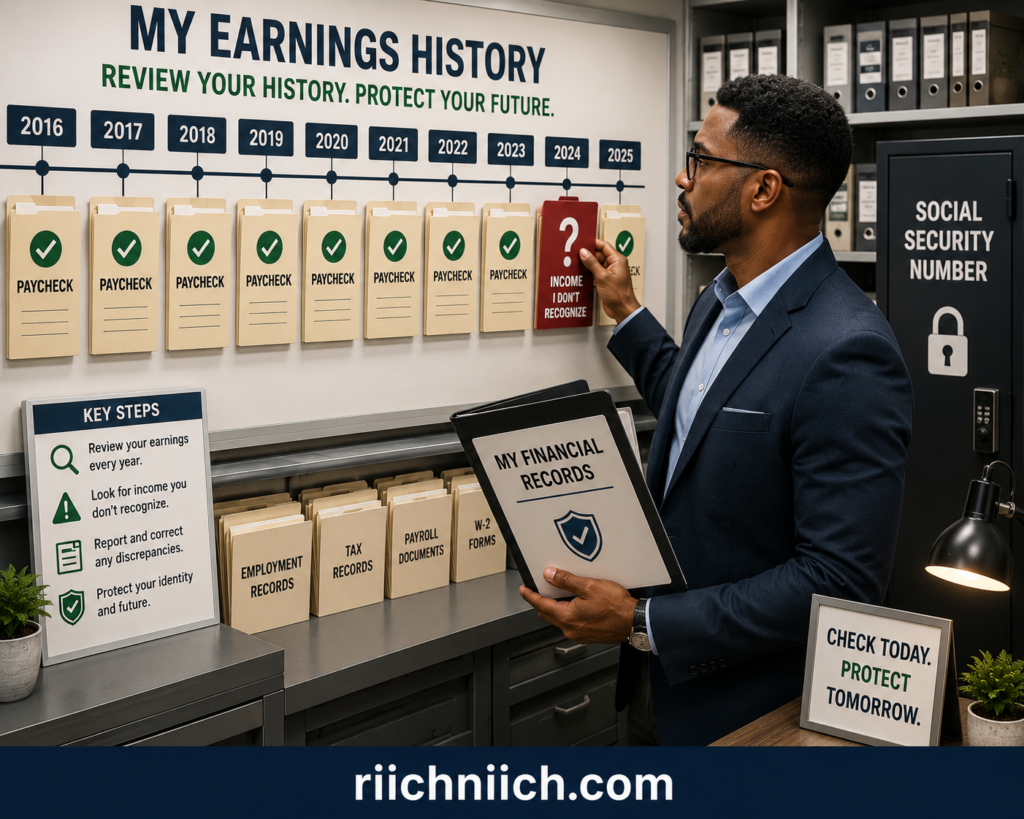
Review Your Social Security Earnings Record
Another important place to check is your Social Security earnings history.
Create or sign in to your official my Social Security account and review your earnings record.
Your record should reflect the income you actually earned.
If earnings appear that you do not recognize, investigate them. An incorrect earnings record can have innocent explanations, including employer reporting errors, so unfamiliar earnings alone do not prove that someone is intentionally using your Social Security number.
However, unexplained discrepancies deserve attention.
Watch for Tax-Related Identity Theft
Someone who obtains your Social Security number and other identifying information may attempt to use it for tax fraud.
One major warning sign is having your legitimate tax return rejected because another return has already been filed using your Social Security number.
You might also receive an IRS notice about a tax return, income, employer, or account activity you do not recognize.
The IRS Identity Theft Central provides official guidance about tax-related identity theft and what taxpayers should do if they believe their information has been compromised.
Do not respond to unexpected messages claiming to be from the IRS by clicking links or providing your Social Security number. Verify communications through official IRS channels.
Consider Getting an IRS Identity Protection PIN
An Identity Protection PIN, or IP PIN, is a six-digit number that helps prevent someone else from filing a federal tax return using your Social Security number or Individual Taxpayer Identification Number.
Eligible taxpayers can obtain one directly from the IRS.
You can learn about enrollment through the IRS Identity Protection PIN program.
An IP PIN does not protect your Social Security number everywhere. It specifically adds protection against fraudulent federal tax returns filed using your identity.
Pay Attention to Government Notices You Do Not Understand
Do not automatically discard an official-looking letter simply because it describes something you never did.
Unexpected notices involving taxes, earnings, government benefits, or other records could indicate that your personal information has been associated with activity you did not authorize.
First verify that the notice itself is legitimate.
Scammers frequently impersonate government agencies to trick people into providing Social Security numbers and other sensitive information.
Instead of using an unfamiliar phone number or web address from a suspicious message, navigate independently to the agency’s official website.
Check Whether Your SSN Was Exposed in a Data Breach
If a company tells you that your Social Security number was compromised in a data breach, take the notification seriously.
But remember the distinction between exposure and misuse.
A compromised Social Security number does not automatically mean someone is currently using your identity. It means information that could potentially be used for identity theft may have fallen into unauthorized hands.
That should prompt you to strengthen your monitoring.
Check your credit reports, review sensitive accounts, consider freezing your credit, and remain alert for suspicious financial or government activity.
Freeze Your Credit If Your SSN Is at Risk
If your Social Security number has been exposed—or you have evidence that someone is attempting to use your identity—a credit freeze can be an important protective measure.
A freeze restricts access to your credit file, making it harder for someone to open certain new credit accounts in your name.
You generally need to place freezes separately with Equifax, Experian, and TransUnion.
A credit freeze does not make your Social Security number unusable, nor does it prevent every form of identity theft. It also will not stop fraudulent activity on an existing compromised account.
However, it can create a significant obstacle for new-account credit fraud.
Can You Change Your Social Security Number After Identity Theft?
Getting a new Social Security number is not a simple solution to identity theft.
The Social Security Administration may assign a different number in limited circumstances, including some situations involving ongoing identity theft where a person continues to be disadvantaged after attempting to resolve the problems.
A new number also does not automatically erase the problems associated with the old one.
The Social Security Administration explains the circumstances in which a different Social Security number may be considered.
For most people, the immediate priority should be securing affected accounts, freezing credit when appropriate, correcting fraudulent records, and establishing ongoing monitoring.
Can Identity Theft Protection Monitor Your Social Security Number?
This is where the buyer-intent side of how to know if someone is using your identity becomes especially important.
You cannot realistically search the internet every day to determine whether your Social Security number has been exposed or associated with suspicious activity.
Identity theft protection services can automate portions of that monitoring.
Depending on the provider and plan, a service may offer Social Security number monitoring, dark web monitoring, credit monitoring, data breach alerts, new-account notifications, identity restoration assistance, and identity theft insurance.
However, the phrase “Social Security number monitoring” can mean different things depending on the service.
Before paying, determine exactly what the provider monitors and what type of alert you will receive.
A service cannot guarantee that nobody will use your SSN. Monitoring is primarily designed to help identify certain signs of exposure or misuse so you can respond sooner.
What Should You Look for in an Identity Protection Plan?
If protecting an exposed Social Security number is one of your main reasons for buying identity theft protection, prioritize monitoring breadth over flashy extras.
Look for a plan that combines Social Security number monitoring with strong credit monitoring, dark web monitoring, useful alerts, and professional identity restoration assistance.
If credit fraud is a major concern, determine whether the plan provides three-bureau credit monitoring or only one-bureau monitoring. That distinction can materially affect how much credit activity the service is watching.
Also compare identity theft insurance carefully. Pay attention to coverage limits, eligible expenses, exclusions, and reimbursement requirements instead of choosing a service based only on the advertised dollar amount.
Free Protection vs. Paid Monitoring
You do not have to pay for an identity protection service simply because your Social Security number was exposed.
You can build a strong free defense by checking your credit reports, freezing your credit, reviewing your Social Security earnings record, monitoring financial accounts, using an IRS IP PIN, and responding quickly to suspicious activity.
Paid identity theft protection is primarily about automation, broader monitoring, alerts, and recovery support.
That can be valuable if you do not want the responsibility of manually checking multiple sources yourself or if your sensitive information has already been repeatedly exposed.
Ultimately, learning how to know if someone is using your identity requires more than checking whether your Social Security number appeared in a breach. Look for evidence of actual misuse across your credit, earnings, taxes, accounts, and government records—and consider automated identity monitoring if you want another layer of detection working alongside the protections you can put in place yourself.
How To Check Your Bank and Credit Card Accounts for Identity Theft
Your bank and credit card accounts are some of the most important places to check when learning how to know if someone is using your identity. Unauthorized transactions, unfamiliar transfers, unexpected account changes, and security alerts can provide early clues that your financial information or login credentials may have been compromised.
Do not wait until a large amount of money disappears. Make reviewing your financial accounts a regular habit and investigate activity you cannot explain.
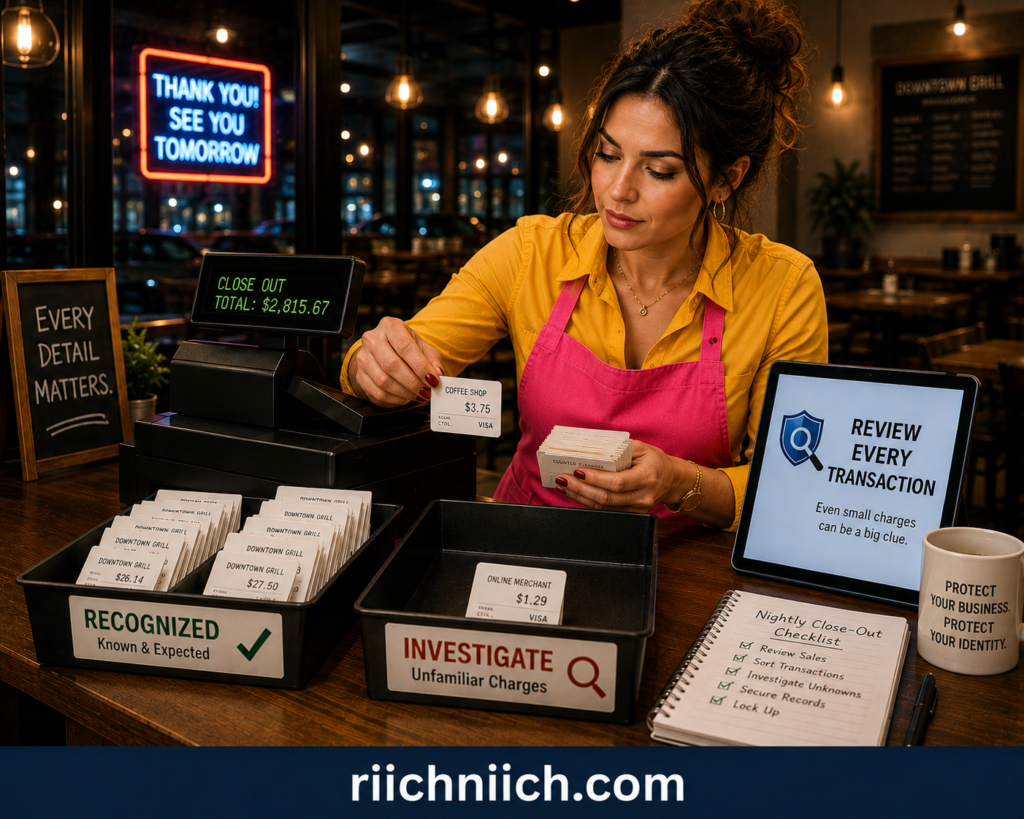
Review Recent Transactions Carefully
Start by signing in through your bank or credit card issuer’s official website or mobile app.
Review transactions line by line rather than looking only at your current balance.
Watch for unfamiliar purchases, ATM withdrawals, electronic transfers, recurring charges, cash advances, peer-to-peer payments, or other transactions you do not recognize.
Small transactions deserve attention too.
An unfamiliar $5 charge may be easier to overlook than a $500 purchase, but any transaction you cannot identify should be investigated. Before reporting fraud, check whether the merchant appears under a different billing name and ask authorized users on the account whether they recognize the purchase.
If nobody recognizes it, contact the financial institution.
Look Beyond Purchases
Identity theft and account fraud do not always appear as ordinary purchases.
Review your account for changes or activity involving:
Bank transfers
ATM withdrawals
Cash advances
New payees
External linked accounts
Recurring payments
Authorized users
Contact information
Password or security changes
Delivery addresses
If your bank suddenly shows an unfamiliar external account connected to yours, for example, investigate immediately.
Changes to your phone number, email address, or mailing address can also be significant because a criminal who gains account access may attempt to redirect security notifications.
Check Your Statements, Not Just Your App
Mobile banking makes it easy to glance at your balance and assume everything is fine.
Go further.
Review your monthly statements and compare them against purchases, withdrawals, transfers, and payments you remember making.
Statements can help you spot patterns that are easy to miss when viewing transactions individually.
This is particularly useful when researching how to know if someone is using your identity because suspicious financial activity may be spread across several weeks rather than occurring all at once.
Turn On Transaction Alerts
One of the easiest ways to detect potentially unauthorized financial activity sooner is to enable account notifications.
Depending on your financial institution, you may be able to receive alerts for purchases, ATM withdrawals, transfers, online transactions, international purchases, balance changes, login attempts, and changes to account information.
Set the notification threshold low enough that suspicious transactions are not missed.
Real-time or near-real-time alerts can turn your phone into an early-warning system instead of forcing you to discover fraud during your next account review.
Review Credit Card Authorized Users
Check which people are currently authorized to use your credit card accounts.
If you see someone you never added, contact the card issuer.
Also review whether replacement cards or additional cards have recently been requested.
An unfamiliar authorized user or card request could indicate unauthorized access to your account even before fraudulent purchases appear.
Watch for Unexpected Verification Codes
Receiving a security code you did not request can mean someone entered your credentials and reached an authentication step.
Do not share the code with anyone.
A legitimate bank representative should not unexpectedly contact you and pressure you to reveal a one-time authentication code.
If you receive unexplained verification requests, access your account through the institution’s official app or website, review recent activity, and contact the bank directly if necessary.
The Federal Trade Commission provides guidance for recognizing phishing attempts designed to steal account credentials and other sensitive information.
Check for New Accounts at Your Bank
Someone misusing your identity may not necessarily attack an existing account.
Review your banking profile to make sure there are no checking, savings, credit card, or other financial accounts associated with you that you did not open.
Also pay attention to unexpected welcome emails, debit cards, credit cards, checks, or statements.
If you receive a card for an account you never requested, do not simply destroy it and move on. Contact the institution through independently verified contact information and investigate why the account was created.
Know the Difference Between Card Fraud and Identity Theft
An unauthorized credit card transaction does not automatically mean someone has stolen your entire identity.
Your card information could have been compromised without the criminal having your Social Security number or enough information to impersonate you elsewhere.
However, unauthorized transactions combined with unfamiliar credit inquiries, new accounts, address changes, password resets, or other suspicious activity may indicate a broader problem.
That is why how to know if someone is using your identity requires looking at multiple signals rather than relying on a single transaction.
What Should You Do If You Find an Unauthorized Transaction?
Contact your bank or credit card issuer promptly using a trusted number from its official website, mobile app, or the back of your physical card.
Explain which transactions you believe are unauthorized.
The institution may recommend locking or replacing the affected card, changing account credentials, reviewing additional transactions, or taking other security measures.
The Consumer Financial Protection Bureau provides consumer resources for dealing with fraud and financial scams.
Document the date you reported the activity, who you contacted, which transactions were disputed, and any case or confirmation numbers you receive.
If the suspicious activity appears to be part of broader identity theft, you can also use IdentityTheft.gov to develop a recovery plan.
Change Compromised Login Credentials
If there is evidence that someone accessed your online banking or credit card account, change the password immediately.
Use a strong, unique password that you do not use anywhere else.
If the compromised password was reused across other websites, change it on those accounts as well.
Enable multi-factor authentication when available, review trusted devices, sign out unfamiliar sessions, and verify that your recovery email address and phone number have not been changed.
Financial Monitoring Can Make Suspicious Activity Easier to Catch
Manually reviewing financial accounts is free and should remain part of your security routine even if you purchase identity theft protection.
However, people with several bank accounts, credit cards, loans, investments, and online accounts can have a lot to monitor.
Some identity theft protection services offer financial account monitoring or transaction-related alerts as part of certain plans. Features vary significantly between providers, so do not assume every service monitors your bank accounts in the same way.
If financial monitoring is important to you, determine exactly which accounts can be connected, which activities are monitored, and what types of alerts the service provides before subscribing.
When Is Paid Identity Theft Protection Worth Considering?
Paid protection becomes more attractive when you want to monitor more than your bank balance.
A comprehensive identity theft protection plan may combine credit monitoring, identity monitoring, dark web monitoring, breach alerts, financial monitoring, identity restoration assistance, and identity theft insurance.
For someone researching how to know if someone is using your identity, that combination can provide broader visibility than checking financial accounts alone.
Before buying, compare the areas monitored, credit bureaus included, speed and usefulness of alerts, restoration support, insurance terms, family coverage, introductory pricing, and renewal cost.
You should still use the security tools your bank provides. Identity theft protection should supplement your bank’s fraud detection and your own monitoring—not replace either one.
Regularly reviewing transactions, enabling account alerts, protecting login credentials, and investigating unexplained activity can help you detect financial fraud sooner. When combined with credit monitoring and broader identity monitoring, these habits create a much stronger system for identifying signs that someone may be using your personal information.
How To Check If Your Personal Information Is on the Dark Web
Checking whether your personal information has been exposed online is an important part of understanding how to know if someone is using your identity. Stolen email addresses, passwords, phone numbers, financial information, and other sensitive data can circulate after data breaches and may eventually be used for account takeover, phishing, financial fraud, or identity theft.
However, finding your information in a breach or through dark web monitoring does not automatically mean someone is actively using your identity. It means your information may be exposed, and you should determine what was compromised and take appropriate precautions.
Start by Checking Whether Your Email Has Been Exposed
Your email address is a practical starting point because it is connected to many of your online accounts.
You can use a reputable breach-notification service to determine whether an email address has appeared in known data breaches. If you receive a breach notification directly from a company you use, read it carefully to determine what information was involved.
Pay particular attention when exposed information includes passwords, phone numbers, dates of birth, financial information, or other sensitive identifying information.
The more sensitive the exposed information, the stronger your response should be.
Understand What Dark Web Monitoring Actually Does
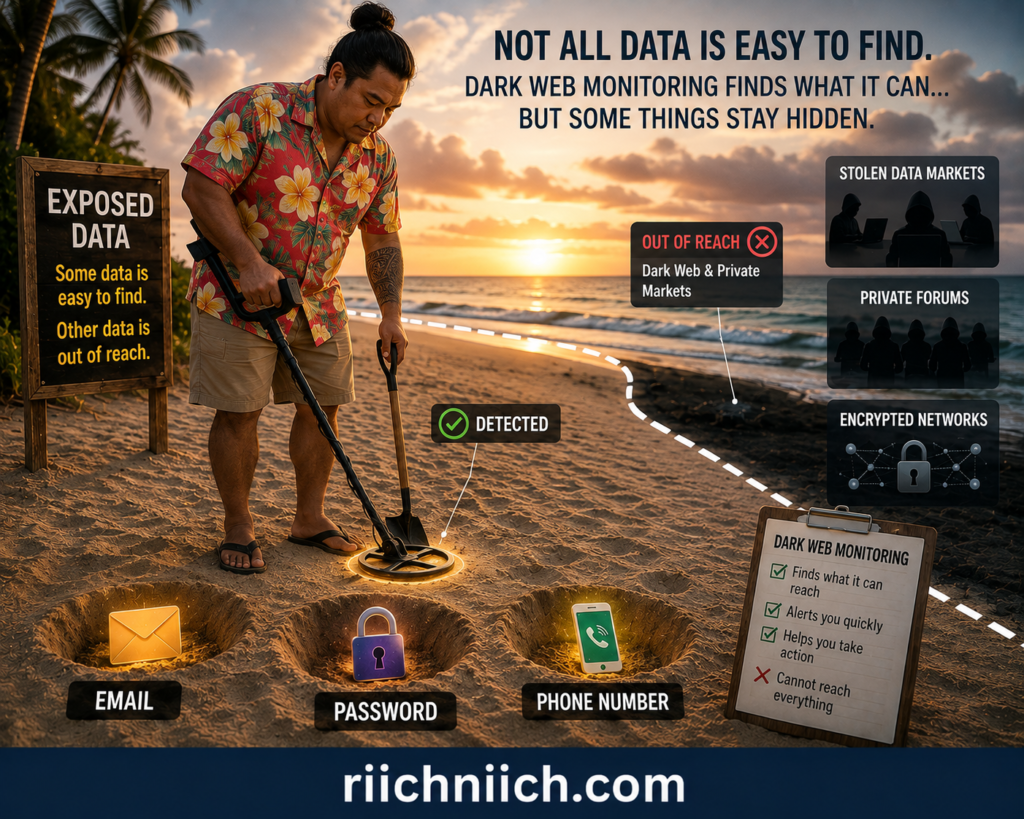
Dark web monitoring does not continuously scan every hidden corner of the internet.
Instead, monitoring providers generally search data sources available to them for information associated with identifiers you provide, such as an email address or other personal details. Coverage varies between services.
If a match is detected, the service may alert you and provide information about what was discovered.
This can help when researching how to know if someone is using your identity, but dark web monitoring should be viewed as an early-warning tool rather than proof of identity theft.
No monitoring service can guarantee that it will discover every instance of stolen information.
Know Which Personal Information Matters Most
Not every exposed piece of information creates the same level of risk.
An old email address is different from an exposed Social Security number.
Information worth paying close attention to includes:
Email addresses
Passwords
Phone numbers
Dates of birth
Social Security numbers
Driver’s license information
Passport information
Bank account information
Credit or debit card information
Security-question answers
Login credentials
A criminal may combine information from multiple breaches rather than relying on a single leaked record.
For example, an exposed email address from one breach and a reused password from another could potentially create an account-takeover opportunity.
Check Your Passwords After a Breach
If a breach exposes a password associated with one of your accounts, change it immediately.
Do not simply modify one character and continue using essentially the same password.
Create a strong, unique password for the affected account.
If you reused the compromised password anywhere else, change it on those accounts too.
Password reuse is particularly dangerous because attackers can try exposed username-and-password combinations on other websites, a technique commonly known as credential stuffing.
The Cybersecurity and Infrastructure Security Agency recommends using strong passwords and a password manager to help maintain unique credentials.
Turn On Multi-Factor Authentication
Even if someone obtains your password, multi-factor authentication can create an additional barrier to account access.
Enable MFA on important accounts whenever it is available, especially for email, banking, credit cards, password managers, cloud storage, and other accounts containing sensitive information.
Whenever possible, use stronger authentication options offered by the service rather than relying only on passwords.
An exposed password is much more concerning when it is the only thing protecting an account.
Do Not Try to Search the Dark Web Yourself
You do not need to visit hidden marketplaces, forums, or other risky websites to determine whether your information has been compromised.
Doing so can expose you to scams, malware, disturbing or illegal content, and misleading information.
Use established breach-notification tools, security services, and official notifications from companies instead.
If a company you use experiences a breach, its official notification should explain what happened, which information may have been involved, and what protective measures it recommends.
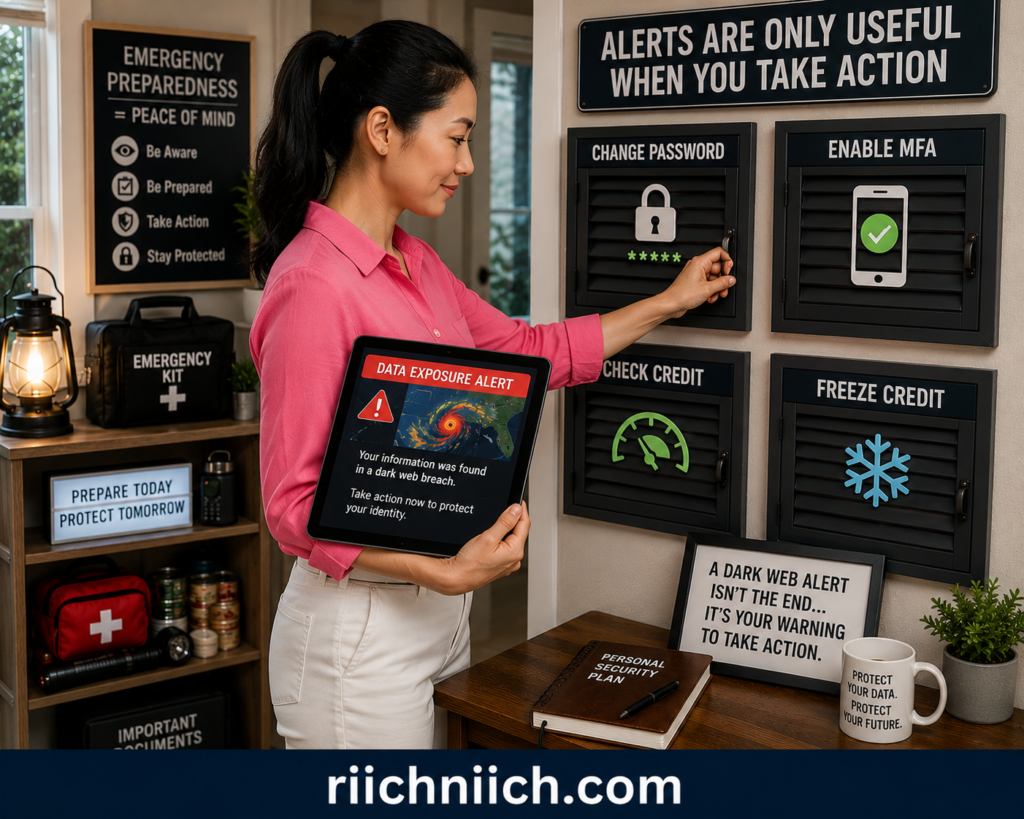
A Dark Web Alert Is a Starting Point, Not the End
Suppose an identity monitoring service tells you that your email address and password appeared in compromised data.
The alert itself does not solve the problem.
You still need to respond.
Change the compromised password, check whether it was reused, enable multi-factor authentication, review recent account activity, and monitor for suspicious login attempts.
If more sensitive information such as your Social Security number was exposed, consider stronger measures such as reviewing your credit reports and freezing your credit.
If you want to understand exactly what these services can detect—and what they cannot—read our guide, What Is Dark Web Monitoring and Is It Worth It?
What If Your Social Security Number Appears in a Breach?
Exposure of a Social Security number deserves greater attention than exposure of less sensitive information.
Check your credit reports for unfamiliar accounts and inquiries and consider freezing your credit with the three nationwide credit bureaus.
A credit freeze can make it more difficult for criminals to open certain new credit accounts using your identity.
You can learn about freezes and fraud alerts through the Federal Trade Commission’s official guidance.
Remember that freezing your credit does not prevent every type of identity theft. Continue monitoring financial, tax, Social Security, and online account activity when appropriate.
Free Breach Checking vs. Paid Dark Web Monitoring
You can perform several important checks yourself without paying for identity theft protection.
Free breach-notification tools, credit reports, account security alerts, credit freezes, and strong passwords can provide substantial protection when used consistently.
Paid dark web monitoring becomes more appealing when you want continuous automated monitoring instead of relying entirely on manual checks.
Depending on the identity theft protection provider and plan, monitoring may cover email addresses, phone numbers, Social Security numbers, financial information, or other personal data.
If information associated with you is detected, you may receive an alert explaining what was found and recommended next steps.
Is Dark Web Monitoring Alone Enough?
No.
Dark web monitoring should be one layer of a broader identity protection strategy.
Someone researching how to know if someone is using your identity should also monitor credit reports, financial accounts, credit inquiries, unfamiliar accounts, login alerts, tax records, and other relevant activity.
That distinction is important when comparing paid services.
A cheap dark web monitoring product may sound attractive, but a more comprehensive identity protection service could offer additional features such as credit monitoring, financial monitoring, identity alerts, restoration assistance, and identity theft insurance.
The best option depends on which risks you want monitored and how much monitoring you are willing to perform yourself.
What to Look for When Buying Dark Web and Identity Monitoring
Do not choose a service simply because its marketing says it “scans the dark web.”
Find out what it actually monitors.
Look for clearly explained monitoring coverage, useful alerts, credit monitoring options, identity restoration support, transparent insurance terms, family coverage if needed, and straightforward pricing.
Also compare what happens after an alert.
A monitoring service becomes considerably more useful when it not only tells you something may be wrong but also provides clear guidance or professional assistance for responding.
If your information has already appeared in multiple breaches, you have experienced previous identity theft, or you simply do not want to perform every check manually, broader identity theft protection may be worth the additional cost.
Ultimately, dark web monitoring is most useful as an early-warning system. When combined with strong passwords, multi-factor authentication, credit monitoring, account alerts, and quick action after a breach, it can become another valuable part of learning how to know if someone is using your identity.
How To Check Your Online Accounts for Suspicious Activity
Checking your online accounts is another important part of understanding how to know if someone is using your identity. Criminals do not always begin by opening a fraudulent loan or making a large bank withdrawal. Sometimes the first sign of trouble is an unfamiliar login, an unexpected password reset, a changed recovery email, or activity inside an account that you did not authorize.
Your email, shopping, social media, financial, cloud storage, and other important accounts can reveal warning signs before the problem spreads.
The goal is simple: know what normal activity looks like so unusual activity is easier to recognize.
Start With Your Email Account
Your primary email account should be one of the first accounts you inspect.
Email is particularly important because many websites use it for password resets, security notifications, verification codes, and account-recovery requests. If someone gains access to your inbox, they may attempt to use it to compromise other accounts.
Review your email security settings and look for unfamiliar devices, recent login activity, password changes, recovery email addresses, recovery phone numbers, forwarding rules, filters, and connected applications.
Pay particular attention to email forwarding.
An attacker who gains access to an inbox may attempt to create a forwarding rule so copies of certain messages are sent somewhere else.
If you find a forwarding address or rule you did not create, remove it, change your password, sign out other sessions, and review the account’s security settings.
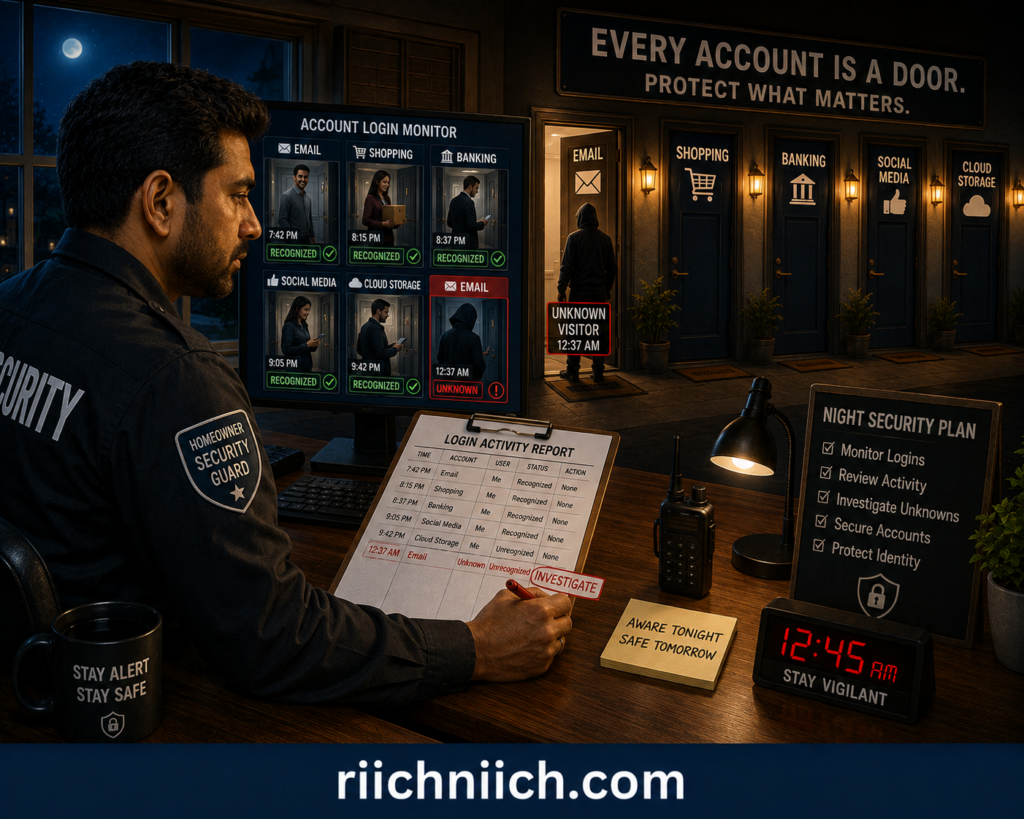
Review Recent Login Activity
Many major online services allow you to review recent sign-ins or devices connected to your account.
Look for devices, browsers, approximate locations, or login times that do not make sense.
For example, if your account shows a login from a device you have never owned at a time when you were not using the service, investigate it.
Remember that location information associated with logins is not always exact. Mobile networks, VPNs, corporate networks, and internet providers can make legitimate activity appear to originate somewhere unexpected.
Focus on the complete picture rather than location alone.
Look for Password Changes You Did Not Make
An unexpected password-change notification is a major warning sign.
If you receive an email saying your password was changed and you did not make the change, do not ignore it.
Go directly to the company’s official website or app rather than clicking a link in an unexpected message. Attempt to access the account and review its security information.
If you still have access, change the password immediately and sign out other active sessions when that option is available.
If you have been locked out, begin the company’s official account-recovery process.
Unexpected password activity is especially important when researching how to know if someone is using your identity because it may indicate that someone has obtained credentials associated with your personal information.
Check Your Recovery Information
Account recovery settings deserve as much attention as your password.
Review the phone number and email address used to recover each important account.
Make sure both still belong to you.
If an attacker changes the recovery information, they may be able to regain access even after you change the password.
Also check whether unfamiliar authentication methods, trusted devices, security keys, or backup options have been added.
Remove anything you do not recognize.
Look for Messages or Posts You Did Not Create
Your accounts can sometimes reveal compromise through activity other people notice first.
Watch for:
Messages you never sent
Social media posts you never created
Friend or follow requests you did not make
Emails appearing in your sent folder that you did not write
Comments you did not post
Purchases you did not make
Changes to your profile
New subscriptions
Unknown connected applications
If friends or family tell you they received a strange message from your account, investigate rather than assuming your account is fine because you can still log in.
Someone could potentially have unauthorized access without immediately changing your password.
Review Shopping and Marketplace Accounts
Shopping accounts often contain more sensitive information than people realize.
An account may store your name, address, phone number, purchase history, saved payment methods, and delivery information.
Review your order history for purchases you did not make.
Also inspect saved addresses and payment methods for anything unfamiliar.
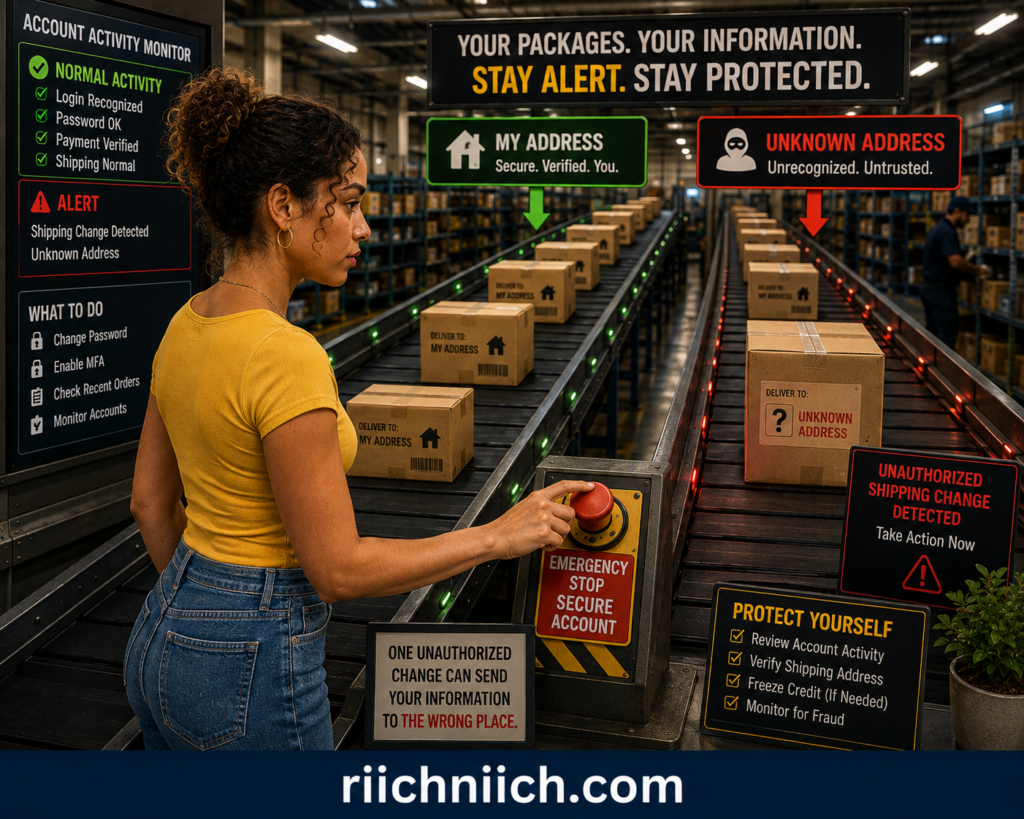
If an attacker changes the shipping address while leaving the rest of your account untouched, the compromise may be less obvious.
Check Connected Apps and Third-Party Access
Some online accounts allow other applications to connect to them.
Over time, you may authorize services and then forget about them.
Review the list of connected apps periodically and remove services you no longer use or recognize.
An old application with unnecessary account permissions can increase your exposure even if your password itself has not been stolen.
Keep access limited to services you currently trust and need.
Pay Attention to Verification Codes You Did Not Request
An unexpected verification code can indicate that someone is trying to sign in, reset your password, or complete another security-sensitive action.
Never give a verification code to someone who unexpectedly contacts you.
Scammers may impersonate a bank, technology company, retailer, or customer-support representative and claim they need the code to verify your identity.
In reality, the code may be the final piece they need to access your account.
The Federal Trade Commission’s phishing guidance explains how criminals use deceptive emails and messages to steal personal information.
Check for Security Alerts You May Have Missed
Search your email inbox for legitimate security notifications from services you use.
Terms such as “new login,” “new device,” “password changed,” “security alert,” and “verification code” can help you find previous notifications.
Verify each message carefully because phishing emails frequently imitate security alerts.
Do not use an email link if you are unsure whether a message is genuine. Open the company’s official app or manually navigate to its website instead.
Secure an Account If You Find Suspicious Activity
If you believe an online account has been compromised, act promptly.
Change the password to a strong, unique password you have never used elsewhere. Sign out unfamiliar devices and other active sessions where possible. Correct recovery information, remove unauthorized connected applications, and enable multi-factor authentication.
If you reused the compromised password on other accounts, change those passwords too.
The Cybersecurity and Infrastructure Security Agency recommends strong, unique passwords and password managers as important account-security practices.
If the compromised account involves banking or credit cards, contact the financial institution if unauthorized financial activity occurred.
Multi-Factor Authentication Adds an Important Barrier
A strong password should not be your only defense.
Enable multi-factor authentication on important accounts whenever available.
This is especially valuable for email, financial accounts, password managers, cloud storage, social media, and other services containing sensitive information.
The CISA Secure Our World guidance recommends using multi-factor authentication because it makes account access more difficult for attackers even when a password has been compromised.
MFA does not make an account impossible to compromise, so continue reviewing security alerts and account activity.
Does a Compromised Online Account Mean Your Identity Was Stolen?
Not necessarily.
Someone gaining access to one online account does not automatically mean they have enough information to commit broader identity theft.
But the risk becomes more concerning when account compromise appears alongside other warning signs, such as unfamiliar credit inquiries, fraudulent accounts, unauthorized financial transactions, changes to personal information, or exposed sensitive data.
That is why learning how to know if someone is using your identity requires monitoring several parts of your digital and financial life together.
Can Identity Theft Protection Monitor Online Risks?
You can perform most account-security checks yourself for free.
The challenge is keeping track of everything.
The average person may have dozens of online accounts, and manually reviewing all of them constantly is unrealistic.
This is where broader identity theft protection can add value.
👉 If you want broader identity monitoring without having to check everything manually, Aura is one option worth considering because it combines identity and credit monitoring with digital security tools and identity theft recovery support in one service. Check Aura’s Current Plans & Pricing →
Depending on the provider and plan, identity protection services may monitor certain personal information, credit activity, data breaches, dark web exposure, and other identity-related signals.
Some services may also provide alerts and identity restoration assistance if suspicious activity develops into actual identity theft.
However, an identity protection service generally cannot see everything happening inside every online account you own.
You should still use each account’s built-in security tools.
What to Look for Before Paying for Identity Monitoring
If online account compromise is one of your biggest concerns, look beyond the advertised number of features.
Compare whether the service provides dark web monitoring, breach notifications, credit monitoring, identity monitoring, useful alerts, restoration assistance, and identity theft insurance.
Also determine what personal information the service allows you to monitor and whether the coverage extends to family members if that matters to you.
A service that identifies compromised credentials but provides little guidance afterward may be less useful than one that combines monitoring with meaningful recovery support.
Paid monitoring should complement—not replace—strong passwords, multi-factor authentication, security alerts, and regular account reviews.
For anyone researching how to know if someone is using your identity, online accounts can provide some of the earliest clues that personal information has been compromised. Watch for unfamiliar logins, unexpected password resets, changed recovery information, unauthorized messages, unknown purchases, and security codes you never requested. Catching those warning signs early can give you an opportunity to secure your accounts before a smaller compromise develops into a much larger identity theft problem.
What To Do Immediately If Someone Is Using Your Identity
Once you understand how to know if someone is using your identity and find evidence of actual misuse, speed matters. Your priority should be to stop additional fraudulent activity, protect accounts that have not been compromised, document what happened, and begin correcting fraudulent records.
If you have confirmed identity theft and need a step-by-step plan, follow our Identity Theft Recovery Checklist to work through the recovery process in the right order.
Do not try to solve everything at once. Start with the accounts or information that are actively at risk, then work through the remaining steps systematically.
1. Contact the Company Where the Fraud Happened
Start with the bank, credit card issuer, lender, retailer, or other company connected to the fraudulent activity.
Ask for its fraud department and explain that someone appears to have used your identity without permission.
Depending on what happened, the company may be able to freeze or close the affected account, block transactions, replace a compromised card, remove unauthorized users, secure account access, or begin investigating a fraudulent account.
Use contact information from the company’s official website, mobile app, statement, or the back of your card. Do not rely on a phone number or link contained in a suspicious email or text message.
Document who you spoke with, the date, what was discussed, and any confirmation or case number you receive.
2. Report the Identity Theft
If you have confirmed identity theft, report it through IdentityTheft.gov, the Federal Trade Commission’s identity theft recovery website.
The site can help you develop a recovery plan based on the type of identity theft you experienced.
Keep copies of your identity theft documentation. You may need supporting records when communicating with businesses, credit bureaus, debt collectors, or other organizations.
3. Freeze Your Credit
If someone has enough personal information to attempt new-account fraud, consider freezing your credit with all three nationwide credit bureaus.
A credit freeze restricts access to your credit file and can make it more difficult for someone to open certain new credit accounts in your name.
Freezes are handled separately by Equifax, Experian, and TransUnion.
The Federal Trade Commission’s credit freeze guidance explains how credit freezes work and how they differ from fraud alerts.
A freeze does not stop every type of identity theft. It also does not prevent fraudulent transactions on an existing compromised account.
That is why a credit freeze should be one part of your response rather than your only action.
4. Consider Placing a Fraud Alert
A fraud alert tells businesses checking your credit that they should take steps to verify your identity before extending new credit.
Unlike a credit freeze, you generally only need to contact one of the three nationwide credit bureaus to place an initial fraud alert; that bureau is responsible for notifying the other two.
Depending on your situation, you may qualify for different types of fraud alerts.
You do not necessarily have to choose between a fraud alert and credit freeze. Understand what each tool does and use the protection appropriate for your circumstances.
5. Change Compromised Passwords
If an online account was compromised, change its password immediately.
Create a strong, unique password that you have never used on another account.
If the stolen password was reused elsewhere, change those accounts too.
Start with your most sensitive accounts, especially your primary email, banking, credit cards, password manager, cloud storage, and other accounts containing personal or financial information.
Also review your account-recovery email address and phone number to make sure an attacker has not changed them.
6. Enable Multi-Factor Authentication
Turn on multi-factor authentication wherever possible.
MFA creates another barrier between a criminal and your account if your password is compromised.
Also review trusted devices, active sessions, connected applications, security keys, and other authentication methods associated with your accounts.
Remove anything you do not recognize.
Never approve an authentication request you did not initiate.
7. Review All Three Credit Reports
After finding one fraudulent account, check whether there are others.
Request your credit reports through AnnualCreditReport.com.
Look for unfamiliar accounts, hard inquiries, addresses, collection accounts, balances, and other information that does not belong to you.
Do not assume one fraudulent account means the criminal only tried once.
Learning how to know if someone is using your identity also means understanding that identity thieves may attempt to use the same stolen information with multiple companies.
8. Dispute Fraudulent Accounts and Information
If fraudulent information appears on your credit reports, begin the dispute process with the appropriate credit reporting company and contact the business that supplied the information.
Keep copies of everything you submit.
Record dates, case numbers, letters, emails, screenshots, and the names of representatives you speak with.
Do not rely on memory to track an identity theft recovery process that could involve several companies.
Create a dedicated digital or physical folder for your documentation.
9. Secure Your Financial Accounts
Review your bank, credit card, investment, and payment accounts.
Look for unauthorized transactions, unfamiliar linked accounts, unknown payees, new authorized users, address changes, or altered contact information.
Enable transaction alerts when available.
If account numbers or payment cards have been compromised, ask the financial institution what steps it recommends, which may include replacing the card or changing account information.
Continue monitoring after the initial fraud has been resolved. A criminal may attempt to use stolen information again later.
10. Respond Based on What Information Was Stolen
Your response should match the type of information compromised.
A stolen password requires a different response than an exposed Social Security number.
If a password was compromised, change it and secure accounts where it was reused.
If payment-card information was stolen, contact the card issuer and monitor transactions.
If your Social Security number or other highly sensitive identifying information was compromised, credit freezes and longer-term monitoring become especially important.
If tax-related identity theft is involved, use the IRS Identity Theft Central for official guidance.
11. Be Alert for Follow-Up Scams
Identity theft victims can become targets for additional scams.
A criminal may contact you pretending to be a bank employee, government official, fraud investigator, or identity recovery specialist.
They may already know personal information about you, making the call or message sound convincing.
Do not provide passwords, authentication codes, or sensitive information simply because someone knows your name, address, or other details.
End the communication and contact the organization independently through an official channel.
12. Continue Monitoring After the Immediate Problem Is Fixed
Closing one fraudulent account does not necessarily mean the risk has disappeared.
Stolen personal information can remain useful to criminals for a long time, especially information that cannot easily be changed.
Continue reviewing your credit reports, financial accounts, security alerts, and important online accounts.
This is where many consumers begin considering paid identity theft protection.
When Identity Theft Protection Can Be Worth Buying
If someone has already used your identity, your needs may be different from someone simply trying to prevent identity theft.
You are no longer dealing only with a theoretical risk.
You may need ongoing monitoring and assistance if additional fraudulent activity appears.
Depending on the provider and plan, identity theft protection may include credit monitoring, identity monitoring, dark web monitoring, financial alerts, restoration assistance, and identity theft insurance.
For someone who has experienced actual identity theft, restoration support can be just as important as monitoring.
When comparing plans, ask:
Does the service provide access to identity restoration specialists?
Does it monitor all three credit bureaus or fewer?
What personal information can it monitor?
How quickly are alerts delivered?
What does the identity theft insurance actually cover?
Are existing identity theft problems eligible for assistance?
Does the service offer family coverage if other household members are at risk?
What will the plan cost after any introductory pricing ends?
Pay particular attention to the question about existing identity theft. Do not assume that purchasing a service after discovering fraud means the provider will automatically resolve everything that happened before enrollment. Coverage and restoration policies vary.
Free Recovery vs. Paid Identity Restoration
You can recover from identity theft without buying a protection service.
Federal resources, credit freezes, credit reports, financial account alerts, password changes, and direct disputes provide powerful tools for handling identity theft yourself.
Paid protection is primarily about convenience, additional monitoring, alerts, and access to recovery assistance.
If your case involves one fraudulent credit card that you quickly resolve, you may feel comfortable handling monitoring yourself.
If multiple accounts are involved, highly sensitive information has been exposed, or you are worried about additional attempts, professional restoration assistance and ongoing monitoring may become considerably more valuable.
That is the buyer-intent decision to make after learning how to know if someone is using your identity:
Do you want to continue monitoring and managing potential identity theft yourself, or would you rather pay for a service that automates part of the monitoring and provides professional support if another problem appears?
Neither approach eliminates identity theft risk completely. The important thing is to respond quickly, secure what has been compromised, prevent additional damage where possible, and continue watching for signs that your stolen information is being used again.
Should You Freeze Your Credit If Someone Is Using Your Identity?
Yes, if you discover evidence that someone is using your identity—or you believe sensitive information such as your Social Security number has been compromised—freezing your credit can be one of the strongest steps for reducing the risk of certain types of new-account fraud.
A credit freeze restricts access to your credit file. Because many lenders check credit before approving a new account, a freeze can make it more difficult for an identity thief to open certain credit cards or loans in your name.
However, a credit freeze is not a complete identity theft solution. It will not stop every type of fraud, which is why understanding how to know if someone is using your identity and continuing to monitor your accounts remain important even after your credit is frozen.
What Does a Credit Freeze Actually Do?
A credit freeze—also called a security freeze—limits access to your credit file.
If someone has your name, date of birth, Social Security number, and other personal information and attempts to apply for new credit, a lender may be unable to access your frozen credit report as part of its normal approval process.
That can create a significant obstacle for the identity thief.
A freeze does not damage your credit score, and federal law allows you to place and remove a security freeze for free.
The Federal Trade Commission’s credit freeze guidance provides official information about how freezes work and how to place them.
When Should You Consider Freezing Your Credit?
You do not necessarily need to wait until identity theft has been confirmed.
A freeze may be worth considering if:
Your Social Security number has been exposed
You discover a credit account you never opened
An unfamiliar hard inquiry appears on your credit report
Someone attempts to obtain credit using your information
You receive bills or collection notices for unknown accounts
Your personal information was exposed in a serious data breach
You have already experienced identity theft
You simply want to make new-account credit fraud more difficult
For someone researching how to know if someone is using your identity, finding an unfamiliar credit account or application is a particularly strong reason to consider a freeze.
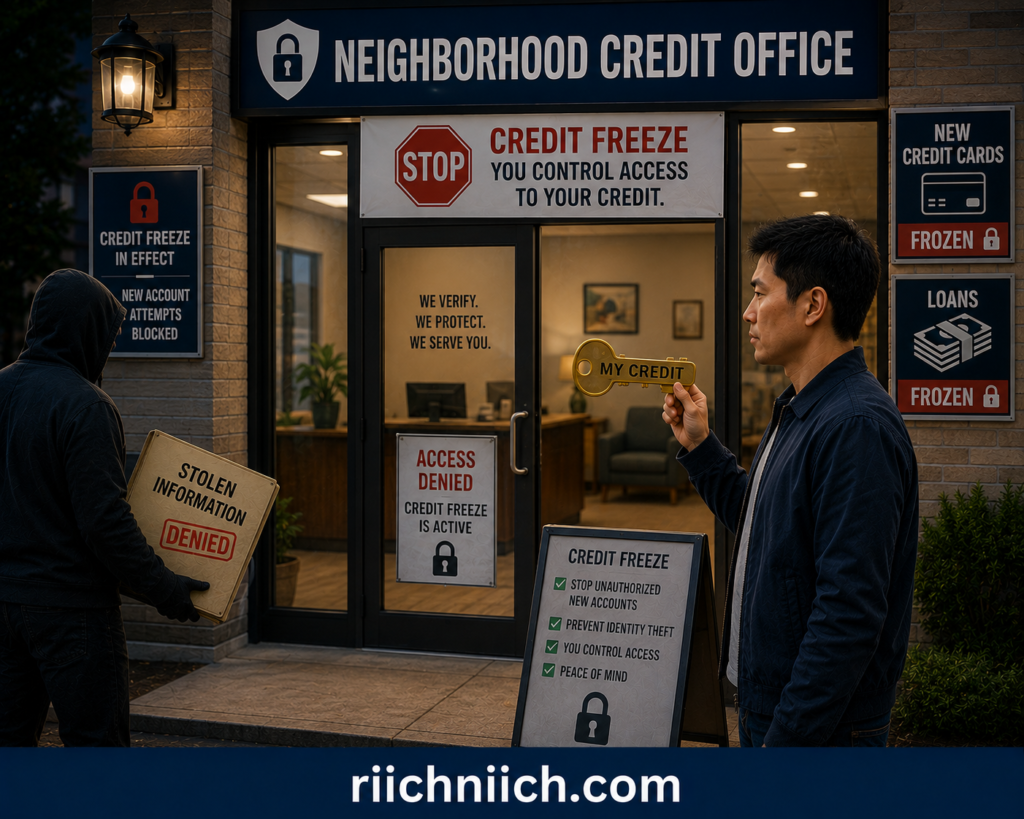
You Need to Freeze All Three Credit Reports
This is important: freezing your credit with one bureau does not automatically freeze it with the other two.
You should generally contact all three nationwide credit bureaus separately:
Follow each bureau’s instructions and keep the information associated with managing your freezes somewhere secure.
What a Credit Freeze Does NOT Stop
A credit freeze is powerful, but its limitations are equally important to understand.
It does not guarantee that nobody can use your identity.
A freeze generally will not stop someone from:
Using an existing stolen credit card
Accessing an online account with compromised credentials
Attempting bank-account fraud
Using a stolen password
Sending phishing messages in your name
Attempting certain forms of tax identity theft
Misusing personal information in situations that do not require a credit check
That is why a credit freeze should be viewed as one security layer.
You should still review financial accounts, monitor important online accounts, use strong unique passwords, enable multi-factor authentication, and investigate suspicious activity.
Will Freezing Your Credit Hurt Your Credit Score?
No. Placing a security freeze does not affect your credit score.
It also does not prevent you from using existing credit cards or paying existing loans.
The main inconvenience appears when you want to apply for new credit.
For example, if you plan to finance a vehicle, apply for a mortgage, open a new credit card, or complete another transaction requiring access to your credit file, you may need to temporarily lift the appropriate freeze.
Afterward, you can freeze the file again.
Credit Freeze vs. Fraud Alert
Credit freezes and fraud alerts are related, but they are not the same thing.
A credit freeze restricts access to your credit file.
A fraud alert tells businesses that they should verify your identity before opening new credit in your name.
Another important difference involves setup.
For a credit freeze, you generally need to contact each nationwide credit bureau separately.
For an initial fraud alert, you can contact one of the three bureaus, and that bureau is responsible for notifying the other two.
The Federal Trade Commission explains the differences and eligibility requirements in more detail.
Depending on your circumstances, you may decide to use both.
If you are deciding between the two major ways of restricting access to your credit file, our Credit Freeze vs. Credit Lock comparison explains the differences and which option may make more sense for protecting your identity.
Should You Freeze Your Child’s Credit?
Identity theft can affect children too.
A child’s Social Security number can be particularly attractive to criminals because fraudulent activity may remain unnoticed until years later when the child first applies for credit.
Parents and guardians can request security freezes for eligible minors by following the procedures established by each credit bureau.
If you are protecting an entire household, this is worth considering when evaluating both free identity protection measures and paid family identity theft protection plans.
Do You Still Need Credit Monitoring After Freezing Your Credit?
Yes, monitoring can still be useful.
A credit freeze and credit monitoring perform different jobs.
Think of a freeze as a barrier, while monitoring acts more like an alarm.
The freeze can make certain new-account fraud more difficult. Monitoring can alert you when certain activity involving your credit or identity is detected.
Neither replaces the other completely.
This distinction matters when researching how to know if someone is using your identity. You want both defensive measures that make fraud harder and detection methods that help you recognize suspicious activity.
Is Identity Theft Protection Still Worth It With Frozen Credit?
Potentially, yes—because identity theft extends beyond credit.
Freezing your credit provides strong protection against certain new-account credit fraud, but it does not monitor your entire identity.
Depending on the provider and plan, paid identity theft protection may include credit monitoring, dark web monitoring, identity monitoring, financial account monitoring, data breach alerts, identity restoration assistance, and identity theft insurance.
That broader coverage can become especially valuable if your personal information has already been compromised.
What to Look for If Your Credit Is Already Frozen
If you already maintain credit freezes, do not pay for an identity protection service solely because it advertises credit monitoring.
Look at what the service adds beyond the freeze.
Consider whether the plan provides:
Three-bureau credit monitoring
Social Security number monitoring
Dark web monitoring
Financial account alerts
Data breach notifications
Identity restoration specialists
Identity theft insurance
Family or child identity monitoring
Useful, fast alerts
A clear recovery process
A comprehensive plan should provide value in areas your credit freeze cannot address.
Credit Freeze + Monitoring Can Be a Strong Combination
You do not necessarily have to choose between free credit freezes and paid identity monitoring.
They can work together.
The freeze creates a barrier against certain forms of new-account fraud. Monitoring watches for certain signs of identity exposure or suspicious activity. Your own security habits protect individual accounts. Restoration assistance can help if fraud still occurs.
This layered approach becomes particularly attractive after you have already discovered evidence that someone is using your personal information.
If you are learning how to know if someone is using your identity because you have found an unfamiliar account, credit inquiry, or other serious warning sign, freezing all three credit reports is a practical step to consider immediately.
Just remember what a freeze can—and cannot—do. It can make certain new credit fraud considerably more difficult, but it cannot protect every part of your identity. Continue monitoring your financial accounts, online accounts, credit reports, and sensitive personal information, and consider broader identity theft protection if you want automated monitoring and professional recovery support beyond what a credit freeze provides.
Can Identity Theft Protection Help If Someone Is Using Your Identity?
Yes. Identity theft protection can help if someone is using your identity, particularly by monitoring for certain suspicious activity, alerting you to potential problems, and providing recovery assistance after identity theft occurs. However, no identity theft protection service can guarantee that criminals will never obtain or misuse your personal information.
If you are researching how to know if someone is using your identity because you have already discovered suspicious activity, the most valuable features may be different from those needed by someone who simply wants preventative monitoring.
Instead of focusing only on the number of features advertised, look closely at three things: what the service monitors, how quickly it alerts you, and what help you receive when identity theft actually happens.
Identity Theft Protection Is Primarily About Detection and Recovery
Identity theft protection is sometimes marketed as though it creates an invisible shield around your identity.
That is not how it works.
A monitoring service cannot prevent every data breach, stop every phishing attack, or guarantee that nobody will ever obtain your Social Security number.
Its value comes primarily from helping detect certain signs of identity misuse and supporting you if fraud occurs.
Depending on the provider and plan, identity theft protection may include credit monitoring, identity monitoring, dark web monitoring, data breach alerts, financial account monitoring, Social Security number monitoring, identity restoration assistance, and identity theft insurance.
Features and coverage vary significantly between services and plans.

Credit Monitoring Can Help Detect New-Account Fraud
If someone attempts to open a credit account using your information, certain activity may appear on your credit reports.
Credit monitoring can alert you to changes such as a new credit inquiry or newly reported account, depending on the service.
The important buying consideration is how many credit bureaus are monitored.
Some plans may monitor one credit bureau, while others provide monitoring across Equifax, Experian, and TransUnion.
If detecting credit-related identity theft is one of your biggest concerns, three-bureau monitoring can provide broader visibility because information may not appear identically across every bureau.
You should still periodically review your own credit reports through AnnualCreditReport.com.
Dark Web Monitoring Can Warn You About Exposed Information
Dark web monitoring may alert you when certain information associated with you is discovered in compromised data available to the monitoring provider.
Depending on the service, monitored information may include email addresses, passwords, phone numbers, Social Security numbers, or other identifiers.
This can be useful when trying to understand how to know if someone is using your identity, but remember that exposure and misuse are different.
Finding your email address in breached data does not prove someone has stolen your identity.
Instead, an alert should prompt action based on what was exposed.
A compromised password should be changed immediately. Exposure of a Social Security number may justify reviewing your credit reports and considering credit freezes.
Financial Monitoring Can Add Another Layer
Credit monitoring will not necessarily detect unauthorized activity inside an existing bank or credit card account.
Some identity theft protection plans therefore provide additional financial monitoring features.
Depending on the service, you may be able to monitor certain financial accounts or receive notifications about specified activity.
This can be useful for someone managing multiple bank accounts, credit cards, investments, or other financial relationships.
However, your bank’s own fraud detection and transaction alerts remain important.
Paid identity protection should complement those tools rather than replace them.
Identity Restoration Can Be Extremely Valuable After Fraud
Monitoring tells you there may be a problem.
Restoration helps you deal with what happens next.
If someone has already used your identity, restoration assistance may become one of the most valuable reasons to pay for an identity theft protection service.
Depending on the provider and plan, restoration specialists may help guide you through steps involving fraudulent accounts, creditors, credit bureaus, documentation, and other parts of the recovery process.
This can reduce some of the administrative burden associated with resolving identity theft.
Before subscribing, determine whether restoration assistance applies to identity theft that occurred before you purchased the plan. Do not assume a newly purchased service will automatically resolve an existing case.
If identity theft has already occurred, you can also use IdentityTheft.gov to create a recovery plan at no cost.
Identity Theft Insurance Can Help With Certain Recovery Costs
Many identity protection services advertise identity theft insurance.
This can sound impressive, especially when a large coverage amount is advertised.
But the headline number does not tell the entire story.
Identity theft insurance generally covers specific eligible expenses subject to the policy’s terms, conditions, exclusions, limits, and deductibles, if applicable.
Before purchasing a plan, read what the insurance actually covers.
Look for information about eligible expenses, stolen-funds reimbursement where offered, legal expenses where applicable, lost wages where applicable, individual versus family limits, exclusions, and claim requirements.
Do not assume that a “$1 million identity theft insurance” advertisement means the company will simply pay you $1 million if your identity is stolen.
Alerts Are Only Valuable If They Arrive Quickly and Explain What Happened
Monitoring becomes less useful when an alert arrives too late or provides little information about what you should do.
When comparing identity theft protection services, consider the quality of their alerts.
A useful notification should help you understand what was detected and what action may be appropriate.
For example, an alert about a new credit inquiry should give you enough information to determine whether you initiated it.
If you did not, you can investigate immediately.
The sooner you recognize unauthorized activity, the sooner you can take steps to limit additional damage.
Identity Protection Cannot Replace a Credit Freeze
Even premium identity theft protection should not stop you from using free security tools.
If your Social Security number has been compromised or someone is attempting to open accounts in your name, consider freezing your credit.
The Federal Trade Commission’s credit freeze guidance explains how security freezes and fraud alerts work.
Think of identity monitoring and credit freezes as performing different jobs.
A credit freeze creates a barrier. Identity monitoring watches for warning signs.
Using both can provide stronger protection against certain forms of identity fraud than relying on either one alone.
Who Is Most Likely to Benefit From Paid Identity Theft Protection?
Not everyone needs to pay for identity monitoring.
A do-it-yourself approach may be enough if you consistently check credit reports, maintain credit freezes, monitor financial accounts, use transaction alerts, protect passwords, enable multi-factor authentication, and respond quickly to security notifications.
Paid protection becomes more attractive when you want those efforts partially automated.
It may be particularly useful if your sensitive information has already been exposed in data breaches, you previously experienced identity theft, you manage numerous financial accounts, you want to monitor multiple family members, or you want access to professional restoration support.
Convenience is part of what you are buying.
👉 If your priority is dedicated identity and credit monitoring, Identity Guard is another service worth comparing before you buy, especially if you want multiple plan levels instead of paying automatically for the most feature-heavy option. See Identity Guard’s Current Plans & Pricing →
What Should You Look for Before Buying Identity Theft Protection?
For someone researching how to know if someone is using your identity, prioritize services that provide meaningful monitoring rather than unnecessary extras.
Important features to compare include:
Three-bureau credit monitoring
Dark web monitoring
Social Security number monitoring
Financial account monitoring
Fast identity alerts
Data breach notifications
Identity restoration assistance
Identity theft insurance
Family and child monitoring
Transparent pricing
Renewal costs
Easy cancellation
Also check which features are included in the specific plan you are considering. A provider may advertise a feature that is only available on a more expensive tier.
If you would rather compare your options directly, we reviewed the Best Identity Theft Protection Services based on the monitoring, alerts, recovery support, and other features that matter when protecting your personal information.
Free Monitoring vs. Paid Identity Theft Protection
There is a lot you can do without spending money.
You can freeze your credit for free, review your credit reports, enable bank transaction alerts, monitor online accounts, use strong passwords, enable MFA, and report identity theft through government resources.
Those protections remain valuable whether or not you subscribe to a paid service.
The difference is largely automation, monitoring breadth, alerts, and recovery assistance.
If you are comfortable managing everything yourself, paying for identity protection may not be necessary.
If you would rather have a service continuously watching certain identity signals and providing support when something goes wrong, paying for a comprehensive plan can be worthwhile.
The Most Important Feature May Change After Identity Theft Happens
Before identity theft, monitoring may be the feature that attracts you.
After identity theft, restoration support may become the feature you value most.
That distinction should influence your buying decision.
Do not choose a service based entirely on its ability to send alerts. Ask what happens when an alert turns into confirmed fraud.
Will you receive professional assistance?
Can someone help you understand the recovery process?
What expenses may qualify under the insurance policy?
What support is available if multiple accounts are involved?
These questions matter significantly more once someone has actually misused your identity.
Ultimately, identity theft protection can provide a valuable additional layer for someone learning how to know if someone is using your identity, particularly when it combines broad monitoring, useful alerts, and strong recovery support.
It cannot make identity theft impossible. But for consumers who want more than a do-it-yourself approach—especially those whose personal information has already been compromised—a reputable identity theft protection service can make detecting and responding to identity fraud considerably easier.
Best Identity Theft Protection Features to Look For
If you are researching how to know if someone is using your identity, choosing an identity theft protection service should come down to more than price or a long list of advertised features. The best service is one that monitors the risks that matter to you, sends useful alerts quickly, and provides meaningful help if identity theft actually occurs.
Some plans focus primarily on credit monitoring. Others combine credit, identity, dark web, financial, and family monitoring with restoration assistance and identity theft insurance.
Before paying for a subscription, understand exactly what you are getting.
1. Three-Bureau Credit Monitoring
Credit monitoring is one of the most valuable features to consider when your primary concern is someone opening credit accounts in your name.
Look for plans that monitor credit activity across Equifax, Experian, and TransUnion.
Why does this matter?
Information can differ between credit bureaus. Monitoring only one bureau could provide less visibility than monitoring all three.
Depending on the service, alerts may cover certain new accounts, hard inquiries, or other changes to your credit file.
You should still periodically review your official credit reports through AnnualCreditReport.com, even if you pay for monitoring.
When comparing plans, verify whether three-bureau monitoring is included at your chosen tier rather than assuming it comes standard.
2. Fast and Useful Identity Alerts
Monitoring is only valuable when you learn about suspicious activity quickly enough to investigate it.
Look for a service that provides timely alerts through convenient channels such as mobile notifications, email, text messages, or an account dashboard, depending on what the provider offers.
The alert should also explain why you are receiving it.
A vague warning that says “activity detected” is less useful than an alert that identifies the type of activity and gives you enough information to determine whether you recognize it.
When learning how to know if someone is using your identity, actionable alerts can make the difference between noticing suspicious activity quickly and discovering it much later.
3. Dark Web Monitoring
Dark web monitoring looks for certain personal information within compromised data sources available to the monitoring provider.
Depending on the service, monitored information may include email addresses, passwords, phone numbers, Social Security numbers, or other identifiers.
Remember that dark web monitoring has limitations.
No company can monitor every criminal marketplace, private forum, database, or hidden communication channel.
Instead of choosing a service because it claims to “scan the dark web,” find out what personal information it monitors and what happens when a match is found.
The value comes from receiving a useful warning and knowing what action to take afterward.
4. Social Security Number Monitoring
Your Social Security number is one of the most sensitive pieces of identifying information you have.
If SSN exposure is one of your main concerns, look for a service that clearly explains how its Social Security number monitoring works.
Do not assume that monitoring means the provider can see every place your SSN is being used.
No identity monitoring service has universal visibility into every transaction or database.
Instead, determine which sources the provider monitors and what types of activity may trigger an alert.
If your SSN has already been compromised, combine monitoring with other protections such as reviewing your credit reports and considering credit freezes.
5. Financial Account Monitoring
Someone could misuse an existing financial account without opening a new credit account.
That means credit monitoring alone may not detect every financial problem.
Some identity protection services offer financial account monitoring that allows you to connect certain bank, credit card, investment, or other accounts.
Features vary substantially between providers.
Before paying extra for financial monitoring, determine which types of accounts are supported, which transactions or changes trigger alerts, and whether you are comfortable connecting those accounts to the service.
Continue using your bank’s own fraud detection and transaction notifications regardless of whether you purchase identity protection.
6. Data Breach Notifications
Data breaches can expose personal information long before identity theft occurs.
A useful identity protection service may notify you when information associated with you appears to have been involved in a known breach.
The alert should ideally tell you what type of information was exposed so you can respond appropriately.
A leaked password requires a different response than an exposed Social Security number.
The Federal Trade Commission’s data breach guidance explains steps consumers can take depending on the type of information involved.
7. Identity Restoration Assistance
Monitoring tells you something might be wrong.
Restoration assistance helps you figure out what to do next.
If you have already experienced identity theft—or are especially concerned about the recovery process—this can be one of the most valuable features in a paid service.
Depending on the provider, restoration specialists may help guide you through contacting creditors, addressing fraudulent accounts, handling documentation, communicating with credit bureaus, and completing other recovery steps.
Before subscribing, determine exactly what “restoration” means.
Ask whether you receive a dedicated specialist, how assistance is delivered, what situations qualify, and whether problems that started before enrollment are covered.
You can also use IdentityTheft.gov for a free identity theft recovery plan.
8. Identity Theft Insurance
Identity theft insurance can provide financial assistance for certain eligible expenses resulting from covered identity theft events.
Do not choose a plan based solely on the advertised coverage amount.
Read the terms.
Determine whether coverage may include eligible legal expenses, lost wages, recovery costs, or stolen-funds reimbursement where applicable.
Also check for exclusions, sublimits, deductibles, claim requirements, and whether coverage limits apply individually or across a family plan.
Insurance is valuable only when you understand what it actually covers.
9. Family and Child Identity Monitoring
If you are protecting more than yourself, family coverage can significantly affect the value of a subscription.
Compare how many adults and children can be included and which monitoring features each family member actually receives.
Do not assume that every person on a family plan receives identical protection.
Children deserve particular attention because fraudulent activity involving a child’s identity may remain unnoticed for years.
If family protection is important to you, compare the total household cost rather than simply looking at the advertised starting price.
10. Account Takeover and Online Monitoring Features
Identity theft increasingly overlaps with compromised online accounts.
Look for monitoring features that can complement your own account-security practices.
Depending on the provider, this might include compromised credential alerts, breach notifications, or other identity-related monitoring.
However, no identity protection service should replace strong unique passwords, multi-factor authentication, and security alerts built into your accounts.
The Cybersecurity and Infrastructure Security Agency recommends multi-factor authentication as an important defense against account compromise.
11. An Easy-to-Use Mobile App and Dashboard
A monitoring service is much less valuable if you rarely use it because the interface is confusing.
A good dashboard should make it easy to understand your monitoring status, review alerts, update monitored information, access credit information where included, and find help when something goes wrong.
Mobile access can be particularly useful for urgent alerts.
If suspicious activity occurs, you want to understand the notification quickly rather than searching through complicated menus.
12. Transparent Pricing and Renewal Costs
The lowest advertised price is not necessarily the lowest long-term cost.
Some identity protection services use introductory pricing that increases when the subscription renews.
Before subscribing, determine:
The introductory price
The regular renewal price
Whether billing is monthly or annual
Which features require a higher-priced tier
How many people are covered
Whether cancellation is straightforward
Whether there is a trial or refund policy
This is especially important when comparing services because a plan that appears cheaper initially could become considerably more expensive over time.
13. Strong Recovery Support After Identity Theft
If you are researching how to know if someone is using your identity because suspicious activity has already appeared, prioritize what happens after fraud is confirmed.
Monitoring alone may no longer be enough.
You may need help identifying affected accounts, organizing documentation, understanding disputes, communicating with companies, and continuing to monitor for additional misuse.
That makes recovery support a major buying consideration.

Which Identity Theft Protection Features Matter Most?
You probably do not need every feature advertised by every provider.
Focus on your actual risk.
If your biggest concern is fraudulent credit accounts, prioritize three-bureau credit monitoring and consider maintaining credit freezes.
If your information has repeatedly appeared in data breaches, dark web monitoring and breach alerts may be more important.
If you manage many financial accounts, financial monitoring may provide additional value.
If you have already experienced identity theft, professional restoration support should move much higher on your priority list.
And if you are protecting an entire household, family pricing and child identity monitoring become essential considerations.
👉 Want these protections handled in one place? If you would rather have a service monitoring multiple areas of your identity instead of managing every check yourself, Aura is one of the more comprehensive options to compare. See Aura’s Current Offer & Protection Plans →
Do Not Pay for Features You Can Get Free
Buyer intent does not mean automatically choosing the most expensive plan.
Several powerful identity protection measures are available for free.
You can freeze your credit, obtain credit reports, enable financial transaction alerts, use multi-factor authentication, review account activity, and report identity theft through government resources without paying a subscription fee.
Paid identity protection should provide something meaningful beyond what you are willing to do yourself.
For many people, that value comes from continuous monitoring, centralized alerts, broader coverage, insurance, and professional restoration assistance.
What Is the Best Identity Theft Protection Setup?
For someone serious about how to know if someone is using your identity, a layered approach generally makes more sense than relying on a single product.
Use strong unique passwords and multi-factor authentication to protect accounts. Consider credit freezes to make certain new-account fraud more difficult. Monitor your financial accounts and credit reports. Pay attention to breach notifications.
Then, if you want more automation and professional support, add an identity theft protection service that fills the gaps you do not want to manage yourself.
When comparing paid plans, prioritize three-bureau credit monitoring, useful alerts, dark web and identity monitoring, restoration support, transparent insurance terms, and reasonable long-term pricing.
Those features are more important than flashy extras because they address the two things that matter most when identity theft happens: finding suspicious activity sooner and getting help recovering afterward.
Common Mistakes to Avoid If Someone Is Using Your Identity

Once you understand how to know if someone is using your identity, what you do next can significantly affect how quickly you contain the problem. People sometimes focus on the first fraudulent transaction they discover while overlooking other accounts, credit reports, passwords, or personal information that may also be at risk.
Avoiding these common mistakes can help you respond more effectively and reduce the chance of additional problems.
Mistake #1: Waiting to See If More Fraud Happens
One of the biggest mistakes is ignoring a suspicious account or transaction because the amount is small.
You may think, “I’ll wait and see if anything else happens.”
That can give a criminal more time to misuse compromised information.
If you discover an unfamiliar credit inquiry, unauthorized transaction, unexpected account, or security change, investigate it promptly.
One suspicious event does not automatically prove identity theft, but it should not be ignored.
Mistake #2: Only Checking the Account Where You Found the Fraud
Suppose you discover an unauthorized credit card account.
Closing that account is important, but it should not necessarily be the end of your investigation.
If someone had enough personal information to open one account, they may have attempted to open others.
Review your credit reports, financial accounts, important online accounts, and recent security notifications for additional suspicious activity.
Understanding how to know if someone is using your identity means looking for patterns rather than focusing exclusively on the first problem you find.
Mistake #3: Assuming a New Password Fixes Everything
Changing a compromised password is important, but it may not be enough.
If someone gained access to an online account, review its security settings too.
Check recovery email addresses, recovery phone numbers, trusted devices, active sessions, connected applications, forwarding rules, and authentication methods.
Also determine whether you reused the compromised password elsewhere.
If you did, change it on those accounts as well.
Use unique passwords and enable multi-factor authentication whenever available.
Mistake #4: Reusing the Same Password After a Breach
A surprisingly dangerous response to a compromised password is changing:
MyPassword1
to something like:
MyPassword2
That does not provide the same protection as replacing it with a completely different, strong password.
More importantly, never continue using a compromised password across multiple accounts.
Attackers can attempt stolen username-and-password combinations on other websites.
The Cybersecurity and Infrastructure Security Agency recommends strong passwords and using a password manager to help maintain unique credentials.
Mistake #5: Forgetting to Freeze Your Credit
If your Social Security number or other sensitive identifying information has been compromised, simply monitoring your credit may not be enough.
Monitoring tells you about certain activity.
A credit freeze creates a barrier against certain new-account fraud by restricting access to your credit file.
The Federal Trade Commission provides official information about credit freezes and fraud alerts.
Remember that you generally need to freeze your credit separately with Equifax, Experian, and TransUnion.
A freeze does not prevent every type of identity theft, so continue monitoring other accounts.
Mistake #6: Thinking a Credit Freeze Stops All Identity Theft
The opposite mistake is assuming that once your credit is frozen, you are completely protected.
You are not.
A credit freeze generally will not stop someone from using an already-compromised credit card, attempting to access an existing account, using stolen passwords, or committing forms of fraud that do not require access to your credit report.
Continue checking bank accounts, credit cards, online accounts, tax-related communications, and other sensitive records.
Credit freezes are extremely useful, but they are only one layer of protection.
Mistake #7: Clicking Links in Unexpected Fraud Alerts
Criminals know people are afraid of identity theft.
They exploit that fear.
You might receive a message claiming:
“Suspicious activity detected.”
“Your bank account has been compromised.”
“Your Social Security number has been suspended.”
“Click immediately to secure your account.”
The message itself could be the scam.
Do not automatically click a link or call an unfamiliar phone number.
Instead, independently open the company’s official website or app and check your account there.
The Federal Trade Commission’s phishing guidance explains common warning signs of phishing attempts.
Mistake #8: Paying an Unfamiliar Debt Without Investigating It
Receiving a collection notice can be intimidating.
Some people may be tempted to pay the debt simply to make the problem disappear.
Do not assume an unfamiliar debt belongs to you.
Verify the collection company and determine which original account created the debt.
If the account resulted from identity theft, paying it without investigating could complicate your efforts to understand what happened.
Keep documentation and follow the appropriate identity theft and dispute procedures.
Mistake #9: Failing to Document Your Recovery
Identity theft recovery can involve numerous phone calls, emails, disputes, letters, and case numbers.
Do not rely on memory.
Create a dedicated identity theft recovery folder.
Record the company involved, date contacted, representative’s name, case number, disputed amount, documents submitted, promised actions, and follow-up dates.
Save copies of letters, emails, screenshots, credit reports, and other supporting documentation.
If you confirm identity theft, IdentityTheft.gov can help you create a recovery plan.
Mistake #10: Assuming a Data Breach Means Your Identity Was Definitely Stolen
Finding your personal information in a data breach is serious, but exposure and misuse are not the same thing.
A breach means information may have been compromised.
Identity theft means someone actually uses personal or financial information without permission.
Your response should depend partly on what information was exposed.
A compromised password should be changed immediately.
An exposed Social Security number may justify stronger measures, including reviewing your credit reports and considering credit freezes.
Do not panic—but do not ignore the exposure either.
Mistake #11: Ignoring Your Email Account
People naturally focus on banking and credit after identity theft.
Your email account can be equally important.
Email often controls password resets and account-recovery requests for other services.
If a criminal controls your primary email account, securing other accounts becomes much harder.
Change compromised email passwords, enable multi-factor authentication, review recovery information, inspect forwarding rules, and sign out unfamiliar sessions.
Treat your primary email account like a key to your digital identity.
Mistake #12: Assuming Identity Theft Is Over After One Account Is Closed
You find the fraudulent account.
You dispute it.
The company closes it.
Problem solved?
Maybe—but not necessarily.
The personal information used to create that account may still be compromised.
Unlike a password, you cannot simply replace your date of birth. Changing a Social Security number is also difficult and available only in limited circumstances.
Continue monitoring for additional attempts even after the original problem has been resolved.
Mistake #13: Buying Identity Theft Protection Without Comparing the Plans
Discovering identity theft can create urgency.
That makes it easy to purchase the first identity protection service you see.
Slow down enough to compare what you are actually buying.
Look at credit monitoring coverage, dark web monitoring, Social Security number monitoring, financial monitoring, alert quality, restoration assistance, identity theft insurance, family coverage, introductory pricing, and renewal costs.
Also determine whether the provider offers assistance for identity theft that began before you enrolled.
That question can be especially important if you are buying protection after discovering fraud.
Mistake #14: Assuming the Most Expensive Plan Is Automatically the Best
More expensive does not always mean better for your situation.
A premium plan filled with features you will never use may provide less practical value than a moderately priced plan that covers your biggest risks.
For example, someone primarily concerned about fraudulent credit accounts may prioritize three-bureau credit monitoring and restoration assistance.
A family may place more value on child identity monitoring and household coverage.
Someone whose information has repeatedly appeared in breaches may prioritize dark web and identity monitoring.
Match the service to your actual risks.
Mistake #15: Expecting Identity Theft Protection to Prevent Everything
Identity theft protection is monitoring and recovery support—not immunity.
Even the strongest service cannot guarantee that criminals will never obtain or misuse your information.
You still need strong unique passwords, multi-factor authentication, credit freezes when appropriate, financial alerts, careful browsing habits, and regular account reviews.
The strongest approach combines prevention, barriers, monitoring, alerts, and recovery support.
Do Not Make Fear Your Buying Decision
If you have discovered suspicious activity while researching how to know if someone is using your identity, buying identity theft protection may be reasonable.
But choose based on coverage rather than fear.
Ask yourself what you actually need help with.
Do you want three-bureau credit monitoring?
Do you want automatic dark web and identity alerts?
Are you protecting children or other family members?
Has your Social Security number already been exposed?
Do you want professional assistance if identity theft occurs?
Are you comfortable handling disputes and recovery yourself?
These questions help determine whether paid protection provides enough value to justify the cost.
The Better Approach: Build Layers of Protection
There is no single switch that turns identity theft risk off.
Instead, build several layers.
Freeze your credit when appropriate. Use strong unique passwords. Enable multi-factor authentication. Monitor financial accounts. Review credit reports. Investigate unexpected security alerts. Keep documentation when fraud occurs.
Then consider identity theft protection if you want additional automated monitoring and professional recovery support.
Learning how to know if someone is using your identity is only the first step. Avoiding these mistakes—and responding quickly when suspicious activity appears—can help prevent a manageable identity theft problem from becoming a much larger one.
How To Protect Your Identity From Being Used Again
After discovering identity theft, the next priority is making it harder for your stolen information to be misused again. Understanding how to know if someone is using your identity helps you recognize the warning signs, but long-term protection requires a combination of credit security, stronger account protection, ongoing monitoring, and quick responses to suspicious activity.
Unfortunately, some personal information cannot easily be changed. You can replace a compromised password or credit card, but information such as your date of birth may remain the same permanently, and Social Security numbers are changed only in limited circumstances.
That makes ongoing protection especially important after identity theft has already occurred.
Keep Your Credit Frozen
If your sensitive personal information has been compromised, consider maintaining security freezes with Equifax, Experian, and TransUnion.
A credit freeze restricts access to your credit file, making it harder for someone to open certain new credit accounts in your name.
When you legitimately need to apply for credit, you can temporarily lift the appropriate freeze and restore it afterward.
The Federal Trade Commission’s credit freeze guidance explains how freezes work and how they differ from fraud alerts.
Remember that a credit freeze does not stop every type of identity theft. Continue protecting existing accounts and monitoring other areas of your identity.
Replace Compromised Passwords With Unique Ones
If identity theft involved a compromised online account, assume that any exposed password should no longer be used.
Replace it with a strong, unique password.
Do the same anywhere you reused that password.
Using a different password for every important account limits the damage if one company’s credentials are compromised in a future data breach.
A password manager can make this much easier by generating and storing unique passwords.
Prioritize your primary email, financial accounts, password manager, cloud storage, shopping accounts, and other services containing sensitive information.

Turn On Multi-Factor Authentication
Passwords should not be the only barrier protecting your important accounts.
Enable multi-factor authentication whenever available.
This creates an additional verification step when someone attempts to access an account.
The Cybersecurity and Infrastructure Security Agency recommends MFA because it makes unauthorized account access more difficult even when a password has been compromised.
Pay particular attention to your email account. If someone controls your primary inbox, they may be able to request password resets for other services.
Never approve an authentication request you did not initiate.
Secure Your Primary Email Account
Treat your main email account as one of your most sensitive accounts.
Change the password if there is any possibility it was compromised.
Then review recovery email addresses, phone numbers, active sessions, trusted devices, connected applications, forwarding rules, and security settings.
Remove anything you do not recognize.
Your email account often acts as the recovery center for your digital life, so securing it can help protect numerous other accounts simultaneously.
Replace Compromised Cards and Account Information
If a debit or credit card number was stolen, contact the issuer and follow its recommendations for replacing the card.
If a bank account itself has been compromised, ask the financial institution what additional steps are appropriate.
Do not assume changing an online banking password automatically makes stolen payment information safe.
Continue checking statements and enable transaction alerts so future unauthorized activity is easier to detect.
Turn On Financial Alerts
Configure your bank and credit card accounts to notify you about important activity.
Depending on the institution, you may be able to receive alerts for purchases, transfers, ATM withdrawals, international transactions, balance changes, login attempts, and changes to contact information.
Alerts can help reduce the time between fraudulent activity and discovery.
This matters when learning how to know if someone is using your identity because detecting a problem sooner gives you an opportunity to respond before additional activity occurs.
Review Your Credit Reports Regularly
Do not stop reviewing your credit simply because the original fraudulent account was removed.
Your stolen information may still exist elsewhere.
Check your reports for new accounts, unfamiliar inquiries, unknown addresses, collection accounts, and other information that does not belong to you.
You can obtain your official credit reports through AnnualCreditReport.com.
If something suspicious appears, investigate it promptly.
Protect Your Social Security Number
Avoid providing your Social Security number unless there is a legitimate reason for it to be collected.
If someone requests it, consider asking why it is required, how it will be protected, and whether another identifier can be used.
If your SSN was already exposed, maintaining credit freezes and ongoing monitoring becomes especially important.
Also review your Social Security earnings history periodically for information that does not match your records.
Consider an IRS Identity Protection PIN
If tax-related identity theft is a concern, an IRS Identity Protection PIN can provide an additional layer of protection.
An IP PIN is a six-digit number that helps prevent someone else from filing a federal tax return using your Social Security number or Individual Taxpayer Identification Number.
You can learn more through the IRS Identity Protection PIN program.
Protect the PIN carefully and follow IRS instructions regarding its use.
Remove Personal Information You Do Not Need Publicly Available
Reducing your public data footprint can make it harder for criminals to collect pieces of information about you.
Review what information appears publicly through search engines, social media profiles, people-search websites, and data broker databases.
Where possible, remove unnecessary details such as personal phone numbers, home addresses, dates of birth, and other identifying information.
Removing personal information from the internet cannot guarantee that previously exposed data disappears everywhere.
However, reducing unnecessary exposure can make future information gathering more difficult.
Be More Suspicious of Unexpected Messages
Once criminals obtain some personal information, they may use it to make future phishing attempts more convincing.
A scammer who already knows your name, email address, phone number, or financial institution may sound legitimate.
Do not assume someone is trustworthy simply because they know personal information about you.
Be especially cautious when someone unexpectedly asks for a password, verification code, Social Security number, payment, or remote access to your device.
Verify the request independently.
Continue Watching for Data Breaches
Identity theft recovery does not mean your information will never be exposed again.
Companies you use may experience future breaches.
Pay attention to legitimate breach notifications and determine exactly what information was compromised.
Your response should match the exposure.
A leaked password should be changed immediately. A compromised payment card may need replacement. Exposure involving highly sensitive identity information may justify stronger credit and identity monitoring.
Consider Ongoing Identity Theft Monitoring
After identity theft, some people decide they no longer want to handle every monitoring task manually.
That is where paid identity theft protection can become more attractive.
Depending on the provider and plan, a service may provide three-bureau credit monitoring, dark web monitoring, Social Security number monitoring, financial monitoring, breach alerts, identity restoration assistance, and identity theft insurance.
Paid protection does not erase stolen information or guarantee that fraud will never happen again.
Its main advantage is continuous monitoring and support.
Restoration Support Matters More After You’ve Already Been a Victim
If your identity has already been misused once, do not evaluate identity protection services based only on their monitoring features.
Look carefully at restoration assistance.
If another fraudulent account appears, having access to specialists who can help you understand the recovery process may be more valuable than simply receiving an alert.
Before subscribing, determine what restoration services are provided and whether the company assists with problems that began before enrollment.
Coverage varies, so verify rather than assume.

Free Protection vs. Paid Protection After Identity Theft
You can build a strong identity protection strategy without paying a monthly subscription.
Credit freezes, credit reports, bank alerts, strong passwords, MFA, account reviews, and government recovery resources provide powerful free protections.
The question is how much monitoring you want to manage personally.
If you are comfortable checking everything yourself, free tools may provide much of what you need.
If you want monitoring automated across several areas of your identity, paid identity theft protection can provide additional convenience and recovery support.
For someone who has already experienced identity theft, that convenience may be worth considerably more than it was before the incident.
Build a Long-Term Identity Protection System
The strongest approach is not relying on one product.
Use layers.
Keep your credit frozen when appropriate. Protect accounts with unique passwords and MFA. Monitor financial activity. Review credit reports. Reduce unnecessary personal information online. Pay attention to breach notifications.
Then decide whether paid identity theft protection adds enough monitoring and recovery support to justify its cost.
Understanding how to know if someone is using your identity helps you detect trouble. Building a long-term protection system helps you respond faster if your information is targeted again.
You may not be able to make stolen personal information disappear, but you can make that information harder to use, easier to monitor, and less likely to cause damage without you noticing.
Frequently Asked Questions About How To Know If Someone Is Using Your Identity

If you are researching how to know if someone is using your identity, you probably have questions about what to check, which warning signs matter most, and whether identity theft protection is worth paying for. The answers below cover some of the most common concerns about detecting identity theft and deciding what to do next.
How Can I Tell If Someone Is Using My Identity?
Start by checking your credit reports, bank and credit card accounts, important online accounts, and security notifications for activity you do not recognize.
Warning signs can include unfamiliar credit accounts, hard inquiries you did not authorize, unexplained transactions, collection notices for unknown debts, unexpected password resets, changes to account information, or government notices involving activity you did not initiate.
One unusual event does not always mean identity theft has occurred, but unexplained activity should be investigated.
What Is the Fastest Way to Check for Identity Theft?
There is no single check that can detect every form of identity theft.
A strong starting point is to review all three credit reports and your most important financial accounts.
You can obtain your official credit reports through AnnualCreditReport.com.
Then review your bank accounts, credit cards, email account, and other sensitive online accounts for unauthorized transactions, unfamiliar logins, password changes, or altered contact information.
If you want ongoing monitoring rather than periodic manual checks, an identity theft protection service may automate some of this process.
How Do I Know If Someone Opened an Account in My Name?
Review your credit reports for credit cards, loans, collection accounts, or other credit accounts you never opened.
Also look for unfamiliar hard inquiries. An inquiry could indicate that someone attempted to apply for credit using your information even if an account was never successfully opened.
Unexpected credit cards, bills, welcome letters, or collection notices can provide additional clues.
If you find an unfamiliar account, verify the creditor before assuming it is fraud. Some financial institutions appear on credit reports under names consumers may not immediately recognize.
How Do I Know If Someone Is Using My Social Security Number?
There is no universal database that shows every place your Social Security number is being used.
Instead, look for evidence across multiple sources.
Review your credit reports for unfamiliar accounts and inquiries, check your Social Security earnings history, pay attention to unexpected government notices, and watch for tax-related identity theft.
You can review your earnings record through your official my Social Security account.
If your Social Security number has been exposed, consider freezing your credit and increasing your ongoing monitoring.
Can Someone Use My Identity Without Me Knowing?
Yes.
Some forms of identity theft may remain unnoticed for weeks, months, or potentially longer.
For example, someone could open an account using your information but provide a different mailing or email address. You might not discover the fraudulent account until it appears on a credit report, becomes delinquent, or reaches collections.
This is one reason understanding how to know if someone is using your identity and monitoring for warning signs is so important.
Does an Unfamiliar Credit Inquiry Mean My Identity Was Stolen?
Not necessarily.
A credit inquiry you do not immediately recognize could have a legitimate explanation. The lender may appear under a different corporate name, for example.
But an unfamiliar hard inquiry deserves investigation.
Contact the company associated with the inquiry using independently verified contact information and ask why your credit was accessed.
If you confirm that an application was submitted without your permission, take appropriate identity theft precautions.
Does Finding My Information on the Dark Web Mean My Identity Has Been Stolen?
No.
Finding personal information in compromised data means the information may have been exposed. It does not automatically prove someone has used it to commit identity theft.
Your response should depend on what was exposed.
If a password was compromised, replace it everywhere it was reused.
If highly sensitive information such as your Social Security number was exposed, review your credit reports and consider placing credit freezes.
Dark web monitoring is best viewed as an early-warning system rather than proof that identity theft has occurred.
Should I Freeze My Credit If I Suspect Identity Theft?
A credit freeze can be a strong precaution, particularly if sensitive personal information has been compromised or you discover evidence of attempted new-account fraud.
A freeze restricts access to your credit file and can make it harder for criminals to open certain new credit accounts in your name.
You generally need to place freezes separately with Equifax, Experian, and TransUnion.
The Federal Trade Commission provides official information about security freezes and fraud alerts.
Remember that a freeze does not prevent every form of identity theft.
Will a Credit Freeze Stop Someone From Using My Credit Cards?
No.
A credit freeze primarily restricts access to your credit file. It does not prevent someone who already has your credit card information from attempting unauthorized transactions on an existing account.
If a card has been compromised, contact the card issuer and follow its recommendations.
Also enable transaction alerts and continue reviewing account activity.
What Should I Do First If Someone Is Using My Identity?
Start with the area where you found the fraud.
Contact the bank, lender, credit card issuer, retailer, or other organization involved and report the unauthorized activity.
Then secure compromised accounts, review your credit reports, consider credit freezes, change exposed passwords, and document everything.
If identity theft is confirmed, use IdentityTheft.gov to create a recovery plan based on what happened.
Should I Change All My Passwords After Identity Theft?
Not necessarily every password you have, but immediately change passwords that were compromised, reused, or associated with affected accounts.
Prioritize your email, banking, credit card, password manager, and other sensitive accounts.
Use strong, unique passwords and enable multi-factor authentication whenever possible.
If one compromised password was reused across several websites, replace it on every account where it was used.
Can Someone Steal My Identity With Just My Name and Address?
A name and address alone may not be enough for many forms of identity theft, but criminals can combine information from multiple sources.
Information obtained from social media, data brokers, phishing attacks, public records, or data breaches can potentially be combined into a more complete identity profile.
That is why reducing unnecessary public exposure and protecting sensitive information remain important.
Can Someone Steal My Identity With Just My Phone Number?
A phone number alone generally does not give someone complete access to your identity, but it can be valuable to scammers.
Criminals may use phone numbers for phishing messages, social engineering, account-recovery attempts, or other scams.
Your phone number becomes more dangerous when combined with other stolen personal information.
Be cautious with unexpected verification codes, password-reset requests, and calls asking you to reveal sensitive information.
How Often Should I Check for Signs of Identity Theft?
There is no single schedule that works for everyone.
Financial accounts can be reviewed frequently because unauthorized transactions may require quick action.
Credit reports should be checked regularly, particularly if your personal information has previously been compromised.
Account security alerts should be investigated whenever they appear.
If manually monitoring everything feels unrealistic, automated identity and credit monitoring may provide additional convenience.
Is Free Credit Monitoring Enough?
It depends on what you want monitored.
Credit monitoring focuses on activity involving your credit file. Identity theft can also involve bank accounts, online accounts, exposed credentials, tax information, and other personal data.
Free credit monitoring can therefore be useful without providing complete identity monitoring.
Compare what your existing financial institutions, credit cards, employers, insurers, or other services already provide before paying for additional protection.
Is Identity Theft Protection Worth Paying For?
It can be.
You can perform many important identity protection tasks yourself for free, including credit freezes, credit-report reviews, financial alerts, strong passwords, and multi-factor authentication.
Paid identity theft protection becomes more attractive when you want continuous monitoring, centralized alerts, broader identity monitoring, and professional recovery assistance.
For someone researching how to know if someone is using your identity, paid monitoring can reduce the burden of repeatedly checking multiple sources manually.
Which Identity Theft Protection Features Are Most Important?
There is no universally best feature combination.
However, strong plans may include three-bureau credit monitoring, dark web monitoring, Social Security number monitoring, financial monitoring, useful alerts, restoration assistance, identity theft insurance, and family monitoring.
If you have already experienced identity theft, give extra weight to restoration support.
If your biggest concern is fraudulent credit accounts, three-bureau credit monitoring may deserve greater priority.
If your personal information has repeatedly appeared in breaches, identity and dark web monitoring may matter more.
Can Identity Theft Protection Prevent Someone From Stealing My Identity?
No identity theft protection service can guarantee prevention.
Identity protection services primarily help monitor certain information, identify suspicious activity, provide alerts, and assist with recovery.
You still need good security habits.
Use unique passwords, enable multi-factor authentication, freeze your credit when appropriate, monitor financial accounts, and remain cautious about phishing attempts.
Think of paid identity protection as an additional layer, not a replacement for basic security.
Can Identity Theft Protection Help After My Identity Has Already Been Stolen?
Possibly, but check the provider’s terms carefully.
Some services provide identity restoration assistance, which can be valuable after identity theft.
However, you should not assume that buying a subscription today means the company will automatically handle identity theft that occurred before your coverage began.
Before purchasing specifically for an existing identity theft problem, verify whether pre-existing incidents qualify for restoration assistance or insurance coverage.
What Is the Best Way to Monitor Your Identity Long Term?
A layered strategy provides broader protection than relying on one tool.
Maintain credit freezes when appropriate, monitor financial accounts, review credit reports, protect important accounts with unique passwords and MFA, respond to breach notifications, and reduce unnecessary personal information online.
Then decide whether paid monitoring adds enough value to justify the subscription.
Ultimately, the answer to how to know if someone is using your identity is not found in one website, credit report, or monitoring service. It comes from watching several parts of your identity for activity that does not belong to you—and having a plan to respond quickly when something looks wrong.
Conclusion: How To Know If Someone Is Using Your Identity
The most reliable way to understand how to know if someone is using your identity is to look for activity that does not belong to you across several areas of your financial and digital life. There is no single website, alert, or credit report that can reveal every possible form of identity theft.
Start with your credit reports, bank and credit card accounts, Social Security records, email, and important online accounts. Pay attention to unfamiliar credit inquiries, accounts you never opened, unexplained transactions, collection notices, unexpected verification codes, password changes, and government communications involving activity you did not initiate.
If something looks suspicious, investigate it rather than waiting for another warning sign.
The Earlier You Detect Identity Theft, the Better
Identity theft can become more difficult to resolve when fraudulent activity continues unnoticed.
An unfamiliar credit inquiry today could eventually become a fraudulent account. A compromised email password could lead to unauthorized password resets. An exposed Social Security number could potentially be combined with other stolen information.
That does not mean every unusual notification is evidence of identity theft.
The goal is to recognize abnormal activity and verify it quickly.
If you confirm identity theft, IdentityTheft.gov can help you create a recovery plan based on the type of fraud you experienced.
Use Free Protection Before Assuming You Need to Pay
You can build a strong identity protection system without immediately purchasing a subscription.
Review your official credit reports through AnnualCreditReport.com, turn on bank and credit card alerts, use strong unique passwords, enable multi-factor authentication, and consider freezing your credit if sensitive information has been compromised.
The Federal Trade Commission provides guidance on credit freezes and fraud alerts.
These steps can make certain forms of fraud harder to commit while making suspicious activity easier to detect.
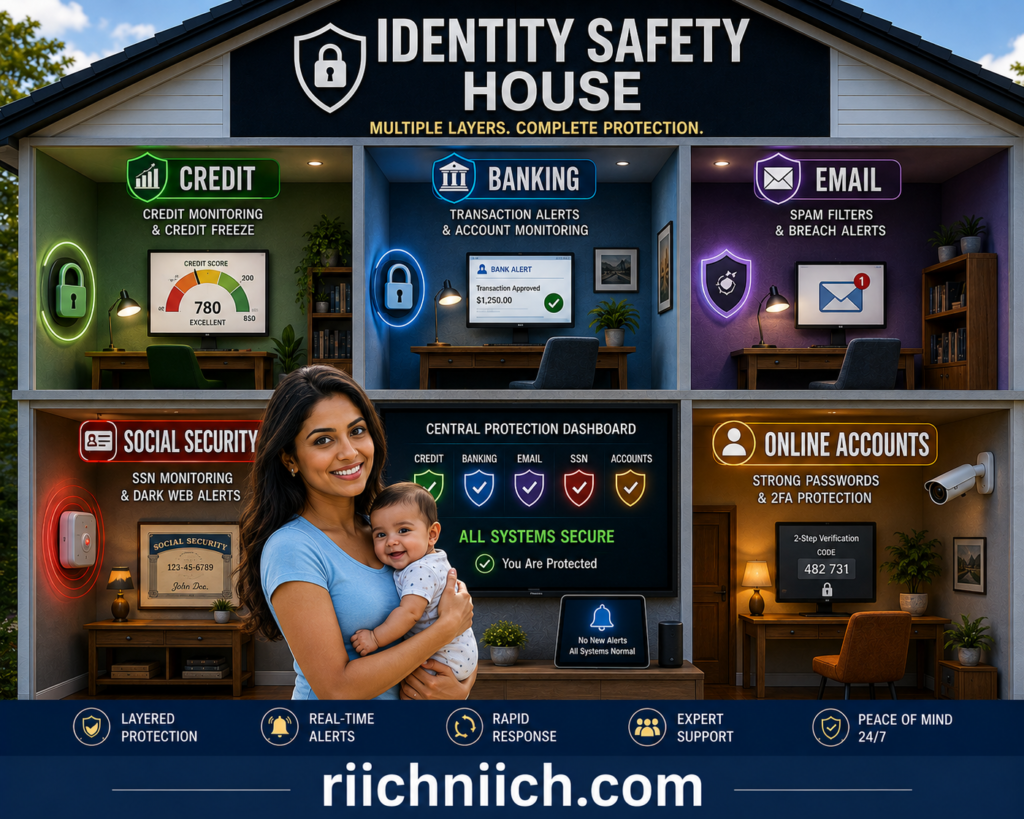
When Paid Identity Theft Protection Makes Sense
The biggest weakness of a do-it-yourself strategy is not necessarily effectiveness.
It is consistency.
You have to remember to check your credit reports, monitor financial accounts, investigate breach notifications, watch online security alerts, and continue doing those things over time.
Paid identity theft protection becomes valuable when you want to automate more of that monitoring.
Depending on the provider and plan, identity theft protection may include credit monitoring, dark web monitoring, Social Security number monitoring, financial monitoring, breach notifications, identity restoration assistance, and identity theft insurance.
That does not make identity theft impossible.
It can, however, make certain warning signs easier to detect and provide additional support when something goes wrong.
What Should You Pay For?
If you decide to purchase identity theft protection, focus on features that solve an actual problem for you.
For credit-related identity theft, look closely at whether the plan includes three-bureau credit monitoring.
If your personal information has appeared in multiple data breaches, prioritize strong identity and dark web monitoring.
If you are protecting several people, compare family and child monitoring rather than simply choosing the cheapest individual plan.
And if someone has already used your identity, give significant weight to professional restoration assistance.
An alert tells you there is a problem.
Good restoration support helps you figure out what to do about it.
Do Not Choose Identity Protection Based on Fear
Discovering suspicious activity creates urgency, and urgency can lead to poor buying decisions.
Do not automatically purchase the most expensive identity theft protection package because it advertises dozens of features or a large insurance amount.
Compare what is actually included.
Look at monitoring coverage, credit bureaus monitored, alert quality, restoration assistance, insurance terms, family coverage, introductory pricing, and renewal costs.
Most importantly, if identity theft has already occurred, verify whether the service provides assistance for incidents that began before you enrolled.
DIY Monitoring vs. Paid Identity Protection
A do-it-yourself approach can work well for someone who is willing to stay involved.
You can freeze your credit, monitor bank transactions, check credit reports, use account alerts, secure passwords, enable MFA, and investigate suspicious activity yourself.
Paid identity theft protection is better suited to people who want more automation, broader monitoring, centralized alerts, and access to professional recovery assistance.
Neither approach eliminates identity theft risk.
For many people, the strongest strategy is actually a combination of both: use free security tools to create barriers and paid monitoring to watch for warning signs you may otherwise miss.
Still deciding whether the extra monitoring and recovery support justify the cost? Our guide, Is Identity Theft Protection Worth It? breaks down when paying for protection makes sense—and when free tools may be enough.
The Best Protection Is Layered Protection
Think about identity security the same way you think about protecting a home.
You would not rely entirely on a security camera while leaving every door unlocked.
The same principle applies online.
Credit freezes can make certain new-account fraud more difficult.
Strong passwords and MFA help protect online accounts.
Bank alerts help detect unauthorized financial activity.
Credit monitoring watches for certain changes to your credit files.
Dark web monitoring may warn you when certain personal information is discovered in compromised data.
Identity restoration assistance can help when prevention and monitoring were not enough.
Each layer serves a different purpose.
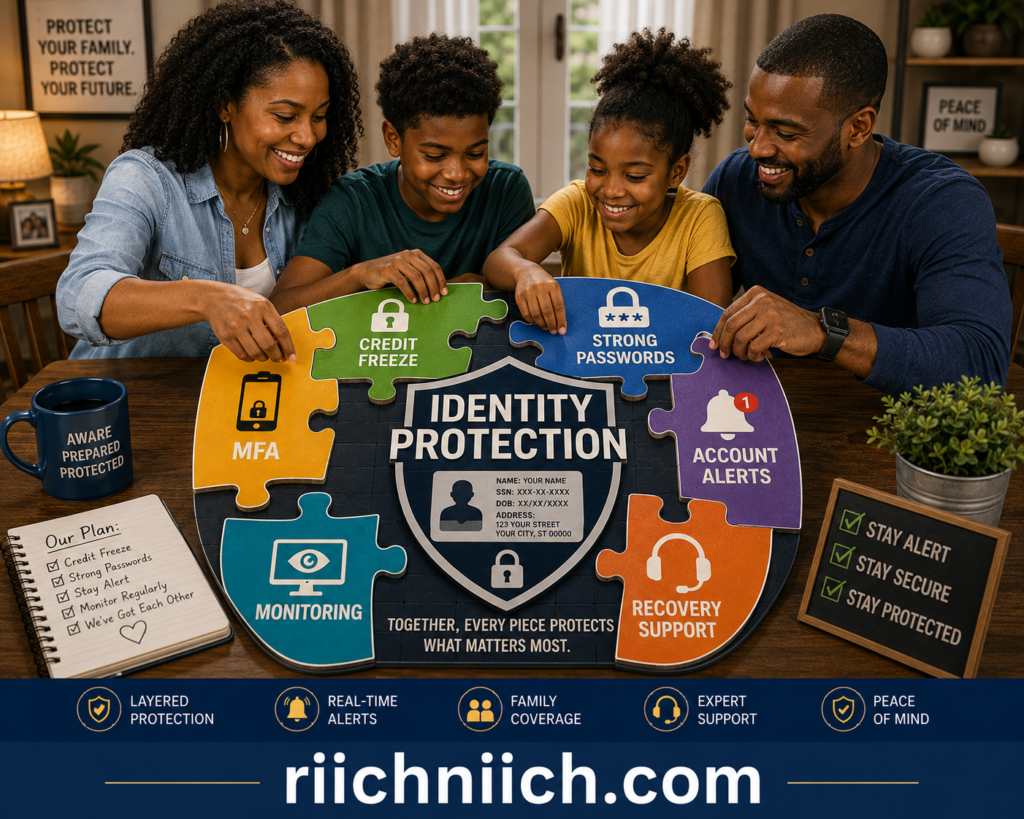
The Bottom Line
If you came to this guide because you were worried someone might be using your personal information, start with evidence—not fear.
Check your credit reports.
Review financial accounts.
Inspect your email and important online accounts.
Investigate unfamiliar credit inquiries.
Look for accounts you never opened.
Review your Social Security and tax records when appropriate.
Respond to legitimate breach notifications.
And if you discover identity theft, document everything and begin recovery immediately.
Understanding how to know if someone is using your identity is ultimately about recognizing what belongs to you—and quickly identifying what does not.
You can perform much of that monitoring yourself for free. But if you want continuous monitoring, faster alerts across multiple areas, and professional assistance if identity theft occurs, a reputable identity theft protection service can be a worthwhile investment.
The goal is not to make yourself impossible to target.
It is to make your identity harder to misuse, suspicious activity easier to detect, and identity theft easier to respond to before the damage grows.